
Erzwingt den Scope von Penetration-Testing-Engagements für KI-Agenten, indem MCP Tool-Aufrufe gegen genehmigte Targets, Techniken und Zeitfenster validiert werden.
Auch bekannt als IntegSec/agentic-pentest-proxy, @integsec/agentic-pentest-proxy
- Stars
- 9
- Tools
- —
- Downloads, 30 Tage
- 6.447
- Neueste Version
- —
- Letzter Commit
- 10. Nov. 2026
- Lizenz
- Apache-2.0
Was ist agentic-pentest-proxy MCP?
agentic-pentest-proxy ist ein MCP server. Erzwingt den Scope von Penetration-Testing-Engagements für KI-Agenten, indem MCP Tool-Aufrufe gegen genehmigte Targets, Techniken und Zeitfenster validiert werden.
Zusammenfassung generiert aus dem README des Projekts
Über agentic-pentest-proxy MCP server
Dieser MCP Proxy fungiert als Security Gateway für Penetration-Testing-Engagements, an denen KI-Agenten beteiligt sind. Er sitzt zwischen einem MCP Client, wie Claude Desktop oder Claude Code, und deinen bestehenden Tools, um sicherzustellen, dass jeder Tool-Aufruf einem vordefinierten Scope-Manifest entspricht. Durch die Validierung von Argumenten gegen genehmigte Targets, spezifische Techniken und autorisierte Zeitfenster verhindert der Proxy, dass Agenten während eines Tests unbefugte Aktionen ausführen.
Entwickler können dies mit Node.js 22 oder neuer via npm, Docker oder GHCR-Images bereitstellen. Das System unterstützt verschiedene Verbindungstypen, einschließlich stdio für lokale Commands, SSE für Upstreams wie Burp Suite und HTTP-Services. Es enthält ein verwaltetes Gateway mit einer Browser-UI für die Team-Administration sowie einen MCP Workbench, der es Nutzern ermöglicht, Requests in Echtzeit abzufangen, zu editieren oder zu droppen. Alle Entscheidungen werden in einem lokalen Audit-Log aufgezeichnet, das über ein dediziertes Terminal User Interface überwacht werden kann.
Was du damit machen kannst
- 1Engagement-Grenzen erzwingenVerhindert, dass ein KI-Agent Targets angreift oder Techniken verwendet, die außerhalb des genehmigten Penetration-Testing-Scopes liegen.
- 2Requests manuell inspizieren und modifizierenNutze einen Workbench, um Tool-Aufrufe abzufangen und deren Argumente zu ändern, bevor sie den Upstream MCP Server erreichen.
Geschrieben aus dem README des Projekts. Jeder Use Case wurde gegen ein Zitat daraus geprüft.
So installierst du agentic-pentest-proxy MCP
Formate geprüft am 10. Nov. 2026Zu Cursor hinzufügenZu Goose hinzufügenagentic-pentest-proxy MCP in Claude Code installieren
$ claude mcp add agentic-pentest-proxy -- npx -y @integsec/agentic-pentest-proxyagentic-pentest-proxy MCP in Cursor installieren
~/.cursor/mcp.json
{
  "mcpServers": {
    "agentic-pentest-proxy": {
      "command": "npx",
      "args": [
        "-y",
        "@integsec/agentic-pentest-proxy"
      ]
    }
  }
}agentic-pentest-proxy MCP in VS Code installieren
.vscode/mcp.json
{
  "servers": {
    "agentic-pentest-proxy": {
      "type": "stdio",
      "command": "npx",
      "args": [
        "-y",
        "@integsec/agentic-pentest-proxy"
      ]
    }
  }
}agentic-pentest-proxy MCP in VS Code CLI installieren
$ code --add-mcp '{"name":"agentic-pentest-proxy","type":"stdio","command":"npx","args":["-y","@integsec/agentic-pentest-proxy"]}'agentic-pentest-proxy MCP in Claude Desktop installieren
claude_desktop_config.json
{
  "mcpServers": {
    "agentic-pentest-proxy": {
      "command": "npx",
      "args": [
        "-y",
        "@integsec/agentic-pentest-proxy"
      ]
    }
  }
}agentic-pentest-proxy MCP in Codex installieren
$ codex mcp add agentic-pentest-proxy -- npx -y @integsec/agentic-pentest-proxyagentic-pentest-proxy MCP in Codex config.toml installieren
~/.codex/config.toml
[mcp_servers.agentic-pentest-proxy]
command = "npx"
args = ["-y", "@integsec/agentic-pentest-proxy"]
agentic-pentest-proxy MCP in Gemini CLI installieren
$ gemini mcp add -s user agentic-pentest-proxy npx -- -y @integsec/agentic-pentest-proxyagentic-pentest-proxy MCP in Gemini settings.json installieren
~/.gemini/settings.json
{
  "mcpServers": {
    "agentic-pentest-proxy": {
      "command": "npx",
      "args": [
        "-y",
        "@integsec/agentic-pentest-proxy"
      ]
    }
  }
}Konfiguration
AUDIT_LOG_PATHMCP_TRANSPORTSCOPE_MANIFEST_PATHUPSTREAM_MCP_ARGS_JSONUPSTREAM_MCP_COMMAND
| Name | Beschreibung | Typ |
|---|---|---|
| AUDIT_LOG_PATH | — | |
| MCP_TRANSPORT | — | |
| SCOPE_MANIFEST_PATH | — | |
| UPSTREAM_MCP_ARGS_JSON | — | |
| UPSTREAM_MCP_COMMAND | — |
Automatisierte Checks
Geluften am 13. Nov. 2026Vollständiger Bericht →Unsere automatisierten Checks bestanden. Das ist kein Security-Audit: Lies den Code und gib dem Server nur den minimal notwendigen Zugriff. Wie die Checks funktionieren

- Source Repository verknüpft und erreichbarintegsec/agentic-pentest-proxy is public and reachablegithub.com/integsec/agentic-pentest-proxy ↗Bestanden
- Paket nennt dieses Repository als Quelle@integsec/agentic-pentest-proxy names integsec/agentic-pentest-proxy as sourcenpmjs.com/package/@integsec/agentic-pentest-proxy ↗Bestanden
- Build-Provenienz (Sigstore-Attestierung)Sigstore attestation for @integsec/agentic-pentest-proxynpmjs.com/package/@integsec/agentic-pentest-proxy/v/0.4.12#p ↗Bestanden
- Open Source Lizenz (OSI)Apache-2.0spdx.org/licenses/Apache-2.0.html ↗Bestanden
- Commit oder Release im letzten JahrLast commit or release 2026-11-10github.com/integsec/agentic-pentest-proxy ↗Bestanden
- OpenSSF ScorecardNicht geprüft
- Package-Name ähnelt keinem populären PackageNo popular package one edit away from @integsec/agentic-pentest-proxyBestanden
- Keine kritischen Advisories im Paket oder seinen AbhängigkeitenNicht geprüft
- Keine versteckten Anweisungen an das Modell0 tool descriptions and the README read; no override phrases, credential paths or hidden charactersBestanden
- Destruktive Tools sind markiertNicht geprüft
- Remote-Endpoint beantwortet den MCP-HandshakeNicht geprüft
README
Auf GitHub ansehenAgentic Pentesting MCP Gateway
New to the gateway? The documentation site shows the local and hosted paths side by side, including where test traffic comes from. The full guides below are also available there after team sign-in.
An MCP proxy that checks tool calls against a pentest scope manifest before forwarding them to your MCP tools. It blocks calls it can identify as outside the targets, techniques, or time window you approved, and records decisions in a local audit log.
Requires Node.js 22 or newer. The proxy supports stdio tools, SSE upstreams such as Burp Suite, and HTTP upstreams.
Managing several tools? The managed gateway adds a browser UI with local MCP server presets, scope templates and technique checkboxes, JSON policy import and download, administrator approval and assignment, and a separate engagement choice for each user. It exposes scoped tools, an active engagement resource, PlexTrac reference resources, a TurboPentest knowledge-base catalog with search and controlled live reads, and guided pentest prompts. It supports one hosted MCP URL for ChatGPT and Claude and a local Burp route.
The MCP workbench shows your live tool calls and background jobs. Intercept requests, edit arguments before forwarding, or drop a call. Long calls return a job ID that you can inspect or cancel without waiting for one MCP request to stay open. The gateway checks scope again after any edit.
To keep the local gateway running after sign-in, use pentest-gateway service install; use pentest-gateway service remove to undo it. It binds to loopback only. See the local startup guide. The gateway cannot prevent an agent with a separate shell or network path from bypassing MCP checks; see the secure deployment guide.
Quick start: add an MCP tool
-
Install the proxy:
npm install -g @integsec/agentic-pentest-proxy -
Create a scope manifest with the guided wizard:
pentest-manifest new -o scope.jsonSet the real engagement targets and time window. Review the generated file with the engagement owner before using it.
-
Generate a client entry for each MCP tool. Put the tool's normal launch command after
--:pentest-setup --name scanner-scoped --manifest ./scope.json -- npx -y @example/scanner-mcpReplace
npx -y @example/scanner-mcpwith the command from your tool's own setup instructions. The command prints anmcpServersentry. Paste that entry into your MCP client's configuration and restart the client. To add another tool, run setup again with a new--name, then add its entry under the samemcpServersobject.For example, the generated entry has this shape (the setup command fills in your actual manifest and audit paths):
{
  "mcpServers": {
    "scanner-scoped": {
      "command": "pentest-proxy",
      "env": {
        "SCOPE_MANIFEST_PATH": "/path/to/scope.json",
        "MCP_TRANSPORT": "stdio",
        "AUDIT_LOG_PATH": "/path/to/audit",
        "UPSTREAM_MCP_COMMAND": "npx",
        "UPSTREAM_MCP_ARGS_JSON": "[\"-y\",\"@example/scanner-mcp\"]"
      }
    }
  }
}
Use the
mcpServersblock in Claude Desktop's MCP configuration or in your Claude Code project's.mcp.json. Other MCP clients may label the server settings differently; use the generated command and environment variables in their equivalent fields. The proxy starts when the client launches the tool. -
Watch decisions in another terminal:
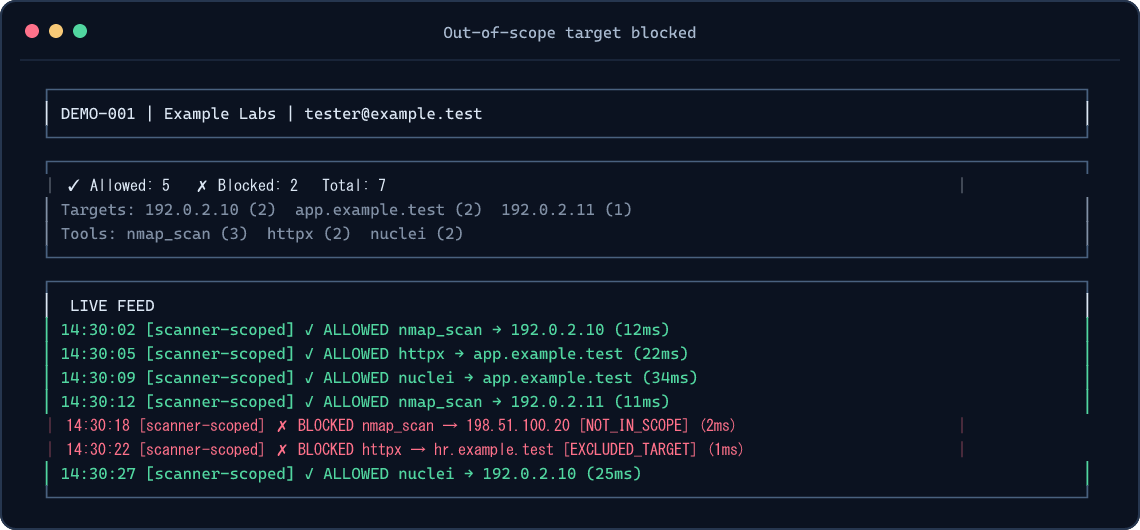
pentest-tui --audit-path ./auditSetup prints the exact audit path to use. If your shell is in another directory, use that printed path. For a one-off TUI without a global install:
npm exec --yes --package=@integsec/agentic-pentest-proxy -- pentest-tui --audit-path ./auditThe TUI reads local audit files; it does not start the proxy. See TUI screenshots.
Other MCP tool types
| Tool connection | What to do |
|---|---|
| stdio tool launched by a command | Use the setup command above with -- <command> [args...]. |
| SSE upstream already listening, such as Burp Suite | Use pentest-setup --name burp-scoped --manifest ./scope.json --sse http://127.0.0.1:9876. |
| HTTP upstream | Run the proxy as an HTTP service and point your MCP client at it. HTTP and Docker guide. |
Use one generated client entry per upstream tool. A single scope manifest can be shared by several entries; each call still gets checked. More client examples.
What gets checked
The proxy checks MCP tools/call arguments it can inspect. It blocks unknown target-bearing arguments, out-of-scope targets, explicit exclusions, restricted techniques, expired engagement windows, and free-form commands by default. DNS names authorized through IP ranges must resolve entirely inside the allowed ranges. Local JSONL auditing is always on; cloud logging is optional.
The proxy cannot control destinations selected inside an upstream tool, HTTP redirects, targets read from files or encoded payloads, DNS changes after validation, or traffic that bypasses MCP. Use network egress controls and review each upstream tool's schema before relying on the proxy for an engagement. Security model.
Install and release options
| Option | Command or image |
|---|---|
| Global npm install | npm install -g @integsec/agentic-pentest-proxy |
| Project install | npm install @integsec/agentic-pentest-proxy |
| GHCR image | ghcr.io/integsec/agentic-pentest-proxy:latest |
| Docker Hub image | integsec/agentic-pentest-mcp-proxy:latest |
The npm package includes the gateway, proxy, manifest builder, setup helper, TUI, bridge, and scanner adapter. Run pentest-gateway version or pentest-gateway --version to check the installed release. The older integsec- command names still work for existing client configurations. To see the optional install welcome banner, add --foreground-scripts; npm hides package install-script output by default. You can always run pentest-gateway --help for the same next steps. The welcome script does not access the network or modify files.
Google Cloud logging and Secret Manager SDKs are opt-in to keep the default install lean and free of their deprecated transitive package. If you use either GCP backend, install the SDKs alongside the proxy:
npm install -g @integsec/agentic-pentest-proxy @google-cloud/logging @google-cloud/secret-manager
AWS and Azure SDKs are included as optional dependencies. See configuration and cloud setup for the required environment variables and Docker notes. If you use GCP and are upgrading from 0.2.6, install the GCP SDKs before restarting the proxy; it now reports a missing Cloud Logging SDK at startup.
Troubleshooting
| Symptom | Check |
|---|---|
| Tool does not appear in your MCP client | Paste the generated entry inside one mcpServers object, restart the client, and confirm the client can run pentest-proxy. |
| TUI shows no decisions | Start a tool call, then use the exact audit path printed by setup. The TUI and client may have different working directories. |
| Call is blocked | Check the decision and reason in the TUI or audit JSONL. Confirm the target, exclusions, technique, and window in your manifest. |
| GCP backend says its SDK is missing | Install the two GCP packages shown above alongside the proxy. |
| Need all CLI options | Run pentest-gateway --help, pentest-proxy --help, pentest-setup --help, pentest-manifest --help, or pentest-tui --help. |
Reference
- Configuration and manifest fields
- Client integrations, HTTP, and Docker
- TUI usage and screenshots
- Security model and limitations
- Contributing and development
License
Apache-2.0. See LICENSE.
agentic-pentest-proxy MCP Fragen
Wie füge ich agentic-pentest-proxy MCP zu Claude Code hinzu?
Führe claude mcp add agentic-pentest-proxy -- npx -y @integsec/agentic-pentest-proxy in deinem Terminal aus. Füge --scope user hinzu, damit der Server in jedem Projekt verfügbar ist.
Wie füge ich agentic-pentest-proxy MCP zu Cursor hinzu?
Öffne ~/.cursor/mcp.json und füge den Server unter mcpServers hinzu, mit der Cursor-Config aus dem Installationsabschnitt oben.
Was genau prüft der Proxy?
Er inspiziert die Argumente der MCP Tool-Aufrufe, um unbekannte Target-bezogene Argumente, Out-of-Scope Targets, eingeschränkte Techniken und abgelaufene Engagement-Zeitfenster zu blockieren.
Kann der Proxy verhindern, dass ein Agent die Checks über eine separate Shell umgeht?
Nein, das Gateway kann nicht verhindern, dass ein Agent mit einer separaten Shell oder einem separaten Netzwerkpfad die MCP-Checks umgeht.
Welche Arten von MCP Tool-Verbindungen werden unterstützt?
Der Proxy unterstützt stdio Tools, SSE Upstreams (wie Burp Suite) und HTTP Upstreams.