
fireround MCP server
Commit 12. Nov. 2026Bietet einen Open-Source-Funding-Feed, mit dem ein AI-Client verifizierte Startup-Finanzierungsrunden, Unternehmensprofile und Investorendaten suchen und abrufen kann.
Auch bekannt als firecrawl/fireround
- Stars
- 11
- Tools
- —
- Downloads, 30 Tage
- —
- Neueste Version
- —
- Letzter Commit
- 12. Nov. 2026
- Lizenz
- MIT
Was ist fireround MCP?
fireround ist ein MCP server. Bietet einen Open-Source-Funding-Feed, mit dem ein AI-Client verifizierte Startup-Finanzierungsrunden, Unternehmensprofile und Investorendaten suchen und abrufen kann.
Zusammenfassung generiert aus dem README des Projekts
Über fireround MCP server
Fireround ermöglicht es dir, direkt aus einem AI-Client heraus nach verifizierten Startup-Funding-Daten zu suchen. Es bietet einen strukturierten Feed von Finanzierungsankündigungen – von Pre-Seed bis hin zu Growth-Stages – und zieht Informationen aus dem gesamten offenen Web. Anstatt sich auf veraltete oder hinter Paywalls liegende Datenbanken zu verlassen, nutzt es Firecrawl, um News zu finden, die Inhalte in strukturierte Datensätze zu verwandeln und die Daten mit den ursprünglichen Quellen abzugleichen.
Entwickler können diesen MCP server nutzen, um auf zwölf spezialisierte Tools zuzugreifen, darunter Funktionen zum Auflisten von Trending Rounds, zur Suche nach spezifischen Unternehmen und zum Abrufen von Investorenprofilen. Der Server benötigt einen MCP_API_KEY für den sicheren Zugriff bei privaten Deployments. Er kann lokal mit einer eingebetteten PGlite-Datenbank gehostet oder via Vercel unter Verwendung einer Neon-Datenbank bereitgestellt werden. Um fortgeschrittene Features wie die quellenübergreifende Verifizierung und tiefgehende Unternehmensdossiers zu nutzen, können User einen AI_GATEWAY_API_KEY oder spezifische Provider-Keys wie OpenAI, Anthropic oder OpenRouter hinterlegen.
Was du damit machen kannst
- 1Trending Startup-Runden trackenFrag deine AI, welche Startup-Finanzierungsrunden aktuell auf X und Hacker News am meisten diskutiert werden.
- 2Investitionshistorie von Unternehmen recherchierenFordere ein detailliertes Profil eines bestimmten Unternehmens an, um die gesamte eingeworbene Summe und eine Liste aller Investoren zu sehen.
- 3Top-Investoren identifizierenLass deinen AI-Client die Investoren auflisten, die in letzter Zeit die meisten Finanzierungsrunden in einem bestimmten Sektor oder einer bestimmten Phase angeführt haben.
- 4Spezifische Finanzierungsphasen überwachenGib der AI den Befehl, nach allen aktuellen Series A und B Finanzierungsankündigungen zu suchen.
Geschrieben aus dem README des Projekts. Jeder Use Case wurde gegen ein Zitat daraus geprüft.
Automatisierte Checks
Geluften am 14. Nov. 2026Vollständiger Bericht →Noch nicht verifiziert. Ein Server benötigt einen Score von 80, keine kritischen Befunde und genug Daten für unsere Prüfung. Wie die Checks funktionieren · Was du für mehr Punkte verbessern kannst

- Source Repository verknüpft und erreichbarfirecrawl/fireround is public and reachablegithub.com/firecrawl/fireround ↗Bestanden
- Paket nennt dieses Repository als QuelleNicht geprüft
- Build-Provenienz (Sigstore-Attestierung)Nicht geprüft
- Open Source Lizenz (OSI)MITspdx.org/licenses/MIT.html ↗Bestanden
- Commit oder Release im letzten JahrLast commit or release 2026-11-12github.com/firecrawl/fireround ↗Bestanden
- OpenSSF ScorecardNicht geprüft
- Package-Name ähnelt keinem populären PackageNicht geprüft
- Keine kritischen Advisories im Paket oder seinen AbhängigkeitenNicht geprüft
- Keine versteckten Anweisungen an das Modell0 tool descriptions and the README read; no override phrases, credential paths or hidden charactersBestanden
- Destruktive Tools sind markiertNicht geprüft
- Remote-Endpoint beantwortet den MCP-HandshakeNicht geprüft
README
Auf GitHub ansehenFireround
The open-source funding feed built on Firecrawl. Fireround finds funding announcements from across the open web, pre-seed to growth, reads each one into a structured record, checks it against the pages that reported it, and serves the result as a dashboard, feeds, an API, and an MCP server.
Live at fireround.dev.
The cron schedule deploys on any Vercel plan: by default every scheduled route runs once a day, which is what Hobby allows and all the default Lite coverage needs. On Vercel Pro, set FIREROUND_SCHEDULE=frequent for the full cadence (hourly lanes, quarter-hour verification); see the deployment guide.


Why
Funding data is usually paywalled, and it is often stale by the time it reaches you. Fireround rebuilds it from primary sources for a few thousand Firecrawl credits a month per preset. Every row is read back against the pages that reported it before it publishes, and every row links to those pages.
What you get
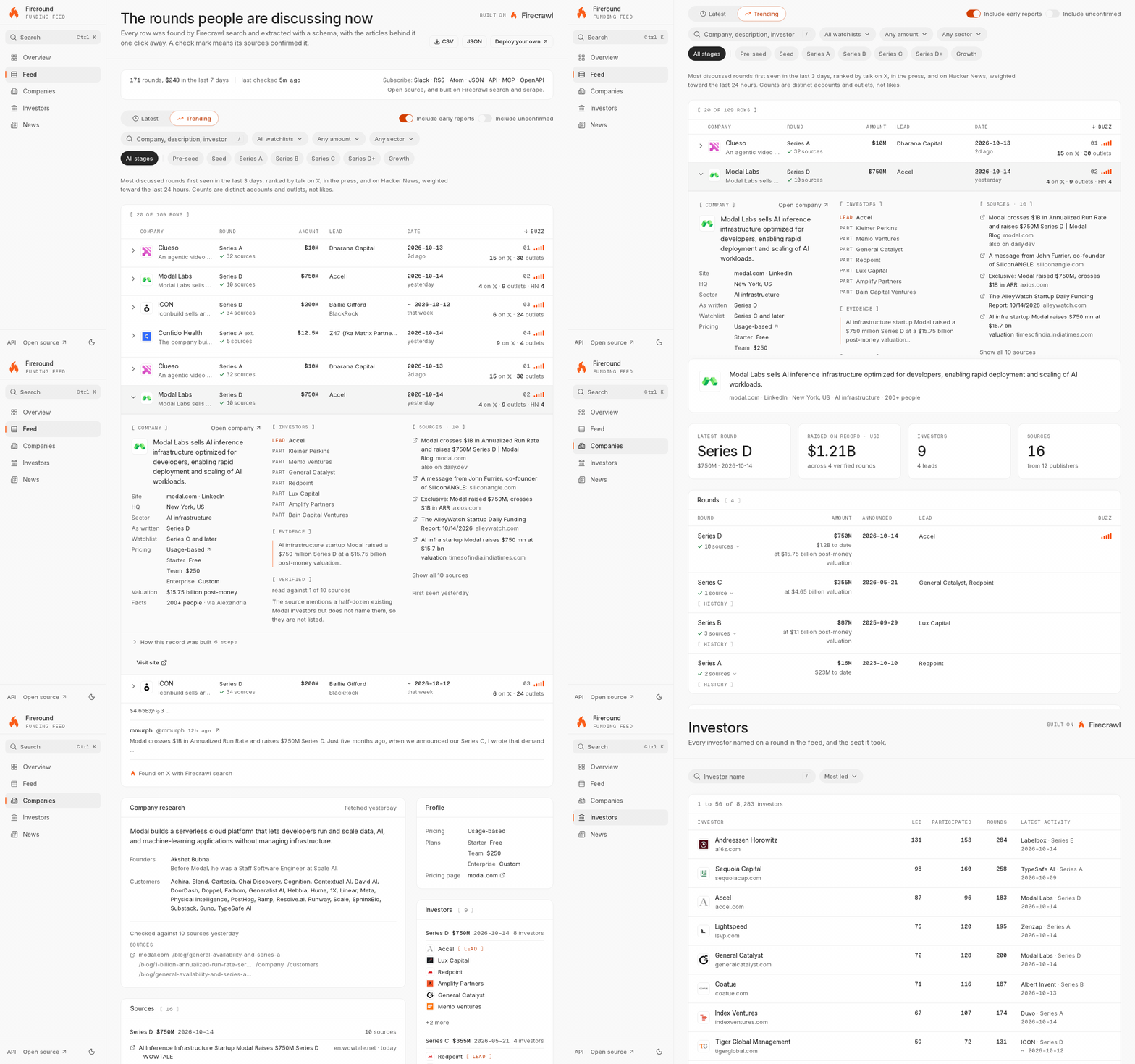
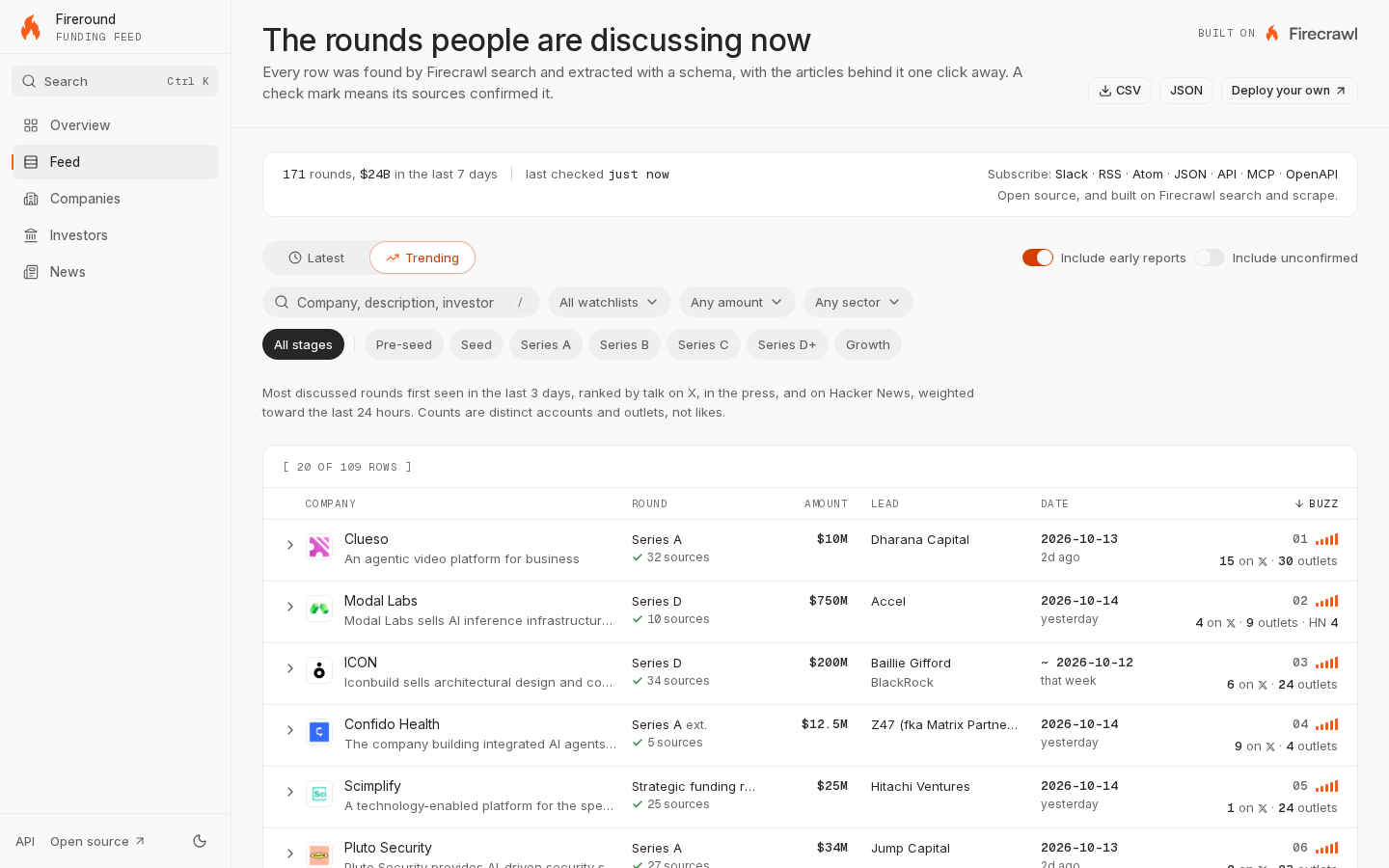
- Feed: every round with its logo, stage, amount, lead, date, and source check. Filter by stage, preset, amount, and sector; open a row for the evidence sentence and the field-by-field verdict. A Trending view ranks rounds first seen in the last three days by how much they are discussed on X, in the press, and on Hacker News.
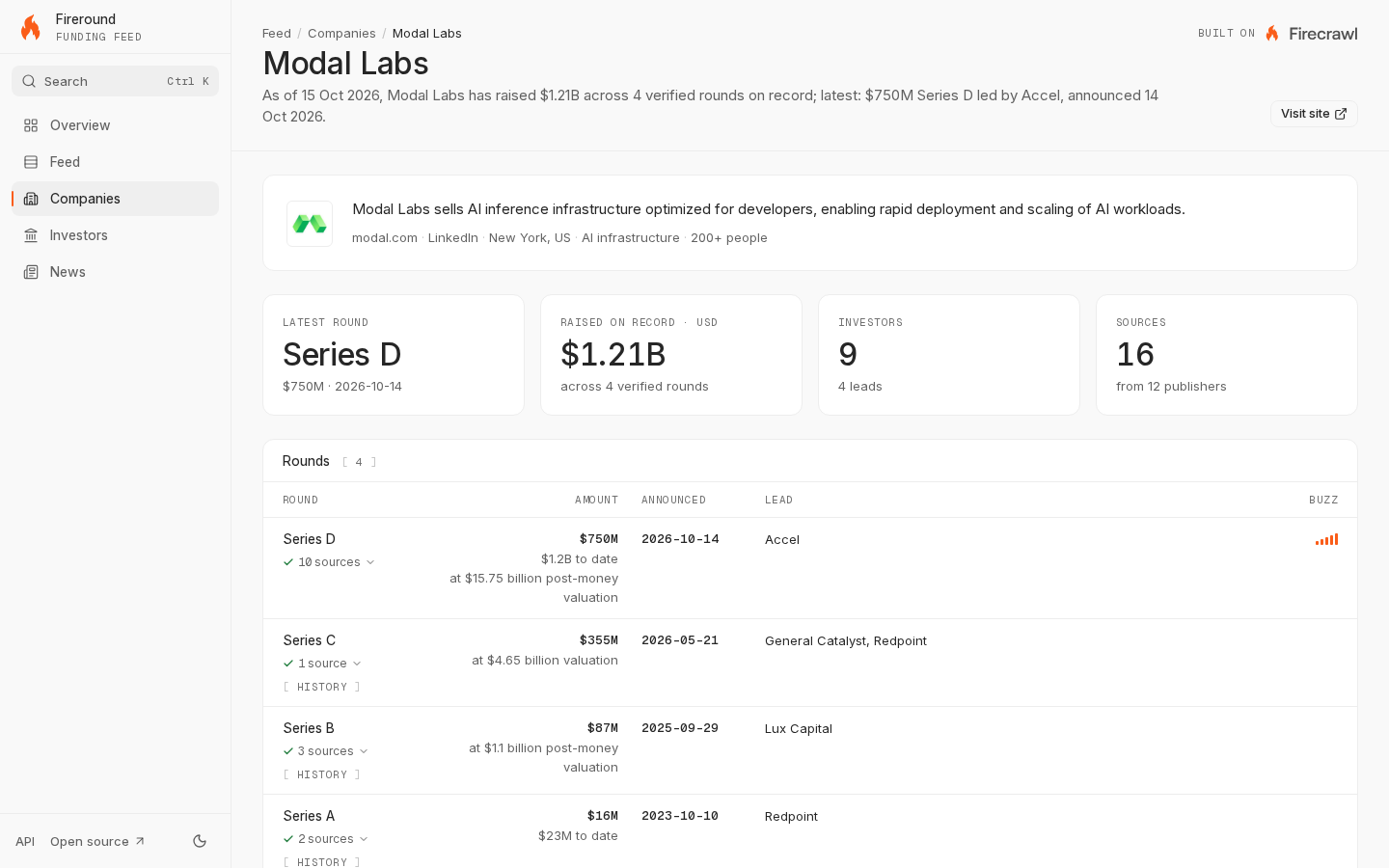
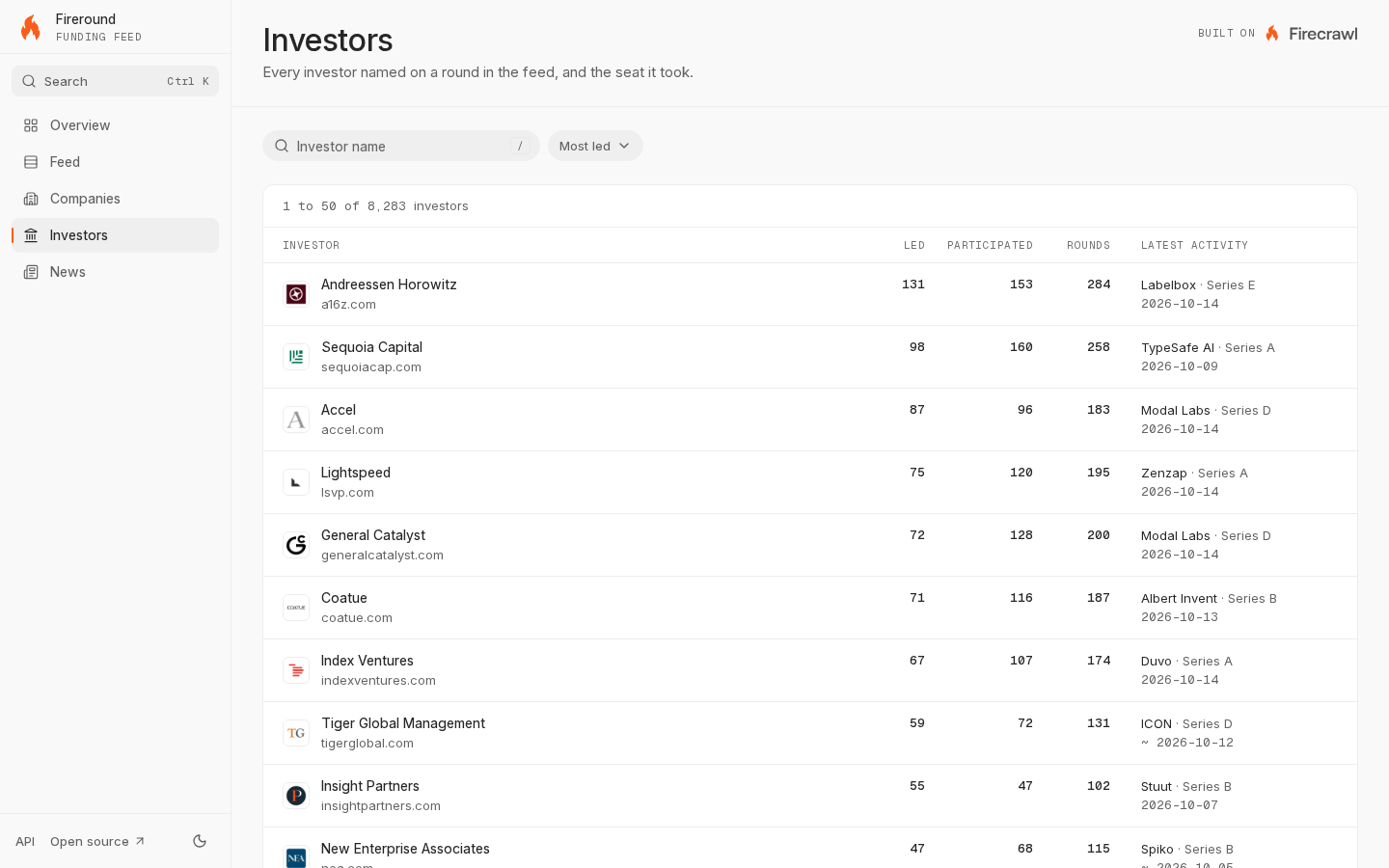
- Companies and investors: a searchable index and a page for each, with every round on record, total raised, the syndicate, logos, and sourced company facts. Deep dive builds a company dossier on demand, checked claim by claim before it is saved.
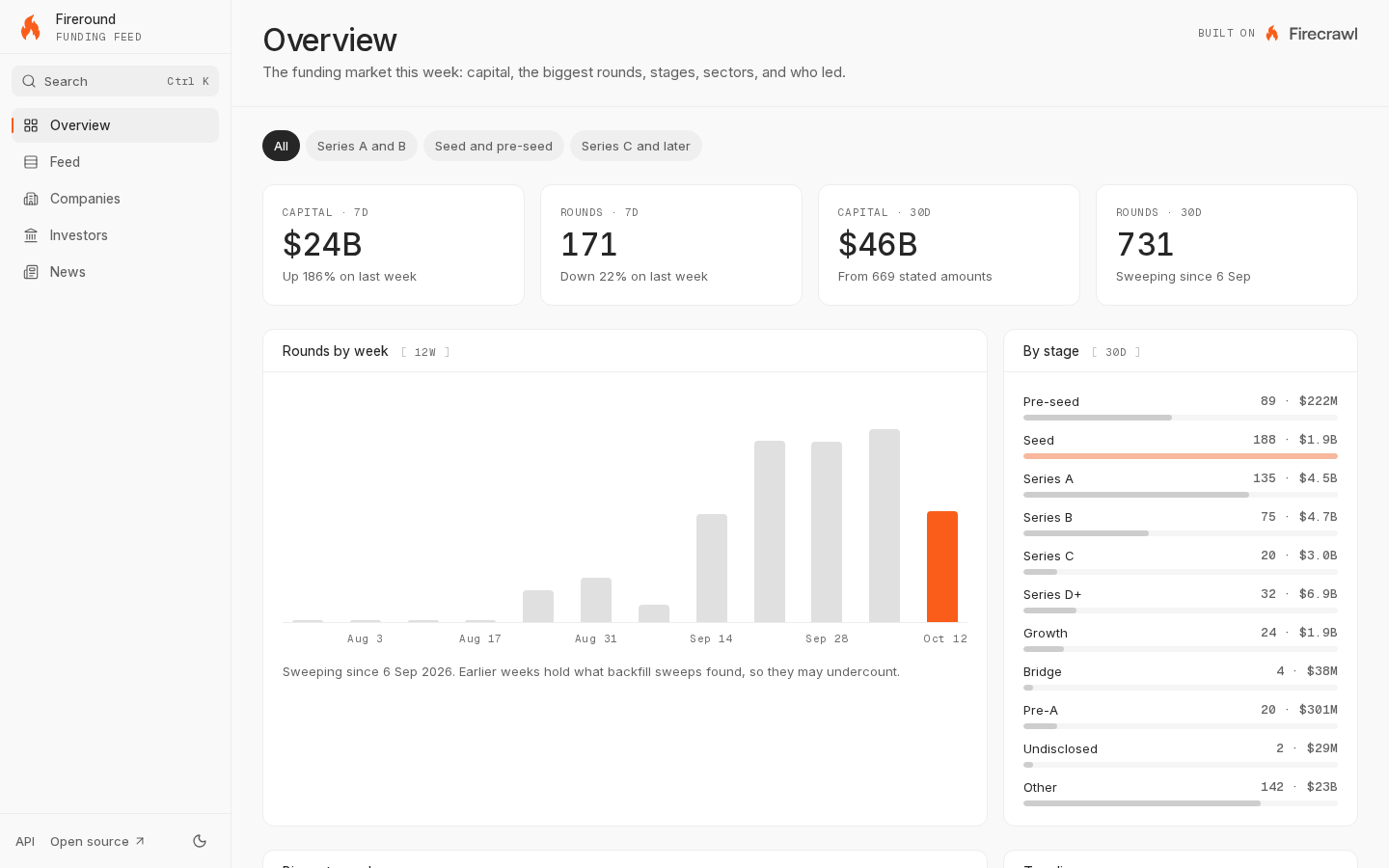
- Overview and news: the market at a glance, and the articles behind the records grouped by day. Cmd+K finds any company or investor.
- Presets: what to watch. Series A and B is the default; seed and pre-seed, and Series C and later, ship too. Add your own in the UI, priced before it runs.
- Review: undated or low-confidence rows to publish, reject, or research, with keyboard shortcuts and undo.
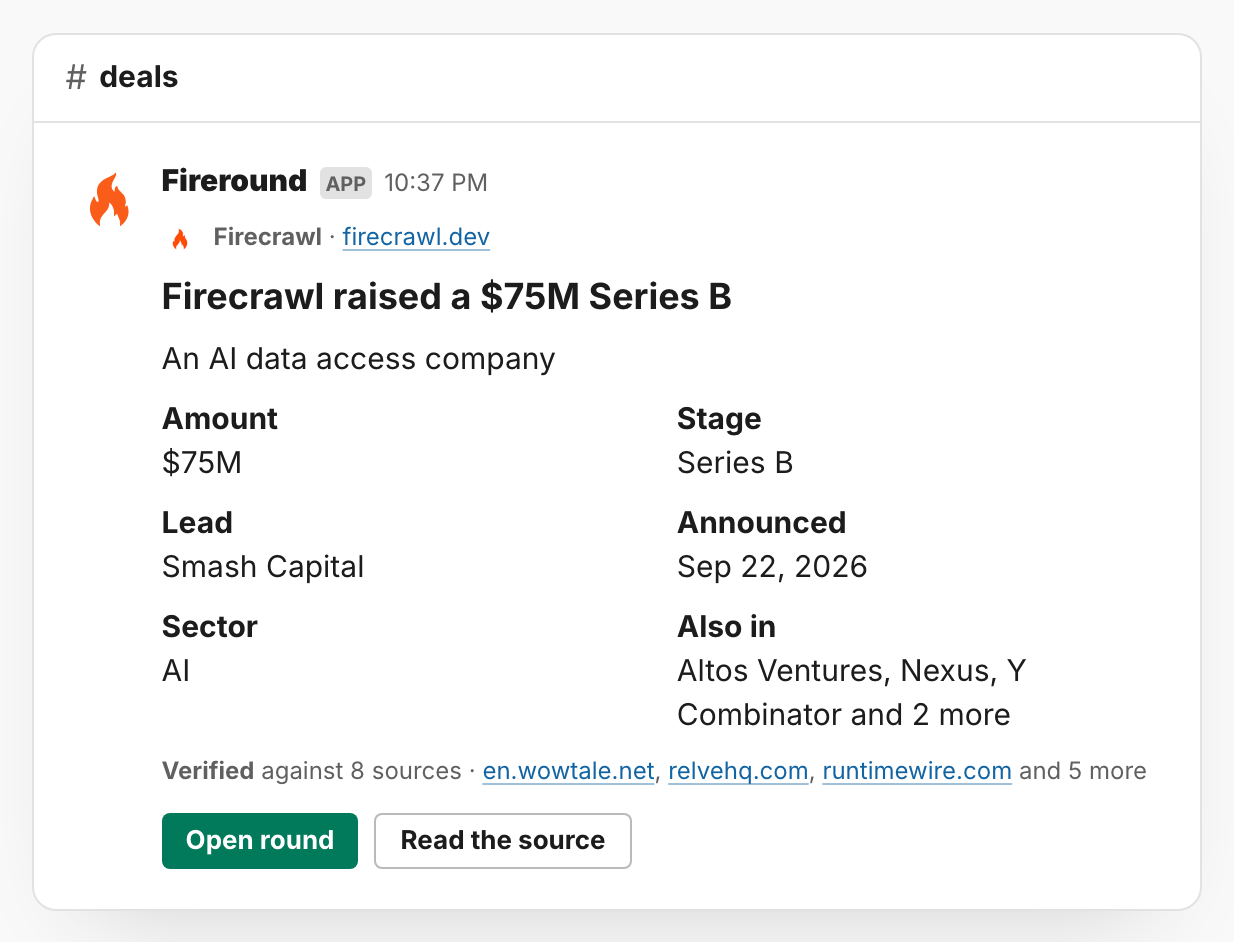
- Delivery: Slack (one click once the app is set up, docs/slack.md), RSS, Atom, and JSON Feed, signed webhooks (Standard Webhooks), and, optionally for self-hosters with a Resend key, a daily or weekly email digest. Company and investor links unfurl as share cards.
- API and MCP: JSON, CSV, and JSONL over
/api/v1with an OpenAPI spec, and twelve MCP tools (fourteen with company requests on). - Runs: every sweep and lane with the credits it was estimated to cost beside the credits it measured.
Quick start
Requires Node 24+ and pnpm (corepack enable installs the version package.json pins).
git clone https://github.com/firecrawl/fireround.git && cd fireround
pnpm install
cp .env.example .env   # paste your Firecrawl key: https://www.firecrawl.dev/app/api-keys
pnpm dev               # http://localhost:3000
No database to set up: without DATABASE_URL the app runs on embedded Postgres (PGlite) under ./data. An empty store opens on one panel that explains the first sweep, prices it, and runs it: last week of Series A and B, about ten minutes and about 630 to 690 credits, which fits in Firecrawl's free plan.
No key yet? Run pnpm demo-data before pnpm dev and the dashboard opens on ten fictional sample rounds, with no key and no credits. pnpm reset-data -- --yes clears them before your first real sweep. The embedded database is single-process, so stop pnpm dev before running either script.
Everything else is optional. Without a model key the read-back uses Firecrawl alone and Deep dive stays off; without Slack, Resend, or X keys those deliveries stay off. Settings lists what each key turns on. Posting to X is off unless you set X_POSTING.
Deploy
Vercel. Press Deploy with Vercel above. It asks for your Firecrawl key, a dashboard password, and a cron secret (any random string of 16+ characters, such as openssl rand -hex 24), and provisions a Neon database (which sets DATABASE_URL). Migrations apply at build. The default schedule runs each cron route once a day, so it deploys on Hobby; on Pro, set FIREROUND_SCHEDULE=frequent and redeploy for the full cadence. Add AI_GATEWAY_API_KEY afterwards to turn on the cross-source read-back and Deep dive, MCP_API_KEY to turn on MCP (a password-protected deployment refuses MCP until it is set), and APP_ORIGIN once you have a production URL.
Anywhere else. Set DATABASE_URL to any Postgres 15+ and CRON_SECRET to any random string of 16+ characters, then pnpm db:migrate && pnpm build && pnpm start. A production pnpm start calls its own cron routes on the hour with that secret; without it every scheduled call is refused and nothing sweeps. With a throwaway local Postgres:
docker run -d --name fireround-pg -p 5432:5432 -e POSTGRES_PASSWORD=postgres postgres:18
echo 'DATABASE_URL=postgres://postgres:postgres@localhost:5432/postgres' >> .env   # no sslmode: local Postgres has no TLS
echo "CRON_SECRET=$(openssl rand -hex 24)" >> .env
pnpm db:migrate && pnpm build && pnpm start
On the default coverage the scheduled sweep runs on Mondays at 06:00 UTC, so press Run the first sweep to fill the store now.
Public instances, Slack, and who can reach what: docs/deploy.md.
Configuration
Only FIRECRAWL_API_KEY is required to run sweeps, and production also needs CRON_SECRET for anything to run on a schedule. .env.example lists every variable with a comment. The ones most deployments set:
| Variable | Purpose |
|---|---|
FIRECRAWL_API_KEY |
Your Firecrawl key |
DATABASE_URL |
Any Postgres 15+; unset uses embedded PGlite |
DASHBOARD_PASSWORD |
HTTP Basic auth on the dashboard and /api/v1; unset means open |
CRON_SECRET |
Bearer for the cron routes; Vercel Cron and a production pnpm start send it on every scheduled call, and without it production runs nothing on a schedule |
MCP_API_KEY |
Bearer for /api/mcp; required to enable MCP on a password-protected private deployment |
AI_GATEWAY_API_KEY |
Reads every record against all its sources with a model before it publishes (or set an OpenAI, OpenRouter, or Anthropic key) |
APP_ORIGIN |
Your public URL, for webhooks, Slack links, and share cards |
Every variable: docs/configuration.md.
Coverage is one setting that decides how wide the net is and how often it runs. Lite, the default, sweeps the news once a week: about 3.3K to 3.6K credits a month for the Series A and B preset, and about 10K for all three shipped presets. Max runs every lane hourly. Settings prices each rung against your presets before you switch: docs/coverage.md.
API, feeds, and MCP
GET /api/v1/roundsreturns JSON, CSV, or JSONL with cursor pagination and acertaintyfield; filter with?certainty=announced,reported,expected, orunconfirmed. A CSV withoutlimitis the whole filtered set, up to 10,000 rows.GET /api/v1/companiessearches and lists companies (by name, sector, stage, date of the latest raise, or headquarters),GET /api/v1/companies/{id}is one company's funding history with total raised, rounds, and investors,GET /api/v1/investorssearches investors by name,GET /api/v1/investors/topranks the investors that led the most rounds in the last 7, 30, or 90 days (optionally by sector or stage),GET /api/v1/investors/{id}is one investor's profile, andGET /api/v1/newslists the latest articles about the feed's rounds.GET /api/v1/runslists runs. The spec is at/api/v1/openapi.json; docs/api.md explains the certainty contract. On a public demo, a visitor's reads are open to any origin (CORS) and cached at the edge for a minute; an admin's are neither.- Feeds live at
/feeds/<token>/<preset>.rss,.atom, or.json. Mint a token in Settings or withpnpm feed-token. - The MCP server at
/api/mcphaslist_rounds,search_rounds,get_company,list_trending,mark_seen, andlist_presets, pluslist_companies,get_company_profile,list_investors,get_investor,top_investors, andlist_news, which answer with the same JSON as/api/v1/companies,/api/v1/companies/{id},/api/v1/investors,/api/v1/investors/{id},/api/v1/investors/top, and/api/v1/news. SetMCP_API_KEYand sendAuthorization: Bearer <key>; a password-protected private deployment refuses MCP without it. A keylessPUBLIC_DEMO=1instance keeps public read tools but omitsmark_seen. WithCOMPANY_REQUESTS=1it addsrequest_companyandcompany_request_status, under the same checks and daily caps as the request page, and the OpenAPI spec listsPOST /api/company-requestsandGET /api/company-requests/{id}; requested rounds are stored as history and never delivered (docs/how-it-works.md).
How Fireround uses Firecrawl
Every record starts with the Firecrawl API through the Node SDK. Each call below links to the code that makes it.
| Firecrawl | What Fireround does with it | Code |
|---|---|---|
| Search | Runs each preset's eight queries over news and the web with a recency window, and finds company homepages, investor sites, and posts on X | sweep.ts, trending/x.ts |
| Scrape with JSON mode | Reads each article into a funding-round schema; one extraction covers every round on a roundup page | extract.ts |
Scrape with the branding format |
Reads the logo, the brand name, and the primary colour off company and investor homepages | enrich.ts, investor-enrich.ts |
Scrape with the links format |
Reads 27 publisher funding sections and daily funding lists, in every region, and extracts only the articles not seen before | watch.ts |
| Map | Finds a company's own announcement on its site to corroborate a round | corroborate.ts |
| Monitoring | Runs a preset's queries on a schedule inside Firecrawl and posts new pages to /api/webhooks/firecrawl |
monitor.ts |
| Agent | Research fills a record's gaps from its sources; Deep dive builds a company dossier | gapfill.ts, deepdive.ts |
| Alexandria | Adds the Y Combinator record on each verified domain | alexandria.ts |
Firecrawl launched Alexandria on September 22, 2026, alongside its Series B: Introducing Alexandria and our $75M Series B.
How it works
Sweeps search for each preset's queries and extract every round from the articles they find. Watched publisher sections, stage-free searches, monitors, X, and SEC Form D filings catch what the sweep misses. Every record is grounded in its page's own text, deduped against the store, and read back against its sources before it publishes, then enriched with the company's homepage profile, its logo, and Alexandria's facts.
- docs/how-it-works.md: the lanes, verification, dossiers, and history rounds
- docs/data-quality.md: the rules that keep the data honest
- docs/coverage.md: what each coverage rung turns on and what it costs
- docs/deploy.md and docs/configuration.md: hosting and every variable
- docs/slack.md: the three ways to get rounds into Slack
- docs/scripts.md: every
pnpmscript
Development
pnpm test        # the suite on an in-memory Postgres; no network, no key
pnpm typecheck
pnpm lint
Next.js 16, React 19, TypeScript, Tailwind 4 and shadcn/ui, Drizzle over PGlite or Postgres, the Vercel Workflow SDK, and the AI SDK. The repo layout and the house rules: CONTRIBUTING.md.
Contributing
Issues and pull requests are welcome. CONTRIBUTING.md covers the three gates, adding a preset or a data-quality rule, and the house rules for prose. Report security problems privately through SECURITY.md, not in a public issue.
License
MIT. See LICENSE.
fireround MCP Fragen
Welche Tools sind über den MCP server verfügbar?
Der MCP server enthält zwölf Tools wie list_rounds, search_rounds, get_company, list_trending, mark_seen, list_presets sowie Tools für Unternehmensprofile, Investoren und News.
Wie aktiviere ich MCP bei einem privaten Deployment?
Du musst die Umgebungsvariable MCP_API_KEY setzen; ein passwortgeschütztes Deployment lehnt MCP-Verbindungen ab, bis dieser Key gesetzt ist.
Benötigt Fireround ein Datenbank-Setup?
Für die lokale Nutzung ist kein Datenbank-Setup erforderlich, da die App auf einer eingebetteten Postgres (PGlite) läuft, falls keine DATABASE_URL bereitgestellt wird.