
Analysiert rohe DNA-Dateien lokal, um Berichte über Haplogruppen, Merkmale, ClinVar-Gesundheitsdaten und Pharmakogenomik zu erstellen.
Auch bekannt als codebase/gnomancer
- Stars
- 5
- Tools
- —
- Downloads, 30 Tage
- 1.013
- Neueste Version
- 0.5.2
- Letzter Commit
- 10. Nov. 2026
- Lizenz
- MIT
Was ist gnomancer MCP?
gnomancer ist ein MCP server. Analysiert rohe DNA-Dateien lokal, um Berichte über Haplogruppen, Merkmale, ClinVar-Gesundheitsdaten und Pharmakogenomik zu erstellen.
Zusammenfassung generiert aus dem README des Projekts
Über gnomancer MCP server
gnomancer ermöglicht es dir, rohe DNA-Dateien von Diensten wie AncestryDNA, 23andMe oder MyHeritage lokal zu analysieren. Es wandelt rohe Genotyp-Daten in lesbare Berichte über Haplogruppen, körperliche Merkmale und Gesundheitsinformationen um, ohne deine genetischen Dateien jemals in die Cloud hochzuladen. Die Verarbeitung findet vollständig auf deinem eigenen Rechner statt, was den Schutz deiner sensiblen Daten gewährleistet.
Entwickler können diesen MCP server über den uvx Befehl mit AI-Clients wie Claude Desktop, Cursor oder LM Studio verbinden. Sobald die Verbindung steht, kann ein AI Assistant die Berichtsergebnisse abfragen oder nach spezifischen Genotypen an einzelnen Stellen suchen. Der Server stellt spezialisierte Tools für ClinVar-Health-Scans und PharmCAT-Pharmakogenomik bereit, die nur bei Bedarf abgerufen werden. Dieses Setup erlaubt es dir, lokale Modelle zu nutzen, um alle genetischen Erkenntnisse auf deiner Hardware zu behalten, oder Cloud-Assistenten einzusetzen, um narrative Zusammenfassungen aus deinen strukturierten Ergebnissen zu generieren.
Was du damit machen kannst
- 1Abfragen spezifischer genetischer MerkmaleFrag deinen AI Assistant, was dein DNA-Bericht über deine Fähigkeit zum Koffeinabbau aussagt.
- 2Analyse von FamilienbeziehungenGib mehrere DNA-Dateien an, um gemeinsame Segmente und wahrscheinliche biologische Beziehungen zwischen Familienmitgliedern zu bestimmen.
- 3Überwachung von Gesundheitsdaten-UpdatesPrüfe automatisch auf neue ClinVar-Klassifizierungen, um zu sehen, ob zuvor identifizierte Varianten neu klassifiziert wurden.
Geschrieben aus dem README des Projekts. Jeder Use Case wurde gegen ein Zitat daraus geprüft.
So installierst du gnomancer MCP
Formate geprüft am 10. Nov. 2026Zu Cursor hinzufügenZu Goose hinzufügengnomancer MCP in Claude Code installieren
$ claude mcp add gnomancer -- uvx gnomancergnomancer MCP in Cursor installieren
~/.cursor/mcp.json
{
  "mcpServers": {
    "gnomancer": {
      "command": "uvx",
      "args": [
        "gnomancer"
      ]
    }
  }
}gnomancer MCP in VS Code installieren
.vscode/mcp.json
{
  "servers": {
    "gnomancer": {
      "type": "stdio",
      "command": "uvx",
      "args": [
        "gnomancer"
      ]
    }
  }
}gnomancer MCP in VS Code CLI installieren
$ code --add-mcp '{"name":"gnomancer","type":"stdio","command":"uvx","args":["gnomancer"]}'gnomancer MCP in Claude Desktop installieren
claude_desktop_config.json
{
  "mcpServers": {
    "gnomancer": {
      "command": "uvx",
      "args": [
        "gnomancer"
      ]
    }
  }
}gnomancer MCP in Codex installieren
$ codex mcp add gnomancer -- uvx gnomancergnomancer MCP in Codex config.toml installieren
~/.codex/config.toml
[mcp_servers.gnomancer]
command = "uvx"
args = ["gnomancer"]
gnomancer MCP in Gemini CLI installieren
$ gemini mcp add -s user gnomancer uvx -- gnomancergnomancer MCP in Gemini settings.json installieren
~/.gemini/settings.json
{
  "mcpServers": {
    "gnomancer": {
      "command": "uvx",
      "args": [
        "gnomancer"
      ]
    }
  }
}Automatisierte Checks
Geluften am 13. Nov. 2026Vollständiger Bericht →Unsere automatisierten Checks bestanden. Das ist kein Security-Audit: Lies den Code und gib dem Server nur den minimal notwendigen Zugriff. Wie die Checks funktionieren

- Source Repository verknüpft und erreichbarcodebase/gnomancer is public and reachablegithub.com/codebase/gnomancer ↗Bestanden
- Paket nennt dieses Repository als Quellegnomancer names codebase/gnomancer as sourcepypi.org/project/gnomancer/ ↗Bestanden
- Build-Provenienz (Sigstore-Attestierung)Sigstore attestation for gnomancerpypi.org/project/gnomancer/ ↗Bestanden
- Open Source Lizenz (OSI)MITspdx.org/licenses/MIT.html ↗Bestanden
- Commit oder Release im letzten JahrLast commit or release 2026-11-10github.com/codebase/gnomancer ↗Bestanden
- OpenSSF ScorecardNicht geprüft
- Package-Name ähnelt keinem populären PackageNo popular package one edit away from gnomancerBestanden
- Keine kritischen Advisories im Paket oder seinen Abhängigkeiten46 resolved dependencies checked; no critical advisoryosv.dev ↗Bestanden
- Keine versteckten Anweisungen an das Modell0 tool descriptions and the README read; no override phrases, credential paths or hidden charactersBestanden
- Destruktive Tools sind markiertNicht geprüft
- Remote-Endpoint beantwortet den MCP-HandshakeNicht geprüft
README
Auf GitHub ansehenTake the raw file you already downloaded from AncestryDNA, 23andMe, MyHeritage, FamilyTreeDNA or LivingDNA (or a VCF) and turn it into one readable report. Everything runs on your computer. Nothing is uploaded.
Quick start
pipx install gnomancer      # Python 3.10+; Java 17+ for the mtDNA haplogroup and PharmCAT steps
gnomancer ~/Downloads/AncestryDNA.zip   # first run fetches the open-source tools and references once (~250 MB)
Open AncestryDNA_analysis/REPORT.html. No Python? curl -fsSL https://gnomancer.com/install.sh | bash sets everything up (macOS and Linux; Windows via WSL).
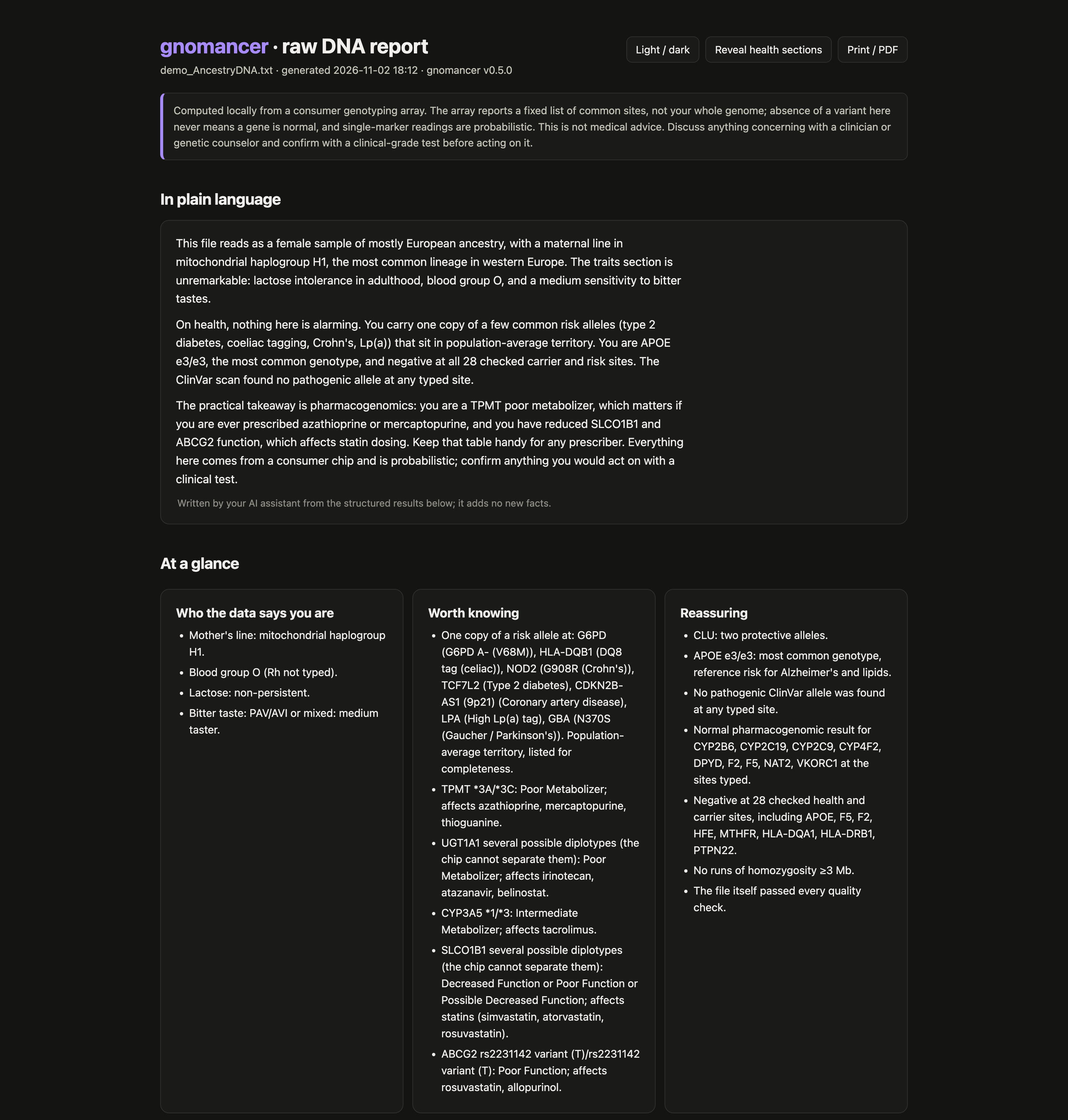
What you get
- Plain language first. An at-a-glance digest, then a narrative your own AI assistant can write from a prompt the run gives you.
- Lineages. Y haplogroup (yhaplo, plus Yleaf on current YFull/FTDNA/ISOGG trees) and mtDNA haplogroup (Haplogrep3), each with population context.
- Traits and ancestry markers. About 110 well-replicated sites: pigmentation, lactose, caffeine, bitter taste, blood group and more.
- Health, carefully. Carrier sites, common risk variants, a ClinVar scan of every typed site with plausibility scoring, and PharmCAT pharmacogenomics. All collapsed by default so nobody sees a result they didn't ask for.
- Family mode.
gnomancer family dad.zip mom.zip me.zipshows shared DNA and the likely relationship for each pair, which lines you share, and which parent each of your alleles came from. - Stays current.
gnomancer watchre-checks ClinVar each month and tells you only what was reclassified at sites you carry. - Honest limits. Every section says what the chip can and cannot tell you.
Use it from your AI assistant
gnomancer is also an MCP server. Connect it and ask "what does my report say about caffeine?"
claude mcp add gnomancer -- uvx gnomancer serve # Claude Code
Any MCP client works the same way: the command is uvx with arguments gnomancer serve. For Claude Desktop, Cursor and LM Studio (for a local model), add it to the client's mcpServers JSON:
{"mcpServers": {"gnomancer": {"command": "uvx", "args": ["gnomancer", "serve"]}}}
For Codex, add it to ~/.codex/config.toml:
[mcp_servers.gnomancer]
command = "uvx"
args = ["gnomancer", "serve"]
Tested with Claude Code and with a generic MCP client; reports from other clients are welcome.
The assistant never gets the raw file. It gets the report's results, and can look up the genotype at a single site when a question needs it; the health tables are separate tools fetched only on request. The repo also works as a Claude plugin (skills/gnomancer/SKILL.md).
Privacy
Your genotype file never leaves your machine. The only network traffic is the one-time download of public tools and references. The optional --ai flag sends the structured results (not the file) to the Anthropic API to write the narrative, and only when you ask. If you connect an AI assistant through the MCP server, it sees what it asks for: the report's results, and the genotype at any single site it looks up. With a cloud assistant those go to its provider; with a local model they stay on your machine.
Not medical advice
A genotyping array reads about 0.02% of the genome at pre-chosen sites, and its calls at rare sites are wrong often enough that a clinical lab found 40% did not confirm. gnomancer tells you what the chip says and how far to trust it. Confirm anything that matters with a clinical-grade test and a clinician or genetic counselor.
More
Discord community · CLI options · vendors and quirks · the marker panel · tools under the hood · development · MCP registry · contributing
MIT licensed. The tools it downloads keep their own licenses; see NOTICE.md for credits.
mcp-name: com.gnomancer/gnomancer
gnomancer MCP Fragen
Wie füge ich gnomancer MCP zu Claude Code hinzu?
Führe claude mcp add gnomancer -- uvx gnomancer in deinem Terminal aus. Füge --scope user hinzu, damit der Server in jedem Projekt verfügbar ist.
Wie füge ich gnomancer MCP zu Cursor hinzu?
Öffne ~/.cursor/mcp.json und füge den Server unter mcpServers hinzu, mit der Cursor-Config aus dem Installationsabschnitt oben.
Werden meine DNA-Daten in die Cloud hochgeladen?
Nein, alles läuft lokal auf deinem Computer und deine Genotyp-Datei verlässt deine Maschine nie.
Welche DNA-Dienste werden unterstützt?
Es werden Rohdateien von AncestryDNA, 23andMe, MyHeritage, FamilyTreeDNA, LivingDNA oder VCF-Dateien unterstützt.