
DiffGate MCPサーバー
✓ 検証済みコードがディスクに書き込まれる前に、差分範囲内のセキュリティおよび保守性のチェックを実行することで、コーディングエージェントに対して決定論的なガードレールを提供します。
別名 srbsa/diffgate, diffgate-review
- スター
- 5
- ツール
- —
- ダウンロード数(30日間)
- —
- 最新バージョン
- 0.8.0
- 最終コミット
- 2026年7月27日
- ライセンス
- Apache-2.0
DiffGate MCPとは
DiffGateはMCPサーバーです。 コードがディスクに書き込まれる前に、差分範囲内のセキュリティおよび保守性のチェックを実行することで、コーディングエージェントに対して決定論的なガードレールを提供します。.
プロジェクトのREADMEから生成された概要
DiffGate MCP server について
DiffGateは、コードがディスクに書き込まれる前に、変更された行に対してセキュリティおよび保守性のチェックを特化して行うことで、コーディングエージェントの決定論的なガードレールとして機能します。プルリクエスト時にトリガーされる従来のレビューボットや、エージェントのタスク完了後に実行されるpre-commit hookとは異なり、このツールはMCPを介したエージェントフックとして動作します。これにより、AIクライアントはミリ秒単位で構造化された検出結果を受け取り、コンテキストがアクティブな状態で問題を修正できます。なお、評価自体にはLLMトークンを一切使用しません。
システムは、ノイズを最小限に抑えるために階層化されたトリアージアプローチを採用しており、変更を安全なマージのためのGreen、手動レビューが必要なYellow、検証が必要な高影響項目のOrangeに分類します。Orangeの検出結果については、エンジンが特定のtestCommandを選択的に実行して変更を検証できます。このツールは、Claude CodeやCursorなどのエージェントを使用する開発者向けに設計されており、エージェントのループ、ローカルエディタ、およびCIパイプライン全体で一貫した判定を提供します。JavaScript、TypeScript、Python、Goなどの言語に対してASTベースのパースを使用し、SQLインジェクションやハードコードされたシークレットなどの問題を正確に検出します。
できること
- 1コードの重複と複雑さの削減開発者はreinvented-helperルールを使用することで、エージェントが既存の関数を再利用せずに、新たに作成してしまうのを防ぐことができます。
- 2高影響な変更の検証の自動化変更が高影響またはOrangeとしてフラグが立てられた場合にのみ、既存のテストスイートを自動的にトリガーできます。
プロジェクトの README から作成されています。すべてのユースケースは、その引用と照らし合わせて確認されています。
DiffGate MCPのインストール方法
フォーマット検証日 2026年11月10日Cursor に追加Gooseに追加Claude CodeにDiffGate MCPをインストール
$ claude mcp add diffgate -- npx -y diffgate-reviewCursorにDiffGate MCPをインストール
~/.cursor/mcp.json
{
  "mcpServers": {
    "diffgate": {
      "command": "npx",
      "args": [
        "-y",
        "diffgate-review"
      ]
    }
  }
}VS CodeにDiffGate MCPをインストール
.vscode/mcp.json
{
  "servers": {
    "diffgate": {
      "type": "stdio",
      "command": "npx",
      "args": [
        "-y",
        "diffgate-review"
      ]
    }
  }
}VS Code CLIにDiffGate MCPをインストール
$ code --add-mcp '{"name":"diffgate","type":"stdio","command":"npx","args":["-y","diffgate-review"]}'Claude DesktopにDiffGate MCPをインストール
claude_desktop_config.json
{
  "mcpServers": {
    "diffgate": {
      "command": "npx",
      "args": [
        "-y",
        "diffgate-review"
      ]
    }
  }
}CodexにDiffGate MCPをインストール
$ codex mcp add diffgate -- npx -y diffgate-reviewCodex config.tomlにDiffGate MCPをインストール
~/.codex/config.toml
[mcp_servers.diffgate]
command = "npx"
args = ["-y", "diffgate-review"]
Gemini CLIにDiffGate MCPをインストール
$ gemini mcp add -s user diffgate npx -- -y diffgate-reviewGemini settings.jsonにDiffGate MCPをインストール
~/.gemini/settings.json
{
  "mcpServers": {
    "diffgate": {
      "command": "npx",
      "args": [
        "-y",
        "diffgate-review"
      ]
    }
  }
}自動チェック
実行日 2026年11月15日完全なレポート →自動チェックに合格しました。これはセキュリティ監査ではありません。コードを読み、サーバーに必要最小限のアクセス権を与えてください。 チェックの仕組み

- ソースリポジトリがリンクされており、アクセス可能srbsa/diffgate is public and reachablegithub.com/srbsa/diffgate ↗合格
- パッケージがこのリポジトリをソースとして指定diffgate-review names srbsa/diffgate as sourcenpmjs.com/package/diffgate-review ↗合格
- ビルドの来歴 (Sigstore 証明)Sigstore attestation for diffgate-reviewnpmjs.com/package/diffgate-review/v/0.8.0#provenance ↗合格
- オープンソースライセンス (OSI)Apache-2.0spdx.org/licenses/Apache-2.0.html ↗合格
- 過去1年以内にコミットまたはリリースありLast commit or release 2026-07-28github.com/srbsa/diffgate ↗合格
- OpenSSF Scorecard未チェック
- パッケージ名が有名なパッケージに酷似していないNo popular package one edit away from diffgate-review合格
- パッケージおよびその依存関係に重大な勧告なし31 resolved dependencies checked; no critical advisoryosv.dev ↗合格
- モデルへの隠れた指示がない0 tool descriptions and the README read; no override phrases, credential paths or hidden characters合格
- 破壊的なツールがラベル付けされている未チェック
- リモートエンドポイントが MCP ハンドシェイクに応答未チェック
README
GitHubで見るDiffGate






A deterministic guardrail your coding agent runs on itself — before the code reaches your disk.
Every other check fires too late. A review bot needs a PR. A pre-commit hook runs after the agent has finished and moved on. DiffGate is an agent hook: your agent calls it over MCP, gets back structured findings in milliseconds for zero LLM tokens, and fixes the problem while it still has the context — then the same engine, same verdict runs in your editor, your pre-commit hook, and CI. Not a model grading its own homework: the same input always produces the same answer.
It stays quiet by construction. It grades only the lines that changed (🟢 merge · 🟡 glance · 🟠 verify), runs your tests only when a change earns it, and blocks only when it's earned — 0 false blocks on a public, versioned corpus you can rerun yourself with diffgate bench (BENCHMARK.md). Everyone claims low noise; this one ships the corpus.
Across local and frontier models: 0% classic OWASP bugs (SQL injection, XSS, hardcoded secrets) in code written from scratch. But the same frontier model that wrote flawless greenfield code reintroduced security footguns in 13% of edits — an unguarded recursive merge (prototype pollution), a bare cors() (any origin), a path built from request data with no containment check. Editing existing code is most of what an agent does, and the residue lives in the diff, not in the textbook. Rerun it yourself with diffgate marginal. The measurement →
The same shift shows up in third-party maintainability data: GitClear's 2026 analysis finds block duplication up 81% since 2023 (40.3 → 73.0 per million changed lines) and cross-file function connectivity down 35% — agents reinvent code rather than reuse it. That's what the reinvented-helper rule is for (docs/STRUCTURAL-RULES.md).
| Tier | Meaning | What you do | Examples |
|---|---|---|---|
| 🟢 Green | Safe / self-contained | merge freely | comments, local logging |
| 🟡 Yellow | Review (soft dependency) | take a look | deprecated APIs, raw SQL, network calls, dependency edits |
| 🟠 Orange | High-impact, gate it | verify before merge | schema/migrations, hardcoded secrets, auth/crypto, public-API changes, injection sinks |
Why an agent hook, not another review bot
Every check in the pipeline fires after the code exists, and each one is later than the last:
| Fires when | Problem | |
|---|---|---|
| Review bot (CodeRabbit, Greptile) | a PR exists | the code is finished, defended, and someone is waiting on it |
| Pre-commit hook | you're done and committing | the agent has moved on; you're re-loading context to fix it |
| DiffGate over MCP | the agent is still writing | it fixes its own output before the code lands |
Being early is not the only thing that matters, though — it has to be quiet, or the agent learns to ignore it. Review bots comment after the PR exists; linters and scanners flag everything they see. Neither guarantees the risky line gets discussed: we scanned 350 merged AI-assisted PRs — of the 109 with flagged AI-attributed changes, only 3 drew public discussion from any human besides the author. DiffGate decides what deserves your attention, your tests, or a block, and stays quiet otherwise. That's the whole product:
- Diff-scoped. Findings report only on the lines that changed, against the committed baseline — no whole-file noise, no re-litigating code you didn't touch.
- Tiered triage, not a flat list. Three tiers route attention: green merges, yellow is a glance, orange is gated.
- The gate runs your tests — selectively. On an orange change, DiffGate runs your
testCommandand shows the real exit code and output. Green and yellow pass instantly. The pre-commit hook is fast because tests fire only when a change is genuinely high-impact. - Earns the right to block. Broad cross-language injection findings stay advisory on their own; they escalate to a blocking finding only when the optional code graph proves the sink is reachable from an untrusted entry point (an HTTP/event handler). Recall from the rules, the right to block from the graph.
- Change-impact aware. With an optional code graph, a finding carries its cross-file blast radius — caller counts, suggested reviewers, untested call sites — and an exported symbol nobody calls is de-escalated. Cross-file context makes reviews quieter, not louder.
- Fast. A review runs in milliseconds on the changed lines — quick enough to sit in the agent and editor inner loop, not only in CI.
- Provably low-noise.
diffgate benchruns a versioned corpus offline: 100% precision / 0 false blocks on clean changes. Reproduce it yourself — that's the point of shipping the corpus. See BENCHMARK.md.
The measurement is reproducible
The 0% / 13% numbers aren't a marketing line — they come from a scripted experiment (four models from local to frontier, greenfield vs. edit mode, Wilson confidence intervals) that you can rerun with diffgate marginal. Methodology, per-model tables, and caveats: docs/MEASUREMENT.md. DiffGate's security rules are tuned to that measured residue, not to maximizing rule count.
Quick start
npm install -g diffgate-review
cd your-repo
diffgate init                    # auto-detects language + test command, writes .diffgate.json
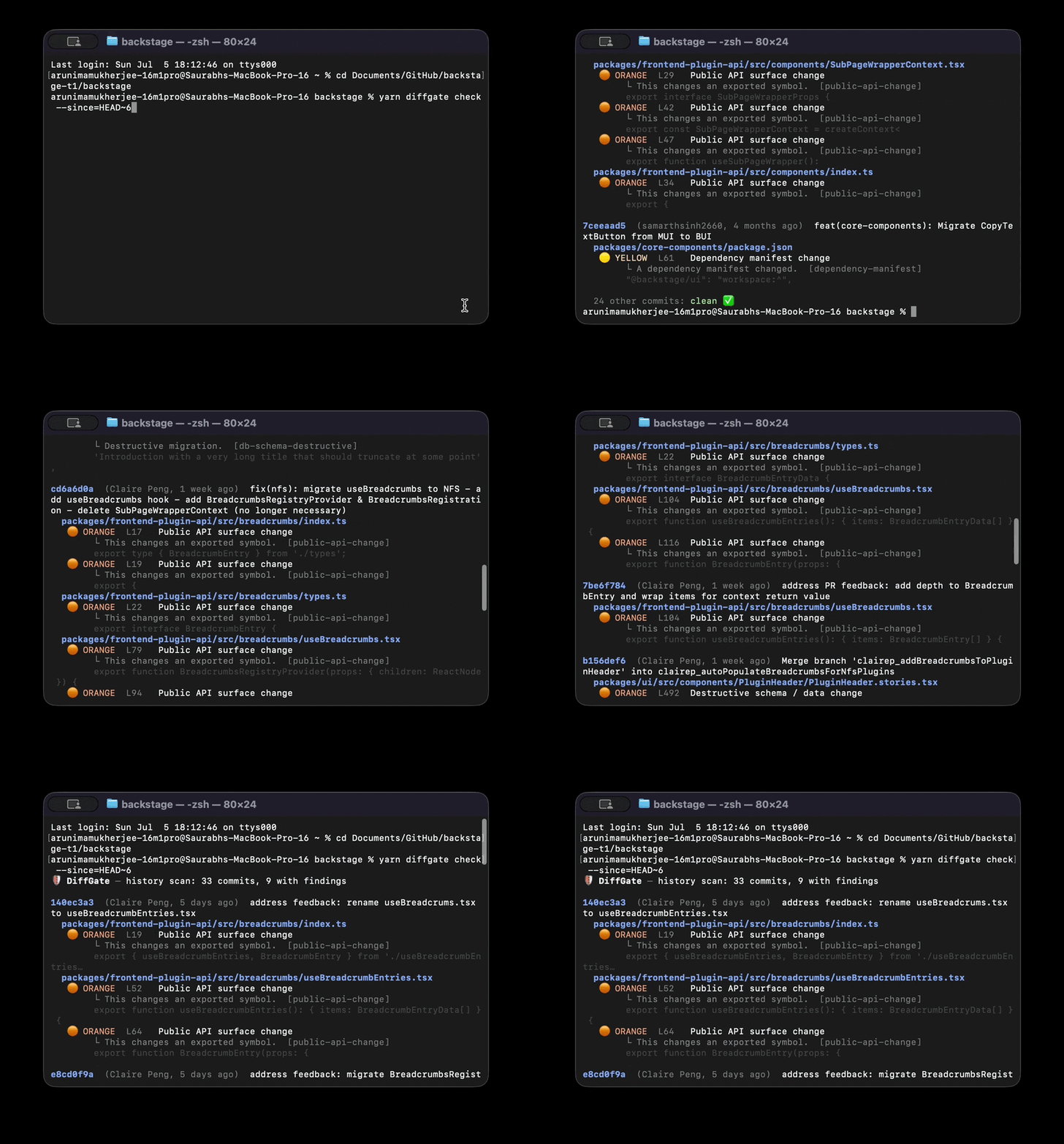
diffgate check --since=HEAD~20   # see what it catches in your own history — no PR required
diffgate check                   # review your pending changes right now
No git history or uncommitted changes yet? See the output on bundled examples first:
diffgate init --demo # live scan, no config or git changes needed
The surfaces (one shared engine, one verdict)
1. In your coding agent (via MCP)
The highest-leverage spot: the agent self-checks generated code before it's written to disk, gets back structured findings (zero LLM tokens), and surfaces what it corrected (original + fix + why) instead of silently rewriting. A trustworthy, deterministic self-check is what makes it safe to grant the agent more autonomy.
# Claude Code — one command:
claude mcp add diffgate -- diffgate mcp

# One-click via Smithery (zero config):
npx @smithery/cli install diffgate-review --client claude

# Cursor — add to MCP settings:
# { "diffgate": { "command": "diffgate", "args": ["mcp"] } }
Or one-click in Claude Desktop: download diffgate.mcpb and open it. The server also exposes prompts and resources; see MCP.md.
2. In your editor (VS Code / Cursor)
Inline squiggles on changed lines, hover cards (why · who owns it · quick-fix), a Risk Review tree, a status-bar summary, and Deep Review (agentic blast-radius analysis for orange findings). The same verdict you'd get from the CLI, on the diff you're reviewing.
Install from the VS Code Marketplace or Open VSX (Cursor / Windsurf / Gitpod).
3. On the command line — and in CI
diffgate check reviews your diff and exits non-zero on high-impact findings: a pre-commit hook locally, the same gate in your pipeline.
diffgate install-hook # adds .git/hooks/pre-commit; only runs tests on 🟠 orange changes
The local loop is the wedge — fix while the context is fresh — and the same engine runs as a PR gate so the verdict carries to where it's enforced for the whole team. See docs/TEAM.md for the GitHub Action, shared learnings, and org policy packs. CI runs can optionally layer an external scanner (Semgrep) through the same gate for broader language coverage — advisory-only, off by default (docs/CONFIG.md).
Common commands:
diffgate check                 # review pending changes (the gate)
diffgate check --staged        # staged-only (pre-commit)
diffgate check --since=HEAD~20 # audit recent history, per-commit (see below)
diffgate check --agent         # machine verdict for coding agents
diffgate scan <path>           # analyze files directly (no git needed)
diffgate watch                 # live review as you edit
diffgate guidelines            # review diff against AGENTS.md / CLAUDE.md etc.
diffgate feedback <rule> <f> <l> --dismiss   # suppress a false positive (shared via git)
diffgate mcp                   # start the MCP stdio server
Audit recent AI-authored history. Point check at commits already in your log — each
finding is attributed to a specific commit, so you get a story, not a repo-wide report card:
diffgate check --since=HEAD~20        # last 20 commits, one block per commit
diffgate check --since="2 weeks ago"  # by date instead of a rev
diffgate check --ai-authored          # only agent commits (Claude/Copilot/Cursor/… — heuristic)
diffgate check --author="Claude"      # matches author *and* Co-authored-by trailers
diffgate check <sha>                  # a single commit by hash
History mode is report-only (it audits the past — it never runs your test command or blocks a
commit) and honors --json and --limit=<n> (default 50). Merge commits are skipped.
Run diffgate --help for the full list (report, bench, stats, graph, marginal, …).
How it works
- Diff-aware:
git diff(CLI) or an in-memory LCS diff (editor, accurate on unsaved buffers) finds changed lines; findings only report on those lines. - Real AST where it counts:
@babel/parser(JS/TS) and tree-sitter (Python, PHP, Go, Ruby, Java, C#, Kotlin — via WASM, no native build) power precise rules: deprecated calls aren't matched inside comments or strings, exported-signature changes are detected structurally, and SQL injection is sink-targeted, parameter-aware, and sanitizer-aware —cur.execute(f"… {uid}")/$pdo->query("… $id")block, whilecur.execute("… %s", (uid,)),$pdo->prepare("… ?"), a single-quoted'… $id', and aSELECTin a log line don't. - A deterministic floor everywhere else: comment-aware pattern rules for secrets, destructive/schema changes, auth/crypto, dynamic execution / shell-out, raw queries, and network calls across Go, Java, Ruby, and any text. Commented-out code (
# os.system(x)) isn't flagged; a secret committed inside a comment still is. Docs/prose files (.md,.rst, …) are held to the same standard: the word "oauth2-provider" in a changelog isn't auth code, but a key pasted in a README is still a leak. - Earned blocking: broad cross-language injection advisories for the non-AST languages (Ruby
#{}, Go/Ruby shell-out) escalate to blocking only when the optional code graph proves reachability from an untrusted entry point — community CodeGraph, no Pro taint engine required. (JS/TS, Python, and PHP block on local AST evidence and don't need this.) - The gate: on a high-impact change, DiffGate runs your
testCommandand shows the actual exit code and output. - Learnings:
diffgate feedbackrecords dismiss/confirm verdicts; dismissed findings (same rule + same code) are suppressed everywhere. Stored in.diffgate/learnings.json; commit it to share across the team. - Optional add-ons: a provider-agnostic AI layer (plain-English explanations + fixes) and a cross-file blast-radius pass via an optional code graph. Both are off by default and degrade gracefully to a no-op.
Engine layout: src/core (shared) · src/cli.ts (CLI) · src/mcp.ts (MCP) · extension/ (VS Code).
Coverage scales with language
How deeply DiffGate analyzes a change depends on the file's language — be explicit about this so you can calibrate how much to trust a clean result.
| Tier | Languages | Depth |
|---|---|---|
| Deep (AST) | JS / TS (@babel) |
All injection classes + public-API & signature changes + deprecated-API quick-fixes. Prototype pollution and NoSQL injection are JS/TS-only; JS/TS findings are also eligible for code-graph taint confirmation. |
| Deep (AST) | Python, PHP, Go, Ruby, Java, C#, Kotlin (tree-sitter) | Sink-targeted, parameter- and sanitizer-aware injection detection — placeholders, argument-vectors, and escapers are correctly treated as safe. Sink classes per language below. |
Sink classes per Deep-AST language (full detail — every sanitizer and safe-form, plus the code-graph boundary — in docs/SCOPE.md):
- Python (7) — SQL · XSS · path traversal · CORS · command · code · deserialization
- PHP (8) — SQL · command · code · file inclusion · deserialization · XSS · path traversal · CORS
- Go (4) — SQL · command · path traversal · CORS
- Ruby (6) — SQL · command · code · deserialization · XSS · CORS
- Java (6) — SQL · command · deserialization · path traversal · XXE · CORS
- C# (7) — SQL · command · deserialization · path traversal · XSS · XXE · CORS
- Kotlin (6) — SQL · command · deserialization · path traversal · XXE · CORS
SSRF is a cross-language advisory across all eight Deep-AST languages (a request-tainted URL into an outbound-request sink; library-qualified and tainted-only, so static/config URLs aren't flagged). XXE covers the JVM (Java, Kotlin) and .NET (C#), suppressed when the file shows recognized hardening. Permissive CORS now also covers all eight — wildcard Access-Control-Allow-Origin, allow-all framework configs (gin/rs-cors, Spring @CrossOrigin, ASP.NET AllowAnyOrigin(), Ktor anyHost(), rack-cors), and request-reflected origins; explicit allowlists aren't flagged.
| Tier | Languages | Depth |
|---|---|---|
| Floor (pattern) | C/C++, Rust, Swift, Scala, … | Secrets, destructive/schema changes, auth/crypto, dynamic exec / shell-out, raw queries, network calls, TODO. Cross-language injection advisories that escalate via the code graph. |
| Text | YAML, Terraform, JSON, any text | Secrets and TODO/FIXME markers. |
Fast by design — and scoped to match. A review runs in milliseconds on the changed lines, which is exactly what lets the same check sit in the agent and editor inner loop. That speed is a deliberate trade: DiffGate is the deterministic gate on the diff, not an exhaustive whole-repo taint engine. Coverage is per-language (deep where there's an AST, a pattern floor elsewhere), the security rules are tuned to the residue agents actually ship rather than to maximize raw rule count, and a clean result means "nothing matched at this language's tier," not "proven safe." For deep cross-file taint analysis across many languages, pair it with a dedicated SAST. Full per-language detail and the code-graph boundary: docs/SCOPE.md.
Configuration
diffgate init writes a tailored .diffgate.json at your repo root. Minimal example:
{
  "testCommand": "npm test",          // run for orange changes (the gate)
  "gate": { "mode": "working", "failOn": "orange" },
  "deprecated": [
    { "pattern": "StripeClient.charge", "replacedBy": "StripeClient.createPaymentIntent" }
  ]
}
Any rule — built-in or custom — can be path-scoped with include/exclude globs, the escape hatch for the one file where a forbidden idiom is legitimate (e.g. process.env inside the config loader itself). Full schema, the built-in rule table, LLM providers, and per-rule tuning: docs/CONFIG.md.
More
- The PR was reviewed. The risky line wasn't. — our PR-trail study: 350 merged AI-assisted PRs, 109 with flagged AI-attributed changes, 3 with public human discussion beyond the author.
- docs/SCOPE.md: per-language coverage tiers (deep AST vs. pattern vs. text-only) and what the code graph does and doesn't do.
- docs/CONFIG.md: full
.diffgate.jsonschema, all built-in rules, LLM providers, native precision & test-scope behavior. - docs/TEAM.md: rolling DiffGate out to a team (GitHub Action / PR gate, shared learnings, org-wide policy packs, SOC 2 evidence, metrics for leaders).
- docs/CODE-GRAPH.md: optional cross-file blast radius (caller counts, suggested reviewers, test gaps, reachability, taint analysis).
- docs/STRUCTURAL-RULES.md: the
structuralpack — over-engineering rather than vulnerabilities (needless abstractions, pass-through wrappers, complexity spikes), all non-blocking, with per-language thresholds. - docs/MEASUREMENT.md: what agents actually ship unprompted and how to reproduce it (
diffgate marginal). - MCP.md: MCP tools, prompts, resources, and AI configuration.
Try it
diffgate scan mock_project
You'll see green findings (logging), yellow findings (a deprecated call), and orange findings (a DROP COLUMN migration, a public export).
Tests
npm test # builds the extension, runs the full unit/integration suite + extension smoke test
Support the project
If DiffGate caught something for you — or you just like the idea of a deterministic gate for agent code — star the repo ⭐. It's the signal that tells other people this is worth trying.
- 🐛 Found a false block, or a sink it missed? Open an issue — a false block is a bug we treat as P0.
- 💡 Want a language or rule covered? File a feature request with the idiom you'd like caught.
- 🔒 Security report? Please disclose privately — see SECURITY.md.
Contributing & License
See CONTRIBUTING.md. Apache 2.0; see LICENSE.
DiffGate MCPのよくある質問
DiffGate MCPをClaude Codeに追加するには
ターミナルでclaude mcp add diffgate -- npx -y diffgate-reviewを実行します。すべてのプロジェクトで利用するには--scope userを追加します。
DiffGate MCPをCursorに追加するには
~/.cursor/mcp.jsonを開き、上記のインストールセクションに示すCursor設定を使ってmcpServersの下にサーバーを追加します。
DiffGateのチェックにLLMトークンは使用されますか?
いいえ、DiffGateは決定論的なエンジンを使用して構造化された検出結果を提供するため、LLMトークンを一切必要としません。
DiffGateは誤検知やノイズをどのように処理しますか?
差分範囲内の検出結果のみを報告するように設計されており、階層化されたトリアージシステム(Green、Yellow、Orange)を採用して、注意が必要な項目を判断します。
DiffGateで既存のテストを実行できますか?
はい、影響度の高い(Orange)変更に対して、DiffGateは指定されたテストコマンドを実行し、その出力を表示できます。