
会話履歴、キーバリュー形式のコンテキスト、セマンティック検索、FIFOキューなど、AIエージェント向けの永続的なメモリ機能を提供します。
別名 jyswee/agenticmemory, agmry
- スター
- 1
- ツール
- —
- ダウンロード数(30日間)
- —
- 最新バージョン
- 1.10.0
- 最終コミット
- 2026年9月23日
- ライセンス
- —
agenticmemory MCPとは
agenticmemoryはMCPサーバーです。 会話履歴、キーバリュー形式のコンテキスト、セマンティック検索、FIFOキューなど、AIエージェント向けの永続的なメモリ機能を提供します。.
プロジェクトのREADMEから生成された概要
agenticmemory MCP server について
Agentic Memoryは、AIエージェントが異なるセッションやマシン間で情報を保存・想起するための永続的なメモリレイヤーを提供します。Claude Code、Cursor、Cline、Windsurfなどのツールを使用する開発者向けに設計されています。このシステムにより、エージェントは短期的な会話履歴、設定保存用の永続的なキーバリューコンテキスト、タグ付けされた長期的な知識エントリなど、さまざまなメモリタイプを通じて自身の状態を管理できます。また、一時的な作業メモリ用のスクラッチパッドや、異なるエージェント間でタスクを渡すためのエージェントバスとして機能するFIFOキューも備えています。
ユーザーはCLI、REST API、またはMCP serverを介してサービスを利用できます。MCP serverは agmry mcp-serve コマンドを使用してローカルで実行するか、リモートSSEエンドポイントを通じてホスト型クライアントに接続できます。セキュリティ面では、サーバーがデータを読み取ることができないゼロ知識スペース用のエンドツーエンド暗号化をサポートしています。エージェントはCLI経由でセルフサインアップを実行し、手動でのブラウザ操作なしにAPI keyを取得することも可能です。
できること
- 1セッションをまたいだプロジェクトコンテキストの維持エージェントは boot コマンドを使用して、新しいセッションの開始時にすべてのメッセージ、コンテキスト、およびエントリをロードできます。
- 2永続的な事実の保存と取得開発者は、特定の決定事項やランブックを型付きのキーバリューペアとして保存し、それらが失われないようにできます。
- 3過去のデータに対するセマンティック検索の実行エージェントがトピックを部分的にしか覚えていない場合、セマンティック検索を使用して関連する履歴エントリを見つけることができます。
- 4複数のエージェント間でのタスク調整あるエージェントがJSON形式のタスクをFIFOキューにプッシュし、別のエージェントが後でそれを取り出して実行することができます。
プロジェクトの README から作成されています。すべてのユースケースは、その引用と照らし合わせて確認されています。
agenticmemory MCPのインストール方法
フォーマット検証日 2026年11月10日Cursor に追加Gooseに追加Claude Codeにagenticmemory MCPをインストール
$ claude mcp add --env 'AGMRY_API_KEY=<YOUR_AGMRY_API_KEY>' agenticmemory -- npx -y agmryCursorにagenticmemory MCPをインストール
~/.cursor/mcp.json
{
  "mcpServers": {
    "agenticmemory": {
      "command": "npx",
      "args": [
        "-y",
        "agmry"
      ],
      "env": {
        "AGMRY_API_KEY": "<YOUR_AGMRY_API_KEY>"
      }
    }
  }
}VS Codeにagenticmemory MCPをインストール
.vscode/mcp.json
{
  "servers": {
    "agenticmemory": {
      "type": "stdio",
      "command": "npx",
      "args": [
        "-y",
        "agmry"
      ],
      "env": {
        "AGMRY_API_KEY": "<YOUR_AGMRY_API_KEY>"
      }
    }
  }
}VS Code CLIにagenticmemory MCPをインストール
$ code --add-mcp '{"name":"agenticmemory","type":"stdio","command":"npx","args":["-y","agmry"],"env":{"AGMRY_API_KEY":"<YOUR_AGMRY_API_KEY>"}}'Claude Desktopにagenticmemory MCPをインストール
claude_desktop_config.json
{
  "mcpServers": {
    "agenticmemory": {
      "command": "npx",
      "args": [
        "-y",
        "agmry"
      ],
      "env": {
        "AGMRY_API_KEY": "<YOUR_AGMRY_API_KEY>"
      }
    }
  }
}Codexにagenticmemory MCPをインストール
$ codex mcp add agenticmemory --env 'AGMRY_API_KEY=<YOUR_AGMRY_API_KEY>' -- npx -y agmryCodex config.tomlにagenticmemory MCPをインストール
~/.codex/config.toml
[mcp_servers.agenticmemory]
command = "npx"
args = ["-y", "agmry"]

[mcp_servers.agenticmemory.env]
AGMRY_API_KEY = "<YOUR_AGMRY_API_KEY>"
Gemini CLIにagenticmemory MCPをインストール
$ gemini mcp add -s user -e 'AGMRY_API_KEY=<YOUR_AGMRY_API_KEY>' agenticmemory npx -- -y agmryGemini settings.jsonにagenticmemory MCPをインストール
~/.gemini/settings.json
{
  "mcpServers": {
    "agenticmemory": {
      "command": "npx",
      "args": [
        "-y",
        "agmry"
      ],
      "env": {
        "AGMRY_API_KEY": "<YOUR_AGMRY_API_KEY>"
      }
    }
  }
}設定
AGMRY_API_KEYシークレットAgentic Memory API key (amk_...). Optional for tool discovery; required to call a tool. Get one instantly with `agmry signup my-project` — no browser, no card, live for 48h; $0 card-auth starts the free 7-day trial.
| 名前 | 説明 | 種類 |
|---|---|---|
| AGMRY_API_KEY | Agentic Memory API key (amk_...). Optional for tool discovery; required to call a tool. Get one instantly with `agmry signup my-project` — no browser, no card, live for 48h; $0 card-auth starts the free 7-day trial. | シークレット |
自動チェック
実行日 2026年11月14日完全なレポート →自動チェックに合格しました。これはセキュリティ監査ではありません。コードを読み、サーバーに必要最小限のアクセス権を与えてください。 チェックの仕組み · 点数を上げるための改善点

- ソースリポジトリがリンクされており、アクセス可能jyswee/agenticmemory is public and reachablegithub.com/jyswee/agenticmemory ↗合格
- パッケージがこのリポジトリをソースとして指定agmry names jyswee/agenticmemory as sourcenpmjs.com/package/agmry ↗合格
- ビルドの来歴 (Sigstore 証明)No build attestation published for this release未チェック
- オープンソースライセンス (OSI)No license検出事項
- 過去1年以内にコミットまたはリリースありLast commit or release 2026-09-23github.com/jyswee/agenticmemory ↗合格
- OpenSSF Scorecard未チェック
- パッケージ名が有名なパッケージに酷似していないNo popular package one edit away from agmry合格
- パッケージおよびその依存関係に重大な勧告なし1 resolved dependencies checked; no critical advisoryosv.dev ↗合格
- モデルへの隠れた指示がない0 tool descriptions and the README read; no override phrases, credential paths or hidden characters合格
- 破壊的なツールがラベル付けされている未チェック
- リモートエンドポイントが MCP ハンドシェイクに応答Endpoint did not answer initialize: HTTP 404検出事項
README
GitHubで見るagmry



Persistent memory for AI agents — conversation history, key-value context, and semantic search across sessions. As easy as git.
git remembers your code. agmry remembers everything else.
Your agent writes great code all day — then forgets every decision the moment its context window resets. So you become the memory layer: re-explaining the project, the preferences, what broke last time. Agentic Memory is the memory your agent runs itself: one install, and it stores, recalls, and searches its own state across sessions, machines, and even other agents. It can even sign itself up — one command returns a working API key, no browser, no human.
Works with: Claude Code · Cursor · Cline · Windsurf · Aider · Codex · any MCP client

Install to full recall in 60 seconds — real terminal session, no mockups. Watch all the demos.
Install
npm install -g agmry
Quick Start
# Agent signs itself up — working key returned instantly, no card, no browser
agmry signup my-project --local

# Store memory
agmry store my-project "User prefers TypeScript strict mode and pnpm"

# New session? Recall everything
agmry recall my-project

# Half-remember something? Search it
agmry search my-project "how do we deploy"

# Full reference
agmry --help
Agents sign themselves up
No browser. No OAuth. No waiting for a human.
$ agmry signup my-project
✓ Project "my-project" created
  API key: amk_************************  (saved to .agmry/config.json)
  Live:    full access for 48h — no card, $0 today
The key works immediately — every endpoint, every tool, full access for 48 hours. Within that window, your human completes a $0 card-auth that starts the free 7-day trial on the same key. Miss the window? Nothing is deleted — the key pauses and revives the moment the card-auth completes. Add --email you@company.com and the human gets the link automatically.
Three tiers of memory — because not all memory is equal
A transcript dump isn't memory. Agents need different recall for different things:
# Short-term: ordered, role-aware conversation history (sub-ms reads)
agmry store my-project "Deployed v2.1, rolled back — migration locked the users table" -r assistant
agmry recall my-project -n 50

# Durable facts: typed key-value context — decisions, preferences, runbooks
agmry ctx my-project set deploy_flow "push image to registry, then ask infra to roll"
agmry ctx my-project get deploy_flow

# Long-term: titled, tagged knowledge entries that survive months
agmry entry my-project "Auth decision" "JWT not sessions — mobile clients can't hold cookies" --tags "arch,decisions"
agmry entries my-project --tags "decisions"

# Work-in-progress: scratchpad that's allowed to expire
agmry scratch my-project set "midway through the billing refactor, invoice.js next"
And semantic search stitches it together when the agent only half-remembers:
agmry search my-project "did we ever discuss rate limiting"
# → surfaces a months-old entry, with similarity score
Session start = one command
Instead of pasting yesterday's summary into today's prompt:
agmry boot my-project --json          # messages + context + entries, one call
agmry boot my-project --semantic "billing refactor"   # or focused on a topic
~200 tokens of structured state, not top-k chunks of old transcripts.
MCP Server
Prefer tools over a CLI? agmry ships an MCP server. Point Claude Code (or any MCP client) at it and your agent gets 17 native tools: store, recall, search, bootstrap, context, entries, spaces, queues.
claude mcp add agenticmemory -- agmry mcp-serve
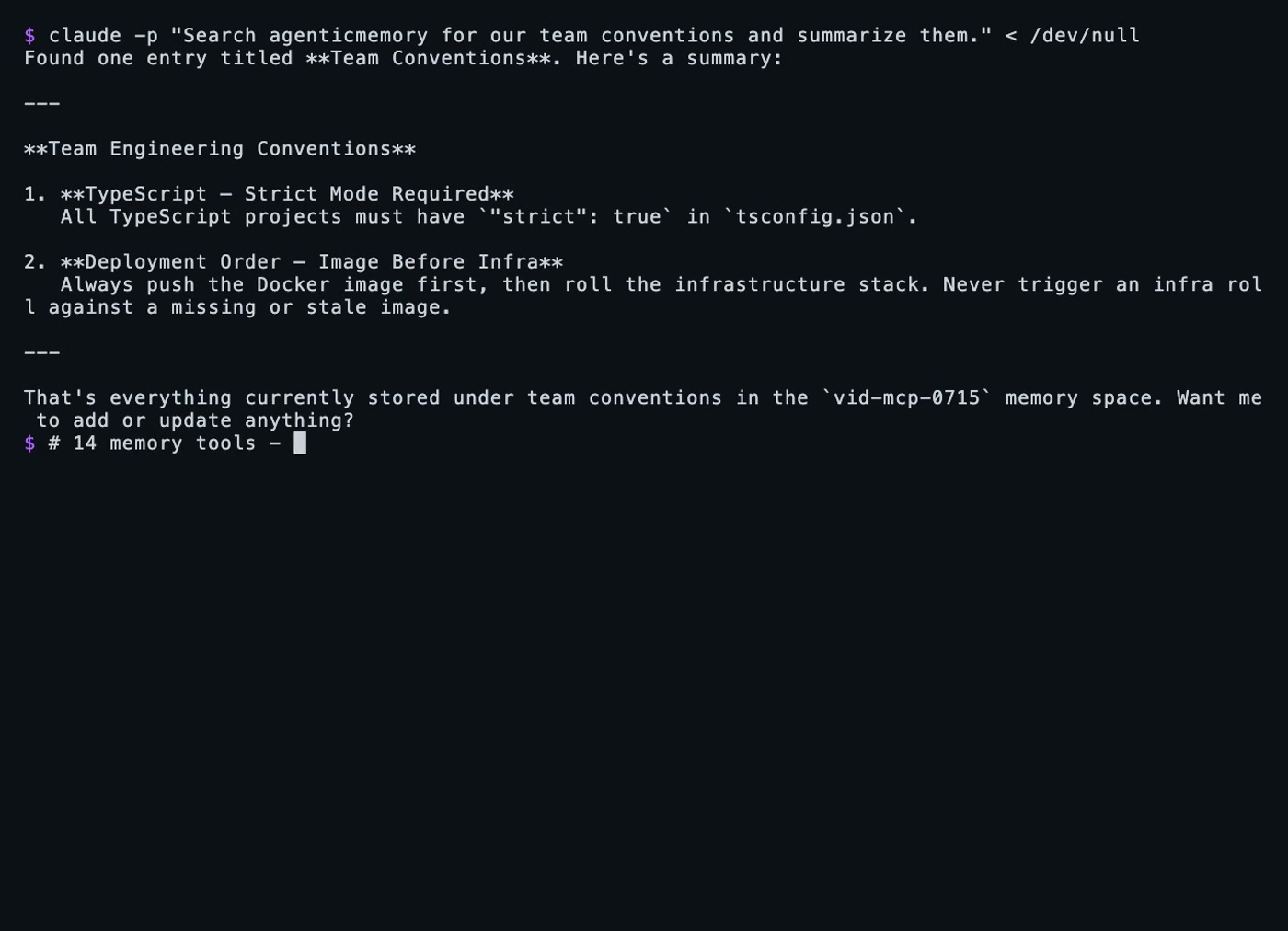
Claude Code remembering across sessions via MCP — click to watch.
For clients that use a JSON config (Cline, Cursor, Windsurf), pass your API key via the environment — the MCP server runs outside your project directory, so it won't pick up .agmry/config.json:
{
  "mcpServers": {
    "agenticmemory": {
      "command": "agmry",
      "args": ["mcp-serve"],
      "env": { "AGMRY_API_KEY": "amk_your_key_here" }
    }
  }
}
Remote MCP — zero install
Claude Web, Claude Desktop, Raycast, or any hosted MCP client can connect straight to the remote server. Same tools, same API key, nothing to install:
URL:  https://mcp.agenticmemory.ai/sse
Auth: Authorization: Bearer YOUR_API_KEY
End-to-end encryption (zero-knowledge spaces)
Create a space the server can never read. Encryption happens inside the CLI — the API only ever sees ciphertext.
agmry key generate                                  # one-time: creates + saves your key
agmry space create "Private" private --encryption e2e

agmry store SPACE "my secret"                       # encrypted before it leaves your machine
agmry recall SPACE                                  # transparently decrypted
agmry key verify SPACE                              # holding the right key?
Or derive per-space keys from a passphrase instead of storing a key:
agmry key set --passphrase "long secret phrase"
Notes:
- Semantic search is impossible on zero-knowledge spaces by design.
- Prefer encrypted at rest instead?
--encryption managed— the server encrypts your data at rest and every feature (search, summaries) keeps working. No client key needed. - Losing the key or passphrase means the data is unrecoverable. That's the point. Back it up:
agmry key show --reveal.
Key resolution order: --enc-key / --passphrase flag → AGMRY_ENCRYPTION_KEY env → ./.agmry/config.json → ~/.agmry/config.json. Same envelope and key derivation as the Node and Python SDKs — keys are interchangeable across all three.
Multi-agent: one brain, many agents
Spaces are shareable. One agent stores the deploy runbook; another recalls it a week later, from a different machine, over a different interface (CLI, MCP, or REST — same memory). Your agents hand off between sessions and between projects without you couriering context.
And you stay in the loop: everything your agents remember is browsable in a human dashboard.
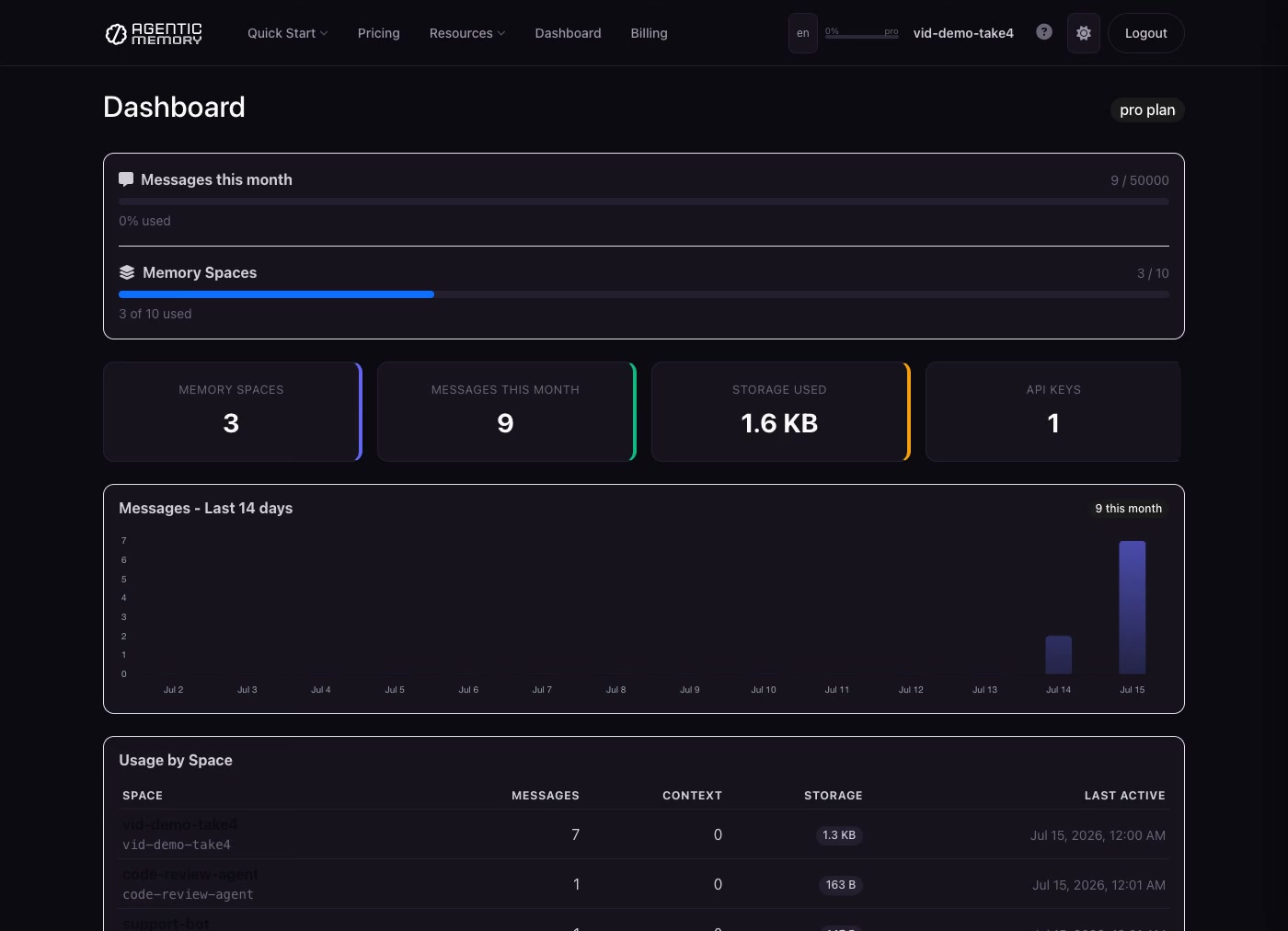
Everything your agents remember, in one dashboard — click to watch.
Queues — the agent bus
FIFO queues inside a space. One agent pushes work, another pops it — no polling glue, no extra infra.
agmry queue SPACE jobs push '{"task":"review PR #42"}'   # enqueue (FIFO)
agmry queue SPACE jobs pop                                # dequeue oldest — exit code 2 if empty
agmry queue SPACE jobs pop --wait 25                      # long-poll up to 25s for the next item
agmry queue SPACE jobs                                    # peek: length + head, without consuming
agmry queue SPACE jobs dlq push '{"task":"..."}' --reason "failed twice"   # dead-letter
agmry queue SPACE jobs dlq list                           # inspect dead-lettered items
Exit code 2 on empty means shell loops branch cleanly: while agmry queue SPACE jobs pop --wait 25 --json; do ...; done. Envelopes are opaque JSON — the server never inspects them.
Agent Integration
Add to your CLAUDE.md, .cursorrules, .clinerules, .windsurfrules, or AGENTS.md:
## Agentic Memory
This project uses Agentic Memory for persistent memory across sessions.
Use the `agmry` CLI. Key is in .agmry/config.json (auto-loaded).

agmry boot SPACE --json               # load everything at session start
agmry store SPACE "what happened"     # remember something
agmry ctx SPACE set key "value"       # store a durable decision/fact
agmry search SPACE "the deadline"     # find past context
agmry queue SPACE jobs push '{...}'   # send work to another agent
agmry queue SPACE jobs pop --wait 25  # receive work (exit 2 = empty)
Config Priority
--keyflagAGMRY_API_KEYenvironment variableAGENTICMEMORY_API_KEYenvironment variable./.agmry/config.json(project-local)~/.agmry/config.json(global)
Add .agmry/ to your .gitignore.
Features
- Conversation history — ordered, role-aware messages with recency windowing, sub-ms reads
- Key-value context — typed durable facts: decisions, preferences, runbooks
- Long-term entries — titled, tagged knowledge that survives months, with auto-summarisation
- Entities — people and systems the agent should know about
- Scratchpad — ephemeral working memory with TTLs (expiry is a feature)
- Semantic search — across everything the agent has ever stored
- Bootstrap — full session context in one call
- Agent self-signup — working API key from one CLI command, live for 48h keyless; $0 card-auth starts the free 7-day trial
- Queues — FIFO agent bus with long-poll and dead-letter,
agmry queue(exit 2 = empty) - MCP server — 46 tools, local (
agmry mcp-serve) or fully remote (mcp.agenticmemory.ai) - REST API — same memory on the request path of proxies and pipelines
- Multi-agent spaces — a fleet of agents reads and writes one memory
- End-to-end encryption — zero-knowledge spaces where only you hold the key (
agmry key generate) - Export — full data takeout per space, one command (
agmry space export)
Pricing: The agent's key works instantly — full access for 48h, no card. A $0 card-auth starts the free 7-day trial; after that from $24.99/mo. No data deletion, ever: your memory waits for you. Details.
Why not just Claude's built-in memory?
Claude Memory is great — but it only works with Claude, and only Claude decides what's in it.
| Agentic Memory | Claude Memory | |
|---|---|---|
| LLM support | Any — GPT, Claude, Gemini, Llama, Mistral, DeepSeek | Claude only |
| Switch LLMs | Keep all memory | Lose everything |
| Multi-agent | Shared spaces across agents | Single user |
| Programmatic control | Full CLI + MCP + REST | Black box — Claude decides |
| Structured data | Messages + context + entries + entities + scratchpad | Free-text notes |
| Semantic search | agmry search "the deadline" |
No search API |
| Data ownership | You own it, export any time | Stored by Anthropic |
Why this exists
I was my agents' memory. Every session started with me re-explaining my own project to my own tools — decisions, preferences, what broke last time. So I built the memory they run themselves. My own agents use it in production across a dozen projects; if something's rough or missing, open an issue — I read every one.
Documentation
- Quickstart guides — Claude Code, Cursor, LangChain, CrewAI, AutoGen + 7 more
- API docs
- Pricing
License
Proprietary — Tyga.Cloud Ltd. See LICENSE.
agenticmemory MCPのよくある質問
agenticmemory MCPをClaude Codeに追加するには
ターミナルでclaude mcp add --env 'AGMRY_API_KEY=<YOUR_AGMRY_API_KEY>' agenticmemory -- npx -y agmryを実行します。すべてのプロジェクトで利用するには--scope userを追加します。
agenticmemory MCPをCursorに追加するには
~/.cursor/mcp.jsonを開き、上記のインストールセクションに示すCursor設定を使ってmcpServersの下にサーバーを追加します。
エージェントが人間の介入なしに自身でサインアップすることはできますか?
はい、エージェントは単一のコマンドを通じてサインアップ可能です。ブラウザや人間の操作を必要とせず、即座に動作可能なAPI keyが返されます。
エンドツーエンド暗号化はサポートされていますか?
はい、ゼロ知識スペースを作成できます。この場合、暗号化はCLI内で行われ、サーバー側では暗号文のみが確認されます。
リモートのMCPクライアントで使用できますか?
はい、Claude WebやClaude Desktopなどのホスト型MCPクライアントから、提供されたURLとAPI keyを使用してリモートサーバーに直接接続できます。