
codeagent-memory MCPサーバー
コミット 2026年11月13日tree-sitterによるシンボル解析とハイブリッドRRF検索を用いて、コーディングエージェント向けのローカルなコードグラフおよび会話メモリシステムを提供します。
別名 HanochZhu/codeagent_memory
- スター
- 1
- ツール
- —
- ダウンロード数(30日間)
- —
- 最新バージョン
- 0.1.6
- 最終コミット
- 2026年11月13日
- ライセンス
- MIT
codeagent-memory MCPとは
codeagent-memoryはMCPサーバーです。 tree-sitterによるシンボル解析とハイブリッドRRF検索を用いて、コーディングエージェント向けのローカルなコードグラフおよび会話メモリシステムを提供します。.
プロジェクトのREADMEから生成された概要
codeagent-memory MCP server について
codeagent-memoryは、AIコーディングエージェント向けに特別に設計された、ローカルの二層構造リトリーバルシステムを提供します。構造的なナビゲーションのためのコードグラフと、プロジェクトの事実や設計上の決定を永続化するための会話メモリツリーを組み合わせています。システムはRustカーネルで構築されており、SQLiteデータベースを使用してローカルマシン上で完全に動作するため、プライバシーが確保され、APIコストも発生しません。
開発者は、MCP stdioインターフェースを介して、Cursor、Claude Code、Windsurf、GitHub Copilotなどの主要な環境にこのMCP serverを統合できます。メインのエージェントはMCPツールを通じてやり取りを行いますが、サブエージェントはJSON対応のCLIを介して同じロジックを利用できます。このツールはtree-sitterを使用して関数や型などのシンボルを解析し、Rust、Python、TypeScriptを含む9つのプログラミング言語をサポートしています。
検索は2つの異なるレイヤーで行われます。コードグラフはファイル全体ではなく、特定のシンボルの本体をピンポイントで読み取ることを可能にします。一方、メモリツリーはハイブリッドRRF検索を使用して、高密度な埋め込みとBM25を組み合わせます。これにより、エージェントは複雑なプロジェクトのコンテキストを想起し、呼び出し元や呼び出し先を介してコードベースを効率的にナビゲートできます。
できること
- 1文脈に基づいたプロジェクトの想起開発者はエージェントに対し、特定の設計上の決定事項やデバッグのメモを記憶し、後で取得するように指示できます。
- 2メモリ管理の自動化システムは、新しいリビジョンを古いものにリンクさせることで、古い情報を自動的に処理できます。
プロジェクトの README から作成されています。すべてのユースケースは、その引用と照らし合わせて確認されています。
codeagent-memory MCPのインストール方法
フォーマット検証日 2026年11月10日Claude Codeにcodeagent-memory MCPをインストール
$ claude mcp add codeagent-memory -- docker run -i --rm ghcr.io/hanochzhu/codeagent-memory:0.1.6Cursorにcodeagent-memory MCPをインストール
~/.cursor/mcp.json
{
  "mcpServers": {
    "codeagent-memory": {
      "command": "docker",
      "args": [
        "run",
        "-i",
        "--rm",
        "ghcr.io/hanochzhu/codeagent-memory:0.1.6"
      ]
    }
  }
}VS Codeにcodeagent-memory MCPをインストール
.vscode/mcp.json
{
  "servers": {
    "codeagent-memory": {
      "type": "stdio",
      "command": "docker",
      "args": [
        "run",
        "-i",
        "--rm",
        "ghcr.io/hanochzhu/codeagent-memory:0.1.6"
      ]
    }
  }
}Claude Desktopにcodeagent-memory MCPをインストール
claude_desktop_config.json
{
  "mcpServers": {
    "codeagent-memory": {
      "command": "docker",
      "args": [
        "run",
        "-i",
        "--rm",
        "ghcr.io/hanochzhu/codeagent-memory:0.1.6"
      ]
    }
  }
}Codexにcodeagent-memory MCPをインストール
~/.codex/config.toml
[mcp_servers.codeagent-memory]
command = "docker"
args = ["run", "-i", "--rm", "ghcr.io/hanochzhu/codeagent-memory:0.1.6"]
Gemini CLIにcodeagent-memory MCPをインストール
~/.gemini/settings.json
{
  "mcpServers": {
    "codeagent-memory": {
      "command": "docker",
      "args": [
        "run",
        "-i",
        "--rm",
        "ghcr.io/hanochzhu/codeagent-memory:0.1.6"
      ]
    }
  }
}自動チェック
実行日 2026年11月14日詳細レポート →まだ検証されていません。サーバーには80点のスコア、重大な問題がないこと、および検証に必要な十分なデータが必要です。 チェックの仕組み

- ソースリポジトリがリンクされており、アクセス可能hanochzhu/codeagent_memory is public and reachablegithub.com/hanochzhu/codeagent_memory ↗合格
- パッケージがこのリポジトリをソースとして示している未チェック
- ビルドの来歴(Sigstore 証明)未チェック
- オープンソースライセンス (OSI)MITspdx.org/licenses/MIT.html ↗合格
- 過去1年以内にコミットまたはリリースありLast commit or release 2026-11-13github.com/hanochzhu/codeagent_memory ↗合格
- OpenSSF Scorecard未チェック
- パッケージ名が有名なパッケージに酷似していない未チェック
- パッケージと依存関係に重大なアドバイザリがない未チェック
- モデルへの隠れた指示がない0 tool descriptions and the README read; no override phrases, credential paths or hidden characters合格
- 破壊的なツールがラベル付けされている未チェック
- リモート endpoint が MCP ハンドシェイクに応答する未チェック
README
GitHubで見るcam
English · 中文 · 日本語 · 한국어 · العربية · 🌐 Website
A local multi-turn conversational memory system purpose-built for coding agents
Code graph + memory · surgical reads · 100% local · MCP + CLI
Kernel written in Rust







Contents
- Why cam?
- Get Started
- Key Features
- How It Works
- Agent Workflow
- CLI Reference
- Memory Rules
- Configuration
- Benchmarks
- Supported Agents
- Supported Languages
- Supported Platforms
- License
Guides: Interactive Showcase (Website) · Main Agent vs Subagent · MCP Configs by IDE · 中文说明
Why cam?
When an AI coding agent explores a repository, it usually rediscovers structure the slow way — running grep, glob, and full-file Read one file at a time — and forgets everything in the next session.
cam gives the agent two local retrieval planes in a single binary:
| Plane | What it stores | How the agent uses it |
|---|---|---|
| Code Graph | Tree-sitter symbols (functions, types, methods) as a virtual filesystem + 1-hop callers/callees | ls, find, read src/file.rs/symbol, ref symbol --dir in|out — surgical symbol reads instead of whole-file dumps |
| Memory Tree | Project facts, architecture decisions, debugging write-ups, and user habits | recall (Vector + BM25 fused with RRF) and add (with branching --parent and revision --supersedes) |
One binary, two interfaces: The main agent calls
camover MCP (cam mcp); subagents (which rarely inherit MCP tools) call the exact same CLI (cam --json …). Both share.cam/cam.dbon disk, 100% local, zero API cost.
Get Started
Option 1: One-Sentence Agent Install (Recommended)
Paste this prompt directly into your coding agent (Cursor, Claude Code, Codex, Windsurf, GitHub Copilot, Cline, etc.) and let it install, index, and wire cam for you:
Install cam from https://github.com/HanochZhu/codeagent_memory: require a working Rust toolchain (rustup), run `cargo install --git https://github.com/HanochZhu/codeagent_memory --locked`, ensure ~/.cargo/bin (or %USERPROFILE%\.cargo\bin on Windows) is on PATH, then verify with `cam --help`. In this repo run `cam index`. For the main agent, register MCP stdio: command `cam`, args `["mcp"]` (Cursor: .cursor/mcp.json; Claude Code: .mcp.json). Subagents call `cam --json` in the shell. Do not add extra docs.
| Environment | What to do |
|---|---|
| Cursor / Windsurf / Claude Code / Codex | Paste into Agent / Chat; the agent runs the terminal install, builds .cam/cam.db, and writes the MCP config |
| VS Code (Copilot / Continue / Cline) | Paste into Agent / Chat mode with terminal access enabled |
| JetBrains (IntelliJ / RustRover / GoLand) | Paste into AI Assistant, or run cargo install in the built-in terminal |
Note: cargo install places cam in ~/.cargo/bin (Windows: %USERPROFILE%\.cargo\bin). Restart your terminal or IDE if cam is not immediately found on PATH.
Option 2: Manual Setup
1. Install the CLI
Requires a Rust toolchain:
cargo install --git https://github.com/HanochZhu/codeagent_memory --locked
cam --help
From a local clone:
git clone https://github.com/HanochZhu/codeagent_memory.git
cd codeagent_memory
cargo install --path . --locked
Docker (no Rust toolchain required):
docker pull ghcr.io/hanochzhu/codeagent-memory:0.1.6
docker run -i --rm -v "$PWD:/work" -w /work ghcr.io/hanochzhu/codeagent-memory:0.1.6
Or build locally: docker build -t cam https://github.com/HanochZhu/codeagent_memory.git
2. Index & query your project
cd your-project
cam index                                              # parse repo into .cam/cam.db

# Query the code graph
cam ls src/                                            # list files or symbols in a file
cam read src/main.rs/main                              # read a single symbol body
cam ref main --dir in                                  # 1-hop callers (in) or callees (out)

# Query & write to the memory tree
cam recall "how does hybrid recall fuse BM25 and vectors"
cam add --summary "..." < notes.md
cam auto-initializes .cam/ on first use. Run cam watch in the background if you want live incremental graph updates as files change.
3. Connect MCP for the main agent
Add cam mcp to your host's MCP configuration (e.g. .cursor/mcp.json or .mcp.json):
{
  "mcpServers": {
    "cam": {
      "command": "cam",
      "args": ["mcp"]
    }
  }
}
See docs/mcp.md for host-specific config paths and docs/agents.md for main-agent / subagent prompt rules.
The first recall or add downloads the default embedding model (potion-multilingual-128M to ~/.cam/models/) and falls back to a lexical hash embedder if offline.
Key Features
| Feature | Details |
|---|---|
| SQLite Code Graph | Tree-sitter parses functions, types, and call edges into .cam/cam.db for instant symbol-level navigation |
| Virtual Paths | src/main.rs addresses a file outline; src/main.rs/main addresses the symbol body directly |
| Live Incremental Sync | cam sync hashes file contents; cam watch keeps the graph updated on save |
| Hybrid Recall (RRF) | Combines local dense embeddings (model2vec) + identifier-aware BM25 via Reciprocal Rank Fusion ($k=60$) |
| Revision Chains & Tree | --parent builds branching topic hierarchies; --supersedes links linear revisions and folds older entries automatically |
| Ebbinghaus Retention | Retention $R = e^{-t / S}$ gently weights ranking ($\le 10%$) and flags stale / needs_update memories without deleting history |
| Dual Interface (MCP + CLI) | Main agent uses cam_* MCP tools; subagents run cam --json … in the shell |
| 100% Local & Private | Zero external API keys; runs entirely on local SQLite and on-disk embeddings |
| 9 Languages | Rust, Python, TypeScript, JavaScript, Go, Java, C, C++, C# |
How It Works
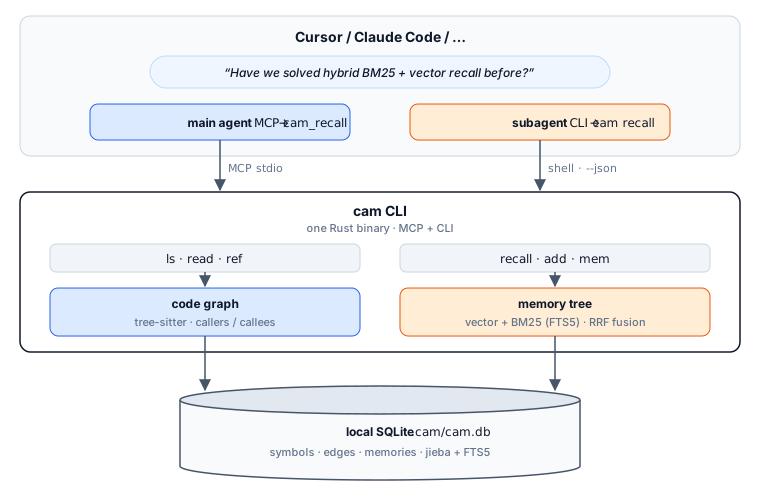
- Extract —
tree-sitterwalks the workspace and stores symbol definitions and call edges in.cam/cam.db. - Surgical Read — Agents navigate via virtual paths (
ls→find→read→ref). Reading a file returns its symbol outline; readingfile/symbolreturns only that symbol's source slice. - Hybrid Recall —
recalltakes an English query, embeds it locally, runs identifier-aware BM25 (splittingsnake_case,kebab-case,camelCase+ English stemming), prunes low-confidence tails, and fuses both lists with RRF ($k=60$) scaled by $0.9 + 0.1 \times R$. Superseded revisions are automatically expanded to their newest replacement. - Write-Back — When an agent solves a non-trivial task, it extracts atomic facts so each
addstores only one fact (English summary; body supports non-Latin characters). Related facts are connected via--link/linksinto a knowledge graph (inspected viamem show; recall does not traverse graph links yet).--parentattaches a memory to a structural topic;--supersedesreplaces an outdated memory while preserving lineage.
Architecture deep dive (Chinese): DESIGN.md.
Agent Workflow
Every coding task follows the same four-step loop:
- Recall first — Query
cam_recall/cam recallin English before grepping. Reuse a hit if it islatestand notneeds_update. - Ensure indexed — If graph tools return
not_indexed, runcam_index/cam indexonce for the project. - Walk the graph — On a memory miss, locate symbols with
findorls, read symbol bodies withread <file>/<symbol>, and trace callers/callees withref <symbol> --dir in|out. - Write back — Persist newly discovered architecture facts or fixes with
cam_add/cam addas atomic facts (one fact per memory, English summary; body supports non-Latin characters), linking related facts withlinks/--link.
| Role | Interface | Typical Usage |
|---|---|---|
| Main Agent (Chat / IDE session) | MCP (cam mcp) |
Calls cam_recall, cam_find, cam_ls, cam_read, cam_ref, cam_add, cam_mem_tree, cam_mem_show directly |
| Subagent (Task / explore / CLI) | CLI (cam --json) |
Runs cam --json --project <dir> <cmd> in the shell (subagents rarely inherit MCP tools) |
Full agent rules & copy-paste system prompts: docs/agents.md.
CLI Reference
Code Graph Commands
| Command | Description |
|---|---|
cam index |
Parse the project with tree-sitter into .cam/cam.db (creates .cam/ if needed) |
cam sync |
Incrementally update the graph for modified files using content hashes |
cam watch [--debounce-ms N] |
Watch source files and auto-sync (--json streams one JSON report per sync) |
cam ls [virt_path] |
List directories, files, or symbols inside a file |
cam read <virt_path> [--full] |
Read a file's symbol outline, a specific symbol body (path/symbol), or the --full file |
cam find <query> [--kind K] [--file S] [--scope D] [--limit N] |
Case-insensitive substring search over symbol names (exact matches first, then prefixes) |
cam ref <symbol> --dir in|out [--file S] [--kind K] [--scope D] |
1-hop callers (in / --callers) or callees (out / --callees). Returns ranked candidates on ambiguous names |
Memory Commands
| Command | Description |
|---|---|
cam recall "<query>" [--limit N] [--no-expand] [--include-superseded] [--snippets] |
Hybrid RRF recall (English query). --no-expand skips newest-revision expansion; --include-superseded keeps old revisions; --snippets clips long bodies below rank 1 |
cam add --summary "..." [--parent ID] [--supersedes ID] [--link ID]... [--body TEXT | --file PATH] |
Store one atomic fact as a memory (English summary required; body supports non-Latin characters; via --body, --file, or stdin). --link connects related facts in the knowledge graph; --parent for topic hierarchy; --supersedes to replace an older memory |
cam mem tree |
Render the memory hierarchy and revision chains |
cam mem show <id> |
Inspect a single memory entry in full |
Server & Configuration Commands
| Command | Description |
|---|---|
cam mcp |
Start the stdio MCP server for the main agent (see docs/mcp.md) |
cam status |
Show resolved project root, database path, node/edge/memory counts, and active config |
cam config get |
Print current ~/.cam/config.toml settings |
cam config set stale_days <N> |
Set age threshold (in days) for marking memories stale |
cam config set embedding_model <model> |
Set Hugging Face model2vec repo, local model directory, hash, or default |
Global flags & conventions:
--project <dir>(orCAM_PROJECTenv var) overrides automatic upward.cam/.gitroot detection.--jsonemits compact JSON (--prettyfor indented JSON). Errors on--jsonprint{"error":{"code":…,"message":…}}tostdoutand exit non-zero.- Ambiguous symbols: When
readorrefmatches multiple definitions,camreturnsstatus: "ambiguous"with candidate node IDs (e.g.src/main.rs:function:main:12) that can be passed directly back toreadorref. - Ignore rules & multi-repo directories: Honors
.gitignoreand.camignoreat any depth. A nested directory with its own.git(standalone clone, submodule, or linked worktree) is indexed into that directory's.cam/cam.db. The parent database keeps a catalog of those graphs and queries fan out into them, so opening the nested directory reuses the graph.cam lslists them askind: "project"(passable to--scope).
Memory Rules
- Atomic facts & knowledge graph links: Store only one atomic fact per memory to avoid packing excessive information into a single entry. When multiple facts are related, link them with
--link/linksto form a knowledge graph (graph recall is not enabled yet). - English queries and summaries: Recall queries and memory summaries must be written in English. Memory bodies support non-Latin characters.
- Retention & reinforcement: Ebbinghaus retention $R = e^{-t / S}$ adjusts recall score via $\text{relevance} \times (0.9 + 0.1 \times R)$. Entries with $R < 0.3$ are marked
needs_update; entries older thanstale_days(default30) are markedstale. Every valid recall hit (needs_update = false) refreshes last-accessed time and multiplies stability $S$ by1.7. - Non-destructive lineage: Memories are never deleted.
--parentforms branching trees;--supersedesforms linear revision chains where only the tail is markedlatestand older revisions are folded out of default recall results.
Configuration
Global settings live in ~/.cam/config.toml:
stale_days = 30
# embedding_model = "minishlab/potion-multilingual-128M" # default (cached under ~/.cam/models/)
# embedding_model = "minishlab/potion-base-8M"           # lighter Hugging Face model2vec repo
# embedding_model = "/path/to/local/model2vec"           # dir with tokenizer.json, config.json, model.safetensors
# embedding_model = "hash"                               # zero-download lexical hash embedder
Use CAM_EMBED_MODEL to override the model for a single process, or cam config set embedding_model default to reset. When the embedding model changes, the next recall automatically re-embeds existing memories before scoring.
Benchmarks
cam evaluates its code graph and memory planes separately against the closest open-source systems on identical corpora:
| Plane | Baseline / Analogue | Benchmark Corpus | Headline Takeaway |
|---|---|---|---|
| Memory | agentmemory hybrid + tokenized grep |
coding-agent-life-v1 | 1.000 R@5 / 0.240 P@5 (matches hybrid ceiling, 1.000 newest R@5 on revision chains) |
| Long-term Memory | BM25 / dense retrievers | LongMemEval-S | 0.909 R@5 / 0.980 Hit@5 / 0.840 MRR with potion-multilingual-128M |
| Code Graph | codegraph v0.9.6 | LongMemCode (clap) |
0.769 vs 0.768 on supported 1-hop tasks, P95 ≈ 5.2 ms, $0 |
| Workflow Retrieval | Lexical / BM25 file retrieval | Agent Retrieval Bench V2 edit2ripple |
0.297 MRR (best first-hit rank, P95 7.3 ms) |
| Multi-turn Tokens | Full context dump | DeepSeek multi-turn | 57% fewer tokens on memory track, 98% fewer tokens on code track |
General chat memory frameworks (Mem0, Zep, Letta) target conversational logs rather than these coding-agent corpora and are omitted from the tables below.
System Comparison
| cam | agentmemory | codegraph | |
|---|---|---|---|
| What it stores | Code graph + memory tree | Session / chat memories | Code graph |
| Query primitives | recall / ls / find / read / ref |
smart-search / remember |
explore / callers / callees |
| Interface | MCP + CLI | MCP + REST + hooks | MCP + CLI |
| Ranking / Fusion | Vector + BM25 + RRF + retention | BM25 + embed + rerank | FTS5 + graph walk |
| Cost | 100% local ($0) |
Local server | Local |
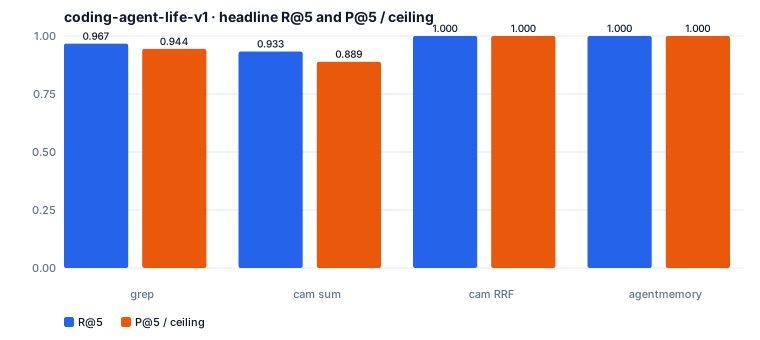
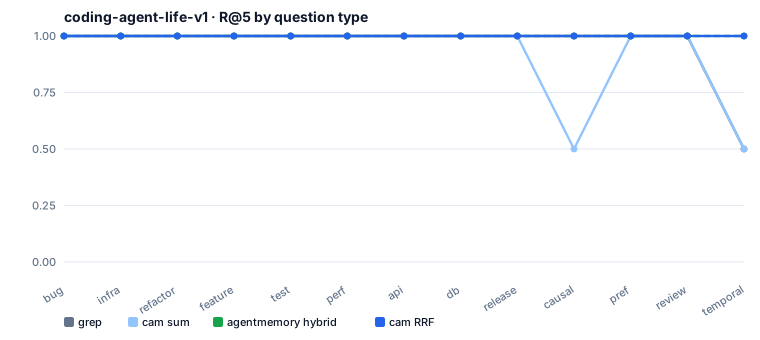
1. Memory — coding-agent-life-v1
15 sessions, 15 queries, $k=5$ (same scoring as agentmemory score.ts; P@5 ceiling is 0.240).
| System | Hit Rate | R@5 | P@5 | Source |
|---|---|---|---|---|
grep (tokenized substring) |
15 / 15 | 0.967 | 0.227 | this repo, 2026-09-23 |
cam min-max sum (legacy) |
15 / 15 | 0.933 | 0.213 | historical, hash embed |
cam RRF |
15 / 15 | 1.000 | 0.240 | this repo, hash embed |
agentmemory hybrid |
15 / 15 | 1.000 | 0.240 | published v0.9.26 |
Revision chains (--lineage): Re-ingesting every turn as a --supersedes revision tests whether top-$k$ returns the newest node of each gold chain (newest R@k) and whether any superseded node falsely claims latest (stale latest).
| k | R@k | P@k | newest R@k | stale latest |
|---|---|---|---|---|
| 5 | 1.000 | 0.240 | 1.000 | 0 |
| 10 | 1.000 | 0.120 | 1.000 | 0 |
2. Long-Term Memory — LongMemEval-S
100 non-abstention questions sampled with seed 42 from cleaned LongMemEval-S. Retrieval fuses embeddings + BM25 with RRF at $k=10$ without an LLM reader.
| Embedder | R@1 | R@5 | R@10 | Hit@1 | Hit@5 | Hit@10 | MRR | Retrieval P50 / P95 |
|---|---|---|---|---|---|---|---|---|
hash (offline test) |
0.382 | 0.803 | 0.922 | 0.580 | 0.910 | 0.970 | 0.718 | 24.1 / 35.5 ms |
potion-multilingual-128M |
0.474 | 0.909 | 0.952 | 0.740 | 0.980 | 0.990 | 0.840 | 1.12 / 1.34 s |
3. Workflow Retrieval — Agent Retrieval Bench V2 (edit2ripple)
58 anchored-change queries across 44 frozen repository snapshots (no LLM; BCY = Budgeted Context Yield under the canonical 8K-token file-packing protocol).
| System | Recall@5 | Recall@10 | Recall@20 | MRR | BCY@8k |
|---|---|---|---|---|---|
cam graph |
0.300 | 0.335 | 0.378 | 0.297 | 0.300 |
| Lexical | 0.412 | 0.536 | 0.588 | 0.243 | 0.447 |
| BM25 | 0.207 | 0.287 | 0.499 | 0.154 | 0.243 |
cam graph achieves the highest first-hit rank (MRR 0.297, query P95 7.3 ms), while lexical search provides broader multi-file coverage — motivating graph + lexical rank fusion.
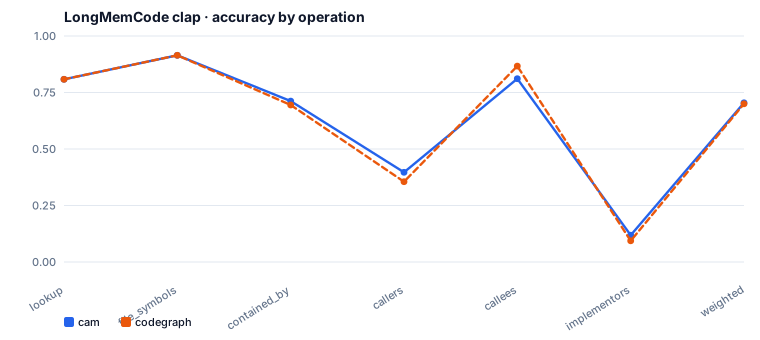
4. Code Graph — LongMemCode (clap)
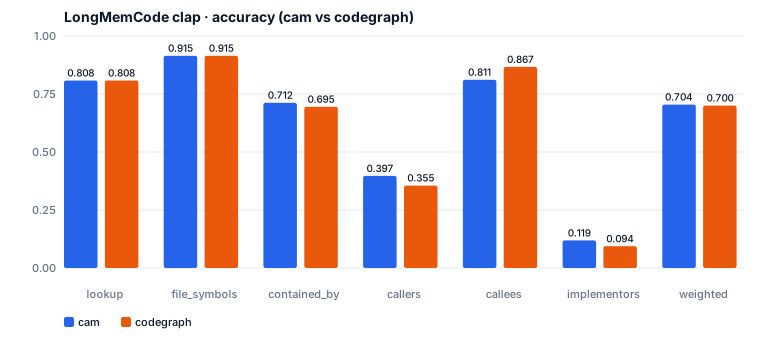
clap v4.6.1, 536 scenarios against SCIP gold (no LLM, P95 ≈ 5.2 ms, $/1k = 0).
| Slice | n | cam |
codegraph 0.9.6 |
|---|---|---|---|
| Supported (1-hop) | 478 | 0.769 | 0.768 |
lookup / file_symbols |
293 / 55 | 0.808 / 0.915 | 0.808 / 0.915 |
callers / callees |
67 / 18 | 0.397 / 0.811 | 0.355 / 0.867 |
implementors |
40 | 0.119 | 0.094 |
| Raw / Weighted (all 536) | 536 | 0.709 / 0.704 | 0.704 / 0.700 |
5. Multi-Turn Token Savings — DeepSeek
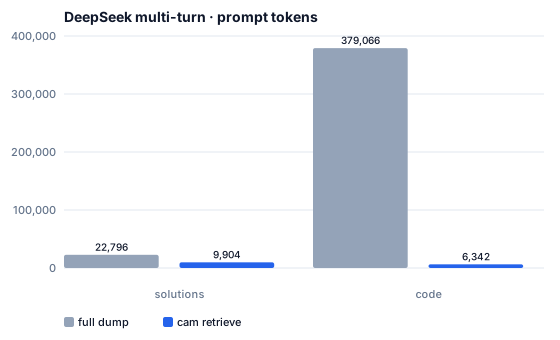
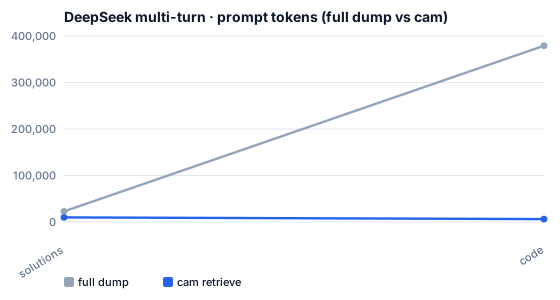
Full context dump vs. per-turn cam retrieval (deepseek-flash, hash embedder, 2026-10-13):
| Track | n | Full Acc. | cam Acc. |
Full Tokens | cam Tokens |
Token Saving |
|---|---|---|---|---|---|---|
Memory (coding-agent-life) |
15 | 1.00 | 0.87 | 22,796 | 9,904 | 57% (1,471 → 616 / turn) |
| Code (this repo indexed) | 6 | 0.83 | 0.33 | 379,066 | 6,342 | 98% (63,076 → 1,000 / turn) |
6. Memory writing — who decides what one memory is
The notes are a separate case set, cam-write-memory-eval. This repo keeps the runner. The first eval/write_memory/run.py downloads cases.json to eval/write_memory/data/ (override with CAM_EVAL_WRITE_MEMORY). That is the same split as LongMemEval and LoCoMo: the corpus stays outside, and the script here fetches it when you run the benchmark.
A model receives one note and calls cam_add. legacy asks for one full write-up. split asks for one fact, or one problem's solution path, and links pieces from the same solution with #0. A fact counts as exclusive when one stored memory contains every required phrase and no other gold fact. The notes are public behavior of this repository: recall fusion, the stale-binary restart notice, retention, and read versus delete. Labels and source files are in the case-set README.
Dataset paths are configured in eval/datasets.toml (coding-agent-life-v1 defaults to ../agentmemory or CAM_EVAL_CODING_LIFE).
python3 eval/coding_life/run.py --adapter grep
python3 eval/coding_life/run.py                                             # potion; errors if the model fails
python3 eval/coding_life/run.py --hash-embed                                # hash embedder
python3 eval/longmemeval/run.py --sample 100 --seed 42 --workers 8          # potion
python3 eval/longmemeval/run.py --sample 100 --seed 42 --workers 8 --hash-embed
python3 eval/locomo/run.py --workers 4                                      # potion, evidence recall

git clone --depth 1 https://github.com/eyuansu62/agent-retrieval-bench \
  eval/agent_retrieval/vendor/agent-retrieval-bench
python3 -m pip install -e eval/agent_retrieval/vendor/agent-retrieval-bench
arb download-benchmark --version v2_edit2ripple --local-dir eval/agent_retrieval/data --force
python3 eval/agent_retrieval/run.py --workers 8

python3 eval/llm_multiturn/run.py --track both   # potion; requires DEEPSEEK_API_KEY
python3 eval/write_memory/test_score.py          # downloads the case set; no model call
python3 eval/write_memory/run.py                 # downloads the case set; DEEPSEEK_API_KEY
python3 eval/longmemcode/run.py --corpus clap
python3 eval/charts/generate.py
codeagent-memory MCPのよくある質問
codeagent-memory MCPをClaude Codeに追加するには
ターミナルでclaude mcp add codeagent-memory -- docker run -i --rm ghcr.io/hanochzhu/codeagent-memory:0.1.6を実行します。すべてのプロジェクトで利用するには--scope userを追加します。
codeagent-memory MCPをCursorに追加するには
~/.cursor/mcp.jsonを開き、上記のインストールセクションに示すCursor設定を使ってmcpServersの下にサーバーを追加します。
データはローカルに保存されますか、それともクラウドに保存されますか?
このシステムは100%ローカルかつプライベートに動作します。ローカルのSQLiteとディスク上の埋め込みを使用するため、外部APIのコストは一切かかりません。
コーディングエージェントとどのように接続できますか?
IDEのMCP設定に、引数 mcp を指定したMCP stdioコマンド cam を登録してください。