
Backstage MCPサーバー
コミット 2026年11月13日Backstage Software Catalog APIをLLM用のツールとして公開し、エンティティの探索、カタログ操作、およびバリデーションを可能にします。
別名 Coderrob/backstage-mcp-server
- スター
- 3
- ツール
- —
- ダウンロード数(30日間)
- —
- 最新バージョン
- —
- 最終コミット
- 2026年11月13日
- ライセンス
- GPL-3.0
Backstage MCPとは
BackstageはMCPサーバーです。 Backstage Software Catalog APIをLLM用のツールとして公開し、エンティティの探索、カタログ操作、およびバリデーションを可能にします。.
プロジェクトのREADMEから生成された概要
Backstage MCP server について
このサーバーは、LLMをBackstage Software Catalog APIに接続することで、AIエージェントによるソフトウェアカタログの管理を実現します。stdio接続を介して、エンティティの探索、ロケーションの管理、および記述子のバリデーションを行うための32個の特化型ツールを提供します。開発者はこれを使用して、エンティティの継承関係、ファセット、ソースロケーションのクエリを実行したり、ロケーションの追加やエンティティのリフレッシュなどの変更操作を行ったりできます。
サーバーのセットアップには、Node.js 24.15 以降と、アクセス可能なBackstageバックエンドが必要です。認証は、BACKSTAGE_TOKEN環境変数によるベアラートークンの提供、または認証情報のローテーション用のBACKSTAGE_TOKEN_FILEを通じて行われます。このサーバーは、本番環境レベルの統合を保証するために、公式のBackstage CatalogClientを使用しています。また、プリンシパルごとのレート制限、タイムアウト、および読み取り専用、変更用、あるいはremove_entity_by_uidのような破壊的なツールを区別するアノテーションなどの安全機能が組み込まれています。
できること
- 1ソフトウェアコンポーネントの探索特定の名前空間内にあるすべてのコンポーネントやAPIをAIに探させることができます。
プロジェクトの README から作成されています。すべてのユースケースは、その引用と照らし合わせて確認されています。
設定
BACKSTAGE_BASE_URLBACKSTAGE_TOKENBACKSTAGE_TOKEN_FILE
| 名前 | 説明 | 種類 |
|---|---|---|
| BACKSTAGE_BASE_URL | — | |
| BACKSTAGE_TOKEN | — | |
| BACKSTAGE_TOKEN_FILE | — |
自動チェック
実行日 2026年11月14日完全なレポート →まだ検証されていません。サーバーには80点のスコア、重大な問題がないこと、および検証に必要な十分なデータが必要です。 チェックの仕組み · 点数を上げるための改善点

- ソースリポジトリがリンクされており、アクセス可能coderrob/backstage-mcp-server is public and reachablegithub.com/coderrob/backstage-mcp-server ↗合格
- パッケージがこのリポジトリをソースとして指定未チェック
- ビルドの来歴 (Sigstore 証明)未チェック
- オープンソースライセンス (OSI)GPL-3.0spdx.org/licenses/GPL-3.0.html ↗合格
- 過去1年以内にコミットまたはリリースありLast commit or release 2026-11-12github.com/coderrob/backstage-mcp-server ↗合格
- OpenSSF Scorecard未チェック
- パッケージ名が有名なパッケージに酷似していない未チェック
- パッケージおよびその依存関係に重大な勧告なし未チェック
- モデルへの隠れた指示がない0 tool descriptions and the README read; no override phrases, credential paths or hidden characters合格
- 破壊的なツールがラベル付けされている未チェック
- リモートエンドポイントが MCP ハンドシェイクに応答未チェック
README
GitHubで見るBackstage MCP Server
A type-safe Model Context Protocol server for the Backstage Software Catalog, built on the published @coderrob/mcp-kernel runtime.
It exposes 32 Catalog tools over stdio, uses Backstage's official Catalog client, supports rotating bearer credentials, and ships with black-box SDK and MCP Inspector verification.
What you get
| Capability | Implementation |
|---|---|
| Catalog discovery | Entity queries, references, ancestry, facets, and source locations |
| Catalog operations | Add locations, refresh entities, remove entities or locations, and validate descriptors |
| Type safety | Zod schemas infer handler inputs and emit MCP-compatible JSON Schemas |
| Runtime policies | Timeouts, caller scopes, per-principal rate limits, tagged caching, and invalidation |
| Safe operations | MCP annotations distinguish read-only, mutating, idempotent, and destructive tools |
| Production boundary | Official Backstage CatalogClient, authenticated fetch, redacted stderr logging |
| Verification | Per-file coverage, SDK stdio smoke tests, every-tool execution, and MCP Inspector |
Quick start
1. Install and build
Requirements:
- Node.js 24.15 or newer
- Corepack
- A reachable Backstage backend and an accepted external-access bearer token
corepack enable
corepack yarn install --immutable
corepack yarn build
The Yarn release comes from the packageManager field in package.json; use corepack yarn so local and CI behavior stay aligned.
2. Configure Backstage
Set the backend root or the complete Catalog plugin URL and choose one credential source:
export BACKSTAGE_BASE_URL=https://backstage.example.com
export BACKSTAGE_TOKEN=your-token
For externally rotated credentials, point to a token file instead:
export BACKSTAGE_BASE_URL=https://backstage.example.com
export BACKSTAGE_TOKEN_FILE=/run/secrets/backstage-token
BACKSTAGE_TOKEN_FILE takes precedence when both variables are present and is reread for every outgoing request. Optional LOG_LEVEL=debug enables diagnostic logging. Logs always go to stderr because stdout carries MCP protocol traffic.
3. Start the stdio server
corepack yarn start
The process waits for an MCP client on stdin/stdout. For a read-only check against a real deployment, use corepack yarn test:live; see live Backstage verification.
Connect an MCP client
After building, configure a stdio client with an absolute path:
{
  "mcpServers": {
    "backstage": {
      "command": "node",
      "args": ["/absolute/path/to/backstage-mcp-server/dist/cli.cjs"],
      "env": {
        "BACKSTAGE_BASE_URL": "https://backstage.example.com",
        "BACKSTAGE_TOKEN": "your-token"
      }
    }
  }
}
After global installation, use backstage-mcp-server as the command. Do not place credentials in committed client configuration; use the client's secret or environment mechanism where available.
Tool catalog
The checked-in tools-manifest.json is generated from the runtime definitions and is the machine-readable source of truth.
| Category | Tools |
|---|---|
| Entity discovery | get_entities, get_entities_by_query, get_entities_by_refs, get_entity_by_ref, get_entity_ancestors, get_entity_facets |
| Location discovery | get_location_by_entity, get_location_by_ref |
| Validation | validate_entity |
| Catalog mutation | add_location, refresh_entity |
| Destructive mutation | remove_entity_by_uid, remove_location_by_id |
get_entities.filter follows Backstage's key-value model: keys in one record are AND conditions, values for one key are OR conditions, and multiple records are OR groups.
{
  "filter": {
    "kind": ["Component", "API"],
    "metadata.namespace": "default"
  }
}
This selects Components or APIs in the default namespace. The Backstage integration guide documents every tool-to-client mapping, cursor behavior, authentication, permissions, and error conversion.
How it works
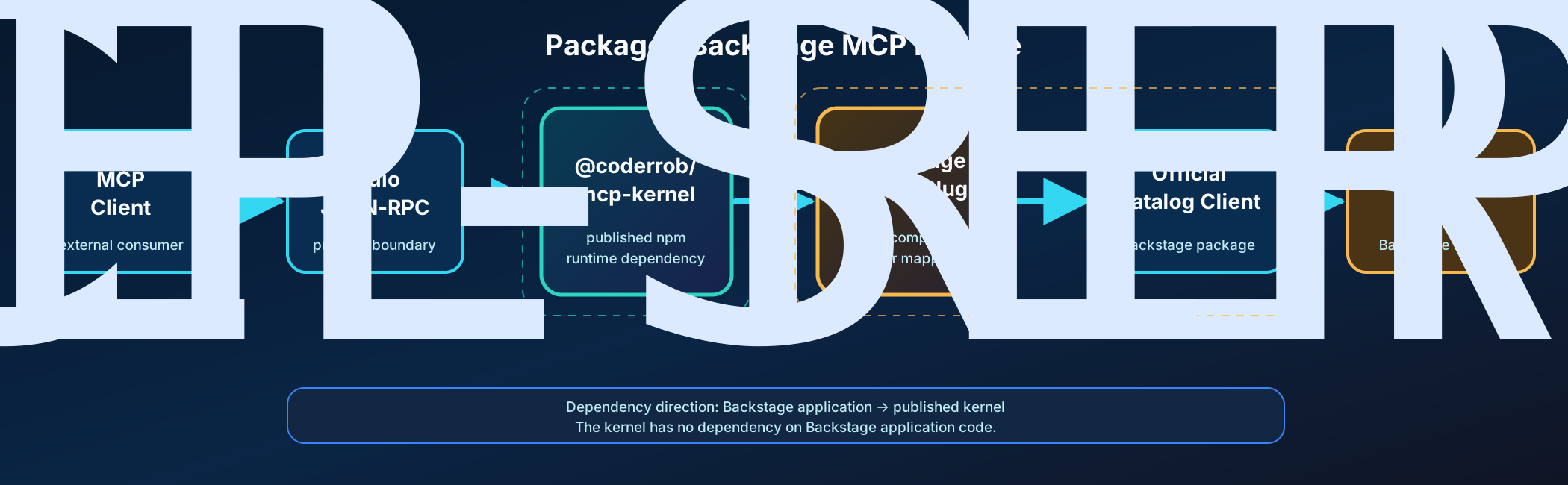
- An MCP client launches the packaged CLI and exchanges JSON-RPC over stdio.
- The published MCP Kernel validates and compiles immutable feature definitions.
- Zod validates input before middleware, authorization, caching, rate limiting, and timeout policies run.
- A Backstage tool calls the typed Catalog contract from its application context.
- The adapter delegates HTTP behavior to the official Backstage
CatalogClientand injects the bearer token at the fetch boundary. - Results return as MCP text plus structured content; expected failures use stable error codes and safe details.
The published @coderrob/mcp-kernel package owns protocol registration, lifecycle, policies, transports, testing support, and protocol-safe logging. This repository owns only the Backstage application and Catalog integration. See the current architecture overview for the dependency boundary.
MCP Kernel dependency
Generic server authoring, lifecycle, policies, transports, results, testing support, and logging are documented in the @coderrob/mcp-kernel repository. This package re-exports the kernel API for compatibility, but new generic consumers should install and import @coderrob/mcp-kernel directly.
To contribute a Catalog capability, follow Adding a Backstage MCP tool.
Verification
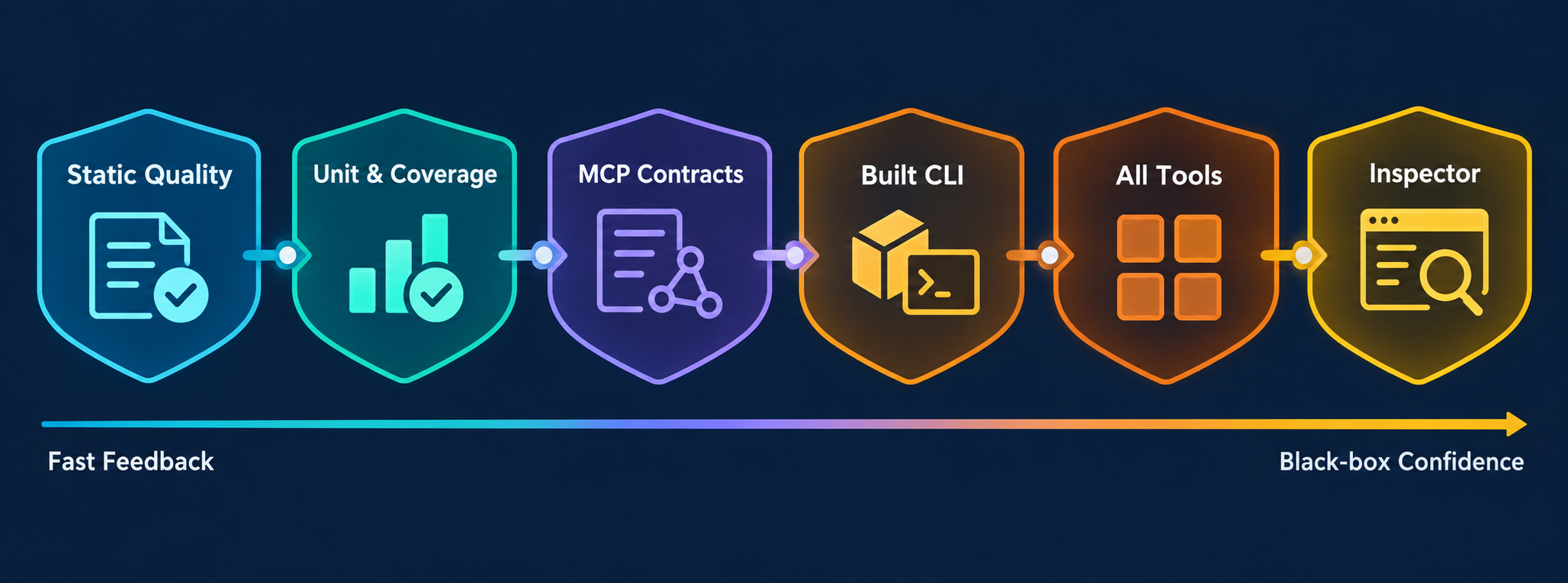
Run the normal contributor gate:
corepack yarn lint
corepack yarn typecheck
corepack yarn architecture:check
corepack yarn knip
corepack yarn test
corepack yarn test:shell
For MCP, tool, adapter, or packaging changes, also run:
corepack yarn test:mcp
corepack yarn manifest:check
test:mcp runs contract tests, builds the distribution, launches dist/cli.cjs over stdio with the official SDK client, invokes every registered tool against a deterministic authenticated Catalog stub, and performs an independent MCP Inspector check. It does not bypass the server with direct handler or HTTP calls.
See Repository tooling for the purpose and side effects of every command and MCP end-to-end testing for the exact black-box boundary.
Documentation
Choose a path from the documentation hub:
- Operate it: Backstage integration and end-to-end testing
- Develop it: Repository tooling, code quality, and adding tools
- Understand it: Architecture overview, ADRs, historical analysis, and implementation plan
- Maintain it: Dependency management
License
GPL-3.0. See LICENSE.
Curated knowledge and skills
The Backstage knowledge base maintains classified articles, named source citations and schema.org metadata. Repository skills in .agents/skills support catalog lookups, entity maintenance and MCP development.
The 19 contextual lookup tools cover names, System and Domain contents, Groups, ownership, dependencies, APIs, annotations and orphaned entities. See lookup contracts and examples, including pagination, ambiguity and work bounds.
Backstage MCPのよくある質問
Backstageサーバーの認証設定はどうすればよいですか?
BACKSTAGE_TOKEN環境変数でベアラートークンを指定するか、BACKSTAGE_TOKEN_FILEを使用してトークンファイルを指定できます。
AIはどのようなカタログ操作を実行できますか?
エンティティの探索、ロケーションの探索、エンティティのバリデーション、およびエンティティやロケーションの追加、リフレッシュ、削除といったカタログの変更(mutation)を行うためのツールを提供します。
実際のBackstage環境でこのサーバーを使用できますか?
はい、test:liveコマンドを使用することで、実際のデプロイメントに対して読み取り専用のチェックを実行できます。
インストールに必要なシステム要件は何ですか?
Node.js バージョン 24.15 以降と、Corepackがインストールされている必要があります。