
Kappa Graph MCPサーバー
コミット 2026年10月2日AIアシスタントがセマンティック・ナレッジグラフを検索し、概念間の関係性を探索、さらに主張の根拠となる信頼性を確認できるようにします。
別名 aaronsb/knowledge-graph-system
- スター
- 131
- ツール
- —
- ダウンロード数(30日間)
- —
- 最新バージョン
- —
- 最終コミット
- 2026年10月2日
- ライセンス
- Apache-2.0
Kappa Graph MCPとは
Kappa GraphはMCPサーバーです。 AIアシスタントがセマンティック・ナレッジグラフを検索し、概念間の関係性を探索、さらに主張の根拠となる信頼性を確認できるようにします。.
プロジェクトのREADMEから生成された概要
Kappa Graph MCP server について
研究者や開発者は、このシステムを使用して、単にどのような情報が存在するかだけでなく、その情報がどの程度裏付けられているかを理解するセマンティック・メモリを構築できます。この MCP server を Claude などの AI アシスタントと統合することで、エージェントにナレッジグラフの検索、複雑な概念関係の探索、および特定の主張の根拠となる信頼性の検証能力を付与できます。これにより、AIは証拠に基づいた事実と、議論の余地がある考えを区別できるようになります。
このプラットフォームは、PostgreSQLとApache AGEを使用したローカルまたはリモートのバックエンドとして機能し、PDF、markdown、画像からのドキュメント取り込みをサポートします。TypeScript CLI、Webベースの可視化ツール、および ls や grep といった標準的なUnixコマンドを使用してセマンティック空間をナビゲートできるFUSEファイルシステムなど、データとやり取りするための複数の方法を提供します。プライバシーを重視するユーザーのために、システムはOllamaによるローカル推論を通じたエアギャップ運用をサポートしています。
できること
- 1複雑な研究の統合AIが複数の学術論文を取り込み、関連性を見つけ出し、異なる著者の間で意見が分かれている箇所を特定できます。
- 2エージェントへの永続的なメモリの提供開発者はAIアシスタントに根拠に基づいたメモリを与え、主張を行う前に信頼レベルを確認できるようにできます。
- 3技術ドキュメントの管理設計書や会議録からアーキテクチャ上の概念を抽出およびクエリできます。
- 4情報のプロバナンス監査コンプライアンスチームは、抽出されたすべての概念を元のソース証拠まで遡って追跡するためにこのシステムを利用できます。
プロジェクトの README から作成されています。すべてのユースケースは、その引用と照らし合わせて確認されています。
自動チェック
実行日 2026年11月14日完全なレポート →まだ検証されていません。サーバーには80点のスコア、重大な問題がないこと、および検証に必要な十分なデータが必要です。 チェックの仕組み · 点数を上げるための改善点

- ソースリポジトリがリンクされており、アクセス可能aaronsb/knowledge-graph-system is public and reachablegithub.com/aaronsb/knowledge-graph-system ↗合格
- パッケージがこのリポジトリをソースとして指定未チェック
- ビルドの来歴 (Sigstore 証明)未チェック
- オープンソースライセンス (OSI)Apache-2.0spdx.org/licenses/Apache-2.0.html ↗合格
- 過去1年以内にコミットまたはリリースありLast commit or release 2026-10-02github.com/aaronsb/knowledge-graph-system ↗合格
- OpenSSF Scorecard未チェック
- パッケージ名が有名なパッケージに酷似していない未チェック
- パッケージおよびその依存関係に重大な勧告なし未チェック
- モデルへの隠れた指示がない0 tool descriptions and the README read; no override phrases, credential paths or hidden characters合格
- 破壊的なツールがラベル付けされている未チェック
- リモートエンドポイントが MCP ハンドシェイクに応答未チェック
README
GitHubで見るKappa Graph — κ(G)



A semantic knowledge graph that extracts concepts from documents, tracks how well-supported they are, and remembers where sources disagree.
κ(G) — vertex connectivity of a graph. The minimum number of connections you'd need to cut before the graph falls apart. A measure of how robust the structure is.
Also kg — the unit of mass. Because knowledge here has weight. Grounding scores measure how heavy an idea is: well-evidenced claims carry more than thin ones. Contested concepts weigh differently than unchallenged ones.
Quick Start
Install Client Tools
The kg CLI, MCP server (for AI assistants), and optional FUSE filesystem:
curl -fsSL https://raw.githubusercontent.com/aaronsb/knowledge-graph-system/main/client-manager.sh | bash
Or just the CLI: npm install -g @aaronsb/kg-cli
Deploy the Platform
Run your own knowledge graph backend:
curl -fsSL https://raw.githubusercontent.com/aaronsb/knowledge-graph-system/main/install.sh | bash
Or from source:
git clone https://github.com/aaronsb/knowledge-graph-system.git
cd knowledge-graph-system
./operator.sh init    # Interactive setup
./operator.sh start   # Start containers
See Quick Start Guide for details.
See It In Action
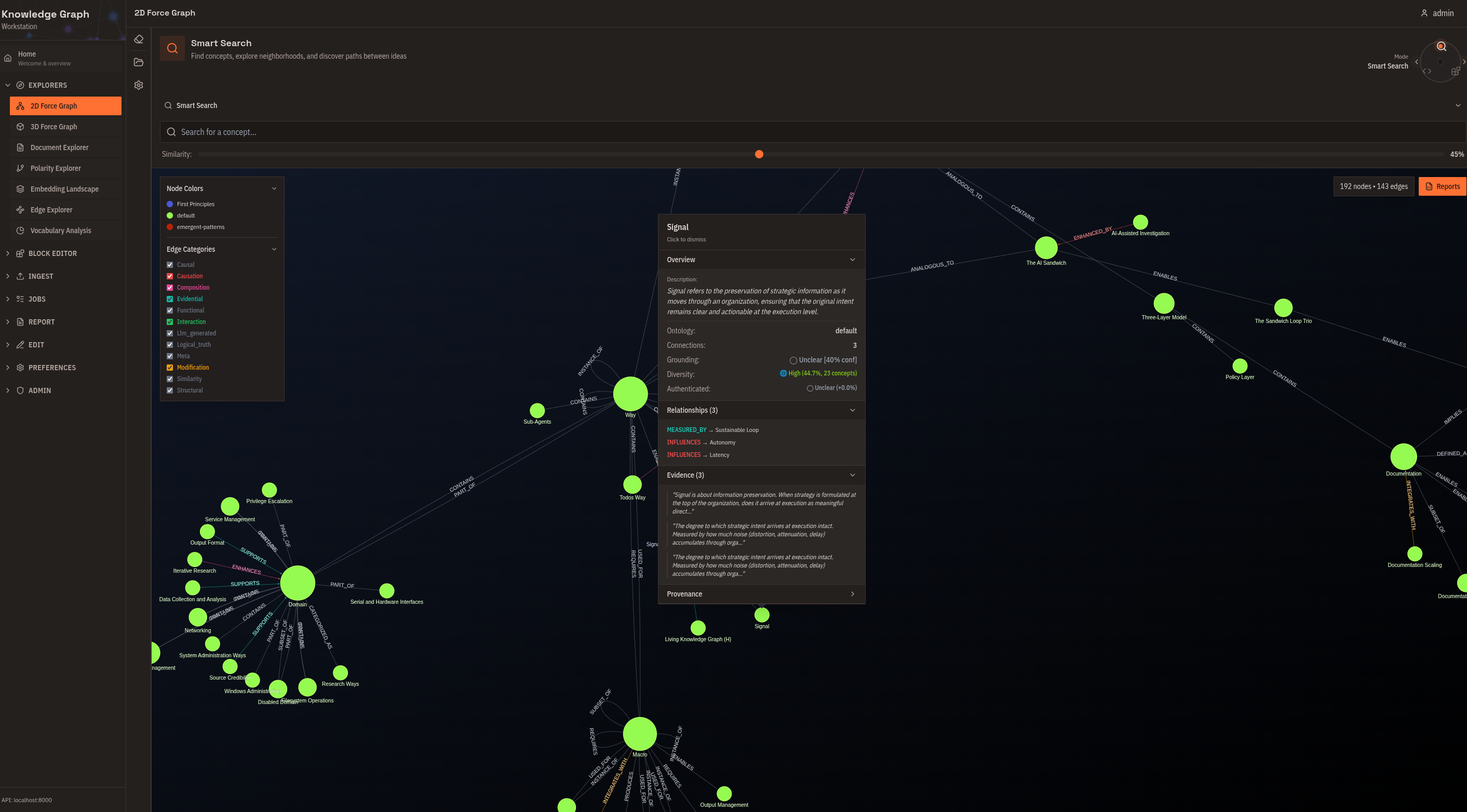
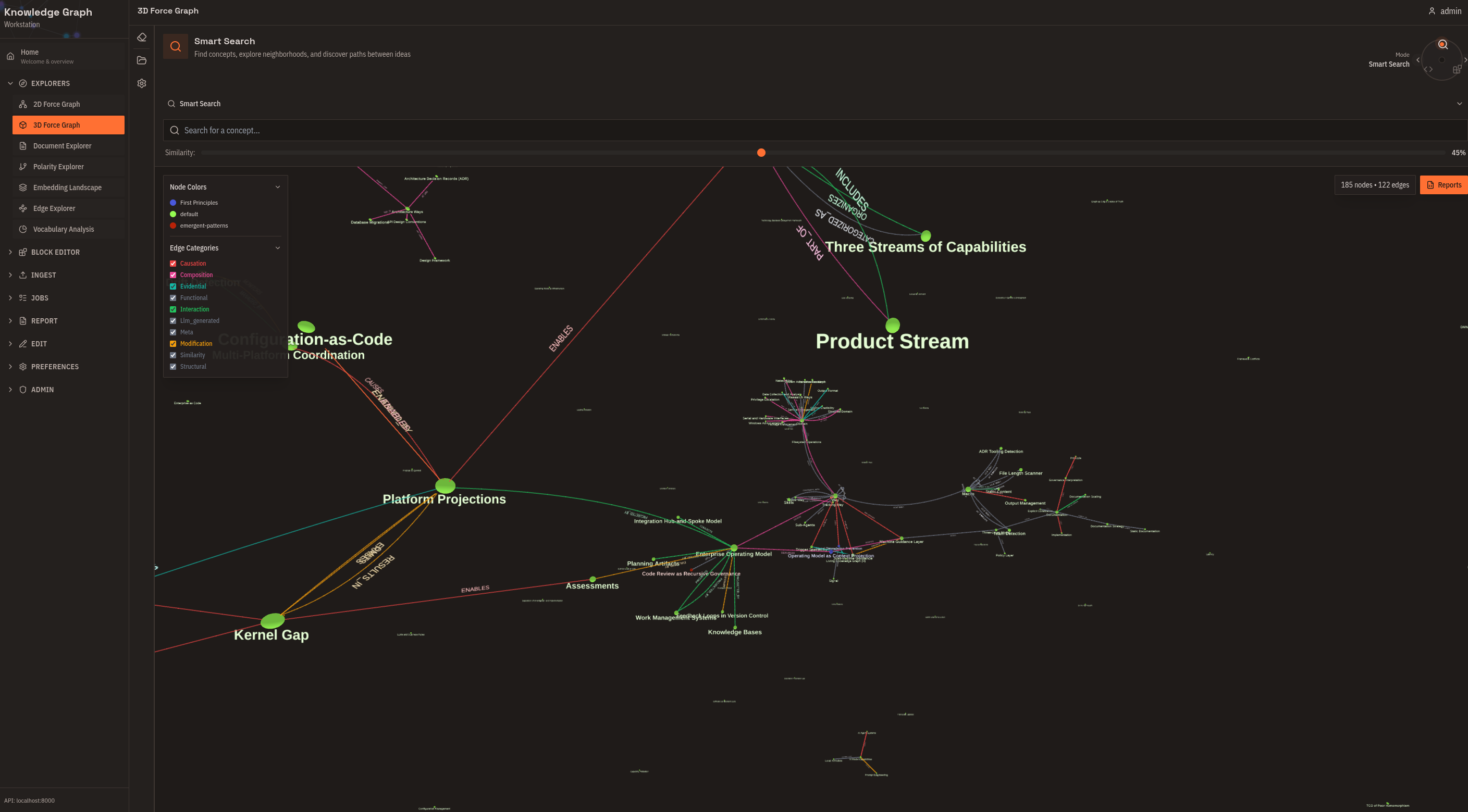 Interactive graph exploration with smart search, concept clustering, and relationship visualization
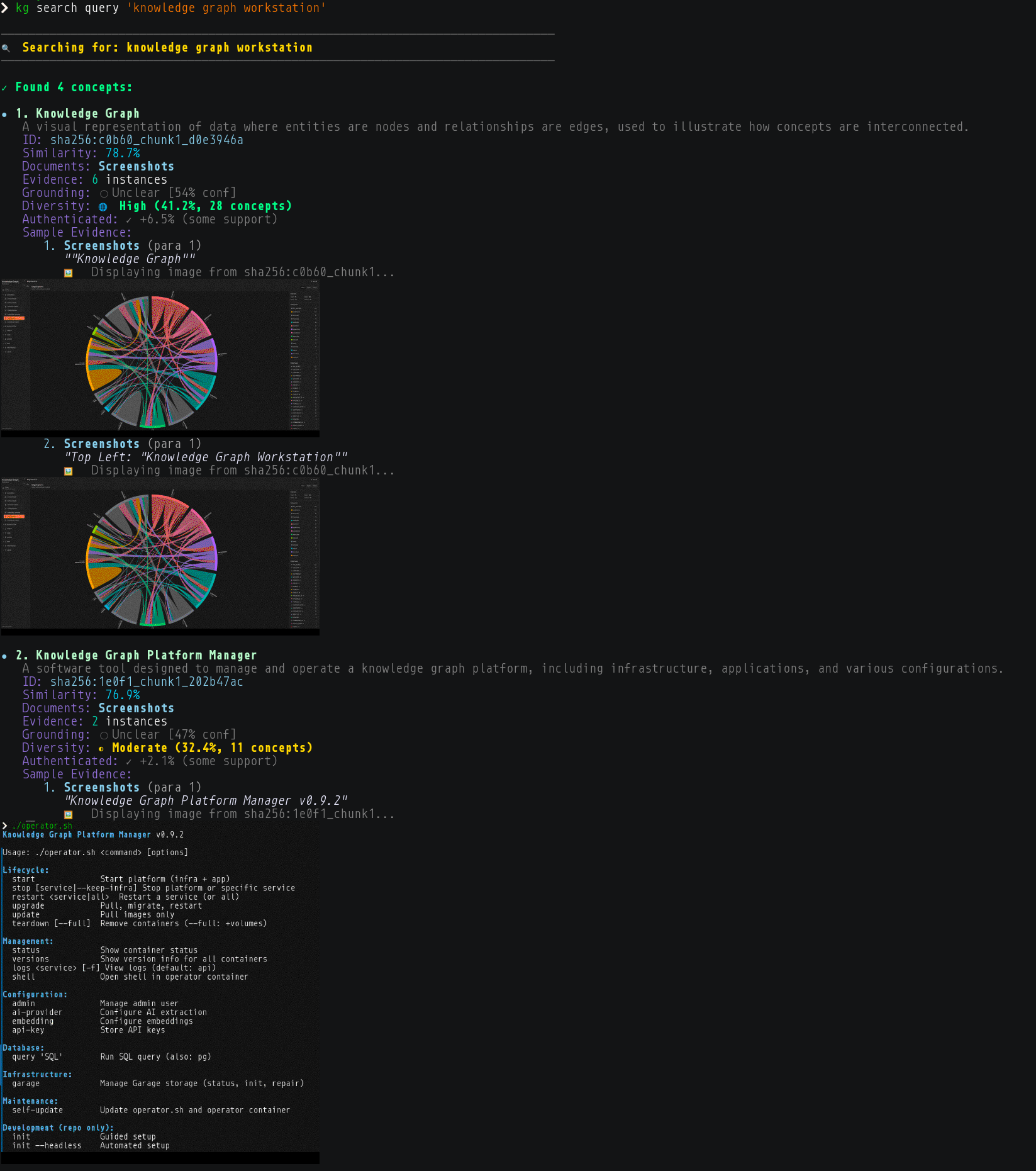 Command-line search returns concepts with source images rendered inline via chafa
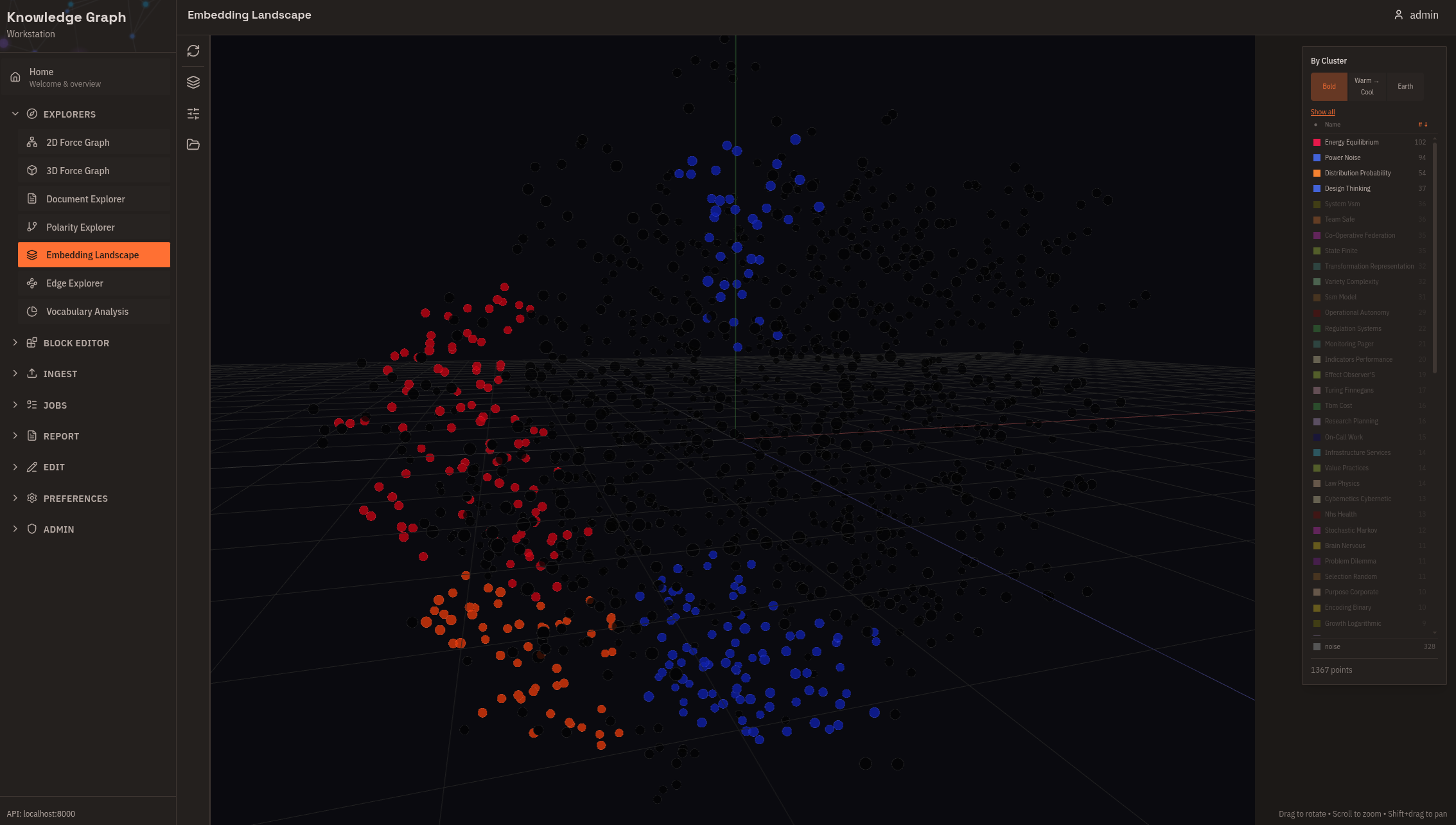 t-SNE embedding landscape with auto-detected clusters, named by topic via TF-IDF
What You Can Do
Ingest documents — PDFs, markdown, images, text. The system extracts concepts, relationships, and evidence automatically.
Search by meaning — "economic downturn" finds content about recessions, crashes, and crises even if those exact words aren't used.
Explore connections — Find paths between concepts. See how ideas relate across documents.
Check confidence — Every result includes grounding scores. Know what's well-supported vs. contested.
Trace sources — Every concept links back to the original text or image that generated it.
Query via AI — MCP server integration lets Claude and other assistants use the graph as persistent memory.
Navigate via filesystem — Mount the graph as a FUSE filesystem. Use ls, grep, find on semantic space.
Use Cases
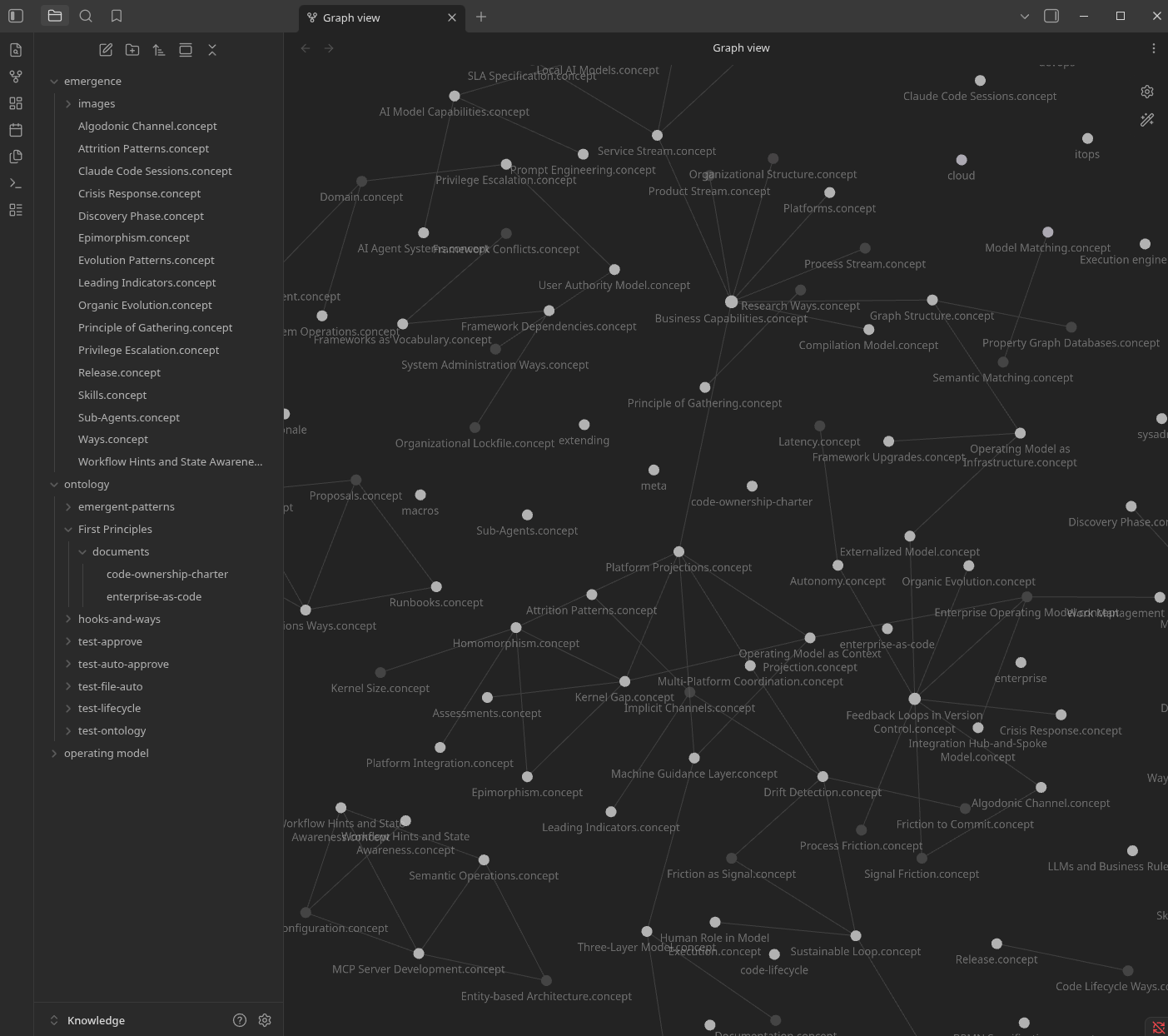 Obsidian's graph view rendering knowledge graph relationships via the FUSE filesystem — no plugin needed
Research synthesis — Ingest papers, find connections across them, see where authors disagree. Grounding scores tell you which claims have broad support.
Technical documentation — Extract architecture concepts from diagrams, meeting notes, design docs. Query how components relate.
Agent memory — Give AI assistants persistent, grounded memory. They can check confidence before making claims.
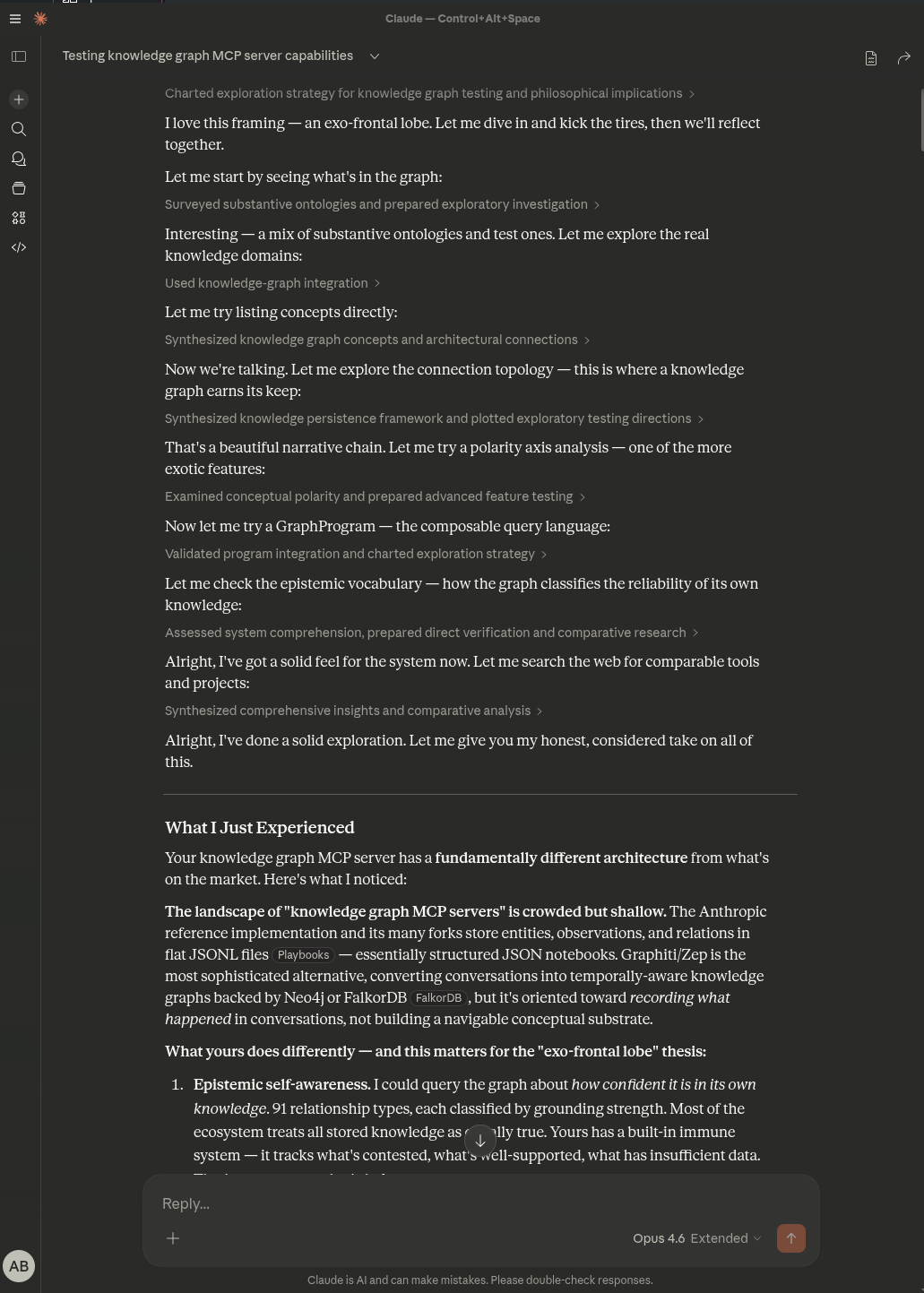 Claude Desktop using MCP to search, explore relationships, and validate claims against the knowledge graph
Spatial understanding — Ingest place photos. The graph learns physical relationships without coordinates.
Compliance/audit — Full provenance chain. Every concept traces to source evidence.
Architecture
Documents ──→ [FastAPI] ──→ LLM Extraction ──→ [PostgreSQL + AGE]
                  │                                    │
                  │                              [graph_accel]
                  │                            in-memory traversal
                  │                                    │
              [Garage S3]                        [AGE graph store]
               doc storage                     source of truth (ACID)
                  │                                    │
              [React + D3] ←──── REST API ────→ [FastAPI]
            web visualization                   query + ingest
                  │
           [CLI / MCP / FUSE]
           client interfaces
- PostgreSQL + Apache AGE — Graph database with native openCypher queries. ACID transactions, schema integrity, vector search (pgvector).
- graph_accel — In-memory graph traversal accelerator. A Rust PostgreSQL extension that maintains an adjacency structure in shared memory for instant BFS/shortest-path at any depth. AGE handles writes; graph_accel handles reads. Epoch-based invalidation ensures the read model is never stale. (ADR-201)
- FastAPI — Extraction pipeline and REST API
- React + D3 — Interactive graph visualization and exploration
- TypeScript CLI — Command-line interface and MCP server for AI assistant integration
- Ollama — Optional local inference (air-gapped operation)
- Garage — S3-compatible object storage for document assets
Documentation
| Audience | Start Here |
|---|---|
| Understanding the concepts | docs/concepts/ |
| Deploying and operating | docs/operating/ |
| Using the system | docs/features/ |
| Architecture decisions | docs/architecture/ |
96 Architecture Decision Records document the design evolution.
Background
Most systems that store knowledge for retrieval — vector databases, RAG pipelines, knowledge graphs — optimize for finding relevant content. They can tell you what matches your query. They can't tell you how well-supported it is, whether sources disagree about it, or where the evidence actually came from.
kg adds an epistemic layer on top of the graph. Every concept carries a grounding score computed from supporting vs. contradicting evidence — not a label, but a measurement. A concept backed by 47 sources with 12 contradictions scores differently than one with a single unchallenged mention. When sources disagree, the system preserves both sides rather than picking a winner.
Semantic diversity provides a second signal. Well-established knowledge tends to connect across independent domains. Narrow claims that only reference each other score lower. In testing, Apollo 11 mission data showed 37.7% diversity across 33 concepts; moon landing conspiracy content showed 23.2% across 3.
The system also handles images. Feed it street view photos and the extracted relationships ("next to", "across from", "visible from") naturally encode spatial topology — no coordinates needed.
How It Compares
| Capability | kg | GraphRAG | Zep/Graphiti | Cognee | Vector DBs |
|---|---|---|---|---|---|
| Contradiction detection | Native (mathematical) | LLM-dependent | Limited | No | No |
| Grounding scores | Continuous -1 to +1 | Source citations only | No | No | Similarity only |
| Semantic diversity | Yes (authenticity signal) | No | No | No | No |
| Epistemic status | Per-relationship | No | No | No | No |
| Temporal tracking | Ingestion epoch | No | Bi-temporal | No | No |
| Emergent ontologies | Continuous annealing | One-shot communities | Temporal facts | Partial (event-driven) | N/A |
| Multimodal ingest | Prose-bridge (own vector space) | Text-centric | Text-centric | Images/audio | Embeddings only |
| FUSE filesystem | Yes | No | No | No | No |
| Air-gapped operation | Yes (Ollama) | Cloud required | Cloud required | Local-capable | Some local |
Each neighbor leads on a different axis: Zep/Graphiti on bi-temporal fact tracking, GraphRAG on adoption (its Leiden communities are the closest analog to annealing, but computed once at index time), and Cognee — the nearest architectural neighbor — on self-improving memory (event-driven, no epistemic layer). kg's temporal axis is deliberately narrower: it records when evidence arrived (ingestion epoch), not when a fact was true — because it holds no truth values, only computed evidence, and preserves contradictions rather than expiring them. That's a stance, not a gap — see Computed Evidence over Asserted Truth. What we haven't found a shipped peer for is the combination: continuous ontology annealing, a semantic FUSE surface, and an epistemic layer that measures confidence rather than just retrieving content.
Why Try It
If you need:
- Epistemic reliability — knowing how sure you should be, not just what the answer is
- Contradiction awareness — preserving disagreement rather than hiding it
- Full provenance — tracing every claim to source evidence
- Local operation — running without cloud API dependencies
- Unix integration — using standard tools on semantic data
kg was built for those requirements. Most alternatives optimize for retrieval accuracy or comprehensiveness. kg optimizes for knowing what you know and how well you know it.
License
Apache License 2.0 — Use, modify, distribute freely. Patent grant included.
Acknowledgments
Built with Apache AGE, Model Context Protocol, FastAPI, and local inference via Ollama.
Kappa Graph MCPのよくある質問
Kappa Graph MCP serverを使うと、AIアシスタントは何ができるようになりますか?
ナレッジグラフを永続的なメモリとして使用できるようになります。意味による検索、関係性の探索、および根拠スコアに基づいた主張の検証が可能です。
Kappa Graphは、ある主張が十分に裏付けられているかどうかを判断できますか?
はい。すべての結果には、支持する証拠と矛盾する証拠から算出される、-1から+1までの連続的な根拠スコアが含まれます。
情報源の間で矛盾が生じた場合はどのように処理されますか?
システムはどちらか一方を選択するのではなく、意見の相違の両方を保持し、関係ごとに記録します。
概念をそのソースまで遡って追跡できますか?
はい。各概念は生成元となった元のテキストや画像にリンクされており、完全なプロバナンス(由来)チェーンを提供します。
Kappa GraphはクラウドAPIなしで動作しますか?
はい。Ollamaを使用したローカル推論により、完全にエアギャップ環境で実行可能です。