
agent-board MCP server
Commit 25. Okt. 2026Bietet ein selbst gehostetes Kanban-Board, das KI-Agenten via MCP nutzen können, um Aufgaben zu teilen, Fortschritte zu verfolgen und eine Historie der kollaborativen Arbeit zu führen.
Auch bekannt als Slayer1Dev/agent-board
- Stars
- 1
- Tools
- 9
- Downloads, 30 Tage
- —
- Neueste Version
- —
- Letzter Commit
- 25. Okt. 2026
- Lizenz
- MIT
Was ist agent-board MCP?
agent-board ist ein MCP server. Bietet ein selbst gehostetes Kanban-Board, das KI-Agenten via MCP nutzen können, um Aufgaben zu teilen, Fortschritte zu verfolgen und eine Historie der kollaborativen Arbeit zu führen. Er stellt 9 Tools bereit, etwa contexto_sessao, ver_quadro, ver_card.
Zusammenfassung generiert aus dem README des Projekts
Über agent-board MCP server
Das Management von geteilten Aufgaben über mehrere KI-Coding-Sessions hinweg ist das, was agent-board für Entwickler ermöglicht, die Tools wie Claude Code oder Codex nutzen. Es bietet ein selbst gehostetes Kanban-Board, das als gemeinsamer State fungiert und es verschiedenen Agent-Sessions erlaubt, dieselbe Aufgabenliste zu lesen und zu beschreiben. Das verhindert, dass Agenten jedes Mal bei Null anfangen müssen, wenn eine neue Session startet, da sie sehen können, was gerade in Arbeit ist und frühere Entscheidungen nachvollziehen können.
Das System läuft lokal auf deinem Rechner über eine einzelne SQLite-Datei und benötigt keine Cloud-Accounts oder externen Dienste. Du kannst mit dem Board über einen Webbrowser interagieren, um Karten zu verschieben, oder die bereitgestellten MCP Tools, die REST API oder das CLI nutzen. Da es für Agenten gebaut wurde, sind die Tool-Namen und API-Routen auf Portugiesisch, obwohl das Web-Interface Englisch unterstützt. Es enthält Features wie Optimistic Locking, um das Überschreiben von Daten zu verhindern, automatische tägliche Backups und eine pro Karte geführte Historie, die aufzeichnet, welcher Agent welche Aktion durchgeführt hat.
Was du damit machen kannst
- 1Aufgaben zwischen verschiedenen Agenten synchronisierenEin KI-Agent kann den aktuellen Board-Status lesen, um zu verstehen, was andere Sessions bereits erledigt haben.
- 2Wiederkehrende Agent-Erinnerungen verwaltenDu kannst einen Agent anweisen, zu Beginn einer Session nach fälligen oder überfälligen Aufgaben zu suchen.
- 3Eine lokale Aufgaben-Datenbank führenBehalte alle Projektaufgaben in einer einzigen SQLite-Datei auf deiner eigenen Hardware, ohne dich auf Drittanbieter-Cloud-Provider zu verlassen.
Geschrieben aus dem README des Projekts. Jeder Use Case wurde gegen ein Zitat daraus geprüft.
agent-board MCP tools 9
Erkannt aus dem READMEcontexto_sessaover_quadrover_cardcriar_cardmover_cardatualizar_cardcomentar_cardatividade_recentelembretes_pendentes
| contexto_sessao | — | |
| ver_quadro | — | |
| ver_card | — | |
| criar_card | — | |
| mover_card | — | |
| atualizar_card | — | |
| comentar_card | — | |
| atividade_recente | — | |
| lembretes_pendentes | — |
Konfiguration
AGENT_BOARD_AUTHORAGENT_BOARD_URL
| Name | Beschreibung | Typ |
|---|---|---|
| AGENT_BOARD_AUTHOR | — | |
| AGENT_BOARD_URL | — |
Automatisierte Checks
Geluften am 14. Nov. 2026Vollständiger Bericht →Noch nicht verifiziert. Ein Server benötigt einen Score von 80, keine kritischen Befunde und genug Daten für unsere Prüfung. Wie die Checks funktionieren · Was du für mehr Punkte verbessern kannst

- Source Repository verknüpft und erreichbarslayer1dev/agent-board is public and reachablegithub.com/slayer1dev/agent-board ↗Bestanden
- Paket nennt dieses Repository als QuelleNicht geprüft
- Build-Provenienz (Sigstore-Attestierung)Nicht geprüft
- Open Source Lizenz (OSI)MITspdx.org/licenses/MIT.html ↗Bestanden
- Commit oder Release im letzten JahrLast commit or release 2026-10-25github.com/slayer1dev/agent-board ↗Bestanden
- OpenSSF ScorecardNicht geprüft
- Package-Name ähnelt keinem populären PackageNicht geprüft
- Keine kritischen Advisories im Paket oder seinen AbhängigkeitenNicht geprüft
- Keine versteckten Anweisungen an das Modell9 tool descriptions and the README read; no override phrases, credential paths or hidden charactersBestanden
- Destruktive Tools sind markiertNo tool named like delete, drop or execBestanden
- Remote-Endpoint beantwortet den MCP-HandshakeNicht geprüft
README
Auf GitHub ansehenagent-board
A self-hosted Kanban board for AI coding agents, with an MCP server built in.


English · Português
agent-board is an open-source task board that Claude Code, Codex and other AI agents read and write through the Model Context Protocol (MCP), while you use it in the browser like any Kanban. It gives every agent session the same task list and a history of who did what, and it runs on your own machine: one SQLite file, no cloud account.
When several AI sessions work on the same projects, each one starts from zero. None of them knows what the others did, what is in progress, or why a decision was made. This board is the shared state: you drag cards in the browser, and Claude Code, Codex and other agents read and write the same cards through MCP, a REST API or a small CLI. Every change is recorded with its author, so opening a card shows which session did what.
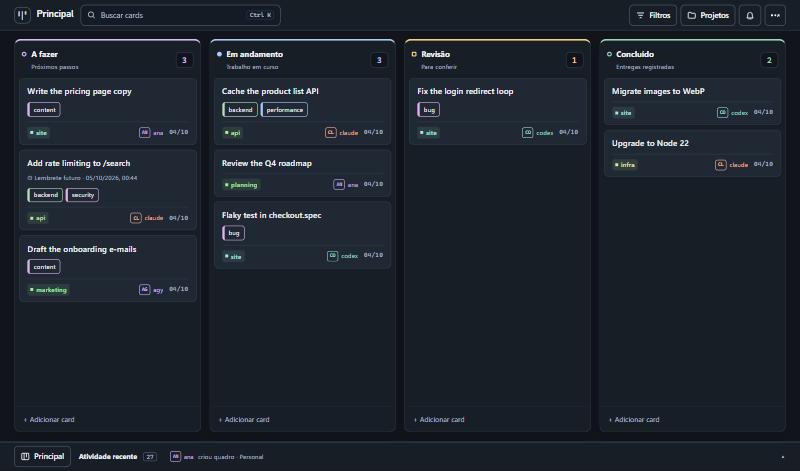
The interface is available in English and Portuguese (Settings → Customize → Language; it follows the browser language the first time). The API routes, the MCP tool names and the default column names are in Portuguese, because agents refer to them by name. The tool descriptions are self-explanatory to an AI agent; see CONTRIBUTING.md to add another language.
What it does
- Kanban with authorship. Columns, drag and drop, comments, and a per-card history that says who did each thing.
- For agents. 30+ MCP tools over HTTP, a REST API, and a dependency-free CLI. All three share one core, so they cannot drift apart.
- Finding things. Search across titles, descriptions, comments and tags (Ctrl+K), combinable filters kept in the URL, tags, and a project list with counts.
- Several boards, each with its own columns.
- Reminders and recurring tasks. Agents can ask for "reminders due today" when a session starts.
- Safe to operate. Archive instead of delete, undo (Ctrl+Z), and optimistic locking so two sessions do not overwrite each other.
- Three themes (dark, light, glass) and wallpapers stored on the server.
- English and Portuguese interface, switched in the settings.
- Small. SQLite in a single file, no external services, few dependencies.
Quick start
Requires Node.js 20 or newer. better-sqlite3 compiles native code on install; on Linux you may need build-essential and python3.
git clone https://github.com/Slayer1Dev/agent-board.git
cd agent-board

# Terminal 1: API and MCP on http://127.0.0.1:8078
cd server && npm install && npm run dev

# Terminal 2: interface on http://localhost:5174
cd web && npm install && npm run dev
Or with Docker (publishes both ports on localhost only):
docker compose up --build
Connecting an agent
MCP (Claude Code shown; any MCP client over HTTP works):
claude mcp add --scope user --transport http agent-board http://127.0.0.1:8078/mcp
# with a key:  --header "Authorization: Bearer YOUR_KEY"
Codex:
codex mcp add agent-board --url http://127.0.0.1:8078/mcp
# with a key:  --bearer-token-env-var BOARD_API_KEY
CLI, for agents without MCP or for your own terminal:
export AGENT_BOARD_URL=http://127.0.0.1:8078/api
export AGENT_BOARD_AUTHOR=claude

node cli/agent-board.mjs ver
node cli/agent-board.mjs criar "Fix the login redirect" --projeto site --coluna "A fazer"
node cli/agent-board.mjs mover 1a2b3c4d "Em andamento"
node cli/agent-board.mjs comentar 1a2b3c4d "Root cause was the cookie domain."
node cli/agent-board.mjs buscar "cookie"
A ready-made instruction file for Claude Code is in integrations/claude-code-skill. Tell every agent to identify itself: the autor field is required on every write.
The full list of routes and tools, with an example for each, is in docs/API.md.
Configuration
| Variable | Default | Purpose |
|---|---|---|
BOARD_DB |
~/.agent-board/board.db |
SQLite file |
BOARD_DADOS |
folder of BOARD_DB |
Where uploaded wallpapers are stored |
BOARD_PORT |
8078 |
Port |
BOARD_HOST |
127.0.0.1 |
Network interface to listen on |
BOARD_API_KEY |
(empty) | When set, every request needs Authorization: Bearer <key> |
BOARD_HOSTS |
(empty) | Extra host names accepted when there is no key (comma separated) |
BOARD_CORS_ORIGENS |
(empty) | Browser origins allowed to call the API from another address |
BOARD_PERMITIR_ABERTO |
(empty) | 1 lets the server listen outside localhost without a key |
BOARD_FUSO |
America/Sao_Paulo |
Time zone used to decide whether a reminder is "today" |
BOARD_BACKUP_DIR |
backups inside BOARD_DADOS |
Where automatic backups are written |
BOARD_BACKUP_HORAS |
24 |
Hours between automatic backups. 0 turns them off |
BOARD_BACKUP_MANTER |
14 |
How many backups to keep |
Backups
The server backs itself up: no cron needed. Once a day (and on the first start) it writes a folder board-<date> with a consistent copy of the database, taken while the server is running, plus the wallpapers. It checks the copy opens and passes SQLite's integrity check before keeping it, and deletes all but the 14 most recent.
- Where:
backups/next to the database by default. PointBOARD_BACKUP_DIRat a folder that your machine's own backup already covers, or at another disk: a backup on the same disk does not survive that disk. - See them: the settings menu shows the last one;
node cli/agent-board.mjs backupslists them; agents havever_backups. - Make one now: "Back up now" in the settings menu,
node cli/agent-board.mjs backup, or thefazer_backuptool. Worth doing before loading many cards at once. - Restore: stop the server, copy
board.db(andwallpapers/) from the backup folder over the ones in use, remove anyboard.db-walandboard.db-shmleft beside the old file, start the server.
Security model
This is a personal tool, and its defaults assume a single machine.
- Without a key the server only accepts calls made to its own localhost address. It rejects unknown
Hostheaders and requests coming from other websites, so a page open in your browser cannot read or change your board. - To reach it from other machines, set
BOARD_API_KEY. The server refuses to start on a non-local interface without one, unless you setBOARD_PERMITIR_ABERTO=1because the port is already protected some other way (a VPN, a firewall). - Do not put the key in the web build. Serve the interface through a proxy that adds the header: web/vite.proxy.example.mjs does exactly that.
autoris declared, not verified. It is a history, not access control. Anyone with access to the API can write under any name.
See SECURITY.md to report a vulnerability.
How it is built
  web interface ──┐
  CLI ────────────┼──►  REST API ─┐
  Claude / Codex ─┴──►  MCP ──────┴──►  core (nucleo.ts)  ──►  SQLite
                                              │
                                    history with authorship
- One core.
server/src/nucleo.tsholds all the rules; REST and MCP are thin layers over it. - SQLite, not Postgres: one file, backup with
cp, nothing to keep running. - Stateless MCP. Each request creates its own transport; there is no session to expire.
- Float positions with a gap of 1000, so reordering is an average between neighbours.
- Native HTML5 drag and drop, no library.
- 4-second polling with a signature check, so the board only re-renders when something changed.
Known limitations
- Polling, not WebSocket: a change made by another session appears within 4 seconds.
- No user accounts. See the security model above.
- API routes, MCP tool names and server error messages are in Portuguese only. The interface translates the default board and column names for display, but agents still use the Portuguese names ("A fazer", "Revisão").
- Reminders are shown in the board and available to agents; nothing is pushed to phone or e-mail.
Tool names in English
The tool and route names are in Portuguese. An AI agent reads them without trouble; this table is for people.
| Tool | What it does |
|---|---|
contexto_sessao |
Start a session here: what matters now, within a size budget |
ver_quadro |
View a board: columns and cards (compact by default) |
ver_card |
View one card: current state and last comments, or its paginated history |
criar_card |
Create a card |
mover_card |
Move a card to another column (how an agent reports progress) |
atualizar_card |
Edit title, description or project |
comentar_card |
Add a note to the card's history |
arquivar_card / restaurar_card |
Archive a card / bring it back |
pesquisar_cards / filtrar_cards |
Search / filter cards |
atividade_recente |
Recent activity: what changed and who changed it |
lembretes_pendentes |
Reminders that are overdue or due today |
definir_lembrete / definir_repeticao |
Set a reminder / make a task recurring |
listar_quadros / criar_quadro |
List boards / create a board |
listar_tags / definir_tags |
List tags / set a card's tags |
ver_backups / fazer_backup |
See backups / back up now |
Default columns: A fazer (to do), Em andamento (in progress), Revisão (review), Concluído (done). The complete list is in docs/API.md.
FAQ
How do I make Claude Code and Codex share the same task list?
Run agent-board, add its MCP endpoint to both (see Connecting an agent), and tell each agent to read the board when a session starts and to move its card when it starts and finishes a task. Both now see the same cards, and each change is signed with the agent's name.
How is this different from Trello, Linear or GitHub Projects?
Those are built for people and reached by agents through an integration. agent-board is built the other way round: every operation an agent needs is an MCP tool, every write must say who made it, and the whole thing is one process and one SQLite file on your machine, with no account, no API quota and no data leaving your network. It has far fewer features than those products, on purpose.
How is this different from a TODO.md file in the repository?
A file works for one agent in one repository. agent-board covers several projects at once, keeps a history per card (who created, moved and commented), lets two sessions write at the same time without overwriting each other, and gives you a board to look at and drag.
Does it give AI agents memory between sessions?
It gives them shared, explicit memory of work: what is to do, what is in progress, what was decided and why, written in cards and comments that the next session reads. It does not store conversation transcripts and does no embedding or semantic search.
Which agents and clients work with it?
Any client that speaks MCP over HTTP (streamable HTTP). It is used daily with Claude Code and Codex. Agents without MCP can use the REST API or the CLI in cli/agent-board.mjs, which needs only Node.js.
Can I use it with a team or over the internet?
It is designed for one person and their agents on a private network. There are no user accounts: an API key protects the server, and the author of each change is declared, not verified. Read the security model before exposing it beyond localhost or a VPN.
What does it need to run?
Node.js 20 or newer, or Docker. No database server, no external service.
Contributing
Issues and pull requests are welcome. Read CONTRIBUTING.md first; if you work with an AI agent, point it to AGENTS.md.
License
agent-board MCP Fragen
Welche Tools bietet agent-board MCP?
Er stellt 9 Tools bereit, darunter contexto_sessao, ver_quadro, ver_card, criar_card, mover_card.
Wie bringe ich Claude Code und Codex dazu, dieselbe Aufgabenliste zu nutzen?
Starte agent-board, füge den MCP-Endpoint in beiden Agenten hinzu und weise sie an, das Board zu Beginn einer Session zu lesen und Karten während des Fortschritts zu verschieben.
Was ist der Unterschied zu Trello, Linear oder GitHub Projects?
Im Gegensatz zu Tools, die für Menschen gebaut wurden, ist agent-board speziell für Agenten konzipiert. Es bietet MCP Tools für jede Operation und erfordert für jeden Schreibvorgang eine Autorisierung.
Bietet es KI-Agenten ein Gedächtnis zwischen den Sessions?
Es bietet ein gemeinsames, explizites Arbeitsgedächtnis durch Karten und Kommentare, speichert jedoch keine Gesprächstranskripte und führt keine semantische Suche durch.
Kann ich es im Team oder über das Internet nutzen?
Es ist für einen einzelnen Nutzer und dessen Agenten in einem privaten Netzwerk gedacht; es verfügt über keine Benutzerkonten und nutzt einen API Key zum Schutz.