
Coder MCP server
Commit 7. Nov. 2026Build and run multi-agent AI pipelines on a visual canvas where agents are linked as a graph and equipped with specific models and MCP tools.
Auch bekannt als GrefferM/coder
- Stars
- 0
- Tools
- —
- Downloads, 30 Tage
- —
- Neueste Version
- —
- Letzter Commit
- 7. Nov. 2026
- Lizenz
- Apache-2.0
Was ist Coder MCP?
Coder ist ein MCP server. Build and run multi-agent AI pipelines on a visual canvas where agents are linked as a graph and equipped with specific models and MCP tools.
Zusammenfassung generiert aus dem README des Projekts
Über Coder MCP server
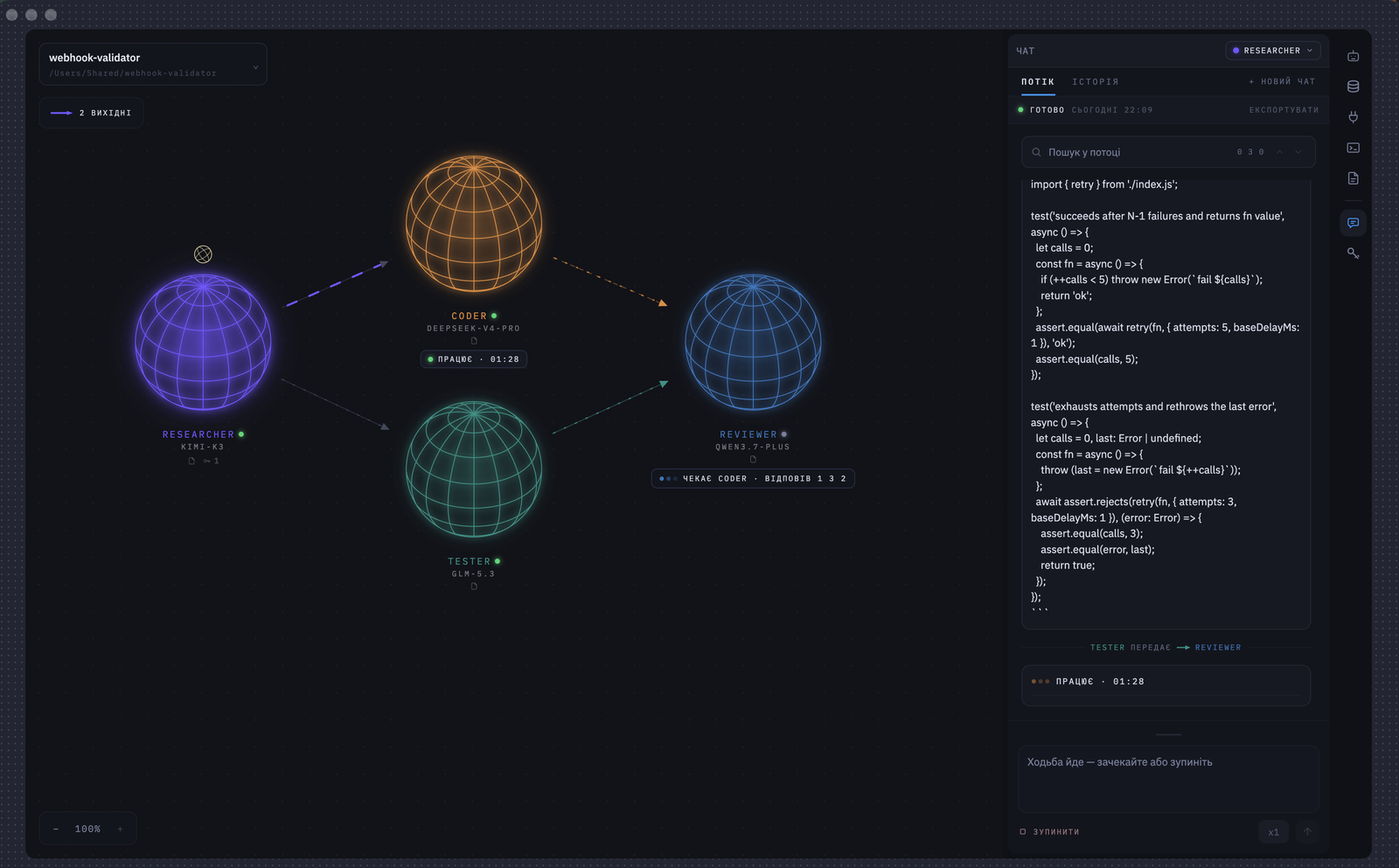
Building multi-agent AI pipelines on a visual canvas is what Coder enables for developers seeking automated code development. Users arrange agents on a graph, connecting them with directed links to pass work through a sequence. Each agent can be assigned a specific model from providers like Anthropic, OpenAI, Google, OpenRouter, Ollama, or LM Studio, allowing for a mix of different costs and capabilities within a single workflow.
This platform functions both as a visual Electron application and a command-line tool. Developers can run specific agent walks via the terminal using npm commands, which is useful for headless automation. Agents interact with the world through granted tools, including local or remote MCP server functions, system commands, and other agents. To ensure security, provider keys and secrets are stored in a file encrypted by the OS keychain, and local server commands require explicit user agreement before execution.
Was du damit machen kannst
- 1Automated multi-agent code developmentCreate a graph of specialized agents to handle different stages of a coding task.
- 2Headless agent executionRun a specific agent's workflow from the command line without opening the visual interface.
- 3Secure tool integrationGrant agents access to specific MCP tools or system commands while maintaining security.
Geschrieben aus dem README des Projekts. Jeder Use Case wurde gegen ein Zitat daraus geprüft.
README
Auf GitHub ansehenCoder



An AI platform for automated code development, built around agents. The user places agents on a canvas, connects them with directed links, and runs work through the graph — assigning models of different cost and capability to each one, and granting each the tools it may call.
What it does
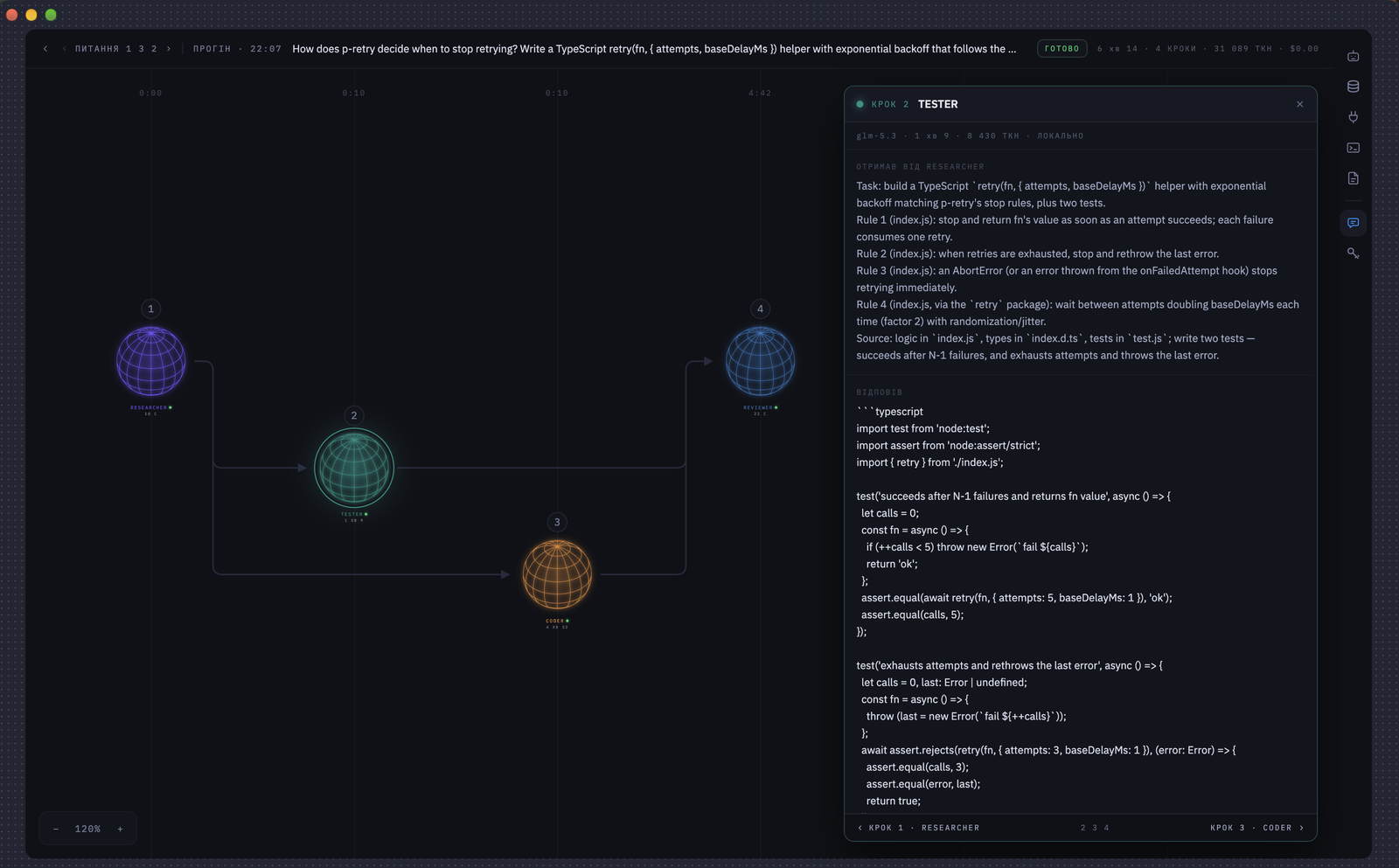
- Agents stand on a canvas and hand work along directed links; a link that would close a ring is refused.
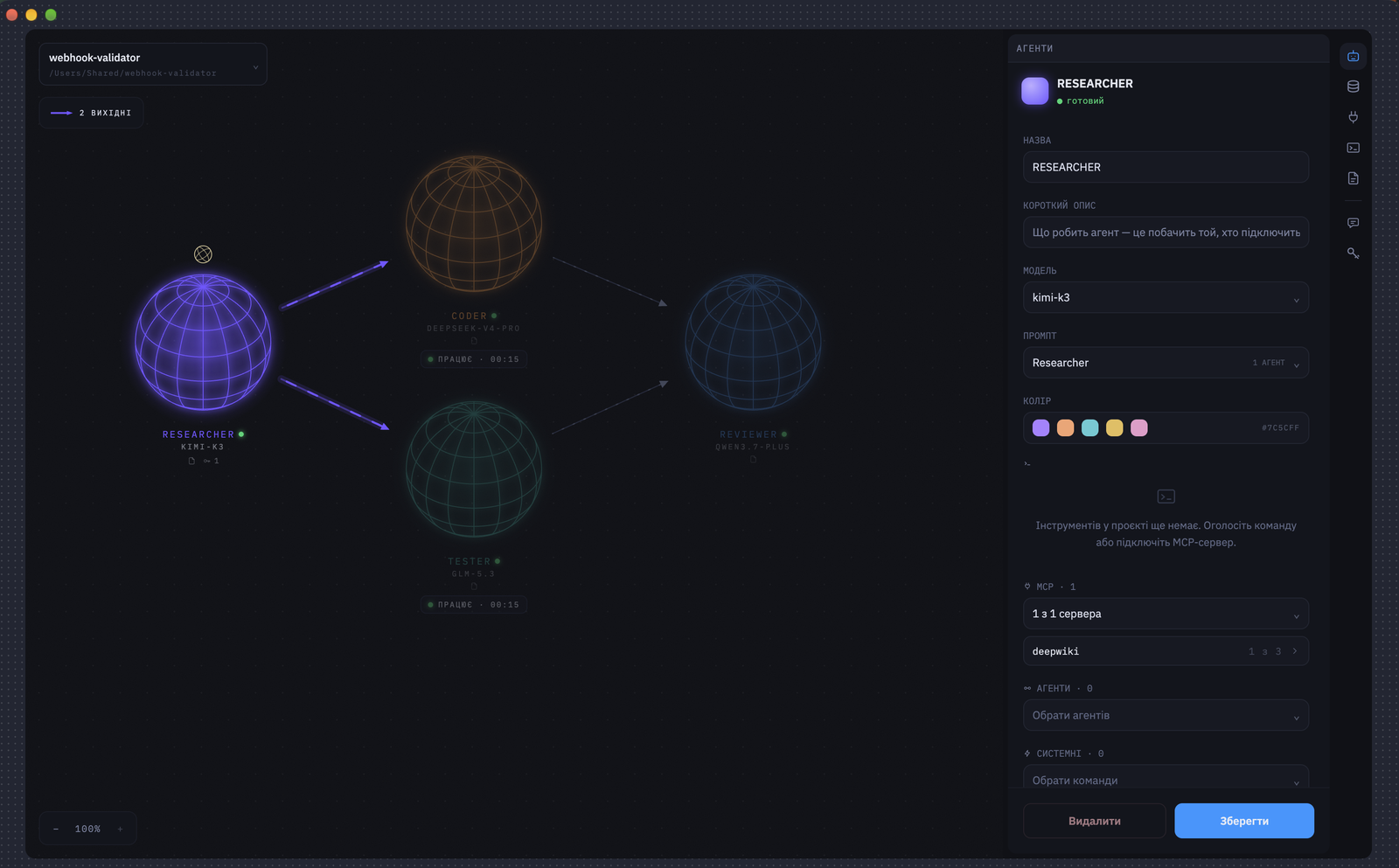
- Each agent has its own model, from Anthropic, OpenAI, Google, OpenRouter, OpenCode Go, RunPod (queue or OpenAI-compatible), Ollama or LM Studio.
- Each agent calls only the tools granted to it: functions of MCP servers, local or remote, the project's declared commands, system commands and other agents. A local server's run line starts only once this machine has agreed to it, word for word, so opening somebody else's project runs nothing it wrote.
- A question can be spoken: the microphone under the field records it, OpenAI, OpenRouter or RunPod OpenAI turns it into words, and they land in the field to be sent by hand. An answer is read aloud in one of the OS's own voices.
npm run agent -- <project> <agent> "question"runs one agent's walk without the window and exits 0 when it stood whole, 1 when something fell, 2 when the question did not go.- A project is a folder on disk with its
project.yaml, so an automation is committed and shared like any other code. - Provider keys and server secrets are kept in a file encrypted with a key the OS keychain holds.
Screenshot
Built with Electron, TypeScript, React, Vite, TypeORM + SQLite (better-sqlite3), LangChain and the MCP TypeScript SDK.
How it is laid out
src/app— the Electron application:main.ts(the window),agent-main.ts(the same backend without a window, fornpm run agent),backend/that builds the modules once for both,ipc/for the channels the two sides speak over, andrenderer/for the window itself — a thin client that shows what the backend pushes.src/modules— what runs outside the window, one directory per responsibility:projects(the folder on disk and the registry of the ones opened),providersandsecrets(the keys, in a file encrypted with a key the OS keychain holds),speech(a recording turned into words by the project's recognition model, and this machine's voice),mcp(the servers and what they hand over),commands(a declared line and what it printed),attachments(the files sent with a question),llm(one turn of an agent, and the only place LangChain is imported),walks(a conversation's walk along the canvas lines, from the question to the last answer) andruns(the record of every run). The registry and the record live in SQLite through TypeORM;migrationsholds that schema.src/contracts— what both halves share: every channel's name, the shape of what travels through it, and the pure rules both apply. Neither side reaches into the other for a type.src/utils— what belongs to neither.tests— the end-to-end suite, run bytest:back; every other test stands beside the file it is about.scripts— whatpackage.jsoncalls: the dev run, the native rebuild, the migration CLI, the feature graph..github/workflows/ci.yml— CI: the three checks and both suites on Node 22 and 24.design— the agreed design, frame by frame.
Documents and design
OPERATOR.md— for whoever composes a pipeline: the project file, every field, the system commands, the providers, the limits and the usual troubles (in Ukrainian).DESIGN.md— how the interface looks and behaves, in words over the frames.BACKEND.mdandFRONTEND.md— how the code is built: modules, contracts, the renderer.CLAUDE.md— how work is done in this repository: conventions, checks, commits.TODO.md— what the built product is still missing.design/— the two canvases of frames. OpenПолотно пайплайну - офлайн.htmlandПолотно пайплайну 2 - офлайн.htmlin a browser: each carries everything inside and needs neither a server nor the network.Карта кадрів.mdindexes every frame;plain/holds the same canvases as readable HTML for search and diff.
Running it
Node.js ^22.22.2, ^24.15.0 or ^26.0.0, with the npm it ships — the range engines in
package.json holds, the narrowest the dependencies allow (jsdom, TypeORM, ESLint, Vite). Node runs
the tooling: the install, Vite, the checks and test:front; the app itself, test:back and the
migrations run on the Node that Electron carries.
npm install, then npm run rebuild:electron once after every install: the install builds
better-sqlite3 for the Node that ran it, and Electron loads only one built for itself, so this
fetches Electron's headers and compiles it again. Then npm run dev:app — the Electron shell with
the renderer served by Vite; npm run dev:app:watch restarts it when the main process changes.
npm run typecheck covers all three tsconfigs, and npm run test:back and npm run test:front are
the two suites.
npm run agent -- <project> <agent> "question" asks one agent of a project without the window: the
project by its name among the recent ones or by its folder, the agent by name or id. The walk goes
along the lines to its end and prints the conversation; the exit code is 0 when it stood whole, 1
when something fell, 2 when the question did not go.
CI runs, on every push to main and every pull request, typecheck, lint, prettier,
test:front, then rebuild:electron and test:back — lint is ESLint followed by
graph:features, which draws which subject of the renderer imports which and fails on a ring;
npm run format writes what prettier checks. A schema change goes through
npm run migration:generate -- src/modules/migrations/<Name>, with migration:run and
migration:revert beside it.
A local provider to check against
docker compose up -d starts Ollama at http://localhost:11434 — the address the app's provider
card already carries. docker-compose.yml says which model to pull and why that one.
Licence
Copyright © 2026 Mykhailo Biloshkurskyi.
Licensed under the Apache License, Version 2.0 — see LICENSE
and NOTICE. The design carries IBM Plex under the SIL Open Font License 1.1
(design/plain/fonts/OFL.txt) and React under the MIT License (design/LICENSE-react.txt).
Coder MCP Fragen
What models can I use with the agents?
You can assign models from Anthropic, OpenAI, Google, OpenRouter, OpenCode Go, RunPod, Ollama, or LM Studio to each agent.
How are tools and MCP servers handled?
Each agent can only call tools specifically granted to it, including functions from local or remote MCP servers, system commands, and other agents.
Can I run agents without the desktop interface?
Yes, you can run a specific agent's walk via the command line using npm, which is useful for headless automation.
How is security handled for provider keys?
Provider keys and server secrets are stored in a file that is encrypted using a key held by the operating system's keychain.