
Indexiert deinen Codebase, um AI-Clients effizienten, durchsuchbaren Code-Kontext zu liefern und gleichzeitig den Token-Verbrauch zu senken.
Auch bekannt als elara-labs/code-context-engine, code-context-engine
- Stars
- 459
- Tools
- —
- Downloads, 30 Tage
- 728
- Neueste Version
- 0.4.13
- Letzter Commit
- 23. Aug. 2026
- Lizenz
- MIT
Was ist Code Context Engine MCP?
Code Context Engine ist ein MCP server. Indexiert deinen Codebase, um AI-Clients effizienten, durchsuchbaren Code-Kontext zu liefern und gleichzeitig den Token-Verbrauch zu senken.
Zusammenfassung generiert aus dem README des Projekts
Über Code Context Engine MCP server
Code Context Engine bietet eine Möglichkeit, lokale Codebases zu indexieren, sodass AI-Clients nach relevanten Informationen suchen können, anstatt ganze Dateien erneut einzulesen. Dieser Ansatz reduziert den Token-Verbrauch erheblich; Benchmarks zeigen Ersparnisse von bis zu 94% bei den Input-Tokens. Es ist für Entwickler konzipiert, die Tools wie Claude Code, Cursor, VS Code und Gemini CLI nutzen, und ermöglicht es ihnen, einen einzigen Index zu pflegen, der über verschiedene Editoren und Agents hinweg funktioniert.
Das System läuft vollständig lokal, um die Privatsphäre des Codes zu gewährleisten; es findet kein Cloud-Indexing statt. Es unterstützt verschiedene Umgebungen wie macOS, Linux und Windows und benötigt Python 3.11 oder höher. Nutzer können die Engine mit einem einzigen Befehl einrichten, der den Editor automatisch erkennt und die notwendigen Dateien konfiguriert. Für diejenigen, die Ollama nutzen, kann die Engine automatisch eine lokale Instanz unter localhost:11434 erkennen, um Embeddings mit nomic-embed-text zu verarbeiten.
Was du damit machen kannst
- 1AI-Coding-Kosten senkenEin Entwickler kann seine monatlichen Kosten senken, indem er indexierte Suchen verwendet, anstatt vollständige Dateien an das Modell zu senden.
- 2Codebase-Privatsphäre wahrenTeams können sicherstellen, dass ihr proprietärer Code während des Indexierungsprozesses niemals ihre lokale Maschine verlässt.
- 3Kontext über Editoren hinweg synchronisierenEin Entwickler, der sowohl in Cursor als auch in VS Code arbeitet, kann denselben Codebase-Index für beide Tools nutzen.
- 4Wissen zwischen Sessions beibehaltenEin AI Agent kann sich auch nach einem Neustart an vorherige Entscheidungen und spezifische Codebereiche erinnern.
Geschrieben aus dem README des Projekts. Jeder Use Case wurde gegen ein Zitat daraus geprüft.
So installierst du Code Context Engine MCP
Formate geprüft am 10. Nov. 2026Code Context Engine MCP in Claude Code installieren
$ claude mcp add code-context-engine -- uvx code-context-engineCode Context Engine MCP in Cursor installieren
~/.cursor/mcp.json
{
  "mcpServers": {
    "code-context-engine": {
      "command": "uvx",
      "args": [
        "code-context-engine"
      ]
    }
  }
}Code Context Engine MCP in VS Code installieren
.vscode/mcp.json
{
  "servers": {
    "code-context-engine": {
      "type": "stdio",
      "command": "uvx",
      "args": [
        "code-context-engine"
      ]
    }
  }
}Code Context Engine MCP in Claude Desktop installieren
claude_desktop_config.json
{
  "mcpServers": {
    "code-context-engine": {
      "command": "uvx",
      "args": [
        "code-context-engine"
      ]
    }
  }
}Code Context Engine MCP in Codex installieren
~/.codex/config.toml
[mcp_servers.code-context-engine]
command = "uvx"
args = ["code-context-engine"]
Code Context Engine MCP in Gemini CLI installieren
~/.gemini/settings.json
{
  "mcpServers": {
    "code-context-engine": {
      "command": "uvx",
      "args": [
        "code-context-engine"
      ]
    }
  }
}Automatisierte Checks
Geluften am 12. Nov. 2026Vollständiger Bericht →Unsere automatisierten Checks bestanden. Das ist kein Security-Audit: Lies den Code und gib dem Server nur den minimal notwendigen Zugriff. Wie die Checks funktionieren

- Source Repository verknüpft und erreichbarBestanden
- Open Source Lizenz (OSI)Bestanden
- Commit oder Release im letzten JahrBestanden
- Package-Name ähnelt keinem populären PackageBestanden
- Remote Endpoint nutzt HTTPSNicht geprüft
- Destruktive Tools sind markiertNicht geprüft
- Keine versteckten Anweisungen an das ModellBestanden
- Kein kritischer Hinweis im Paket oder seinen AbhängigkeitenBestanden
README
Auf GitHub ansehenUse cases
| Use case | How CCE helps | |
|---|---|---|
| 💰 | Reduce Claude Code costs | 94% fewer input tokens per session |
| 🔒 | Keep code private | Everything local, no cloud indexing |
| 🔄 | Multi-editor teams | One index across Claude Code, Cursor, VS Code, Gemini CLI |
| 🧠 | Cross-session memory | Decisions and context survive restarts |
| ⚡ | Faster responses | Less context = faster Claude replies |
| 📊 | Track actual savings | Dollar amounts, not estimates |
Quick start
One command. 30 seconds.
uvx --from "code-context-engine[local]" cce init # install + index + configure, one shot
Or if you prefer a persistent install:
uv tool install "code-context-engine[local]"    # or: pipx install "code-context-engine[local]"
cd /path/to/your/project
cce init
Restart your editor. Done. Every question now hits the index instead of re-reading files.
Agent Plugin support: Run
cce init --pluginto generate a portable Agent Plugin directory that works with VS Code, Cursor, Copilot, Codex, ChatGPT, and Kiro. The plugin usesuvxto launch CCE on demand, so users don't need to pre-install the Python package. See Agent Plugin below.
Already have Ollama? Skip
[local]and useuv tool install code-context-engineinstead. CCE auto-detects Ollama at localhost:11434 and usesnomic-embed-text.
Python 3.11+ and a C compiler (for tree-sitter grammars).
| Platform | Setup |
|---|---|
| macOS | xcode-select --install |
| Ubuntu/Debian | sudo apt install build-essential cmake |
| Fedora/RHEL | sudo dnf install gcc gcc-c++ cmake |
| Windows | Visual Studio Build Tools (C++ workload) + CMake |
Tested on macOS, Linux, Windows with Python 3.11/3.12/3.13.
cce init auto-detects your editor and writes the right config. To target a
specific agent, use --agent claude, --agent codex, --agent copilot, --agent pi, or
--agent all.
| Editor | Config written | Instructions |
|---|---|---|
| Claude Code | .mcp.json |
CLAUDE.md |
| VS Code / Copilot | .vscode/mcp.json |
.github/copilot-instructions.md |
| Cursor | .cursor/mcp.json |
.cursorrules |
| Gemini CLI | .gemini/settings.json |
GEMINI.md |
| OpenAI Codex | ~/.codex/config.toml (user-global, per-project section) |
AGENTS.md |
| OpenCode | opencode.json |
|
| Tabnine | .tabnine/agent/settings.json |
TABNINE.md |
| Pi | .mcp.json |
AGENTS.md |
Multiple editors in the same project? All get configured in one command.
Codex note: Codex CLI reads MCP servers from ~/.codex/config.toml only —
it has no per-project config. cce init adds one [mcp_servers.cce-<project>-<hash>]
section per project so multiple projects coexist; cce uninstall removes only
the section for the current project.
Pi note: Pi does not support MCP natively. To use CCE with Pi, you need a
pi MCP adapter extension (e.g. pi-mcp-adapter)
that consumes the .mcp.json config and exposes CCE's tools to the Pi agent.
cce init sets up both .mcp.json and AGENTS.md (Pi loads the latter
automatically for startup instructions).
  my-project · 38 queries · last query 5m ago

  ⛁ ⛶ ⛶ ⛶ ⛶ ⛶ ⛶ ⛶ ⛶ ⛶  88% tokens saved

  Input savings   1.9M  tokens   $27.78
  Output savings  4.8k  tokens   $0.36
  ──────────────────────────────────────────
  Total saved   1.9M  tokens   $28.15

  Breakdown:
    retrieval              84%  ▰▰▰▰▰▰▰▰▰▰    1.8M   $26.76 · 12 calls
    chunk compression       3%  ▰▱▱▱▱▱▱▱▱▱   68.5k    $1.03 · 12 calls
    output compression*    <1%  ▰▱▱▱▱▱▱▱▱▱    4.8k    $0.36 · 12 calls

  Cost estimate based on Opus pricing (input $15.0/1M, output $75.0/1M)
Supports Anthropic, OpenAI, and Google model pricing. Configure via pricing.model in ~/.cce/config.yaml.
Why this matters
Input tokens are 85-95% of your Claude Code bill. CCE cuts them by 94% (benchmarked on FastAPI).
Without CCE:    Claude reads payments.py + shipping.py   = 45,000 tokens
With CCE:       context_search "payment flow"            =    800 tokens
| Without CCE | With CCE | |
|---|---|---|
| Session startup | Re-reads files every time | Queries the index |
| Finding a function | Read entire 800-line file | Get the 40-line function |
| Cross-session memory | None | Decisions + code areas persisted |
| Token cost (Sonnet, medium project) | ~$0.14/session | ~$0.04/session |
Benchmark: FastAPI (reproducible)
We benchmarked CCE against FastAPI (53 source files, 180K tokens) with 20 real coding questions. No cherry-picking, no synthetic queries.
Methodology: For each query, "without CCE" means reading the full content of every file the query touches. "With CCE" means the relevant chunks after compression.
Important baseline note: The 94% number is measured against full-file reads, not against what Claude Code actually does. In practice, Claude Code already uses grep, partial file reads, and targeted tools, so the real-world savings compared to normal Claude Code behavior will be lower than 94%. We use full-file as the baseline because it's reproducible and deterministic (no agent behavior variability). The benchmark measures CCE's retrieval efficiency, not a head-to-head comparison with Claude Code's built-in exploration.
| Metric | Result |
|---|---|
| Retrieval savings | 94% (83,681 → 4,927 tokens/query) |
| Compression (additional, on retrieved chunks) | 89% (4,927 → 523 tokens/query) |
| Recall@10 (found the right files) | 0.90 |
| Latency p50 | 0.4ms |
| Queries tested | 20 |
Per-Layer Savings (each measured independently)
| Layer | What it does | Savings | Method |
|---|---|---|---|
| Retrieval | Full files → relevant code chunks | 94% | measured |
| Chunk Compression | Raw chunks → signatures + docstrings | 89% | measured |
| Grammar | Drops articles/fillers from memory text | 13% | measured |
Output compression (reducing Claude's reply length) provides additional savings (~65% estimated) but is not included in the headline number above.
Multi-language benchmarks
| Repo | Language | Files | Retrieval savings | Recall@10 |
|---|---|---|---|---|
| FastAPI | Python | 53 | 94% | 0.90 |
| Django | Python (large) | 2,347 | 93% | 0.95 |
| Express | JavaScript | 6 | 94% | 1.00 |
| chi | Go | 94 | 76% | 0.67 |
| fiber | Go (monorepo) | 396 | 93% | 0.07 |
Django (2,347 files, 5.4M tokens) shows CCE scales to large codebases with 0.95 recall. Go's shorter files reduce the retrieval headroom (smaller baseline). Monorepos dilute recall at top-10 (fiber). Middleware queries with one-feature-per-file hit R=1.00 consistently.
Reproduce it yourself:
pip install code-context-engine
python benchmarks/run_benchmark.py --repo https://github.com/fastapi/fastapi.git --source-dir fastapi
python benchmarks/run_benchmark.py --repo https://github.com/go-chi/chi.git --source-dir .
Full results in benchmarks/results/. Queries and methodology in benchmarks/.
What you get
11 MCP tools that Claude uses automatically:
| Tool | What it does |
|---|---|
context_search |
Hybrid vector + BM25 search with graph expansion |
expand_chunk |
Full source for a compressed result |
related_context |
Find code via graph edges (calls, imports) |
session_recall |
Recall decisions from past sessions |
session_timeline |
Walk turn summaries for a session (drill into recall hits) |
session_event |
Inspect raw tool input/output for a specific event |
record_decision |
Save a decision for future sessions |
record_code_area |
Record which files were worked in |
index_status |
Check index freshness |
reindex |
Re-index a file or the full project |
set_output_compression |
Adjust response verbosity (off / lite / standard / max) |
Live dashboard with donut charts, file health, and session history:
cce dashboard
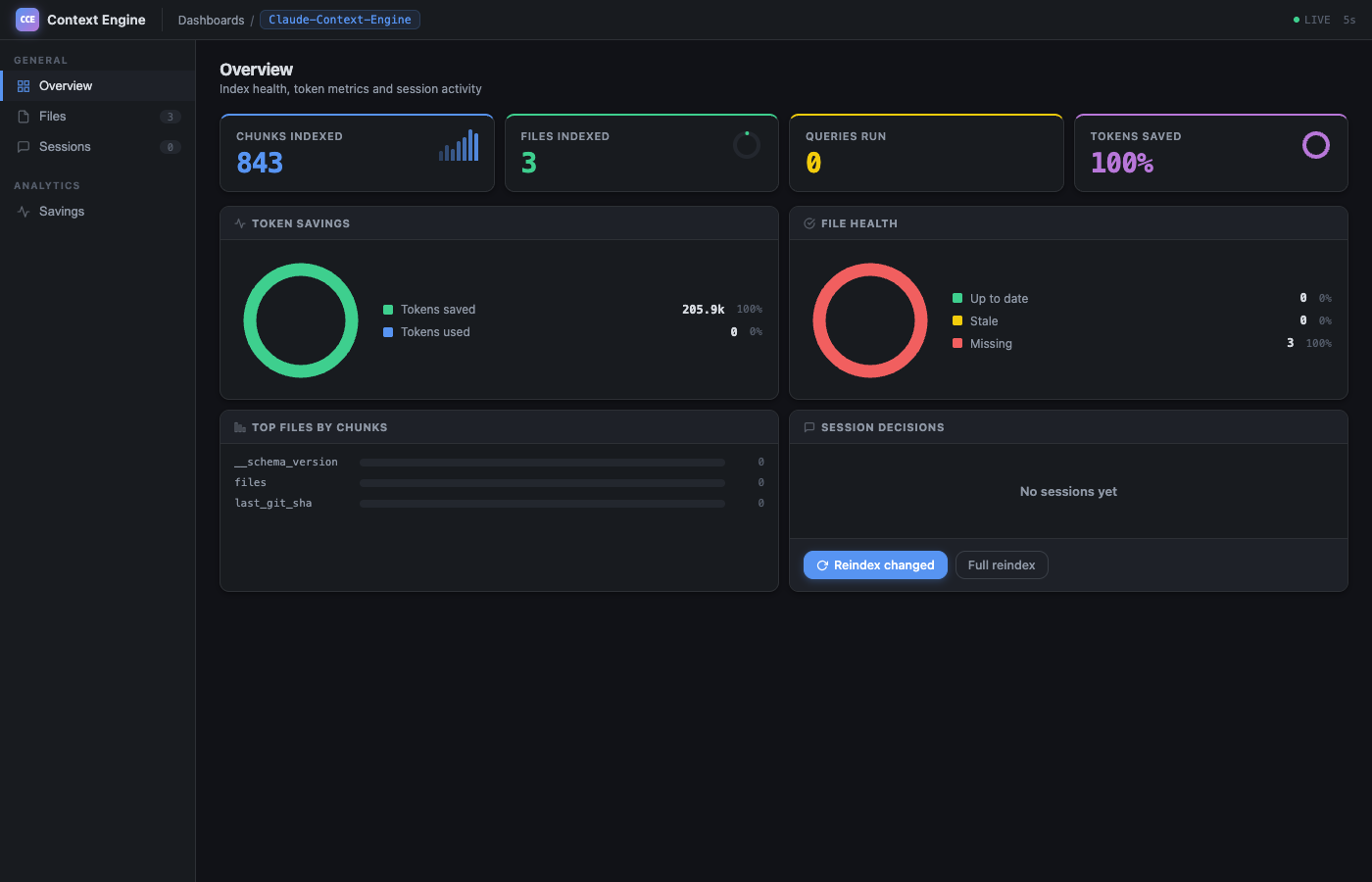
Dollar estimates with multi-provider pricing (Anthropic, OpenAI, Google):
cce savings --all # see savings across all projects
How it works
- Index: Tree-sitter parses your code into semantic chunks (functions, classes, modules). Stored as vector embeddings locally.
- Search: Claude calls
context_search. Hybrid vector + BM25 retrieval finds the right chunks. Code graph adds related files automatically. - Compress: Chunks are truncated to signatures + docstrings (or LLM-summarized if Ollama is running).
- Remember: Decisions and code areas persist across sessions via
session_recall. - Track: Every query is logged.
cce savingsshows exactly how much you saved.
Re-indexing after edits takes under 1 second (96% embedding cache hit rate). Git hooks keep the index current automatically.
What makes CCE different
It saves where the money is
Output compression tools (like Caveman) save 20-75% on output tokens. Output is 5-15% of your bill. Net savings: ~11%.
CCE saves on input tokens (94% retrieval savings on FastAPI, reproducibly benchmarked). Input is 85-95% of your bill.
It actually understands your code
Not a text search. Tree-sitter AST parsing creates semantic chunks. Hybrid retrieval merges vector similarity with BM25 keyword matching via Reciprocal Rank Fusion. A confidence scorer blends similarity (50%), keyword match (30%), and recency (20%). Graph expansion walks CALLS/IMPORTS edges to pull in related code.
It remembers
record_decision("use JWT for auth", reason="session tokens flagged by legal") is stored in SQLite and surfaces via session_recall in the next session. No re-explaining your architecture.
It tracks real savings
Not estimates. Actual tokens served vs full-file baseline, broken down by buckets (retrieval, compression, output, memory, grammar). Dollar costs fetched from Anthropic's pricing page. Savings summary shown at every session start.
It is secure by default
Secret files (.env, *.pem, credentials.json) are never indexed. Content is scanned for AWS keys, GitHub tokens, Slack tokens, Stripe keys, JWTs, and generic credentials. PII (emails, IPs, SSNs, credit cards) is scrubbed from memory writes. All MCP file paths are validated against path traversal.
Under the hood
SHA-256 fingerprint per chunk, salted with model name. Re-index skips unchanged code. Binary float32 storage (10x smaller than JSON). Typical re-index: 96% cache hit, under 1 second.
Replaced LanceDB with sqlite-vec. Same cosine-distance quality, 99% smaller install. WAL mode + PRAGMA NORMAL for 80% write speedup. Vectors, FTS5, code graph, and compression cache all in three SQLite files.
Memory entries compressed without LLM calls. Drops articles, fillers, pronouns. Three levels (lite/full/ultra, 20-60% savings). Code, paths, URLs preserved byte-for-byte. Same input always yields same output.
5 Claude Code lifecycle hooks capture session context. Every hook runs curl ... || true, so a crashed server never blocks the user. SessionStart injects bootstrap context; others capture silently.
Dollar estimates in cce savings support 15+ models across Anthropic, OpenAI, and Google. Static pricing ships with CCE, live Anthropic pricing is fetched and cached 7 days. Configure pricing.model (e.g. gpt-4o, gemini-2.5-pro, sonnet) or override with pricing.input / pricing.output for custom rates.
Running dozens of cce serve processes (one per project per AI session) can exhaust system memory. The resource governor caps ONNX Runtime threads per process, uses advisory file locks so only one process indexes a given project at a time, backs off under Linux memory pressure (PSI), and auto-shuts down idle servers after 30 minutes. Configure via serve.idle_timeout_minutes and serve.max_ort_threads.
CCE's cross-session memory depends on the agent calling record_decision and record_code_area. Memory nudges make recording ambient: after N searches without a recording, context_search results include a short reminder. At session end, the Stop hook summarizes unrecorded activity. Nudges re-arm after the first recording so they stay useful without being noisy.
cce serve --http exposes a POST /search endpoint for custom agent integrations that speak HTTP instead of MCP stdio. Same hybrid retrieval pipeline, structured JSON response with confidence scores. Input validation clamps top_k (1..100) and confidence_threshold (0.0..1.0).
7 buckets track every token saved: retrieval, chunk compression, output compression, memory recall, grammar, turn summarization, progressive disclosure. Survives restarts. Powers CLI and dashboard analytics.
Agent Plugin
Agent Plugins is an open standard (v1.0.0) backed by Amazon, Cursor, Microsoft, OpenAI, and Vercel for packaging AI skills and MCP servers into portable, zero-install bundles. CCE can generate a plugin directory that compatible editors can discover and load automatically.
cce init --plugin                          # Generate at .cce/plugin/
cce init --plugin --plugin-dir ~/plugins/cce  # Custom location
cce init --agent claude --plugin           # Both: agent config + plugin
What gets generated
.cce/plugin/
├── plugin.json                       # Agent Plugins v1.0.0 manifest
├── mcp.json                          # MCP server config (uvx + stdio)
├── skills/
│   └── code-context/
│       ├── SKILL.md                  # Agent instructions (frontmatter + body)
│       └── references/
│           └── tools.md              # Per-tool parameter docs (loaded on demand)
└── LICENSE
Compatible editors
VS Code, GitHub Copilot, ChatGPT, Codex, Cursor, and Kiro. The plugin uses uvx to launch CCE on demand, so users do not need to pre-install the Python package. The MCP server auto-discovers the project root by walking up from its working directory, looking for .context-engine.yaml or .git/.
When to use --plugin vs --agent
--agent (default) |
--plugin |
|
|---|---|---|
| Install method | Writes editor-specific config files | Generates a portable plugin directory |
| Zero-install | No, CCE must be on PATH | Yes, uvx fetches CCE on demand |
| Instruction updates | Stale until cce init re-run |
Stale until cce init --plugin re-run |
| Best for | Your own machine | Sharing with a team or distributing |
Both can be used together. --agent handles per-editor MCP config, --plugin provides a portable alternative.
CLI at a glance
cce init                    # Index + install hooks + register MCP
cce init --plugin           # Generate Agent Plugin for VS Code, Cursor, etc.
cce                         # Status banner
cce savings                 # Token savings with dollar estimates
cce savings --all           # All projects
cce dashboard               # Web dashboard with live charts
cce search "auth flow"      # Test a query
cce status                  # Index health + config
cce services                # Ollama + dashboard + MCP status
cce commands add-rule '...' # Project rules for Claude
cce uninstall               # Clean removal of all CCE artifacts
Run cce list for the full command reference.
Configuration
Zero-config by default. Override what you need in ~/.cce/config.yaml or .context-engine.yaml:
compression:
  level: standard          # minimal | standard | full
  output: standard         # off | lite | standard | max
  ollama_url: http://localhost:11434   # point at a remote Ollama if desired

retrieval:
  top_k: 20
  confidence_threshold: 0.5

pricing:
  model: opus              # opus | sonnet | haiku | gpt-4o | gemini-2.5-pro | ...
  # input: 15.0            # override $/1M input tokens
  # output: 75.0           # override $/1M output tokens
Remote Ollama: If you run Ollama on another machine in your network, set compression.ollama_url (e.g. http://nas.local:11434) or export CCE_OLLAMA_URL (the env var wins). CCE probes the endpoint and falls back to truncation-only compression when it's unreachable, so a flaky link won't break indexing.
Output Compression
CCE also compresses Claude's responses (same concept as Caveman):
| Level | Style | Savings |
|---|---|---|
off |
Full output | 0% |
lite |
No filler or hedging | ~30% |
standard |
Fragments, drop articles | ~65% |
max |
Telegraphic | ~75% |
Tell Claude: "switch to max compression" or "turn off compression". Code blocks and commands are never compressed.
Disk Footprint
| Component | Size |
|---|---|
| Core install (Ollama backend) | ~17 MB |
With [local] extra (fastembed + ONNX) |
~189 MB |
| Embedding model (one-time download) | ~60 MB (fastembed) or managed by Ollama |
| Index per project (small/medium/large) | 5-60 MB |
No GPU required. With Ollama, embeddings are handled by the Ollama server. With the [local] extra, the embedding model runs on CPU via ONNX Runtime.
Supported Languages
AST-aware chunking (tree-sitter parsed, 11 extensions):
| Language | Extensions |
|---|---|
| Python | .py |
| JavaScript | .js, .jsx |
| TypeScript | .ts, .tsx |
| PHP | .php |
| Go | .go |
| Rust | .rs |
| Java | .java |
| C# | .cs |
Language-aware fallback chunking (40+ extensions):
| Category | Languages |
|---|---|
| Web | HTML, CSS, SCSS, LESS, Vue, Svelte |
| Systems | C, C++, Zig, Nim |
| Mobile | Swift, Kotlin, Dart |
| Functional | Haskell, Scala, Clojure, Elixir, Erlang, F# |
| Scripting | Ruby, Perl, Lua, R, Bash/Zsh |
| Data/Config | JSON, YAML, TOML, XML, SQL, GraphQL, Protobuf |
| DevOps | Terraform, HCL, Dockerfile |
| Docs | Markdown |
All other text files are chunked by line range. Binary files are skipped.
Code Context Engine MCP Fragen
Wie füge ich Code Context Engine MCP zu Claude Code hinzu?
Führe claude mcp add code-context-engine -- uvx code-context-engine in deinem Terminal aus. Füge --scope user hinzu, damit der Server in jedem Projekt verfügbar ist.
Wie füge ich Code Context Engine MCP zu Cursor hinzu?
Öffne ~/.cursor/mcp.json und füge den Server unter mcpServers hinzu, mit der Cursor-Config aus dem Installationsabschnitt oben.
Wie viel kann ich bei den Tokens sparen?
Die Engine kann bis zu 94% Token-Ersparnis erzielen, indem sie indexierte Suchen nutzt, anstatt ganze Dateien erneut einzulesen.
Welche Editoren werden unterstützt?
Es werden viele Tools unterstützt, darunter Claude Code, VS Code, Cursor, Gemini CLI und weitere.
Funktioniert es mit Ollama?
Ja, wenn du Ollama installiert hast, erkennt CCE es automatisch unter localhost:11434 und verwendet nomic-embed-text.