
diffusers-workflow MCP server
Commit 14. Nov. 2026Führt Hugging Face Diffusers Workflows für die Generierung von Bildern, Videos und Audio als Jobs auf deiner eigenen GPU aus, gesteuert durch einen AI Agent.
Auch bekannt als dkackman/diffusers-workflow
- Stars
- 18
- Tools
- —
- Downloads, 30 Tage
- —
- Neueste Version
- —
- Letzter Commit
- 14. Nov. 2026
- Lizenz
- Apache-2.0
Was ist diffusers-workflow MCP?
diffusers-workflow ist ein MCP server. Führt Hugging Face Diffusers Workflows für die Generierung von Bildern, Videos und Audio als Jobs auf deiner eigenen GPU aus, gesteuert durch einen AI Agent.
Zusammenfassung generiert aus dem README des Projekts
Über diffusers-workflow MCP server
Die Generierung von Medien durch AI Agents auf der eigenen Hardware ist das, was diffusers-workflow für Entwickler und Creator ermöglicht. Dieser MCP server erlaubt es einem Agent, Hugging Face Diffusers Pipelines zu steuern, um Bilder, Videos und Audio direkt auf deiner lokalen GPU oder einer Remote-Maschine zu produzieren. Er unterstützt verschiedene Hardware wie NVIDIA CUDA, Apple Silicon MPS und CPU und lässt sich in Claude Code oder andere MCP Clients integrieren, um komplexe generative Aufgaben zu verwalten.
Nutzer interagieren mit dem System über einen Agent, der JSON-basierte Workflows schreiben, validieren und ausführen kann. Der Server bietet ein Web-UI, in dem du den Prozess steuern, Variablen in einem Formular bearbeiten und eine Galerie der Ergebnisse ansehen kannst. Er enthält spezifische Tools zur Schätzung der GPU-Kosten via validate_workflow und zur Verwaltung von Assets. Da ein persistenter Worker genutzt wird, bleiben die Modelle im Speicher geladen, um aufeinanderfolgende Runs zu beschleunigen. Für geschützte Modelle wie FLUX oder MiniMax musst du lediglich deine Hugging Face Authentifizierung via hf auth login bereitstellen.
Was du damit machen kannst
- 1Kostenschätzung vor dem RenderingDu kannst den Agent bitten, die erwartete GPU-Zeit für einen spezifischen Workflow zu berechnen, bevor du dich auf ein langes Rendering festlegst.
Geschrieben aus dem README des Projekts. Jeder Use Case wurde gegen ein Zitat daraus geprüft.
Automatisierte Checks
Geluften am 14. Nov. 2026Vollständiger Bericht →Noch nicht verifiziert. Ein Server benötigt einen Score von 80, keine kritischen Befunde und genug Daten für unsere Prüfung. Wie die Checks funktionieren · Was du für mehr Punkte verbessern kannst

- Source Repository verknüpft und erreichbardkackman/diffusers-workflow is public and reachablegithub.com/dkackman/diffusers-workflow ↗Bestanden
- Paket nennt dieses Repository als QuelleNicht geprüft
- Build-Provenienz (Sigstore-Attestierung)Nicht geprüft
- Open Source Lizenz (OSI)Apache-2.0spdx.org/licenses/Apache-2.0.html ↗Bestanden
- Commit oder Release im letzten JahrLast commit or release 2026-11-12github.com/dkackman/diffusers-workflow ↗Bestanden
- OpenSSF ScorecardNicht geprüft
- Package-Name ähnelt keinem populären PackageNicht geprüft
- Keine kritischen Advisories im Paket oder seinen AbhängigkeitenNicht geprüft
- Keine versteckten Anweisungen an das Modell0 tool descriptions and the README read; no override phrases, credential paths or hidden charactersBestanden
- Destruktive Tools sind markiertNicht geprüft
- Remote-Endpoint beantwortet den MCP-HandshakeNicht geprüft
README
Auf GitHub ansehen
diffusers-workflow
Your GPU, as something an agent can drive.
diffusers-workflow runs Hugging Face Diffusers image, video and audio generation as jobs on your own GPU. An agent does the work. Claude Code, or any MCP client, picks or writes the workflow, checks what it will cost, runs it, and looks at what came back. You steer from the browser. Every workflow, run and output the agent made is in the web UI, where you can change a variable, run it again, compare takes and keep the one you like.
Python 3.12-3.14 | CUDA (NVIDIA) | MPS (Apple Silicon) | CPU
Getting started
1. Install. The script picks the right torch build for your platform, creates a virtual environment and installs everything, MCP server included.
bash ./install.sh && source ./activate      # Linux / macOS
.\install.ps1; .\venv\scripts\activate      # Windows
2. Start the engine. Leave it running; the agent and the browser both talk to it.
dw-serve # web UI on http://127.0.0.1:8765
3. Connect your agent. Register the MCP server with the absolute path to dw-mcp
in the venv you just made (a relative path is the setup detail that most often goes
wrong). Then add the dw plugin:
claude mcp add dw -- "$(pwd)/venv/bin/dw-mcp"
/plugin marketplace add dkackman/diffusers-workflow
/plugin install dw@diffusers-workflow
Most of the shipped models (Flux, LTX, MiniMax, ...) are gated. Request access on
the model's Hugging Face page and run hf auth login once. Without it a run fails
partway through with a 401/403 from the Hub. templates/text-to-image uses a small,
ungated model, so it makes a good first run.
Start the engine on the GPU box with --mcp and connect over HTTP. There is nothing
to install on the laptop:
# on the GPU box
dw-serve --host 0.0.0.0 --token "$DW_API_TOKEN" --mcp --workspace ~/studio

# on your laptop
claude mcp add --transport http dw http://gpu-box:8765/mcp \
  --header "Authorization: Bearer $DW_API_TOKEN"
The server's Status page writes that line for you. The whole setup is in Remote GPU server.
On Linux with an NVIDIA GPU, the
dkackman/diffusers-workflow
image runs the server with torch, the engine and the web UI built in. It shares the
model cache and workspace with a native install on the same box. See
Docker.
Ask the agent
Describe what you want. The agent has 65 tools covering the workflow catalog, the real diffusers pipeline signatures, the job queue, the gallery and the model cache, and it stays with a long render until it finishes:
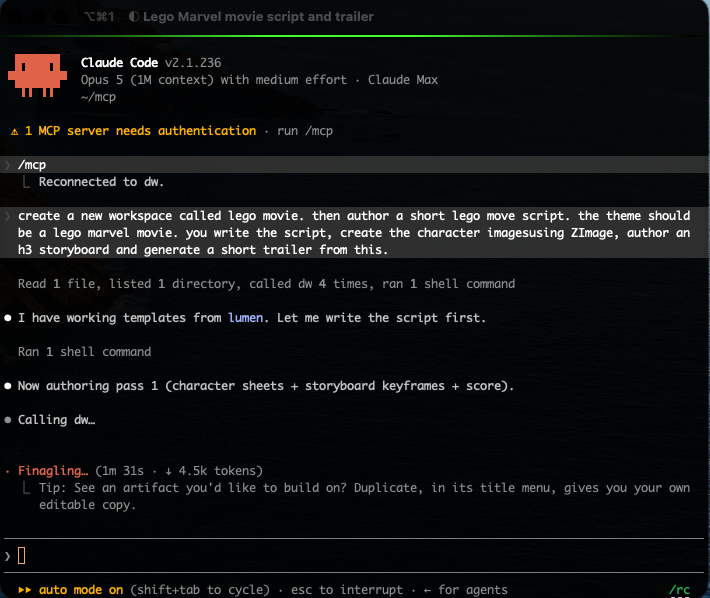
A session sounds like this:
- "Make a 30-second musical trailer: four men in boater hats, a giant eye, a
score under it." The agent picks a shape from the catalog (
list_workflows), breaks the brief into shots, writes each prompt to the prompt library, and builds the workflow that renders the shots and cuts them to the score. - "What will that cost?"
validate_workflowchecks the JSON against the schema and the real pipeline signatures, with no model loads, and quotes an estimate in GPU minutes from this box's own history. Anything that spends GPU time or disk refuses to run until the agent passesacknowledged_cost, so it has to tell you what it is about to spend first. - "How's it going?"
wait_for_jobwaits out a render without polling. Thenget_output_frames,get_output_imageandget_output_audiobring the result back into the conversation, so the agent judges what it made against what you asked for. - "Shot three is the one. Keep it and start the next scene from it."
keep_outputturns the file into a named asset, and the next workflow references it asasset:hero-frame.png.
The dw plugin adds what a general-purpose agent can't know on its own: one skill per model family (MiniMax H3 and Music 3, LTX-2.5, Kandinsky 6, FLUX 3 Klein) that picks the template for a request and states the rules that bite. Cross-cutting skills cover script-to-video, series with a consistent cast, storyboards and animatics, and a shared camera-and-look vocabulary.
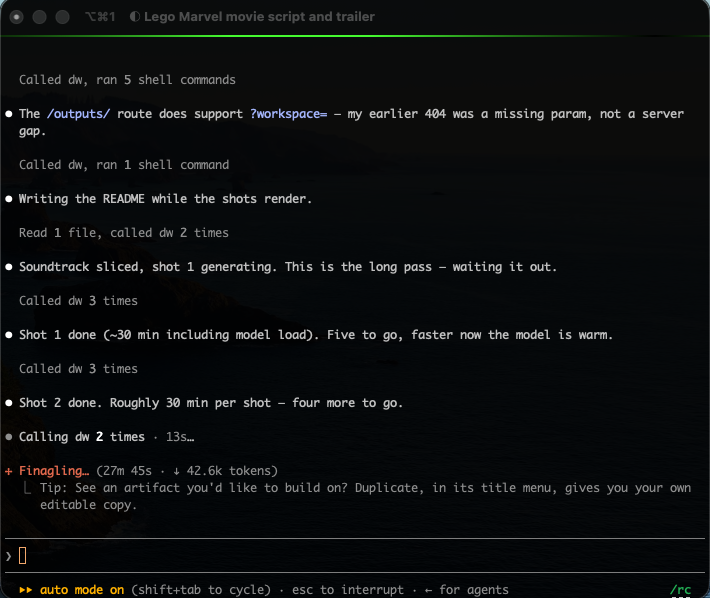
One server holds several workspaces, each with its own workflows, assets and outputs. Two agents, or an agent and you in the browser, can share one GPU without saving over each other's work.
The tool reference, setup for other MCP hosts and the troubleshooting table are in MCP Server.
Then tweak it in the browser
The web UI shows everything the agent made and lets you take over at any point. It runs on the same persistent GPU worker, so models stay loaded between runs.
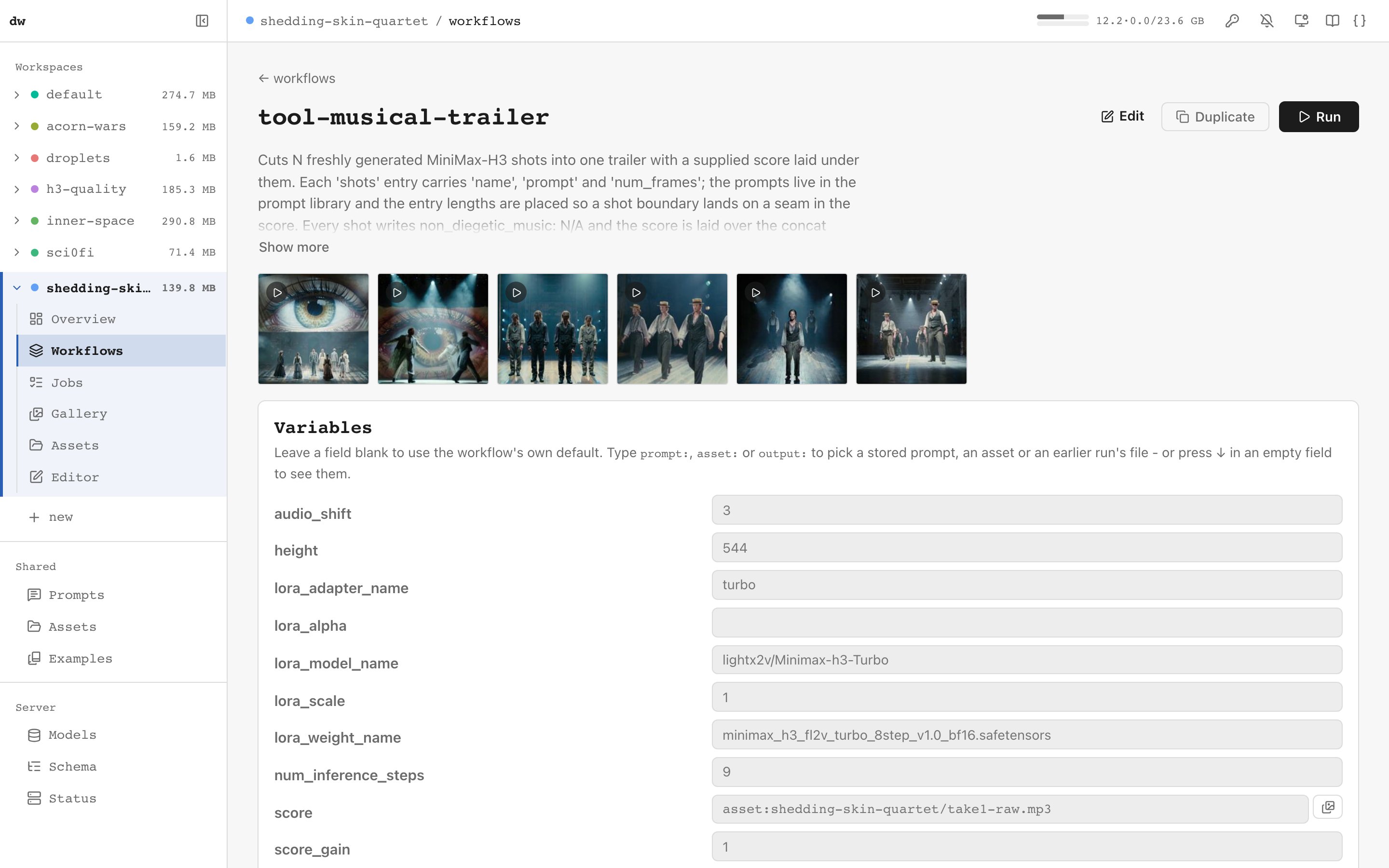
A workflow the agent wrote is a form you can edit. The workflow's description, recent outputs and variables are on one page. Change a prompt, a frame count or a LoRA scale and press Run.
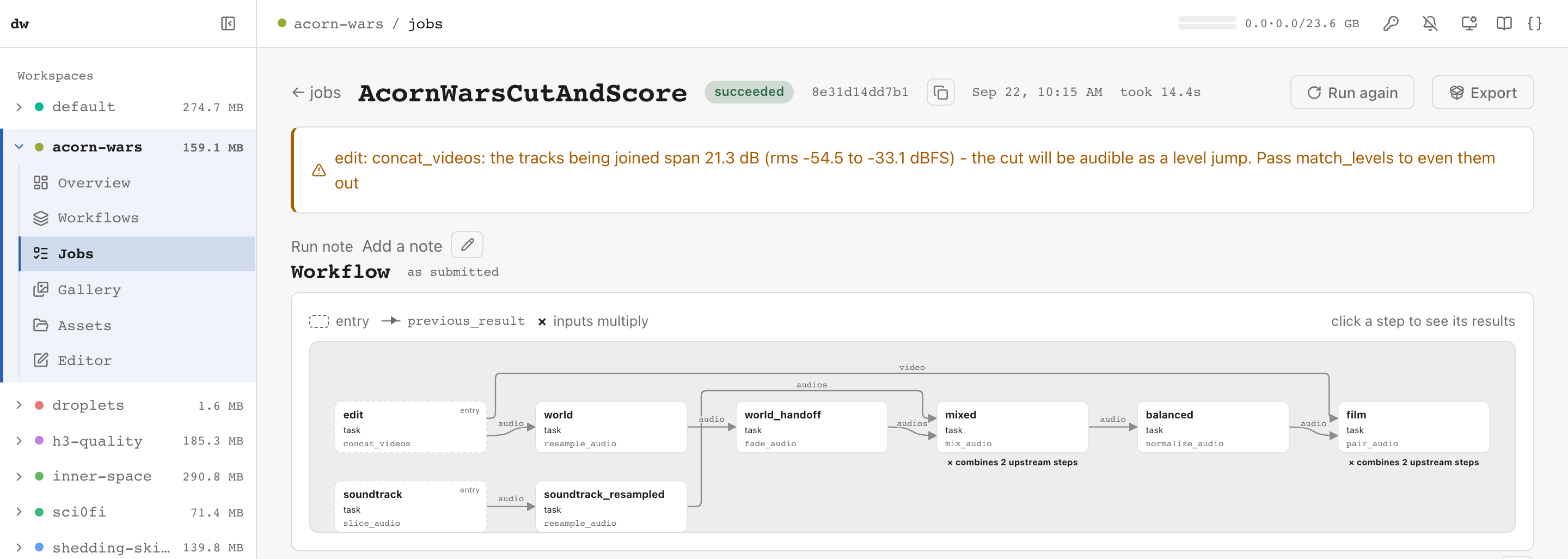
Every job is a recipe. A job keeps the exact workflow it ran and draws it as a graph of how data flows between steps. Click a step to see what it produced. The run's warnings sit above the graph, so a problem the agent missed, such as an audible level jump at a cut, is in front of you with the argument that fixes it. Run again repeats the job, and New seed gives you another take. Progress streams live for each denoising step, and a cancel stops the job cleanly at the next step.
The gallery groups outputs by the workflow that made them, with final and intermediate files kept apart. Any image reopens as the workflow that produced it. Keep as asset adds a file to the asset library for later workflows to use.
The editor works on the agent's JSON. You can view the workflow as a form, as JSON, side by side, or as a flow graph. The forms and autocomplete come from the real diffusers pipeline signatures, so every argument a pipeline takes is there with its documentation. Validate catches schema errors and argument typos before any model loads.
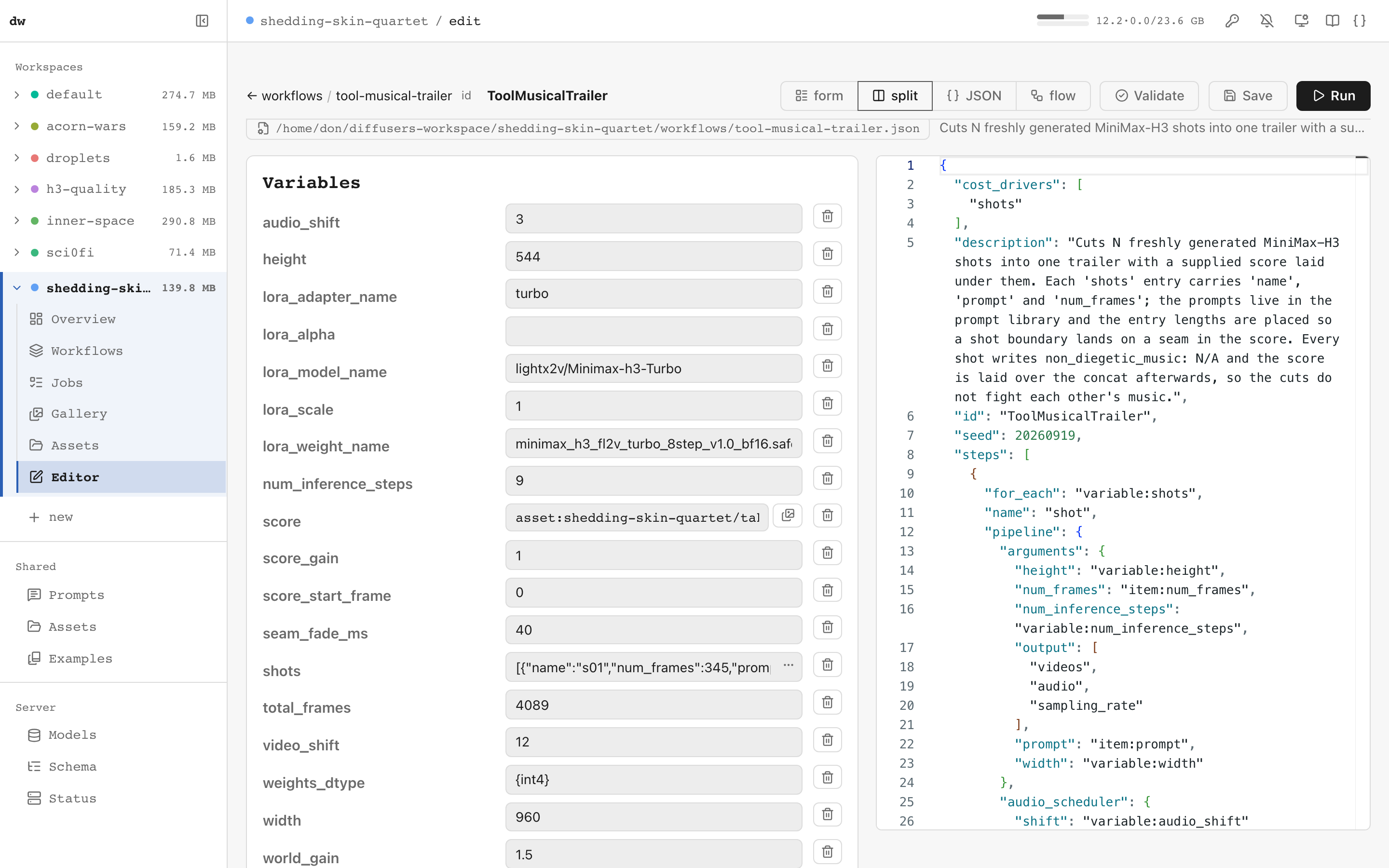
There is also a prompt library, with an Enhance with AI panel that expands an idea into a full prompt using a local language model. The model manager shows the Hugging Face cache (size, last use, free disk) and downloads or deletes models with live progress.
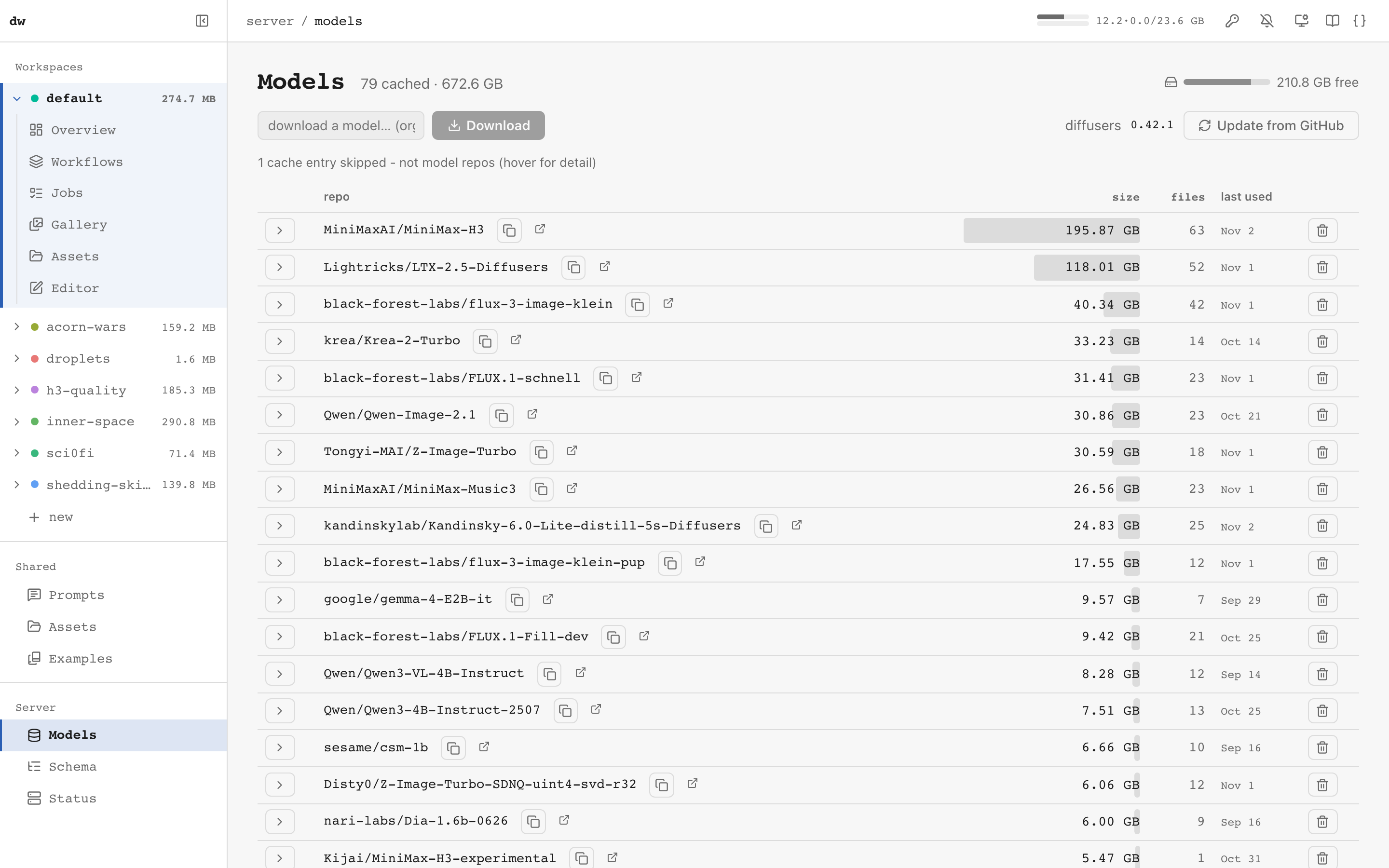
The pages are described in Server & Web UI. The UI and the agent
both use the server's HTTP API, which you can browse at /docs on a running server
(see The HTTP API).
Underneath
Every front end reads and writes the same thing: a JSON workflow of named steps,
each a diffusers pipeline or a utility task. Its arguments are references to
variables, earlier steps' results, stored prompts and assets, not hard-coded
values. That is how text-to-image chains into image-to-video, and how a generated
image reopens as the recipe that made it. You rarely need to write one by hand. When
you do, the Workflow Guide is the reference, the
JSON Schema is the exact structure, and
workflows/ has runnable examples for each model family. There is also
a command-line client, python -m dw.run workflow.json prompt="a cat", which queues
a job on a running server (see Server & Web UI).
The engine also covers:
- Quantization: BitsAndBytes, TorchAO, GGUF, SDNQ and optimum-quanto, set per component.
- Acceleration: FirstBlockCache, FasterCache, MagCache, TaylorSeerCache,
torch.compileand attention backends. - Adapters and prompts: LoRA, IP-Adapter and A1111-style prompt weighting.
- Long video and caching: long-video chaining with audio-driven length, and step-output caching, so re-running a fixed-seed workflow finishes instantly.
- Utility tasks: upscaling, face restoration, segmentation, captioning, frame interpolation, audio slicing, cut-and-score assembly and more.
A workflow can reach any diffusers pipeline or quantization backend by dynamic
import, so loading one can execute arbitrary Python. Treat a workflow file from
someone else the way you'd treat a .py script. See
Trust model.
Field reports. At the end of a session, ask the agent what got in its way, and
have it file each bug or gap as an issue on dkackman/diffusers-workflow with the
field-report label. The label marks a report as coming from real use. A report
from anyone but the maintainer is reviewed before the agent loop
acts on it.
Documentation
Using it
- MCP Server - the agent's tool surface (Claude Code, Claude Desktop, other MCP hosts)
- dw plugin - the model-family and composition skills
- Server & Web UI - the web UI, the command line, and the HTTP API with its OpenAPI spec
- Workspaces - where your content lives, run directories, several workspaces on one server
- Remote GPU server - the server, UI and MCP from another machine
- Docker - the server in a container on a Linux NVIDIA box
Workflows in depth
- Workflow Guide - JSON structure, variables, steps, data flow, references
- Tasks - image, video and audio utility tasks, ControlNet preprocessors
- Quantization - BitsAndBytes, TorchAO, GGUF, SDNQ
- Inference Acceleration - caches,
torch.compile, attention backends, MPS - Fast on 24GB - tested speed/memory settings per model family
- LoRA, IP-Adapter, Prompt Weighting
Reference
- Architecture - each concept, the module that owns it, and the check that enforces it
- Worker Guide - the persistent GPU worker and troubleshooting
- Security - validators and the trust gate (quick reference)
- Dependencies, Testing, Releasing
- Agent Loop - what the automated implementer/tester labels mean
- Attributions - code from other projects, and the projects whose ideas dw reimplemented
diffusers-workflow MCP Fragen
Wie verbinde ich den diffusers-workflow MCP server mit Claude Code?
Registriere den MCP server mit dem absoluten Pfad zu dw-mcp in deiner virtuellen Umgebung, z. B. claude mcp add dw -- "$(pwd)/venv/bin/dw-mcp". Achte darauf, einen absoluten Pfad zu verwenden, da relative Pfade der häufigste Konfigurationsfehler sind.
Kann ich diffusers-workflow auf einer Remote-GPU oder in Docker ausführen?
Ja. Starte die Engine auf der GPU-Maschine mit --mcp und verbinde dich über HTTP; auf dem Client muss nichts installiert werden. Auf Linux mit einer NVIDIA GPU kannst du auch das Docker Image nutzen.
Warum ist mein Run mit einem 401/403 Fehler von Hugging Face fehlgeschlagen?
Die meisten bereitgestellten Modelle sind geschützt (gated). Beantrage den Zugriff auf der Hugging Face Seite des Modells und führe einmal hf auth login aus. Der templates/text-to-image Workflow nutzt ein kleines, nicht geschütztes Modell, sodass er beim ersten Run direkt funktioniert.
Kann ein Agent die GPU-Kosten schätzen, bevor er einen Job startet?
Ja. validate_workflow prüft den Workflow gegen das Schema und die Pipeline-Signaturen, ohne Modelle zu laden, und gibt eine Schätzung in GPU-Minuten an. Aufgaben, die GPU-Zeit oder Festplattenspeicher verbrauchen, erfordern, dass der Agent zuerst acknowledged_cost bestätigt.
Was ist ein MCP server für diffusers?
Er ermöglicht es einem MCP Client wie Claude Code, Diffusers Workflows für die Generierung von Bildern, Videos und Audio auf deiner GPU zu erstellen, zu validieren und auszuführen, während du die Ergebnisse in einem Web-UI überprüfen und bearbeiten kannst.