
Backstage MCP server
Commit 13. Nov. 2026Stellt die Backstage Software Catalog API als Tools für LLMs bereit, um Entity Discovery, Katalog-Operationen und Validierungen durchzuführen.
Auch bekannt als Coderrob/backstage-mcp-server
- Stars
- 3
- Tools
- —
- Downloads, 30 Tage
- —
- Neueste Version
- —
- Letzter Commit
- 13. Nov. 2026
- Lizenz
- GPL-3.0
Was ist Backstage MCP?
Backstage ist ein MCP server. Stellt die Backstage Software Catalog API als Tools für LLMs bereit, um Entity Discovery, Katalog-Operationen und Validierungen durchzuführen.
Zusammenfassung generiert aus dem README des Projekts
Über Backstage MCP server
Dieser Server ermöglicht die Verwaltung von Software-Katalogen durch AI Agents, indem er LLMs mit der Backstage Software Catalog API verbindet. Er stellt 32 spezialisierte Tools für die Entity Discovery, das Management von Locations und die Validierung von Descriptoren über eine stdio-Verbindung bereit. Entwickler können ihn nutzen, um Entity Ancestry, Facets und Source Locations abzufragen oder Mutationen wie das Hinzufügen von Locations und das Aktualisieren von Entities vorzunehmen.
Um den Server einzurichten, benötigst du Node.js 24.15 oder neuer und ein erreichbares Backstage Backend. Die Authentifizierung erfolgt über ein Bearer Token, das entweder via BACKSTAGE_TOKEN Umgebungsvariable oder über eine BACKSTAGE_TOKEN_FILE für rotierende Credentials übergeben wird. Der Server nutzt den offiziellen Backstage CatalogClient, um eine Integration auf Produktionsniveau zu gewährleisten. Er enthält integrierte Sicherheitsfeatures wie Rate Limits pro Principal, Timeouts und Annotationen, die zwischen Read-only, mutierenden und destruktiven Tools wie remove_entity_by_uid unterscheiden.
Was du damit machen kannst
- 1Software-Komponenten entdeckenFrag die KI, um alle Components und APIs innerhalb eines spezifischen Namespaces zu finden.
Geschrieben aus dem README des Projekts. Jeder Use Case wurde gegen ein Zitat daraus geprüft.
Konfiguration
BACKSTAGE_BASE_URLBACKSTAGE_TOKENBACKSTAGE_TOKEN_FILE
| Name | Beschreibung | Typ |
|---|---|---|
| BACKSTAGE_BASE_URL | — | |
| BACKSTAGE_TOKEN | — | |
| BACKSTAGE_TOKEN_FILE | — |
Automatisierte Checks
Geluften am 14. Nov. 2026Vollständiger Bericht →Noch nicht verifiziert. Ein Server benötigt einen Score von 80, keine kritischen Befunde und genug Daten für unsere Prüfung. Wie die Checks funktionieren · Was du für mehr Punkte verbessern kannst

- Source Repository verknüpft und erreichbarcoderrob/backstage-mcp-server is public and reachablegithub.com/coderrob/backstage-mcp-server ↗Bestanden
- Paket nennt dieses Repository als QuelleNicht geprüft
- Build-Provenienz (Sigstore-Attestierung)Nicht geprüft
- Open Source Lizenz (OSI)GPL-3.0spdx.org/licenses/GPL-3.0.html ↗Bestanden
- Commit oder Release im letzten JahrLast commit or release 2026-11-12github.com/coderrob/backstage-mcp-server ↗Bestanden
- OpenSSF ScorecardNicht geprüft
- Package-Name ähnelt keinem populären PackageNicht geprüft
- Keine kritischen Advisories im Paket oder seinen AbhängigkeitenNicht geprüft
- Keine versteckten Anweisungen an das Modell0 tool descriptions and the README read; no override phrases, credential paths or hidden charactersBestanden
- Destruktive Tools sind markiertNicht geprüft
- Remote-Endpoint beantwortet den MCP-HandshakeNicht geprüft
README
Auf GitHub ansehenBackstage MCP Server
A type-safe Model Context Protocol server for the Backstage Software Catalog, built on the published @coderrob/mcp-kernel runtime.
It exposes 32 Catalog tools over stdio, uses Backstage's official Catalog client, supports rotating bearer credentials, and ships with black-box SDK and MCP Inspector verification.
What you get
| Capability | Implementation |
|---|---|
| Catalog discovery | Entity queries, references, ancestry, facets, and source locations |
| Catalog operations | Add locations, refresh entities, remove entities or locations, and validate descriptors |
| Type safety | Zod schemas infer handler inputs and emit MCP-compatible JSON Schemas |
| Runtime policies | Timeouts, caller scopes, per-principal rate limits, tagged caching, and invalidation |
| Safe operations | MCP annotations distinguish read-only, mutating, idempotent, and destructive tools |
| Production boundary | Official Backstage CatalogClient, authenticated fetch, redacted stderr logging |
| Verification | Per-file coverage, SDK stdio smoke tests, every-tool execution, and MCP Inspector |
Quick start
1. Install and build
Requirements:
- Node.js 24.15 or newer
- Corepack
- A reachable Backstage backend and an accepted external-access bearer token
corepack enable
corepack yarn install --immutable
corepack yarn build
The Yarn release comes from the packageManager field in package.json; use corepack yarn so local and CI behavior stay aligned.
2. Configure Backstage
Set the backend root or the complete Catalog plugin URL and choose one credential source:
export BACKSTAGE_BASE_URL=https://backstage.example.com
export BACKSTAGE_TOKEN=your-token
For externally rotated credentials, point to a token file instead:
export BACKSTAGE_BASE_URL=https://backstage.example.com
export BACKSTAGE_TOKEN_FILE=/run/secrets/backstage-token
BACKSTAGE_TOKEN_FILE takes precedence when both variables are present and is reread for every outgoing request. Optional LOG_LEVEL=debug enables diagnostic logging. Logs always go to stderr because stdout carries MCP protocol traffic.
3. Start the stdio server
corepack yarn start
The process waits for an MCP client on stdin/stdout. For a read-only check against a real deployment, use corepack yarn test:live; see live Backstage verification.
Connect an MCP client
After building, configure a stdio client with an absolute path:
{
  "mcpServers": {
    "backstage": {
      "command": "node",
      "args": ["/absolute/path/to/backstage-mcp-server/dist/cli.cjs"],
      "env": {
        "BACKSTAGE_BASE_URL": "https://backstage.example.com",
        "BACKSTAGE_TOKEN": "your-token"
      }
    }
  }
}
After global installation, use backstage-mcp-server as the command. Do not place credentials in committed client configuration; use the client's secret or environment mechanism where available.
Tool catalog
The checked-in tools-manifest.json is generated from the runtime definitions and is the machine-readable source of truth.
| Category | Tools |
|---|---|
| Entity discovery | get_entities, get_entities_by_query, get_entities_by_refs, get_entity_by_ref, get_entity_ancestors, get_entity_facets |
| Location discovery | get_location_by_entity, get_location_by_ref |
| Validation | validate_entity |
| Catalog mutation | add_location, refresh_entity |
| Destructive mutation | remove_entity_by_uid, remove_location_by_id |
get_entities.filter follows Backstage's key-value model: keys in one record are AND conditions, values for one key are OR conditions, and multiple records are OR groups.
{
  "filter": {
    "kind": ["Component", "API"],
    "metadata.namespace": "default"
  }
}
This selects Components or APIs in the default namespace. The Backstage integration guide documents every tool-to-client mapping, cursor behavior, authentication, permissions, and error conversion.
How it works
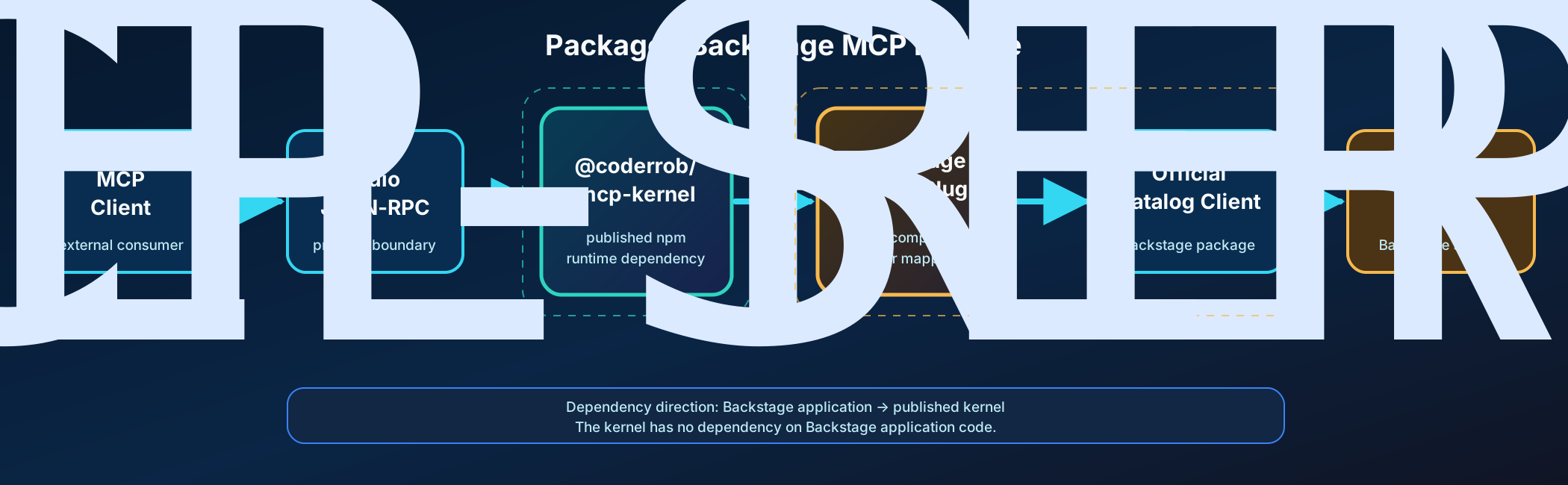
- An MCP client launches the packaged CLI and exchanges JSON-RPC over stdio.
- The published MCP Kernel validates and compiles immutable feature definitions.
- Zod validates input before middleware, authorization, caching, rate limiting, and timeout policies run.
- A Backstage tool calls the typed Catalog contract from its application context.
- The adapter delegates HTTP behavior to the official Backstage
CatalogClientand injects the bearer token at the fetch boundary. - Results return as MCP text plus structured content; expected failures use stable error codes and safe details.
The published @coderrob/mcp-kernel package owns protocol registration, lifecycle, policies, transports, testing support, and protocol-safe logging. This repository owns only the Backstage application and Catalog integration. See the current architecture overview for the dependency boundary.
MCP Kernel dependency
Generic server authoring, lifecycle, policies, transports, results, testing support, and logging are documented in the @coderrob/mcp-kernel repository. This package re-exports the kernel API for compatibility, but new generic consumers should install and import @coderrob/mcp-kernel directly.
To contribute a Catalog capability, follow Adding a Backstage MCP tool.
Verification
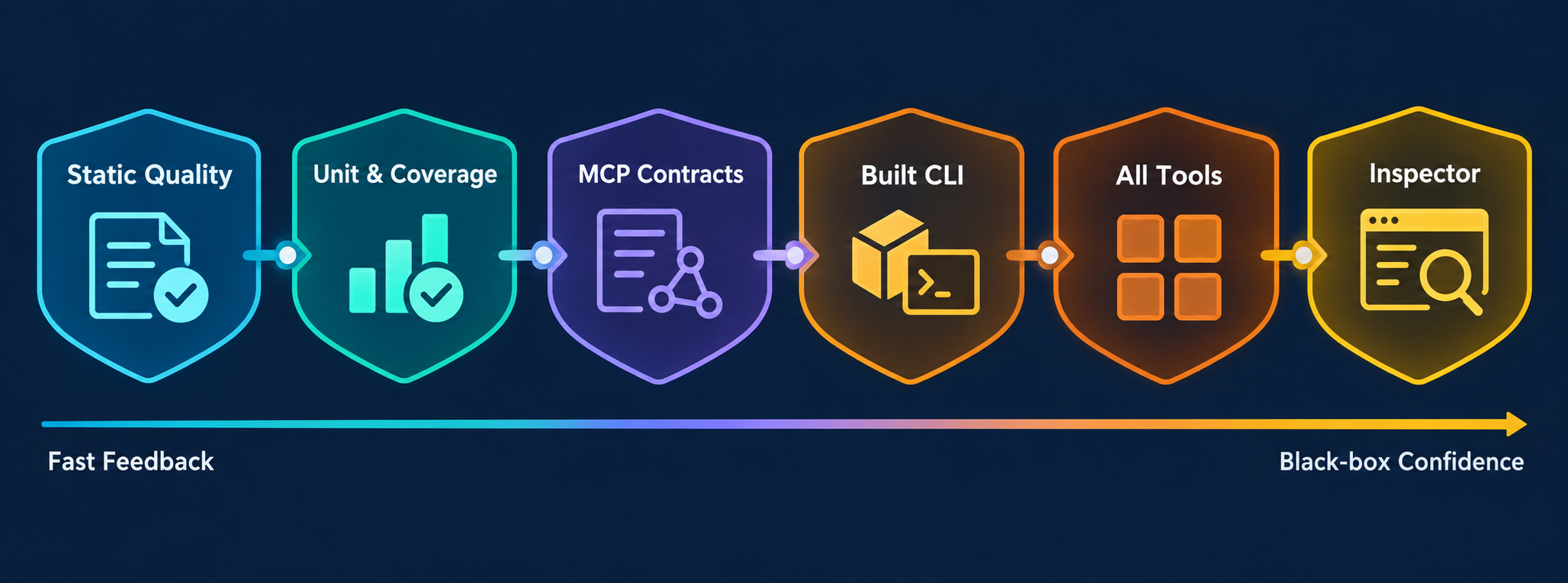
Run the normal contributor gate:
corepack yarn lint
corepack yarn typecheck
corepack yarn architecture:check
corepack yarn knip
corepack yarn test
corepack yarn test:shell
For MCP, tool, adapter, or packaging changes, also run:
corepack yarn test:mcp
corepack yarn manifest:check
test:mcp runs contract tests, builds the distribution, launches dist/cli.cjs over stdio with the official SDK client, invokes every registered tool against a deterministic authenticated Catalog stub, and performs an independent MCP Inspector check. It does not bypass the server with direct handler or HTTP calls.
See Repository tooling for the purpose and side effects of every command and MCP end-to-end testing for the exact black-box boundary.
Documentation
Choose a path from the documentation hub:
- Operate it: Backstage integration and end-to-end testing
- Develop it: Repository tooling, code quality, and adding tools
- Understand it: Architecture overview, ADRs, historical analysis, and implementation plan
- Maintain it: Dependency management
License
GPL-3.0. See LICENSE.
Curated knowledge and skills
The Backstage knowledge base maintains classified articles, named source citations and schema.org metadata. Repository skills in .agents/skills support catalog lookups, entity maintenance and MCP development.
The 19 contextual lookup tools cover names, System and Domain contents, Groups, ownership, dependencies, APIs, annotations and orphaned entities. See lookup contracts and examples, including pagination, ambiguity and work bounds.
Backstage MCP Fragen
Wie konfiguriere ich die Authentifizierung für den Backstage Server?
Du kannst ein Bearer Token über die Umgebungsvariable BACKSTAGE_TOKEN bereitstellen oder auf eine Token-Datei mittels BACKSTAGE_TOKEN_FILE verweisen.
Welche Art von Katalog-Operationen kann die KI ausführen?
Der Server bietet Tools für die Entity Discovery, Location Discovery, Entity Validation sowie Katalog-Mutationen wie das Hinzufügen, Aktualisieren oder Entfernen von Entities und Locations.
Kann ich diesen Server mit einem echten Backstage Deployment nutzen?
Ja, du kannst mit dem Befehl test:live eine Read-only-Prüfung gegen ein echtes Deployment durchführen.
Was sind die Systemvoraussetzungen für die Installation?
Du benötigst Node.js Version 24.15 oder neuer sowie installiertes Corepack.