
Lorebase MCP server
Commit 13. Nov. 2026Eine Open-Source-Ontologie-Plattform, mit der KI-Agenten Enterprise Knowledge Graphs über MCP und eine REST API lesen, versionieren und mergen können.
Auch bekannt als aantenore/lorebase
- Stars
- 2
- Tools
- —
- Downloads, 30 Tage
- —
- Neueste Version
- —
- Letzter Commit
- 13. Nov. 2026
- Lizenz
- Apache-2.0
Was ist Lorebase MCP?
Lorebase ist ein MCP server. Eine Open-Source-Ontologie-Plattform, mit der KI-Agenten Enterprise Knowledge Graphs über MCP und eine REST API lesen, versionieren und mergen können.
Zusammenfassung generiert aus dem README des Projekts
Über Lorebase MCP server
Das Management von Enterprise Knowledge Graphs mit Version Control und Schema Governance ist das, was Lorebase für Data Teams und Agent Builder ermöglicht. Es bietet eine Open-Source-Ontologie-Plattform, die es Nutzern erlaubt, sowohl Schemata als auch Daten mittels eines Workflows zu branchten, zu mergen und zu reviewen, der der Softwareentwicklung ähnelt. Da es auf deiner bestehenden Postgres-Datenbank läuft, wird sichergestellt, dass das Wissen typisiert und nachvollziehbar bleibt, ohne dass im Read-Pfad ein Language Model benötigt wird, was die Antworten deterministisch und schnell hält.
Entwickler können KI-Agenten über den Herald MCP server an diese Knowledge Base anbinden, der via PyPI verfügbar ist. Das Setup umfasst die Konfiguration der Umgebungsvariablen LOREBASE_URL und LOREBASE_DOMAIN, um auf eine laufende Keeper-Instanz zu verweisen. Für authentifizierte Umgebungen ist ein LOREBASE_API_KEY erforderlich. Das System unterstützt verschiedene Hosts wie Claude, Cursor und VS Code, sodass Agenten lexikalische oder hybride Suchen durchführen und typisierte Records abrufen können, die mit spezifischen Revisionen versehen sind.
Was du damit machen kannst
- 1Typisierte Enterprise-Records durchsuchenEin KI-Agent kann eine lexikalische Suche nach spezifischen Teilen innerhalb einer definierten Kategorie durchführen, um strukturierte JSON-Ergebnisse zu erhalten.
- 2Schreiboperationen von Agenten steuernEntwickler können sicherstellen, dass KI-Agenten Wissen nur durch validierte und auditierte Operations modifizieren, anstatt direkte Overwrites durchzuführen.
- 3Wissen aus Dokumenten extrahierenNutzer können den Prozess automatisieren, unstrukturierte Dateien wie PDFs oder Markdown in strukturierte, reviewbare Proposals umzuwandeln.
Geschrieben aus dem README des Projekts. Jeder Use Case wurde gegen ein Zitat daraus geprüft.
Konfiguration
LOREBASE_URL
| Name | Beschreibung | Typ |
|---|---|---|
| LOREBASE_URL | — |
Automatisierte Checks
Geluften am 14. Nov. 2026Vollständiger Bericht →Noch nicht verifiziert. Ein Server benötigt einen Score von 80, keine kritischen Befunde und genug Daten für unsere Prüfung. Wie die Checks funktionieren · Was du für mehr Punkte verbessern kannst

- Source Repository verknüpft und erreichbaraantenore/lorebase is public and reachablegithub.com/aantenore/lorebase ↗Bestanden
- Paket nennt dieses Repository als QuelleNicht geprüft
- Build-Provenienz (Sigstore-Attestierung)Nicht geprüft
- Open Source Lizenz (OSI)Apache-2.0spdx.org/licenses/Apache-2.0.html ↗Bestanden
- Commit oder Release im letzten JahrLast commit or release 2026-11-13github.com/aantenore/lorebase ↗Bestanden
- OpenSSF ScorecardOpenSSF Scorecard 5.2 / 10; weakest: Code-Review 0, Maintained 0, CII-Best-Practices 0scorecard.dev/viewer/?uri=github.com/aantenore/lorebase ↗Teilweise 8/15
- Package-Name ähnelt keinem populären PackageNicht geprüft
- Keine kritischen Advisories im Paket oder seinen AbhängigkeitenNicht geprüft
- Keine versteckten Anweisungen an das Modell0 tool descriptions and the README read; no override phrases, credential paths or hidden charactersBestanden
- Destruktive Tools sind markiertNicht geprüft
- Remote-Endpoint beantwortet den MCP-HandshakeNicht geprüft
README
Auf GitHub ansehenLorebase
A governed, versioned knowledge graph that AI agents read over MCP: schema and data branch, merge and get reviewed like code, on the Postgres you already run, with no model in the read path.
Documentation | Quickstart | Why Lorebase | Comparison | Validation | Roadmap




- For data and platform teams who own company knowledge (suppliers, parts, contracts) and want it typed, reviewed and versioned, with Sources that disagree sent to a reconciliation queue instead of the newest write winning.
- For agent builders who want typed Records with provenance, answers stamped with the Revision they came from, and writes only through governed Operations and Proposals.
- Instead of chunk retrieval over stale documents, agent memory engines that a model writes unreviewed, or a proprietary ontology platform: see the comparison.
An agent call
Herald, the MCP server, is on PyPI. Against a running Keeper with the sample Domain (quickstart):
export LOREBASE_URL=http://127.0.0.1:8080   # your Keeper; `make up` prints the local one
claude mcp add lorebase -e LOREBASE_URL="$LOREBASE_URL" -e LOREBASE_DOMAIN=supply -- uvx lorebase-herald
The agent then calls lorebase_search with {"query": "bearing", "kinds": ["Part"], "limit": 2, "format": "json"} and gets typed hits stamped with the Revision they were read from (64 hex digits, cut short here; snippets shortened):
{"revision": "10a13aad99df...", "mode": "lexical", "items": [
  {"ref": "Part/P-10001", "title": "Tapered roller bearing 6305", "snippet": "Tapered roller <b>bearing</b> 6305 ...", "score": 2.4},
  {"ref": "Part/P-10010", "title": "Needle roller bearing 6305", "snippet": "Needle roller <b>bearing</b> 6305 ...", "score": 2.4}]}
No model ran to answer it. Cursor, VS Code and other hosts take the same uvx lorebase-herald command (MCP host configuration); a Keeper with authentication on also needs LOREBASE_API_KEY.
Pre-alpha, v0.3.1. The versioning and merge engine, the Keeper REST API, the MCP server (Herald), the Python client, the
lorebaseCLI, Scribe (Sources, document extraction, embeddings) and the web app run today, and interfaces may change before 1.0. Status and roadmap lists what is open. The quickstart is the place to start and the validation record the place to check the claims.
30-second demo
The core engine runs in memory, with no services. This script loads the sample supply Domain into main, branches model/risk (analysts change the schema and data) and source/erp (a nightly feed changes data), merges both, lists the Conflicts, resolves them and diffs.
git clone https://github.com/aantenore/lorebase.git && cd lorebase
uv sync --all-packages
uv run python examples/merge_demo.py
== 5. merge source/erp into main
merge base 44de5fcc: 5 Conflicts

DV1 ATTRIBUTE_VALUE (1)
  where            attribute   base  ours  theirs  choices
  -----            ---------   ----  ----  ------  -------
  Supplier S-1001  risk_score  32    80    45      ours/theirs/base/custom

DV2 DELETE_MODIFY (1)
  where         attribute  base      ours      theirs    choices
  -----         ---------  ----      ----      ------    -------
  Part P-10003  -          {record}  (absent)  {record}  ours/theirs/base/custom
...
== 7. merge again
merged: Revision f6e285ab, parents bd2792a4, 95cc2625
validation: 72 Records against the merged schema, 0 issues
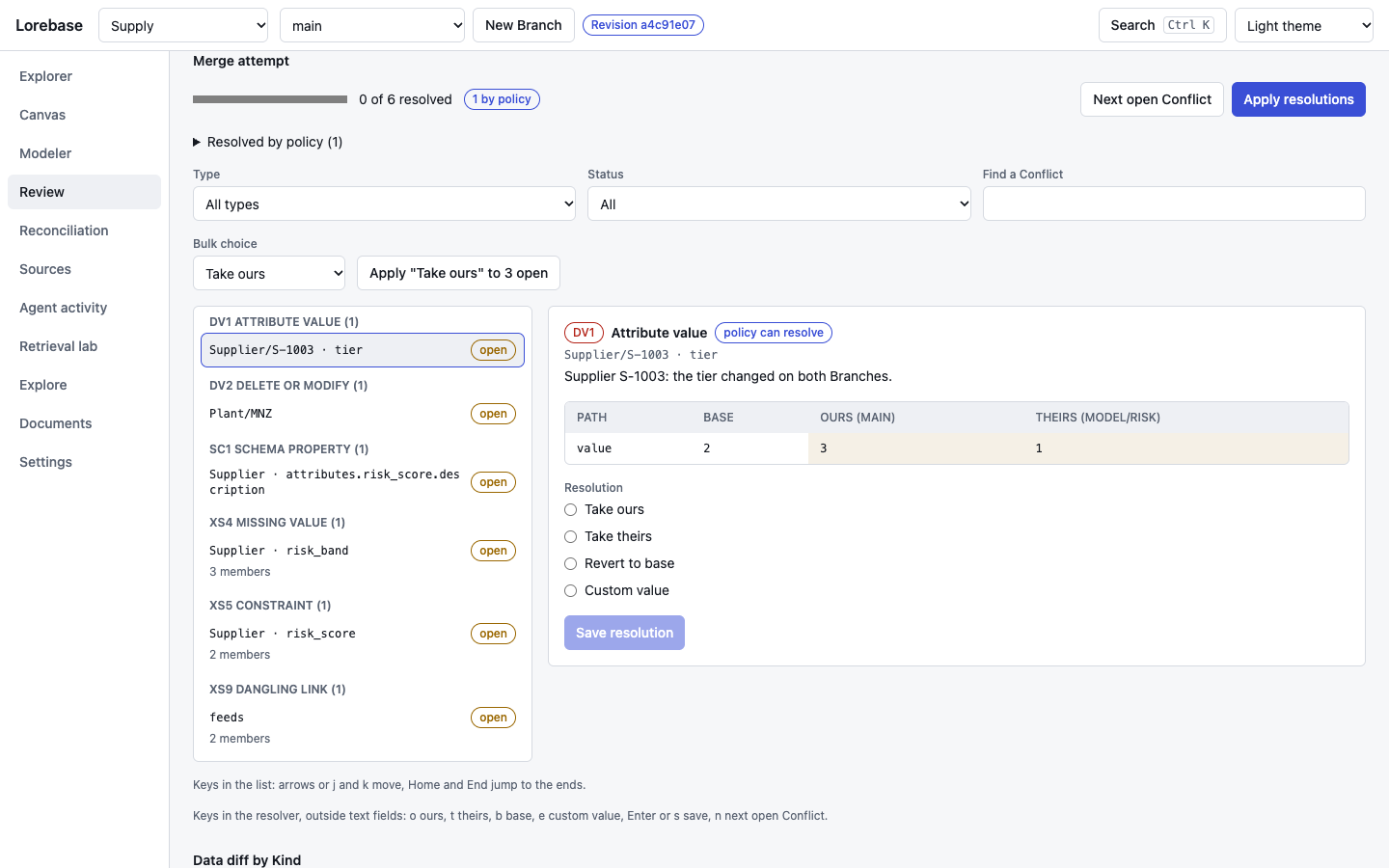
The analysts say 80, the ERP says 45, and someone has to decide. That decision is a recorded resolution, not a silent overwrite. The walkthrough of the whole output is in manual setup.
What it is
Lorebase is an open-source ontology platform: a versioned knowledge graph for AI agents, self-hosted on Postgres, the only datastore it needs (language models are optional and used only by Scribe and Guide, never on reads). You model what your organization knows as a typed ontology (Kinds, Attributes, Relations, Operations) and change it the way developers change code: on a branch, reviewed, merged, traceable. Schema and data branch and merge together, with three-way Conflicts resolved per Attribute. Agents live outside Lorebase, in any framework. They read through a REST API or the MCP server, neither of which calls a language model, so answers are deterministic and fast, and they write only through governed Operations and Proposals. It is meant as an open-source alternative to proprietary ontology platforms and runs on a laptop with docker compose.
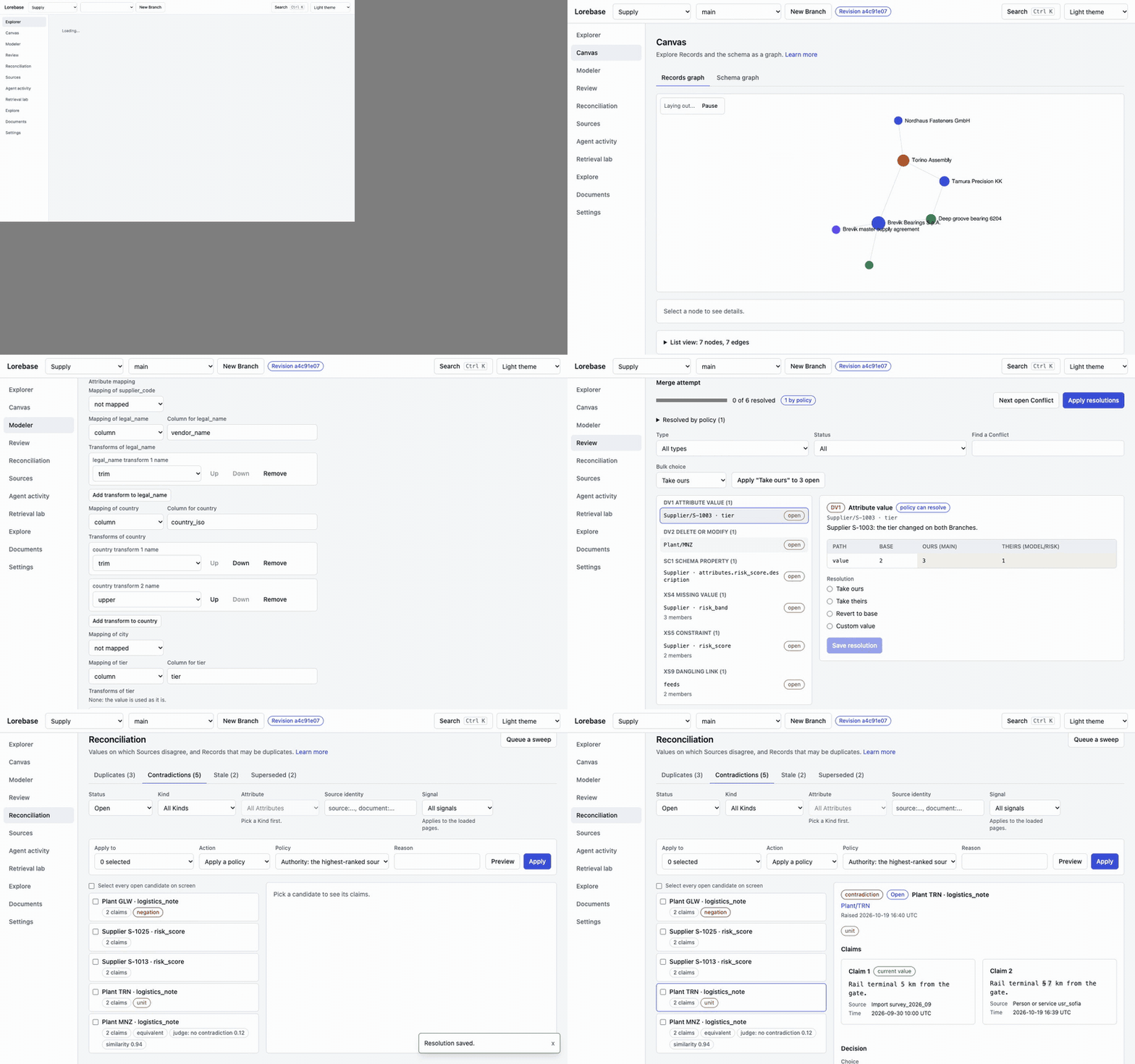
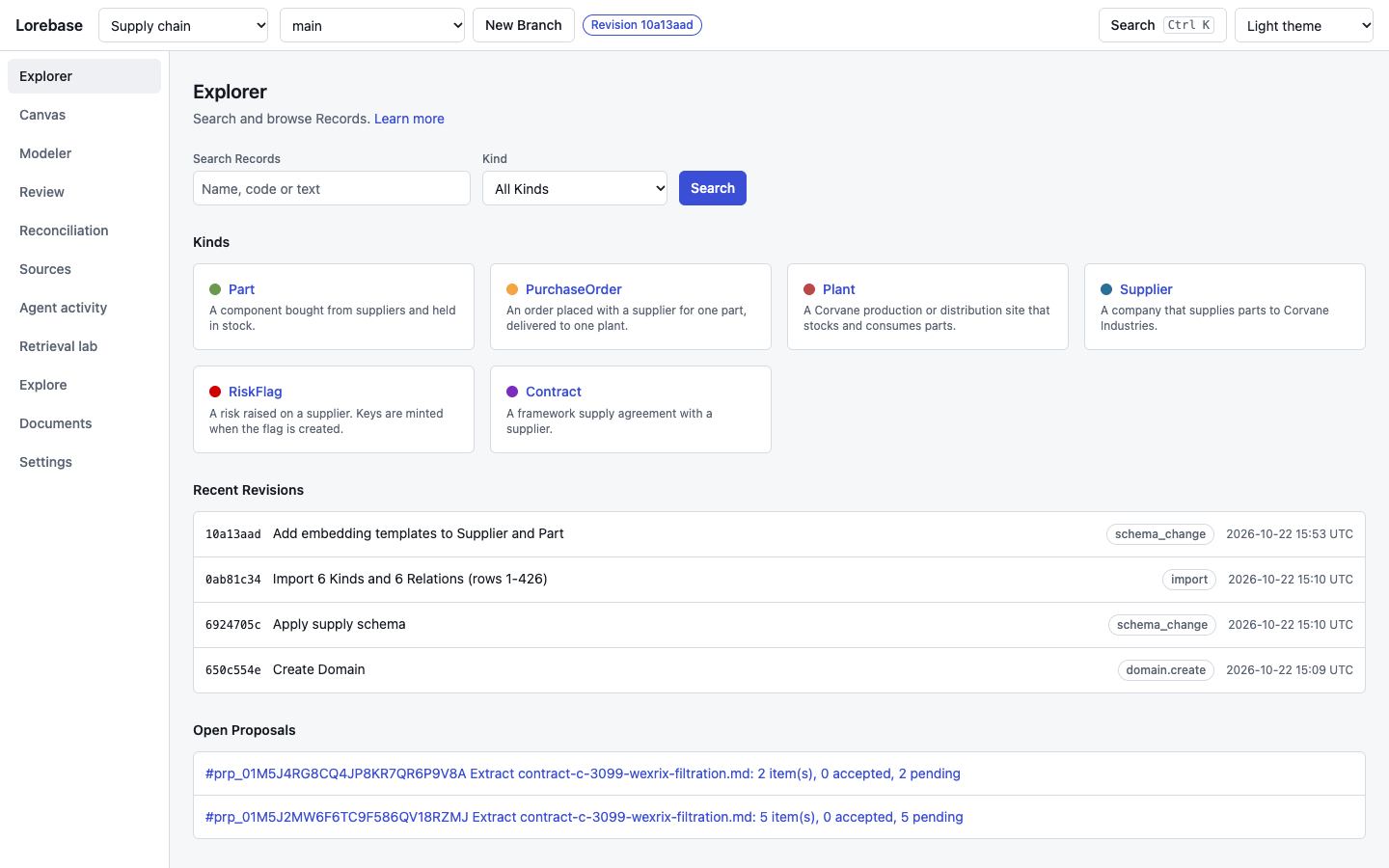
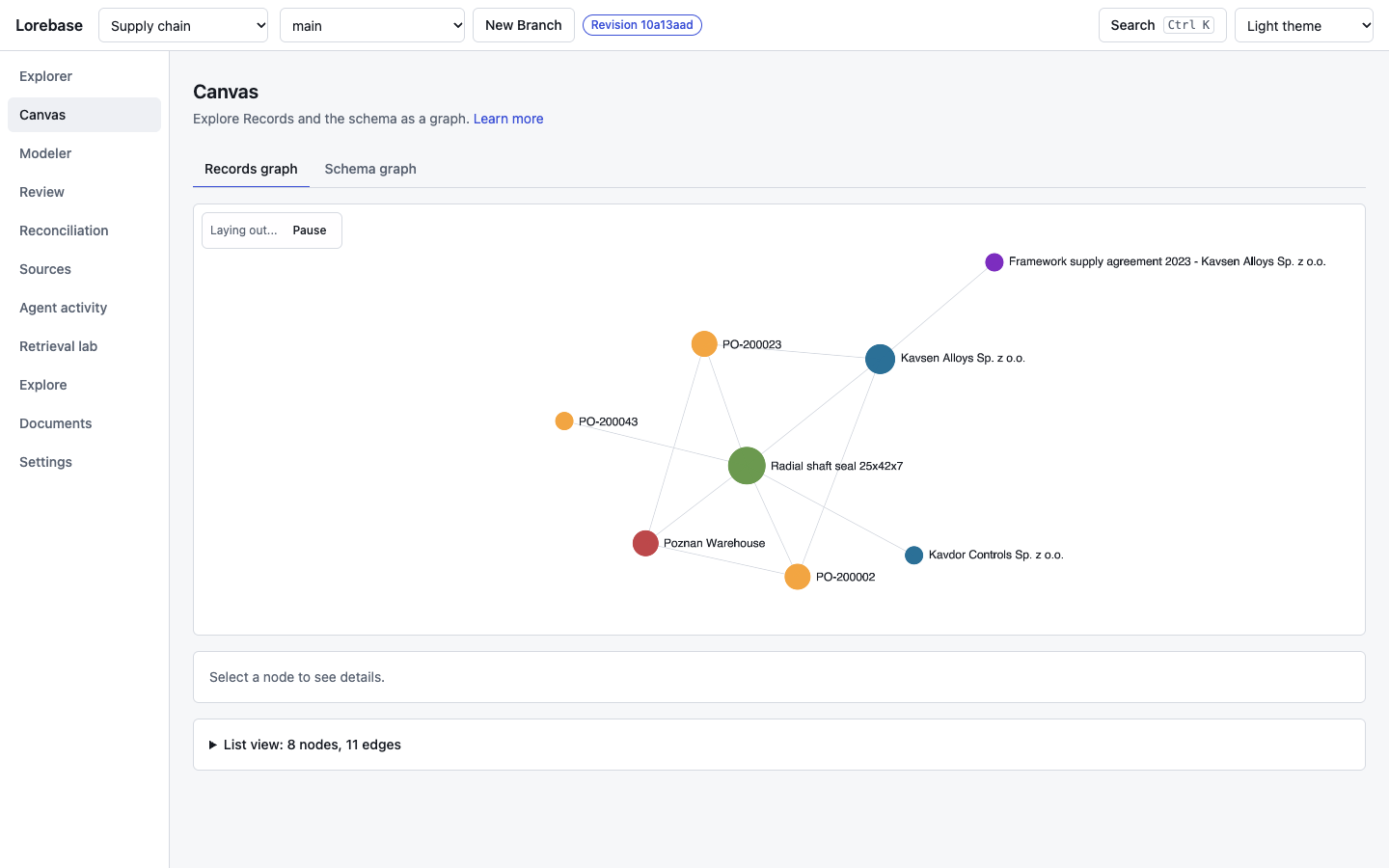
The web app walking through Explorer, Canvas and a Conflict in Review. It runs on a mock API with sample data; see the visual tour.
Try the five-day demo
The proof scenario of the design as one command, against a real stack: schema inferred from CSV files, data loaded, two teams editing the same suppliers on two branches, Conflicts resolved from the command line, a Source sync, a signed webhook, an agent reading and writing through the MCP server, rate limits and a backup restored into a second database. It needs Docker and uv.
make demo                # builds the stack under its own project name, runs the five days, removes it
make demo KEEP=1         # leave the stack running afterwards; `make demo-down` removes it
The stack is the compose project lorebase-demo with Keeper on port 18080 and Postgres on 15432 (DEMO_KEEPER_PORT, DEMO_POSTGRES_PORT change them), so it does not touch a stack you already run. The first run builds the image; the five days themselves take under a minute. Each command is printed before its output. docs/demo.md tells the story day by day with the transcript; examples/five_day_demo/run.sh runs the same days against any Keeper.
Why Lorebase
- Branch and merge schema and data, with three-way conflicts. Change the model and the data on a branch, merge, and get typed Conflicts (attribute value, delete or modify, type coercion, cardinality, dangling link and more) instead of a corrupted knowledge base. The merge engine checks the merged data against the merged schema before it commits.
- Milliseconds reads for agents. Reads are deterministic SQL over materialized branch heads, with no model in the path. This is enforced by the build: Keeper cannot import the inference package. Every response names the Revision it was served from. Measured numbers are below.
- Governed writes through Operations and Proposals. Agents change knowledge only through Operations with validation, permissions, dry run, idempotency and audit. Writes to a protected branch go through a Proposal, with reviews, required approvals and Conflict resolution over REST. Both are there today.
- Schema as code. The ontology is a YAML document you review in a pull request and apply as one schema change set. Attribute ids are stable, so renames merge cleanly.
- Runs free on a laptop, scales out when you need it. One
docker compose, Postgres 16, no API keys. Add Keepers behind a load balancer and Postgres read replicas with a freshness guard for read load. Document extraction uses one OpenAI-compatible interface, local (Ollama, fastembed, GLiNER, GLiREL) or paid, selected by configuration, and only Scribe calls it.
Features
| Area | What is there |
|---|---|
| Modeling | Typed ontology as YAML: Kinds, Attributes, Relations with cardinality, Traits, Operations, Derivations and Sources, validated statically. CEL expressions in Operations and Derivations are type checked when a schema is applied. LinkML schemas import and export. |
| Derivations | Expression and aggregate Derivations recomputed in the materialized head; path Derivations composed from Relations at read time, or stored and kept current when materialized (design 5.8). |
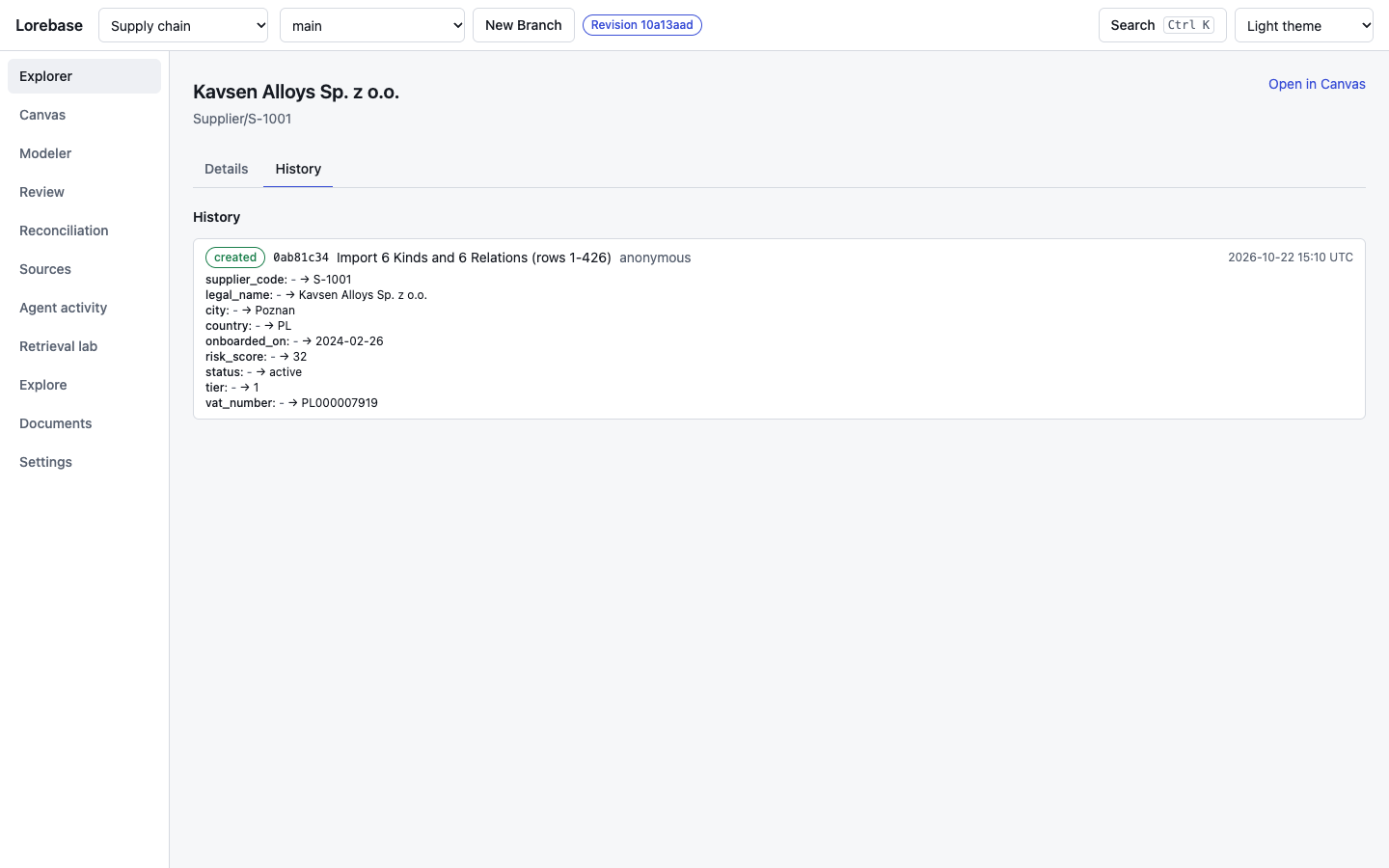
| Versioning | Content-addressed Revisions, branches, tags, diff, three-way merge of schema and data with the full Conflict taxonomy and merge policies, and time travel reads at any Revision. Overlay branches store only the rows they change and are created in milliseconds. |
| Review | Proposals with reviews, required approvals, branch protection and Conflict resolution over REST, CLI and the web app. Agent writes that need review run on a task branch and open a Proposal (agents). |
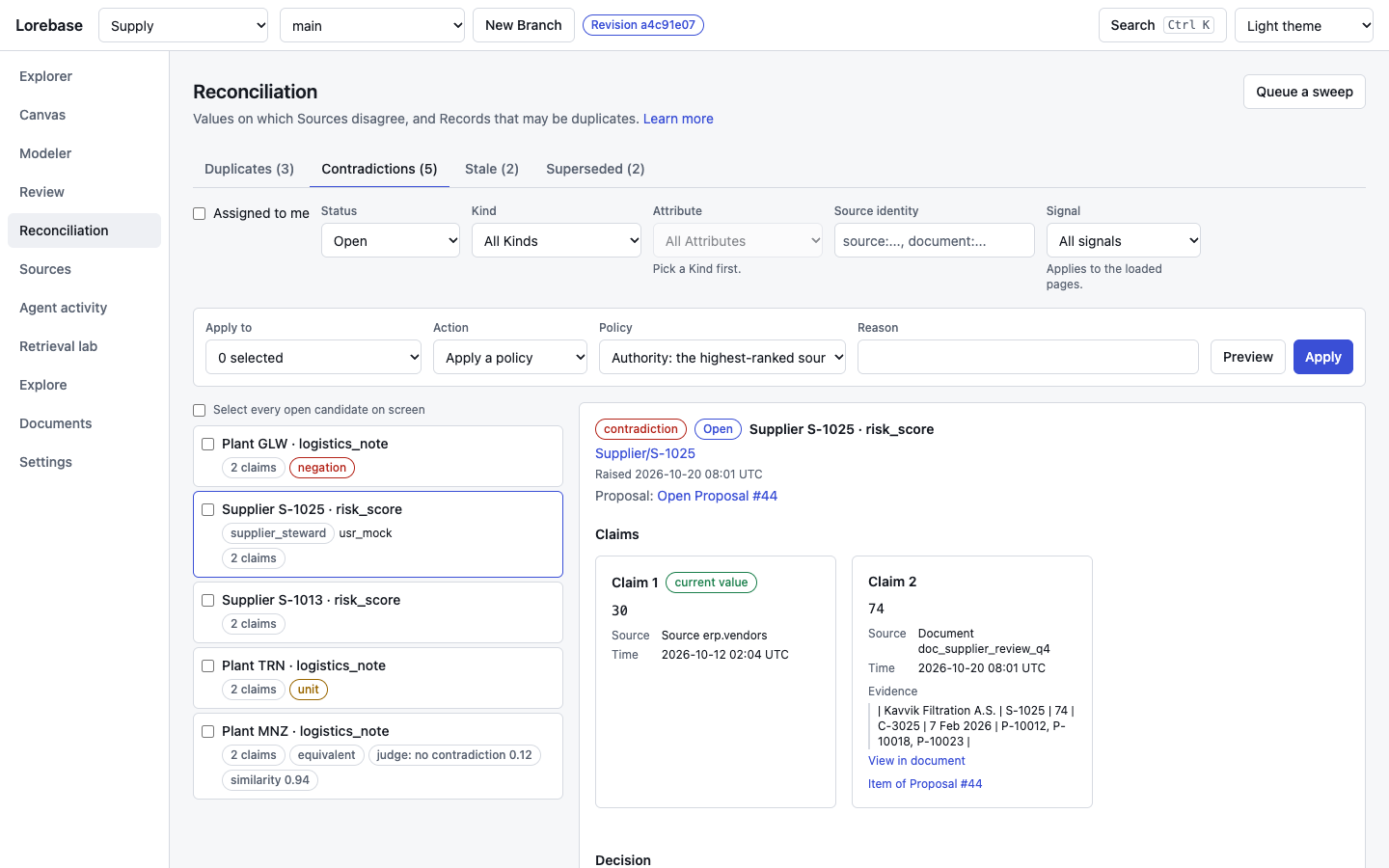
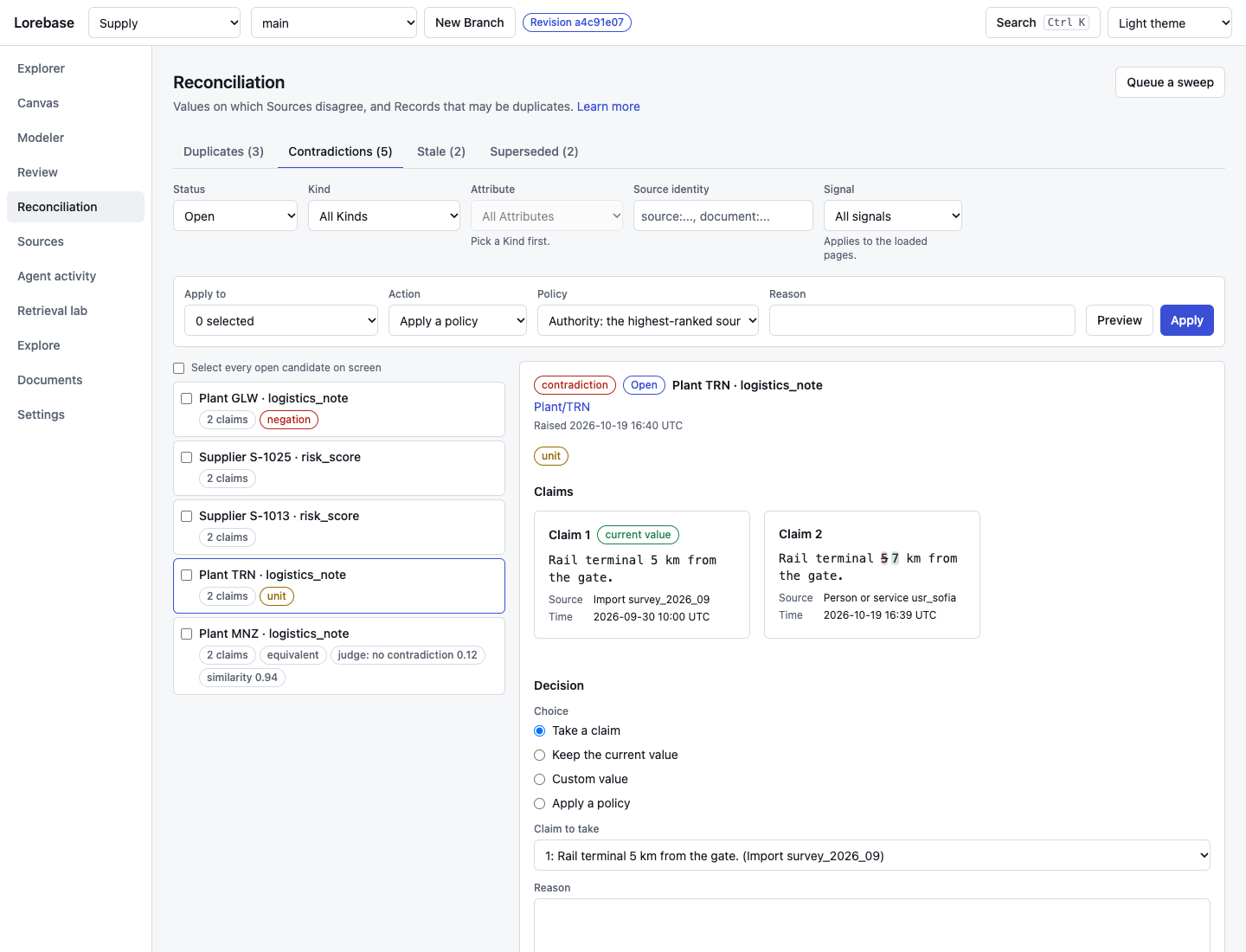
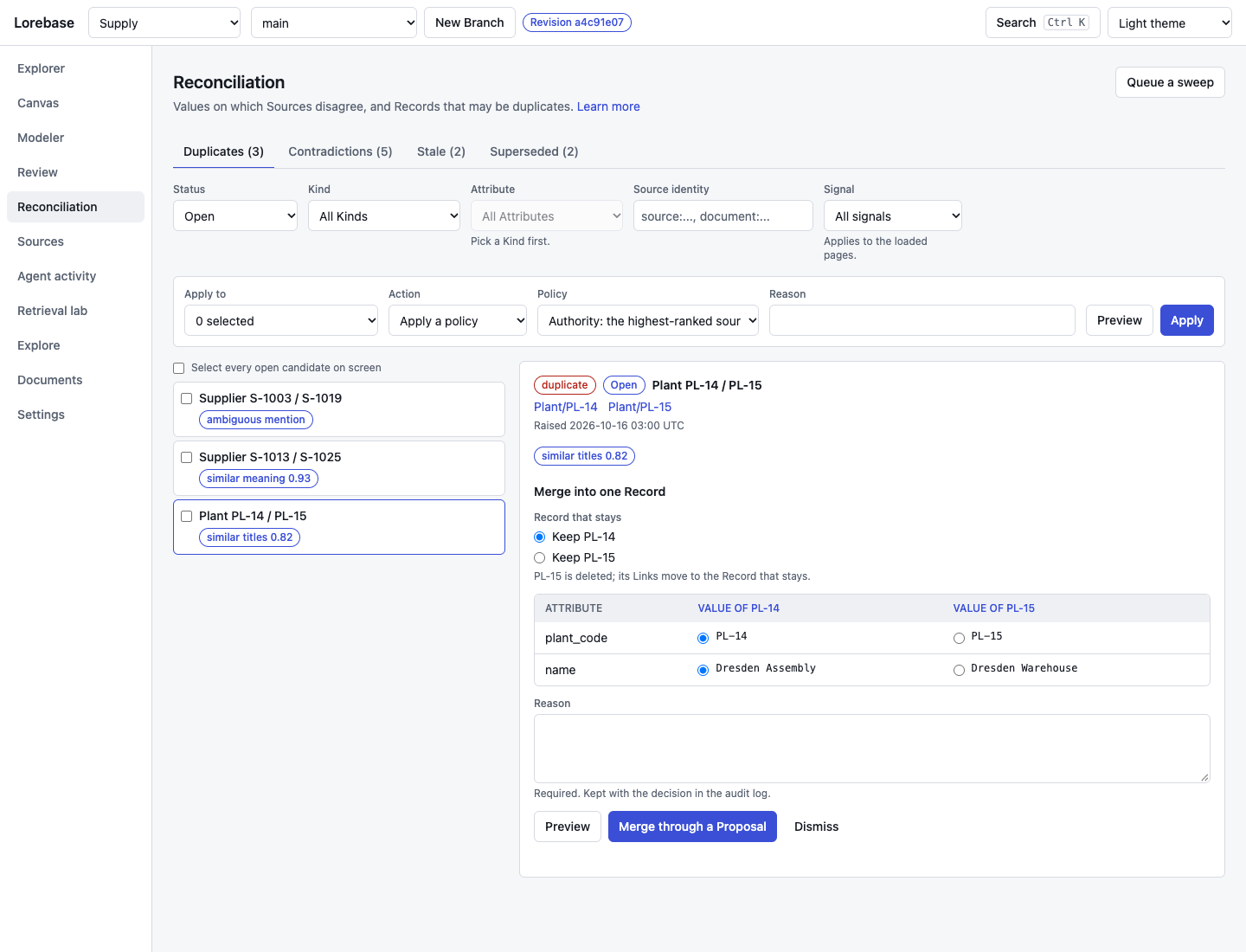
| Reconciliation | Values on which Sources disagree, Records that may be duplicates, stale and superseded values go to a review queue instead of the newest write winning unnoticed. Nothing is decided automatically: a person takes a claim, keeps the current value, applies a policy or merges duplicates, written through Operations with provenance and audit (design 10.6, Scribe). |
| Reads | Records, Links, query DSL, traversal, neighborhood, lexical and typo-tolerant search, hybrid search over embeddings computed by Scribe, Record history and lineage, all with ETags. Context packs within a token budget and Record explanations (agents). |
| Governance | API keys and OIDC, role grants per Domain, Kind, Operation and branch, a hash-chained audit log with signed checkpoints, shared rate limits, signed webhooks and a change feed. |
| PII vault | Attributes tagged pii, confidential or restricted are masked without clearance on every read path and kept out of search. vault: true Attributes store encrypted values that lorebase admin erase removes from every Revision (design 13.5). |
| Connectors | CSV, JSON, JSON Lines, Parquet, HTTP JSON, Postgres, MySQL/MariaDB and SQL Server Sources with snapshot and incremental syncs into Source branches, Proposals or direct merges, with per-row Lineage (Scribe). Schema inference from files and tables (inference). |
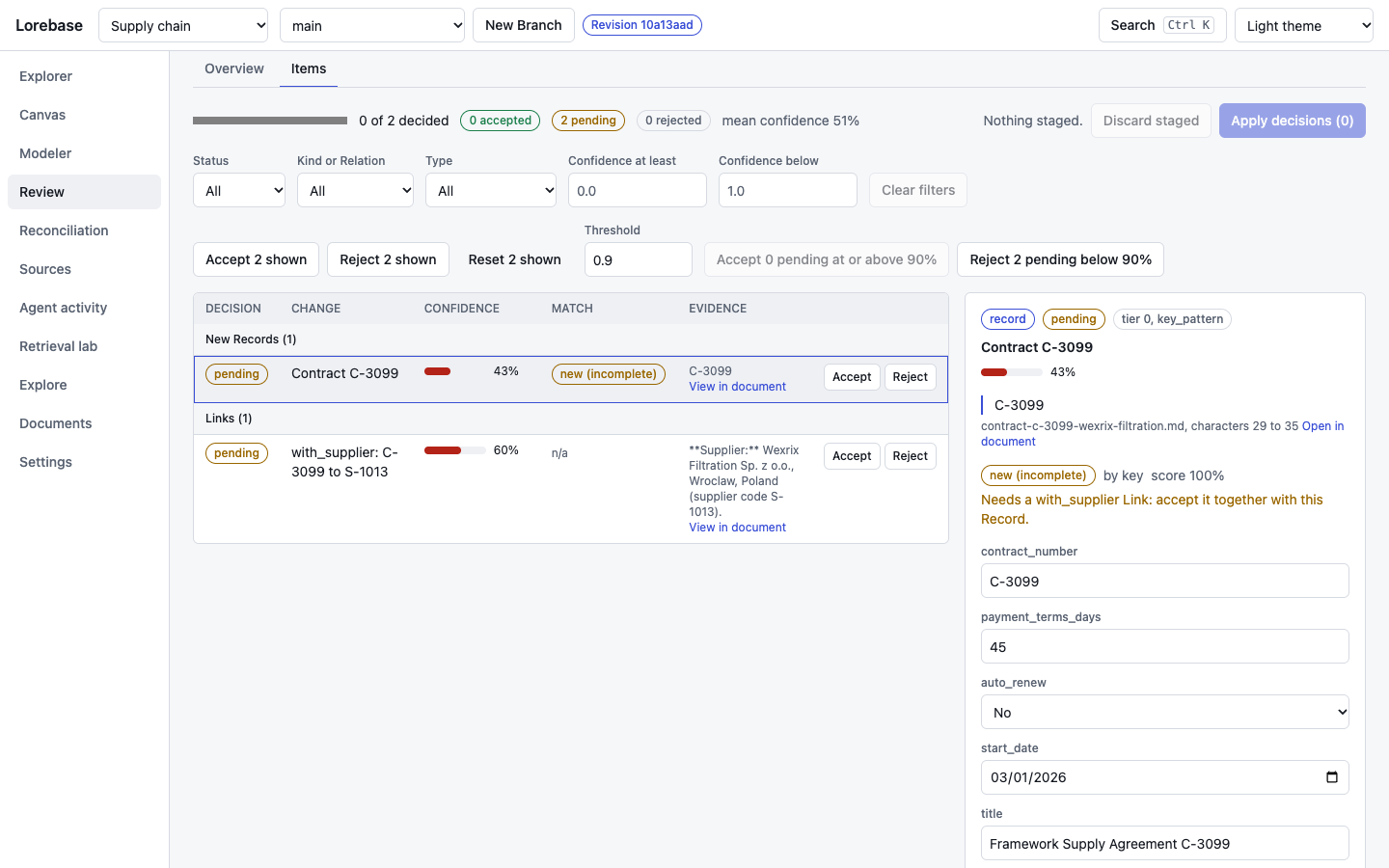
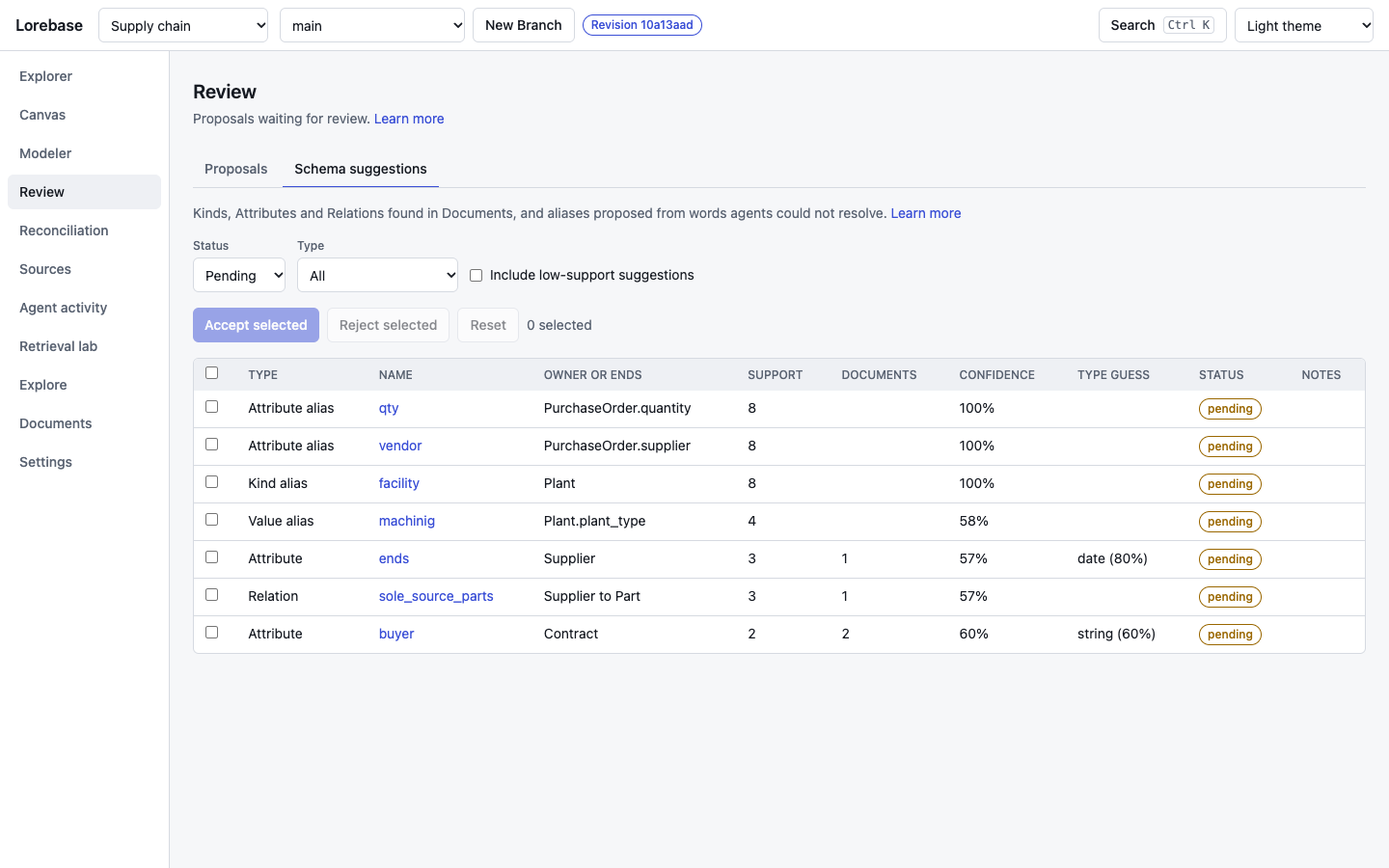
| Documents | Markdown, text, PDF and DOCX extracted into reviewable Proposals by rules, local span and relation models, or any LLM with JSON schema output, with verified evidence and schema suggestions (extraction). Any OpenAI-compatible endpoint or local model, chosen by configuration (providers). |
| Agent access | Herald, the MCP server, on stdio and Streamable HTTP (MCP). Python client (sync and async) and CLI, checked against the committed OpenAPI document. |
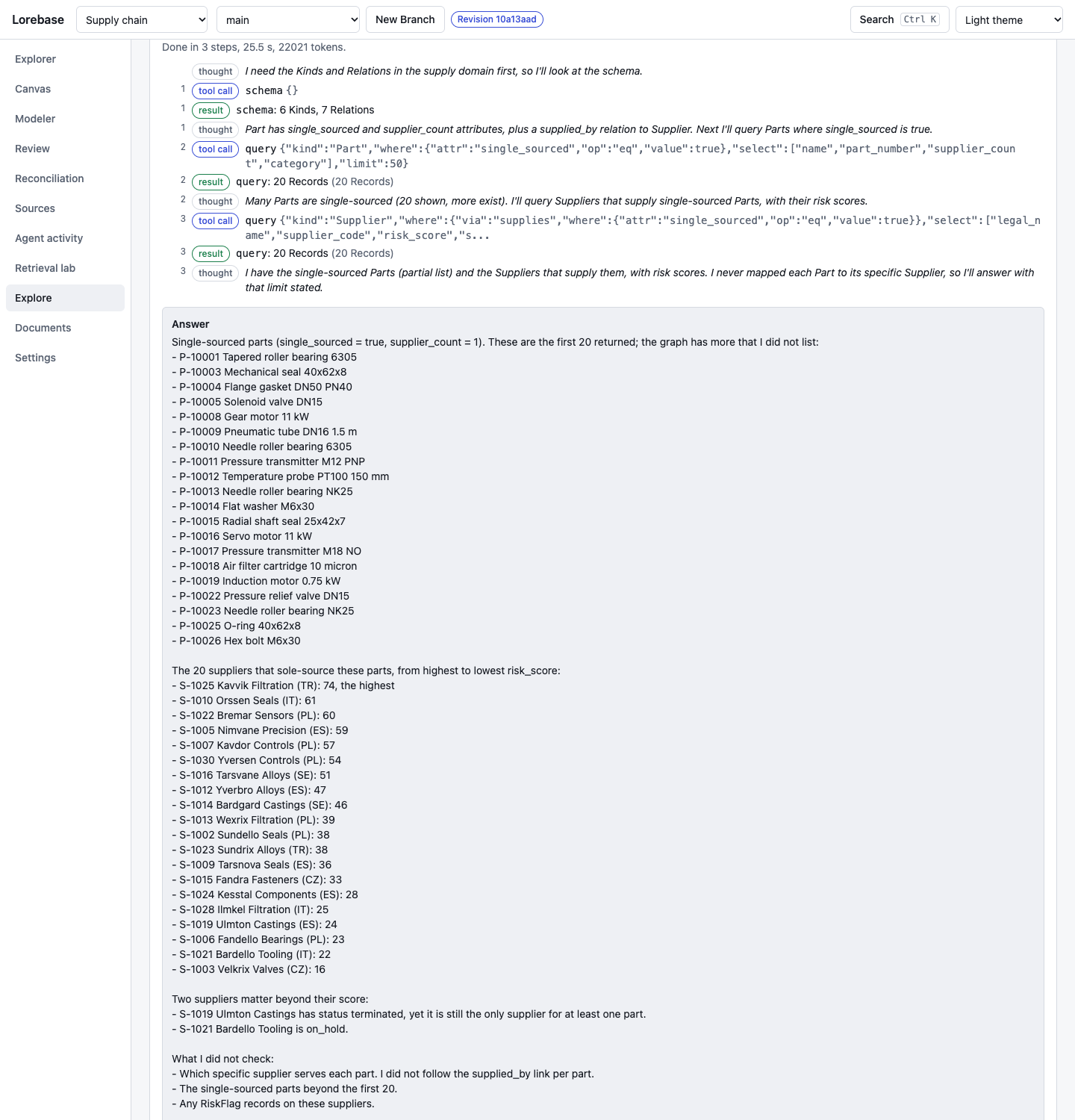
| Guide and Explore | An optional assistant answers questions about a Domain by reading it through Keeper, streamed step by step with links to the cited Records (guide). |
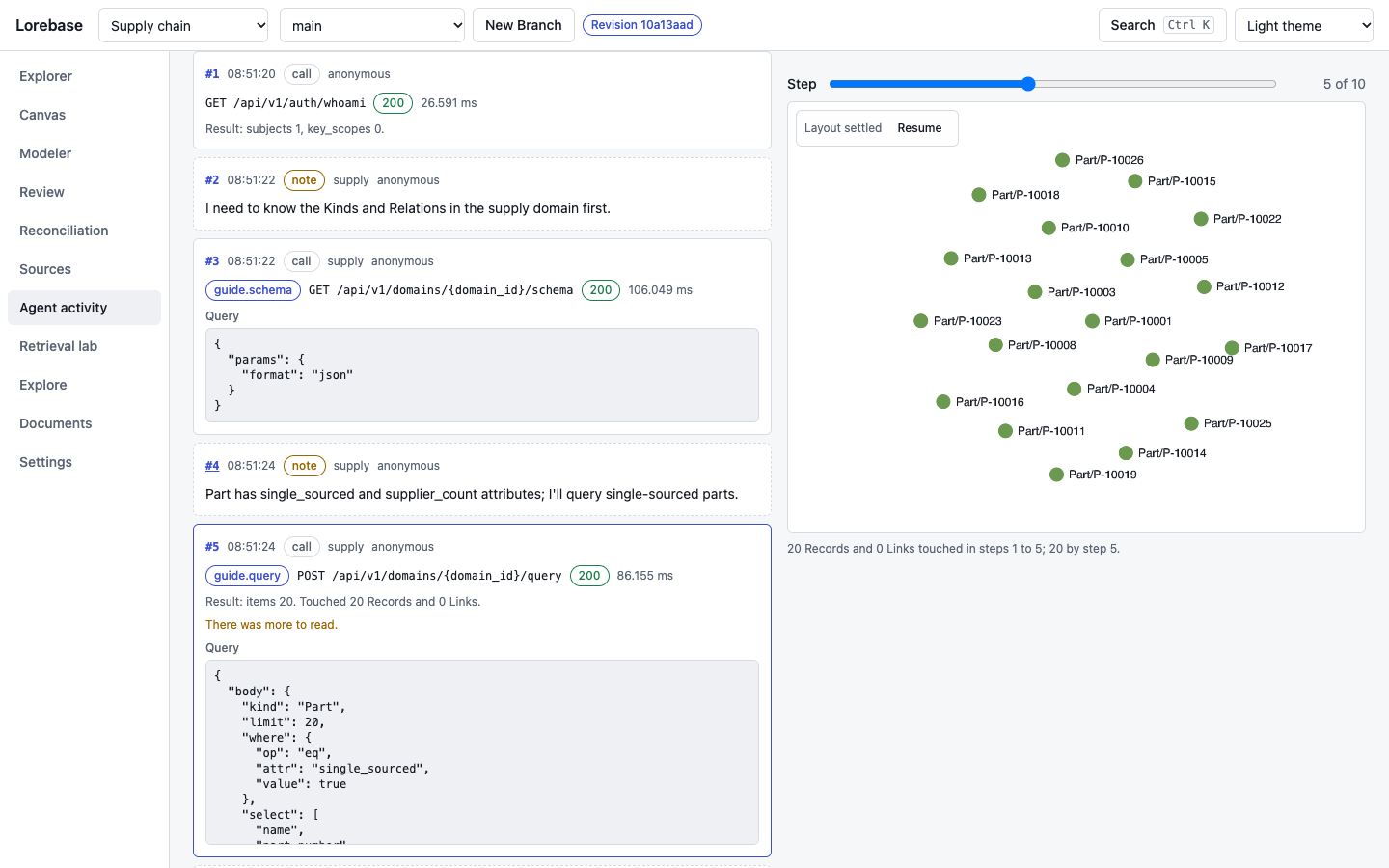
| Agent trace | The steps of an agent session and the Records it touched are recorded and shown on the Canvas (agent trace). |
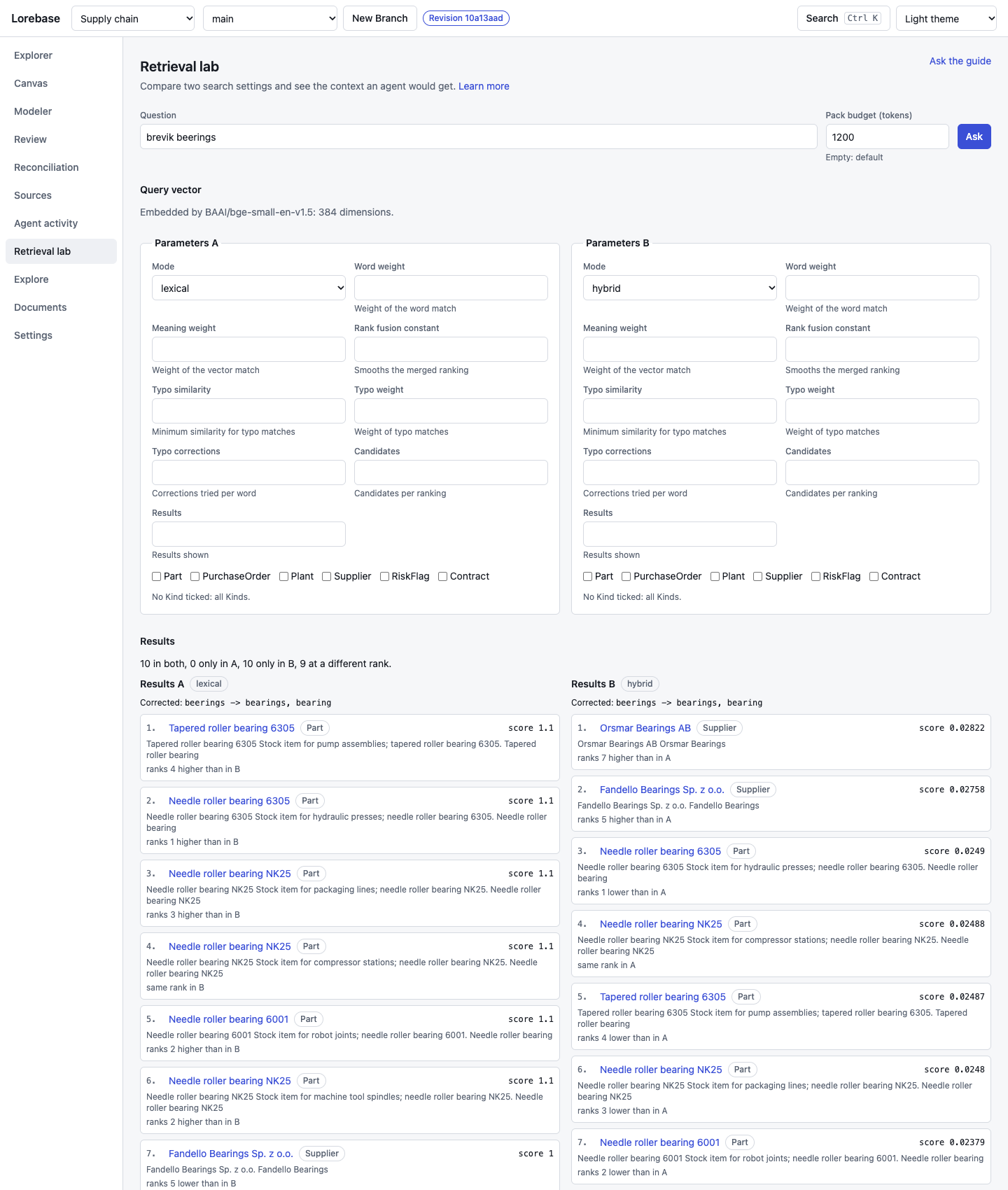
| Retrieval lab | Two search settings compared side by side, with the resulting context pack (retrieval lab). |
| Web app | Explorer, Canvas, Modeler, Review, Reconciliation, Documents, Sources, Explore, Agent activity, Retrieval lab and Admin basics, on a mock API or on Keeper (tour). |
| Storage profiles | compact, balanced and fast decide which secondary indexes exist and how lineage is stored; python -m lorebase_store.storage apply switches a running install (performance). |
| Operations | docker compose and a Helm chart, read replicas with a freshness guard, garbage collection, Domain backup and restore bundles, a Postgres job queue, metrics, Grafana dashboards and alert rules, CI with CodeQL (run on demand and on every release tag, not on every pull request) and signed images (operations, Kubernetes). |
The milestone breakdown with checkboxes is in the roadmap.
Read performance
p95 latency in milliseconds of the agent reads on a materialized head of 99,900 Records and 302,940 Links, one laptop with Postgres in Docker, measured by tests/perf/bench.py (docs/performance.md). owner is a database role not subject to row-level security; rls is subject to it, like the role Keeper runs as in production:
| Read | Budget | owner p95 | rls p95 |
|---|---|---|---|
| Record by key | 5 | 1.07 | 1.25 |
| Page of 50 | 20 | 1.57 | 1.65 |
| Links of a Record | 10 | 1.30 | 1.58 |
| Neighborhood, 2 hops | 30 | 5.67 | 5.11 |
| Query on an indexed Attribute | 25 | 1.71 | 1.86 |
| Full-text search | 50 | 2.58 | 2.75 |
| Full-text search, typo-tolerant titles | 50 | 22.32 | 22.64 |
Under row-level security Postgres cannot use non-leakproof operators (->>, casts, @@) as index conditions, so search, incoming Links, neighborhoods and attribute queries run inside security definer functions that pin the Domain they are given (store schema notes), and search reads an index scoped by Domain and branch (migration 0011). Every read of both roles is within its budget; as plain SQL the rls role measured 28 ms, 137 ms and 68 ms for Links of a Record, the neighborhood and search. Reads on an overlay branch stay within 30% of a full copy at p50. At 1M Records every read on main is within budget; the neighborhood on other branches is just over it when the working set does not fit in memory. The 1M and 10M runs, with the storage profiles, are in the validation record.
See it
Screens of the web app on a running demo stack with the supply sample: real data, a real answer of the guide service and its trace. The Conflict resolver and the Reconciliation queue come from the mock API. The visual tour shows every screen and says where each picture comes from.
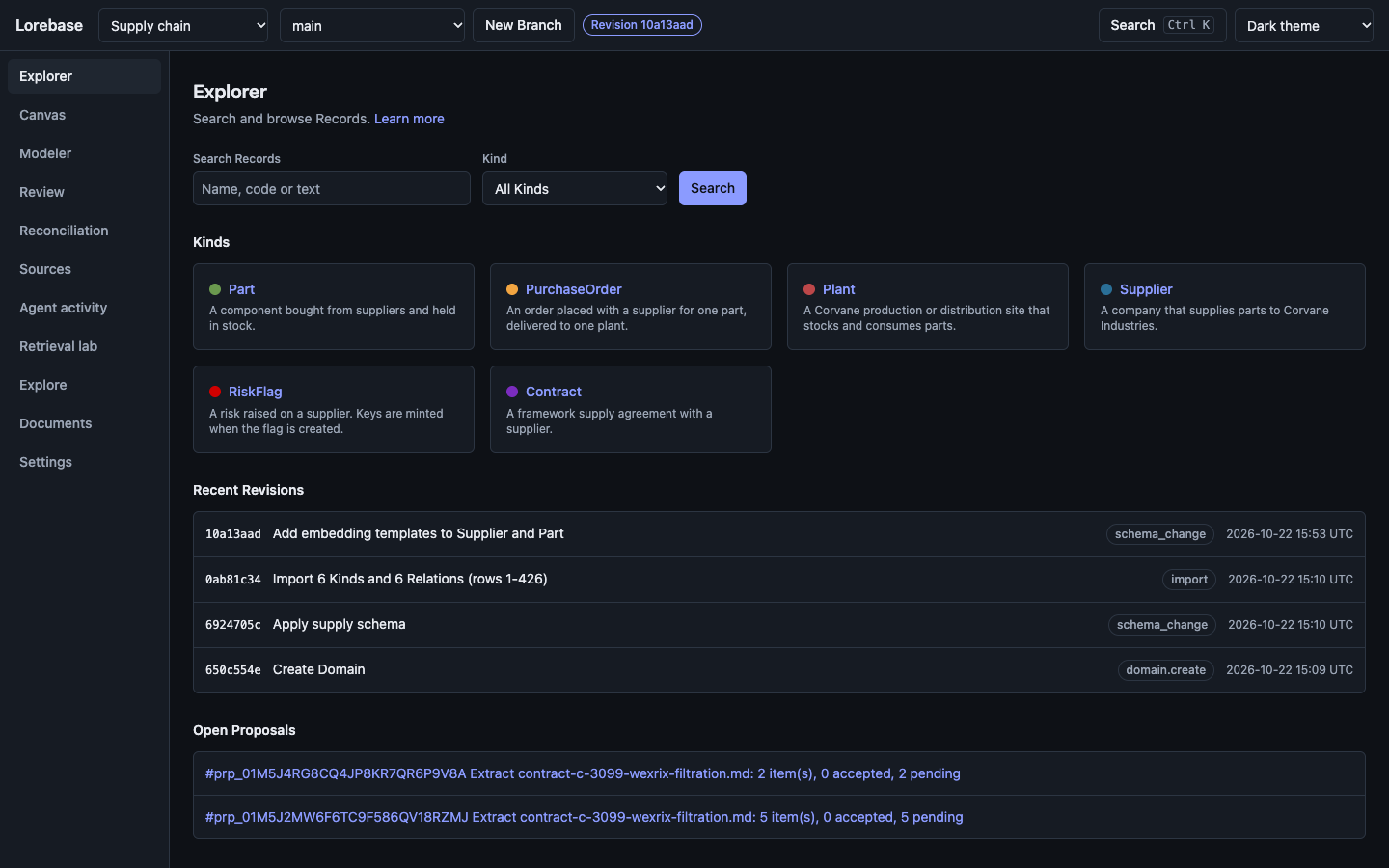
| Explore | Agent activity | Retrieval lab |
|---|---|---|
 |
 |
 |
| Explorer | Canvas | Record history |
 |
 |
 |
| Extraction items | Schema suggestions | Conflict resolver |
 |
 |
 |
| Reconciliation queue | A contradiction | Duplicate merge |
 |
 |
 |
Quickstart
Requirements: uv (it installs Python 3.12), Docker with compose, make, curl and openssl; no Node.js needed (the web app runs in a container). Keeper uses port 8080, the web app port 8090 and Postgres port 5432 on 127.0.0.1; change KEEPER_HOST_PORT, LOREBASE_WEB_PORT and POSTGRES_HOST_PORT in .env if they are taken.
git clone https://github.com/aantenore/lorebase.git && cd lorebase
uv sync --all-packages

make env            # .env from .env.example, with generated database passwords
make up             # build the images, start Postgres, migrations, Keeper and the web app; prints the web URL
make example-data   # Domain `supply`: schema, 185 Records with their Links, merged into main

eval "$(make shell-env)"   # exports LOREBASE_URL (the Keeper URL `make up` printed) and LOREBASE_DOMAIN=supply
uv run lorebase search bearing --kind Part     # first query
Then open the web app at http://127.0.0.1:8090 (the URL make up printed). It is served by the web container, which forwards /api/ to Keeper, so nothing else is installed or configured. Contributors changing the app use the dev server instead.
There is nothing to sign in to: the example configuration runs with authentication off, on loopback only. make down stops the stack and make clean-stack deletes its data.
The first make up builds the backend and web images (a few minutes); the rest takes about a minute. The quickstart explains each step and continues with an agent connected over MCP, a real model (Ollama by default, or any hosted OpenAI-compatible endpoint with its key in a file), cleanup and troubleshooting; manual setup goes through the REST API one call at a time, and the modeling guide explains the schema of your own Domain. Scale-out with replicas is in docs/deployment.md, and the Kubernetes install in docs/kubernetes.md. Configuration is external: .env for compose, config/lorebase.example.yaml for the services, apps/web/.env.example for the web app.
Install the command line and the MCP server from PyPI
The ten packages are published on PyPI at 0.3.1 (lorebase-cli, lorebase-client, lorebase-herald, lorebase-keeper, and the rest). To talk to a running Keeper you do not need a clone:
uv tool install lorebase-cli            # or: pip install lorebase-cli
lorebase --version
uv tool install lorebase-herald         # the MCP server, `lorebase-herald`
pip install lorebase-client             # the Python client library
The stack itself (Postgres, Keeper, web app) still starts from a clone with make up, as above. uvx --from lorebase-cli lorebase ... runs the CLI without installing it, and uvx lorebase-herald the MCP server (host configuration).
Architecture
flowchart LR
  subgraph Clients
    A1[External agents<br/>any framework]
    A2[Web app<br/>Explorer, Canvas, Modeler, Review]
    A3[Python client and CLI]
  end

  subgraph Lorebase
    H[Herald<br/>MCP server]
    K[Keeper<br/>REST API, auth, commit pipeline,<br/>merge engine, read path]
    S[Scribe<br/>jobs, scheduler, Source syncs,<br/>document extraction, webhooks]
  end

  subgraph PG[Postgres 16]
    V[(Versioned store<br/>objects, trees, Revisions, refs)]
    M[(Materialized branch heads<br/>records, links, search)]
    G[(Governance<br/>grants, audit, jobs)]
  end

  A1 -- MCP --> H
  A1 -- REST --> K
  H -- REST --> K
  A2 -- REST --> K
  A3 -- REST --> K
  K --> V
  K --> M
  K --> G
  S --> V
  S --> M
  S -. extraction, offline only .-> L[Model endpoint<br/>local or OpenAI-compatible]
The agent read path is agent -> Keeper -> materialized head, or agent -> Herald -> Keeper -> materialized head over MCP. It never touches a model; only Scribe does, offline, to extract documents. Postgres is the only required store, with pgvector for optional semantic search. Details: docs/design.md.
How it compares
Lorebase sits between proprietary ontology platforms, versioned databases, graph databases and agent memory engines. The full comparison, including where each of them is the better choice, is in docs/comparison.md.
| Product | What it is | Branch and merge of knowledge | Choose it instead when |
|---|---|---|---|
| Lorebase | Typed ontology as a shared system of record, Postgres only | Yes, schema and data together, three-way | You want agents to read a reviewed, versioned knowledge base and change it only through governed Operations |
| Palantir Foundry Ontology | Proprietary operational ontology inside a full data platform | Within the platform | You need the whole platform and a vendor to run it |
| TerminusDB | Versioned document and graph database | Yes, on its own storage engine | You want a general versioned graph database to build on |
| Dolt | SQL database with git semantics | Yes, on tables | Your data is tabular and you want versioned SQL |
| Neo4j | Property graph database | No | You need graph algorithms and pattern queries at scale |
| Cognee | Agent memory built by LLM pipelines | No | You want automated memory for a single agent |
| Graphiti and Zep | Temporal knowledge graph for agent memory | No (facts carry validity time) | You need conversational memory with temporal reasoning |
| Mem0 | Per-user memory layer | No | You want personalization memory for assistants |
| DataHub | Metadata catalog with an MCP server and metadata proposals | Versions and proposals of metadata, not of the data | You need lineage, ownership and a glossary across a data platform |
| Semantica | Python framework building knowledge graphs with OWL, SHACL and PROV-O | No | You want a standards-heavy toolkit inside your own application |
Who is it for
- Platform teams that need one governed place for company knowledge that many agents and applications read, with SSO, roles, audit and no new proprietary platform to buy.
- Data teams that own the definitions (suppliers, parts, contracts) and want them modeled, reviewed and versioned like code, with structured sources mapped in.
- Agent builders who are tired of agents answering from stale chunks, and want typed entities, provenance, a deterministic read API and a safe write path.
Lorebase MCP Fragen
Wie interagieren KI-Agenten mit Lorebase?
Agenten können Wissen über eine REST API oder den Herald MCP server lesen und über kontrollierte Operations und Proposals in die Knowledge Base schreiben.
Benötigt Lorebase ein Language Model zum Lesen von Daten?
Nein, Lesezugriffe sind deterministische SQL-Queries über materialisierte Branch Heads und nutzen im Read-Pfad kein Language Model.
Was passiert, wenn Datenquellen widersprüchliche Informationen liefern?
Anstatt dass der neueste Schreibvorgang gewinnt, werden konfliktbehaftete Werte in eine Reconciliation Queue zur menschlichen Überprüfung verschoben.
Kann ich meine bestehende Postgres-Datenbank mit Lorebase nutzen?
Ja, Lorebase wird selbst gehostet auf Postgres und nutzt dieses als einzigen Datastore.