
Kodlama ajanlarının öğrenmesini pekiştirmek için son kod değişiklikleri hakkında çoktan seçmeli sorular sorarak geri çağırma pratiği (retrieval practice) yapmalarını sağlar.
Ayrıca bilinen adı atomicreps/cli, cli
- Yıldızlar
- 0
- Araçlar
- —
- İndirmeler, 30 gün
- —
- En son sürüm
- 0.1.0
- Son commit
- 6 Eki 2026
- Lisans
- MIT
atomicreps MCP nedir?
atomicreps bir MCP sunucusudur. Kodlama ajanlarının öğrenmesini pekiştirmek için son kod değişiklikleri hakkında çoktan seçmeli sorular sorarak geri çağırma pratiği (retrieval practice) yapmalarını sağlar.
Özet, projenin README dosyasından oluşturuldu
atomicreps MCP sunucusu hakkında
Atomic Reps, geliştiricilerin kodlama bilgilerini geri çağırma pratiği yoluyla pekiştirmelerine yardımcı olmak için tasarlanmış bir araçtır. Bir kodlama ajanı dosya değişiklikleri içeren bir görevi tamamladıktan hemen sonra kullanıcılara çoktan seçmeli sorular sunarak çalışır. Bu süreç, son kod değişiklikleri üzerindeki hafızayı test ederek aktif geliştirme oturumlarını öğrenme fırsatlarına dönüştürür.
Sunucu; Claude Code, GitHub Copilot, Cursor, Windsurf ve Codex dahil olmak üzere çeşitli MCP istemcileriyle entegre olur. Kullanıcılar, Node 24 veya üzeri kullanarak bir terminal sihirbazı aracılığıyla sunucuyu kurabilirler; bu işlem ücretsiz bir hesap oluşturmayı ve bir web tarayıcısı üzerinden kimlik doğrulamayı gerektirir. Bağlantı kurulduktan sonra sunucu, kontrollü bir öğrenme temposu sağlamak için soruların sıklığını, zorluğunu ve belirli konularını yönetir.
Geliştiriciler; rep, answer, me ve settings gibi araçları kullanarak deneyimlerini özelleştirebilirler. Sistem, kullanıcıların belirli konuları sessize almasına veya yoğunluk seviyelerini ayarlamasına izin verirken, seriler (streaks) ve özetler aracılığıyla ilerlemeyi takip eder. Gerçek kod içerikleri veya istemler yerine yalnızca katalog tanımlayıcılarını ve meta verileri göndererek gizliliğe öncelik verir.
Neler yapabilirsiniz
- 1Son kod değişikliklerini pekiştirinYapay zekadan, henüz tamamlanmış bir hata düzeltmesi veya kod değişikliği hakkında çoktan seçmeli bir soru sunmasını isteyin.
- 2Öğrenme ilerlemesini takip edinGelişimi izlemek için mevcut öğrenme serinizi, becerilerinizi ve oturum özetlerinizi görüntüleyin.
- 3Çalışma konularını özelleştirinPratik yapmak istemediğiniz belirli programlama konularını veya alt becerileri sessize alın.
- 4Zorluk ve sıklığı yönetinGeri çağırma pratiği için soruların ne sıklıkla görüneceğini ve zorluk seviyesini ayarlayın.
Projenin README dosyasından alınmıştır. Her kullanım durumu, oradaki bir alıntı ile kontrol edilir.
atomicreps MCP nasıl yüklenir
Biçimler 10 Kas 2026 tarihinde doğrulandıCursor'a ekleGoose'a ekleatomicreps MCP'yi Claude Code içine yükleyin
$ claude mcp add cli -- npx -y atomicrepsatomicreps MCP'yi Cursor içine yükleyin
~/.cursor/mcp.json
{
  "mcpServers": {
    "cli": {
      "command": "npx",
      "args": [
        "-y",
        "atomicreps"
      ]
    }
  }
}atomicreps MCP'yi VS Code içine yükleyin
.vscode/mcp.json
{
  "servers": {
    "cli": {
      "type": "stdio",
      "command": "npx",
      "args": [
        "-y",
        "atomicreps"
      ]
    }
  }
}atomicreps MCP'yi VS Code CLI içine yükleyin
$ code --add-mcp '{"name":"cli","type":"stdio","command":"npx","args":["-y","atomicreps"]}'atomicreps MCP'yi Claude Desktop içine yükleyin
claude_desktop_config.json
{
  "mcpServers": {
    "cli": {
      "command": "npx",
      "args": [
        "-y",
        "atomicreps"
      ]
    }
  }
}atomicreps MCP'yi Codex içine yükleyin
$ codex mcp add cli -- npx -y atomicrepsatomicreps MCP'yi Codex config.toml içine yükleyin
~/.codex/config.toml
[mcp_servers.cli]
command = "npx"
args = ["-y", "atomicreps"]
atomicreps MCP'yi Gemini CLI içine yükleyin
$ gemini mcp add -s user cli npx -- -y atomicrepsatomicreps MCP'yi Gemini settings.json içine yükleyin
~/.gemini/settings.json
{
  "mcpServers": {
    "cli": {
      "command": "npx",
      "args": [
        "-y",
        "atomicreps"
      ]
    }
  }
}Otomatik kontroller
Çalıştırıldı 15 Kas 2026Tam rapor →Otomatik kontrollerimizden geçti. Bu bir güvenlik denetimi değildir: kodu okuyun ve sunucuya ihtiyaç duyduğu en dar erişimi verin. Kontroller nasıl çalışır

- Kaynak deposu bağlantılı ve erişilebiliratomicreps/cli is public and reachablegithub.com/atomicreps/cli ↗Geçti
- Paket, bu depoyu kaynağı olarak gösteriyoratomicreps names atomicreps/cli as sourcenpmjs.com/package/atomicreps ↗Geçti
- Derleme kökeni (Sigstore onayı)No build attestation published for this releaseKontrol edilmedi
- Açık kaynak lisansı (OSI)MITspdx.org/licenses/MIT.html ↗Geçti
- Son bir yıl içinde commit veya sürüm mevcutLast commit or release 2026-10-06github.com/atomicreps/cli ↗Geçti
- OpenSSF ScorecardKontrol edilmedi
- Paket adı popüler bir pakete yakın değilNo popular package one edit away from atomicrepsGeçti
- Pakette veya bağımlılıklarında kritik uyarı yok1 resolved dependencies checked; no critical advisoryosv.dev ↗Geçti
- Modele yönelik gizli talimat yok0 tool descriptions and the README read; no override phrases, credential paths or hidden charactersGeçti
- Yıkıcı araçlar etiketlenmişKontrol edilmedi
- Uzak uç nokta MCP el sıkışmasına yanıt veriyorHTTPS endpoint answered 401 (sign-in required)Geçti
atomicreps


One short question about the thing you just built. Works inside Claude Code, GitHub Copilot, Cursor, Windsurf, Codex, or any MCP client.
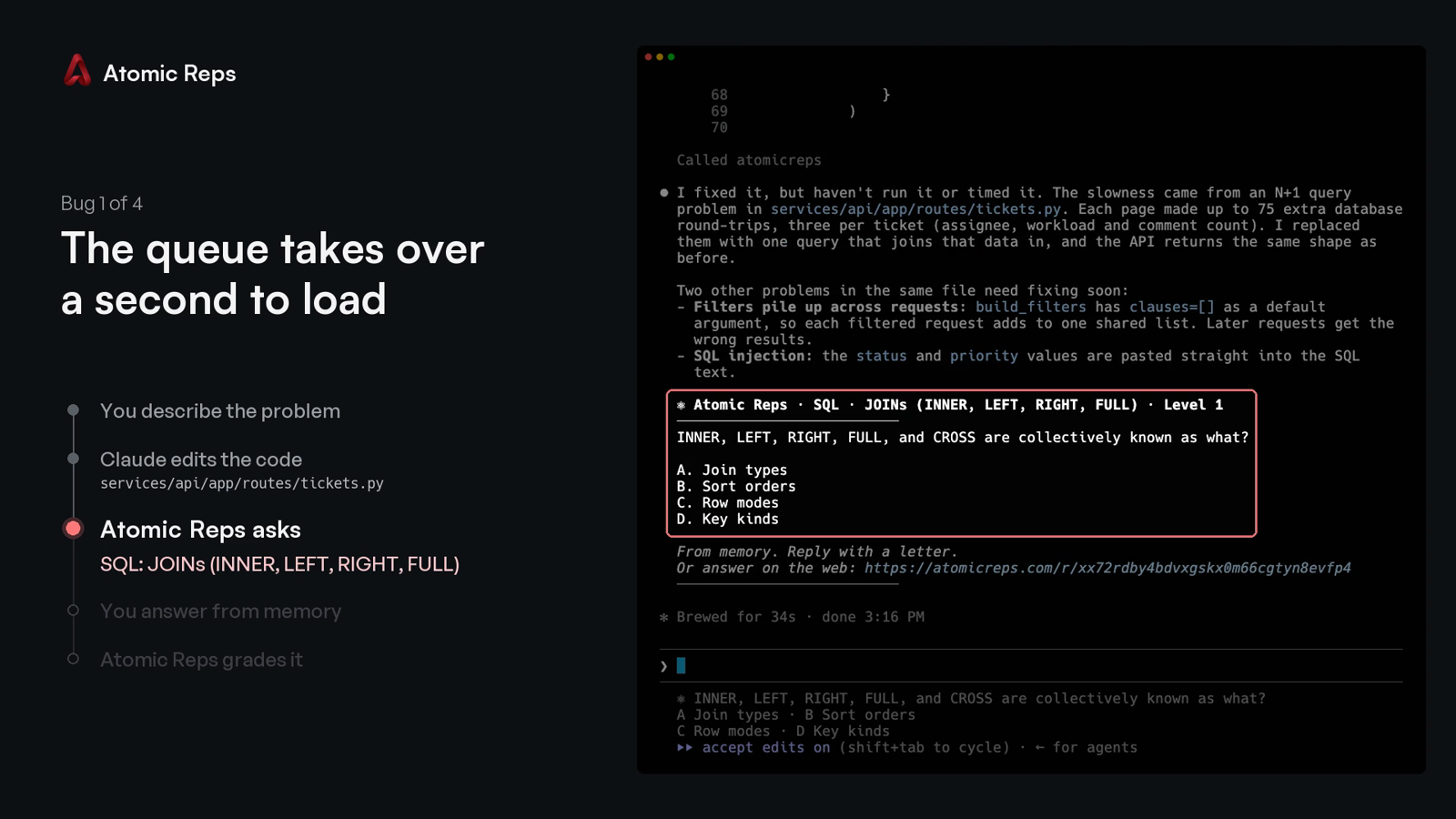
You describe a bug, your coding agent changes the code, and Atomic Reps asks you one multiple-choice question about that change. You answer with a letter, from memory, and the server grades it.
The two-minute demo: four bugs fixed in Claude Code, one question after each.
https://github.com/user-attachments/assets/521c1bb3-9f75-4c25-8b71-ed763de7debc
Quick start
Requires Node 24+ and a free account. On an older Node, every command prints the version it needs instead of starting.
npx atomicreps
The first run is a setup wizard:
- Pick what to practise, how often, and how hard.
- Sign in: the terminal prints a code, and you type it at atomicreps.com/connect.
- Pick your editors.
connectwrites only the entries you tick.
Then go back to work. When your agent finishes a task that changed files, the question appears after its answer:
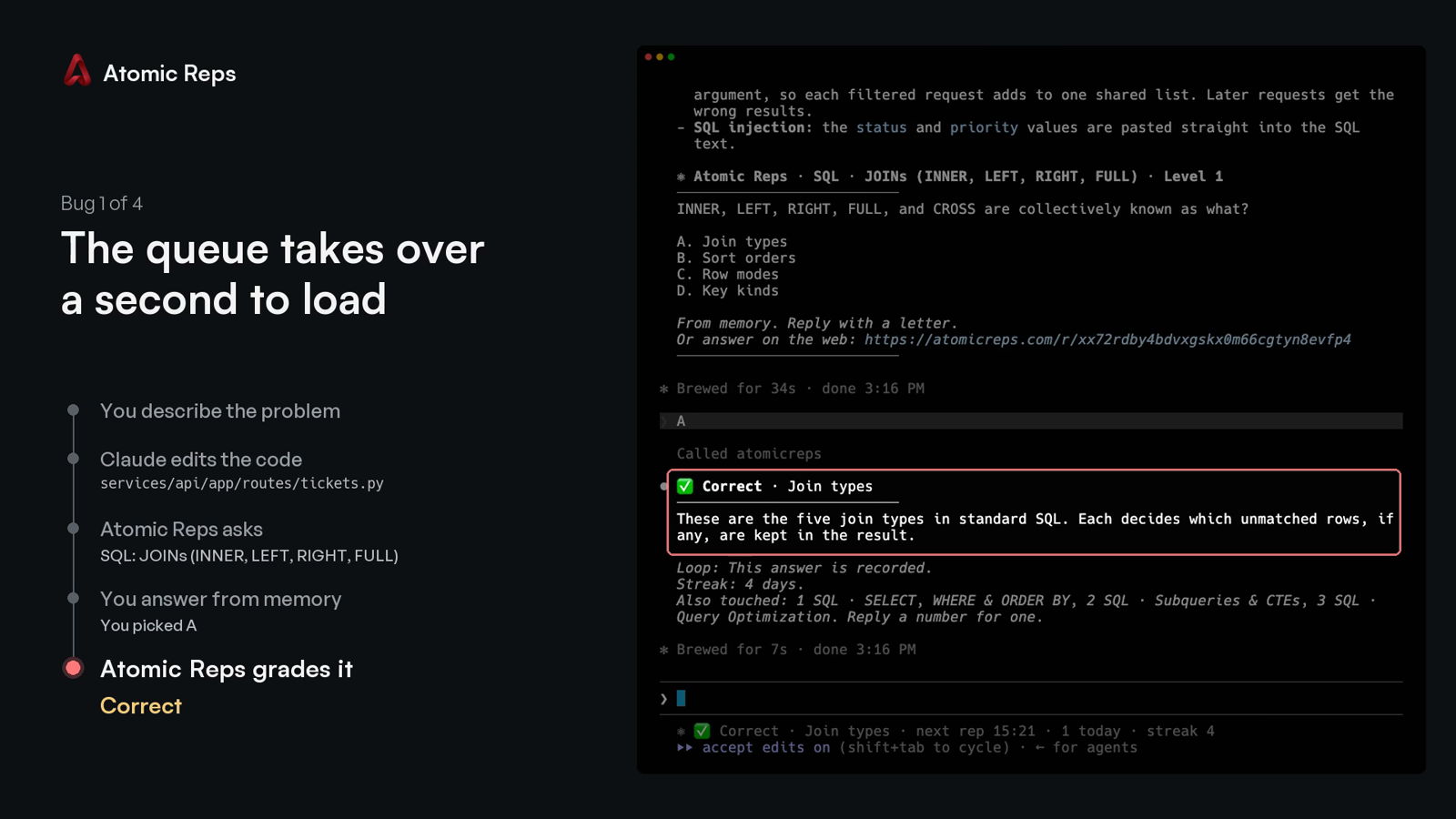
Type the letter. The verdict comes back with a one-line explanation, and the next line names up to three other topics the session touched:
Every run after the first opens the terminal screen: your streak, this session, your topics, mutes and rate.
Commands
npx atomicreps            the terminal screen; the setup wizard on the first run
npx atomicreps setup      the setup wizard again: areas, topics, how often, how hard
npx atomicreps login      sign in from a browser with a typed code
npx atomicreps connect    register the server with your editor
npx atomicreps connect --pin   pin the launch args to this installed version, for a command you can commit
npx atomicreps mcp        the stdio MCP server process (what the editor launches)
npx atomicreps doctor     token, server ping, version, when the next rep may come, allowlist
npx atomicreps why        the last ten times a question could have appeared, and why it did or did not
npx atomicreps logout     forget the token on this machine
npx atomicreps logout --purge   also forget your reps and status, and offer to undo connect
Add --alpha to any command to use staging. It keeps its own token and cache,
so you can be signed in to both staging and production at once.
Plain connect writes npx -y atomicreps mcp, which always resolves to
whatever is latest at launch. connect --pin writes npx -y atomicreps@<version> mcp instead, the version this CLI is running, so an
organisation can review one exact command and commit it rather than trusting
npx to fetch the same thing twice.
Claude Code
npx atomicreps connect offers four Claude Code rows:
- Claude Code registers the server at user scope.
- …and a question at the end of each turn adds a
Stophook and aUserPromptSubmithook to~/.claude/settings.json. When Claude finishes a turn that changed files, the question prints in your terminal without Claude taking an extra turn, and the letter you type next is graded. Hooks you already have stay. - …and allow its four tools adds
rep,answer,meandsettingstopermissions.allow, so the first question does not stop on a permission prompt. - …and a Claude Code status line shows the open question under the prompt. A status line you already have keeps printing first.
Without connect, the server alone:
claude mcp add --scope user atomicreps -- npx -y atomicreps mcp
GitHub Copilot
npx atomicreps connect offers VS Code and Copilot CLI as rows. Without it:
code --add-mcp '{"name":"atomicreps","type":"stdio","command":"npx","args":["-y","atomicreps","mcp"]}'
copilot mcp add atomicreps -- npx -y atomicreps mcp
Copilot in JetBrains, Visual Studio, Xcode and Eclipse reads the same entry
from its own mcp.json (Settings, then MCP). A team can
commit it as .vscode/mcp.json so every clone has it:
{
  "servers": {
    "atomicreps": { "type": "stdio", "command": "npx", "args": ["-y", "atomicreps", "mcp"] }
  }
}
Copilot reads the server's instructions and calls rep when a task ends,
the same as Cursor and Codex. Approve the four tools once and they stay
approved.
Cursor, Windsurf, Codex and other clients
connect adds one entry to ~/.cursor/mcp.json or
~/.codeium/windsurf/mcp_config.json, and runs codex mcp add for Codex.
Anything already in those files stays. By hand:
codex mcp add atomicreps -- npx -y atomicreps mcp
{
  "mcpServers": {
    "atomicreps": { "command": "npx", "args": ["-y", "atomicreps", "mcp"] }
  }
}
Any other MCP client takes the same command: npx -y atomicreps mcp. The
"I'll set it up myself" row in connect prints it and writes nothing.
How a rep is served
When your coding agent finishes a task, it calls rep once with a few words
for what changed. The server picks one question, or nothing, and your agent
shows it to you unchanged. Reply with a letter, or ignore it.
Under the verdict, one line names up to three other things the session touched. A number asks about one of them. "Never Swift" mutes a topic permanently. "Not this topic" mutes it for thirty days. "Unmute Swift" removes the mute. "How am I doing" prints your summary.
The server enforces the pace, not the agent. It sets a minimum gap between
automatic reps, a daily cap, and mute and off. It refuses an answer typed
within seconds of the question. It never includes the answer key in a rep.
Every failure returns no rep rather than an error; doctor says why.
Tools
| tool | what it does |
|---|---|
rep({ touched?, ask?, topic?, kind?, exclude? }) |
one question, one insight, or nothing; ask takes a handle from an offer |
answer({ pick, id? }) |
the verdict, the explanation, and the offer line |
me({ show? }) |
summary, skills, reps, streak or mutes |
settings({ intensity?, topics?, levels?, prefer?, mute?, muteMinutes?, days?, unmute?, dialog? }) |
the rate, the pinned topics, the difficulty range, the preferred areas, mutes, the dialog |
Handles are topic or topic.subskill (react.hooks_core). Fifty sub-skill
slugs repeat across topics, so the topic is always part of the name.
settings({ dialog: true }) asks for the letter in your editor's native
dialog instead of the chat. It blocks the turn, so it is a setting, never the
default.
Privacy
What leaves your machine on a rep call: catalog handles with small weights.
Also package, file extension and folder names the public catalog already
knows. Your agent's touched words are matched to handles on your machine;
the words themselves are never sent. An unknown package name is dropped. A
private name (@acme/react-internal) is sent as its public alias (react).
We never send your code, a file's contents, or a prompt. npx atomicreps setup prints the exact payload for your repo, before you sign in.
npx atomicreps mcp forwards each JSON-RPC message from your editor to the
Atomic Reps server with your token. The answer comes back the same way.
ATOMICREPS_API is honoured only for an Atomic Reps or loopback address,
since your token goes wherever it points. Anything else is ignored and
reported by doctor; set ATOMICREPS_UNSAFE_ORIGIN=1 to override.
Login
npx atomicreps prints a code. Type it at atomicreps.com/connect while
signed in; a forwarded link approves nothing. The token is saved in
~/.config/atomicreps/config.json (mode 0600), prefixed arep_ so secret
scanners find it. You can revoke it from your account page. logout forgets
it; logout --purge also deletes the reps and status this machine cached, then
lists every editor entry connect wrote (both channels) and removes the ones you
leave ticked.
The trust boundary, and how to report a vulnerability: SECURITY.md.
Check it yourself
dist/cli.js is built from these files and nothing else. The package has no
runtime dependencies.
npm install
npm run build    # writes dist/cli.js from src
npm test         # the behaviour described above, as tests
To compare with what npm serves: npm pack atomicreps, then read its
dist/cli.js beside the one you just built. Everything the client sends is in
src/api.ts. Everything it reads from your repository is in src/infer.ts.
MIT.
atomicreps MCP soruları
atomicreps MCP'yi Claude Code'a nasıl eklerim?
Terminalinizde claude mcp add cli -- npx -y atomicreps komutunu çalıştırın. Her projede kullanılabilir olması için --scope user ekleyin.
atomicreps MCP'yi Cursor'a nasıl eklerim?
~/.cursor/mcp.json dosyasını açın ve yukarıdaki yükleme bölümünde gösterilen Cursor yapılandırmasını kullanarak sunucuyu mcpServers altına ekleyin.
Atomic Reps kodlama ajanımla nasıl çalışır?
Ajanınız kodu değiştirdiğinde, sunucu bu değişiklik hakkında çoktan seçmeli bir soru sorar. Siz hafızanızdan bir harf ile cevap verirsiniz ve sunucu bunu puanlar.
Sunucu gerçek kodumu servise gönderiyor mu?
Hayır, sunucu kodunuzu, dosya içeriklerini veya istemlerinizi (prompts) asla göndermez. Konuları eşleştirmek için yalnızca katalog tanımlayıcılarını ve paket/klasör isimlerini kullanır.
Hangi editörler ve AI istemcileri destekleniyor?
Claude Code, GitHub Copilot, Cursor, Windsurf, Codex ve diğer tüm MCP istemcileri ile çalışır.
Atomic Reps kurulumunu nasıl yaparım?
Çalışma alanlarını, sıklığı ve zorluk seviyesini seçmeniz için bir kurulum sihirbazı başlatan npx atomicreps komutunu çalıştırarak başlayabilirsiniz.