
shadowclone MCP server
2026년 11월 14일 커밋여러 코딩 에이전트 간에 엔지니어링 선호도와 기술을 동기화하고, 자동화된 개발을 위한 GitHub Actions bot을 제공합니다.
다른 이름 theonly1me/shadowclone
- 스타
- 26
- Tools
- —
- 다운로드, 30일
- —
- 최신 버전
- —
- 마지막 커밋
- 2026년 11월 14일
- 라이선스
- MIT
shadowclone MCP란?
여러 코딩 에이전트 간에 엔지니어링 선호도와 기술을 동기화하고, 자동화된 개발을 위한 GitHub Actions bot을 제공합니다.
프로젝트 README에서 생성된 요약
shadowclone MCP server 정보
shadowclone는 Claude Code, Codex, Cursor, Pi, Antigravity, OpenCode를 포함한 여러 코딩 에이전트 간에 엔지니어링 선호도와 기술적 역량을 동기화합니다. 도구 간에 규칙을 수동으로 복사하는 대신, 이 시스템은 작업에 따라 진화하는 단일 지침 세트를 유지합니다. 자체적인 독립형 에이전트로 작동하는 것이 아니라, 이미 사용 중인 에이전트에 기능을 부여하는 방식으로 작동합니다.
사용자는 기존 구독이나 API key를 사용하여 자신의 머신에 있는 새로운 Docker container에서 실행되는 clone을 배포할 수 있습니다. 이러한 clone은 테스트 수정이나 사용자의 이름으로 draft pull request를 생성하는 등의 작업을 수행할 수 있습니다. 팀 환경의 경우, Anthropic, OpenAI 또는 Cursor의 제공업체 key를 사용하여 issue 및 pull request 작업을 수행하도록 GitHub Actions bot을 구성할 수 있습니다. 또한 개인용, 비공개용 또는 공유용 빌드를 구성하기 위한 skill wizard와 저장소 표준에 따라 코드를 분석하는 로컬 리뷰 도구도 포함되어 있습니다.
활용 사례
- 1반복적인 버그 수정 자동화사용자가 자리를 비운 동안 특정 실패 테스트를 해결하도록 에이전트에게 clone 실행을 지시합니다.
- 2도구 간 코딩 스타일 동기화서로 다른 AI 코딩 어시스턴트 전반에 걸쳐 일관된 엔지니어링 규칙 세트를 유지합니다.
- 3로컬 pull request 리뷰 수행저장소 표준과 기계적 점검을 결합하여 로컬에서 코드 분석을 실행합니다.
- 4협업 팀 bot 배포팀 skill을 따라 issue 및 pull request를 처리하는 GitHub Actions bot을 설정합니다.
프로젝트의 README를 바탕으로 작성되었습니다. 모든 활용 사례는 해당 내용의 인용문과 대조하여 확인합니다.
자동 검사
2026년 11월 14일에 실행됨전체 보고서 →아직 인증되지 않았습니다. 서버는 80점 이상의 점수, 심각한 결함 없음, 그리고 검사에 충분한 데이터를 갖추어야 합니다. 검사 방식 · 점수를 높이기 위해 수정할 항목

- 소스 저장소 연결 및 접근 가능theonly1me/shadowclone is public and reachablegithub.com/theonly1me/shadowclone ↗통과
- 패키지가 이 저장소를 소스로 명시검사되지 않음
- 빌드 출처(Sigstore 증명)검사되지 않음
- 오픈 소스 라이선스 (OSI)MITspdx.org/licenses/MIT.html ↗통과
- 최근 1년 내 커밋 또는 릴리스Last commit or release 2026-11-11github.com/theonly1me/shadowclone ↗통과
- OpenSSF Scorecard검사되지 않음
- 패키지 이름이 인기 패키지와 유사하지 않음검사되지 않음
- 패키지 및 해당 종속성에 중요한 보안 권고 없음검사되지 않음
- 모델에 대한 숨겨진 지침 없음0 tool descriptions and the README read; no override phrases, credential paths or hidden characters통과
- 파괴적인 도구에 라벨 표시됨검사되지 않음
- 원격 엔드포인트가 MCP 핸드셰이크에 응답검사되지 않음
README
GitHub에서 보기


Quick start · Clones · What shadowclone offers · Compare · How it works · Eval and Results · Docs
shadowclone keeps your engineering preferences the same in every coding agent. It maintains one set of skills and instructions for Claude Code, Codex, Cursor, Pi, Antigravity, and OpenCode. You do not copy rules from one tool to the next. shadowclone can also learn new preferences from the sessions that you allow.
It works as you while you are away. Ask your agent to start a clone. Claude Code or Codex works with your skills, on your own subscription, in Docker on your own machine. It opens a draft pull request as you. shadowclone is not a separate agent. It equips the agent that you already use. See how it compares to other tools.
Quick start
Paste this into Claude Code, Codex, Cursor, Pi, Antigravity, or OpenCode:
Set up shadowclone: https://raw.githubusercontent.com/theonly1me/shadowclone/main/plugins/shadowclone/skills/setup-shadowclone/SKILL.md
The agent handles installation and configuration in about 5 minutes. You answer the consent questions and pick skills in the browser:
- It installs the CLI, and the plugin in Claude Code or Codex.
- It asks if shadowclone can learn from your past sessions, keep skills in sync, and keep learning in the background.
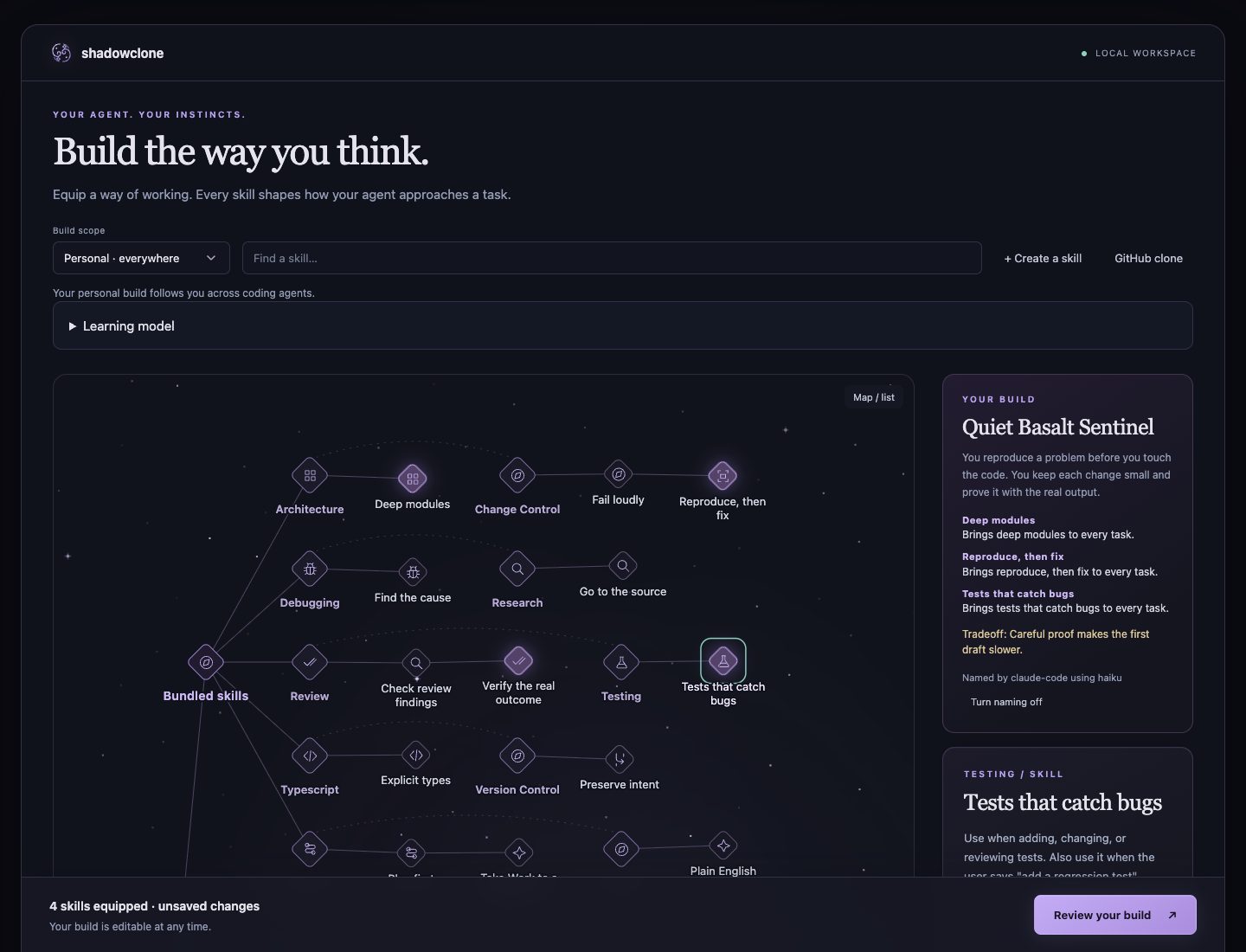
- It opens the skill wizard, where you pick skills and select Equip.
- It learns from your past sessions while you pick skills, if you agreed.
npm install -g @shadowclone/cli
shadowclone init
shadowclone wizard
To add the plugin, run /plugin install shadowclone@shadowclone after /plugin marketplace add theonly1me/shadowclone in Claude Code. In Codex, run codex plugin marketplace add theonly1me/shadowclone and then codex plugin add shadowclone@shadowclone.
What shadowclone offers
Your clone works while you are away
Ask, and it works as you. Tell your agent "start a clone to fix the flaky date parser test", or run shadowclone clone start. Claude Code or Codex works with your skills, on your Claude or ChatGPT plan or a key. It stops when its draft pull request has green CI. The pull request shows your name.
$ shadowclone clone start --repo you/app "fix the flaky date parser test"
Queued clone k3x9m2qa for you/app: fix the flaky date parser test
$ shadowclone clone list
k3x9m2qa done you/app shadowclone/k3x9m2qa #43 2026-10-18T14:02:11Z fix the flaky date parser test
Runs on your machine. Each clone runs in a fresh Docker container on a machine that you own. There is no shadowclone server, and your tokens stay in a file on that machine. Clones never push to the default branch, and each commit names the agent.
Set it up with one sentence. Ask your agent to "set up shadowclone clones for this repository." You approve your skills and paste two tokens. See the clones guide.
Reach them from your phone. The hub puts your clones behind Tailscale Funnel as an MCP connector. Ask Claude on your phone what your clones are doing, and answer their questions there. See the hub guide.
Preferences that evolve with your work
Learn from corrections. shadowclone reads the sessions you allow and turns reusable instructions into skills and short native guidance. It keeps repository-specific rules in their scope. Rules remain readable, editable, and reversible.
Keep guidance current. Background learning reviews new rules after each session. It applies durable guidance when automatic maintenance is on and discards rules that existing guidance covers. You can review and undo each change. See the learning guide.
Skills and builds you can configure
Start with a build. shadowclone includes 15 workflow skills for planning, debugging, implementation, verification, and review. New users can pick skills immediately. Learning from past sessions is optional. Browse the skills in skills/, or install them without the CLI.
Choose where skills apply. The browser wizard supports a personal build, a private build for one repository, or a shared build that a team commits. The same skills reach all six agents. Pi can use any model it supports. See Agent builds.
Reviews on your machine and on GitHub
Review a pull request. Run a local review with your Claude subscription:
shadowclone review 123
The reviewer combines repository standards, mechanical checks, and code analysis. Findings include evidence checked against the source. The result stays in a local file. Run shadowclone review --base main to review committed branch changes before opening a PR.
Read a guided review. Equip guided-pr-review and shadowclone-review, then ask your agent:
Use guided-pr-review to review PRs 1, 2, and 3.
The agent creates an HTML guide with actual diffs, behavior traces, and a reading order across the PRs. It supports inline notes and lets the reader reveal agent findings after forming a review. The guide stays local. See reviews.
Review in the cloud. Comment @<bot> review on a pull request, also on one from a fork. The Actions bot posts its findings on GitHub under its own identity. See cloud review.
An Actions bot for your team
Share an agent with your team. A bot runs in GitHub Actions with your selected skills and one provider API key: Anthropic, OpenAI, an OpenAI-compatible endpoint, or Cursor. Anyone with write access can tag it. It works on issues, opens pull requests, and follows checks and review feedback. You decide when to merge.
Ask the agent to configure it. After local setup, ask:
Set up the shadowclone Actions bot here with the account octo-shadow.
The agent prepares the skills repository and workflows. Then it gives you one link where you add the bot token and the API key on GitHub. Merge the setup PR, and the agent runs a check. The Actions bot guide covers providers, setup, and pausing work to continue locally.
Keep your key on GitHub. The bot reads the API key from a GitHub environment, and shadowclone never sees it. Anyone with write access can tag the bot, so set a spending limit in your provider console.
How shadowclone compares to other tools
shadowclone gives one set of skills to the agents that you already use, on your machine and on GitHub. The table uses each project's own pages, checked on 12 October 2026. "Not stated" means that those pages do not answer the question.
| Tool | What it is | Agents | Learns from your sessions | Same guidance in the cloud | Reviews pull requests |
|---|---|---|---|---|---|
| shadowclone | Skills, instructions, learning, and a GitHub Actions bot for the agents that you already use | Claude Code, Codex, Cursor, Pi, Antigravity, OpenCode | Yes, from the sessions that you allow | Yes, clones and a bot | Yes, locally, guided, and on GitHub |
| pstack | A skill and principle pack | Cursor | No. You run /reflect to edit a skill |
Not stated | Yes, /interrogate and Comment Sicko |
| Hermes Agent | Its own agent with a learning loop | Hermes only | Yes, it writes skills after tasks | Yes, on a server with chat apps | Not stated |
| Claude Code auto memory | Built-in notes from corrections | Claude Code | Yes, notes from your corrections | No. Memory stays on one machine | No |
| Claude Subconscious | A background Letta agent | Claude Code | Yes, through a Letta agent | Not stated | No |
| imprint | A plugin that trains one profile | Claude Code | Yes, when you run /imprint:train |
Not stated | No |
Claude Code loads its auto memory beside shadowclone skills, so you can use both. See the comparison guide for each tool and its sources.
How it works
flowchart LR
  A[Consented sessions] --> B[Learning]
  B --> C[Skills and native instructions]
  C --> D[Agents on your machine]
  C --> E[Clones that work as you]
  C --> F[Actions bot on GitHub]
shadowclone indexes references to enabled sessions and copies no transcript. It redacts text and learns rules. One session can give an explicit rule, and an inferred pattern needs three independent sessions. Rules become skills that you can read, edit, and undo. shadowclone changes the guidance, not the model. See the architecture.
Eval and Results
Across 24 fixed tasks, shadowclone learning scored above existing user skills on all four models. Scores measure preference adherence on synthetic tasks. See setups, methods, and limits.
| Setup | GPT 6.1 Sol | GPT 6 Luna | Claude Sonnet 5.5 | Claude Opus 5.5 |
|---|---|---|---|---|
| Agent alone | 77.3% | 59.0% | 56.5% | 53.2% |
| Existing user skills | 85.2% | 80.6% | 76.4% | 73.6% |
| Existing skills + shadowclone learning | 89.4% | 83.3% | 90.0% | 82.9% |
Privacy
- No collection service. No telemetry. Model work uses the agent CLI that you choose.
- Consent. Every source is off by default and has its own setting.
- Redaction. Tool results, tool-returned file contents, and thinking blocks never enter learning.
- Removal. Run
shadowclone learning disable,shadowclone skills automatic off, orshadowclone forget --all.
Read the privacy policy and data handling.
Docs
| Guide | Use it to |
|---|---|
| Agent builds | Pick skills and scope |
| Learning | Learn from sessions |
| Skill maintenance | Review updates, undo |
| Repository setup | Share checks |
| Pi setup | Use Pi models |
| OpenCode setup | Use OpenCode |
| Delegated work | Ready a pull request |
| Actions bot | Set up the GitHub bot |
| Clones | Work as you, anywhere |
| Hub | Reach your clones |
| Reviews | Review a pull request |
| MCP server | Give agents the tools |
| Command reference | Find every command |
| Enterprise controls | Set scope and policy |
| Comparison | Compare related tools |
More: documentation index, motivation, design records, security.
Contributing
Read CONTRIBUTING.md before you open a pull request. shadowclone uses the MIT license. If shadowclone saves you a correction, star the repository.
shadowclone MCP 질문
shadowclone가 자체 서버에서 실행되나요?
아니요, 각 clone은 사용자가 소유한 머신의 새로운 Docker container에서 실행되며 별도의 shadowclone 서버는 존재하지 않습니다.
어떤 코딩 에이전트가 shadowclone skill을 사용할 수 있나요?
Claude Code, Codex, Cursor, Pi, Antigravity, OpenCode를 지원합니다.
shadowclone가 저의 코딩 세션으로부터 학습할 수 있나요?
네, 허용된 세션으로부터 새로운 선호도를 학습하여 재사용 가능한 지침을 skill로 변환할 수 있습니다.
GitHub Actions bot은 어떻게 작동하나요?
bot이 GitHub Actions에서 실행되며, 선택한 skill과 Anthropic 또는 OpenAI와 같은 제공업체의 API key를 사용하여 issue 및 pull request 작업을 수행합니다.