
archwhere MCP server
2026년 11월 7일 커밋자동화된 아키텍처 맵을 유지하고 브랜치 충돌을 감지하여 AI 코딩 에이전트를 위한 미션 컨트롤 기능을 제공합니다.
다른 이름 tapaskar/archwhere
- 스타
- 6
- Tools
- —
- 다운로드, 30일
- —
- 최신 버전
- —
- 마지막 커밋
- 2026년 11월 7일
- 라이선스
- MIT
archwhere MCP란?
archwhere은(는) MCP server입니다. 자동화된 아키텍처 맵을 유지하고 브랜치 충돌을 감지하여 AI 코딩 에이전트를 위한 미션 컨트롤 기능을 제공합니다.
프로젝트 README에서 생성된 요약
archwhere MCP server 정보
대규모 AI 코딩 에이전트 인력을 관리하려면 개별 diff를 검토하는 것 이상의 작업이 필요합니다. Archwhere는 모든 에이전트가 수정하는 컴포넌트를 추적하는 자동화된 아키텍처 맵을 유지하여 미션 컨트롤 기능을 제공합니다. 디렉토리 구조, 패키지 워크스페이스, import 관계를 선언된 모델로 매핑하고 자동화된 CI 체크를 통해 이를 최신 상태로 유지함으로써 개발자가 에이전트 활동을 감독할 수 있도록 돕습니다.
사용자는 mission이라는 로컬 UI를 통해 시스템과 상호작용하며, 이는 개발자가 GitHub issue를 통해 에이전트와 직접 대화할 수 있는 대화 인터페이스 역할을 합니다. 이 도구는 Claude 또는 GitHub와 상호작용할 수 있는 모든 에이전트와 함께 작동합니다. 설정에는 단일 JSON 파일이 필요하며 npx를 사용하여 로컬에 설정할 수 있습니다. 또한 에이전트가 아키텍처를 조사할 수 있도록 stdio를 통한 읽기 전용 MCP server 모드도 지원합니다.
매핑 기능 외에도, 이 시스템은 진행 중인 여러 pull request 간의 파일 중복을 확인하여 브랜치 충돌을 감지합니다. 에이전트가 보안 구역 밖으로 파일을 이동하려고 시도하거나 적절한 레이블 없이 모델을 수정할 경우 CI를 실패하게 만들어 아키텍처 저하를 방지합니다. 이를 통해 아키텍처 맵이 오래된 수동 기록이 아닌 살아있는 문서로 유지되도록 보장합니다.
활용 사례
- 1브랜치 충돌 감지머지를 시도하기 전에 활성화된 브랜치 중 어떤 것들이 서로 충돌할지 식별합니다.
- 2아키텍처 유지보수 자동화에이전트가 매핑되지 않은 파일을 컴포넌트에 자동으로 포함하도록 하여 아키텍처 맵을 최신 상태로 유지합니다.
- 3컴포넌트 상태 모니터링통합 대시보드를 통해 특정 시스템 컴포넌트의 실시간 상태와 에러율을 시각화합니다.
프로젝트의 README를 바탕으로 작성되었습니다. 모든 활용 사례는 해당 내용의 인용문과 대조하여 확인합니다.
구성
AGENT_MENTIONS
| 이름 | 설명 | 유형 |
|---|---|---|
| AGENT_MENTIONS | — |
자동 검사
2026년 11월 14일에 실행됨전체 보고서 →아직 인증되지 않았습니다. 서버는 80점 이상의 점수, 심각한 결함 없음, 그리고 검사에 충분한 데이터를 갖추어야 합니다. 검사 방식 · 점수를 높이기 위해 수정할 항목

- 소스 저장소 연결 및 접근 가능tapaskar/archwhere is public and reachablegithub.com/tapaskar/archwhere ↗통과
- 패키지가 이 저장소를 소스로 명시검사되지 않음
- 빌드 출처(Sigstore 증명)검사되지 않음
- 오픈 소스 라이선스 (OSI)MITspdx.org/licenses/MIT.html ↗통과
- 최근 1년 내 커밋 또는 릴리스Last commit or release 2026-11-07github.com/tapaskar/archwhere ↗통과
- OpenSSF Scorecard검사되지 않음
- 패키지 이름이 인기 패키지와 유사하지 않음검사되지 않음
- 패키지 및 해당 종속성에 중요한 보안 권고 없음검사되지 않음
- 모델에 대한 숨겨진 지침 없음0 tool descriptions and the README read; no override phrases, credential paths or hidden characters통과
- 파괴적인 도구에 라벨 표시됨검사되지 않음
- 원격 엔드포인트가 MCP 핸드셰이크에 응답검사되지 않음
README
GitHub에서 보기archwhere
Your AI coding agents ship thirty PRs a week. Do you know where they land?
archwhere puts every change — every PR, every task, every agent — on a declared architecture map: which component it touches, whether that component is a security zone, and what needs you right now. Then it goes further: the map becomes the place you talk to your agents.
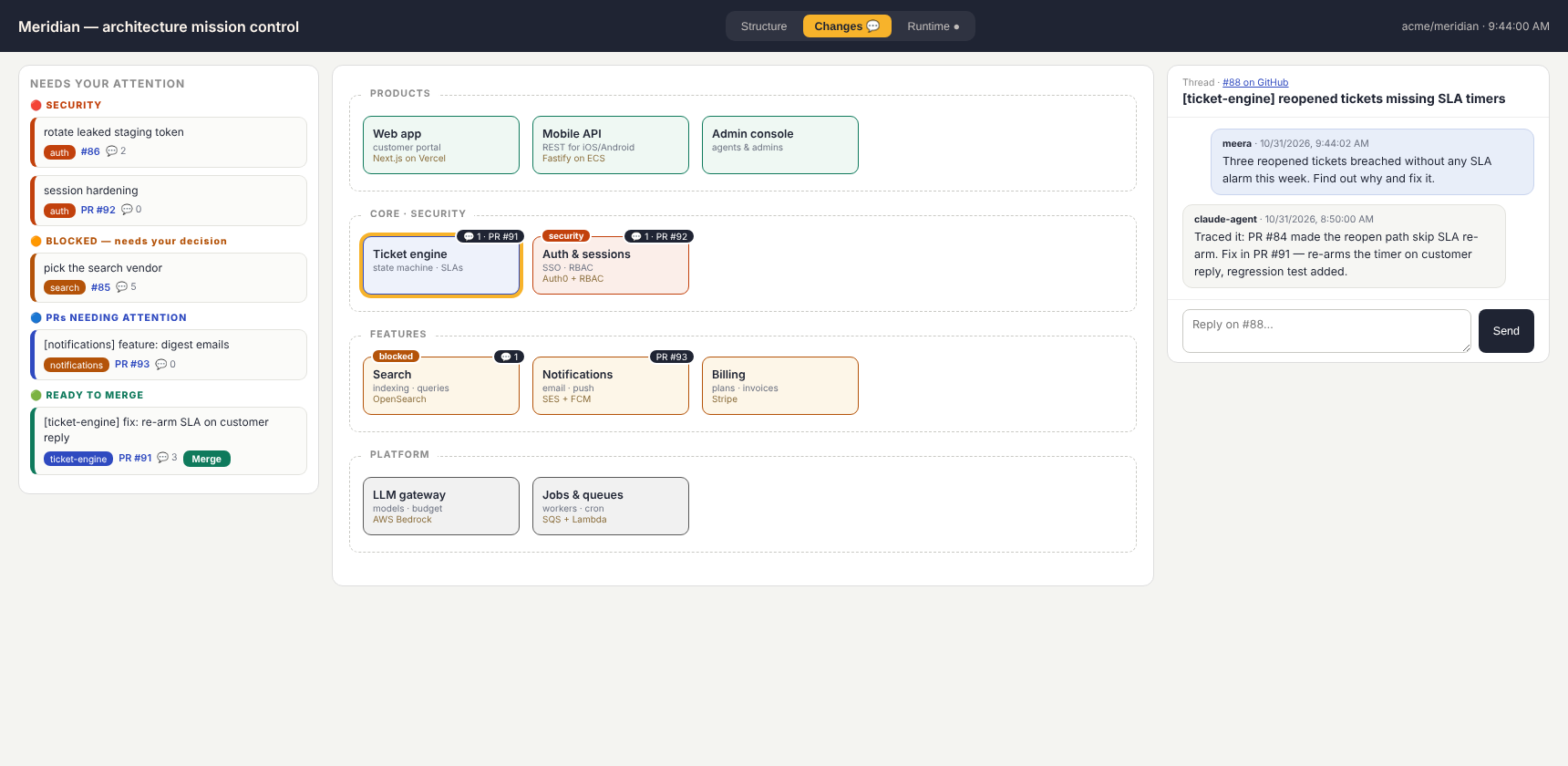
Mission control on Meridian, the fictional product in examples/: failing components
at the top of the attention rail, the work strip, and the map graded by live health.
One surface — no tabs. The health figures come from an example runtime endpoint.
Zero dependencies. One JSON file. Works with Claude, or any agent that can see GitHub.
Why
Supervising an agent workforce diff-by-diff doesn't scale. Architecture tools (Structurizr, IcePanel) assume a human architect maintains the model — so the model rots. CODEOWNERS and labelers map files to owners but carry no meaning.
archwhere inverts it: your agents maintain the map as a condition of merging
(there's a SKILL.md that tells them how, and archwhere check fails CI when
the map goes stale). You read components, not diffs.
Quickstart
npx archwhere init
That drafts the model from your repo itself — directory structure,
package.json workspaces, import edges — with guessed kinds (auth → security,
ui → product, scripts → ops), plus the PR-comment workflow and two agent
listeners. archwhere check passes from minute one; you rename and refine
instead of starting from a blank file. It also prints a prompt you paste to
your coding agent so it polishes the model by surveying the repo. The
cold-start problem every architecture-as-code tool dies on? Automated.
Daily driver:
npx archwhere                    # what is my working tree touching?
npx archwhere --base origin/main # what does this branch touch?
npx archwhere check              # CI guard: model valid, no file unmapped, no stale glob
npx archwhere check --fix        # adopt unmapped files into the nearest component
npx archwhere heat               # which components churned most in the last 30 days?
npx archwhere doc --out ARCHITECTURE.md
npx archwhere mission            # the UI at http://localhost:4610
npx archwhere mcp                # MCP server on stdio; read-only unless --write
npx archwhere record verify      # check the shared record's hash chain
npx archwhere collide --refs a,b # which branches in flight will fight each other
The map heals itself
When an agent's PR adds files the model doesn't own, the PR comment doesn't
just complain — it suggests the exact patch (adopt into the nearest
component, or create a new one), and archwhere check --fix applies it. Tell
your agents "run check --fix and review the adopted globs" and the map stays
alive with no human bookkeeping.
Every PR gets mapped
Add the action (one of the files init writes):
- uses: tapaskar/archwhere@v1
Every PR gets a comment: a component/kind/files table, security flags, and the system map with touched components highlighted — rendered natively by GitHub:
flowchart LR
  web-app["Web app"]
  mobile-api["Mobile API"]
  admin-console["Admin console"]
  ticket-engine["Ticket engine"]
  auth["Auth & sessions"]
  search["Search"]
  notifications["Notifications"]
  billing["Billing"]
  llm-gateway["LLM gateway"]
  jobs["Jobs & queues"]
  ops["Ops & CI"]
  docs["Docs"]
  web-app --> ticket-engine
  web-app --> auth
  mobile-api --> ticket-engine
  mobile-api --> auth
  admin-console --> ticket-engine
  ticket-engine --> search
  ticket-engine --> notifications
  ticket-engine --> llm-gateway
  search --> jobs
  notifications --> jobs
  classDef core fill:#E8EEF9,stroke:#2F4AC0,color:#1F2433
  classDef security fill:#FDE8E4,stroke:#C2410C,color:#1F2433
  classDef feature fill:#FFF4E0,stroke:#B45309,color:#1F2433
  classDef infra fill:#EFEFEF,stroke:#595959,color:#1F2433
  classDef product fill:#E3F2EC,stroke:#0F7A5C,color:#1F2433
  classDef ops fill:#F3E8F9,stroke:#7E3FA0,color:#1F2433
  classDef docs fill:#F7F7F7,stroke:#8A8A8A,color:#1F2433
  classDef other fill:#F2F2EF,stroke:#777,color:#1F2433
  classDef touched fill:#F7B32B,stroke:#1F2433,stroke-width:3px,color:#1F2433
  class web-app,mobile-api,admin-console product
  class ticket-engine core
  class auth security
  class search,notifications,billing feature
  class llm-gateway,jobs infra
  class ops ops
  class docs docs
A PR can't quietly review itself out
The map decides what gets reviewed, and a PR can edit the map. So with enforce: true,
archwhere reads the model from the base commit and compares. The PR fails, and its comment says why, when it:
| The PR | Example |
|---|---|
| removes or reclassifies a security component | "kind": "security" becomes "feature" in the PR that edits core/auth/ |
removes or rewrites a watch pattern |
session|token|rbac becomes session |
| moves a file out of a zone with a glob | web-app gains core/auth/session.js, and the longest match wins |
| moves the model file | arch/architecture.json is replaced by a looser architecture.json |
changes a security component or fires a watch pattern, with no owner-review label |
judged by the base model too, so reclassifying doesn't help |
edits a workflow or CODEOWNERS with no owner-review label |
these decide whether the check runs |
Adding the owner-review label reruns the check and lets it pass. A weakening stays in the comment.
Create the label once with gh label create owner-review; init doesn't create it.
Run archwhere check --base origin/main locally for the same report without failing on the label.
What this doesn't do. A label records that someone looked; it isn't an approval, and anyone with
triage access can add one. A pull_request workflow also runs from the PR's own merge commit, so a PR
can rewrite the workflow itself. Mission control flags that from outside CI, but only GitHub can stop
it. For real enforcement, turn on branch protection: make this job a required check, require a review,
and put arch/ and .github/ in CODEOWNERS.
Talk to your agents on the diagram
npx archwhere mission serves a local UI where the map is the conversation surface:
- Attention rail — security items, blocked decisions, PRs needing attention, PRs ready to merge (the Merge button uses your token; agents never merge).
- Click any component → open a thread. Threads are GitHub issues labelled
component:<id>(auto-created). Your agent answers; the reply appears on the map. - One surface, no tabs. The rail, the map and the thread are all on screen at once. Open PRs, alerts and each component's live health show together, so "this one is red and has an open PR" is a glance, not two clicks.
- Health or Heat, as a toggle over the same cards. Health comes from any
endpoint you point
RUNTIME_URLat (see below); a component that reports nothing readsunknown— dashed and dimmed, never green. Heat colours by git churn over the last 30 days: where your agents are actually spending effort. - Two drawers under the map, for the things you consult rather than watch. System flow draws the Mermaid system map, with components that have an open PR highlighted, and every process flow in your model as a sequence diagram; it fetches Mermaid 11 from jsDelivr the first time you open it, pinned by hash. Record shows, read-only, whether the shared record verifies, active claims and the latest entries.
The runtime contract
Point RUNTIME_URL at anything that answers this shape. It is deliberately dumb,
so you can satisfy it from Prometheus, Datadog, pm2 or a shell script, and
archwhere never learns to speak a vendor's API.
{"components": {"<id>": {
  "status": "ok|warn|bad|unknown",
  "deploy": {"at": "2026-11-06T07:00:00Z", "ref": "PR #221"},
  "signals": {"traffic": {"value": 1840, "unit": "req/h"},
              "errors":  {"value": 212, "of": 1840},
              "latency": {"p99_ms": 4800}},
  "failures": [{"name": "restarts", "count": 24522, "window": "9h", "severity": "bad"}],
  "lines": ["pm2 online", "up 9 h"],
  "links": [{"label": "errors", "url": "https://obs.example/errors"}]
}}}
Only status is required, and the older {status, lines} shape still works. Two
rules are enforced rather than suggested:
- Errors need
of. A count with no denominator is not a signal: 212 failures out of 300 is an outage, 212 out of two million is noise. A count without a denominator is shown, never graded. - Unknown is not ok. A component reporting a status archwhere does not
recognise, or whose reading is over two minutes old, renders as
unknown— dashed and dimmed, never green. Silence looking like health is how a dead service goes unnoticed.
Grading lives in one tested place (lib/signals.js): the worst of the stated
status, the error rate against traffic, and any declared failure severity. Bands
are per component, so a chatty service and a quiet one are not held to one number.
Collisions: what GitHub does not tell you
GitHub computes a pull request against its base. When several agents work at once the expensive conflict is pull request against pull request, and nothing reports it until the second merge.
npx archwhere collide --refs feat/a,feat/b,fix/c --base main
against main:
  ✗ feat/a  conflicts in docs, mission
  ✓ fix/c clean

against each other:
  ✗ feat/a  ×  feat/b
      components: docs
      both change: CHANGELOG.md, README.md

merge order (least entangled first):
  fix/c  (collides with nothing)
git merge-tree merges in memory: no working tree, no network, no GitHub API, so
it is cheap enough to run on every page load. Conflicts are reported in
components, not only paths. A branch behind base conflicts with every branch
that is current, which says nothing about those two — so the matrix reports file
overlap since base beside the merge result, names the stale branches, and ranks
the merge order on genuine overlap only.
Bring your own coding agent
The bus is GitHub — archwhere never talks to an agent directly:
| Your agent | Setup |
|---|---|
| Claude | agent-reply.yml (written by init) answers @claude via the Claude GitHub App |
| Any agent with an API | agent-webhook.yml POSTs each thread event (component, issue, body, HMAC) to AGENT_WEBHOOK_URL; it replies with its own GitHub token |
| Anything already watching GitHub | nothing to do — have it watch issues labelled component:* |
Which mention the UI appends is yours: arch/mission.config.json → {"agentMention": "@your-bot"} (env AGENT_MENTION overrides; "" disables).
Several agents (Claude + Kiro)
Put more than one agent on the board and choose who answers each message:
AGENT_MENTIONS="Claude=@claude,Kiro=@kiro" npx archwhere mission
or in arch/mission.config.json:
{ "agents": [ { "name": "Claude", "mention": "@claude" }, { "name": "Kiro", "mention": "@kiro" } ] }
AGENT_MENTIONS beats AGENT_MENTION, which beats agents, which beats agentMention. The old
single-agent settings still work, and the first agent is the default.
- The Ask selector. With two or more agents, an Ask: menu sits next to Send: each agent, plus Both (two agents) or All (three or more). Your last choice is remembered in the browser. With one agent you see nothing new.
- A typed mention wins. If your message already names any known agent (
@kiro where is…), archwhere adds nothing, so a hand-typed@kironever summons Claude as well. - Who replied. Each reply is tagged with the agent: the Claude GitHub App by its bot login, and
bridge replies by their
🤖 **Kiro** (via archwhere bridge)header.
archwhere bridge lets a CLI agent with no GitHub App answer board threads. Kiro is the example.
It runs on your machine, polls the repo for new issues and comments that mention the agent, runs the
CLI once per mention in a read-only checkout, and posts the answer back as a comment:
# once: install the read-only Kiro agent (reads the working directory only, no shell, no writes, no MCP)
mkdir -p ~/.kiro/agents && cp node_modules/archwhere/examples/kiro/archwhere-readonly.json ~/.kiro/agents/

git clone --depth 1 https://github.com/you/repo ~/ro/repo   # a separate checkout just for reading
npx archwhere bridge --repo you/repo --mention @kiro --cwd ~/ro/repo \
  --cmd "kiro-cli chat --no-interactive --agent archwhere-readonly"
| Flag | Default | |
|---|---|---|
--mention |
(required) | handle to watch for, e.g. @kiro |
--cmd |
(required) | agent command; the prompt is added as the last argument |
--cwd |
current dir | where the agent runs: use a read-only checkout |
--repo |
origin of --cwd |
owner/name |
--name |
the mention without @ |
name in the reply header |
--allow |
extra GitHub logins allowed to summon it (the repo owner always is) | |
--interval / --timeout |
30 s / 300 s | poll interval and per-answer time limit |
--state |
~/.archwhere/bridge-<owner>-<repo>-<mention>.json |
cursor + seen-set, so restarts never answer twice |
--once |
poll once, answer, exit (for cron and tests) |
It uses the same token as mission control (GITHUB_TOKEN or gh auth token). It runs one job at a
time, strips ANSI colour codes, caps replies at about 60k characters, and posts a short "couldn't
answer" note when the agent fails or times out.
Security notes
- Allow-list. Only the repo owner and the logins in
--allowcan summon it. Bots are never answered, and neither are the bridge's own replies (it spots them by the header). On a public repo this matters: anyone can comment, and the comment becomes the agent's prompt. - Read-only. Point
--cwdat a separate checkout that nothing deploys from, and give the agent read-only tools: thearchwhere-readonlyKiro agent above exposes onlyread, limited to the working directory. - Don't pre-approve the tool. In
kiro-cli2.28, listing a tool inallowedToolsor passing--trust-toolsskips its path limits, so the agent could read any file your user can, including secrets elsewhere on the machine. LeaveallowedToolsempty: reads insideallowedPathsstill go through, and in--no-interactivemode anything else is refused. Check this on your own version. - Never trust all tools. The bridge refuses to start if
--cmdcontains-aor--trust-all-tools. - No shell. The command is split once and run with
execFileand an argument array. The thread text goes in as one argument and is never shell-interpolated. - No pings.
@handlesin the agent's answer are broken with a zero-width space, so an answer can't summon another agent or notify people.
Give your agents the map over MCP
claude mcp add --transport stdio archwhere -- npx -y archwhere mcp
archwhere mcp serves the map, what a file or diff touches, the attention rail, threads and the record to any MCP
client. It is hand-written JSON-RPC over stdio with no dependencies. It speaks the current protocol (2026-07-28) and the
older initialize handshake.
It is read-only by default. With --write and a declared identity, agents can also store specs, findings and
decisions, claim tasks, and ask the owner one question, which lands under Blocked. There is no merge tool and no shell
tool, and agents can't sign off. Output from GitHub and the record is marked as untrusted data.
Setup for Claude Code, Kiro and Hermes, the tool list and the safety rules: docs/MCP.md.
A shared, attributed record
Agents forget, and GitHub threads don't say who decided what. archwhere record is an append-only log that every agent
reads and writes, with each entry naming its author, agent, model and vendor:
archwhere record spec put ticket-sla --file specs/sla.md --components ticket-engine   # word for word, SHA-256, versioned
archwhere task claim T-12 --role builder --branch feat/sla                            # atomic; one writer per branch
archwhere record search holidays --component ticket-engine
archwhere record independent --task T-12    # did a different vendor and model approve this? exit 0 or 1
archwhere record signoff --target <hash> --decision approve --signer dana             # owner signature, from a terminal
archwhere record verify                     # detects edits, deletions and reordering
archwhere record anchor --tag --push        # keep the head hash somewhere else
Be clear about what this is:
- Tamper-evident, not tamper-proof. Someone with disk access can rewrite the whole chain. Only an anchor kept elsewhere exposes that, and deleting the newest entries breaks no link either.
- Vendor and model are self-declared. The independent check confirms what was recorded, not what ran.
- A sign-off holds only while an agent can't get the key and its passphrase and can't change the trust list.
- Claims are atomic on one filesystem and advisory. Claims from separate clones can collide; that is reported on import, not prevented.
- Not committed by default, because it can hold sensitive text. In a public repo, committing it publishes it for good.
Storage, concurrency, merge behaviour and every limit: docs/RECORD.md.
The model
One file, declared judgment — not an auto-extracted import hairball:
{
  "system": "Meridian",
  "components": {
    "auth": {
      "name": "Auth & sessions", "kind": "security",
      "provider": "Auth0 + RBAC",               // shows on every surface: map, PR comment, docs, mission UI
      "paths": ["core/auth/**"],                  // ** crosses dirs, * stays in one; longest match wins
      "watch": [{ "pattern": "session|token|rbac", "note": "security review" }],
      "deps": []
    }
  },
  "lanes": [["web-app"], ["auth"]],               // optional; defaults to kind grouping
  "flows": { "signup": { "name": "…", "actor": "…", "steps": [{"from": "web-app", "to": "auth", "label": "SSO"}] } }
}
Kinds: core · security · feature · infra · product · ops · docs. flows are
your C4-style dynamic views — the process layer above the components. The full
example: examples/meridian/architecture.json.
Interactive diagrams (Archify)
npx archwhere ir compiles the model into Archify
IR — an animated signal-flow system diagram with trust boundaries and guided
views per flow, plus one numbered diagram per flow. Render with Archify's CLI.
For your agents
SKILL.md is the agent's side of the contract: place work on the map
before coding, extend the model when adding modules, update flows when changing
user-visible processes, keep archwhere check green. Works as a Claude Code /
agent skill, or paste it into your agent's instructions.
Compared to…
| maps PRs | visual | agents maintain it | talk to agents on it | |
|---|---|---|---|---|
| CODEOWNERS / labeler | ✓ | — | — | — |
| Structurizr / IcePanel | — | ✓ | — | — |
| dependency graphs | ✓ | hairball | n/a | — |
| archwhere | ✓ | ✓ | ✓ | ✓ |
Compared to OnMemory
OnMemory describes a similar loop: a spec kept verbatim, agents on several models writing to one memory, review by another vendor's model, and attributed sign-off. It is in closed test. We haven't used it, and what follows about it comes only from its public page.
| archwhere | OnMemory's page says | |
|---|---|---|
| Spec kept word for word | SHA-256 addressed, versioned | keeps it verbatim |
| Shared memory | Local append-only log, exportable, not hosted | all writing to one memory |
| Cross-vendor review | Recorded and checked on declared data; archwhere doesn't run the reviewers | a different vendor's model reviews |
| Provable history | Tamper-evident hash chain, with limits spelled out | history is provable |
| Retrieval | Plain-text, component and task search | its own retrieval method; archwhere has no equivalent |
archwhere is open source (MIT) and also puts the work on an architecture map.
Onboarding at a glance
From stranger to agent-replies-on-the-map in under twenty minutes — the full funnel, stage by stage: docs/ONBOARDING.md.
Releasing
Push a version tag; .github/workflows/release.yml publishes it.
npm version patch          # or minor / major — this also makes the tag
git push --follow-tags origin main
The workflow uses npm trusted publishing: GitHub mints a short-lived identity token for that
one workflow and npm checks it against the trusted publisher on the package. No token is stored —
not in a repository secret, not in a .npmrc, not on anyone's machine. It refuses to publish if
the tag and package.json disagree, and runs the suite and archwhere check first.
One-time setup, on npmjs.com → the package → Settings → Trusted publisher → GitHub Actions:
organization tapaskar, repository archwhere, workflow release.yml. The package has to exist
already, which it does.
License
MIT © Tapas Kar. Built with and for AI coding agents — this repo's own model
lives in arch/architecture.json, of course.
archwhere MCP 질문
archwhere는 아키텍처 맵을 어떻게 최신 상태로 유지하나요?
에이전트가 머지 조건으로 맵을 유지하며, archwhere check --fix 명령어를 통해 매핑되지 않은 파일을 가장 가까운 컴포넌트에 자동으로 포함할 수 있습니다.
머지하기 전에 여러 브랜치 간의 충돌 여부를 감지할 수 있나요?
네, archwhere collide 명령어가 컴포넌트 내 파일 중복을 보고하여 현재 작업 중인 브랜치 중 어떤 것들이 서로 충돌할지 식별합니다.
기존 코딩 에이전트에 archwhere를 어떻게 통합하나요?
GitHub를 통해 작동합니다. Claude GitHub App을 사용하거나, 다른 에이전트를 위한 웹훅을 설정하거나, 에이전트가 컴포넌트 ID가 레이블된 GitHub issue를 모니터링하도록 설정할 수 있습니다.
컴포넌트 상태를 표시하기 위해 특정 런타임이 필요한가요?
아니요, Prometheus, Datadog 또는 쉘 스크립트와 같이 특정 JSON 형식을 반환하는 모든 엔드포인트를 RUNTIME_URL로 지정할 수 있습니다.