
Markdown 볼트를 로컬 SQLite RAG 스토어에 인덱싱하여 AI 클라이언트가 노트를 검색하고, 링크 그래프를 탐색하며, 메모리를 저장할 수 있게 합니다.
다른 이름 raphasouthall/neurostack
- 스타
- 47
- Tools
- —
- 다운로드, 30일
- —
- 최신 버전
- 0.12.0
- 마지막 커밋
- 2026년 11월 9일
- 라이선스
- Apache-2.0
NeuroStack MCP란?
NeuroStack은(는) MCP server입니다. Markdown 볼트를 로컬 SQLite RAG 스토어에 인덱싱하여 AI 클라이언트가 노트를 검색하고, 링크 그래프를 탐색하며, 메모리를 저장할 수 있게 합니다.
프로젝트 README에서 생성된 요약
NeuroStack MCP server 정보
NeuroStack은 연구자, 작가, 개발자가 기존의 Markdown 지식 베이스를 로컬 SQLite 데이터베이스로 인덱싱할 수 있게 해줍니다. 이를 통해 Claude, Cursor, Windsurf와 같은 AI 클라이언트가 Obsidian 또는 Logseq 볼트를 검색하고, 위키 링크 그래프를 탐색하며, 시맨틱 임베딩에 접근할 수 있는 검색 레이어를 생성합니다. 시스템은 로컬에서 작동하여 파일에 대한 제어권을 유지하며, 요약을 위해 타사 제공자를 설정한 경우에만 데이터를 전송합니다.
사용자는 키워드 검색을 위한 Lite 모드와 Ollama를 통한 시맨틱 검색을 위한 Full 모드 중 하나를 선택할 수 있습니다. 서버는 기본적으로 읽기 전용이지만, vault_write_file과 같은 쓰기 도구를 선택하여 AI 클라이언트가 git history를 통해 노트를 편집하도록 할 수 있습니다. 또한 이 시스템은 AI 세션에서 결정 사항과 학습 내용을 수집하여, 반복되는 기억을 영구적인 노트로 변환하는 동시에 문맥에 맞지 않는 오래된 정보를 표시하는 최적화 루프 기능을 갖추고 있습니다.
활용 사례
- 1개인 지식 베이스 쿼리AI에게 수백 개의 연구 논문이나 개인 노트에서 특정 정보 또는 연결 고리를 찾도록 요청합니다.
- 2세계관 설정의 일관성 유지소설 작가의 AI 어시스턴트가 캐릭터의 역사와 이전 스토리의 결정 사항을 기억하도록 합니다.
- 3Git을 통한 노트 업데이트 자동화AI 에이전트가 버전 관리되는 리포지토리 내에서 Markdown 파일을 직접 작성하거나 편집할 수 있도록 합니다.
- 4오래된 정보 식별내용이 오래되었거나 더 이상 사용되지 않는 기술적 세부 사항을 참조하는 노트를 자동으로 감지하고 표시합니다.
프로젝트의 README를 바탕으로 작성되었습니다. 모든 활용 사례는 해당 내용의 인용문과 대조하여 확인합니다.
NeuroStack MCP 설치 방법
형식 확인: 2026년 11월 10일Cursor에 추가Goose에 추가Claude Code에 NeuroStack MCP 설치
$ claude mcp add neurostack -- npx -y neurostackCursor에 NeuroStack MCP 설치
~/.cursor/mcp.json
{
  "mcpServers": {
    "neurostack": {
      "command": "npx",
      "args": [
        "-y",
        "neurostack"
      ]
    }
  }
}VS Code에 NeuroStack MCP 설치
.vscode/mcp.json
{
  "servers": {
    "neurostack": {
      "type": "stdio",
      "command": "npx",
      "args": [
        "-y",
        "neurostack"
      ]
    }
  }
}VS Code CLI에 NeuroStack MCP 설치
$ code --add-mcp '{"name":"neurostack","type":"stdio","command":"npx","args":["-y","neurostack"]}'Claude Desktop에 NeuroStack MCP 설치
claude_desktop_config.json
{
  "mcpServers": {
    "neurostack": {
      "command": "npx",
      "args": [
        "-y",
        "neurostack"
      ]
    }
  }
}Codex에 NeuroStack MCP 설치
$ codex mcp add neurostack -- npx -y neurostackCodex config.toml에 NeuroStack MCP 설치
~/.codex/config.toml
[mcp_servers.neurostack]
command = "npx"
args = ["-y", "neurostack"]
Gemini CLI에 NeuroStack MCP 설치
$ gemini mcp add -s user neurostack npx -- -y neurostackGemini settings.json에 NeuroStack MCP 설치
~/.gemini/settings.json
{
  "mcpServers": {
    "neurostack": {
      "command": "npx",
      "args": [
        "-y",
        "neurostack"
      ]
    }
  }
}구성
NEUROSTACK_VAULT_ROOTPath to your Markdown vault (e.g. ~/brain, ~/notes)
| 이름 | 설명 | 유형 |
|---|---|---|
| NEUROSTACK_VAULT_ROOT | Path to your Markdown vault (e.g. ~/brain, ~/notes) |
자동 검사
2026년 11월 14일에 실행됨전체 보고서 →자동 검사를 통과했습니다. 이는 보안 감사가 아닙니다. 코드를 직접 읽고 서버에 필요한 최소한의 권한만 부여하십시오. 검사 방식 · 점수를 높이기 위해 수정할 항목

- 소스 저장소 연결 및 접근 가능raphasouthall/neurostack is public and reachablegithub.com/raphasouthall/neurostack ↗통과
- 패키지가 이 저장소를 소스로 명시neurostack names raphasouthall/neurostack as sourcenpmjs.com/package/neurostack ↗통과
- 빌드 출처(Sigstore 증명)No build attestation published for this release검사되지 않음
- 오픈 소스 라이선스 (OSI)Apache-2.0spdx.org/licenses/Apache-2.0.html ↗통과
- 최근 1년 내 커밋 또는 릴리스Last commit or release 2026-11-09github.com/raphasouthall/neurostack ↗통과
- OpenSSF Scorecard검사되지 않음
- 패키지 이름이 인기 패키지와 유사하지 않음No popular package one edit away from neurostack통과
- 패키지 및 해당 종속성에 중요한 보안 권고 없음1 resolved dependencies checked; no critical advisoryosv.dev ↗통과
- 모델에 대한 숨겨진 지침 없음0 tool descriptions and the README read; no override phrases, credential paths or hidden characters통과
- 파괴적인 도구에 라벨 표시됨검사되지 않음
- 원격 엔드포인트가 MCP 핸드셰이크에 응답Endpoint did not answer initialize: HTTP 525결함 발견
README
GitHub에서 보기


A local retrieval layer and optimizer for the Markdown knowledge base you already have.
NeuroStack indexes a folder of .md files (Obsidian, Logseq, Notion exports, plain Markdown) into one SQLite database with full-text search, embeddings and a wiki-link graph. Any MCP client can then search it, walk the graph and save memories. A query returns ranked evidence with note paths, and your AI does the reasoning, so no model runs while you wait. Between queries NeuroStack keeps the knowledge base accurate. It flags notes that have gone stale, harvests decisions and root causes from your AI sessions, merges recurring memories into learnings, and queues the proven ones to become notes. Indexing never changes your files, and optional MCP write tools let a client edit notes through your git history.
Works with Claude, Cursor, Windsurf, Gemini CLI, VS Code, Codex and any other client that supports MCP.
60-second start
npm install -g neurostack          # install
neurostack init                    # pick your notes folder, press Enter for the rest
/save                              # in omp or Claude Code, keep what this session learned
neurostack doctor                  # check that everything works
The steps below explain each part and how to connect other AI clients.
Your notes, in your control
By default, NeuroStack is a read-only indexing layer:
- Indexing, search, summaries, and graph analysis never modify your Markdown files
- All index data lives in NeuroStack's own separate database
- To remove it completely, run
neurostack uninstall. Your notes stay untouched. - Nothing ever leaves your machine, unless you configure a third-party LLM provider for summaries and embeddings
If your vault is a git repo, four opt-in MCP write tools let an AI client author and edit notes for you: vault_write_file, vault_delete_file, plus vault_read_file / vault_list_files. Every write commits and pushes to your git remote with a descriptive message, so every change is visible in git log, revertable with git revert, and serialised under a per-vault lock. Writes hard-reject invalid frontmatter, paths outside the vault, and hidden directories (.git, .obsidian, …). Because the tools are exposed to any client talking to neurostack serve, gate them at the transport (auth, tunnel, LAN only) if you put the MCP endpoint on the public internet.
Who this is for
You do not need to be a developer. If you take notes in Markdown, or can export your notes as Markdown from Obsidian, Notion, Bear, or Roam, NeuroStack works for you.
| If you are... | NeuroStack helps you... |
|---|---|
| A researcher | Ask your AI "what do my notes say about X?" across hundreds of papers. Get warned when a note references a retracted finding or superseded paper before your AI cites it confidently. |
| A fiction writer | Your AI knows your world-building bible, character histories, and chapter decisions. It remembers that you agreed in session 4 that Elena's backstory changes in act 2. |
| A student | Ask your AI to explain connections across all your course notes. When a syllabus topic changes, stale revision notes are flagged automatically. |
| A professional | Your AI remembers client context, project decisions, and meeting notes session-to-session. No more re-pasting the same background every time. |
| A developer or DevOps engineer | Notes that reference deprecated APIs or reversed architecture decisions get flagged before your AI cites them as current. |
Get started in three steps
You will need Node.js installed (most computers already have it). The npm package handles the Python setup for you.
Step 1. Install
npm install -g neurostack
Step 2. Set up (takes about two minutes)
neurostack init
The setup wizard asks which vault folder to index, which mode to run (Lite or Full), and which profession pack to apply. Then it finishes the install for you. It adds the NeuroStack hook to omp or Claude Code if you have them, so /save keeps what a session learned. It sets up the AI that turns saved sessions into memories, using the same model as your summaries. If no model answers yet, it leaves that off and tells you so. It also installs one background timer that keeps the index tidy, and a failed background job shows up as a desktop notification. Press Enter at each question to take the default. At the end it runs neurostack doctor and shows what to try first.
Step 3. Connect to your AI
For Claude Desktop:
neurostack setup-desktop
For Claude Code:
claude mcp add neurostack -- neurostack serve
For Cursor, Windsurf, Gemini CLI, or VS Code:
neurostack setup-client cursor # or: windsurf, gemini, vscode
Done. Open a new conversation and ask your AI about something from your notes.
Everything runs on your machine. Choose a tier during neurostack init:
- Lite (~130 MB) gives you keyword search, link-based connections between notes, stale detection and the MCP server. No GPU or Ollama required.
- Full (~560 MB) adds semantic search by meaning, AI-generated summaries, connections between notes, and topic clustering via local Ollama. GPU or 6+ core CPU recommended.
Non-interactive setup takes every default:
neurostack init --mode lite ~/my-notes --yes    # lite mode
neurostack init --mode full ~/my-notes --yes    # full mode
--no-hooks, --no-schedule and --checkpoint none turn off the hook, the timer and the checkpoint AI.
# PyPI
pipx install neurostack
pip install neurostack        # inside a venv
uv tool install neurostack

# One-line script
curl -fsSL https://raw.githubusercontent.com/raphasouthall/neurostack/main/install.sh | bash

# Lite mode (no ML deps)
curl -fsSL https://raw.githubusercontent.com/raphasouthall/neurostack/main/install.sh | NEUROSTACK_MODE=lite bash
On Ubuntu 23.04+, Debian 12+, and Fedora 38+, bare pip install outside a virtual environment is blocked by the operating system. Use npm, pipx, or uv tool install instead.
To uninstall: neurostack uninstall
What it does
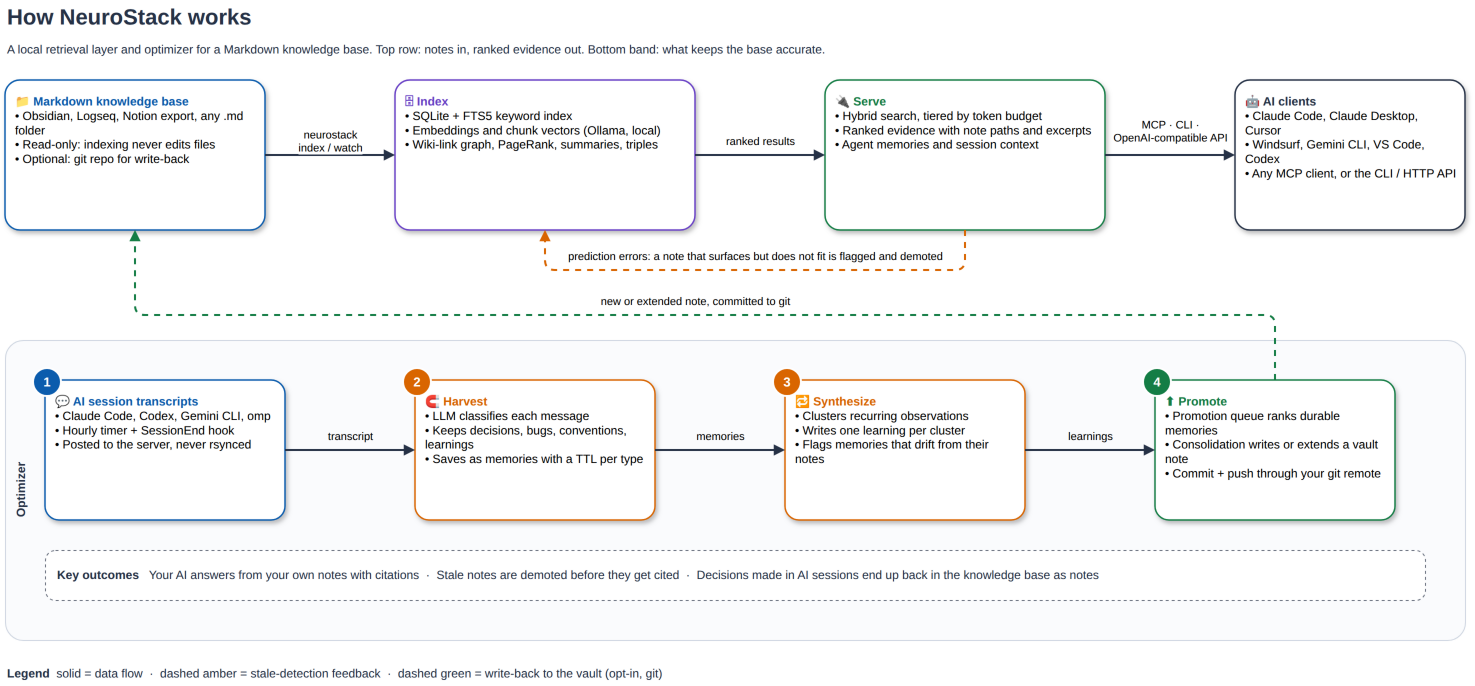
- Hybrid search (FTS5 keyword + semantic) with tiered depth, so a client can fetch triples, summaries or full notes by token budget.
- Ranked evidence with note paths and excerpts over the CLI, MCP, or an OpenAI-compatible API, for your AI to cite and reason over.
- Stale detection. A note that keeps surfacing in contexts where it no longer fits is flagged and demoted in later results.
- Session harvest. A timer scans Claude Code, Codex, Gemini and omp transcripts and saves decisions, bugs, conventions and learnings as memories with TTLs.
- Synthesis and promotion. Recurring memories become learnings; a promotion queue lists which ones are ready to become notes.
- Wiki-link graph with PageRank, community detection, gap and bridge analysis.
- Read-only by default. Opt-in write tools commit and push every change to your git remote.
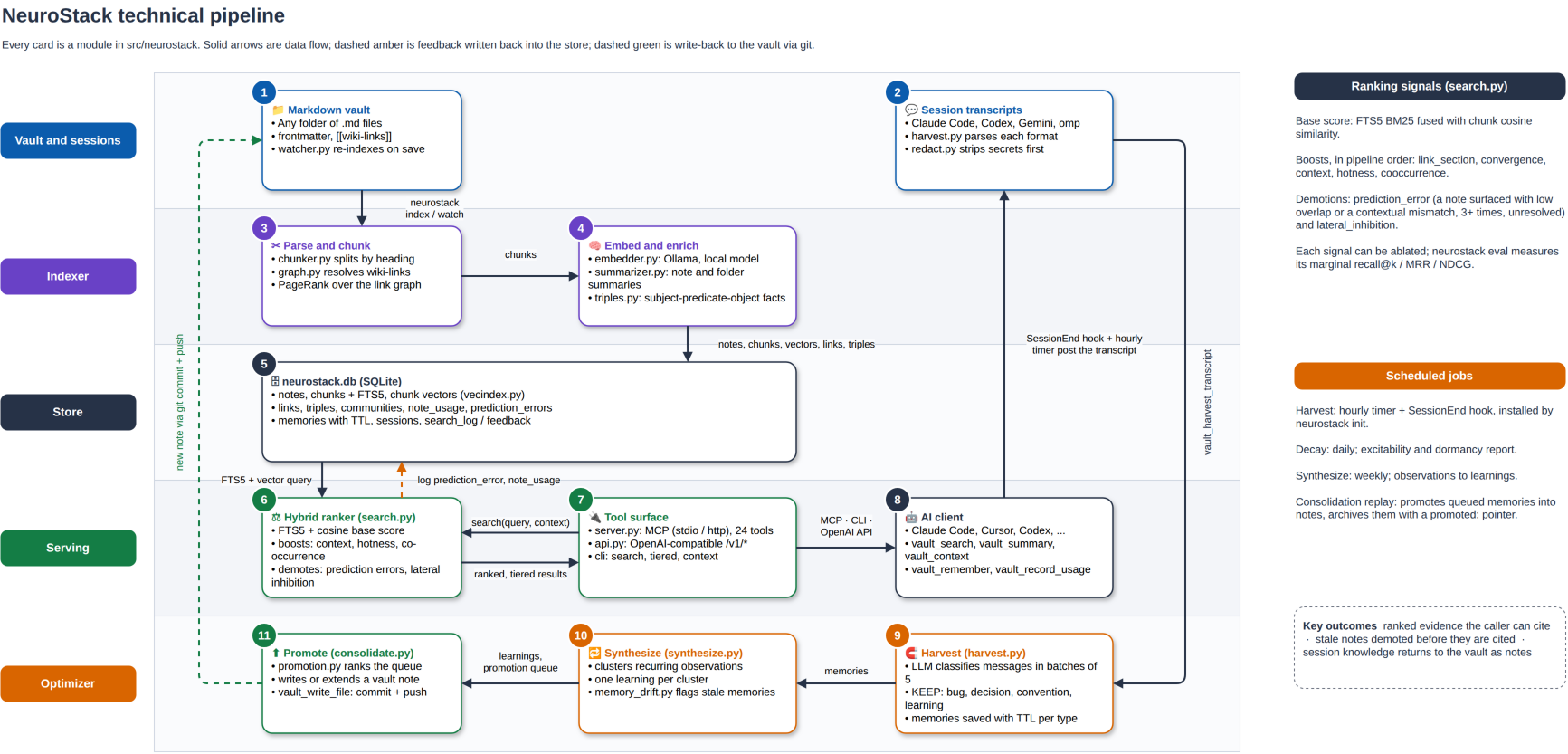
Editable sources live in the .drawio files next to the images.
Design
Philosophy
- Your files stay yours. The index lives in its own database, so deleting it leaves your notes exactly as they were.
- NeuroStack returns evidence and your AI reasons over it. No tool answers questions, and
tests/test_no_answering.pykeeps it that way. - Removing a memory moves it to an archive that search cannot reach, and you can restore it later.
- NeuroStack redacts secrets from text a model wrote, such as harvested summaries. It stores what you or your agent saved on purpose word for word.
- Ranking changes get measured first.
neurostack evalswitches off usage learning while it runs, so one pass cannot skew the next.
Mental model
NeuroStack holds two layers and one loop.
The vault is your Markdown. NeuroStack reads it, splits it into chunks, embeds them, summarises each note, extracts facts as triples and builds the link graph. Note status and tags live in NeuroStack's own note_metadata table, so it never needs to edit your frontmatter.
The memory layer holds what agents learn, typed as observations, decisions, conventions, learnings, bugs or context. These rows belong to NeuroStack and carry an optional workspace and an optional expiry.
The optimizer loop runs on a timer and connects the two. A memory usually starts in an AI session, becomes a learning when it keeps recurring, and becomes a note once no existing note covers it.
Architecture
flowchart LR
    V[/"Markdown vault<br/>never modified"/] --> IX["index<br/>chunk, embed, summarise,<br/>triples, link graph"]
    IX --> DB[("neurostack.db<br/>SQLite + FTS5")]
    S[/"AI session transcripts"/] --> H["harvest"]
    A["MCP client or CLI"] -->|vault_remember| DB
    H --> DB
    DB --> R["search, tiered, context,<br/>graph, brief"]
    R --> A
    DB --> J["timer jobs<br/>synthesize, promotion,<br/>decay, communities"]
    J --> DB
    J -->|opt-in, git commit| V
    DB --> UI["neurostack ui<br/>read-only dashboard"]
One OS timer runs neurostack run-due every minute, and that command runs each due job in turn. neurostack serve exposes 33 MCP tools over stdio or HTTP, and neurostack api serves the same retrieval as an OpenAI-compatible API.
Data model
| Area | Tables | Purpose |
|---|---|---|
| Vault index | notes, chunks + chunks_fts, summaries, triples + triples_fts, graph_edges, note_metadata |
Searchable copy of your notes. Deleting a note cascades to its chunks, summaries and triples. |
| Topics | communities, community_members, folder_summaries |
Topic clusters and folder summaries for broad questions. |
| Memories | memories + memories_fts, memories_archive, memory_sessions |
Live memories and their embeddings. The archive has no full-text index and no embedding, so search cannot reach it. |
| Quality signals | prediction_errors, trigger_log, memory_coverage, note_usage |
Stale notes, memories that drifted from the notes they cite, ignored reminders, cached coverage verdicts, and usage for hotness. |
| Feedback and jobs | search_log, search_feedback, job_runs, job_queue |
Implicit search feedback (opt-in), job history, and queued checkpoint work. |
A memory row stores its content, tags, type, workspace, source agent, embedding and expiry. It also records embed_pending when the embedder was down, so neurostack backfill can embed it later, plus revision_count and merged_from for edits and merges. A second database, sessions.db, indexes raw session transcripts for neurostack sessions search.
Write mechanics
- Deliberate saves.
vault_rememberandneurostack memories addstore the text as written, embed it once, then report any near-duplicate above 0.85 similarity without refusing the save. If embedding fails, the row still saves and gets flagged for backfill. - Harvest. The index LLM reads each session message and keeps decisions, root causes, rules and facts. A second pass reads the session as a whole and saves up to 3 final conclusions tagged
session-verdict. The judge model then picks each memory's type. Harvest redacts secrets, skips anything above 0.88 similarity to a live memory, and records how many messages of each session it has read. - Synthesis. Observations at least 7 days old that cluster at 0.75 similarity or higher (one anchor plus 3 or more others) become one learning. The originals stay, tagged
superseded_by:<id>. - Removal. Forget, the losing side of a merge, expiry and prune all go through one helper that copies the row into
memories_archivewith a reason and a timestamp, then deletes it from the live table. Search checks expiry before it runs, so an expired memory never shows up. - Vault writes. Only the opt-in tools (
vault_write_file,vault_delete_file) and the promotion job touch the vault, and each one commits and pushes to git.
Read mechanics
- Hybrid search. NeuroStack runs keyword search and embedding search separately, takes the top 50 chunks from each, and merges the two lists by reciprocal rank (k = 60). A chunk found by only one search still competes. It then adds a convergence bonus, a 1.4× boost for the caller's context, usage hotness and co-occurrence, and demotes notes flagged as stale.
- Diversity. Results keep one chunk per note, and similar notes suppress each other, so one long note cannot fill the result list.
- Tiered depth. A client asks for triples (about 15 tokens), summaries (about 75) or full notes (about 300), or lets
autoescalate only when the cheaper tier misses. - Context assembly.
vault_contextsplits its token budget into 40% memories, 20% triples, 30% summaries and 10% sessions, so no single source crowds out the rest. - Hard limits. Every search returns at most
top_kresults. No retrieval path calls an LLM unless you passrerank=True(see below).
Optional reranking. vault_search(rerank=True) asks the judge model to score each whole-note result against your query and returns the judge's order. On 76 real search clicks it raised MRR from 0.503 to 0.652, top-1 hits from 34% to 49% and top-3 hits from 57% to 75% (paired permutation p=0.004). Each search costs about $0.0004 and adds about 0.4 s. It works with depth="full" or reference_only=True and raises an error at the other depths. If the judge fails, you get the normal order back.
Usage makes a note easier to find again. It never marks a note as true.
Known limits
- Harvested memories do not record their workspace yet, so a workspace-scoped search misses them.
- A harvested memory does not link back to the session and message it came from.
- A forgotten memory can come back if a later session says the same thing, because the duplicate check reads only live memories.
- Editing a memory replaces its text, and only
revision_countshows that it changed.
External services
Lite mode needs none of these. Everything below is opt-in and set in ~/.config/neurostack/config.toml, and each one has a matching NEUROSTACK_* env var. When a service is missing, the feature that needs it switches off and the rest keeps working.
| Service | Config keys | Default | What uses it | Without it |
|---|---|---|---|---|
Embedder, any OpenAI-compatible /v1/embeddings |
embed_url, embed_model, embed_api_key, embed_timeout_s |
Local Ollama, nomic-embed-text |
Semantic search, memory similarity, duplicate checks, synthesis clusters | Keyword search only. New memories get flagged for neurostack backfill. |
| Index LLM, Ollama or any OpenAI-compatible chat API | index_llm_url, index_llm_model, index_llm_api_key, or index_llm_command for a CLI such as claude -p |
Local Ollama, phi3.5 |
Note summaries, triples, topic labels, harvest extraction, synthesis | No summaries or triples. Harvest cannot extract memories. |
| Judge model, OpenRouter decisions API | judge_url, judge_model, judge_api_key |
~typesafe/jev-latest on OpenRouter, fails without a key |
Harvest memory types, rerank=True, the promotion queue's "uncovered" check |
Harvest keeps the index LLM's type, rerank returns the normal order, and uncovered memories are counted as pending. |
Agent, Pi (@earendil-works/pi-coding-agent) on OpenRouter or a compatible proxy |
agent_provider, agent_model, agent_api_key, agent_base_url |
anthropic/claude-sonnet-5, needs Node 22.19+ |
neurostack agent promotion, which writes notes from the promotion queue, and neurostack agent vault-save, which writes one session transcript into the notes |
The promotion job shows as blocked. The queue still builds. |
| Checkpoint command, any shell command that answers a prompt on stdin | checkpoint_command |
Off | Server workers that turn queued /save checkpoints and harvest jobs into memories |
Queued checkpoints wait. Local harvest still runs. |
| Notify command, any shell command | notify_command |
Off | Receives a failed job run as JSON, for example ntfy publish mytopic |
Failures show only in neurostack jobs and the dashboard. |
| Git remote on your vault | Your vault's git config | None | vault_write_file, vault_delete_file and promotion commit and push each change |
A write rolls back when the push fails. Reading never needs git. |
Only the embedder and the index LLM see your note text. The judge sees queries, memories and the notes being ranked or checked. Point every URL at localhost to keep all data on your machine.
What makes it different
NeuroStack is not a replacement for Obsidian, Notion, or any note-taking app. It sits on top of what you already use and adds what they don't have.
| Capability | Note apps | Basic RAG | NeuroStack |
|---|---|---|---|
| Stores your notes | Yes | No | No (read-only by default; opt-in git-backed write tools) |
| AI can search your notes | Some | Yes | Yes |
| Detects stale/outdated notes | No | No | Yes |
| AI memories persist across sessions | No | No | Yes |
| Works with any MCP-compatible AI | No | Varies | Yes |
| Tiered retrieval (saves 80-95% tokens) | No | No | Yes |
| Profession-specific workflows | No | No | Yes |
| Open source, self-hostable | Varies | Varies | Yes (Apache 2.0) |
Stale detection is the part other tools lack. When a note keeps appearing in contexts where it no longer fits, such as a deprecated API or a superseded paper, NeuroStack flags it and demotes it in later results.
Profession packs
When you run neurostack init, you choose a profession pack. Each one configures NeuroStack with templates, folder structures, and AI guidance suited to how your profession actually uses notes.
| Pack | Built for |
|---|---|
researcher |
Literature review, citation tracking, evolving arguments, stale paper detection |
writer |
Character sheets, world-building, chapter outlines, continuity tracking |
student |
Course notes, spaced repetition, exam prep, syllabus change detection |
developer |
Code decisions, architecture notes, runbooks, deprecated API detection |
devops |
Infrastructure runbooks, incident notes, change logs |
data-scientist |
Experiment tracking, model notes, dataset documentation |
Apply a pack to an existing vault without losing any notes:
neurostack scaffold researcher ~/my-notes # or: writer, student, developer, devops, data-scientist
You can also import an existing Markdown directory:
neurostack onboard ~/my-notes
How retrieval works
Most memory tools give your AI a wall of text and let it figure out what's relevant. NeuroStack is tiered. It starts with the cheapest retrieval that answers the question and escalates only when it needs to.
| Level | Tokens | What your AI gets |
|---|---|---|
| Quick facts | ~15 | Structured facts extracted from your notes: experiment-3 used learning-rate 0.001 |
| Summaries | ~75 | AI-generated overview of a note |
| Full content | ~300 | Actual Markdown content |
| Auto (default) | Varies | Starts at quick facts, escalates only if the answer isn't there |
Simple factual questions resolve at ~15 tokens. Deep dives get full context. Your AI spends its attention budget where it matters.
Your AI remembers decisions
Across sessions, your AI can save and retrieve typed memories: observations, decisions, conventions, learnings, bugs. When you start a new session, those memories are surfaced automatically.
"We decided to keep authentication stateless." "The thesis framing shifted from consolidation to complementary learning systems." "Elena's surname changed from Vasquez to Reyes in the chapter 7 revision."
These aren't just notes. They're things your AI remembers you decided together. They survive /clear. They survive closing the terminal. They survive switching machines.
neurostack memories add "revised thesis framing to CLS, not just consolidation" --type decision --tags "thesis,neuroscience"
neurostack memories search "thesis direction"
Learns from your AI sessions
NeuroStack scans your past AI conversations on a timer, extracts the decisions, observations and learnings, and saves them as memories. You do not have to write them down yourself.
neurostack harvest --sessions 5          # extract insights from last 5 sessions
neurostack schedule install              # one timer runs due jobs every minute
Supports Claude Code, VS Code, Codex CLI, Aider, and Gemini CLI session formats.
Keeps itself current
Your vault changes. NeuroStack watches it.
neurostack watch # auto-index on vault changes
The index updates as you write and stale detection runs continuously, so you do not maintain it by hand.
Scheduling
NeuroStack runs its background jobs from one OS timer. The timer calls neurostack run-due once a minute, and run-due works out which jobs are due and runs them one at a time. neurostack init installs the timer for you. Installing it records each daily job as just run, so the jobs start at their next scheduled time instead of all at once. The commands below manage it by hand.
neurostack schedule install   # install or overwrite the timer
neurostack schedule status    # show whether the timer is active
neurostack schedule remove    # remove the timer
schedule install uses the scheduler your OS already ships:
| OS | Backend | What it writes |
|---|---|---|
| Linux | systemd user timer | ~/.config/systemd/user/neurostack.timer and neurostack.service |
| macOS | launchd agent | ~/Library/LaunchAgents/io.neurostack.run-due.plist |
| Windows | Task Scheduler | a task named NeuroStackRunDue |
The timer calls the neurostack executable it finds on your PATH at install time, so run schedule install again after you move or reinstall NeuroStack. All three subcommands accept --json.
A systemd user timer runs only while you have a login session. On a headless Linux server, or when you run NeuroStack as root, enable lingering for that user so the timer keeps running after you log out:
sudo loginctl enable-linger <user>
neurostack doctor shows when each job last ran.
NeuroStack MCP 질문
NeuroStack MCP를 Claude Code에 추가하려면 어떻게 하나요?
터미널에서 claude mcp add neurostack -- npx -y neurostack를 실행합니다. 모든 프로젝트에서 사용할 수 있게 하려면 --scope user를 추가합니다.
NeuroStack MCP를 Cursor에 추가하려면 어떻게 하나요?
~/.cursor/mcp.json를 열고 mcpServers 아래에 서버를 추가합니다. 위 설치 섹션에 표시된 Cursor 구성을 사용합니다.
NeuroStack이 제 Markdown 파일을 수정하나요?
아니요. 인덱싱, 검색, 그래프 분석은 기본적으로 읽기 전용입니다. 쓰기 도구는 선택 사항이며 git repo가 필요합니다.
어떤 AI 클라이언트가 NeuroStack에 연결할 수 있나요?
Claude, Cursor, Windsurf, Gemini CLI, VS Code, Codex 및 기타 모든 MCP 지원 클라이언트에서 작동합니다.
데이터가 제 컴퓨터 외부로 유출되나요?
요약 및 임베딩을 위해 타사 LLM 제공자를 설정하지 않는 한, 데이터는 기기 외부로 나가지 않습니다.
NeuroStack을 어떻게 설치하나요?
npm을 통해 설치한 후, 초기화 마법사를 실행하여 노트 폴더와 모드를 선택하십시오. pipx와 uv도 지원합니다.
Lite 모드와 Full 모드의 차이점은 무엇인가요?
Lite(~130 MB)는 GPU 없이 키워드 검색 및 오래된 정보 감지 기능을 제공합니다. Full(~560 MB)은 로컬 Ollama를 통해 시맨틱 검색, 요약 및 토픽 클러스터링 기능을 추가합니다.