
git 명령 및 다단계 작업의 결과를 보정된 확률로 예측하는 오픈 결과 모델입니다.
다른 이름 OpenInterpretability/ekbasis
- 스타
- 18
- Tools
- —
- 다운로드, 30일
- —
- 최신 버전
- 0.1.42
- 마지막 커밋
- 2026년 10월 16일
- 라이선스
- Apache-2.0
Ekbasis MCP란?
Ekbasis은(는) MCP server입니다. git 명령 및 다단계 작업의 결과를 보정된 확률로 예측하는 오픈 결과 모델입니다.
프로젝트 README에서 생성된 요약
Ekbasis MCP server 정보
Ekbasis는 AI 에이전트를 사용하는 개발자가 셸 명령 및 다단계 작업의 결과를 예측할 수 있도록 지원합니다. 특정 명령이 데이터 손실을 일으키거나 실패할지 여부와 같이 입력된 질문에 대해 보정된 확률을 제공하는 결과 모델 역할을 합니다. 텍스트를 생성하는 추론 모델과 달리, 이 시스템은 단 한 번의 포워드 패스를 사용하여 개입 후 상태가 어떻게 변할지 예측합니다.
사용자는 API 키를 사용하여 호스팅된 API에 연결하거나 GPU에서 오픈 가중치를 사용하여 직접 모델을 호스팅할 수 있습니다. 서버는 모든 MCP 클라이언트를 위한 ekbasis-mcp 도구나 전용 Claude Code 플러그인을 통해 워크플로우에 통합할 수 있습니다. git 관련 안전성을 위해 Claude Code hook은 리포지토리 상태를 읽고 명령 실행 전에 확인하여 에이전트가 커밋되지 않은 작업 내용을 잃지 않도록 방지하는 가드 역할을 합니다. 이 시스템은 빠른 초기 판단을 제공하도록 설계되었으며, 결과 모델이 불확실할 때만 에이전트가 비용이 많이 드는 추론 모델로 넘어가도록 유도합니다.
활용 사례
- 1git 데이터 손실 방지코딩 에이전트가 리포지토리의 커밋되지 않은 작업 내용을 실수로 삭제하는 것을 방지합니다.
- 2운영 환경 변경 계획 검증에이전트가 실행하기 전에 인프라 또는 데이터베이스 변경 사항 묶음을 확인합니다.
프로젝트의 README를 바탕으로 작성되었습니다. 모든 활용 사례는 해당 내용의 인용문과 대조하여 확인합니다.
Ekbasis MCP 설치 방법
형식 확인: 2026년 11월 10일Claude Code에 Ekbasis MCP 설치
$ claude mcp add --env EKBASIS_API_KEY=<YOUR_EKBASIS_API_KEY> ekbasis -- uvx ekbasisCursor에 Ekbasis MCP 설치
~/.cursor/mcp.json
{
  "mcpServers": {
    "ekbasis": {
      "command": "uvx",
      "args": [
        "ekbasis"
      ],
      "env": {
        "EKBASIS_API_KEY": "<YOUR_EKBASIS_API_KEY>"
      }
    }
  }
}VS Code에 Ekbasis MCP 설치
.vscode/mcp.json
{
  "servers": {
    "ekbasis": {
      "type": "stdio",
      "command": "uvx",
      "args": [
        "ekbasis"
      ],
      "env": {
        "EKBASIS_API_KEY": "<YOUR_EKBASIS_API_KEY>"
      }
    }
  }
}Claude Desktop에 Ekbasis MCP 설치
claude_desktop_config.json
{
  "mcpServers": {
    "ekbasis": {
      "command": "uvx",
      "args": [
        "ekbasis"
      ],
      "env": {
        "EKBASIS_API_KEY": "<YOUR_EKBASIS_API_KEY>"
      }
    }
  }
}Codex에 Ekbasis MCP 설치
~/.codex/config.toml
[mcp_servers.ekbasis]
command = "uvx"
args = ["ekbasis"]

[mcp_servers.ekbasis.env]
EKBASIS_API_KEY = "<YOUR_EKBASIS_API_KEY>"
Gemini CLI에 Ekbasis MCP 설치
~/.gemini/settings.json
{
  "mcpServers": {
    "ekbasis": {
      "command": "uvx",
      "args": [
        "ekbasis"
      ],
      "env": {
        "EKBASIS_API_KEY": "<YOUR_EKBASIS_API_KEY>"
      }
    }
  }
}구성
EKBASIS_API_KEY비밀Key for the hosted API (ekb_..., from https://openinterp.org/console); not needed for your own server
EKBASIS_URLEkbasis server: the hosted API, or your own server (open weights)
| 이름 | 설명 | 유형 |
|---|---|---|
| EKBASIS_API_KEY | Key for the hosted API (ekb_..., from https://openinterp.org/console); not needed for your own server | 비밀 |
| EKBASIS_URL | Ekbasis server: the hosted API, or your own server (open weights) |
자동 검사
2026년 11월 12일에 실행됨전체 보고서 →자동 검사를 통과했습니다. 이는 보안 감사가 아닙니다. 코드를 직접 읽고 서버에 필요한 최소한의 권한만 부여하십시오. 검사 방식

- 소스 저장소 연결 및 접근 가능통과
- 오픈 소스 라이선스 (OSI)통과
- 최근 1년 내 커밋 또는 릴리스통과
- 패키지 이름이 인기 패키지와 유사하지 않음통과
- 원격 엔드포인트가 HTTPS 사용검사되지 않음
- 파괴적인 도구에 라벨 표시됨검사되지 않음
- 모델에 대한 숨겨진 지침 없음통과
- 패키지와 의존성에 심각한 보안 권고 없음통과
README
GitHub에서 보기Ekbasis
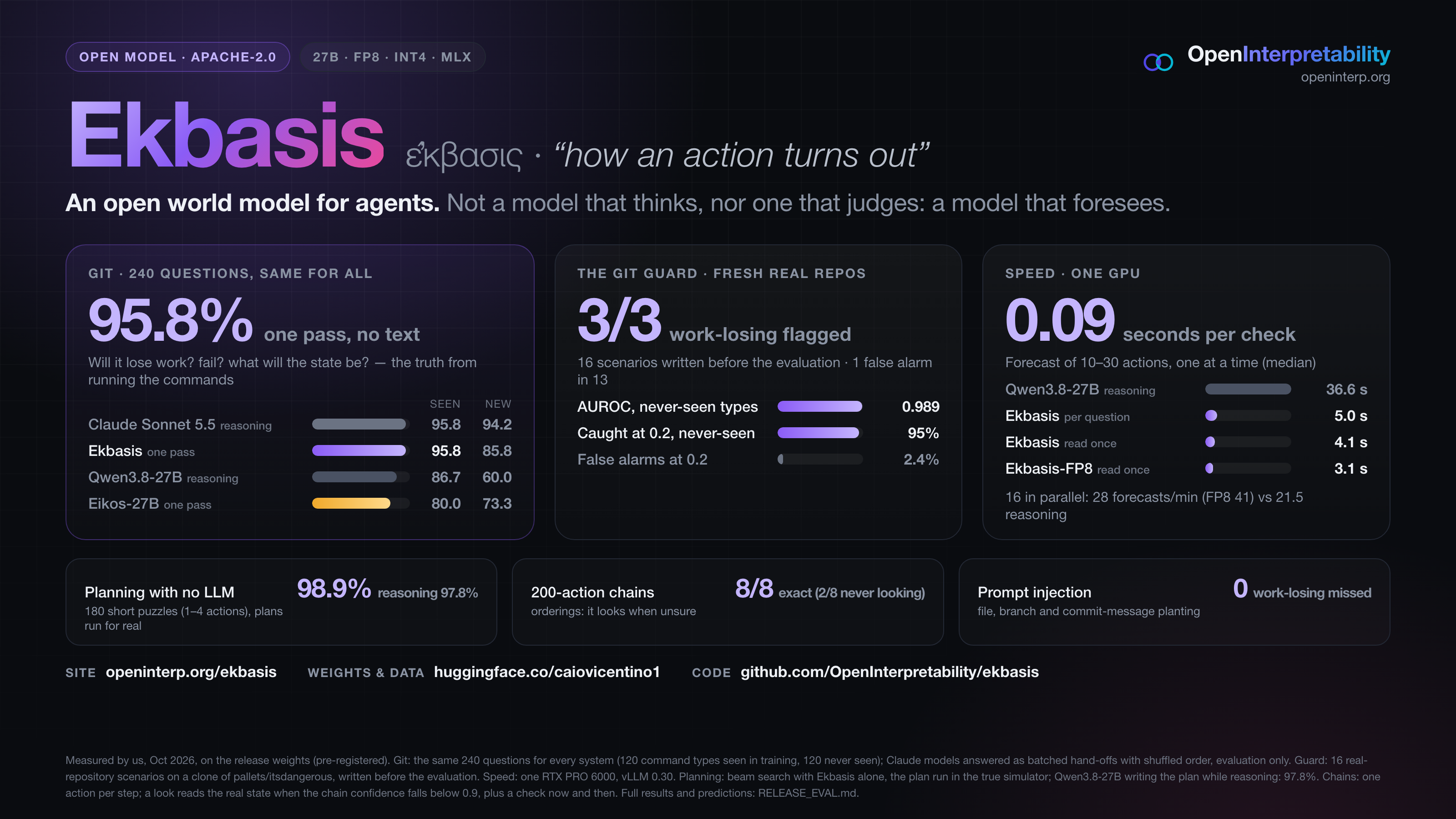
Papers: Look When Unsure, Check When Sure · DOI 10.5281/zenodo.23146970 · When Does a Consequence Model Make AI Agents Safer? · DOI 10.5281/zenodo.23197341 (data, scripts and the benchmark to rerun its studies: paper/agents) · Code: github.com/OpenInterpretability/ekbasis · Site: openinterp.org/ekbasis
Ekbasis (ἔκβασις, "how an action turns out") is an open consequence model for agents: given the current state and an action, it answers typed questions about what will happen — will this command lose work? will it fail? what will X be afterwards? — with a calibrated probability, in one forward pass (no generated text).
It is the consequence layer of the Eikos family (Eikos decides; Ekbasis foresees), trained on synthetic worlds and on real executions of git commands in throwaway repositories, so its answers come from what actually happened, not from what an agent believes.
Every number on this page was measured on the exact release weights. RELEASE_EVAL.md has the results, every prediction, how this checkpoint was chosen, which measurements were pre-registered (PREREG_release_eval.md, paper/prereg/) and the deviations.
New (2026-10-16): Ekbasis-Skopos-27B, the next version, trained further on executed shell, git, SQLite, PostgreSQL and Python scenarios. Against Ekbasis-27B on the same items: the git guard raises fewer false alarms on the held-out command types, 26/799 instead of 49/799 (paired McNemar p = 5.6 × 10⁻⁶; these command types are held out of the git sandbox's training rows but appear in Skopos' factory rows), and flags as many work-losing commands; on the known types, 27 instead of 37 of 863 is within chance. On 3,014 fresh answers of never-trained world families the actions change, +1.6 points [+0.7, +2.5]: the pre-registered release read failed this criterion on
ftest_family, and a confirmation registered after that result (before any fresh item existed), by trainer readout, did not confirm the loss. Its largest gains are in-distribution (the generators it was trained on), and in world families it never saw more of its errors come with confidence ≥ 0.9 (4.49 vs 3.75 per 100). Same prompt, readout, API and client; its evaluation is in RELEASE_EVAL_SKOPOS.md and its card. The numbers further down this page are Ekbasis-27B's.ekbasis.verify's certified mode, certified on Ekbasis-27B, carried over to Skopos INT4 in a pre-registered check (7 errors among 927 accepted answers; docs/VERIFY.md). A pre-launch release blocker is declared: on paraphrased short checks it is right on 113 of 120 against Ekbasis-27B's 117 (−3.3 points, paired 95% CI [−6.7, −0.8]), so the pre-registered rule fired; the exact test on the 4 discordant items does not reject (p = 0.125), and Ekbasis-27B re-run on the same machine reproduced its published answers (240/240) (release decision).
Install
The client needs a server: the hosted API (EKBASIS_URL=https://openinterp.org/api/v1 and EKBASIS_API_KEY=ekb_…,
key at openinterp.org/console) or your own, with the open weights
(Quick start).
What leaves your machine (to the server you choose): the state of each check, as text. For the guards that is the
command line, with credentials typed on it replaced (since 0.1.42: known key prefixes, Authorization and Cookie
headers, passwords in URLs, --password/--token values, values of *TOKEN*/*SECRET*/*PASSWORD*-like names,
private keys and long random-looking strings; EKBASIS_REDACT=0 turns it off), and a listing of what the line could
touch: names, sizes, ages and short fingerprints keyed anew for each check, never file contents; for git, the
repository's state (branches, the names of changed files, commit subjects). Redaction is a safety net with limits
(docs/SECURITY.md): a short or unusual secret without a known prefix or name can pass. The hook's
log (log mode) stays on your machine and holds the redacted line.
-
Command line and Python (standard library only, Python ≥ 3.9):
ekbasis,ekbasis-claude-hook, andekbasis-mcpwith themcpextra.pip install ekbasis # or without installing: uvx ekbasis health pip install "ekbasis[mcp]" # with the MCP server (Python >= 3.10) pip install "git+https://github.com/OpenInterpretability/ekbasis" # from source -
Claude Code plugin: the git guard hook, the
ekbasis-guardskill, the MCP server and theekbasiscommand on the Bash tool's PATH, in one install:claude plugin marketplace add OpenInterpretability/ekbasis --sparse .claude-plugin plugins claude plugin install ekbasis@ekbasisor, inside Claude Code,
/plugin marketplace add OpenInterpretability/ekbasisthen/plugin install ekbasis@ekbasis(without--sparsethe marketplace step clones the whole repository, about 86 MB with the results and papers, once; with it, about 1 MB).The plugin (
plugins/ekbasis/, about 0.5 MB) runs its own copy of the client, so it needspython3(≥ 3.9) andshfor the hooks anduvfor the MCP server, and nothing from PyPI. SetEKBASIS_API_KEY(a key alone means the hosted API) orEKBASIS_URL, in your shell or in the"env"block of~/.claude/settings.json, and restart Claude Code. Until one of them is set the guard is off: each session starts with one line saying how to set it up, andekbasissays it is not set up (exit 3). Once set, the hook is the same fail-closed hook described in Claude Code and MCP, and a hook that cannot run (python3missing or older than 3.9, an error in the hook, no answer within 27 s) asks you to confirm, saying why, instead of letting the command through. If you addedekbasis-claude-hooktosettings.jsonby hand, remove it, or every line is checked twice. -
MCP server for any MCP client (Python ≥ 3.10):
uvx --python ">=3.10" --with "mcp>=1.2" ekbasis mcp # same as ekbasis-mcp from pip install "ekbasis[mcp]"
What kind of model is it?
Not a model that thinks. Not a model that judges. A model that foresees.
Ekbasis is a world model for agents in the precise sense: an action-conditioned model of how the state changes. It answers what will be, if I do this, as calibrated distributions over the next state's variables, in one forward pass.
| LLM, reasoning | System One (Eikos, Jev) | Ekbasis | |
|---|---|---|---|
| It answers | anything, in text | what is: which option holds now | what will be, if I do this |
| Kind of question | open | a judgment of the present | an intervention: the outcome of acting |
| Output | generated text | calibrated distribution over the options | calibrated distribution over the next state's variables |
| Learns from | human and model text | a teacher's judgments | what actually happened when the action ran |
| Time | seconds to minutes of reasoning | one forward pass | one forward pass per step; chains to long sequences |
| Role in an agent | plans and talks | judge | simulator and guard: it foresees |
Two ways to picture it:
- The forward model the agents were missing. Before you move your arm, the brain predicts the consequence of the motor command; that is what lets us act fast and correct before an error. One part plans, another predicts. The agent plans; Ekbasis predicts.
- The world-model module, made real. LeCun's architecture for autonomous machine intelligence separates a world model (it predicts the next state given an action) from the actor and the critic. The LLM agent is the actor, AgentGuard the critic, Ekbasis the world model. It was trained with a JEPA-style loss that aligns its internal state with the true outcome.
It is derived from an LLM (Qwen3.8-27B, through Eikos-27B) but does not work as one: its training objective and its readout make it answer with probabilities, not text.
Where to start
| You want to | Use | What decides the quality |
|---|---|---|
Check a batch of production changes before an agent runs it (kubectl, SQL, deploys, server commands) |
ekbasis plan-check with a rules file about your system; test that file with --cases |
The facts in the rules and the state: what depends on what, what is deleted for good, what has no copy |
| Keep a coding agent from losing uncommitted work in git | The Claude Code plugin or hook | Nothing to write: it reads the repository, and runs local commands on a copy when it is cheap |
| Ask your own question about an outcome | ask / predict |
How clearly the state and the question are written |
Most of the value is in the first row. The hook covers git only; outside git, the shell guard (EKBASIS_SHELL_GUARD=1)
is a prototype that asks too often to keep on.
What it is for
- A check before acting: ~0.1 s per question on one GPU, calibrated, so an agent can check every action and escalate only the risky or uncertain ones.
- A git guard for coding agents: the state of your real repository is described in the format the model was trained on (including what decides a conflict), and the commands are checked before they run.
- Simulation and state tracking: chain it one action at a time to follow long sequences; given a way to read the real state, it looks only when unsure (see Look when unsure).
- A fast first opinion before expensive reasoning: answer from Ekbasis when it is confident, escalate to a large reasoning model when it is not.
Quick start
-
Serve the model (one GPU with ~80 GB; vLLM ≥ 0.30). The model folder ships its serving code; run it in the Python environment where vLLM is installed:
hf download caiovicentino1/Ekbasis-Skopos-27B --local-dir Ekbasis-Skopos-27B
bash Ekbasis-Skopos-27B/serve_vllm.sh Ekbasis-Skopos-27B 8001             # vLLM on 127.0.0.1:8001
python Ekbasis-Skopos-27B/serve.py --model Ekbasis-Skopos-27B --vllm-url http://127.0.0.1:8001 --port 8000
The previous version,
caiovicentino1/Ekbasis-27B, is served the same way. -
Install the client (standard library only, Python ≥ 3.9), anywhere that can reach the server:
pip install "git+https://github.com/OpenInterpretability/ekbasis" # ekbasis, ekbasis-claude-hook (MCP: below) export EKBASIS_URL=http://127.0.0.1:8000 ekbasis health -
Check git commands before running them (in any repository):
ekbasis git-check -- "git checkout -- app.py"
# Ekbasis: RISKY  (lose uncommitted work: 99%)
#     0% fails  git checkout -- app.py
#   - may permanently lose uncommitted work (99%)
Exit code 0 when no risk is found, 2 when the commands may lose uncommitted work, 3 when the guard cannot foresee (the server cannot be reached or does not answer in time, the repository cannot be read, or a command points git at another repository or uses an alias): treat 3 as risky. 1 is a usage error. The guard fails closed;
--fail-openturns "cannot foresee" into 0 with a warning. It is a warning layer that can be wrong, not a security boundary: keep confirmations, backups and least privilege (docs/SECURITY.md).
Builds
Ekbasis-Skopos-27B (recommended): each build's card shows its quality against bf16 on the same evaluation (the gate
of PREREG_quantized.md) and ships its own calibrated_temperature. Memory needs are those measured for Ekbasis-27B's
builds, which have the same architecture and sizes.
| Build | Size | Runs on | Against bf16 |
|---|---|---|---|
| Ekbasis-Skopos-27B (bf16) | 54.7 GB | GPUs with 80 GB | the reference |
| Ekbasis-Skopos-27B-FP8 | 30.4 GB | GPUs with 48 GB | quantization gate passed: same answer as bf16 on 98.6% |
| Ekbasis-Skopos-27B-INT4 | 18.6 GB | GPUs with 32 GB | quantization gate passed: same answer as bf16 on 97.4% |
Ekbasis-27B (the previous version): every build that works is released, so each machine runs the one that fits; each
build's card shows its quality against bf16 on the same evaluation (the gate was pre-registered in
PREREG_quantized.md).
| Build | Size | Runs on | Speed (one RTX PRO 6000) |
|---|---|---|---|
| Ekbasis-27B (bf16) | 55 GB | GPUs with 80 GB | the reference |
| Ekbasis-27B-FP8 | 30.4 GB | GPUs with 48 GB; fastest with FP8 kernels (Ada, Hopper, Blackwell) | 1.6× the throughput of bf16 |
| Ekbasis-27B-INT4 | 18.6 GB | GPUs with 32 GB; 24 GB with text only and a 4k context (command in its card) | about bf16's |
| Ekbasis-27B-MLX-4bit | 15 GB | Macs with Apple Silicon (32 GB or more recommended) | — |
GPU sizes were tested by limiting vLLM to that much memory on one RTX PRO 6000 and checking that the answers match the build at full memory; the MLX build's quality gate ran with MLX on a Linux GPU, and it was then tested on an Apple-silicon Mac (its card, "On a Mac: tested").
Python
from ekbasis import Ekbasis, world_state, choice, yes_no, simulate
from ekbasis import git

client = Ekbasis()                                     # EKBASIS_URL or http://127.0.0.1:8000

# a git guard
v = git.check(["git stash", "git checkout feature", "git stash pop"], repo=".")
print(v.risky, v.p_lost, v.p_fail, v.summary())

# any world whose rules you can write down
rules = ("World: containers A (holds 5 liters), B (holds 3 liters) of water. 'fill X' fills X to the top; "
         "'empty X' empties X; 'pour X into Y' moves water from X to Y until X is empty or Y is full, "
         "whichever comes first.")
ans = client.ask(world_state(rules, "A: 5 of 5 liters, B: 0 of 3 liters", ["pour A into B"]),
                 {"a": choice("How many liters are in A?", [str(k) for k in range(6)])})
print(ans["a"].value, ans["a"].confidence)

# a long sequence: one action at a time, every variable asked after each action
render = lambda s: f"A: {s['a']} of 5 liters, B: {s['b']} of 3 liters"
qs = {"a": choice("How many liters are in A?", [str(k) for k in range(6)]),
      "b": choice("How many liters are in B?", [str(k) for k in range(4)])}
sim = simulate(client, rules, {"a": "5", "b": "0"}, ["pour A into B", "empty B", "pour A into B"], qs, render)
print(sim.final, sim.confidence)   # use the chain confidence, not the last step's

# (0.1.2) the rule that decides the answer, repeated right before the question
from ekbasis import recap
q = recap(yes_no("Is the small disk still on peg A?"), "A disk can never be placed on a smaller disk.")

# (0.1.2) a running total: the model tracks the number, the code compares it with the limit
from ekbasis import number, threshold
t = threshold(client, "Each purchase adds its price to the month's spending.", {"spent": "0"},
              ["buy a 30-dollar plan", "buy a 45-dollar add-on", "buy a 25-dollar seat"],
              {"spent": number("How much has been spent this month, in dollars?", range(0, 205, 5))},
              lambda s: f"Spent this month: {s['spent']} dollars.", quantity="spent", op=">=", limit=100, when="ever")
print(t.value, t.holds, t.confidence)
- Calibrated probabilities (
answer.calibrated, since 0.1.41 / TS 0.2.5): the hosted API also returns every answer at a temperature fit on held-out validation, in its own field.ans["a"].calibrated.p_yes(yes/no) and.calibrated.confidence/.probabilitiesare meant to be read as frequencies. The chosen answer is the same, and the plain fields (p_yes,confidence,probabilities) keep the model's raw probabilities, which every threshold built into this client uses, so nothing it decides changes. Show the calibrated numbers to people and set your own thresholds on them;Noneon servers that do not send them. - Recap (
recap,simulate(..., recap=True),ekbasis predict --recap): repeating the rule that decides the answer right before the question fixed the case where Ekbasis ignored a written prohibition that compares two values (Tower of Hanoi's size rule: 0 of 8 right, 8 of 8 with the recap; capability map,habit_vs_rule). On fresh items it helps on balance but not everywhere: 97.4% → 98.6% on familiar and invented single-rule worlds (12 answers fixed, none broken), 86.7% → 88.9% on invented worlds with chains of rules and captures along a line (51 fixed, but 26 of 1,120 right answers turned wrong). Use it for the rule you know decides the answer; it stays opt-in, and without it every prompt is the same as in 0.1.1. - Compare in code (
threshold): Ekbasis carries running totals well (98–100% exact step by step) but judges "is the limit reached?" poorly when the total is within a unit or two of it; asking it for the number and comparing in code gave 99.0% on budgets, timers, quotas, rate limits and lockouts (capability map,accumulation). Use it whenever an effect depends on a sum crossing a limit.
TypeScript / JavaScript
npm install ekbasis (sdk/typescript): the same requests and prompt layouts as the Python client,
no dependencies, Node 18+, Deno, Bun and browsers.
import { Ekbasis, yesNo, checkPlan } from "ekbasis";
const ek = new Ekbasis();   // EKBASIS_API_KEY; EKBASIS_URL defaults to the hosted API
const pc = await checkPlan(ek, rules, state, actions,
  { data: yesNo("Do these actions permanently delete data the user did not ask to delete?") });
Ekbasis MCP 질문
Ekbasis MCP를 Claude Code에 추가하려면 어떻게 하나요?
터미널에서 claude mcp add --env EKBASIS_API_KEY=<YOUR_EKBASIS_API_KEY> ekbasis -- uvx ekbasis를 실행합니다. 모든 프로젝트에서 사용할 수 있게 하려면 --scope user를 추가합니다.
Ekbasis MCP를 Cursor에 추가하려면 어떻게 하나요?
~/.cursor/mcp.json를 열고 mcpServers 아래에 서버를 추가합니다. 위 설치 섹션에 표시된 Cursor 구성을 사용합니다.
Ekbasis는 무엇을 하나요?
Ekbasis는 에이전트를 위한 결과 모델로, 특정 명령이 작업 내용을 손실시키거나 실패할지 여부와 같이 작업 후 어떤 일이 발생할지에 대한 질문에 보정된 확률을 사용하여 답변합니다.
Ekbasis는 일반적인 LLM과 어떻게 다른가요?
추론을 통해 텍ast를 생성하는 LLM과 달리, Ekbasis는 단 한 번의 포워드 패스(forward pass)로 다음 상태 변수에 대한 보정된 분포를 제공하는 월드 모델입니다.
Ekbasis를 사용하여 git 리포지토리를 보호할 수 있나요?
네, 리포지토리 상태를 읽고 명령이 실행되기 전에 확인하여 코딩 에이전트를 위한 git 가드 역할을 수행할 수 있습니다.
서버로 어떤 정보가 전송되나요?
서버는 명령줄(자격 증명은 삭제됨)과 파일 이름 및 크기 등 해당 명령이 영향을 미칠 수 있는 목록을 포함하여 각 확인 상태를 텍스트로 수신합니다.