
대화 기록, 키-값 컨텍스트, 시맨틱 검색, FIFO 큐를 포함하여 AI agent를 위한 지속성 메모리를 제공합니다.
다른 이름 jyswee/agenticmemory, agmry
- 스타
- 1
- Tools
- —
- 다운로드, 30일
- —
- 최신 버전
- 1.10.0
- 마지막 커밋
- 2026년 9월 23일
- 라이선스
- —
agenticmemory MCP란?
agenticmemory은(는) MCP server입니다. 대화 기록, 키-값 컨텍스트, 시맨틱 검색, FIFO 큐를 포함하여 AI agent를 위한 지속성 메모리를 제공합니다.
프로젝트 README에서 생성된 요약
agenticmemory MCP server 정보
Agentic Memory는 AI agent가 서로 다른 세션과 기기 간에 정보를 저장하고 불러올 수 있도록 지속성 메모리 계층을 제공합니다. Claude Code, Cursor, Cline, Windsurf와 같은 도구를 사용하는 개발자를 위해 설계되었습니다. 이 시스템을 통해 agent는 단기 대화 기록, 선호도를 위한 내구성 있는 키-값 컨텍스트, 장기 태그 기반 지식 항목 등 다양한 메모리 유형을 통해 자체 상태를 관리할 수 있습니다. 또한 휘발성 작업 메모리를 위한 scratchpad와 서로 다른 agent 간에 작업을 전달하는 agent 버스 역할을 하는 FIFO 큐도 포함되어 있습니다.
사용자는 CLI, REST API 또는 MCP server를 통해 서비스와 상호작용할 수 있습니다. MCP server는 agmry mcp-serve 명령어를 사용하여 로컬에서 실행하거나 원격 SSE 엔드포인트를 통해 hosted client에 연결할 수 있습니다. 보안을 위해 서버가 데이터를 읽을 수 없는 제로 지식 공간을 위한 종단간 암호화를 지원합니다. 또한 agent는 CLI를 통해 셀프 가입을 수행하여 수동으로 브라우저를 조작하지 않고도 API key를 받을 수 있습니다.
활용 사례
- 1세션 간 프로젝트 컨텍스트 유지agent는 boot 명령어를 사용하여 새로운 세션 시작 시 모든 메시지, 컨텍스트 및 항목을 로드할 수 있습니다.
- 2내구성 있는 사실 저장 및 검색개발자는 특정 결정 사항이나 런북을 타입화된 키-값 쌍으로 저장하여 정보가 누락되지 않도록 할 수 있습니다.
- 3과거 데이터에 대한 시맨틱 검색 수행agent가 특정 주제를 부분적으로만 기억할 때, 시맨틱 검색을 사용하여 관련 과거 항목을 찾을 수 있습니다.
- 4여러 agent 간의 작업 조정한 agent가 JSON 작업을 FIFO 큐에 푸시하면 다른 agent가 나중에 이를 가져와 처리할 수 있습니다.
프로젝트의 README를 바탕으로 작성되었습니다. 모든 활용 사례는 해당 내용의 인용문과 대조하여 확인합니다.
agenticmemory MCP 설치 방법
형식 확인: 2026년 11월 10일Cursor에 추가Goose에 추가Claude Code에 agenticmemory MCP 설치
$ claude mcp add --env 'AGMRY_API_KEY=<YOUR_AGMRY_API_KEY>' agenticmemory -- npx -y agmryCursor에 agenticmemory MCP 설치
~/.cursor/mcp.json
{
  "mcpServers": {
    "agenticmemory": {
      "command": "npx",
      "args": [
        "-y",
        "agmry"
      ],
      "env": {
        "AGMRY_API_KEY": "<YOUR_AGMRY_API_KEY>"
      }
    }
  }
}VS Code에 agenticmemory MCP 설치
.vscode/mcp.json
{
  "servers": {
    "agenticmemory": {
      "type": "stdio",
      "command": "npx",
      "args": [
        "-y",
        "agmry"
      ],
      "env": {
        "AGMRY_API_KEY": "<YOUR_AGMRY_API_KEY>"
      }
    }
  }
}VS Code CLI에 agenticmemory MCP 설치
$ code --add-mcp '{"name":"agenticmemory","type":"stdio","command":"npx","args":["-y","agmry"],"env":{"AGMRY_API_KEY":"<YOUR_AGMRY_API_KEY>"}}'Claude Desktop에 agenticmemory MCP 설치
claude_desktop_config.json
{
  "mcpServers": {
    "agenticmemory": {
      "command": "npx",
      "args": [
        "-y",
        "agmry"
      ],
      "env": {
        "AGMRY_API_KEY": "<YOUR_AGMRY_API_KEY>"
      }
    }
  }
}Codex에 agenticmemory MCP 설치
$ codex mcp add agenticmemory --env 'AGMRY_API_KEY=<YOUR_AGMRY_API_KEY>' -- npx -y agmryCodex config.toml에 agenticmemory MCP 설치
~/.codex/config.toml
[mcp_servers.agenticmemory]
command = "npx"
args = ["-y", "agmry"]

[mcp_servers.agenticmemory.env]
AGMRY_API_KEY = "<YOUR_AGMRY_API_KEY>"
Gemini CLI에 agenticmemory MCP 설치
$ gemini mcp add -s user -e 'AGMRY_API_KEY=<YOUR_AGMRY_API_KEY>' agenticmemory npx -- -y agmryGemini settings.json에 agenticmemory MCP 설치
~/.gemini/settings.json
{
  "mcpServers": {
    "agenticmemory": {
      "command": "npx",
      "args": [
        "-y",
        "agmry"
      ],
      "env": {
        "AGMRY_API_KEY": "<YOUR_AGMRY_API_KEY>"
      }
    }
  }
}구성
AGMRY_API_KEY비밀Agentic Memory API key (amk_...). Optional for tool discovery; required to call a tool. Get one instantly with `agmry signup my-project` — no browser, no card, live for 48h; $0 card-auth starts the free 7-day trial.
| 이름 | 설명 | 유형 |
|---|---|---|
| AGMRY_API_KEY | Agentic Memory API key (amk_...). Optional for tool discovery; required to call a tool. Get one instantly with `agmry signup my-project` — no browser, no card, live for 48h; $0 card-auth starts the free 7-day trial. | 비밀 |
자동 검사
2026년 11월 14일에 실행됨전체 보고서 →자동 검사를 통과했습니다. 이는 보안 감사가 아닙니다. 코드를 직접 읽고 서버에 필요한 최소한의 권한만 부여하십시오. 검사 방식 · 점수를 높이기 위해 수정할 항목

- 소스 저장소 연결 및 접근 가능jyswee/agenticmemory is public and reachablegithub.com/jyswee/agenticmemory ↗통과
- 패키지가 이 저장소를 소스로 명시agmry names jyswee/agenticmemory as sourcenpmjs.com/package/agmry ↗통과
- 빌드 출처(Sigstore 증명)No build attestation published for this release검사되지 않음
- 오픈 소스 라이선스 (OSI)No license결함 발견
- 최근 1년 내 커밋 또는 릴리스Last commit or release 2026-09-23github.com/jyswee/agenticmemory ↗통과
- OpenSSF Scorecard검사되지 않음
- 패키지 이름이 인기 패키지와 유사하지 않음No popular package one edit away from agmry통과
- 패키지 및 해당 종속성에 중요한 보안 권고 없음1 resolved dependencies checked; no critical advisoryosv.dev ↗통과
- 모델에 대한 숨겨진 지침 없음0 tool descriptions and the README read; no override phrases, credential paths or hidden characters통과
- 파괴적인 도구에 라벨 표시됨검사되지 않음
- 원격 엔드포인트가 MCP 핸드셰이크에 응답Endpoint did not answer initialize: HTTP 404결함 발견
README
GitHub에서 보기agmry



Persistent memory for AI agents — conversation history, key-value context, and semantic search across sessions. As easy as git.
git remembers your code. agmry remembers everything else.
Your agent writes great code all day — then forgets every decision the moment its context window resets. So you become the memory layer: re-explaining the project, the preferences, what broke last time. Agentic Memory is the memory your agent runs itself: one install, and it stores, recalls, and searches its own state across sessions, machines, and even other agents. It can even sign itself up — one command returns a working API key, no browser, no human.
Works with: Claude Code · Cursor · Cline · Windsurf · Aider · Codex · any MCP client

Install to full recall in 60 seconds — real terminal session, no mockups. Watch all the demos.
Install
npm install -g agmry
Quick Start
# Agent signs itself up — working key returned instantly, no card, no browser
agmry signup my-project --local

# Store memory
agmry store my-project "User prefers TypeScript strict mode and pnpm"

# New session? Recall everything
agmry recall my-project

# Half-remember something? Search it
agmry search my-project "how do we deploy"

# Full reference
agmry --help
Agents sign themselves up
No browser. No OAuth. No waiting for a human.
$ agmry signup my-project
✓ Project "my-project" created
  API key: amk_************************  (saved to .agmry/config.json)
  Live:    full access for 48h — no card, $0 today
The key works immediately — every endpoint, every tool, full access for 48 hours. Within that window, your human completes a $0 card-auth that starts the free 7-day trial on the same key. Miss the window? Nothing is deleted — the key pauses and revives the moment the card-auth completes. Add --email you@company.com and the human gets the link automatically.
Three tiers of memory — because not all memory is equal
A transcript dump isn't memory. Agents need different recall for different things:
# Short-term: ordered, role-aware conversation history (sub-ms reads)
agmry store my-project "Deployed v2.1, rolled back — migration locked the users table" -r assistant
agmry recall my-project -n 50

# Durable facts: typed key-value context — decisions, preferences, runbooks
agmry ctx my-project set deploy_flow "push image to registry, then ask infra to roll"
agmry ctx my-project get deploy_flow

# Long-term: titled, tagged knowledge entries that survive months
agmry entry my-project "Auth decision" "JWT not sessions — mobile clients can't hold cookies" --tags "arch,decisions"
agmry entries my-project --tags "decisions"

# Work-in-progress: scratchpad that's allowed to expire
agmry scratch my-project set "midway through the billing refactor, invoice.js next"
And semantic search stitches it together when the agent only half-remembers:
agmry search my-project "did we ever discuss rate limiting"
# → surfaces a months-old entry, with similarity score
Session start = one command
Instead of pasting yesterday's summary into today's prompt:
agmry boot my-project --json          # messages + context + entries, one call
agmry boot my-project --semantic "billing refactor"   # or focused on a topic
~200 tokens of structured state, not top-k chunks of old transcripts.
MCP Server
Prefer tools over a CLI? agmry ships an MCP server. Point Claude Code (or any MCP client) at it and your agent gets 17 native tools: store, recall, search, bootstrap, context, entries, spaces, queues.
claude mcp add agenticmemory -- agmry mcp-serve
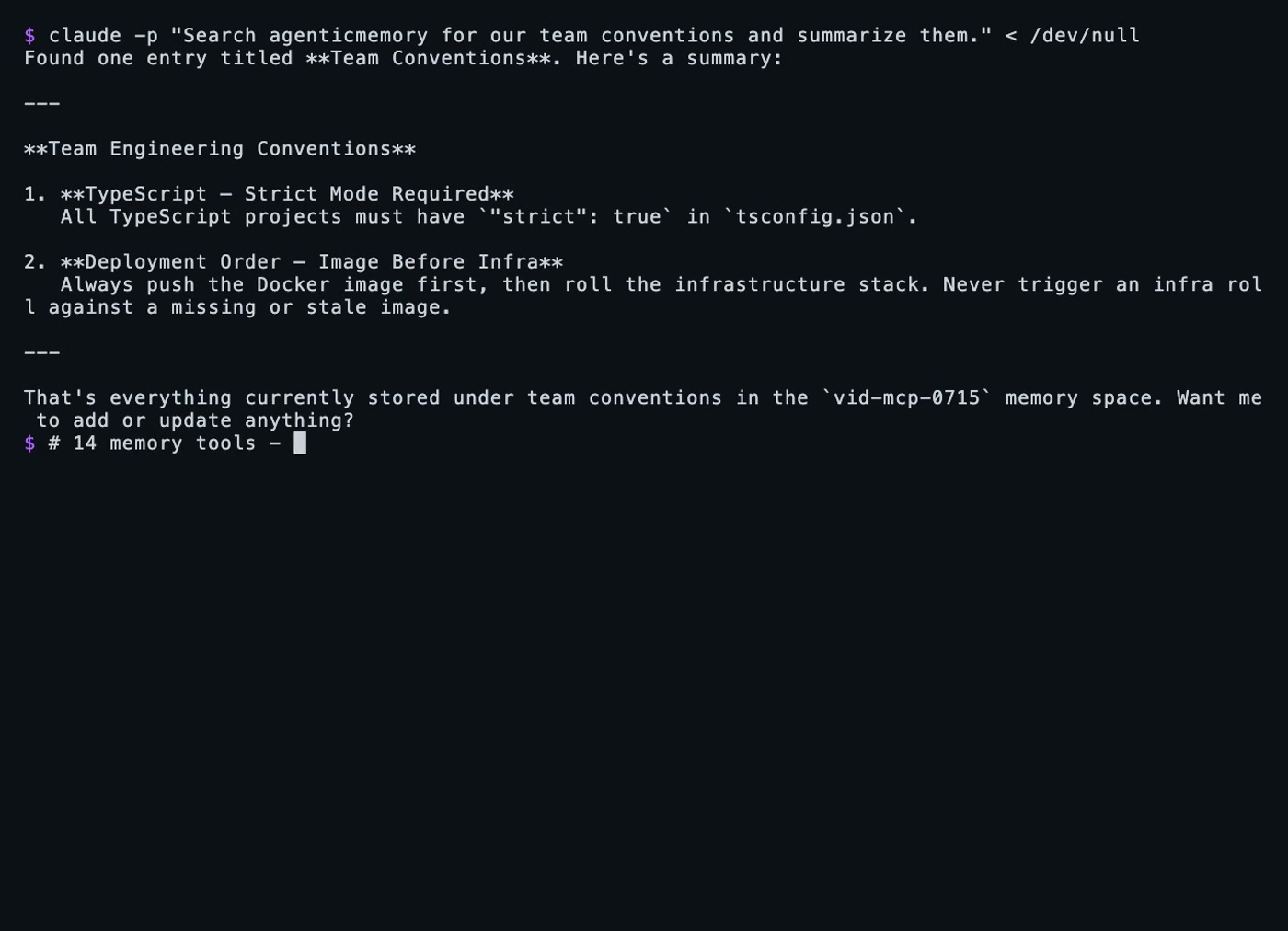
Claude Code remembering across sessions via MCP — click to watch.
For clients that use a JSON config (Cline, Cursor, Windsurf), pass your API key via the environment — the MCP server runs outside your project directory, so it won't pick up .agmry/config.json:
{
  "mcpServers": {
    "agenticmemory": {
      "command": "agmry",
      "args": ["mcp-serve"],
      "env": { "AGMRY_API_KEY": "amk_your_key_here" }
    }
  }
}
Remote MCP — zero install
Claude Web, Claude Desktop, Raycast, or any hosted MCP client can connect straight to the remote server. Same tools, same API key, nothing to install:
URL:  https://mcp.agenticmemory.ai/sse
Auth: Authorization: Bearer YOUR_API_KEY
End-to-end encryption (zero-knowledge spaces)
Create a space the server can never read. Encryption happens inside the CLI — the API only ever sees ciphertext.
agmry key generate                                  # one-time: creates + saves your key
agmry space create "Private" private --encryption e2e

agmry store SPACE "my secret"                       # encrypted before it leaves your machine
agmry recall SPACE                                  # transparently decrypted
agmry key verify SPACE                              # holding the right key?
Or derive per-space keys from a passphrase instead of storing a key:
agmry key set --passphrase "long secret phrase"
Notes:
- Semantic search is impossible on zero-knowledge spaces by design.
- Prefer encrypted at rest instead?
--encryption managed— the server encrypts your data at rest and every feature (search, summaries) keeps working. No client key needed. - Losing the key or passphrase means the data is unrecoverable. That's the point. Back it up:
agmry key show --reveal.
Key resolution order: --enc-key / --passphrase flag → AGMRY_ENCRYPTION_KEY env → ./.agmry/config.json → ~/.agmry/config.json. Same envelope and key derivation as the Node and Python SDKs — keys are interchangeable across all three.
Multi-agent: one brain, many agents
Spaces are shareable. One agent stores the deploy runbook; another recalls it a week later, from a different machine, over a different interface (CLI, MCP, or REST — same memory). Your agents hand off between sessions and between projects without you couriering context.
And you stay in the loop: everything your agents remember is browsable in a human dashboard.
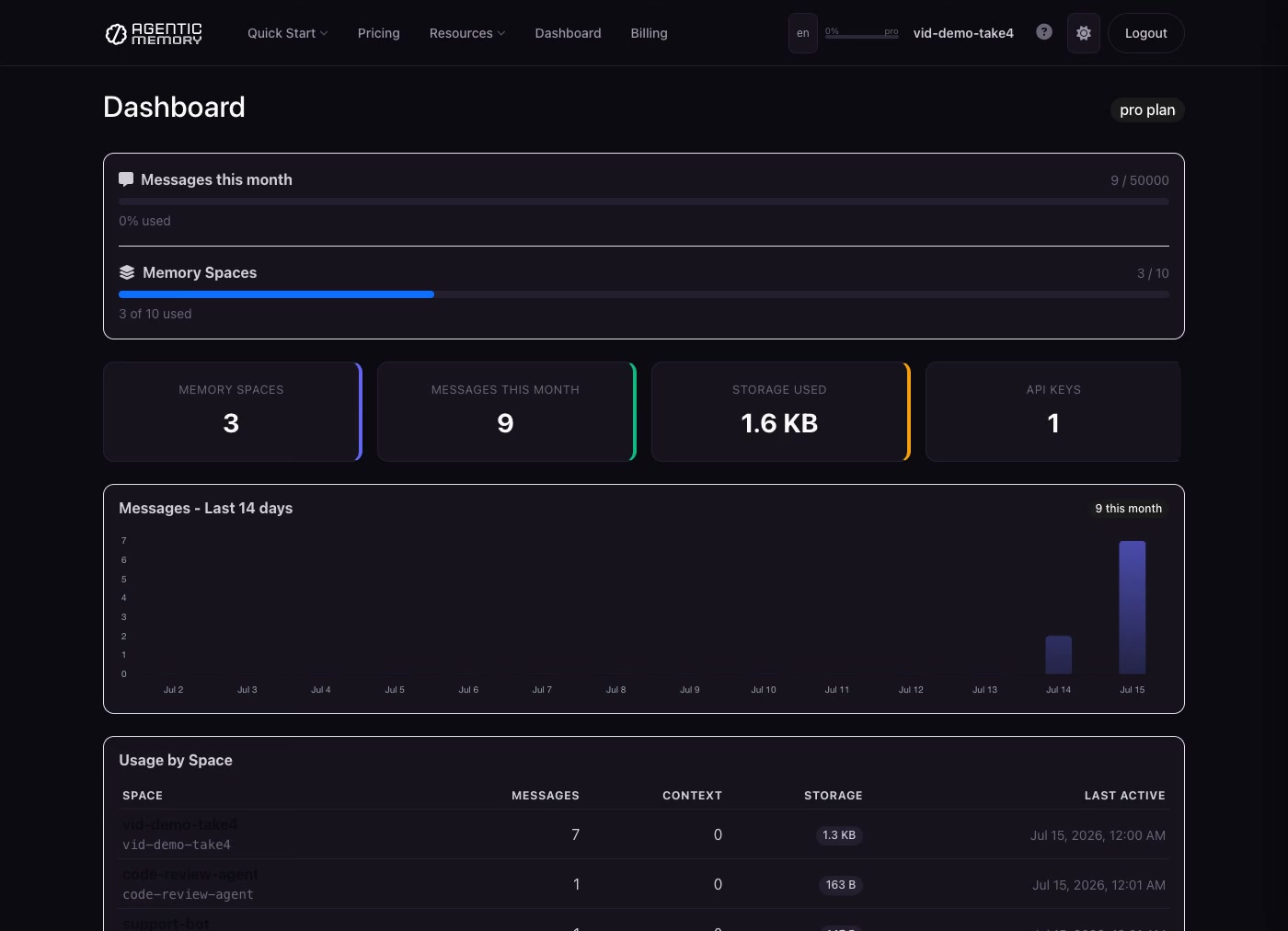
Everything your agents remember, in one dashboard — click to watch.
Queues — the agent bus
FIFO queues inside a space. One agent pushes work, another pops it — no polling glue, no extra infra.
agmry queue SPACE jobs push '{"task":"review PR #42"}'   # enqueue (FIFO)
agmry queue SPACE jobs pop                                # dequeue oldest — exit code 2 if empty
agmry queue SPACE jobs pop --wait 25                      # long-poll up to 25s for the next item
agmry queue SPACE jobs                                    # peek: length + head, without consuming
agmry queue SPACE jobs dlq push '{"task":"..."}' --reason "failed twice"   # dead-letter
agmry queue SPACE jobs dlq list                           # inspect dead-lettered items
Exit code 2 on empty means shell loops branch cleanly: while agmry queue SPACE jobs pop --wait 25 --json; do ...; done. Envelopes are opaque JSON — the server never inspects them.
Agent Integration
Add to your CLAUDE.md, .cursorrules, .clinerules, .windsurfrules, or AGENTS.md:
## Agentic Memory
This project uses Agentic Memory for persistent memory across sessions.
Use the `agmry` CLI. Key is in .agmry/config.json (auto-loaded).

agmry boot SPACE --json               # load everything at session start
agmry store SPACE "what happened"     # remember something
agmry ctx SPACE set key "value"       # store a durable decision/fact
agmry search SPACE "the deadline"     # find past context
agmry queue SPACE jobs push '{...}'   # send work to another agent
agmry queue SPACE jobs pop --wait 25  # receive work (exit 2 = empty)
Config Priority
--keyflagAGMRY_API_KEYenvironment variableAGENTICMEMORY_API_KEYenvironment variable./.agmry/config.json(project-local)~/.agmry/config.json(global)
Add .agmry/ to your .gitignore.
Features
- Conversation history — ordered, role-aware messages with recency windowing, sub-ms reads
- Key-value context — typed durable facts: decisions, preferences, runbooks
- Long-term entries — titled, tagged knowledge that survives months, with auto-summarisation
- Entities — people and systems the agent should know about
- Scratchpad — ephemeral working memory with TTLs (expiry is a feature)
- Semantic search — across everything the agent has ever stored
- Bootstrap — full session context in one call
- Agent self-signup — working API key from one CLI command, live for 48h keyless; $0 card-auth starts the free 7-day trial
- Queues — FIFO agent bus with long-poll and dead-letter,
agmry queue(exit 2 = empty) - MCP server — 46 tools, local (
agmry mcp-serve) or fully remote (mcp.agenticmemory.ai) - REST API — same memory on the request path of proxies and pipelines
- Multi-agent spaces — a fleet of agents reads and writes one memory
- End-to-end encryption — zero-knowledge spaces where only you hold the key (
agmry key generate) - Export — full data takeout per space, one command (
agmry space export)
Pricing: The agent's key works instantly — full access for 48h, no card. A $0 card-auth starts the free 7-day trial; after that from $24.99/mo. No data deletion, ever: your memory waits for you. Details.
Why not just Claude's built-in memory?
Claude Memory is great — but it only works with Claude, and only Claude decides what's in it.
| Agentic Memory | Claude Memory | |
|---|---|---|
| LLM support | Any — GPT, Claude, Gemini, Llama, Mistral, DeepSeek | Claude only |
| Switch LLMs | Keep all memory | Lose everything |
| Multi-agent | Shared spaces across agents | Single user |
| Programmatic control | Full CLI + MCP + REST | Black box — Claude decides |
| Structured data | Messages + context + entries + entities + scratchpad | Free-text notes |
| Semantic search | agmry search "the deadline" |
No search API |
| Data ownership | You own it, export any time | Stored by Anthropic |
Why this exists
I was my agents' memory. Every session started with me re-explaining my own project to my own tools — decisions, preferences, what broke last time. So I built the memory they run themselves. My own agents use it in production across a dozen projects; if something's rough or missing, open an issue — I read every one.
Documentation
- Quickstart guides — Claude Code, Cursor, LangChain, CrewAI, AutoGen + 7 more
- API docs
- Pricing
License
Proprietary — Tyga.Cloud Ltd. See LICENSE.
agenticmemory MCP 질문
agenticmemory MCP를 Claude Code에 추가하려면 어떻게 하나요?
터미널에서 claude mcp add --env 'AGMRY_API_KEY=<YOUR_AGMRY_API_KEY>' agenticmemory -- npx -y agmry를 실행합니다. 모든 프로젝트에서 사용할 수 있게 하려면 --scope user를 추가합니다.
agenticmemory MCP를 Cursor에 추가하려면 어떻게 하나요?
~/.cursor/mcp.json를 열고 mcpServers 아래에 서버를 추가합니다. 위 설치 섹션에 표시된 Cursor 구성을 사용합니다.
사람의 개입 없이 agent가 직접 가입할 수 있나요?
네, agent는 단일 명령어를 통해 가입할 수 있으며, 브라우저나 사람의 도움 없이 즉시 사용 가능한 API key를 반환받습니다.
종단간 암호화를 지원하나요?
네, CLI 내부에서 암호화가 이루어지고 서버는 암호문만 볼 수 있는 제로 지식(zero-knowledge) 공간을 생성할 수 있습니다.
원격 MCP client와 함께 사용할 수 있나요?
네, Claude Web 또는 Claude Desktop과 같은 hosted MCP client는 제공된 URL과 API key를 사용하여 원격 서버에 직접 연결할 수 있습니다.