
자체 호스팅되는 플릿 대시보드를 통해 AI 클라이언트가 Claude Code 및 Codex CLI 세션을 관찰, 검색, 실행 및 제어할 수 있게 합니다.
다른 이름 jstuart0/agentpulse, @craze0/agentpulse-mcp
- 스타
- 34
- Tools
- —
- 다운로드, 30일
- 692
- 최신 버전
- —
- 마지막 커밋
- 2026년 11월 11일
- 라이선스
- MIT
AgentPulse MCP란?
AgentPulse은(는) MCP server입니다. 자체 호스팅되는 플릿 대시보드를 통해 AI 클라이언트가 Claude Code 및 Codex CLI 세션을 관찰, 검색, 실행 및 제어할 수 있게 합니다.
프로젝트 README에서 생성된 요약
AgentPulse MCP server 정보
AgentPulse는 Claude Code, Codex CLI, Copilot CLI 또는 OpenCode를 사용하는 개발자가 단일 대시보드에서 여러 AI 코딩 세션을 모니터링하고 관리할 수 있도록 지원합니다. 서로 다른 머신에서 실행 중인 활성 에이전트를 관찰할 수 있는 중앙 집중식 뷰를 제공하며, 현재 상태, 프로젝트 컨텍스트, 프롬프트 및 도구 사용 기록이 포함된 전체 채팅 히스토리를 보여줍니다.
사용자는 세션을 실시간으로 지켜보는 관찰 모드와 로컬 슈퍼바이저를 통해 세션을 실행, 제어 및 관리하는 오케스트레이션 모드 중 하나를 선택할 수 있습니다. 시스템은 SQLite 또는 PostgreSQL 데이터베이스와 함께 Docker 또는 Kubernetes를 통한 자체 호스팅을 지원합니다. 또한 세션 원격 제어가 가능하여 다른 컴퓨터에서 작업을 프롬프트하거나 중지 또는 재시도할 수 있습니다.
제공된 MCP server를 사용하면 하나의 에이전트가 전체 플릿을 관리하도록 할 수도 있습니다. 이를 통해 기본 에이전트가 다른 세션들을 직접 목록화, 검색, 실행 및 제어할 수 있습니다. 플랫폼은 작업을 프로젝트 단위로 구성하며, 세션 템플릿을 사용하여 특정 에이전트 구성 및 호스트 라우팅 설정을 자동화합니다.
활용 사례
- 1여러 활성 코딩 세션 모니터링실행 중인 모든 Claude Code 및 Codex CLI 세션을 라이브 그리드로 확인하여 작업 중, 대기 중 또는 유휴 상태인 세션을 파악합니다.
- 2원격 장치에서 에이전트 제어세션을 원격으로 실행하거나 중지하여 휴대폰 또는 다른 컴퓨터에서 코딩 에이전트를 관리합니다.
- 3MCP를 통한 에이전트 관리 자동화MCP server를 사용하여 기본 AI 에이전트가 코딩 세션 플릿 전체를 오케스트레이션하도록 합니다.
- 4머신 간 에이전트 활동 중앙 집중화다양한 노트북, 데스크톱 또는 서버의 세션 데이터를 하나의 통합된 대시보드로 모읍니다.
프로젝트의 README를 바탕으로 작성되었습니다. 모든 활용 사례는 해당 내용의 인용문과 대조하여 확인합니다.
AgentPulse MCP 설치 방법
형식 확인: 2026년 11월 10일Cursor에 추가Goose에 추가Claude Code에 AgentPulse MCP 설치
$ claude mcp add agentpulse -- npx -y @craze0/agentpulse-mcpCursor에 AgentPulse MCP 설치
~/.cursor/mcp.json
{
  "mcpServers": {
    "agentpulse": {
      "command": "npx",
      "args": [
        "-y",
        "@craze0/agentpulse-mcp"
      ]
    }
  }
}VS Code에 AgentPulse MCP 설치
.vscode/mcp.json
{
  "servers": {
    "agentpulse": {
      "type": "stdio",
      "command": "npx",
      "args": [
        "-y",
        "@craze0/agentpulse-mcp"
      ]
    }
  }
}VS Code CLI에 AgentPulse MCP 설치
$ code --add-mcp '{"name":"agentpulse","type":"stdio","command":"npx","args":["-y","@craze0/agentpulse-mcp"]}'Claude Desktop에 AgentPulse MCP 설치
claude_desktop_config.json
{
  "mcpServers": {
    "agentpulse": {
      "command": "npx",
      "args": [
        "-y",
        "@craze0/agentpulse-mcp"
      ]
    }
  }
}Codex에 AgentPulse MCP 설치
$ codex mcp add agentpulse -- npx -y @craze0/agentpulse-mcpCodex config.toml에 AgentPulse MCP 설치
~/.codex/config.toml
[mcp_servers.agentpulse]
command = "npx"
args = ["-y", "@craze0/agentpulse-mcp"]
Gemini CLI에 AgentPulse MCP 설치
$ gemini mcp add -s user agentpulse npx -- -y @craze0/agentpulse-mcpGemini settings.json에 AgentPulse MCP 설치
~/.gemini/settings.json
{
  "mcpServers": {
    "agentpulse": {
      "command": "npx",
      "args": [
        "-y",
        "@craze0/agentpulse-mcp"
      ]
    }
  }
}구성
AGENTPULSE_AI_ENABLEDAGENTPULSE_OTEL_ENDPOINTAGENTPULSE_SECRETS_KEYAPI_TOKENTELEGRAM_BOT_TOKENTELEGRAM_WEBHOOK_SECRET
| 이름 | 설명 | 유형 |
|---|---|---|
| AGENTPULSE_AI_ENABLED | — | |
| AGENTPULSE_OTEL_ENDPOINT | — | |
| AGENTPULSE_SECRETS_KEY | — | |
| API_TOKEN | — | |
| TELEGRAM_BOT_TOKEN | — | |
| TELEGRAM_WEBHOOK_SECRET | — |
자동 검사
2026년 11월 12일에 실행됨전체 보고서 →자동 검사를 통과했습니다. 이는 보안 감사가 아닙니다. 코드를 직접 읽고 서버에 필요한 최소한의 권한만 부여하십시오. 검사 방식

- 소스 저장소 연결 및 접근 가능통과
- 오픈 소스 라이선스 (OSI)통과
- 최근 1년 내 커밋 또는 릴리스통과
- 패키지 이름이 인기 패키지와 유사하지 않음통과
- 원격 엔드포인트가 HTTPS 사용검사되지 않음
- 파괴적인 도구에 라벨 표시됨검사되지 않음
- 모델에 대한 숨겨진 지침 없음통과
- 패키지 및 해당 종속성에 중요한 보안 권고 없음검사되지 않음
README
GitHub에서 보기AgentPulse



Open-source, self-hosted dashboard to monitor, orchestrate and remotely control Claude Code and Codex CLI sessions, and observe Copilot CLI and OpenCode, across all your machines.
If you run multiple Claude Code, Codex CLI, Copilot CLI, or OpenCode sessions across different terminal tabs, you know the pain: which tab is doing what? AgentPulse gives you a live dashboard that shows every active session, what it's working on, and a scrollable chat history of everything you've said to each agent.
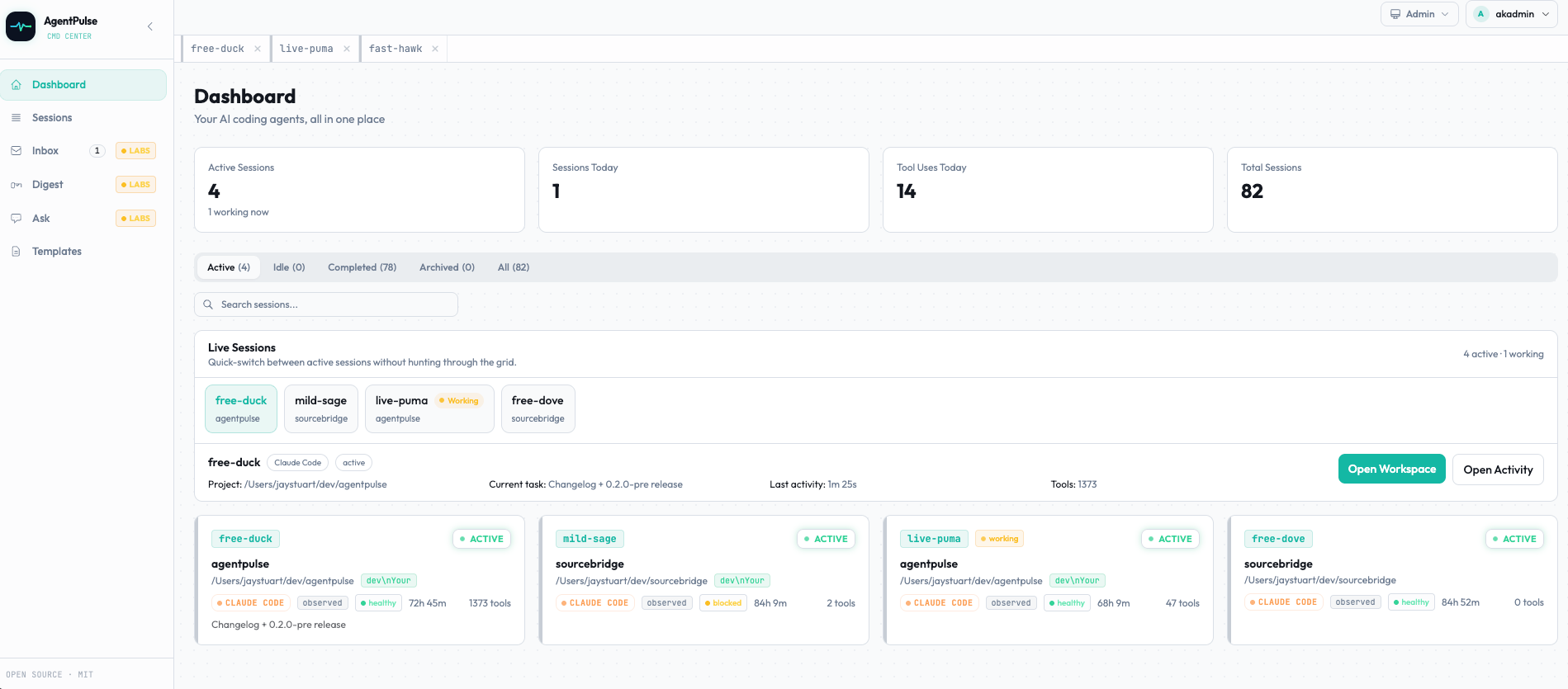
The AgentPulse dashboard: every running Claude Code, Codex CLI, Copilot CLI and OpenCode session in one grid, marked Working, Waiting, Idle or Error.
What AgentPulse is
AgentPulse has two major modes:
- Observability -- watch Claude Code, Codex, Copilot CLI, and OpenCode sessions in real time, with prompts, responses, progress, notes, and session history in one dashboard (Copilot CLI and OpenCode are observed only -- AgentPulse can't launch or steer them)
- Orchestration -- launch and manage sessions from AgentPulse itself with templates, supervisors, headless tasks, interactive sessions, retries, host routing, answering a managed Codex session's command and file-change approvals from the dashboard (see Answering Codex approvals), and continuing a Claude Code session you started by hand as a fork, with its approvals answered the same way (see Continuing a Claude Code session)
Plus an AI Labs layer that's very new and explicitly experimental -- see the Labs section below.
You can run AgentPulse as:
- observability only -- hooks + dashboard, no supervisor/control plane
- full local orchestration -- hooks + dashboard + local supervisor for launch/control on the same machine
- remote dashboard -- relay local events to a remote AgentPulse instance
Use cases
- Monitor multiple Claude Code sessions at once. One live grid instead of a dozen terminal tabs, with each session's state, last prompt and full history. Guide
- See agents on every machine in one place. A relay on each laptop, desktop or server forwards events to one dashboard, with a filter by machine. Guide
- Check on and control Claude Code from your phone or another computer. Watch any session remotely, and launch, prompt, stop or retry the ones AgentPulse started. Guide
- Self-host it for yourself or a team. Docker or Kubernetes, SQLite or PostgreSQL, behind Authentik, Authelia, oauth2-proxy, Pomerium or Cloudflare Access. Guide
- Let your agents manage your other agents over MCP. Claude Code or Codex CLI can list, search, launch and steer sessions through the
@craze0/agentpulse-mcpserver. Guide
Not sure whether you need monitoring or orchestration? See observability vs. orchestration for AI coding agents.
How it works
Your terminal tabs                          AgentPulse dashboard
┌─────────────────┐                        ┌──────────────────────┐
│ Claude Code (1) │──── hook events ──────>│  bold-falcon: active │
│ fixing auth bug │                        │  "fix the auth bug"  │
├─────────────────┤                        ├──────────────────────┤
│ Claude Code (2) │──── hook events ──────>│  zen-owl: active     │
│ writing tests   │                        │  "add unit tests"    │
├─────────────────┤                        ├──────────────────────┤
│ Codex CLI       │──── hook events ──────>│  warm-crane: idle    │
│ (idle)          │                        │  last: 5m ago        │
├─────────────────┤                        ├──────────────────────┤
│ Copilot CLI     │──── hook events ──────>│  quiet-otter: active │
│ (observed only) │                        │  "review the diff"   │
├─────────────────┤                        ├──────────────────────┤
│ OpenCode        │──── plugin events ────>│  calm-heron: idle    │
│ (observed only) │                        │  last: 2m ago        │
└─────────────────┘                        └──────────────────────┘
Each session gets a random memorable name (like bold-falcon) so you can match the dashboard to your terminal tabs at a glance. Click any session to see a live chat-style timeline of your prompts and the agent's tool usage.
Quick start
Easiest local install: 1 command
macOS / Linux:
This installs AgentPulse locally with Bun + SQLite, starts the web app and local supervisor as services, and configures Claude Code + Codex hooks automatically.
curl -fsSL https://raw.githubusercontent.com/jstuart0/agentpulse/main/scripts/install-local.sh | bash
Windows:
irm https://raw.githubusercontent.com/jstuart0/agentpulse/main/scripts/install-local.ps1 | iex
It needs curl and git, plus python3 for the supervisor and hooks. If it can't find a Bun 1.3.12 or newer it installs a pinned one, which also needs unzip and shasum or sha256sum. Anything missing is listed up front with the command to install it, and nothing is installed until it's there. To put Bun somewhere of your choosing (supply it again on a re-run; with a BUN_INSTALL other than ~/.bun, only $BUN_INSTALL/bin/bun is considered, not PATH):
curl -fsSL https://raw.githubusercontent.com/jstuart0/agentpulse/main/scripts/install-local.sh | BUN_INSTALL=/opt/bun bash
When it finishes, open http://localhost:3000 and start a new Claude Code or Codex session.
Docker install: 1 shell line
If you prefer Docker, this starts the container, waits for health, and configures hooks:
docker run -d -p 127.0.0.1:3000:3000 -v agentpulse-data:/app/data -e DISABLE_AUTH=true --restart unless-stopped --name agentpulse ghcr.io/jstuart0/agentpulse && until curl -fsSL http://localhost:3000/api/v1/health >/dev/null 2>&1; do sleep 1; done && curl -fsSL http://localhost:3000/setup.sh | bash
Security note:
-p 127.0.0.1:3000:3000binds the host port to localhost only. The older-p 3000:3000form would publish on all host interfaces, exposing the auth-disabled server to your LAN. Use the127.0.0.1:prefix wheneverDISABLE_AUTH=true.
Done. Open http://localhost:3000 and you have:
- live session observability
- local launch/control via the supervisor
- Claude Code + Codex hooks already configured
Why localhost? Claude Code and Codex block HTTP hooks to remote/private IPs as a security measure. Only
localhost/127.0.0.1is allowed. This keeps things simple -- one Docker container on your machine, no networking to configure. If port 3000 is taken, use any free port:docker run -d -p 127.0.0.1:4000:3000 -v agentpulse-data:/app/data -e DISABLE_AUTH=true -e PUBLIC_URL=http://localhost:4000 --restart unless-stopped --name agentpulse ghcr.io/jstuart0/agentpulse curl -fsSL http://localhost:4000/setup.sh | bash
What you'll see
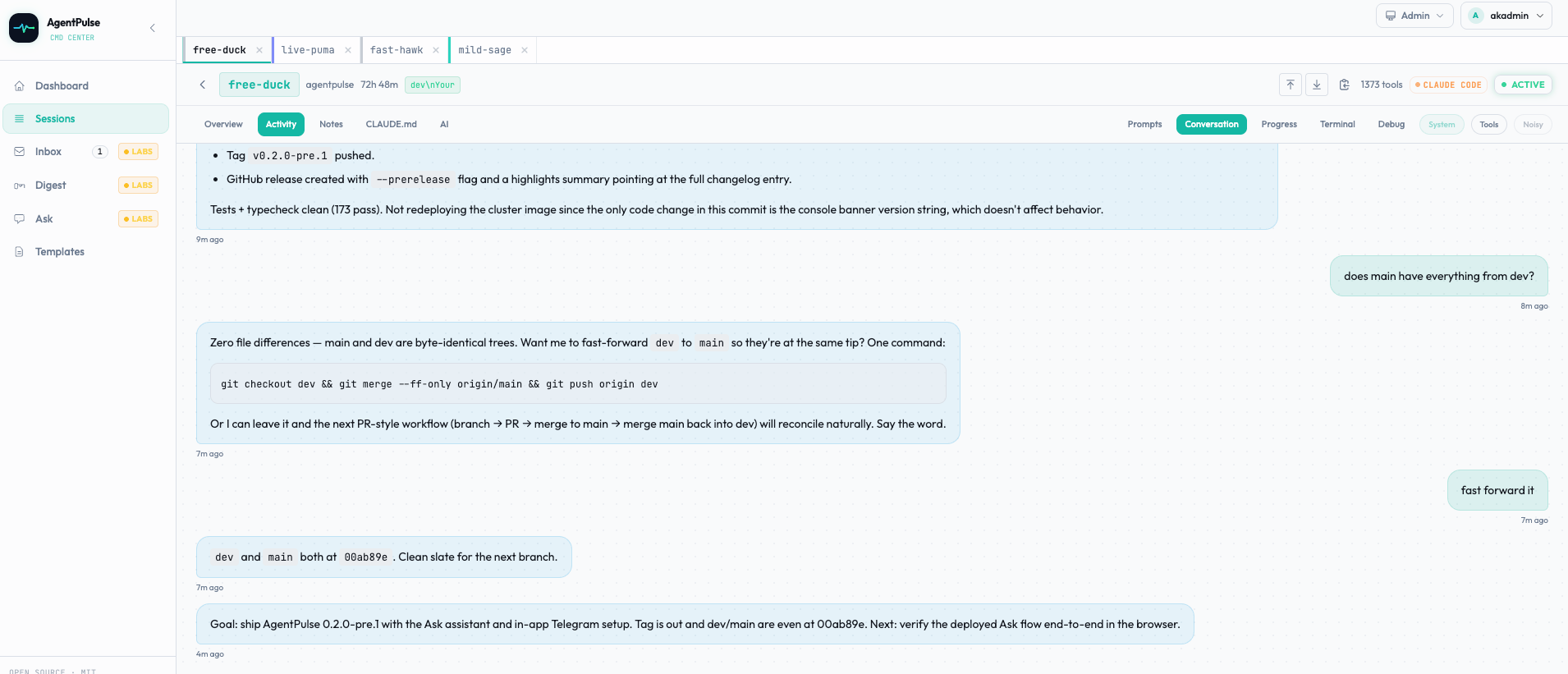
Session detail: a chat-style history of your prompts to one agent, with its tool calls inline.
- Dashboard -- grid of all sessions with status, project name, session name, duration, and tool use count. Each session is in exactly one operational state: Waiting (the agent finished a turn, or has an outstanding permission prompt, and is waiting on you -- "Mark as seen" clears it), Error (the session failed and hasn't been dismissed -- "Dismiss error" clears it), Working (the agent is actively working right now), or Idle (nothing is waiting and the agent isn't working). Status cards above the grid filter by state; a "What do these states mean?" popover repeats this explanation in the UI
- Session detail -- click a session to see a chat-style timeline with your prompts as blue bubbles and tool usage inline
- Unsent prompts -- a prompt you typed in a session's box and haven't sent is kept in your browser (in plain text, in
localStorage) for up to 7 days, per person and per session, so it survives switching sessions and reloading. It says "Unsent draft, saved ..." with a Discard draft button (and an Undo for a few seconds), drafts over 20,000 characters are kept only while the page is open, and Sign out removes every draft this browser holds - Projects -- first-class projects with cwd-based session resolution; sessions stamp themselves with the right project on ingest, templates inherit project defaults (cwd, agentType, model) with per-field overrides, and a
/projectspage lets you create / edit / delete them. Saving a template under a new directory auto-creates the project for you - Session templates -- save reusable Claude Code and Codex session setups, link them to a project for live-inheritance defaults, preview normalized launch specs, and route launches to the right host
- Orchestration -- launch headless or interactive sessions from AgentPulse, track launch status, retry, stop, and manage sessions through the local supervisor
- Search -- full-text across session names, prompts, plans, notes, and event payloads. SQLite uses FTS5 (BM25-ranked); Postgres uses ILIKE. Clicking an event hit jumps to the matching event in the timeline and applies a brief amber flash
- Inbox -- single
/inboxview that aggregates every open approval (HITL, Ask-driven actions, alert-rule firings), stuck / risky session warnings, and recent failures. Approve / decline inline; snooze noisy items - Real-time updates -- everything updates live via WebSocket, no refreshing needed
- Random session names -- each session gets a name like
brave-falconso you can tell them apart - CLAUDE.md editor -- view and edit your agent instruction files from the dashboard
- Setup page -- generates hook config you can copy-paste, or use the one-liner above
- MCP server -- let Claude Code, Codex CLI, or any MCP-compliant agent observe and orchestrate your fleet directly (list/inspect sessions, search, launch agents, steer live sessions, decide inbox items). Ships from a checkout via
agentpulse mcp serve, or standalone via the@craze0/agentpulse-mcpnpm package -- no checkout required. See below. - AI Labs (experimental) -- optional AI layer that watches sessions, classifies health, proposes next steps with human-in-the-loop approval, plus an Ask command surface that lets you launch / edit / search / summarize / alert in natural language. Each feature is behind its own Labs toggle. See below.
MCP server
AgentPulse can be driven by an external AI coding agent over the Model Context Protocol: read tools (sessions, search, digest, AI intelligence) plus orchestration tools (launch agents, prompt/stop live sessions, decide HITL/inbox items), gated behind a scoped API key.
From a checkout:
agentpulse mcp install --mint my-agent          # observe-only (read-only), the safe default
agentpulse mcp install --mint my-agent --orchestrate  # adds launch/steer/decide -- read the security notes first
Without cloning this repo -- the standalone @craze0/agentpulse-mcp npm package:
npx @craze0/agentpulse-mcp install --mint my-agent
Either way, install prints ready-to-paste Claude Code and Codex CLI config. See docs/MCP.md for the full tool catalog, client setup, and a security section covering what a manage-scoped key can do and why Codex CLI does not honor Claude Code's confirmation prompt.
AI Labs (experimental)
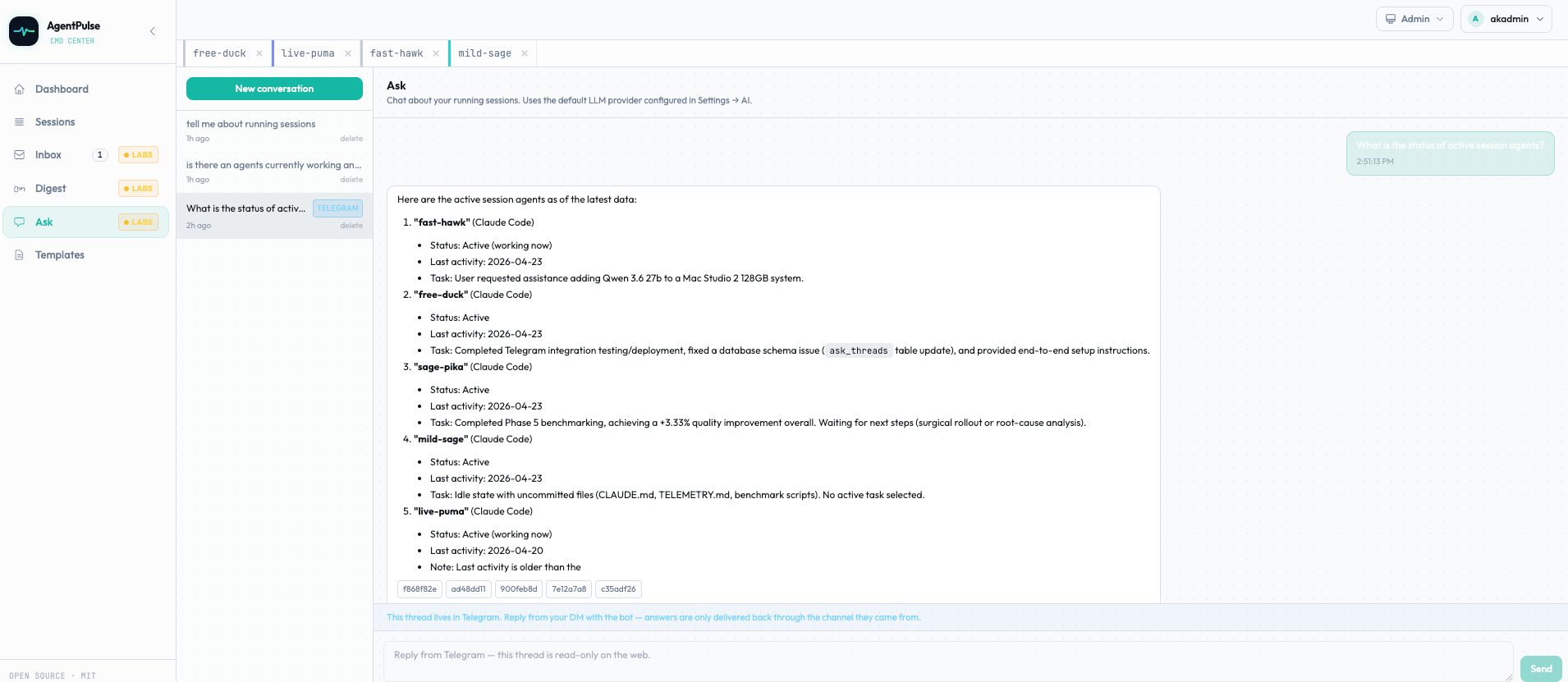
The Ask assistant: ask about, launch or search your agent sessions in plain language.
Heads up: the AI layer is new, shipping under explicit Labs framing. Every feature is toggleable under Settings → Labs. Contracts, UI, and defaults may change. Disable any toggle if it gets in your way -- nothing else in AgentPulse depends on it.
When enabled, AgentPulse can use an LLM provider you choose (Anthropic, OpenAI, OpenRouter, Google, or any OpenAI-compatible endpoint like Ollama / LM Studio / vLLM) to do the following. All AI work is human-in-the-loop by default: the watcher proposes, you approve or decline, and the runtime records every step as an auditable event.
AgentPulse MCP 질문
AgentPulse MCP를 Claude Code에 추가하려면 어떻게 하나요?
터미널에서 claude mcp add agentpulse -- npx -y @craze0/agentpulse-mcp를 실행합니다. 모든 프로젝트에서 사용할 수 있게 하려면 --scope user를 추가합니다.
AgentPulse MCP를 Cursor에 추가하려면 어떻게 하나요?
~/.cursor/mcp.json를 열고 mcpServers 아래에 서버를 추가합니다. 위 설치 섹션에 표시된 Cursor 구성을 사용합니다.
AgentPulse MCP server로 AI 에이전트가 무엇을 할 수 있나요?
MCP server를 통해 세션 목록 확인 및 검사, 히스토리 검색, 새로운 에이전트 세션 실행, 라이브 세션 제어, 인박스 항목 결정이 가능합니다.
체크아웃 없이 AgentPulse MCP server를 설치하려면 어떻게 하나요?
단독 @craze0/agentpulse-mcp npm 패키지를 사용하거나, 대안으로 agentpulse mcp serve 명령어를 사용할 수 있습니다.
AgentPulse는 어떤 코딩 에이전트를 지원하나요?
Claude Code, Codex CLI, GitHub Copilot CLI, OpenCode를 지원하며, Copilot CLI와 OpenCode는 관찰 모드만 지원합니다.
AgentPulse를 자체 호스팅할 수 있나요?
네, Docker 또는 Kubernetes를 통해 SQLite 또는 PostgreSQL과 함께 자체 호스팅할 수 있으며, 선택적으로 인증 프록시 뒤에 배치할 수 있습니다.
AgentPulse는 업데이트를 실시간으로 보여주나요?
네, 세션과 이벤트는 페이지 새로고침 없이 WebSocket을 통해 실시간으로 업데이트됩니다.