
마크다운 노트와 코드를 대상으로 로컬 하이브리드 키워드 및 벡터 검색을 제공하여 AI의 장기 기억을 지원합니다.
다른 이름 GitGudatCodeing/claude-second-brain, claude-second-brain
- 스타
- 1
- Tools
- —
- 다운로드, 30일
- —
- 최신 버전
- 0.4.2
- 마지막 커밋
- 2026년 11월 7일
- 라이선스
- MIT
vault-index MCP란?
vault-index은(는) MCP server입니다. 마크다운 노트와 코드를 대상으로 로컬 하이브리드 키워드 및 벡터 검색을 제공하여 AI의 장기 기억을 지원합니다.
프로젝트 README에서 생성된 요약
vault-index MCP server 정보
vault-index는 Claude Code를 위해 특별히 설계된 로컬 기반의 프라이빗 장기 기억 솔루션을 제공합니다. 키워드 검색과 벡터 검색을 결합한 하이브리드 검색 메커니즘을 통해 마크다운 노트와 코드를 인덱싱함으로써 사용자가 '제2의 뇌'를 유지할 수 있도록 돕습니다. 이 시스템은 정보를 불투명한 데이터베이스에 가두지 않고 사람이 읽을 수 있는 마크다운 파일 형태로 유지하므로, 편집과 버전 관리 및 감사가 매우 용이합니다.
이 server는 클라우드 서비스나 외부 API 키 없이 단일 SQLite 파일과 소형 CPU 기반 모델을 사용하여 로컬 머신에서 완전히 실행됩니다. 키워드 검색에는 FTS5를, 벡터 검색에는 sqlite-vec를 활용하며, MiniLM-L6 cross-encoder를 통해 검색 결과의 순위를 재조정(reranking)하여 성능을 높였습니다. 개발자는 index_paths, search_notes, get_note와 같은 특정 도구를 사용하여 로컬 볼트에서 정확한 정보를 검색하고 지식을 관리할 수 있습니다.
활용 사례
- 1과거 프로젝트 결정 사항 조회AI에게 이전 작업 세션에서 내린 특정 아키텍처 결정이나 교훈을 찾아달라고 요청합니다.
- 2기술적 교훈 문서화특정 기술적 실패나 성공 사례를 문서 내에 테스트 가능한 지침으로 기록합니다.
프로젝트의 README를 바탕으로 작성되었습니다. 모든 활용 사례는 해당 내용의 인용문과 대조하여 확인합니다.
vault-index MCP 설치 방법
형식 확인: 2026년 11월 10일Claude Code에 vault-index MCP 설치
$ claude mcp add claude-second-brain -- uvx vault-indexCursor에 vault-index MCP 설치
~/.cursor/mcp.json
{
  "mcpServers": {
    "claude-second-brain": {
      "command": "uvx",
      "args": [
        "vault-index"
      ]
    }
  }
}VS Code에 vault-index MCP 설치
.vscode/mcp.json
{
  "servers": {
    "claude-second-brain": {
      "type": "stdio",
      "command": "uvx",
      "args": [
        "vault-index"
      ]
    }
  }
}Claude Desktop에 vault-index MCP 설치
claude_desktop_config.json
{
  "mcpServers": {
    "claude-second-brain": {
      "command": "uvx",
      "args": [
        "vault-index"
      ]
    }
  }
}Codex에 vault-index MCP 설치
~/.codex/config.toml
[mcp_servers.claude-second-brain]
command = "uvx"
args = ["vault-index"]
Gemini CLI에 vault-index MCP 설치
~/.gemini/settings.json
{
  "mcpServers": {
    "claude-second-brain": {
      "command": "uvx",
      "args": [
        "vault-index"
      ]
    }
  }
}구성
VAULT_INDEX_DBPath to the SQLite index file (default ~/.mcp-memory/vault-index.db)
VAULT_MODEL_CACHEEmbedding model cache folder (default ~/.mcp-memory/models)
VAULT_RERANKSet to 0 to turn off the cross-encoder rerank of the top 10 results
| 이름 | 설명 | 유형 |
|---|---|---|
| VAULT_INDEX_DB | Path to the SQLite index file (default ~/.mcp-memory/vault-index.db) | |
| VAULT_MODEL_CACHE | Embedding model cache folder (default ~/.mcp-memory/models) | |
| VAULT_RERANK | Set to 0 to turn off the cross-encoder rerank of the top 10 results |
자동 검사
2026년 11월 13일에 실행됨전체 보고서 →자동 검사를 통과했습니다. 이는 보안 감사가 아닙니다. 코드를 직접 읽고 서버에 필요한 최소한의 권한만 부여하십시오. 검사 방식

- 소스 저장소 연결 및 접근 가능gitgudatcodeing/claude-second-brain is public and reachablegithub.com/gitgudatcodeing/claude-second-brain ↗통과
- 패키지가 이 저장소를 소스로 지정vault-index names gitgudatcodeing/claude-second-brain as sourcepypi.org/project/vault-index/ ↗통과
- 빌드 출처(Sigstore 증명)Sigstore attestation for vault-indexpypi.org/project/vault-index/ ↗통과
- 오픈 소스 라이선스 (OSI)MITspdx.org/licenses/MIT.html ↗통과
- 최근 1년 내 커밋 또는 릴리스Last commit or release 2026-11-07github.com/gitgudatcodeing/claude-second-brain ↗통과
- OpenSSF Scorecard검사되지 않음
- 패키지 이름이 인기 패키지와 유사하지 않음No popular package one edit away from vault-index통과
- 패키지와 의존성에 심각한 보안 권고 없음51 resolved dependencies checked; no critical advisoryosv.dev ↗통과
- 모델에 대한 숨겨진 지침 없음0 tool descriptions and the README read; no override phrases, credential paths or hidden characters통과
- 파괴적인 도구에 라벨 표시됨검사되지 않음
- 원격 endpoint가 MCP 핸드셰이크에 응답검사되지 않음
README
GitHub에서 보기claude-second-brain




A local, private long-term memory for Claude Code. Your markdown notes stay the record. Claude searches them through a hybrid keyword + vector index, writes decisions and lessons back as plain files, and hooks keep the index, the knowledge graph and long sessions in check.
Everything runs on your machine: one SQLite file, two small CPU models, no cloud services.
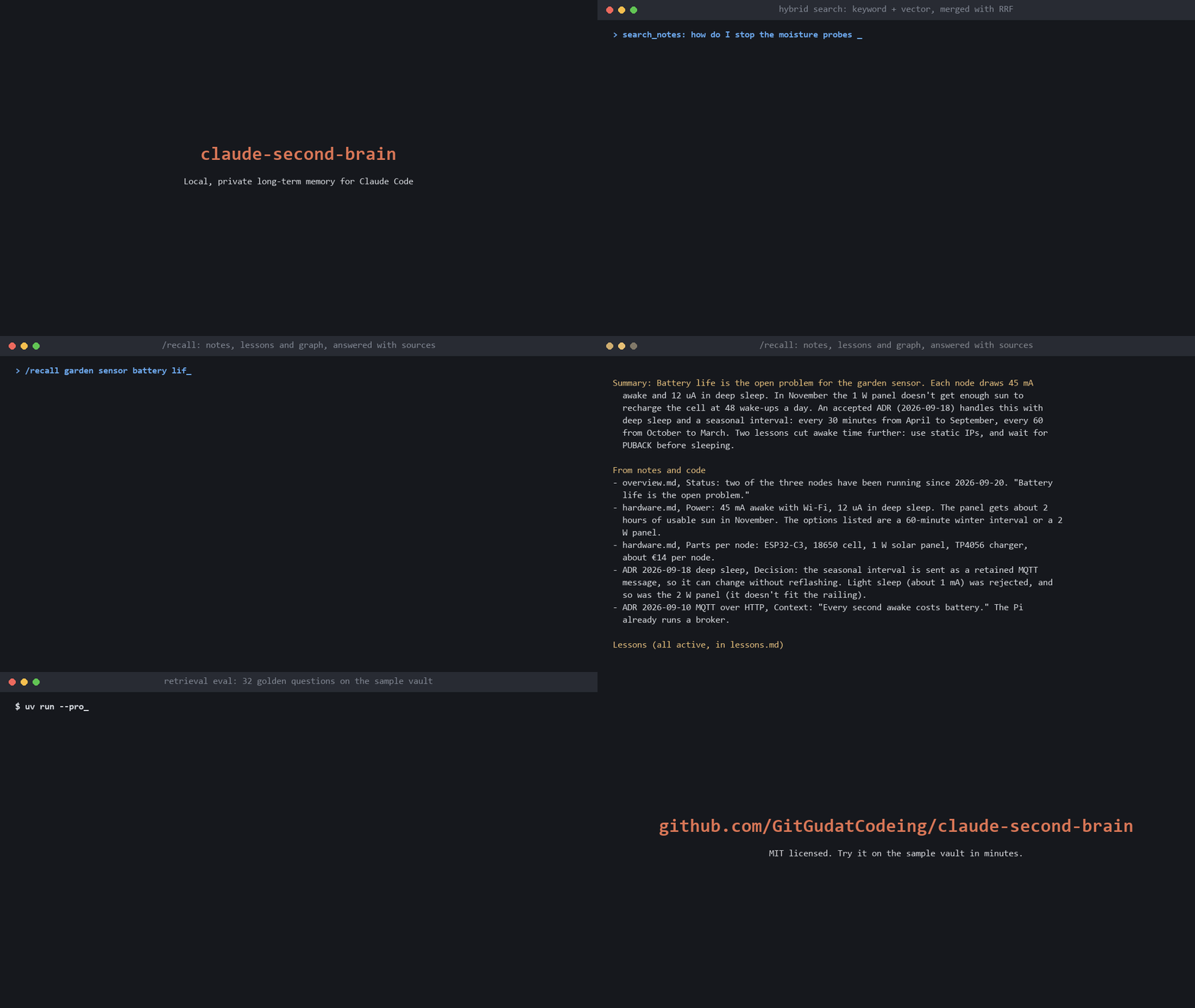
Terminal replay of real output from a fresh clone of v0.1.0 with the sample vault (eval then had 32 questions); only the typing animation is added.
Why
Claude Code forgets everything between sessions. The usual fixes are a huge CLAUDE.md (expensive on every turn) or a vector store nobody can read or fix. This project takes a different line:
- Files are the truth. Notes, decision records and lessons are markdown you can read, edit and version. The index and the graph can be rebuilt from them at any time.
- Search before guessing. Claude is told to search the vault before answering about past work, and gets a tool that actually finds paraphrased answers.
- Measured, not vibes. Every search change is scored against a golden set and kept only if it beats the baseline. The experiments that failed are documented too.
- Self-checking. At session start, invariants verify that each pipeline still reaches its consumer, so silent breakage shows up the same day.
How it works
flowchart LR
    subgraph files["Markdown files: the record"]
        notes["notes/"]
        adr["docs/adr/"]
        lessons["docs/lessons.md"]
        handoffs["docs/handoffs/"]
    end

    cc["Claude Code"]
    vi["vault-index MCP server<br/>mcp/server.py"]
    db[("vault-index.db<br/>FTS5 + sqlite-vec")]
    mem["memory MCP server"]
    kg[("memory.jsonl<br/>entities and relations")]

    cc -- "Write / Edit" --> files
    cc -- "PostToolUse hook<br/>reindex_hook.py" --> db
    cc -- "search_notes, get_note" --> vi
    vi --> db
    files -- "index_paths" --> db
    cc -- "search_nodes" --> mem
    mem --> kg
    kg -. "each fact names its source file" .-> files
| Hook | Script | What it does |
|---|---|---|
| SessionStart | scripts/invariants.py --hook |
10 checks: MCP servers launchable, graph sources exist, index fresh, hooks wired, golden labels valid, lessons well-formed, context budget. |
| PostToolUse (Write, Edit) | mcp/reindex_hook.py |
Re-indexes the edited file if it sits under a registered source. Never blocks. |
| UserPromptSubmit, PostToolUse (async) | scripts/context_guard.py |
Reads the real context size from the transcript. Silent until 250k tokens (.claude/handoff.json), then requires /handoff: a note plus a card to start the fresh session. On every prompt, and once per session mid-turn. |
| PreCompact | scripts/precompact_snapshot.py |
Saves recent requests and touched files to docs/handoffs/auto/ as a fallback before compaction. |
Search
flowchart LR
    q["query"] --> sw["drop stopwords"] --> fts["FTS5 bm25<br/>top 4 x limit"]
    q --> emb["embed with<br/>bge-small-en-v1.5"] --> vec["sqlite-vec kNN<br/>top 4 x limit"]
    fts --> rrf["reciprocal rank fusion<br/>k = 60, keyword weight 0.1"]
    vec --> rrf
    rrf --> rr["cross-encoder rerank<br/>top 10, MiniLM-L6"]
    rr --> out["top chunks with<br/>file path and heading path"]
- Markdown is chunked by heading (up to about 1,200 characters), so every hit carries a path like
Recipe box data model > Units. - Indexing is incremental: unchanged files are skipped by mtime and content hash; deleted files are dropped on the next sync.
- Keyword ranks count at a tenth of vector ranks: they break ties and lift exact terms (ids, tool names) without outvoting meaning.
- A small cross-encoder (
ms-marco-MiniLM-L-6-v2, 80 MB) then reorders the top 10 by reading query and chunk together. It adds about 200 ms per search on CPU;VAULT_RERANK=0turns it off. - A per-folder
.indexignorekeeps tooling code out of results.
MCP tools: index_paths, search_notes, get_note, list_sources, remove_source.
Commands
| Command | What it does |
|---|---|
/recall <topic> |
Searches notes, lessons and the graph together and answers with clickable sources. Read-only. |
/adr <title> |
Writes a decision record to docs/adr/ and links it in the graph. |
/learn <what happened> |
Records a lesson as a testable directive (scripts/learn.py): lesson, cause, how to detect it. Supersede or retire, never delete. |
/ingest <path> |
Indexes a file or folder and adds its durable entities to the graph. |
/handoff [topic] |
Writes a handoff note and starts a fresh session from it. |
Installed as a plugin, the commands carry its name: /second-brain:recall, /second-brain:adr and so on.
Quickstart
Needs uv (it fetches Python 3.10 to 3.13), Node.js for the memory server, and Claude Code.
As a plugin
In the folder that holds your notes:
claude plugin marketplace add GitGudatCodeing/claude-second-brain
claude plugin install second-brain@second-brain --scope project
Start claude there, then ask it to index the folder ("index_paths .") and try /second-brain:recall <topic>. The plugin brings the five commands, the hooks (re-index on edit, context guard, pre-compact snapshot) and both MCP servers. Decision records go to docs/adr/, lessons to docs/lessons.md, handoffs to docs/handoffs/, and the knowledge graph to memory.jsonl, all inside that folder. The search index is shared at ~/.mcp-memory/vault-index.db.
--scope project keeps the plugin to that folder: the context guard would otherwise run in every project. The plugin leaves out the session-start invariants, which check this repo's layout. Change the handoff limit with a .claude/handoff.json like this repo's (default 250k tokens).
Use the plugin or the clone below in a folder, not both: each starts its own vault-index server.
From a clone
The full repo adds the sample vault, the eval and the invariants.
git clone https://github.com/GitGudatCodeing/claude-second-brain.git
cd claude-second-brain
uv run --project mcp python scripts/setup.py
setup.py writes .mcp.json (memory graph at ~/.mcp-memory/memory.jsonl unless you pass --memory-file), indexes the folder and runs the invariants. Then start claude in the folder, approve the project MCP servers and hooks, and try /recall garden sensor battery life. Check the wiring any time with python scripts/invariants.py.
Your own notes go in notes/. Delete example-vault/ when you no longer need the eval, and update eval/golden.jsonl with questions about your own notes.
On Windows, Claude Code runs hooks through Git Bash; the hook commands already use forward slashes.
Just the search server
vault-index is on PyPI and in the MCP registry. To use the hybrid search on any folder of notes without the rest of this repo:
claude mcp add vault-index -- uvx --python 3.12 vault-index
Then ask Claude to index a folder (for example "index_paths ~/notes") and search it with search_notes.
It also works from a terminal. Indexing a large vault there first shows progress and keeps Claude's first tool call short:
uvx --python 3.12 vault-index index ~/notes        # no paths re-syncs every source
uvx --python 3.12 vault-index search "your question" -n 5
uvx --python 3.12 vault-index sources
uvx --python 3.12 vault-index --help
With no command it serves MCP over stdio. The index lives in ~/.mcp-memory/vault-index.db. To move it, set VAULT_INDEX_DB in your shell environment rather than only in the MCP config, so the server, the re-index hook and the invariants all use the same file. --python 3.12 keeps uvx off newer Pythons that the embedding runtime does not support yet.
Retrieval eval
example-vault/ is a fictional person's notes, decisions and lessons. eval/golden.jsonl has 44 questions about it and about this repo's own docs, worded differently from the notes on purpose, so keyword overlap alone does not find most answers. The last 12 are hard paraphrases that share almost no words with their answer. (Keep golden questions out of indexed files like this README, or they compete with the real answers.)
VAULT_INDEX_DB=/tmp/csb-eval.db uv run --project mcp python eval/run_eval.py --modes all -v
| Mode | NDCG@5 | MRR | Recall@5 |
|---|---|---|---|
hybrid + rerank (what search_notes serves) |
0.747 | 0.797 | 0.780 |
| hybrid, fusion only (no rerank) | 0.686 | 0.724 | 0.758 |
| keyword only (FTS5) | 0.491 | 0.544 | 0.576 |
| vector only | 0.697 | 0.729 | 0.758 |
| naive grep, no index (baseline) | 0.305 | 0.341 | 0.375 |
The grep row ranks chunks by how many query words they contain, roughly what searching with rg per word gives you.
Without the reranker, vector-only edged out fusion on the sample vault (the hard paraphrases give keywords nothing to match); the reranker puts hybrid back on top. On the author's private vault (41 questions) the order is the same: hybrid + rerank 0.550, fusion only 0.487, vector 0.473, keyword 0.433, grep 0.327.
Compared with basic-memory
basic-memory is a popular markdown memory MCP server with its own hybrid search. eval/compare_basic_memory.py runs it (v0.24.1, same bge-small model) on a copy of the same markdown files and scores both on the same 44 questions. basic-memory returns whole notes, so both are scored per file here (vault-index chunks collapsed to their file):
| System (file level) | NDCG@5 | MRR | Recall@5 |
|---|---|---|---|
| vault-index hybrid + rerank | 0.829 | 0.858 | 0.886 |
| basic-memory, default search | 0.619 | 0.611 | 0.750 |
| basic-memory, vector only | 0.708 | 0.736 | 0.814 |
basic-memory does much more than search (it writes notes, builds a graph from them, offers cloud sync); this compares retrieval only. Its default search varied by about 0.005 between runs. It is not run in CI.
CI fails if any hybrid metric drops more than 0.03 below eval/baseline.json. Scores are identical on Ubuntu and Windows.
What worked and what did not
Each change tested alone against a saved baseline, mostly on the author's private vault:
| Change | Effect on NDCG@5 | Kept |
|---|---|---|
| Cross-encoder rerank of the top 10 (MiniLM-L6, 80 MB) | sample +0.061, private +0.063 | yes: about 200 ms per search |
| Larger rerankers (MiniLM-L12, Jina v1 tiny/turbo, bge-reranker-base) | mixed: some lost on the sample set | no |
| Keyword weight 0.1 in the fusion (was 1.0) | private +0.037, sample +0.066 | yes |
Exclude tooling code (.indexignore) |
+0.063 | yes |
| Drop stopwords from the FTS query | +0.018 | yes |
| all-MiniLM-L6-v2 instead of bge-small | -0.024 | no |
| Weight headings higher in bm25 (x2 to x10) | -0.015 to -0.036 | no |
| bge-base + query prefix (768 dims) | +0.030, about one question | no: 3x the model for noise-level gain |
With equal weights, vector-only beat hybrid on the sample vault while hybrid won on the private one (jargon needs keywords). A sweep of keyword weight by RRF k on both sets found one setting that wins on both; vector-only is still worse on the private vault, so keywords stay in at a low weight. Details in docs/adr/.
Repository layout
mcp/            vault-index MCP server and re-index hook
scripts/        invariants, learn.py, context guard, pre-compact snapshot
eval/           golden set, baseline, run_eval.py, compare_basic_memory.py
tests/          pytest suite (fake embedder, no model download)
example-vault/  fictional sample notes for the eval
docs/adr/       decision records for this system
docs/lessons.md lessons learned while building it
.claude/        slash commands, hook settings, handoff thresholds
plugin/         the Claude Code plugin, built from the files above
.claude-plugin/ marketplace listing the plugin
Development
uv run --project mcp --with pytest pytest tests -q
uvx ruff check .
The tests use a fake bag-of-words embedder, so they run in about a second. CI runs lint, tests, the retrieval eval and the invariants on Ubuntu and Windows for every push. See CONTRIBUTING.md.
Status
Early and opinionated: built for one person's daily use, then generalised. Tested day to day on Windows 11 with the Claude desktop app; CI covers Ubuntu and Windows. The portable hook commands ($CLAUDE_PROJECT_DIR) pass the invariants in CI but have not yet run in a live session on macOS or Linux.
License
vault-index MCP 질문
vault-index MCP를 Claude Code에 추가하려면 어떻게 하나요?
터미널에서 claude mcp add claude-second-brain -- uvx vault-index를 실행합니다. 모든 프로젝트에서 사용할 수 있게 하려면 --scope user를 추가합니다.
vault-index MCP를 Cursor에 추가하려면 어떻게 하나요?
~/.cursor/mcp.json를 열고 mcpServers 아래에 서버를 추가합니다. 위 설치 섹션에 표시된 Cursor 구성을 사용합니다.
이 MCP server를 사용하려면 클라우드 서비스가 필요한가요?
아니요, 모든 과정은 단일 SQLite 파일과 소형 CPU 모델을 사용하여 사용자의 로컬 환경에서 실행됩니다.