
통합된 SQLite 기반 데이터 모델을 통해 AI 클라이언트가 작업, 일정, 반복 업무를 관리할 수 있도록 합니다.
다른 이름 GhostPawJS/questlog, questlog, @ghostpaw/questlog
- 스타
- 1
- Tools
- 12
- 다운로드, 30일
- 4,256
- 최신 버전
- 0.14.2
- 마지막 커밋
- 2026년 11월 12일
- 라이선스
- MIT
GhostPaw Questlog MCP란?
통합된 SQLite 기반 데이터 모델을 통해 AI 클라이언트가 작업, 일정, 반복 업무를 관리할 수 있도록 합니다. 12개 도구를 제공합니다. 예: search_questlog, review_questlog, inspect_questlog_item.
프로젝트 README에서 생성된 요약
GhostPaw Questlog MCP server 정보
GhostPaw Questlog는 로컬 SQLite 데이터베이스를 사용하여 작업, 일정, 마감일 및 반복 업무를 관리하기 위한 통합 데이터 모델을 제공합니다. CLI를 사용하는 개발자와 구조화된 도구 인터페이스를 통해 상호작용하는 LLM 에이전트 모두를 위해 설계되었습니다. 이 시스템은 일정과 할 일 목록을 별도의 시스템으로 유지하는 대신, 모든 형태의 업무를 하나의 일관된 모델로 취급합니다.
사용자는 Claude Desktop, Cursor 또는 Claude Code와 같은 클라이언트를 위해 stdio를 통해 서버를 배포할 수 있습니다. npx를 사용하여 로컬에서 실행하거나 독립형 바이너리로 실행할 수 있으며, GHOSTPAW_QUESTLOG_DB 환경 변수나 특정 명령줄 플래그를 통해 사용자 정의 데이터베이스 위치를 지원합니다. 이 서버는 Node.js 환경을 위해 구축되었으며 다양한 MCP 리비전과 호환되어 다양한 에이전트 워크플로우 및 샌드박스 환경에서 작동합니다.
활용 사례
- 1결과와 함께 작업 완료 기록AI 에이전트가 달성한 내용에 대한 요약문을 제공하여 퀘스트를 완료 상태로 표시할 수 있습니다.
- 2시간 제한이 있는 약속 관리개발자는 자연어 또는 ISO 형식을 사용하여 특정 마감일이 있는 작업을 예약할 수 있습니다.
- 3기존 작업 항목 검색에이전트는 키워드 검색을 사용하여 데이터베이스 내의 특정 작업이나 노트를 찾을 수 있습니다.
- 4메타데이터를 활용한 작업 정리사용자는 단일 항목에 여러 태그를 적용하여 업무량을 분류할 수 있습니다.
프로젝트의 README를 바탕으로 작성되었습니다. 모든 활용 사례는 해당 내용의 인용문과 대조하여 확인합니다.
GhostPaw Questlog MCP 설치 방법
형식 확인: 2026년 11월 10일Cursor에 추가Goose에 추가Claude Code에 GhostPaw Questlog MCP 설치
$ claude mcp add questlog -- npx -y @ghostpaw/questlogCursor에 GhostPaw Questlog MCP 설치
~/.cursor/mcp.json
{
  "mcpServers": {
    "questlog": {
      "command": "npx",
      "args": [
        "-y",
        "@ghostpaw/questlog"
      ]
    }
  }
}VS Code에 GhostPaw Questlog MCP 설치
.vscode/mcp.json
{
  "servers": {
    "questlog": {
      "type": "stdio",
      "command": "npx",
      "args": [
        "-y",
        "@ghostpaw/questlog"
      ]
    }
  }
}VS Code CLI에 GhostPaw Questlog MCP 설치
$ code --add-mcp '{"name":"questlog","type":"stdio","command":"npx","args":["-y","@ghostpaw/questlog"]}'Claude Desktop에 GhostPaw Questlog MCP 설치
claude_desktop_config.json
{
  "mcpServers": {
    "questlog": {
      "command": "npx",
      "args": [
        "-y",
        "@ghostpaw/questlog"
      ]
    }
  }
}Codex에 GhostPaw Questlog MCP 설치
$ codex mcp add questlog -- npx -y @ghostpaw/questlogCodex config.toml에 GhostPaw Questlog MCP 설치
~/.codex/config.toml
[mcp_servers.questlog]
command = "npx"
args = ["-y", "@ghostpaw/questlog"]
Gemini CLI에 GhostPaw Questlog MCP 설치
$ gemini mcp add -s user questlog npx -- -y @ghostpaw/questlogGemini settings.json에 GhostPaw Questlog MCP 설치
~/.gemini/settings.json
{
  "mcpServers": {
    "questlog": {
      "command": "npx",
      "args": [
        "-y",
        "@ghostpaw/questlog"
      ]
    }
  }
}GhostPaw Questlog MCP 도구 12
README에서 감지됨search_questlogreview_questloginspect_questlog_itemcapture_rumorshape_workplan_questrun_questorganize_workmanage_repeatabletag_workreward_workretire_work
| search_questlog | — | |
| review_questlog | — | |
| inspect_questlog_item | — | |
| capture_rumor | — | |
| shape_work | — | |
| plan_quest | — | |
| run_quest | — | |
| organize_work | — | |
| manage_repeatable | — | |
| tag_work | — | |
| reward_work | — | |
| retire_work | — |
구성
GHOSTPAW_QUESTLOG_DBSQLite database path (default: ~/.ghostpaw/questlog.db)
| 이름 | 설명 | 유형 |
|---|---|---|
| GHOSTPAW_QUESTLOG_DB | SQLite database path (default: ~/.ghostpaw/questlog.db) |
자동 검사
2026년 11월 12일에 실행됨전체 보고서 →자동 검사를 통과했습니다. 이는 보안 감사가 아닙니다. 코드를 직접 읽고 서버에 필요한 최소한의 권한만 부여하십시오. 검사 방식

- 소스 저장소 연결 및 접근 가능통과
- 오픈 소스 라이선스 (OSI)통과
- 최근 1년 내 커밋 또는 릴리스통과
- 패키지 이름이 인기 패키지와 유사하지 않음통과
- 원격 엔드포인트가 HTTPS 사용검사되지 않음
- 파괴적인 도구에 라벨 표시됨통과
- 모델에 대한 숨겨진 지침 없음통과
- 패키지 및 해당 종속성에 중요한 보안 권고 없음통과
README
GitHub에서 보기@ghostpaw/questlog







Agent tasks as quests that finish only with a written outcome.
curl -fsSL https://raw.githubusercontent.com/GhostPawJS/questlog/main/install.sh | sh
A unified task and calendar model for Node.js, built on SQLite.
Questlog treats tasks, events, deadlines, recurring commitments, and loose intake as one coherent data model instead of separate systems. It ships as a single prebundled blob with zero runtime dependencies, designed for two audiences at once: human developers working directly in code, and LLM agents operating through a structured tool facade.
MCP server
Every client below starts the same stdio server: ghostpaw-questlog mcp.
For npm-based environments, use npx -y @ghostpaw/questlog mcp (Node 24+).
Data lives in ~/.ghostpaw/questlog.db unless the GHOSTPAW_QUESTLOG_DB
environment variable (absolute path) or --db <path> says otherwise.
Claude Code
claude mcp add ghostpaw-questlog -- ghostpaw-questlog mcp
or as a plugin, which also installs the skill:
/plugin marketplace add GhostPawJS/questlog
/plugin install ghostpaw-questlog@ghostpaw-questlog
Codex CLI (~/.codex/config.toml)
[mcp_servers.ghostpaw-questlog]
command = "ghostpaw-questlog"
args = ["mcp"]
Cursor (.cursor/mcp.json), Claude Desktop (claude_desktop_config.json)
or a project .mcp.json:
{
  "mcpServers": {
    "ghostpaw-questlog": {
      "command": "ghostpaw-questlog",
      "args": ["mcp"]
    }
  }
}
Claude Desktop users can also install server.mcpb from the
latest GitHub release.
A Dockerfile is included for container hosts:
docker build -t ghostpaw-questlog . && docker run -i --rm -v questlog:/data ghostpaw-questlog.
The server speaks MCP 2026-07-28 (stateless, server/discover) and the
initialize-based revisions 2025-11-25, 2025-06-18, 2025-03-26 and 2024-11-05.
Running inside sandboxed agent harnesses
Inside a Codex CLI --sandbox workspace-write session, the database and its
parent directory must be inside a writable root, including SQLite's -wal and
-shm side files. A default DB under ~/.ghostpaw outside those roots can fail
with SQLITE_CANTOPEN or EPERM (often exit 70; directory creation failures
may exit 2), even when normal shell permissions allow access. Put the DB inside the workspace with --db ./state/questlog.db,
or set GHOSTPAW_QUESTLOG_DB="$PWD/state/questlog.db" for CLI/MCP use.
To use an external DB directory, add it when starting the OpenAI Codex CLI
(replace <dir-with-db> with its absolute path):
codex exec --sandbox workspace-write --add-dir <dir-with-db> "Run the GhostPaw CLI"
Alternatively, set sandbox_workspace_write.writable_roots in
~/.codex/config.toml before starting the session:
[sandbox_workspace_write]
writable_roots = ["/absolute/dir-with-db"]
CLI
Install the release binary for ghostpaw-questlog (questlog is an alias).
questlog add "Review release notes" --tag release --due 2030-01-02
questlog list --limit 10
questlog search release notes --limit 5
questlog show 1
questlog start 1
questlog done 1 --outcome "Reviewed changes"
questlog list --view quests.resolved --json
add accepts comma-separated tags (--tag a,b) and repeated --tag flags, --objective (defaults to the title),
--questline <id>, and --due as YYYY-MM-DD, DD.MM.YYYY, today, tomorrow,
+3d, an ISO date-time with timezone, or milliseconds since epoch. Date-only
values use local end of day.
--objective is the one flag that reads a file: @path, @- for stdin, and
@@text for a literal @text (help marks it (@file, @- stdin, @@ literal @)). Every
other value, including titles, --outcome and per-tool flags, is literal.
list --tag work --tag urgent requires all tags and supports quest views; unknown tags return an empty list.
list defaults to available quests; list --help lists all supported views.
Its --limit and --offset paginate text and JSON. JSON data includes total, offset, limit, and hasMore.
search --fts enables raw FTS5 syntax; search text is literal by default.
search --limit caps matches in both formats. show prints full quest detail.
Lists show local due dates, overdue markers, and recorded outcomes. Plain JSON
adds ISO UTC siblings for numeric timestamp fields ending in At.
done stores --outcome with the finished quest; without it the command prints a usage hint (--outcome '...') and exits 2.
drop <id> [--reason text] (also quest abandon <id>) abandons a quest and records the reason; the default is "Abandoned via CLI."
Quest actions are revise and abandon. Create quests with questlog add "<title>" --tag x;
unsupported quest actions such as create, new, or add print this guidance and exit 2.
Top-level --help leads with add, list, start, done, due, and drop. Advanced commands
for rumors, unlocks, rewards, hooks, and repeatables remain available in its advanced section.
Revise a title with questlog quest revise <id> --title "New title".
Count filtered quests with questlog list --count-by tag|prefix.
Find similar open quest titles with questlog list --view quests.duplicates.
Commands print text by default, including hooks, delivery views and each watch tick; call and direct tool commands return the raw tool result as JSON. Use --json for the full tool result
and --compact for compact JSON. --db path works before or after the command.
Each command accepts --help. Exit codes are 0 for success, 1 for invalid input
or a tool error, 2 for usage errors, and 3 when clarification is needed or a quest, delivery, or hook target is not found.
An empty hook list prints No hooks ([] with --json). Delivery text timestamps use local time; JSON retains UTC/epoch timestamps. hook label names the database, not an individual target.
questlog skill --short prints the compact cheat sheet; questlog skill --list lists guides.
ISO date-times without a zone (for example 2026-10-29T09:00) use the local time zone.
The call command and the per-tool form still reach every tool and parameter:
questlog tools
questlog call capture_rumor '{"title":"Review release notes"}'
questlog search_questlog --query "release notes"
questlog mcp starts the stdio server.
The default database is ~/.ghostpaw/questlog.db. Override it with --db <path>
or GHOSTPAW_QUESTLOG_DB; top-level help shows the selected path. New database
files are reported on stderr. The npm entry requires Node 24+ and exits 2 with
an installation hint on older Node versions, including for help and version.
Agent Skill
SKILL.md (repo root) and skills/questlog/SKILL.md follow the
Agent Skills format and ship in the npm package.
Copy skills/questlog/ into your agent's skills folder, or print it:
ghostpaw-questlog skill > SKILL.md
Install
Release binary (default)
Each line downloads the latest release asset, checks it against the release’s SHA256SUMS and installs it on the PATH (~/.local/bin on Linux/macOS; the Windows script adds its folder to the user PATH).
These lines never edit ~/.profile or other shell startup files: export PATH applies to the current shell only. To keep it in new shells, use the ~/.profile line below.
linux-x64:
curl -fsSL https://raw.githubusercontent.com/GhostPawJS/questlog/main/install.sh | sh -s -- --target linux-x64 && export PATH="$HOME/.local/bin:$PATH"
linux-arm64:
curl -fsSL https://raw.githubusercontent.com/GhostPawJS/questlog/main/install.sh | sh -s -- --target linux-arm64 && export PATH="$HOME/.local/bin:$PATH"
darwin-arm64:
curl -fsSL https://raw.githubusercontent.com/GhostPawJS/questlog/main/install.sh | sh -s -- --target darwin-arm64 && export PATH="$HOME/.local/bin:$PATH"
darwin-x64:
curl -fsSL https://raw.githubusercontent.com/GhostPawJS/questlog/main/install.sh | sh -s -- --target darwin-x64 && export PATH="$HOME/.local/bin:$PATH"
windows-x64 (PowerShell; persistently adds its folder to the user PATH):
irm https://raw.githubusercontent.com/GhostPawJS/questlog/main/install.ps1 | iex
Pinned to a release:
curl -fsSL https://raw.githubusercontent.com/GhostPawJS/questlog/main/install.sh | sh -s -- --target linux-x64 --version 0.11.1 && export PATH="$HOME/.local/bin:$PATH"
Also adding ~/.local/bin to ~/.profile (edits ~/.profile once; skipped if it already mentions ~/.local/bin; zsh login shells read ~/.zprofile instead, so use that file name there):
curl -fsSL https://raw.githubusercontent.com/GhostPawJS/questlog/main/install.sh | sh -s -- --target linux-x64 && { grep -qs '.local/bin' ~/.profile || echo 'export PATH="$HOME/.local/bin:$PATH"' >> ~/.profile; } && export PATH="$HOME/.local/bin:$PATH"
To skip the persistent Windows user PATH edit (the installer still installs and prints the folder to add):
$env:GHOSTPAW_NO_MODIFY_PATH=1; irm https://raw.githubusercontent.com/GhostPawJS/questlog/main/install.ps1 | iex
$ ghostpaw-questlog --version
questlog 0.11.1 (binary, linux-x64)
Scripts that compare versions should use --version --short or --version --json.
Standalone binaries are available from GitHub Releases.
A session with the 0.9.1 linux-x64 binary against a fresh database:
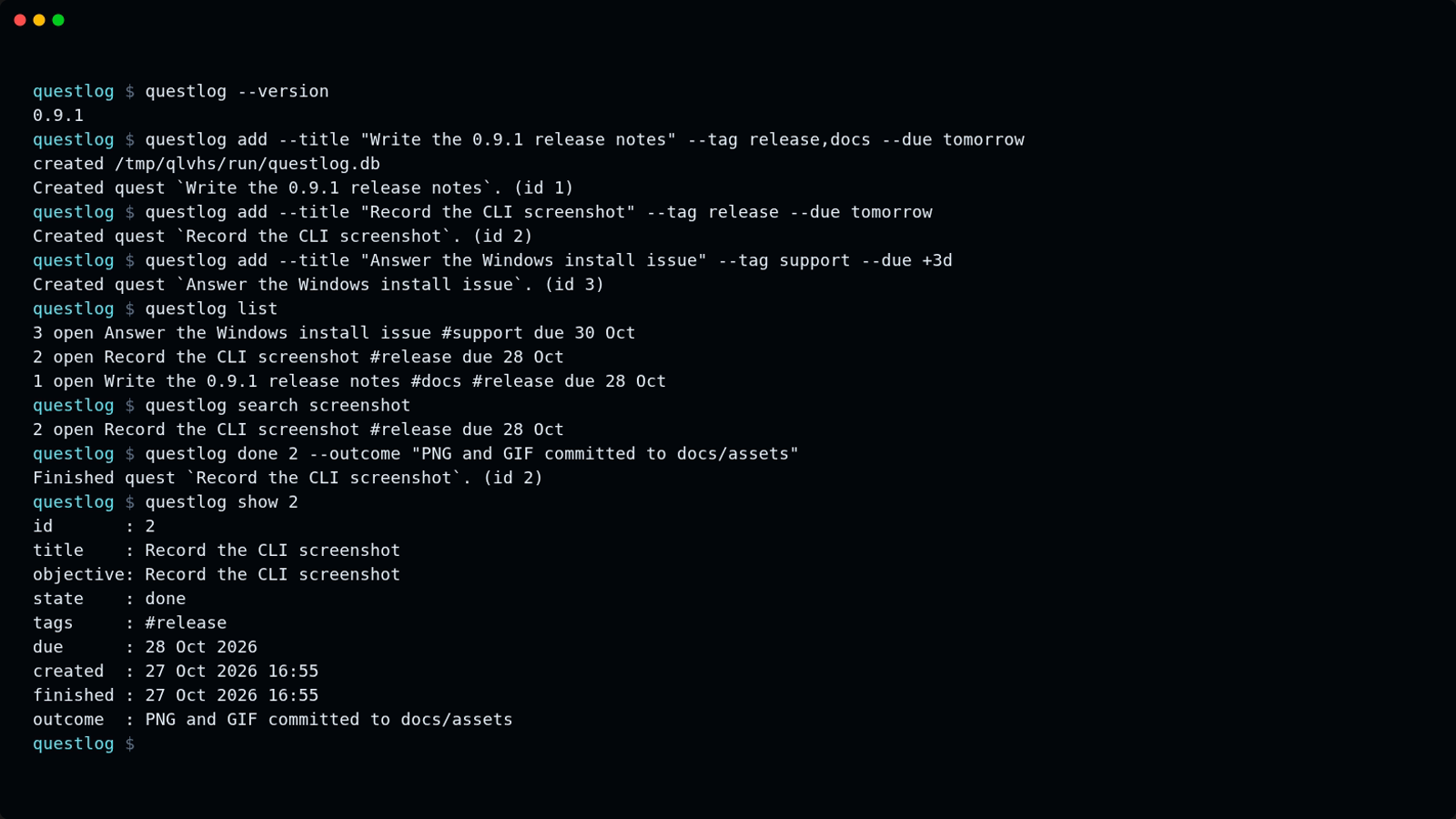
The same session as an animated GIF.
Other release installers:
mise use -g github:GhostPawJS/questlog
ubi --project GhostPawJS/questlog --exe ghostpaw-questlog --in ~/.local/bin
eget GhostPawJS/questlog
For aqua, define a
github_release package in aqua.yaml:
registries:
  - name: questlog
    type: local
    path: questlog-registry.yaml
packages:
  - name: GhostPawJS/questlog@v0.8.0
    registry: questlog
questlog-registry.yaml:
packages:
  - type: github_release
    repo_owner: GhostPawJS
    repo_name: questlog
    asset: ghostpaw-questlog-{{trimV .Version}}-{{.OS}}-{{.Arch}}.tar.gz
    format: tar.gz
    replacements: { amd64: x64 }
    overrides:
      - goos: windows
        asset: ghostpaw-questlog-{{trimV .Version}}-windows-{{.Arch}}.zip
        format: zip
    files:
      - name: ghostpaw-questlog
Install scripts verify SHA256SUMS. To verify a downloaded archive's build attestation:
gh attestation verify <archive> -R GhostPawJS/questlog
Set GHOSTPAW_VERIFY=attestation for attestation verification in install.sh.
Binaries are unsigned; macOS binaries carry an ad-hoc signature. For a browser
download on macOS, remove quarantine with
xattr -d com.apple.quarantine /path/to/ghostpaw-questlog.
Linux binaries require glibc 2.28+; use npx on Alpine.
See the binary build workflow.
npx / npm (for npm-based environments)
The npm package requires Node 24+:
npx -y @ghostpaw/questlog --help
npm install -g @ghostpaw/questlog
Library (for harnesses embedding it in code)
npm install @ghostpaw/questlog
import { initQuestlogTables, read, write } from '@ghostpaw/questlog';
See library usage. The library uses built-in node:sqlite with zero runtime dependencies.
Quick Start
import { DatabaseSync } from 'node:sqlite';
import { initQuestlogTables, read, write } from '@ghostpaw/questlog';

const db = new DatabaseSync(':memory:');
initQuestlogTables(db);

// Capture incoming work as a rumor before committing to shape
const rumor = write.captureRumor(db, {
  title: 'Legal says the vendor terms changed',
  details: 'Need to understand pricing delta and termination clause.',
});

// Settle the rumor into real work once the shape is clear
write.settleRumor(db, rumor.id, {
  settledAt: Date.now(),
  questline: {
    title: 'Vendor Renewal',
    description: 'Commercial, legal, and approval work.',
  },
  quests: [
    { title: 'Collect redlines', objective: 'Obtain the latest legal markup.' },
    { title: 'Review pricing delta', objective: 'Compare current vs. proposed cost.' },
  ],
});

// Drive the day from derived views, not from memory
const available = read.listAvailableQuests(db);
const dueSoon = read.listDueSoonQuests(db, 7 * 24 * 60 * 60 * 1000);
const results = read.searchQuestlog(db, 'vendor');
Docs
The live demo runs the library in your browser against an in-memory SQLite database. Each view below opens a different part of it:
- Dashboard: open, available, overdue and pending work
- Intake: capture rumors and triage them into quests
- Quests: start, block and finish quests with an outcome
- Planning: questlines and scheduling
- Search: full-text search across the log
The Model
Seven concepts, strict separation of concerns:
| Concept | Purpose |
|---|---|
| Rumor | Incoming signal that may or may not become real work |
| Questline | Shared context and rollup for a group of related quests |
| Quest | One concrete commitment with lifecycle, timing, and outcome |
| Repeatable Quest | Recurring template that spawns fresh quests on a schedule |
| Unlock | Hard prerequisite: quest B stays blocked until quest A succeeds |
| Reward | Descriptive outcome attached to completed work, with a claim lifecycle |
| Tag | Cross-cutting label for filtering and reporting |
The unified model means one entity type covers every temporal intention:
| What it looks like | What it actually is |
|---|---|
| A todo item | A quest with no temporal metadata |
| A deadline | A quest with dueAt |
| A calendar event | A quest with scheduledStartAt and scheduledEndAt |
| A recurring commitment | A repeatable quest with an RRULE |
| A completed action | A quest resolved via finishQuest |
State is derived, not toggled. A quest's availability comes from its lifecycle, timing fields, and unlock graph — computed at read time, never stored as a status flag.
Lifecycle at a glance
Questlog computes WoW-style markers on every read. They change as work moves through its lifecycle:
Intake
$\color{Goldenrod}{\textsf{❗}}$ Legal says the vendor terms changed rumor · open↓ settle into questline + quests Quest progression
$\color{Goldenrod}{\textsf{❗}}$ Review pricing delta open · available$\color{Gray}{\textsf{❓}}$ Review pricing delta in progress$\color{Goldenrod}{\textsf{❓}}$ Review pricing delta done · reward unclaimed✓ Review pricing delta done · reward claimedOther markers
$\color{CornflowerBlue}{\textsf{❗}}$ Weekly standup notes repeatable · due$\color{Gray}{\textsf{❗}}$ Plan Q3 roadmap open · deferred$\color{Gray}{\textsf{❓}}$ Obtain finance approval open · blocked
Marker IDs are semantic strings (attention.available, progress.complete, ...) computed at read time, never stored. The markers namespace maps each to its symbol, color, label, and CSS class for consistent rendering across HTML, TTY, and plain text.
Two Audiences
Human developers
Use the read and write namespaces for direct-code access to every domain operation:
import { read, write } from '@ghostpaw/questlog';

write.createQuest(db, { title: 'Ship release notes', objective: 'Draft and publish.' });
write.startQuest(db, questId);
write.finishQuest(db, questId, 'Published to blog and changelog.');

const blocked = read.listBlockedQuests(db);
const overdue = read.listOverdueQuests(db);
See HUMAN.md for the full human-facing guide with worked examples.
LLM agents
Use the tools, skills, and soul namespaces for a structured runtime surface designed to minimize LLM cognitive load:
import { tools, skills, soul } from '@ghostpaw/questlog';

// 12 intent-shaped tools with JSON Schema inputs and structured results
const allTools = tools.questlogTools;
const searchTool = tools.getQuestlogToolByName('search_questlog')!;
const result = searchTool.handler(db, { query: 'vendor', mode: 'browse' });

// 25 reusable workflow skills for common multi-step scenarios
const allSkills = skills.questlogSkills;

// Thinking foundation for system prompts
const prompt = soul.renderQuestlogSoulPromptFoundation();
Every tool returns a discriminated result with outcome: 'success' | 'no_op' | 'needs_clarification' | 'error', structured entities, next-step hints, and actionable recovery advice. No thrown exceptions to parse, no ambiguous prose.
See LLM.md for the full AI-facing guide covering soul, tools, and skills.
Tools
Twelve tools shaped around operator intent, not raw storage operations:
| Tool | What it does |
|---|---|
search_questlog |
Cross-entity full-text search |
review_questlog |
Filtered list views (available, overdue, due soon, ...) |
inspect_questlog_item |
Detailed inspection of any single entity |
capture_rumor |
Record incoming work before committing to shape |
shape_work |
Create quests, questlines, settle rumors into structure |
plan_quest |
Set timing: due dates, defer dates, scheduled windows |
run_quest |
Start, finish, abandon, log effort |
organize_work |
Move quests between questlines, manage questline lifecycle |
manage_repeatable |
Create and maintain recurring quest templates |
tag_work |
Classify quests and repeatables with tags |
reward_work |
Attach, update, claim, or remove rewards |
retire_work |
Soft-delete or archive things that should leave the active surface |
Each tool exports runtime metadata — name, description, JSON Schema, input descriptions, side-effect level — so agent harnesses can wire them without reading docs.
The run_quest tool refuses to start a quest with unmet unlock prerequisites and returns the blocking quests with inspection hints. Set force: true to start anyway with a warning. The library startQuest function remains permissive.
Key Properties
- Zero runtime dependencies. Only
node:sqlite(built into Node 24+). - Single prebundled blob. One ESM + one CJS entry in
dist/. No subpath exports, no code splitting. - Pure SQLite storage. FTS5 full-text search, CHECK-constrained state transitions, trigger-maintained indexes. Bring your own
DatabaseSyncinstance. - Derived state. Availability, blocking, deferral, overdue, and markers are computed at read time from fields and relationships, never stored as flags.
- Intention-shaped writes.
captureRumor,settleRumor,startQuest,finishQuest,abandonQuest— operations that say what happened, not generic CRUD. - RFC 5545 recurrence. Standard RRULE strings for recurring work. No custom recurrence format.
- WoW-style markers. Semantic marker IDs (
attention.available,progress.complete, ...) computed on every read, renderable to any channel. - Colocated tests. Every non-type module has a colocated
.test.tsfile. The behavior described in docs is backed by executable coverage.
Performance
Measured with npm run bench on Node 24.14.0, Linux, Intel Xeon (shared
cloud vCPU), 10,000 quests in a file-backed database:
| Operation | p50 | p95 |
|---|---|---|
search_questlog (tool) |
0.06 ms | 0.07 ms |
MCP tools/call search, stdio framing included |
0.07 ms | 0.08 ms |
read.searchQuestlog, one matching quest |
0.07 ms | 0.08 ms |
read.searchQuestlog, all 10,000 quests matching |
26.6 ms | 41.9 ms |
write.createQuest |
0.22 ms | 0.69 ms |
The library search returns every match with a highlighted snippet, so a query
that matches the whole log pays for building all of those rows. Cold start
(process spawn to first response, median) is about 30 ms for --version and
the MCP server.
Package Surface
import {
  initQuestlogTables,  // schema setup
  read,                // all query functions
  write,               // all mutation functions
  tools,               // LLM tool definitions + registry
  skills,              // LLM workflow skills + registry
  soul,                // thinking foundation for system prompts
  markers,             // marker derivation and lookup
} from '@ghostpaw/questlog';
All domain types are also available at the root for TypeScript consumers:
import type {
  QuestlogDb,
  QuestState,
  QuestDetail,
  CreateQuestInput,
  QuestlogSearchResult,
  QuestlogToolDefinition,
  QuestlogSkill,
  QuestlogSoul,
} from '@ghostpaw/questlog';
Documentation
| Document | Audience |
|---|---|
| HUMAN.md | Human developers using the low-level read/write API |
| LLM.md | Agent builders wiring tools, skills, and soul into LLM systems |
| docs/README.md | Architecture overview: model, invariants, lifecycle, markers |
| docs/entities/ | Per-entity manuals with exact public API listings |
Development
npm install
npm test            # node:test runner
npm run typecheck   # tsc --noEmit
npm run lint        # biome check
npm run build       # ESM + CJS + declarations via tsup
The repo is pinned to Node 24.14.0 via .nvmrc / .node-version / .tool-versions / mise.toml / Volta. Use whichever version manager you prefer.
Support
If this package helps your project, consider sponsoring its maintenance:

GhostPaw Questlog MCP 질문
GhostPaw Questlog MCP를 Claude Code에 추가하려면 어떻게 하나요?
터미널에서 claude mcp add questlog -- npx -y @ghostpaw/questlog를 실행합니다. 모든 프로젝트에서 사용할 수 있게 하려면 --scope user를 추가합니다.
GhostPaw Questlog MCP를 Cursor에 추가하려면 어떻게 하나요?
~/.cursor/mcp.json를 열고 mcpServers 아래에 서버를 추가합니다. 위 설치 섹션에 표시된 Cursor 구성을 사용합니다.
GhostPaw Questlog MCP는 어떤 도구를 제공하나요?
12개 도구를 제공합니다. 예: search_questlog, review_questlog, inspect_questlog_item, capture_rumor, shape_work.
questlog 데이터는 어디에 저장되나요?
데이터는 기본적으로 ~/.ghostpaw/questlog.db에 위치한 SQLite 데이터베이스에 저장됩니다. 다만, GHOSTPAW_QUESTLOG_DB 환경 변수나 --db 플래그를 사용하여 사용자 정의 경로를 지정할 수 있습니다.
Claude Desktop에서 Questlog를 어떻게 사용하나요?
Claude Desktop 사용자는 claude_desktop_config.json에 서버를 추가하거나, 최신 GitHub release에서 server.mcpb 파일을 설치하여 서버를 사용할 수 있습니다.
결과(outcome) 없이 작업을 완료로 표시하면 어떻게 되나요?
명령어 실행 시 --outcome 플래그가 필요하다는 사용법 힌트를 출력하고 코드 2로 종료됩니다.