
diffusers-workflow MCP server
2026년 11월 14일 커밋AI 에이전트가 사용자의 GPU에서 Hugging Face Diffusers 이미지, 비디오, 오디오 생성 워크플로우를 작업 단위로 실행합니다.
다른 이름 dkackman/diffusers-workflow
- 스타
- 18
- Tools
- —
- 다운로드, 30일
- —
- 최신 버전
- —
- 마지막 커밋
- 2026년 11월 14일
- 라이선스
- Apache-2.0
diffusers-workflow MCP란?
diffusers-workflow은(는) MCP server입니다. AI 에이전트가 사용자의 GPU에서 Hugging Face Diffusers 이미지, 비디오, 오디오 생성 워크플로우를 작업 단위로 실행합니다.
프로젝트 README에서 생성된 요약
diffusers-workflow MCP server 정보
diffusers-workflow는 개발자와 크리에이터가 자신의 하드웨어에서 AI 에이전트를 통해 미디어를 생성할 수 있도록 지원합니다. 이 MCP server를 사용하면 에이전트가 Hugging Face Diffusers 파이프라인을 구동하여 로컬 GPU 또는 원격 머신에서 이미지, 비디오, 오디오를 직접 생성할 수 있습니다. NVIDIA CUDA, Apple Silicon MPS, CPU 등 다양한 하드웨어를 지원하며, Claude Code 또는 기타 MCP 클라이언트와 통합되어 복잡한 생성 작업을 관리합니다.
사용자는 JSON 기반 워크플로우를 작성, 검증 및 실행할 수 있는 에이전트를 통해 시스템과 상호작용합니다. 서버는 프로세스를 제어하고, 폼에서 변수를 편집하며, 출력 갤러리를 볼 수 있는 웹 UI를 제공합니다. validate_workflow를 통한 GPU 비용 추정 및 에셋 관리를 위한 전용 도구가 포함되어 있습니다. 지속적인 워커(persistent worker)를 사용하므로 모델이 메모리에 로드된 상태로 유지되어 연속적인 실행 속도가 빠릅니다. FLUX 또는 MiniMax와 같이 권한이 필요한 모델의 경우 hf auth login을 통해 Hugging Face 인증을 제공하기만 하면 됩니다.
활용 사례
- 1렌더링 전 비용 추정긴 렌더링 작업을 시작하기 전에 에이전트에게 특정 워크플로우에 예상되는 GPU 시간을 계산하도록 요청할 수 있습니다.
프로젝트의 README를 바탕으로 작성되었습니다. 모든 활용 사례는 해당 내용의 인용문과 대조하여 확인합니다.
자동 검사
2026년 11월 14일에 실행됨전체 보고서 →아직 인증되지 않았습니다. 서버는 80점 이상의 점수, 심각한 결함 없음, 그리고 검사에 충분한 데이터를 갖추어야 합니다. 검사 방식 · 점수를 높이기 위해 수정할 항목

- 소스 저장소 연결 및 접근 가능dkackman/diffusers-workflow is public and reachablegithub.com/dkackman/diffusers-workflow ↗통과
- 패키지가 이 저장소를 소스로 명시검사되지 않음
- 빌드 출처(Sigstore 증명)검사되지 않음
- 오픈 소스 라이선스 (OSI)Apache-2.0spdx.org/licenses/Apache-2.0.html ↗통과
- 최근 1년 내 커밋 또는 릴리스Last commit or release 2026-11-12github.com/dkackman/diffusers-workflow ↗통과
- OpenSSF Scorecard검사되지 않음
- 패키지 이름이 인기 패키지와 유사하지 않음검사되지 않음
- 패키지 및 해당 종속성에 중요한 보안 권고 없음검사되지 않음
- 모델에 대한 숨겨진 지침 없음0 tool descriptions and the README read; no override phrases, credential paths or hidden characters통과
- 파괴적인 도구에 라벨 표시됨검사되지 않음
- 원격 엔드포인트가 MCP 핸드셰이크에 응답검사되지 않음
README
GitHub에서 보기
diffusers-workflow
Your GPU, as something an agent can drive.
diffusers-workflow runs Hugging Face Diffusers image, video and audio generation as jobs on your own GPU. An agent does the work. Claude Code, or any MCP client, picks or writes the workflow, checks what it will cost, runs it, and looks at what came back. You steer from the browser. Every workflow, run and output the agent made is in the web UI, where you can change a variable, run it again, compare takes and keep the one you like.
Python 3.12-3.14 | CUDA (NVIDIA) | MPS (Apple Silicon) | CPU
Getting started
1. Install. The script picks the right torch build for your platform, creates a virtual environment and installs everything, MCP server included.
bash ./install.sh && source ./activate      # Linux / macOS
.\install.ps1; .\venv\scripts\activate      # Windows
2. Start the engine. Leave it running; the agent and the browser both talk to it.
dw-serve # web UI on http://127.0.0.1:8765
3. Connect your agent. Register the MCP server with the absolute path to dw-mcp
in the venv you just made (a relative path is the setup detail that most often goes
wrong). Then add the dw plugin:
claude mcp add dw -- "$(pwd)/venv/bin/dw-mcp"
/plugin marketplace add dkackman/diffusers-workflow
/plugin install dw@diffusers-workflow
Most of the shipped models (Flux, LTX, MiniMax, ...) are gated. Request access on
the model's Hugging Face page and run hf auth login once. Without it a run fails
partway through with a 401/403 from the Hub. templates/text-to-image uses a small,
ungated model, so it makes a good first run.
Start the engine on the GPU box with --mcp and connect over HTTP. There is nothing
to install on the laptop:
# on the GPU box
dw-serve --host 0.0.0.0 --token "$DW_API_TOKEN" --mcp --workspace ~/studio

# on your laptop
claude mcp add --transport http dw http://gpu-box:8765/mcp \
  --header "Authorization: Bearer $DW_API_TOKEN"
The server's Status page writes that line for you. The whole setup is in Remote GPU server.
On Linux with an NVIDIA GPU, the
dkackman/diffusers-workflow
image runs the server with torch, the engine and the web UI built in. It shares the
model cache and workspace with a native install on the same box. See
Docker.
Ask the agent
Describe what you want. The agent has 65 tools covering the workflow catalog, the real diffusers pipeline signatures, the job queue, the gallery and the model cache, and it stays with a long render until it finishes:
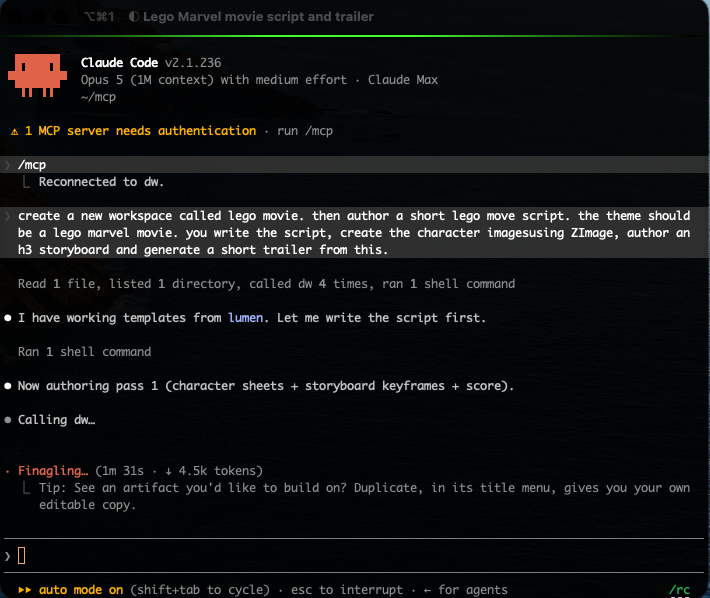
A session sounds like this:
- "Make a 30-second musical trailer: four men in boater hats, a giant eye, a
score under it." The agent picks a shape from the catalog (
list_workflows), breaks the brief into shots, writes each prompt to the prompt library, and builds the workflow that renders the shots and cuts them to the score. - "What will that cost?"
validate_workflowchecks the JSON against the schema and the real pipeline signatures, with no model loads, and quotes an estimate in GPU minutes from this box's own history. Anything that spends GPU time or disk refuses to run until the agent passesacknowledged_cost, so it has to tell you what it is about to spend first. - "How's it going?"
wait_for_jobwaits out a render without polling. Thenget_output_frames,get_output_imageandget_output_audiobring the result back into the conversation, so the agent judges what it made against what you asked for. - "Shot three is the one. Keep it and start the next scene from it."
keep_outputturns the file into a named asset, and the next workflow references it asasset:hero-frame.png.
The dw plugin adds what a general-purpose agent can't know on its own: one skill per model family (MiniMax H3 and Music 3, LTX-2.5, Kandinsky 6, FLUX 3 Klein) that picks the template for a request and states the rules that bite. Cross-cutting skills cover script-to-video, series with a consistent cast, storyboards and animatics, and a shared camera-and-look vocabulary.
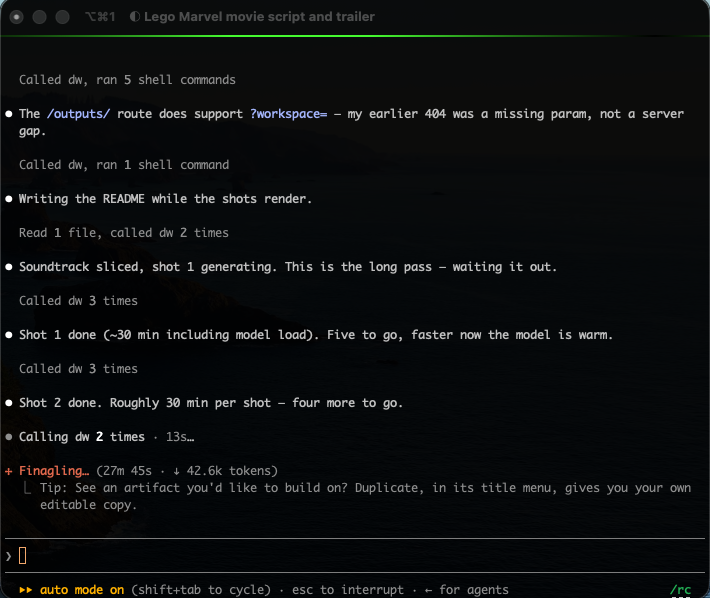
One server holds several workspaces, each with its own workflows, assets and outputs. Two agents, or an agent and you in the browser, can share one GPU without saving over each other's work.
The tool reference, setup for other MCP hosts and the troubleshooting table are in MCP Server.
Then tweak it in the browser
The web UI shows everything the agent made and lets you take over at any point. It runs on the same persistent GPU worker, so models stay loaded between runs.
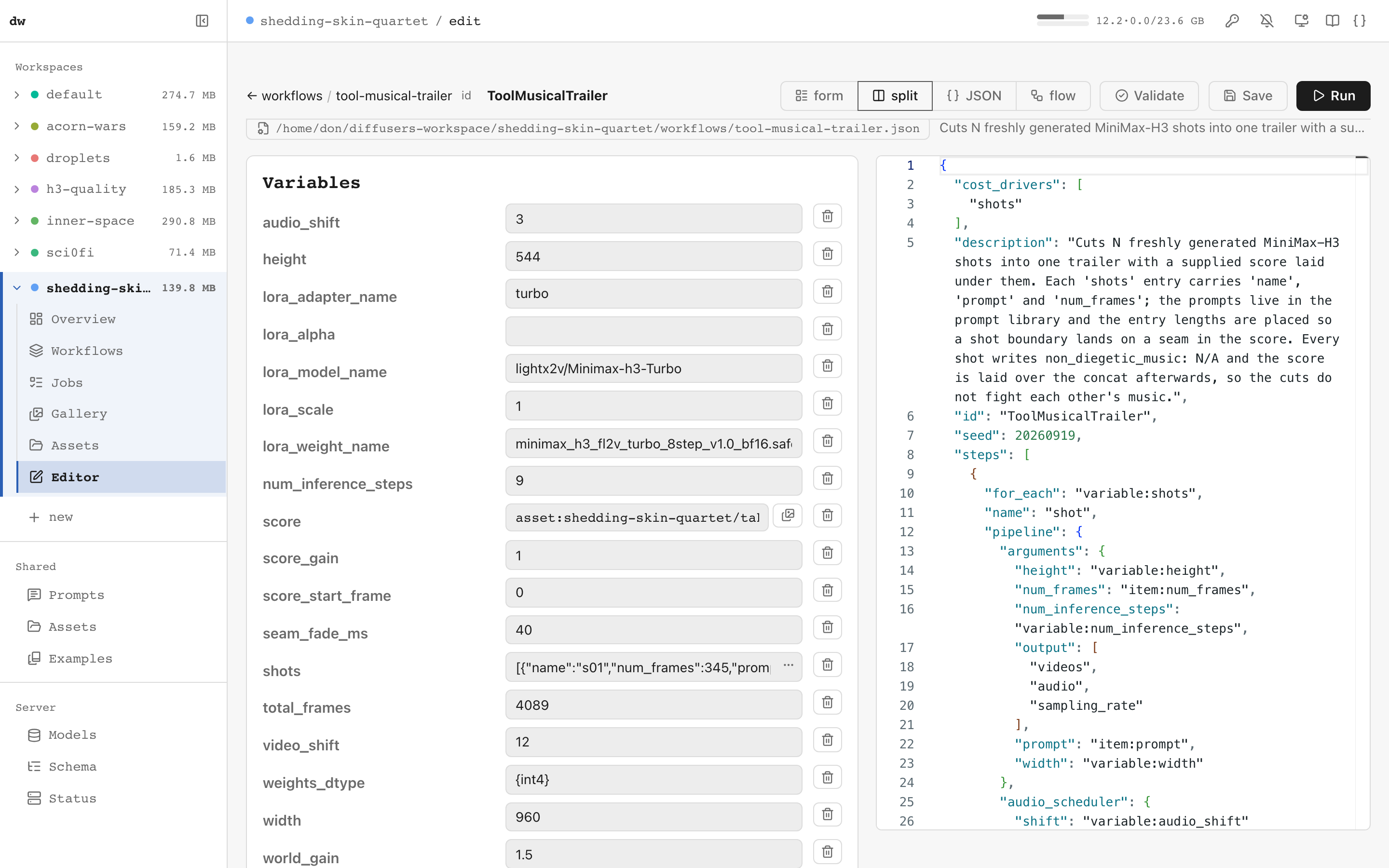
A workflow the agent wrote is a form you can edit. The workflow's description, recent outputs and variables are on one page. Change a prompt, a frame count or a LoRA scale and press Run.
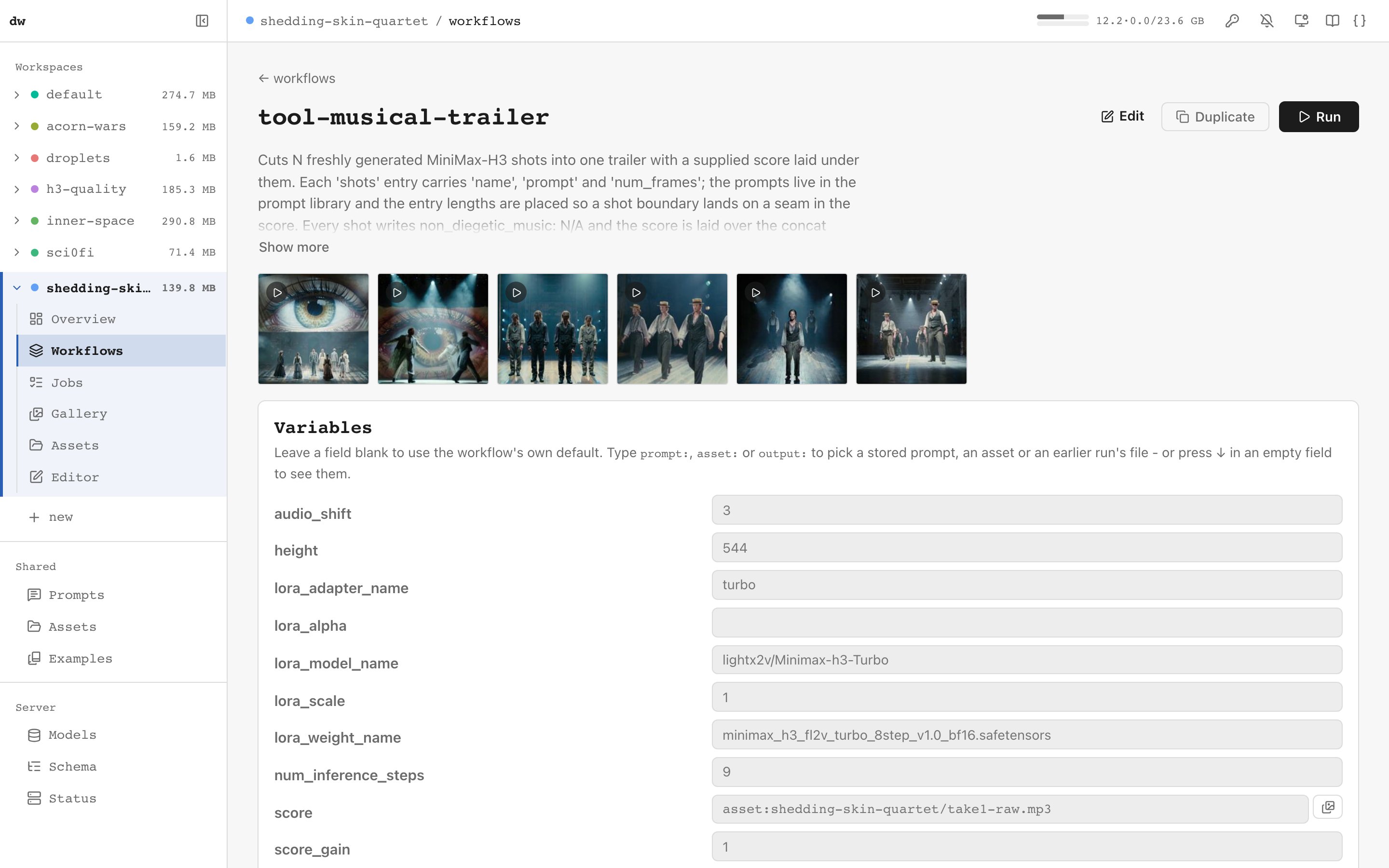
Every job is a recipe. A job keeps the exact workflow it ran and draws it as a graph of how data flows between steps. Click a step to see what it produced. The run's warnings sit above the graph, so a problem the agent missed, such as an audible level jump at a cut, is in front of you with the argument that fixes it. Run again repeats the job, and New seed gives you another take. Progress streams live for each denoising step, and a cancel stops the job cleanly at the next step.
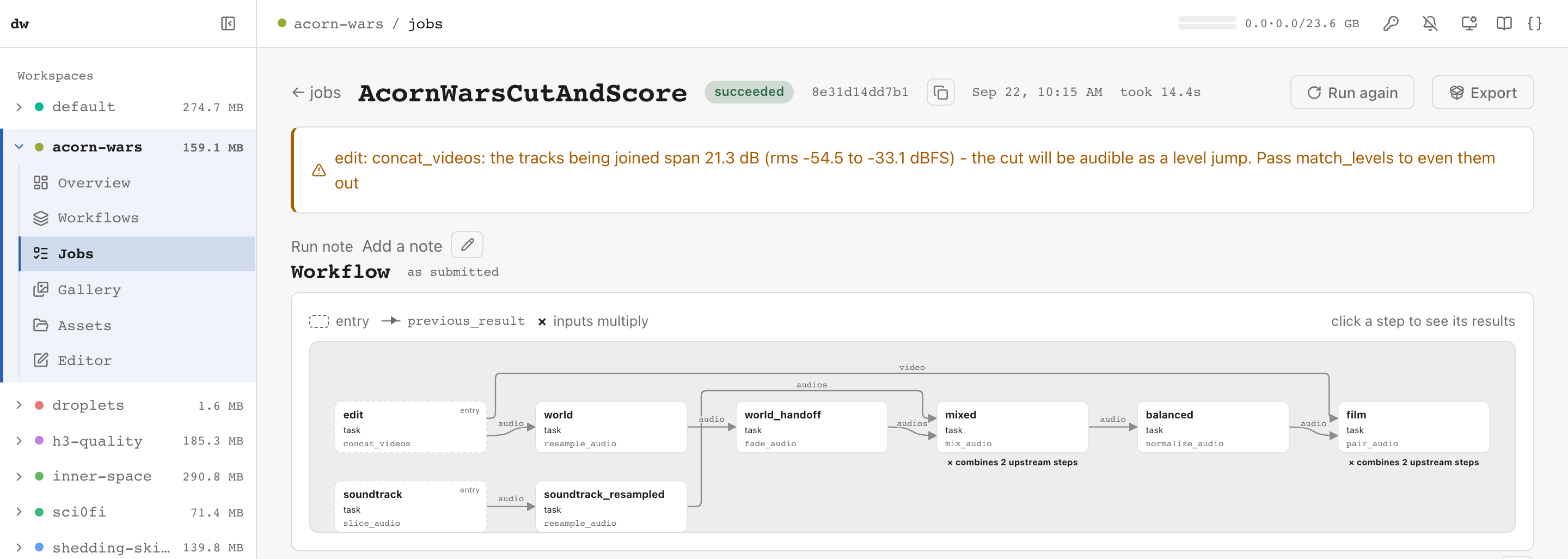
The gallery groups outputs by the workflow that made them, with final and intermediate files kept apart. Any image reopens as the workflow that produced it. Keep as asset adds a file to the asset library for later workflows to use.
The editor works on the agent's JSON. You can view the workflow as a form, as JSON, side by side, or as a flow graph. The forms and autocomplete come from the real diffusers pipeline signatures, so every argument a pipeline takes is there with its documentation. Validate catches schema errors and argument typos before any model loads.
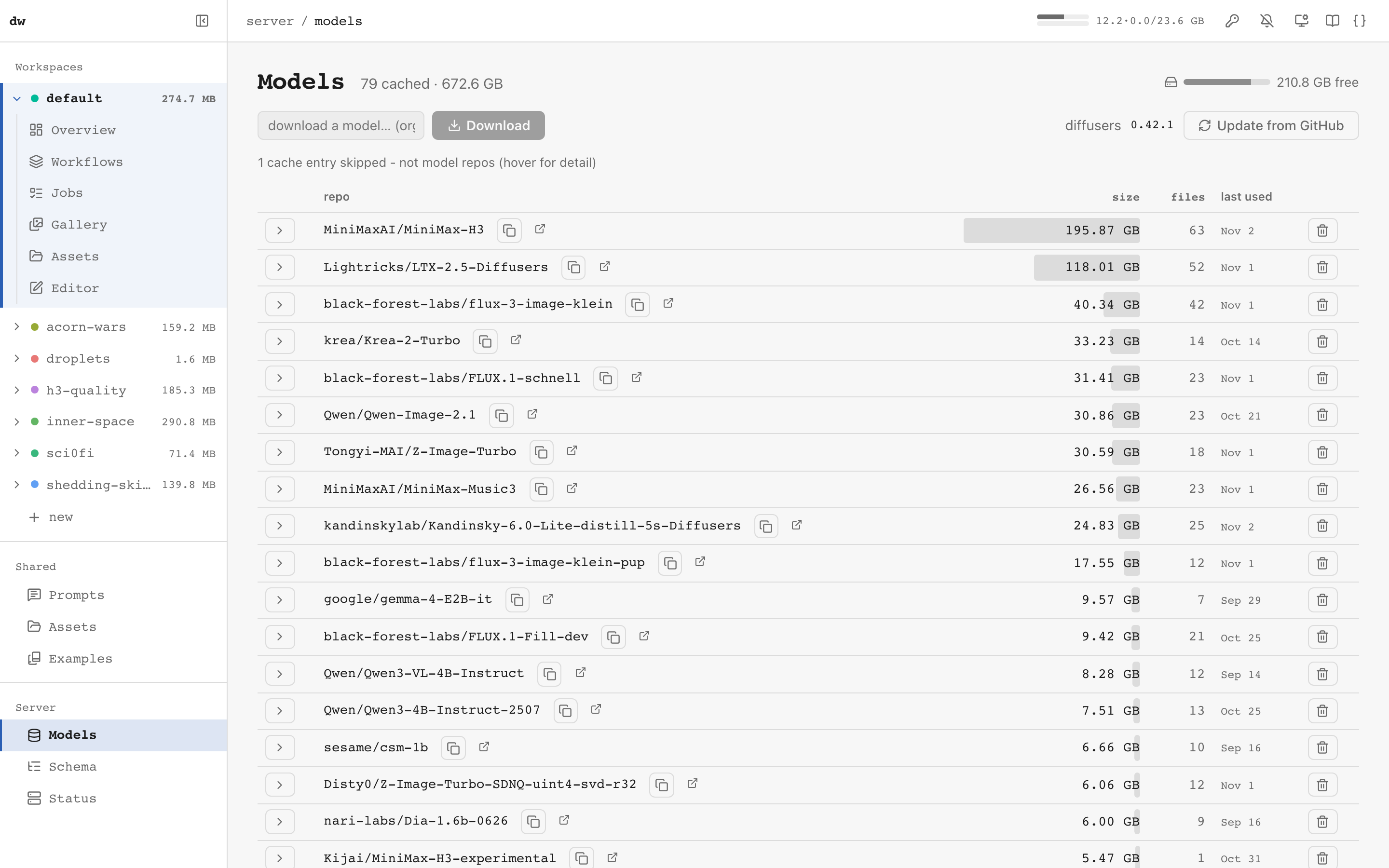
There is also a prompt library, with an Enhance with AI panel that expands an idea into a full prompt using a local language model. The model manager shows the Hugging Face cache (size, last use, free disk) and downloads or deletes models with live progress.
The pages are described in Server & Web UI. The UI and the agent
both use the server's HTTP API, which you can browse at /docs on a running server
(see The HTTP API).
Underneath
Every front end reads and writes the same thing: a JSON workflow of named steps,
each a diffusers pipeline or a utility task. Its arguments are references to
variables, earlier steps' results, stored prompts and assets, not hard-coded
values. That is how text-to-image chains into image-to-video, and how a generated
image reopens as the recipe that made it. You rarely need to write one by hand. When
you do, the Workflow Guide is the reference, the
JSON Schema is the exact structure, and
workflows/ has runnable examples for each model family. There is also
a command-line client, python -m dw.run workflow.json prompt="a cat", which queues
a job on a running server (see Server & Web UI).
The engine also covers:
- Quantization: BitsAndBytes, TorchAO, GGUF, SDNQ and optimum-quanto, set per component.
- Acceleration: FirstBlockCache, FasterCache, MagCache, TaylorSeerCache,
torch.compileand attention backends. - Adapters and prompts: LoRA, IP-Adapter and A1111-style prompt weighting.
- Long video and caching: long-video chaining with audio-driven length, and step-output caching, so re-running a fixed-seed workflow finishes instantly.
- Utility tasks: upscaling, face restoration, segmentation, captioning, frame interpolation, audio slicing, cut-and-score assembly and more.
A workflow can reach any diffusers pipeline or quantization backend by dynamic
import, so loading one can execute arbitrary Python. Treat a workflow file from
someone else the way you'd treat a .py script. See
Trust model.
Field reports. At the end of a session, ask the agent what got in its way, and
have it file each bug or gap as an issue on dkackman/diffusers-workflow with the
field-report label. The label marks a report as coming from real use. A report
from anyone but the maintainer is reviewed before the agent loop
acts on it.
Documentation
Using it
- MCP Server - the agent's tool surface (Claude Code, Claude Desktop, other MCP hosts)
- dw plugin - the model-family and composition skills
- Server & Web UI - the web UI, the command line, and the HTTP API with its OpenAPI spec
- Workspaces - where your content lives, run directories, several workspaces on one server
- Remote GPU server - the server, UI and MCP from another machine
- Docker - the server in a container on a Linux NVIDIA box
Workflows in depth
- Workflow Guide - JSON structure, variables, steps, data flow, references
- Tasks - image, video and audio utility tasks, ControlNet preprocessors
- Quantization - BitsAndBytes, TorchAO, GGUF, SDNQ
- Inference Acceleration - caches,
torch.compile, attention backends, MPS - Fast on 24GB - tested speed/memory settings per model family
- LoRA, IP-Adapter, Prompt Weighting
Reference
- Architecture - each concept, the module that owns it, and the check that enforces it
- Worker Guide - the persistent GPU worker and troubleshooting
- Security - validators and the trust gate (quick reference)
- Dependencies, Testing, Releasing
- Agent Loop - what the automated implementer/tester labels mean
- Attributions - code from other projects, and the projects whose ideas dw reimplemented
diffusers-workflow MCP 질문
diffusers-workflow MCP server를 Claude Code에 어떻게 연결하나요?
가상 환경에 있는 dw-mcp의 절대 경로를 사용하여 MCP server를 등록합니다. 예: claude mcp add dw -- "$(pwd)/venv/bin/dw-mcp". 상대 경로를 사용하는 것이 가장 흔한 설정 실수이므로 반드시 절대 경로를 사용해야 합니다.
diffusers-workflow를 원격 GPU나 Docker에서 실행할 수 있나요?
네. GPU 머신에서 --mcp 옵션으로 엔진을 시작하고 HTTP로 연결하면 됩니다. 클라이언트에는 아무것도 설치할 필요가 없습니다. NVIDIA GPU가 있는 Linux 환경에서는 Docker 이미지를 실행할 수도 있습니다.
Hugging Face에서 401/403 에러가 발생하며 실행에 실패하는 이유는 무엇인가요?
대부분의 배포된 모델은 접근 권한이 필요합니다. 해당 모델의 Hugging Face 페이지에서 접근 권한을 요청한 후 hf auth login을 한 번 실행하십시오. templates/text-to-image 워크플로우는 권한이 필요 없는 작은 모델을 사용하므로 첫 실행 시 바로 작동합니다.
에이전트가 작업을 시작하기 전에 GPU 비용을 추정할 수 있나요?
네. validate_workflow는 모델을 로드하지 않고도 스키마와 파이프라인 시그니처를 기준으로 워크플로우를 확인하여 GPU 사용 시간 단위로 예상 비용을 산출합니다. GPU 시간이나 디스크를 사용하는 작업은 에이전트가 acknowledged_cost를 먼저 통과해야 합니다.
diffusers를 위한 MCP server란 무엇인가요?
Claude Code와 같은 MCP 클라이언트가 사용자의 GPU에서 Diffusers 이미지, 비디오, 오디오 생성 워크플로우를 생성, 검증 및 실행할 수 있게 해줍니다. 사용자는 브라우저 UI에서 결과를 검토하고 편집할 수 있습니다.