
AI 클라이언트가 여러 출판물에 걸쳐 Substack 초안 생성 및 관리, Note 게시, 포스트 검색, 분석 데이터 확인, 동의한 구독자 관리를 수행할 수 있도록 합니다.
다른 이름 conorbronsdon/substack-mcp, substack-mcp, @conorbronsdon/substack-mcp
- 스타
- 48
- Tools
- 42
- 다운로드, 30일
- 5,504
- 최신 버전
- 1.3.0
- 마지막 커밋
- 2026년 11월 14일
- 라이선스
- MIT
Substack MCP란?
AI 클라이언트가 여러 출판물에 걸쳐 Substack 초안 생성 및 관리, Note 게시, 포스트 검색, 분석 데이터 확인, 동의한 구독자 관리를 수행할 수 있도록 합니다. 42개 도구를 제공합니다. 예: get_subscriber_count, list_subscribers, search_subscribers.
프로젝트 README에서 생성된 요약
Substack MCP server 정보
이 MCP server를 사용하면 AI 어시스턴트를 통해 Substack 뉴스레터를 관리할 수 있습니다. 사용자는 풍부한 내용의 긴 글 초안을 준비하고, 기존 아카이브를 검색하며, 출판물 분석 데이터를 확인할 수 있습니다. 즉시 게시되는 짧은 형식의 Note는 처리할 수 있지만, 긴 글 콘텐츠는 초안 작성 워크플로우로 제한됩니다. 이는 사용자가 공식 Substack 에디터를 통해 게시물을 직접 검토하고 게시하도록 하여, 중요한 콘텐츠에 대한 최종 확인 단계를 보장합니다.
개발자는 로컬 stdio 또는 자체 호스팅된 HTTP 전송 방식을 사용하여 이 서버를 Claude Desktop 또는 Claude Code와 같은 클라이언트에 연결할 수 있습니다. 설정에는 Substack 계정이 필요하며, 환경 변수 또는 Playwright를 이용한 브라우저 기반 로그인을 통해 구성할 수 있습니다. 이 서버는 이름이 지정된 프로필을 통해 여러 출판물을 관리하는 기능을 지원하며, 로컬 암호화 파일이나 macOS Keychain 또는 Windows Credential Manager와 같은 OS 전용 키체인을 포함한 안전한 자격 증명 저장 옵션을 제공합니다. 또한 로그인 시 적절한 권한이 부여되면 동의한 무료 구독자를 관리하는 도구도 제공합니다.
활용 사례
- 1긴 글 뉴스레터 포스트 초안 작성AI에게 상세한 뉴스레터 초안을 생성, 업데이트 및 계획하도록 지시한 후 나중에 수동으로 검토할 수 있습니다.
- 2짧은 형식의 소셜 업데이트 게시AI 클라이언트가 Substack 출판물에 짧은 형식의 Note를 즉시 게시할 수 있습니다.
- 3출판물 성과 분석AI 어시스턴트에게 뉴스레터 분석 데이터를 조회하도록 요청하여 콘텐츠 전략을 세울 수 있습니다.
- 4구독자 데이터 관리어시스턴트를 사용하여 구독자 수를 확인하거나 리스트 수신에 동의한 사용자를 관리할 수 있습니다.
프로젝트의 README를 바탕으로 작성되었습니다. 모든 활용 사례는 해당 내용의 인용문과 대조하여 확인합니다.
Substack MCP 설치 방법
형식 확인: 2026년 11월 10일Cursor에 추가Goose에 추가Claude Code에 Substack MCP 설치
$ claude mcp add --env 'SUBSTACK_SESSION_TOKEN=<YOUR_SUBSTACK_SESSION_TOKEN>' --env 'SUBSTACK_PUBLICATION_URL=<SUBSTACK_PUBLICATION_URL>' --env 'SUBSTACK_USER_ID=<SUBSTACK_USER_ID>' substack-mcp -- npx -y @conorbronsdon/substack-mcpCursor에 Substack MCP 설치
~/.cursor/mcp.json
{
  "mcpServers": {
    "substack-mcp": {
      "command": "npx",
      "args": [
        "-y",
        "@conorbronsdon/substack-mcp"
      ],
      "env": {
        "SUBSTACK_SESSION_TOKEN": "<YOUR_SUBSTACK_SESSION_TOKEN>",
        "SUBSTACK_PUBLICATION_URL": "<SUBSTACK_PUBLICATION_URL>",
        "SUBSTACK_USER_ID": "<SUBSTACK_USER_ID>"
      }
    }
  }
}VS Code에 Substack MCP 설치
.vscode/mcp.json
{
  "servers": {
    "substack-mcp": {
      "type": "stdio",
      "command": "npx",
      "args": [
        "-y",
        "@conorbronsdon/substack-mcp"
      ],
      "env": {
        "SUBSTACK_SESSION_TOKEN": "<YOUR_SUBSTACK_SESSION_TOKEN>",
        "SUBSTACK_PUBLICATION_URL": "<SUBSTACK_PUBLICATION_URL>",
        "SUBSTACK_USER_ID": "<SUBSTACK_USER_ID>"
      }
    }
  }
}VS Code CLI에 Substack MCP 설치
$ code --add-mcp '{"name":"substack-mcp","type":"stdio","command":"npx","args":["-y","@conorbronsdon/substack-mcp"],"env":{"SUBSTACK_SESSION_TOKEN":"<YOUR_SUBSTACK_SESSION_TOKEN>","SUBSTACK_PUBLICATION_URL":"<SUBSTACK_PUBLICATION_URL>","SUBSTACK_USER_ID":"<SUBSTACK_USER_ID>"}}'Claude Desktop에 Substack MCP 설치
claude_desktop_config.json
{
  "mcpServers": {
    "substack-mcp": {
      "command": "npx",
      "args": [
        "-y",
        "@conorbronsdon/substack-mcp"
      ],
      "env": {
        "SUBSTACK_SESSION_TOKEN": "<YOUR_SUBSTACK_SESSION_TOKEN>",
        "SUBSTACK_PUBLICATION_URL": "<SUBSTACK_PUBLICATION_URL>",
        "SUBSTACK_USER_ID": "<SUBSTACK_USER_ID>"
      }
    }
  }
}Codex에 Substack MCP 설치
$ codex mcp add substack-mcp --env 'SUBSTACK_SESSION_TOKEN=<YOUR_SUBSTACK_SESSION_TOKEN>' --env 'SUBSTACK_PUBLICATION_URL=<SUBSTACK_PUBLICATION_URL>' --env 'SUBSTACK_USER_ID=<SUBSTACK_USER_ID>' -- npx -y @conorbronsdon/substack-mcpCodex config.toml에 Substack MCP 설치
~/.codex/config.toml
[mcp_servers.substack-mcp]
command = "npx"
args = ["-y", "@conorbronsdon/substack-mcp"]

[mcp_servers.substack-mcp.env]
SUBSTACK_SESSION_TOKEN = "<YOUR_SUBSTACK_SESSION_TOKEN>"
SUBSTACK_PUBLICATION_URL = "<SUBSTACK_PUBLICATION_URL>"
SUBSTACK_USER_ID = "<SUBSTACK_USER_ID>"
Gemini CLI에 Substack MCP 설치
$ gemini mcp add -s user -e 'SUBSTACK_SESSION_TOKEN=<YOUR_SUBSTACK_SESSION_TOKEN>' -e 'SUBSTACK_PUBLICATION_URL=<SUBSTACK_PUBLICATION_URL>' -e 'SUBSTACK_USER_ID=<SUBSTACK_USER_ID>' substack-mcp npx -- -y @conorbronsdon/substack-mcpGemini settings.json에 Substack MCP 설치
~/.gemini/settings.json
{
  "mcpServers": {
    "substack-mcp": {
      "command": "npx",
      "args": [
        "-y",
        "@conorbronsdon/substack-mcp"
      ],
      "env": {
        "SUBSTACK_SESSION_TOKEN": "<YOUR_SUBSTACK_SESSION_TOKEN>",
        "SUBSTACK_PUBLICATION_URL": "<SUBSTACK_PUBLICATION_URL>",
        "SUBSTACK_USER_ID": "<SUBSTACK_USER_ID>"
      }
    }
  }
}시작하려면 키가 필요
2026년 11월 16일에 키 없이 실행하자 멈추고 키를 요구했습니다. 위 변수를 설정하기 전까지 클라이언트에는 도구가 보이지 않습니다.
Substack MCP 도구 42
README에서 감지됨get_subscriber_countlist_subscriberssearch_subscribersget_subscriberlist_published_postsget_publicationlist_publication_tagsget_post_tagssearch_postsplan_draft_updateexport_draftpreflight_draft
| get_subscriber_count | — | |
| list_subscribers | — | |
| search_subscribers | — | |
| get_subscriber | — | |
| list_published_posts | — | |
| get_publication | — | |
| list_publication_tags | — | |
| get_post_tags | — | |
| search_posts | — | |
| plan_draft_update | — | |
| export_draft | — | |
| preflight_draft | — |
도구 42개 모두 보기도구 수 줄이기
list_draftsget_postget_draftget_post_commentsget_sectionsget_post_analyticsrank_postsget_publication_statsget_growth_sourceslist_incoming_recommendationslist_outgoing_recommendationslist_outgoing_recommendation_statslist_scheduled_postsget_user_profileget_profile_feedget_note_threadlist_public_postsget_public_postcreate_draftupdate_draftupdate_draft_tagsupload_imagecreate_post_commentrestackcreate_notecreate_note_with_linkreview_draftwhat_workeddraft_from_ideaplan_notes
| list_drafts | — | |
| get_post | — | |
| get_draft | — | |
| get_post_comments | — | |
| get_sections | — | |
| get_post_analytics | — | |
| rank_posts | — | |
| get_publication_stats | — | |
| get_growth_sources | — | |
| list_incoming_recommendations | — | |
| list_outgoing_recommendations | — | |
| list_outgoing_recommendation_stats | — | |
| list_scheduled_posts | — | |
| get_user_profile | — | |
| get_profile_feed | — | |
| get_note_thread | — | |
| list_public_posts | — | |
| get_public_post | — | |
| create_draft | — | |
| update_draft | — | |
| update_draft_tags | — | |
| upload_image | — | |
| create_post_comment | — | |
| restack | — | |
| create_note | — | |
| create_note_with_link | — | |
| review_draft | — | |
| what_worked | — | |
| draft_from_idea | — | |
| plan_notes | — |
구성
SUBSTACK_SESSION_TOKEN필수비밀connect.sid cookie value from your Substack session
SUBSTACK_PUBLICATION_URL필수Your Substack publication URL (e.g., https://yourblog.substack.com)
SUBSTACK_USER_ID필수Your Substack user ID
SUBSTACK_PUBLICATION_URLSUBSTACK_PUB_KEVIN_MULDOON_PUBLICATION_URLSUBSTACK_PUB_KEVIN_MULDOON_SESSION_TOKENSUBSTACK_PUB_KEVIN_MULDOON_USER_IDSUBSTACK_PUB_SAPERE_PUBLICATION_URLSUBSTACK_PUB_SAPERE_SESSION_TOKENSUBSTACK_PUB_SAPERE_USER_IDSUBSTACK_REQUEST_TIMEOUT_MSSUBSTACK_SESSION_TOKENSUBSTACK_USER_AGENTSUBSTACK_USER_ID
| 이름 | 설명 | 유형 |
|---|---|---|
| SUBSTACK_SESSION_TOKEN | connect.sid cookie value from your Substack session | 필수비밀 |
| SUBSTACK_PUBLICATION_URL | Your Substack publication URL (e.g., https://yourblog.substack.com) | 필수 |
| SUBSTACK_USER_ID | Your Substack user ID | 필수 |
| SUBSTACK_PUBLICATION_URL | — | |
| SUBSTACK_PUB_KEVIN_MULDOON_PUBLICATION_URL | — | |
| SUBSTACK_PUB_KEVIN_MULDOON_SESSION_TOKEN | — | |
| SUBSTACK_PUB_KEVIN_MULDOON_USER_ID | — | |
| SUBSTACK_PUB_SAPERE_PUBLICATION_URL | — | |
| SUBSTACK_PUB_SAPERE_SESSION_TOKEN | — | |
| SUBSTACK_PUB_SAPERE_USER_ID | — | |
| SUBSTACK_REQUEST_TIMEOUT_MS | — | |
| SUBSTACK_SESSION_TOKEN | — | |
| SUBSTACK_USER_AGENT | — | |
| SUBSTACK_USER_ID | — |
자동 검사
2026년 11월 12일에 실행됨전체 보고서 →자동 검사를 통과했습니다. 이는 보안 감사가 아닙니다. 코드를 직접 읽고 서버에 필요한 최소한의 권한만 부여하십시오. 검사 방식

- 소스 저장소 연결 및 접근 가능통과
- 오픈 소스 라이선스 (OSI)통과
- 최근 1년 내 커밋 또는 릴리스통과
- 패키지 이름이 인기 패키지와 유사하지 않음통과
- 원격 엔드포인트가 HTTPS 사용검사되지 않음
- 파괴적인 도구에 라벨 표시됨통과
- 모델에 대한 숨겨진 지침 없음통과
- 패키지 및 해당 종속성에 중요한 보안 권고 없음통과
README
GitHub에서 보기substack-mcp
Create and manage your Substack newsletter from your AI assistant or terminal. Prepare rich drafts, search your archive, publish Notes, inspect analytics, and manage explicitly consented free subscribers across publications. Review and publish long-form posts in Substack.






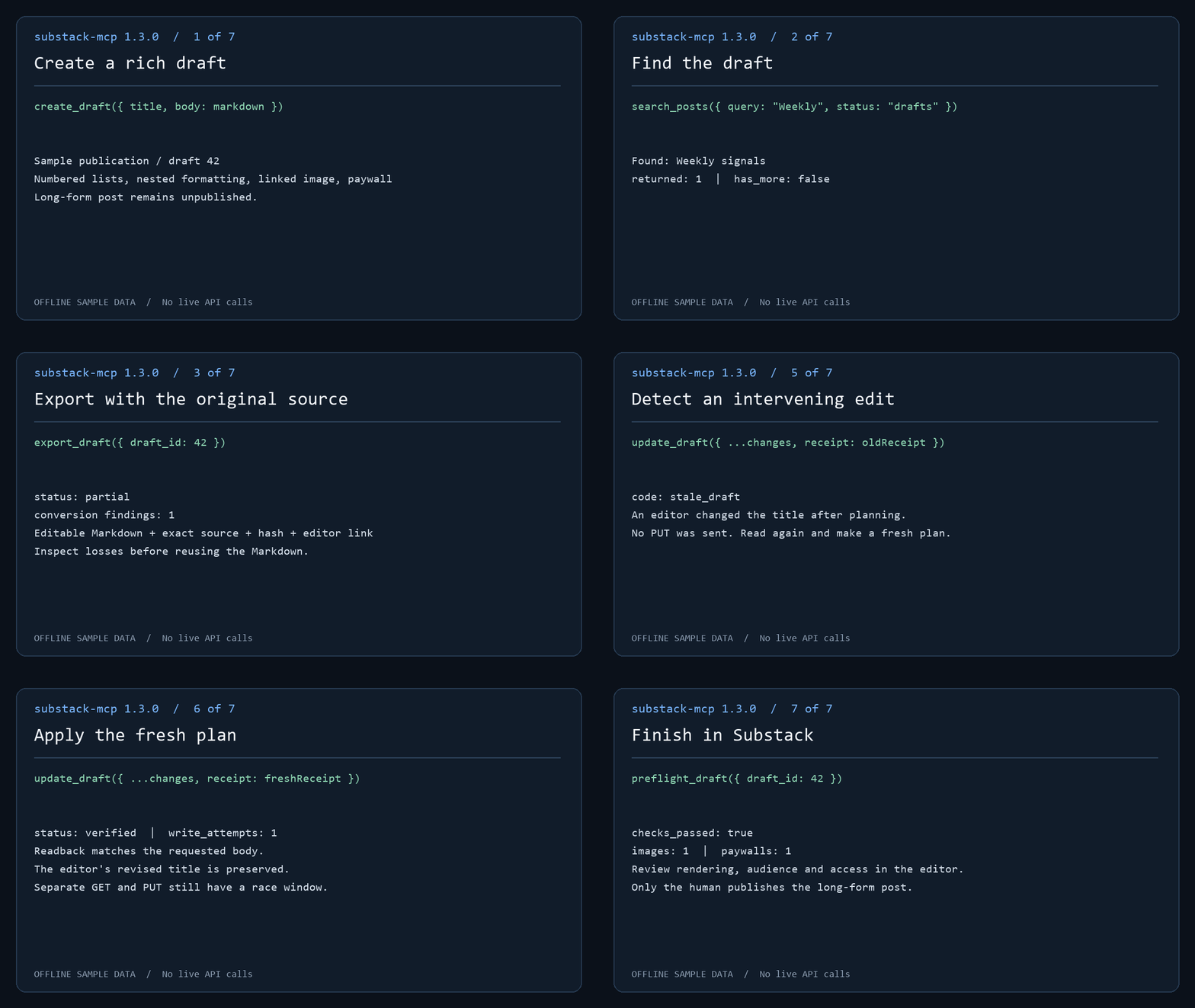
The demo runs actual MCP handlers against offline sample data. No live API calls or publication occur. Follow the draft workflow to create, find, export and review a post.
Draft-only long-form posts; explicit public actions: This server cannot publish or delete long-form posts. Post tools create and edit drafts only; you review and publish manually through Substack's editor. Public community comments/restacks are separately experimental and consent-gated. Substack Notes also publish publicly: create_note and create_note_with_link publish short-form Notes immediately, because Notes have no draft state on Substack. Treat the Note tools as public-publish actions — there is no preview step and no undo from this server. The split is proportionate review, the piece of trust infrastructure for agents this server cares most about: the high-stakes surface gets a human gate, and the exception is stated loudly.
This server imposes no Bestseller-status check. Use an authenticated account with permission to manage the publication; individual operations depend on your Substack access. Connect through local stdio or self-hosted HTTP.
For 1.0 setup coverage and account eligibility, see compatibility. Run substack-mcp compatibility report for an offline, shareable diagnostic report; reporting guide. Maintainers can use the release checklist and distribution inventory.
Contents: Quick start · Setup · Tools · Operator CLI · Draft workflow · Analytics to draft · Export · Markdown · Multiple publications · Transports · Compatibility
Quick start
-
Install and sign in. Browser login needs the optional Playwright dependency:
npm install @conorbronsdon/substack-mcp playwright
npx playwright install chromium
npx substack-mcp login https://yourblog.substack.com --user-id 12345
Use your own account's user ID (how to find it). The session is saved only after a bounded authenticated read succeeds. To paste credentials instead, see Option B.
-
Verify a read.
npx substack-mcp doctor --json --check-authmakes one bounded read per publication. It confirms read access, not your user ID or write permission. -
Connect your MCP client. Add the server to Claude Desktop or Claude Code, or use the Codex plugin. Environment variables take precedence; omit them to use the stored browser-login session. Then ask your assistant: "How many Substack subscribers do I have?"
-
Prepare a draft for review. Follow the draft workflow:
create_draft,search_posts,export_draft,preflight_draft, thenplan_draft_updateandupdate_draft. Long-form posts stay unpublished drafts until you publish them in Substack's editor.create_noteandcreate_note_with_linkpublish immediately.
Community walkthrough
Jonathan Price's I used Codex to connect ChatGPT to Substack. Then it drafted this post. walks through using Codex to install the MCP locally, connecting ChatGPT through OpenAI's Secure MCP Tunnel, and creating a private draft for manual publication. He used the connection to create the draft of the guide itself.
The guide documents his September 18, 2026 setup with version 1.2.0. Its reported
get_post 404 is fixed in 1.2.1. Client interfaces and access requirements can
change; use the setup instructions below for this package's current
configuration. This is a community walkthrough, not a hosted service provided
by this project.
Setup
Requires Node.js 22 or newer (CI covers Node 22 and 24). Browser login additionally requires Playwright.
You can supply credentials two ways: paste them as env vars (below), or run the optional browser login which captures and stores them for you.
Option A — Browser login (optional, no manual cookie copying)
Install the server and optional Playwright dependency together in a local tools directory, then sign in:
npm install @conorbronsdon/substack-mcp playwright
npx playwright install chromium
npx substack-mcp login https://yourblog.substack.com --user-id 12345
substack-mcp-login remains a supported alias. Missing publication URL and user
ID are prompted. Supply your own account's user ID (steps below); a post author's byline does
not verify your identity. The browser opens for sign-in, including any CAPTCHA.
Login then opens <publication>/publish/home and waits for the publication
session cookie; on custom domains this is connect.sid on the custom domain.
A bounded authenticated read must succeed before saving. The default flow verifies
read access, not the configured user ID or permission to write.
To derive your ID from the selected publication's authenticated session instead of entering it manually, use:
npx substack-mcp login https://yourblog.substack.com --verify-identity --profile work
--verify-identity reads the publication-host /api/v1/user/profile/self with
that host's cookie, requires a positive safe integer top-level ID, and then
performs the existing authenticated draft-list check before saving. Supplying
--user-id as well turns it into an assertion: a mismatch stops without saving
or replacing a profile, even with --force. No public profile, post byline,
other-host cookie or other-host endpoint is used as a fallback. The verified
mode's JSON result reports user_identity: "verified" and
identity_source: "authenticated_publication_self_profile"; it prints no ID.
This is an observation at login time, not a persisted identity attestation or
proof of write permission. Ordinary doctor continues to report identity as
unverified.
For subscriber tools or the calendar opt-in sync, add --subscriber-access.
Substack asks for a one-time "Confirm it's you" code (by email or authenticator
app) before it allows subscriber reads, and login prompts for it. See
docs/subscriber-step-up.md.
Self-profile support on publication hosts has not been live-verified for every Substack/custom-domain configuration. If the endpoint is unavailable, expired, redirected or malformed, verified mode fails closed and saves nothing. The existing manually configured-ID flow remains available and explicitly unverified. A real browser run is still needed for #150; fixture tests are not evidence about the current sign-in UI.
Without --profile, login saves ~/.substack-mcp/session.json (directory override:
SUBSTACK_MCP_HOME). The server uses this legacy session when publication
credential environment variables and SUBSTACK_PROFILES are unset.
Default storage (SUBSTACK_CREDENTIAL_STORE=file): sessions use AES-256-GCM with a key derived from the OS account and
machine. File permissions request 0600; Windows access also depends on directory
ACLs. This is a machine-bound file, not an OS keychain or secret vault. Code
running as your OS user can derive the key. Use environment credentials if your
MCP client manages secrets for you.
Optional OS keychain: set SUBSTACK_CREDENTIAL_STORE=keychain in both the
login process and the MCP client's environment. macOS uses Keychain via
/usr/bin/security; Linux needs libsecret and secret-tool plus an unlocked Secret
Service; Windows uses Credential Manager through PowerShell's PasswordVault. All
three are exercised with synthetic credentials by the keychain CI workflow on
GitHub-hosted runners (an unlocked temporary macOS keychain and a gnome-keyring
session on Linux); desktop setups with locked keychains may still prompt. Login writes the selected account to the keychain, and the
server reads it there. Explicit keychain selection never reads the encrypted
file as a fallback. The keychain helps against other OS users, copied disks,
and some malware limited to file access. Code running as your user can usually
query the keychain. Keep the OS account and running code trusted.
On Linux, secret-tool lookup can exit 1 without an error message for either
an absent entry or a locked keyring. Named writes without --force search and
unlock first, and refuse overwrites when an entry is found.
Named profiles and migration
npx substack-mcp login https://yourblog.substack.com --user-id 12345 --profile work
npx substack-mcp profiles list
# Copy an existing legacy session without changing its file:
npx substack-mcp profiles migrate --name personal
# Copy a file session or named file profile into the keychain; source remains:
npx substack-mcp profiles migrate --to keychain
npx substack-mcp profiles migrate --to keychain --name work
Keys start with a lowercase ASCII letter and contain only lowercase letters,
digits and hyphens, up to 64 characters. Existing profiles require explicit
--force to replace. List output contains keys, readability status, publication origins and file save
times; it excludes cookies and user IDs. Unreadable profiles remain visible but
cannot be selected. Save time records local persistence, including migration; it
is not token issuance or expiration time. Listing is bounded to 32 profiles.
Profile storage requires a local filesystem supporting hard links (such as NTFS
or a typical Linux filesystem), so creation can install a complete encrypted file
without overwriting an existing name. FAT/exFAT and some network mounts are not
supported: set SUBSTACK_MCP_HOME to a suitable local directory. Do not use
--force to work around an unsupported filesystem.
Set SUBSTACK_PROFILES=work,personal in your MCP client's environment to select
up to 32 distinct profiles. Remove all publication credential variables first:
combining profile selection with legacy or named credential variables is an
error, including empty variables. Missing, corrupt or invalid selected profiles
stop startup; they never fall back to another account. Profiles on disk are
never activated by discovery. With multiple profiles, tools require an explicit
publication key and CLI reads require --publication.
To roll back, unset SUBSTACK_PROFILES and restore your previous environment
configuration. Migration preserves the legacy session byte-for-byte. These files
use the existing encryption format. profiles list lists file profiles; select
keychain profiles explicitly with SUBSTACK_PROFILES after migration or login.
Run substack-mcp status --json for offline configuration diagnostics or
substack-mcp doctor --check-auth --json for a bounded read per selected account.
Option B — Get your credentials manually
Open your Substack in a browser, then:
- Session token: For custom domains, open DevTools → Application → Cookies →
https://your-custom-domainand copyconnect.sidfrom the publication's own domain (URL-encoded string starting withs%3A). Do not copysubstack.sidfrom substack.com: it is a different session that the custom domain's admin API rejects with 403. For*.substack.compublications, useconnect.sidon that host orsubstack.sidon.substack.com. The token must match the host ofSUBSTACK_PUBLICATION_URL, with the.substack.comfallback only for Substack-hosted publications. - User ID: Follow Find your account user ID. Do not use a publication post's byline ID: publications can have multiple authors. This server does not independently verify the supplied ID.
- Publication URL: Your Substack URL, including custom domain if you have one (e.g.,
https://newsletter.yourdomain.comorhttps://yourblog.substack.com)
Find your account user ID
- In Substack, open your own account profile and copy its handle (the part after
@inhttps://substack.com/@your-handle). A publication URL or another author's profile is not your account handle. - Open
https://substack.com/api/v1/user/your-handle/public_profilewith that handle substituted. Read the top-level numericidin the JSON response; do not use an ID nested under a publication or post byline. This public profile endpoint is also used by this server's anonymous profile lookup. - Confirm that the response's
handleand name match the account you will sign in with. Supply the top-levelidtologin --user-idorSUBSTACK_USER_ID. A public profile lookup identifies the handle you entered; the browser-login read check does not prove that the cookie belongs to that ID. Recheck the account before any write operation.
2. Configure your MCP client
Claude Desktop
Add to your claude_desktop_config.json:
{
  "mcpServers": {
    "substack": {
      "command": "npx",
      "args": ["-y", "@conorbronsdon/substack-mcp"],
      "env": {
        "SUBSTACK_PUBLICATION_URL": "https://yourblog.substack.com",
        "SUBSTACK_SESSION_TOKEN": "your-session-token",
        "SUBSTACK_USER_ID": "your-user-id"
      }
    }
  }
}
Claude Code and Codex plugin setup is available alongside manual MCP configuration. The repository marketplace and local plugin are separate from curated-directory acceptance or hosted ChatGPT support.
Claude Code
Add to your .mcp.json:
{
  "mcpServers": {
    "substack": {
      "command": "npx",
      "args": ["-y", "@conorbronsdon/substack-mcp"],
      "env": {
        "SUBSTACK_PUBLICATION_URL": "https://yourblog.substack.com",
        "SUBSTACK_SESSION_TOKEN": "your-session-token",
        "SUBSTACK_USER_ID": "your-user-id"
      }
    }
  }
}
3. Verify
Ask your AI assistant: "How many Substack subscribers do I have?"
Tool output compatibility, response limits and versioning are documented in the tool contract.
Operator diagnostics
The CLI exposes operator commands and configuration checks through the same MCP
handlers and credential resolution as the server. drafts create writes one
private draft; the other operator commands read:
substack-mcp status --json
substack-mcp doctor --json --check-auth
substack-mcp drafts list --limit 10
Commands, the JSON envelope, exit codes, request deadlines and response limits are documented in operator CLI and diagnostics.
Tools
Every tool declares explicit MCP side-effect annotations; see tool annotations. Tool descriptions carry the authoritative wording.
Read
| Tool | Description |
|---|---|
get_subscriber_count |
Get your publication's current subscriber count |
list_subscribers |
Read a bounded page of private subscriber records |
search_subscribers |
Filter and page private subscriber records; optional activity, date, flags and revenue fields |
get_subscriber |
Look up membership by exact email; reconcile pending additions |
list_published_posts |
List published posts with pagination |
get_publication |
Read projected publication identity/settings, verify the configured host, and report missing fields; does not verify account identity or role |
list_publication_tags |
Read tag definitions, including hidden tags by default, with bounded local pagination |
get_post_tags |
Resolve post tag associations; preserves unresolved IDs and reports empty-result identity uncertainty. Draft coverage is currently live-verified only for empty responses |
search_posts |
Search a publication archive by query and status; bounded pages with continuation metadata |
plan_draft_update |
Review proposed changes, preflight and a receipt for best-effort stale detection; no writes |
export_draft |
Editable Markdown, exact original body, conversion diagnostics, preflight and editor link |
preflight_draft |
Read-only checks for title, audience, body structure, images, and paywalls, with an editor link; optionally adds Substack's own prepublish errors and suggestions |
list_drafts |
List draft posts |
get_post |
Get full content of a published post by ID |
get_draft |
Get full content of a draft by ID |
get_post_comments |
Get comments on a published post |
get_sections |
List your publication's sections (categories) with their IDs |
get_post_analytics |
Get a published post's stats (views, opens, signups, subscribes, reactions) by ID |
rank_posts |
Rank posts by views, opens, sends, rates, signups, subscribes, estimated value or date, keeping null and missing values distinct |
get_publication_stats |
Read dashboard summary and ranged publication metrics, with missing and unavailable states |
get_growth_sources |
Read bounded growth source attribution and optional events |
list_incoming_recommendations |
List publications that recommend yours, with start date, active state and dashboard-attributed subscribers |
list_outgoing_recommendations |
List whom your publication recommends (can be partial). This is not who recommends it; use list_incoming_recommendations for that |
list_outgoing_recommendation_stats |
List subscribers your publication has sent to the publications it recommends |
list_scheduled_posts |
List posts scheduled for future publication (read-only; scheduling stays in Substack's editor) |
get_user_profile |
Read a minimal public user profile by handle, anonymously |
get_profile_feed |
Read one public profile feed page with cursor continuation, anonymously |
get_note_thread |
Read a public Note, ancestors and one replies page, anonymously |
list_public_posts |
Read a bounded public archive page, anonymously |
get_public_post |
Read an anonymous public post by URL with body status and truncation flags |
Public reading
These five tools use a separate anonymous reader. It sends only User-Agent and
Accept, never the configured publication cookie or other credentials. The
configured publication selects the default archive origin; callers may supply an
allowlisted HTTPS publication origin. Allowed hosts are substack.com, one-label
*.substack.com, configured publication origins, and exact origins in
SUBSTACK_PUBLIC_READ_ORIGINS (comma-separated HTTPS origins without ports,
paths or userinfo). Redirects are rejected. A *.substack.com publication may
redirect to its custom domain (for example, lenny.substack.com); JSON reads do
not follow that redirect. Add the custom HTTPS origin to
SUBSTACK_PUBLIC_READ_ORIGINS and read through that origin. With multiple
publications, the publication key remains required for every publication tool.
Profile feed pages are upstream-sized; has_more: null means the upstream omitted
continuation metadata. Thread pages can omit replies when more_branches or
next_cursor is present; completeness: "unknown" means continuation metadata
was omitted.
Archive full pages have has_more: null because no total is returned. Public
post body_status is a heuristic based on audience and body presence; it does
not establish full access. The anonymous reader does not use subscription
entitlements. Reader subscriptions and inbox are unsupported: the configured
publication session received 401 on the substack.com reader-account routes,
which require a separate reader session this server does not manage.
Archive search and draft review
search_posts accepts query (1–500 characters), status (published, drafts,
or scheduled, default published), offset (default 0), and limit (1–50,
default 25). It makes one authenticated archive request and returns projected
metadata, returned, total, has_more, and next_offset. Continue with
next_offset and the same query/status. When Substack omits the total and a
page is full, has_more is null (unknown); another page may be empty. Substack
controls matching and indexing: this is not a guaranteed full-text scan. Use
get_post or get_draft to retrieve full content. Pagination is not a snapshot;
concurrent edits can move results between pages.
preflight_draft accepts draft_id, reads it once, and returns checks_passed,
findings with severity/code/message, content counts and an editor link. It checks title,
audience, JSON/body shape, image wrappers and HTTPS sources, and paywall count
and edge placement. Unknown nodes and external images produce review warnings.
Bodies over two million characters, 10,000 nodes, or depth 100 are not fully
checked; counts.complete is false and aggregate checks are skipped after a
scan limit. Unknown-node warnings name up to five types for editor review.
With substack_check: true, it also makes one more read: Substack's own
prepublish validator (GET /api/v1/drafts/{id}/prepublish, the check the editor
runs before its publish dialog). The result comes back separately as
substack_check with errors and suggestions (up to 50 each, 300 characters
each) and never changes checks_passed or findings. The endpoint is
undocumented and its response shape is not yet live-verified: any failure or
unexpected shape returns substack_check.status: "unavailable" with a reason, and
the static checks still return. A clean result is not publish approval.
This is a focused static check, not full ProseMirror validation or
publish approval. It does not fetch links/images, verify access settings, or
prove final rendering. Review the draft in Substack; no content is modified.
Both tools require publication when multiple publications are configured.
Substack MCP 질문
Substack MCP를 Claude Code에 추가하려면 어떻게 하나요?
터미널에서 claude mcp add --env 'SUBSTACK_SESSION_TOKEN=<YOUR_SUBSTACK_SESSION_TOKEN>' --env 'SUBSTACK_PUBLICATION_URL=<SUBSTACK_PUBLICATION_URL>' --env 'SUBSTACK_USER_ID=<SUBSTACK_USER_ID>' substack-mcp -- npx -y @conorbronsdon/substack-mcp를 실행합니다. 모든 프로젝트에서 사용할 수 있게 하려면 --scope user를 추가합니다.
Substack MCP를 Cursor에 추가하려면 어떻게 하나요?
~/.cursor/mcp.json를 열고 mcpServers 아래에 서버를 추가합니다. 위 설치 섹션에 표시된 Cursor 구성을 사용합니다.
Substack MCP는 어떤 도구를 제공하나요?
42개 도구를 제공합니다. 예: get_subscriber_count, list_subscribers, search_subscribers, get_subscriber, list_published_posts.
Substack MCP server로 긴 글의 포스트를 바로 게시할 수 있나요?
아니요. 긴 글 포스트 도구는 초안 생성 및 편집만 가능합니다. 게시물은 Substack 에디터를 통해 직접 검토하고 수동으로 게시해야 합니다.
서버를 통해 작성한 Note는 즉시 게시되나요?
네. Substack에서 Note는 초안 상태가 없으므로, Note 도구를 사용하면 미리보기나 실행 취소 없이 즉시 공개 게시됩니다.
Substack MCP server 인증은 어떻게 하나요?
자격 증명을 환경 변수로 붙여넣거나, 선택 사항인 브라우저 로그인을 실행하여 세션을 저장할 수 있습니다.
여러 개의 Substack 출판물에서도 작동하나요?
네. 이름이 지정된 프로필을 통해 별도의 세션을 저장할 수 있으며, SUBSTACK_PROFILES 환경 변수로 선택할 수 있습니다.
Substack MCP server를 실행하려면 무엇이 필요한가요?
Node.js 22 이상의 버전이 필요하며, 브라우저 로그인을 사용하려면 Playwright가 추가로 필요합니다.