
Memora MCP server
2026년 11월 10일 커밋AI agent이 Model Context Protocol을 통해 마크다운 노트를 읽고 쓸 수 있는 셀프 호스팅 방식의 장기 기억 저장소를 제공합니다.
다른 이름 Codrihub/memora
- 스타
- 11
- Tools
- —
- 다운로드, 30일
- —
- 최신 버전
- —
- 마지막 커밋
- 2026년 11월 10일
- 라이선스
- AGPL-3.0
Memora MCP란?
Memora은(는) MCP server입니다. AI agent이 Model Context Protocol을 통해 마크다운 노트를 읽고 쓸 수 있는 셀프 호스팅 방식의 장기 기억 저장소를 제공합니다.
프로젝트 README에서 생성된 요약
Memora MCP server 정보
Memora는 셀프 호스팅 아키텍처를 통해 AI agent에게 장기 기억 저장소를 제공합니다. agent가 git 기반 폴더 내에서 마크다운 노트를 읽고 쓸 수 있도록 지원하며, 모든 정보가 사용자가 소유한 일반 텍스트 형식으로 유지되도록 보장합니다. 이 시스템은 단일 Rust 바이너리로 작동하며, 임베디드 SQLite 데이터베이스를 사용하여 상태 관리를 수행하고 단일 포트에서 HTTP API, MCP 엔드포인트 및 웹 UI를 관리합니다.
개발자는 Docker, npm 또는 네이티브 Linux 설치 프로그램을 사용하여 서버를 배포할 수 있습니다. 서버가 실행되면 API 키 또는 OAuth를 사용하여 Claude 또는 ChatGPT와 같은 클라이언트를 연결할 수 있습니다. 이 플랫폼은 세밀한 제어 기능을 제공하여 서로 다른 agent에게 읽기, 쓰기 또는 관리자와 같은 특정 권한(scope)을 할당할 수 있습니다. 또한 웹 UI를 사용하여 브레인 및 그래프 뷰를 탐색하고, 태그를 관리하며, agent의 실시간 활동을 모니터링할 수 있습니다.
활용 사례
- 1지속적인 agent 지식 유지마크다운 파일을 사용하여 AI agent가 서로 다른 세션 간에 정보를 저장하고 검색할 수 있는 방법을 제공합니다.
- 2agent 권한 관리도구 접근 권한이 제한된 고유 API 키를 할당하여 특정 AI agent의 작업 범위를 제한합니다.
- 3변경 사항 추적 및 복구git 통합을 사용하여 agent 노트의 기록을 확인하거나 이전 버전으로 복구합니다.
- 4지식 연결 시각화대화형 그래프 레이아웃을 통해 서로 다른 노트와 폴더가 어떻게 연결되어 있는지 탐색합니다.
프로젝트의 README를 바탕으로 작성되었습니다. 모든 활용 사례는 해당 내용의 인용문과 대조하여 확인합니다.
구성
MEMORA_STATEMEMORA_VAULT
| 이름 | 설명 | 유형 |
|---|---|---|
| MEMORA_STATE | — | |
| MEMORA_VAULT | — |
자동 검사
2026년 11월 14일에 실행됨전체 보고서 →아직 인증되지 않았습니다. 서버는 80점 이상의 점수, 심각한 결함 없음, 그리고 검사에 충분한 데이터를 갖추어야 합니다. 검사 방식 · 점수를 높이기 위해 수정할 항목

- 소스 저장소 연결 및 접근 가능codrihub/memora is public and reachablegithub.com/codrihub/memora ↗통과
- 패키지가 이 저장소를 소스로 명시검사되지 않음
- 빌드 출처(Sigstore 증명)검사되지 않음
- 오픈 소스 라이선스 (OSI)AGPL-3.0spdx.org/licenses/AGPL-3.0.html ↗통과
- 최근 1년 내 커밋 또는 릴리스Last commit or release 2026-11-10github.com/codrihub/memora ↗통과
- OpenSSF Scorecard검사되지 않음
- 패키지 이름이 인기 패키지와 유사하지 않음검사되지 않음
- 패키지 및 해당 종속성에 중요한 보안 권고 없음검사되지 않음
- 모델에 대한 숨겨진 지침 없음0 tool descriptions and the README read; no override phrases, credential paths or hidden characters통과
- 파괴적인 도구에 라벨 표시됨검사되지 않음
- 원격 엔드포인트가 MCP 핸드셰이크에 응답검사되지 않음
README
GitHub에서 보기Memora is a self-hosted memory vault for AI agents. Notes are plain markdown files in a git-backed folder. Agents read and write them over the Model Context Protocol (MCP); you browse, edit and govern them in a web UI. One Rust binary serves the HTTP API, the MCP endpoint, the web UI and realtime updates on a single port, with all server state in one embedded SQLite database.
Screenshots
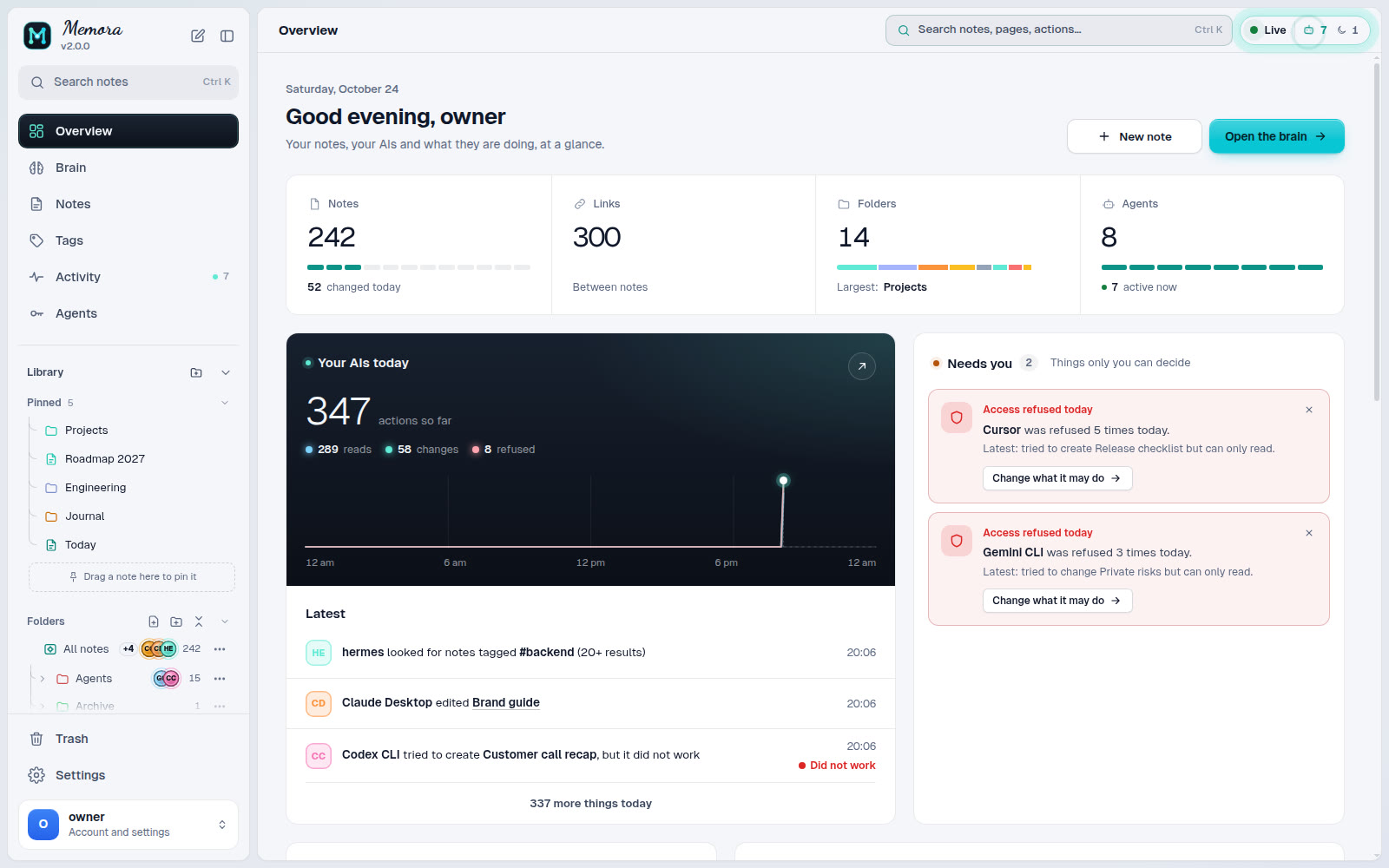
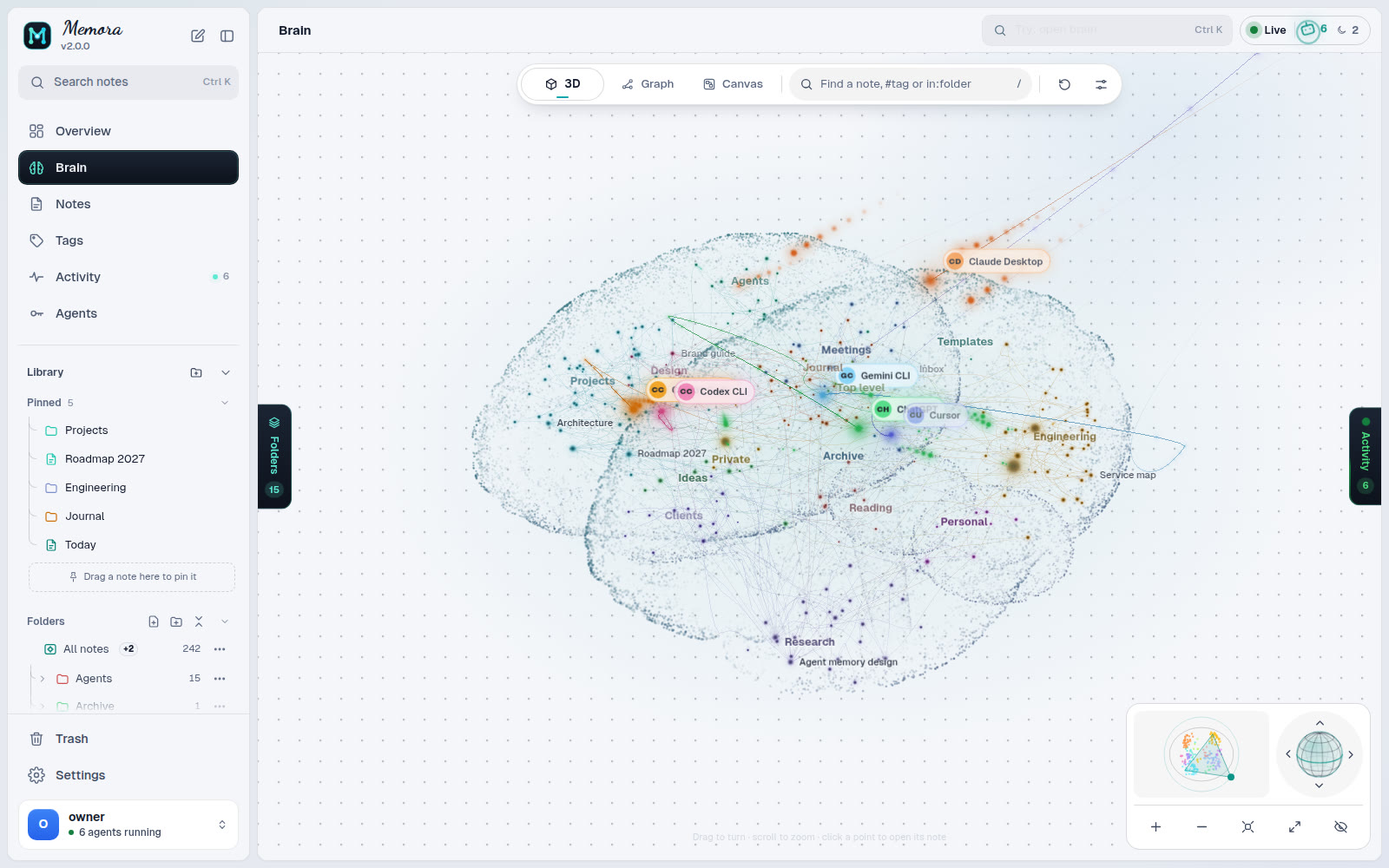 Brain: every folder is a region, every note a node |
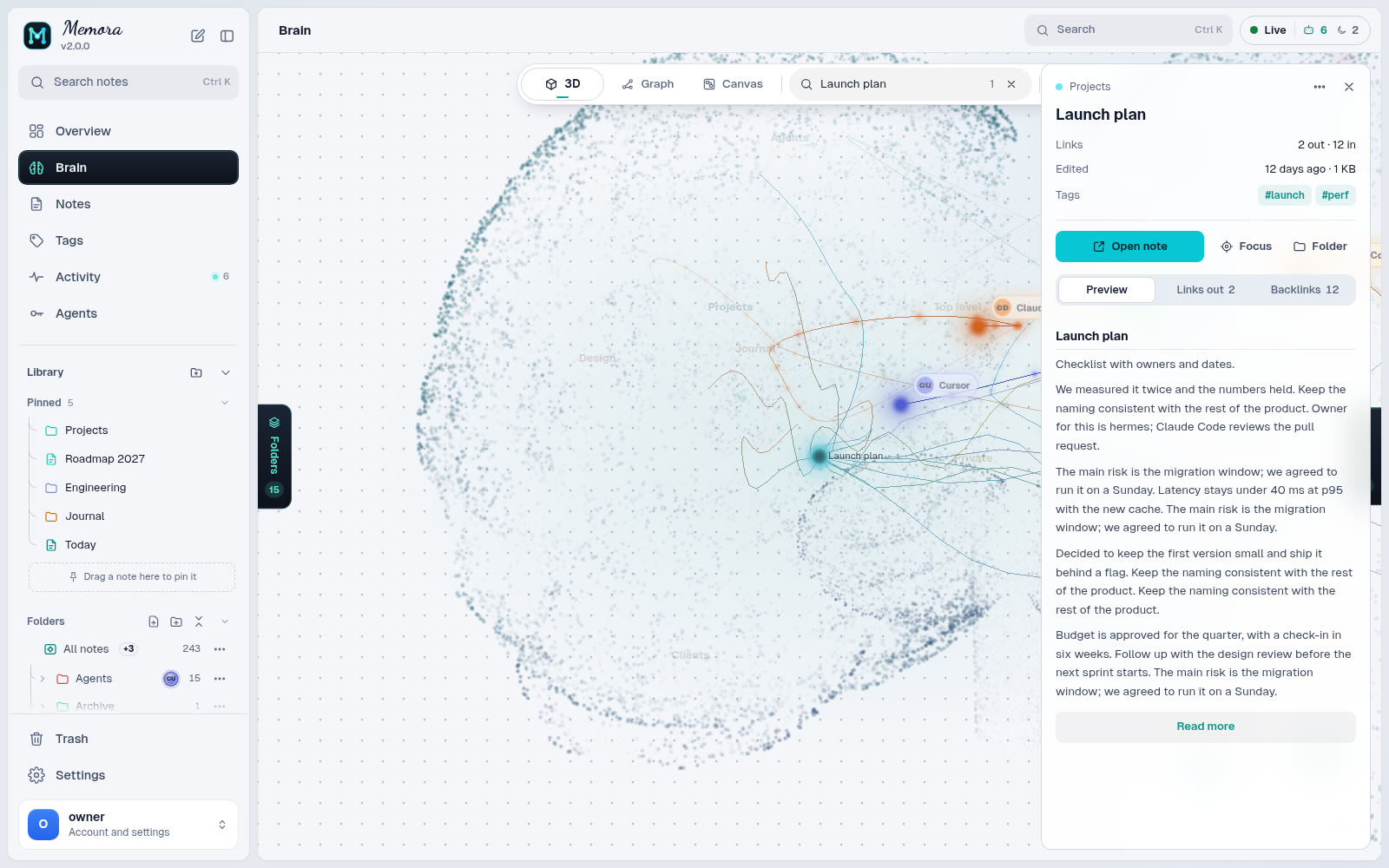 Node card: links, backlinks and a preview |
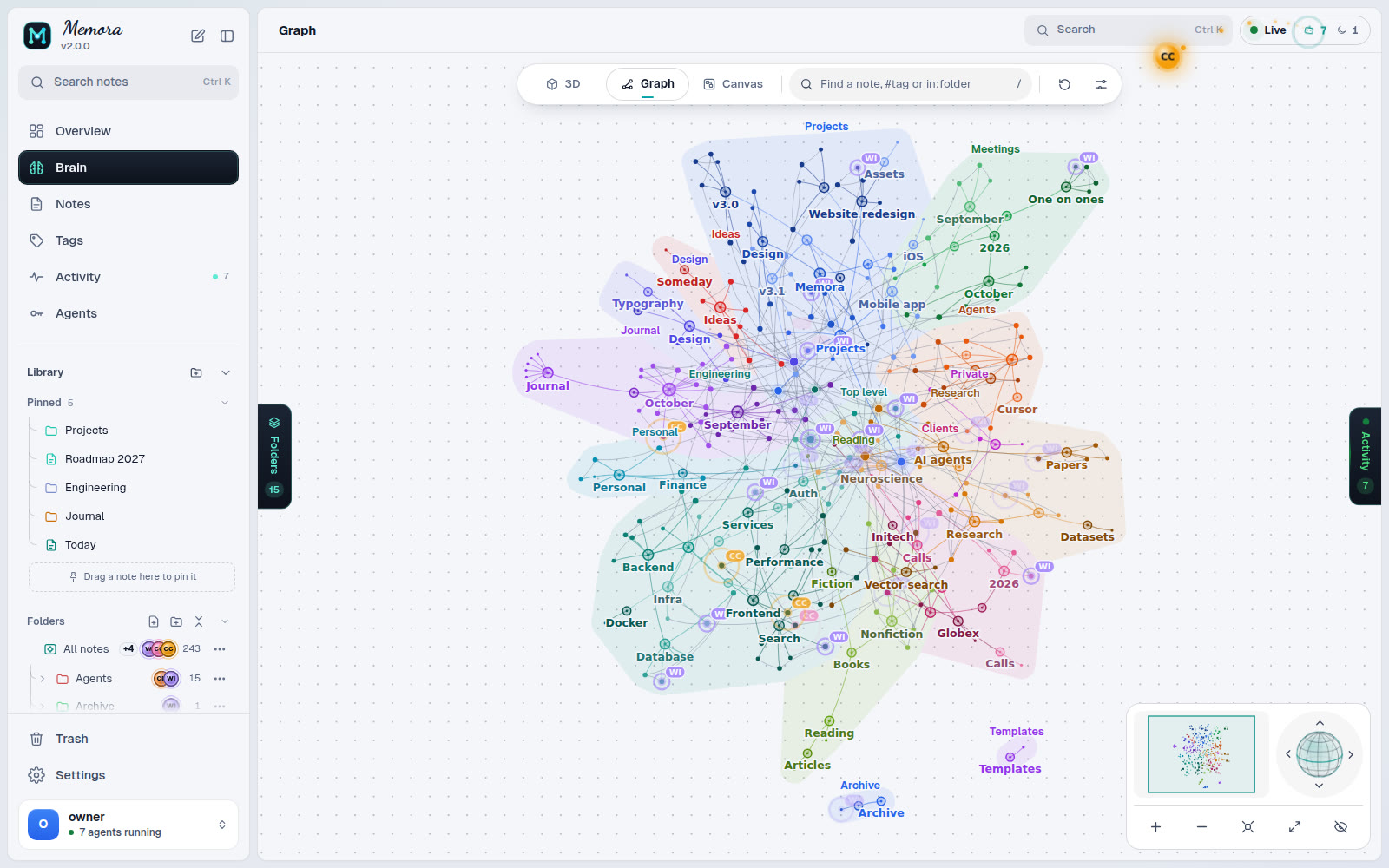 Graph: force, radial or cluster layouts |
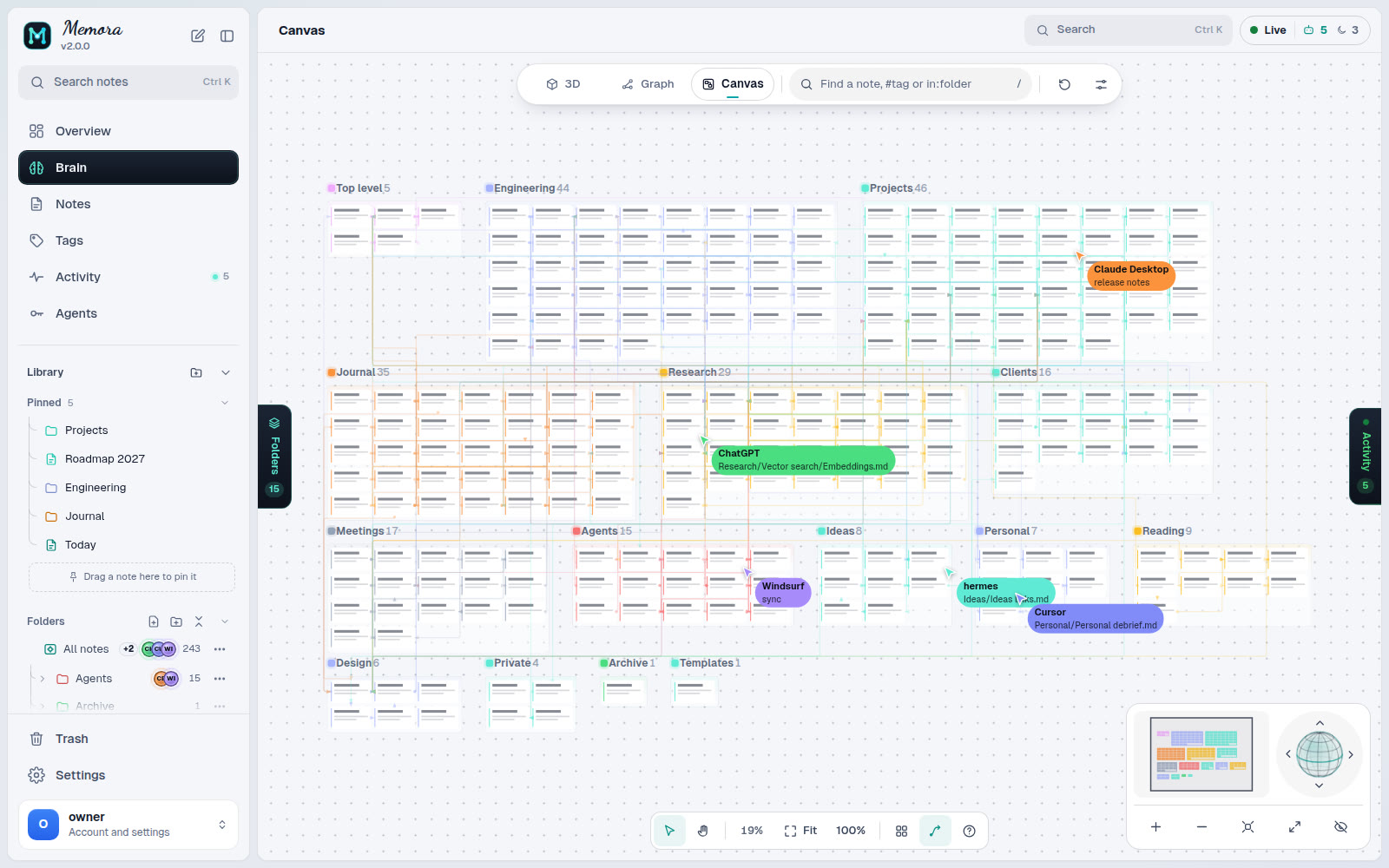 Canvas: one frame per folder |
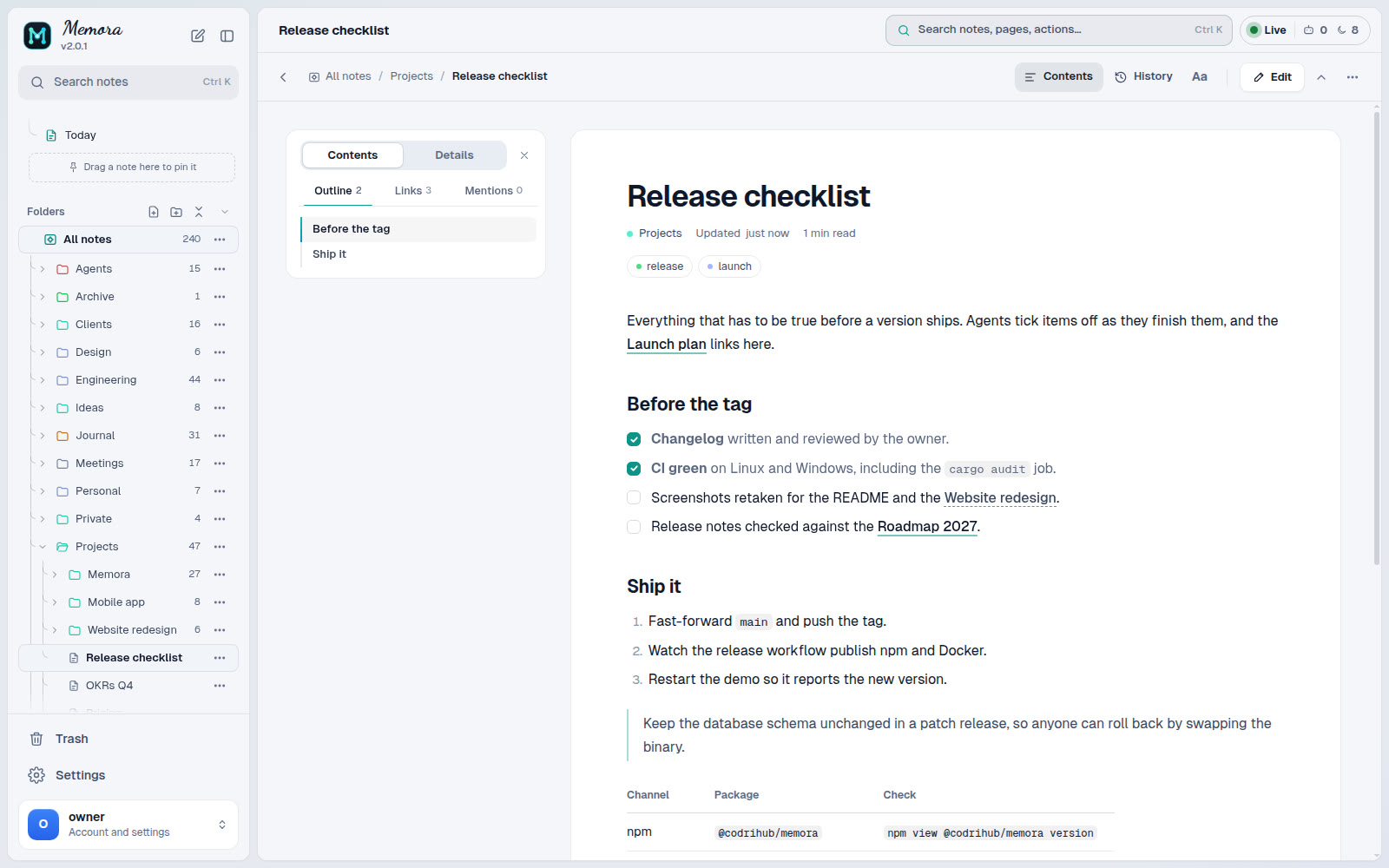 Reader with contents and reading settings |
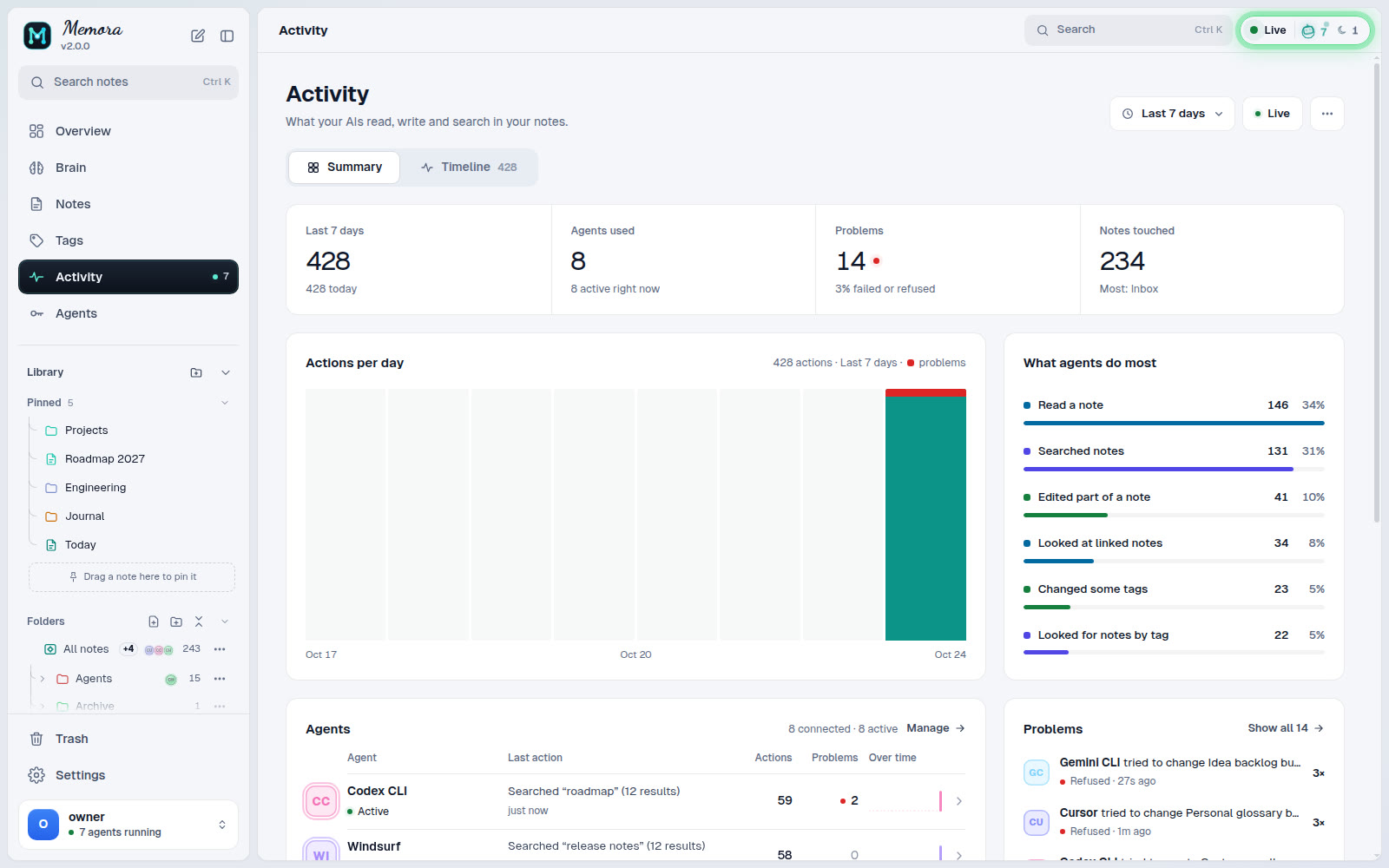 Activity: every agent call, live |
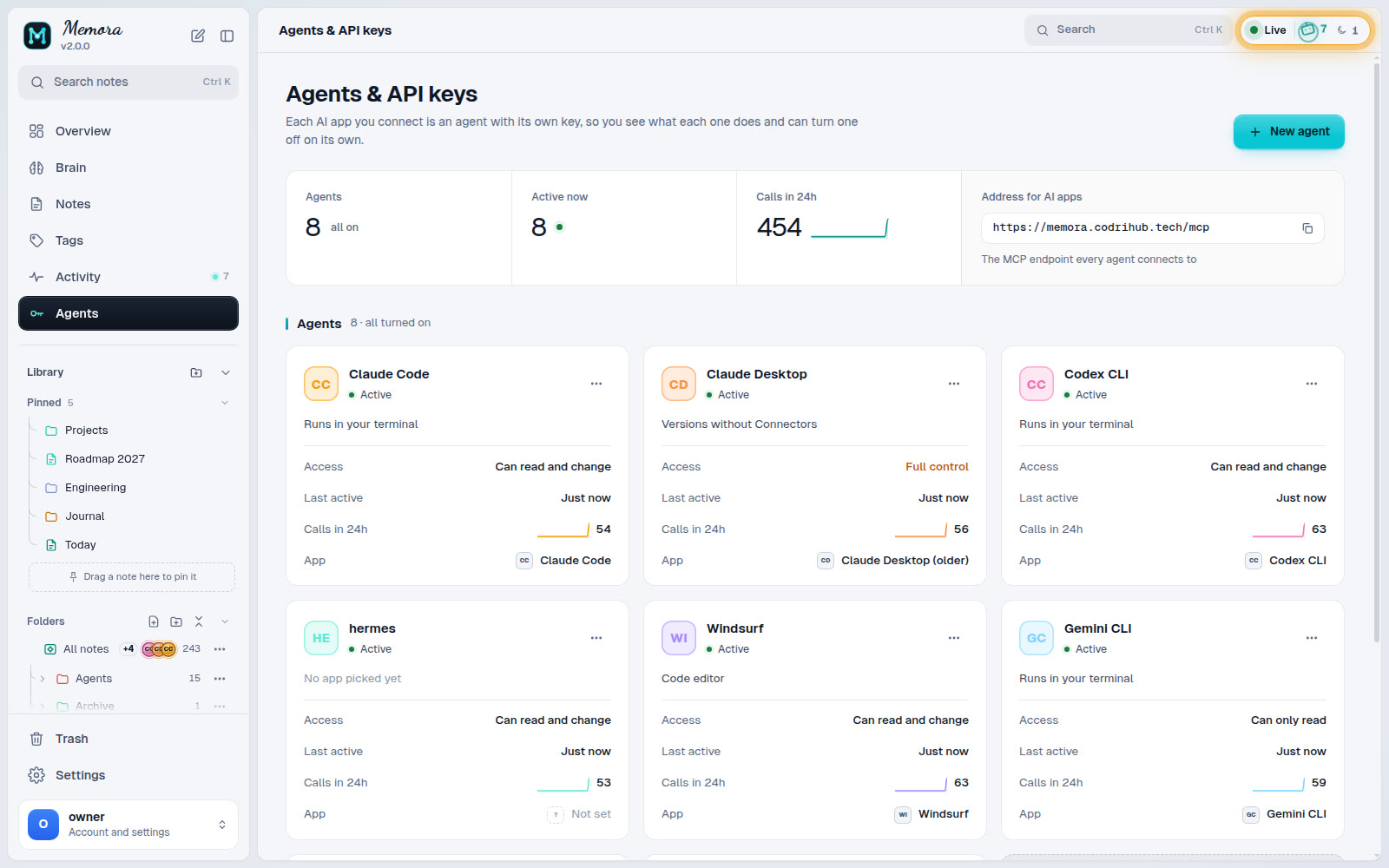 Agents & API keys: one key per agent, scoped |
Screenshots use a demo vault.
Features
- Markdown you own. Every note is a
.mdfile with optional frontmatter and[[wikilinks]]. Edit it with any tool; nothing is locked in a database. - Git history. Changes are committed, so any revision can be listed, diffed
and restored (
get_history,diff,restore_memory). - MCP for agents. 75 tools for notes, folders, search, tags, graph traversal, history, locks, activity, pins and import/export, plus admin tools, over the streamable HTTP transport.
- API keys or OAuth. Give each agent its own key, or let MCP clients such as Claude or ChatGPT connect with OAuth after you approve them in the browser.
- Per-agent control. Scopes (
mcp,read,write,admin), per-key tool lists, server-wide tool switches, and privacy rules that hide notes or folders from chosen agents. - Web UI. Brain and graph views, a canvas, the vault editor, tags, live agent activity, keys, tools, access rules and settings. Installable as a PWA.
- Safe first run. An unclaimed instance cannot be taken over by whoever finds the port: the operator console opens a short setup window and you finish in the browser.
- One port, one process. HTTP API, MCP, UI and WebSocket share port 8400. The database has no network port.
Quick start
Three steps, about two minutes.
1. Install (pick one, in this order of ease)
# npm (Linux x86_64 / arm64, Windows x64; Node.js 22 or newer): install, then keep it running
npm install -g @codrihub/memora && memora

# Docker (any OS with Docker)
docker run -d --name memora --restart unless-stopped -p 8400:8400 \
  -v memora-data:/data -v memora-state:/state ghcr.io/codrihub/memora:latest

# Native installer (Linux server with systemd, x86_64 or aarch64)
curl -fsSL https://raw.githubusercontent.com/Codrihub/memora/main/scripts/install.sh | sudo sh
On Windows, install Node.js 22 or newer and use npm (see npm).
2. Get a one-time setup code
memora-cli setup --minutes 15                         # npm, in a second terminal
docker exec -it memora memora-cli setup --minutes 15  # Docker
sudo memora-cli setup --minutes 15                    # native
3. Open the link it prints (http://<your-server>:8400/login), enter the code
and create your account. Memora then asks which folder to use as the vault and
shows how to connect your first agent.
That is all. The sections below cover every other option.
npm (Linux x86_64 / arm64, Windows x64)
npm install -g @codrihub/memora
mkdir -p ~/memora && cd ~/memora
MEMORA_VAULT=./vault MEMORA_STATE=./state memora
# in a second terminal, same folder:
MEMORA_STATE=./state memora-cli setup --minutes 15
On Windows (PowerShell):
npm install -g @codrihub/memora
mkdir ~\memora; cd ~\memora
$env:MEMORA_VAULT = '.\vault'; $env:MEMORA_STATE = '.\state'; memora
# in a second terminal, same folder:
$env:MEMORA_STATE = '.\state'; memora-cli setup --minutes 15
The package carries the prebuilt release binaries and the web UI (no install
script, nothing downloaded at install time) and needs Node.js 22 or newer. It is
handy for trying Memora or running it under your own user; for a server, the
native installer adds the systemd service. On macOS use Docker or build from
source. Update with npm install -g @codrihub/memora@latest.
Docker (any OS)
One container, notes and state in named volumes (no clone, no folder permissions):
docker run -d --name memora --restart unless-stopped -p 8400:8400 \
  -v memora-data:/data -v memora-state:/state ghcr.io/codrihub/memora:latest
docker exec -it memora memora-cli setup --minutes 15
With Docker Compose from the repository instead:
git clone https://github.com/Codrihub/memora.git && cd memora
cp .env.example .env                     # optional, every value has a default
mkdir -p data state && sudo chown -R 1000:1000 data state
docker compose up -d
docker compose exec -it gateway memora-cli setup --minutes 15
The image is ghcr.io/codrihub/memora (linux/amd64 and linux/arm64). See
docker/README.md for volumes, upgrades and local builds.
Native installer (Linux x86_64 / aarch64 with systemd)
One command:
curl -fsSL https://raw.githubusercontent.com/Codrihub/memora/main/scripts/install.sh | sudo sh
Or download it and read it first:
curl -fsSL https://raw.githubusercontent.com/Codrihub/memora/main/scripts/install.sh -o install.sh
less install.sh                          # read it first
sudo sh install.sh                       # add --behind-proxy for a local reverse proxy
sudo memora-cli                          # then type /web
The installer downloads the release for your CPU, verifies it against the
release SHA256SUMS, creates a memora system user, and installs a hardened
memora.service unit. Data lives in /var/lib/memora. Run
sh install.sh --help for every option, and see
docs/INSTALL.md for details.
From source
git clone https://github.com/Codrihub/memora.git && cd memora
cargo build --release
MEMORA_VAULT=./data MEMORA_STATE=./state ./target/release/memora
# in a second terminal:
./target/release/memora-cli              # then type /web
The server binds to 127.0.0.1:8400 by default. To install your build as a
service: sudo ./scripts/install.sh --from-source. The web UI is built from
web/ (see CONTRIBUTING.md).
First run
- Run
memora-cli setup(or type/webin thememora-cliconsole). It prints a one-time setup code and the link to open. - Open
http://<host>:8400/login, enter the code and create the owner account. - Choose the vault folder (
/var/lib/memora/vaultnatively,/datain Docker). - Add an agent: Agents, then New agent. Pick the app and paste the config it shows. One agent per app or device.
If a setup code expires unused, nothing breaks: run memora-cli setup again
for a new code.
Configuration
Settings come from the environment (systemd unit, .env for Docker) and can be
overridden in the state database with memora-cli -> /config; a stored value
wins until you clear it. The most common ones:
| Name | Default | Meaning |
|---|---|---|
MEMORA_PORT |
8400 |
HTTP port for API, MCP, UI and WebSocket |
MEMORA_BIND |
127.0.0.1 |
Bind address (0.0.0.0 in the container) |
MEMORA_STATE |
state |
Directory holding memora.db |
MEMORA_VAULT |
empty | Suggested vault folder; the vault is confirmed in the browser |
MEMORA_BASE_URL |
empty | Public URL behind a reverse proxy |
MEMORA_DOMAIN |
empty (any) | Allowed hostnames; other hosts get 404 |
MEMORA_TRUSTED_PROXIES |
empty | Remote proxies whose forwarding headers are trusted |
MEMORA_ADMIN_PASSWORD[_FILE], MEMORA_API_KEY[_FILE] |
unset | Provision an owner or an agent key at startup; only hashes are stored |
RUST_LOG |
info |
Log filter |
The full list, precedence rules and the Docker Compose variables are in docs/CONFIGURATION.md. For TLS, reverse proxies and hardening, see docs/DEPLOYMENT.md.
Connecting agents over MCP
The MCP endpoint is /mcp on the same port. Authenticate with an API key in
Authorization: Bearer <key> (or X-API-Key), or let the client use OAuth.
Claude Code:
claude mcp add --transport http memora https://memory.example.com/mcp \
  --header "Authorization: Bearer memora_live_REPLACE_WITH_YOUR_KEY"
Clients with an mcpServers JSON config:
{
  "mcpServers": {
    "memora": {
      "type": "http",
      "url": "http://localhost:8400/mcp",
      "headers": {
        "Authorization": "Bearer memora_live_REPLACE_WITH_YOUR_KEY"
      }
    }
  }
}
Clients that support MCP authorization can connect with only the URL; you
approve them in the browser and they appear as keys you can restrict or revoke.
The discovery card is at /.well-known/mcp.json and a readable tool catalog at
/tools. docs/MCP.md covers OAuth, other clients, every tool and
the error codes; docs/API.md lists the HTTP API.
Operating
sudo systemctl status memora             # native service
sudo journalctl -u memora -f             # logs
sudo memora-cli                          # console: /status, /keys, /tools, /config, /backup ...
sudo memora-cli db backup                # consistent copy of memora.db, safe while running
sudo /usr/local/share/memora/install.sh --upgrade
docker compose pull && docker compose up -d   # Docker upgrade
Back up the vault folder and memora.db (with memora-cli db backup, never a
plain cp of the live file). See docs/INSTALL.md.
Start, stop and restart
memora-cli start          # or /start in the console
memora-cli stop           # or /shutdown
memora-cli restart        # or /restart
memora-cli uninstall      # or /uninstall
They work out how this install runs: a systemd service is driven with
systemctl, an npm or source install runs in the background (pid and
log in the state folder), and inside Docker the console prints the host
commands (docker start / stop / restart memora). Uninstall asks, with a
checklist, whether to also delete your settings and your vault; both are kept
unless you tick them. Details: docs/INSTALL.md.
Update, uninstall, troubleshooting
memora-cli update prints the right steps for your install (npm:
npm install -g @codrihub/memora@latest, then memora-cli restart). Check
your version with memora --version. Per install method, and for older
versions without memora-cli uninstall (before 1.3.2), see
Update,
Uninstall by hand and
Troubleshooting.
The owner can also shut the server down from the browser: Settings, Server,
Shut down. Every browser and agent is disconnected until it is started again on
the server. When a supervisor restarts it on its own (systemd Restart=always,
Docker --restart unless-stopped), the confirmation says so and shows the stop
command to use instead.
Security notes
- The owner password is hashed with argon2id. API keys (
memora_live_...) and session ids are stored only as SHA-256 hashes; a key is shown once. - Session cookies are
HttpOnlyandSameSite=Lax, cookie writes are checked against the request origin, and pages use a nonce-based Content-Security-Policy. - Login and setup are rate limited with per-IP cooldowns; many failures from many IPs only slow sign-ins down and never lock the owner out.
- Forwarding headers are trusted only from loopback and
MEMORA_TRUSTED_PROXIES. - Access rules can allow or block by IP, range, CIDR and domain; loopback always stays allowed so you cannot lock yourself out.
- Terminate TLS at a reverse proxy before exposing Memora to the internet.
Report vulnerabilities privately as described in SECURITY.md.
Documentation
| Document | Contents |
|---|---|
| docs/INSTALL.md | Native installer, Docker, npm, updates, uninstall, troubleshooting, reverse proxy, backups |
| docs/CONFIGURATION.md | Every setting and where it lives |
| docs/DEPLOYMENT.md | Production deployment and hardening |
| docs/MCP.md | Connecting agents, OAuth, tool reference |
| docs/API.md | HTTP API |
| docs/ARCHITECTURE.md | Crates, request flow, vault files |
| docs/DATABASE.md | State database schema |
Project layout
crates/core      vault: markdown, wikilinks, search, graph, git history
crates/state     SQLite state database (memora.db)
crates/gateway   password and key hashing, access checks, environment provisioning
crates/mcp       MCP server: tool catalog, permissions, privacy
crates/http      axum server: middleware, API, OAuth, UI assets (binary: memora)
crates/cli       operator console (binary: memora-cli)
web/             web UI (TypeScript), built into crates/http/assets
docker/          container entrypoint and release Dockerfile
docs/            user and operator documentation
scripts/         installer and maintenance scripts
Versioning
Memora follows Semantic Versioning. Each release is a
vX.Y.Z tag with a GitHub Release
(static Linux binaries for x86_64 and aarch64 plus SHA256SUMS), npm
packages for Linux and Windows, and a
multi-arch image ghcr.io/codrihub/memora:X.Y.Z. Changes are listed in
CHANGELOG.md.
Contributing
Contributions are welcome. Read CONTRIBUTING.md and the Code of Conduct before opening a pull request.
License
Memora is free software under the GNU Affero General Public License v3.0 or later. You may use, modify and share it, including commercially. If you distribute a modified version, or run one as a service for others, you must publish its source under the same license and keep the attribution in NOTICE: "Based on Memora by Codrihub Tech". The name and logo are covered by TRADEMARK.md.
Versions 1.3.8 and earlier were released under the MIT License.
Memora MCP 질문
노트는 어떤 형식으로 저장되나요?
노트는 git 기반 폴더 내에 프론트매터(frontmatter)와 위키링크(wikilinks)를 포함할 수 있는 일반 마크다운 파일 형식으로 저장됩니다.
웹 인터페이스를 통해 메모리 저장소를 관리할 수 있나요?
네, Memora는 노트를 탐색, 편집 및 관리하고 그래프와 캔버스 레이아웃을 볼 수 있는 웹 UI를 포함하고 있습니다.