
OpenStack Ops MCP server
2026년 11월 14일 커밋AI 클라이언트가 OpenStack 프로젝트의 컴퓨팅, 네트워크, 스토리지 및 텔레메트리 리소스를 검사하고 관리할 수 있게 합니다. 기본적으로 읽기 전용으로 동작합니다.
다른 이름 call518/MCP-OpenStack-Ops
- 스타
- 50
- Tools
- —
- 다운로드, 30일
- —
- 최신 버전
- —
- 마지막 커밋
- 2026년 11월 14일
- 라이선스
- MIT
OpenStack Ops MCP란?
AI 클라이언트가 OpenStack 프로젝트의 컴퓨팅, 네트워크, 스토리지 및 텔레메트리 리소스를 검사하고 관리할 수 있게 합니다. 기본적으로 읽기 전용으로 동작합니다.
프로젝트 README에서 생성된 요약
OpenStack Ops MCP server 정보
이 server를 사용하면 Claude 또는 OpenWebUI와 같은 AI 어시스턴트를 OpenStack 프로젝트에 연결하여 자연어로 클라우드 인프라를 관리할 수 있습니다. 사용자는 컴퓨팅, 네트워크, 스토리지 및 텔레메트리 서비스 전반의 리소스를 검사하고 조작할 수 있습니다. 기본적으로 server는 읽기 전용 모드로 작동하며, 리소스를 생성하거나 삭제하는 도구는 특정 설정값을 통해 명시적으로 활성화한 경우에만 사용할 수 있습니다.
시작하려면 Keystone host, project name, username, password를 포함한 OpenStack 인증 정보를 제공해야 합니다. 이 server는 리소스 소유권을 보장하기 위해 단일 프로젝트 범위 내에서 작동하도록 설계되었습니다. Nova, Neutron, Cinder, Glance, Keystone, Heat, Octavia, Gnocchi 텔레메트리를 아우르는 111개의 개별 도구를 제공합니다. 사용자는 Claude Desktop 확장 번들을 사용하여 로컬에 배포하거나, OpenWebUI와 통합하기 위해 Docker Compose를 통해 배포할 수 있습니다.
활용 사례
- 1클라우드 리소스 상태 모니터링AI 어시스턴트에게 현재 종료 상태인 가상 머신 인스턴스가 무엇인지 확인하도록 요청합니다.
- 2프로젝트 할당량 감사현재 프로젝트에 할당된 vCPU 및 메모리 사용량을 남은 제한량과 비교하여 요약해 달라고 요청합니다.
- 3대량 리소스 관리 수행이름에 특정 문자열이 포함된 모든 실행 중인 인스턴스를 중지하도록 AI에게 명령합니다.
- 4텔레메트리 데이터 분석특정 웹 서버에 대해 정의된 1시간 동안의 CPU 사용량 메트릭을 가져옵니다.
프로젝트의 README를 바탕으로 작성되었습니다. 모든 활용 사례는 해당 내용의 인용문과 대조하여 확인합니다.
구성
DEFAULT_MODEL_PARAMS
| 이름 | 설명 | 유형 |
|---|---|---|
| DEFAULT_MODEL_PARAMS | — |
자동 검사
2026년 11월 14일에 실행됨전체 보고서 →아직 인증되지 않았습니다. 서버는 80점 이상의 점수, 심각한 결함 없음, 그리고 검사에 충분한 데이터를 갖추어야 합니다. 검사 방식 · 점수를 높이기 위해 수정할 항목

- 소스 저장소 연결 및 접근 가능call518/mcp-openstack-ops is public and reachablegithub.com/call518/mcp-openstack-ops ↗통과
- 패키지가 이 저장소를 소스로 명시검사되지 않음
- 빌드 출처(Sigstore 증명)검사되지 않음
- 오픈 소스 라이선스 (OSI)MITspdx.org/licenses/MIT.html ↗통과
- 최근 1년 내 커밋 또는 릴리스Last commit or release 2026-11-13github.com/call518/mcp-openstack-ops ↗통과
- OpenSSF Scorecard검사되지 않음
- 패키지 이름이 인기 패키지와 유사하지 않음검사되지 않음
- 패키지 및 해당 종속성에 중요한 보안 권고 없음검사되지 않음
- 모델에 대한 숨겨진 지침 없음0 tool descriptions and the README read; no override phrases, credential paths or hidden characters통과
- 파괴적인 도구에 라벨 표시됨검사되지 않음
- 원격 엔드포인트가 MCP 핸드셰이크에 응답검사되지 않음
README
GitHub에서 보기English | Korean
MCP-OpenStack-Ops
MCP OpenStack Operations Server: A comprehensive MCP (Model Context Protocol) server providing OpenStack project management and monitoring capabilities with built-in safety controls and single-project scope.








What is MCP-OpenStack-Ops?
MCP-OpenStack-Ops lets an AI assistant such as Claude or a model in OpenWebUI inspect and operate an OpenStack project in plain language. It is an MCP server that turns requests like "which instances are stopped?" into OpenStack API calls and returns the results.
- Read-only by default: tools that create, change or delete resources are not even registered unless you enable them.
- One project at a time: each server works inside one OpenStack project and checks resource ownership.
- Broad coverage: 111 tools (55 read-only, 56 management) for Nova, Neutron, Cinder, Glance, Keystone, Heat, Octavia, and Gnocchi/Aodh telemetry.
For an AI-generated walkthrough of the code, see

What can you do with it?
Ask questions and give instructions in natural language, for example:
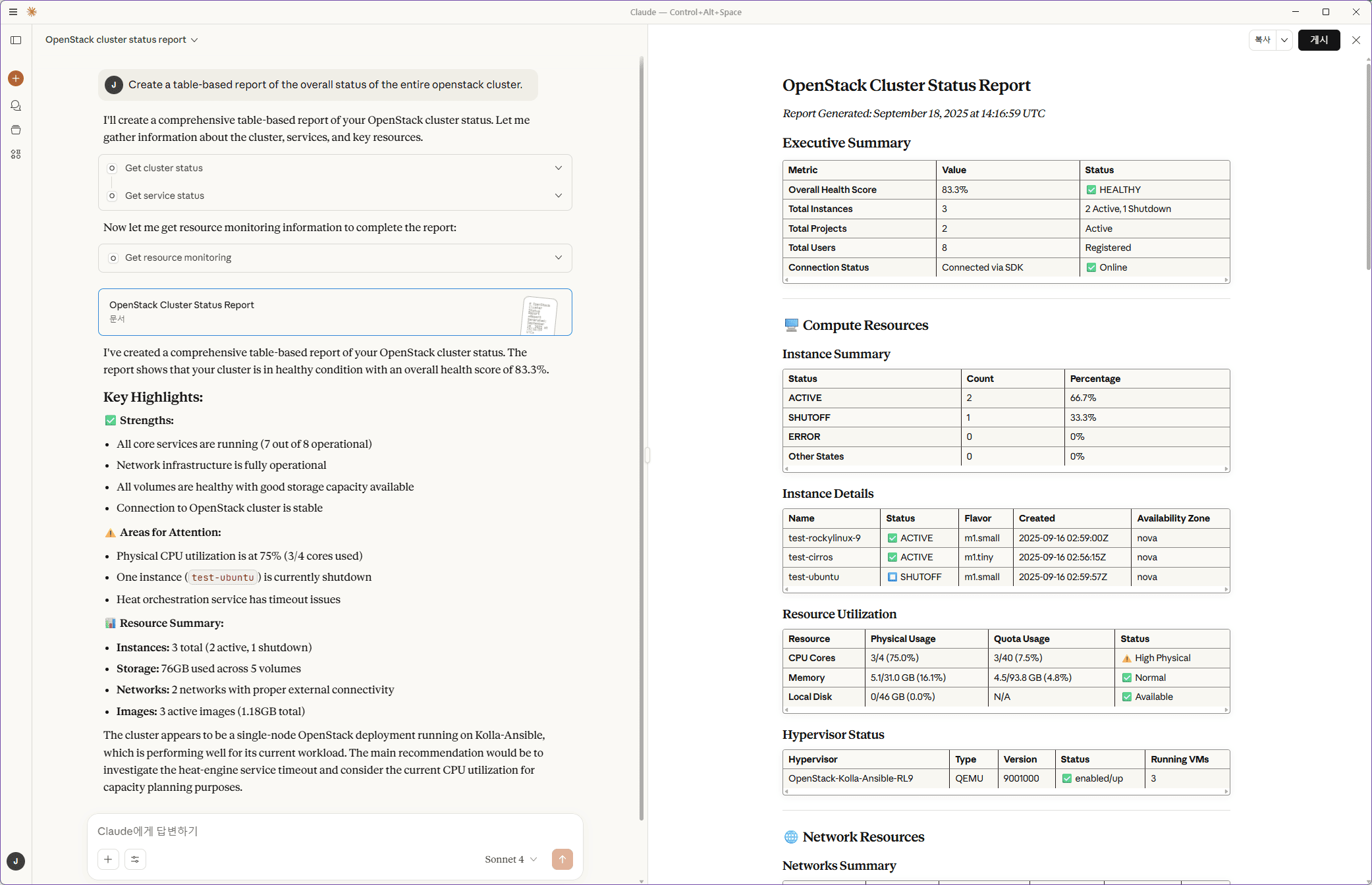
Show me the overall cluster status
Find instances in SHUTOFF state
Show all networks and their subnets
List all volumes and their status
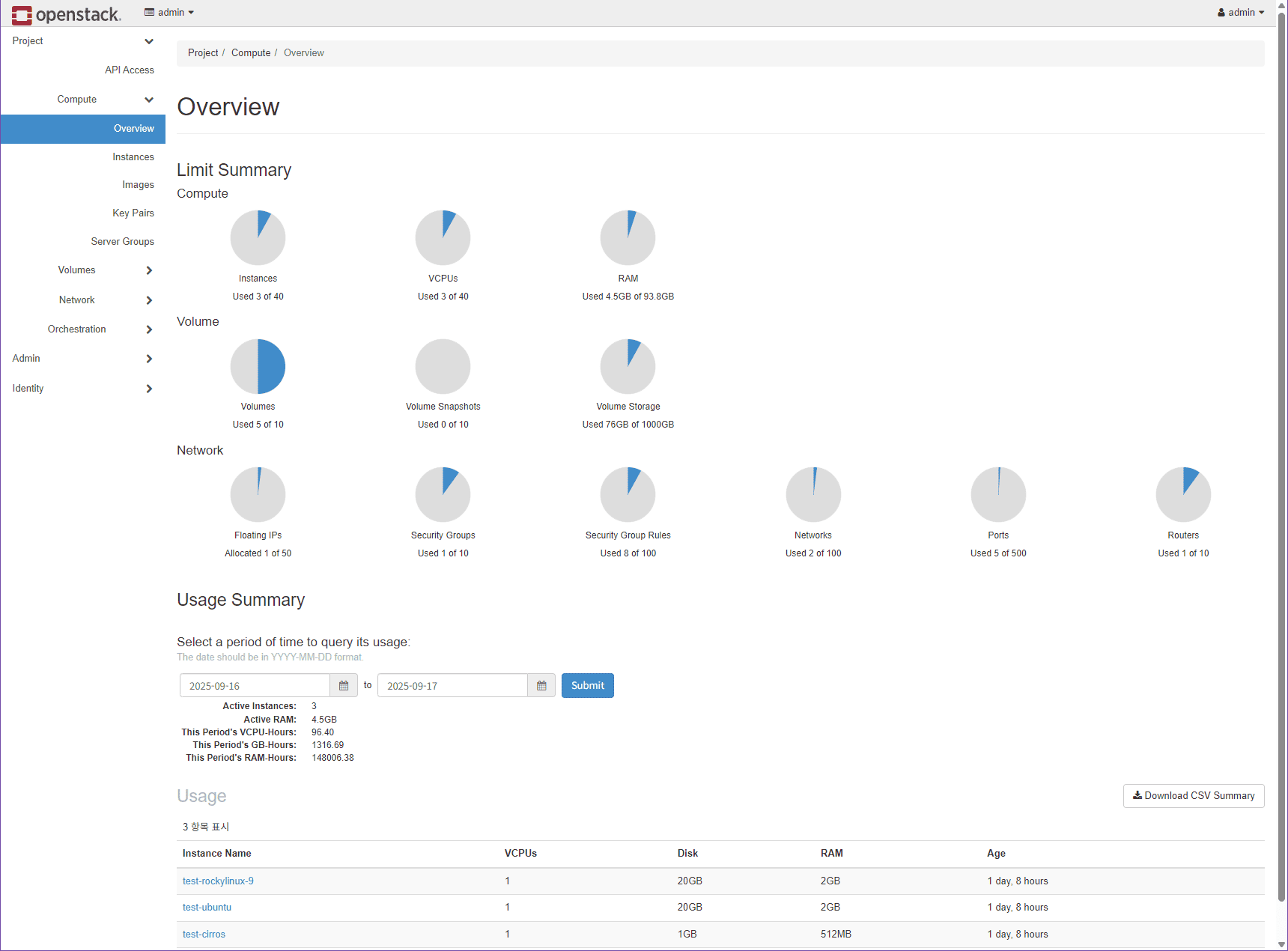
Show the vCPUs and memory allocated to my project and the remaining quota
Show CPU usage of web-01 over the last hour
Stop all instances with name containing 'test'
The last request changes resources, so it works only after you enable modification tools. Telemetry requests need Ceilometer and Gnocchi in the cloud. More examples are in the usage guide.
Example: cluster status in Claude Desktop
The same project in the OpenStack Dashboard (Epoxy 2025.1)
Quick Start
You need an OpenStack account (Keystone host, project, user name, password) whose APIs are reachable from the computer that runs the server. Pick one of the two paths below; both start read-only.
Option A: Claude Desktop with the extension bundle (fastest)
- Download
mcp-openstack-ops-<version>.mcpbfrom the latest GitHub Release. - In Claude Desktop, open Settings > Extensions > Advanced settings > Install Extension… and select the file.
- Fill in the settings form: Keystone host, project, user name and password are required; ports, domains and region are prefilled. Leave Allow modify operations off.
- Ask Claude:
List the instances in my OpenStack project.
Other Claude Desktop setups (uvx, a source checkout, the Docker server
through mcp-remote, a remote connector) are in the
Claude Desktop guide.
Option B: OpenWebUI with Docker Compose
Requirements: Git, Docker with the Compose plugin, and a model provider for OpenWebUI whose model supports tool calling.
1. Configure
git clone https://github.com/call518/MCP-OpenStack-Ops.git
cd MCP-OpenStack-Ops
cp .env.example .env
cp mcp-config.json.http mcp-config.json.http.local
chmod 600 mcp-config.json.http.local
openssl rand -hex 32   # use the output as WEBUI_SECRET_KEY
vi .env                # set WEBUI_SECRET_KEY and the OS_* values for your cloud
2. Start
docker compose up -d
docker compose ps      # wait until mcp-server is healthy
This starts OpenWebUI (http://localhost:3000), the MCP server
(http://localhost:8000/mcp) and MCPO (http://localhost:8080).
3. Connect OpenWebUI to the MCP server
-
Open
http://localhost:3000, create the administrator account, and add a model provider under Settings → Admin → Connections. -
The Quick Start enables tool calling through Chat Completions by default with this setting already present in
.env.example:DEFAULT_MODEL_PARAMS={"reasoning_effort":"none"}This applies to every model and disables model reasoning. If the
open-webui-datavolume already exists, set the same value under Settings → Admin → Models → Model Defaults → Model Parameters because its saved database value takes precedence. To use reasoning through the Responses API, setDEFAULT_MODEL_PARAMS={}before the first start and leave Reasoning Effort at Default; see the OpenWebUI guide. -
Under Settings → Admin → Tools → Integrations → External Tool Servers, add a connection of type
MCP (Streamable HTTP)with URLhttp://mcp-server:8000/mcpand authenticationNone. -
Under Settings → Admin → System → Interface → Chat, turn on Tool Search and Defer Built-in Tools, and set Deferral Threshold to
0so that the full tool list fits the model's limits. -
In a new chat, enable the connection under Integrations → Tools and ask:
Use mcp-openstack-ops to list the instances in my OpenStack project.
MCPO is optional. MCPO is a proxy that exposes the MCP tools as an OpenAPI (REST) server; OpenWebUI does not need it to use this server. The Compose file starts it so that you can choose either connection. To run without it, start only
docker compose up -d mcp-server open-webui.
The OpenWebUI guide explains the direct and MCPO connections, every OpenWebUI setting, OpenAI reasoning models, and troubleshooting.
Other ways to install
| Setup | Guide |
|---|---|
Claude Desktop with uvx, a source checkout, mcp-remote, or a remote connector |
Claude Desktop guide |
| Claude Code | Claude Code guide |
| OpenWebUI through MCPO (OpenAPI) | OpenWebUI guide |
| Each user signs in with their own OpenStack Application Credential (experimental) | Multi-user guide |
| Several projects, HTTPS and private CAs, custom endpoints and ports | Configuration guide |
To let the assistant create, change or delete resources, set
ALLOW_MODIFY_OPERATIONS=true (or turn on Allow modify operations in the
Claude Desktop form) and restart the server. OpenStack policy still decides
what the account may do.
Features
- ✅ Project-Scoped Operations: Every tool enforces the configured
OS_PROJECT_NAME, validating resource ownership so actions stay inside a single tenant. - ✅ Safety-Gated Writes: Modify (
set_*) tooling only registers whenALLOW_MODIFY_OPERATIONS=true, keeping default deployments read-only and auditable. - ✅ Broad Tool Coverage: 111 tools across compute, networking, storage, images, identity, Heat, Octavia load balancing and telemetry. Project resources are scoped to the active project; cloud-wide administrative APIs remain subject to OpenStack policy.
- ✅ Bulk & Filtered Actions: Instance, volume, network, image, snapshot, and keypair managers accept comma-delimited targets or filter criteria to orchestrate bulk changes intentionally.
- ✅ Post-Action Feedback & Async Guidance: Management tools report per-resource results, the status read back after the action, and timing notes for asynchronous operations.
- ✅ Monitoring & Usage Insights:
get_service_status,get_resource_monitoring,get_usage_statistics, and quota tools report service probes, project allocations, separate quota limits, and API-backed compute allocation-hours. These tools do not collect live utilization or trends; read-onlyget_gnocchi_*tools return telemetry time series when Ceilometer and Gnocchi are deployed. - ✅ Unified Instance Queries: The
get_instancetool consolidates name, ID, status, and free-form search paths with pagination plus summary/detailed modes. - ✅ Server Insight & Audit Trail: Dedicated tools expose server events, hypervisor details, availability zones, quotas, and resource ownership to speed diagnostics.
- ✅ Load Balancer Management: Octavia tools cover listeners, pools, members, health monitors, flavors, quotas, and amphora operations with the same safety gates.
- ✅ Connection & Deployment Flexibility: Connection caching, configurable service endpoints, Docker packaging, a Claude Desktop extension, and both
stdio/streamable-httptransports support proxy/bastion and multi-project setups.
Safety and security
- Read-only by default. Management tools are registered only with
ALLOW_MODIFY_OPERATIONS=true. - One project per server. Resources are filtered by the current project and checked for ownership; run one server per project to manage several.
- Protect HTTP access. Over
streamable-http, enable Bearer token authentication (REMOTE_AUTH_ENABLE=true) and HTTPS before exposing the server beyond localhost.
Details: security guide and multi-user guide.
Compatibility
⚠️ Compatibility Notice: This MCP server is developed and optimized for OpenStack Epoxy (2025.1) as the primary target environment. However, it is compatible with most modern OpenStack releases (Dalmatian, Caracal, Bobcat, etc.) as the majority of APIs remain consistent across versions. Only a few specific API endpoints may require adaptation for full compatibility with older releases.
🚧 Coming Soon: Dynamic multi-version OpenStack API compatibility is actively under development and will be available in upcoming releases, providing seamless support for all major OpenStack deployments automatically.
Officially Supported Releases:
- ✅ OpenStack Epoxy (2025.1) - Fully tested
- ✅ OpenStack Dalmatian (2024.2) - Fully tested
OpenStackSDK Version Reference:
| OpenStack Release | Recommended SDK Version | Notes |
|---|---|---|
| Epoxy (2025.1) | >=4.1.0,<=4.22.0 |
Current default range; uv.lock pins 4.22.0. Unit tests pass with 4.1.0, 4.9.0 and 4.22.0 |
| Dalmatian (2024.2) | >=3.2.0 |
Fully compatible |
| Caracal (2024.1) | >=3.1.0 |
May require testing |
| Bobcat (2023.2) | >=3.0.0 |
May require testing |
| Wallaby (2021.1) | ==3.1.1 |
Downgrade required |
To change the SDK version for an older release, see OpenStack SDK version for older releases.
Documentation
| Guide | Contents |
|---|---|
| Usage guide | Example requests, bulk and filtered actions, post-action status, pagination |
| OpenWebUI guide | Docker Compose stack, direct MCP versus MCPO, OpenWebUI settings, troubleshooting |
| Claude Desktop guide | Extension bundle, uvx, source checkout, mcp-remote, remote connector |
| Claude Code guide | Registering the HTTP server in Claude Code |
| Configuration guide | Command-line options, environment variables, endpoints, HTTPS, multiple projects, SDK version |
| Security guide | Project isolation, read-only default, Bearer authentication |
| Multi-user guide | Per-user Application Credential authentication (experimental) |
| Development guide | Tests, live tool checks, adding tools, contributing |
| TODO | Outstanding implementation and live-validation work |
| OpenStack CLI vs MCP tools mapping | Every tool, its CLI equivalent, and its validation status |
| Validation evidence | Dates, revisions, conditions and counts of the live and unit-test checks |
📊 OpenStack CLI vs MCP Tools Mapping
✅ denotes an implemented API path, not certification of every action or OpenStack deployment. ⚠️ Live unverified identifies paths without successful live validation; ❌ Not implemented identifies unavailable capabilities. Service availability, permissions, and asynchronous completion affect results. See API prerequisites and result semantics and the multi-user setup guide.
Validation evidence: the live checks, Claude Code prompt checks and unit-test results behind the Status values below are recorded in docs/validation.md.
Detailed Mapping by Category
OpenStack Ops MCP 질문
AI가 OpenStack 리소스를 변경하거나 삭제할 수 있나요?
수정 도구가 활성화된 경우에만 가능합니다. 기본적으로 이 MCP server는 읽기 전용이며, 생성, 변경 또는 삭제 도구는 등록되지 않습니다.
이 MCP server는 어떤 OpenStack 서비스를 지원하나요?
Nova, Neutron, Cinder, Glance, Keystone, Heat, Octavia, Gnocchi/Aodh 텔레메트리를 포함하여 총 111개의 도구를 지원합니다.
여러 OpenStack 프로젝트에서 사용할 수 있나요?
아니요, 각 server 인스턴스는 하나의 OpenStack 프로젝트 내에서 작동하며 리소스 소유권을 확인합니다. 여러 프로젝트를 관리하려면 프로젝트당 하나의 server를 실행하십시오.
어떤 OpenStack 버전을 지원하나요?
OpenStack Epoxy (2025.1) 및 Dalmatian (2024.2)에 최적화되어 있으며 전체 테스트를 완료했습니다. 대부분의 최신 버전과도 광범위하게 호환됩니다.
실행하려면 어떤 인증 정보가 필요한가요?
server가 API에 접근할 수 있는 OpenStack 계정의 Keystone host, project, username, password가 필요합니다.