
AccessFlow MCP server
2026년 11월 11일 커밋SQL, NoSQL 및 API 액세스에 대한 검토, 승인 및 감사 워크플로우를 제공하는 쿼리 프록시 및 거버넌스 플랫폼입니다.
다른 이름 bablsoft/accessflow
- 스타
- 13
- Tools
- —
- 다운로드, 30일
- —
- 최신 버전
- —
- 마지막 커밋
- 2026년 11월 11일
- 라이선스
- Apache-2.0
AccessFlow MCP란?
AccessFlow은(는) MCP server입니다. SQL, NoSQL 및 API 액세스에 대한 검토, 승인 및 감사 워크플로우를 제공하는 쿼리 프록시 및 거버넌스 플랫폼입니다.
프로젝트 README에서 생성된 요약
AccessFlow MCP server 정보
엔지니어와 데이터베이스 관리자는 AccessFlow를 사용하여 운영 데이터 및 서비스에 대해 통제된 셀프 서비스 액세스를 구현할 수 있습니다. AccessFlow는 사용자와 다양한 데이터 엔진 사이에서 작동하는 풀 쿼리 프록시 역할을 합니다. 지원 대상에는 PostgreSQL 및 MySQL과 같은 관계형 데이터베이스, MongoDB 및 Redis와 같은 NoSQL 시스템, Snowflake 또는 BigQuery와 같은 클라우드 데이터 웨어하우스가 포함됩니다. 또한 이 플랫폼은 외부 REST, SOAP, GraphQL 및 gRPC API 호출로 거버넌스를 확장합니다.
운영 환경의 자격 증명을 직접 공유하는 대신, 사용자는 프록시를 통해 쿼리를 제출합니다. 프록시는 AES-256-GCM을 사용하여 암호화된 자격 증명을 보유합니다. 모든 요청은 파싱 및 분류 과정을 거치며, 설정된 사용자 승인 워크플로우를 통해 라우팅되기 전에 AI를 통한 리스크 스코어링 분석을 선택적으로 수행할 수 있습니다. 이 구조를 통해 다단계 순차 승인, 쿼리 형태 또는 리스크 수준에 따른 자동 라우팅, 모든 결정에 대한 위변조 방지 감사 로그 생성이 가능합니다. 시스템은 사용자의 인프라 내에서 완전히 실행되도록 설계되었으며 JWT, SAML 2.0, OAuth 2.0/OIDC를 통한 인증을 지원합니다.
활용 사례
- 1실수로 인한 데이터 삭제 방지엔지니어가 파괴적인 SQL 명령을 제출하면 즉시 실행되는 대신 자동으로 검토 대상으로 분류됩니다.
- 2외부 API 통신 보안 강화팀은 외부 REST 또는 GraphQL 호출에 AI 리스크 스코어링과 다단계 승인을 적용하여 서비스 보안을 보장할 수 있습니다.
- 3새로운 보안 정책 테스트개발자는 초안 상태의 라우팅 또는 마스킹 정책을 과거 트래픽에 적용하여 과거 쿼리에 어떤 영향을 미쳤을지 확인할 수 있습니다.
- 4데이터베이스 액세스 검토 자동화관리자는 읽기 전용 쿼리는 자동으로 승인하고, 모든 쓰기 작업에는 수동 승인이 필요하도록 규칙을 설정할 수 있습니다.
프로젝트의 README를 바탕으로 작성되었습니다. 모든 활용 사례는 해당 내용의 인용문과 대조하여 확인합니다.
자동 검사
2026년 11월 14일에 실행됨전체 보고서 →아직 인증되지 않았습니다. 서버는 80점 이상의 점수, 심각한 결함 없음, 그리고 검사에 충분한 데이터를 갖추어야 합니다. 검사 방식 · 점수를 높이기 위해 수정할 항목

- 소스 저장소 연결 및 접근 가능bablsoft/accessflow is public and reachablegithub.com/bablsoft/accessflow ↗통과
- 패키지가 이 저장소를 소스로 명시검사되지 않음
- 빌드 출처(Sigstore 증명)검사되지 않음
- 오픈 소스 라이선스 (OSI)Apache-2.0spdx.org/licenses/Apache-2.0.html ↗통과
- 최근 1년 내 커밋 또는 릴리스Last commit or release 2026-11-11github.com/bablsoft/accessflow ↗통과
- OpenSSF Scorecard검사되지 않음
- 패키지 이름이 인기 패키지와 유사하지 않음검사되지 않음
- 패키지 및 해당 종속성에 중요한 보안 권고 없음검사되지 않음
- 모델에 대한 숨겨진 지침 없음0 tool descriptions and the README read; no override phrases, credential paths or hidden characters통과
- 파괴적인 도구에 라벨 표시됨검사되지 않음
- 원격 엔드포인트가 MCP 핸드셰이크에 응답검사되지 않음
README
GitHub에서 보기AccessFlow sits as a full query proxy in front of your databases — the relational engines PostgreSQL, MySQL, MariaDB, Oracle, and Microsoft SQL Server are supported out of the box via a declarative connector catalog (additional engines such as ClickHouse install with one click), any other JDBC-compatible engine can be added by uploading its driver JAR, the NoSQL document engines MongoDB and Couchbase (SQL++), the NoSQL key-value engine Redis, the NoSQL wide-column engines Apache Cassandra (CQL) and ScyllaDB (CQL-compatible), the NoSQL search engines Elasticsearch and OpenSearch, the NoSQL key-value engine Amazon DynamoDB (PartiQL), the NoSQL graph engine Neo4j (Cypher over Bolt), and the cloud data warehouses Snowflake, Google BigQuery (GoogleSQL), and Databricks SQL install the same way through on-demand native engine plugins. The catalog separates the SQL (relational) family, the cloud data-warehouse family, and the NoSQL umbrella of native engine-managed connectors. Every query a user submits — SQL, a MongoDB shell / JSON command, a Couchbase SQL++ statement, a Redis command, a Cassandra/ScyllaDB CQL statement, an Elasticsearch/OpenSearch query, a DynamoDB PartiQL statement, a Neo4j Cypher statement, or a Snowflake / BigQuery / Databricks warehouse SQL statement — is parsed, classified, optionally analyzed by AI, and routed through a configurable human-approval workflow before it ever reaches live data. The same governance extends beyond databases: outbound REST, SOAP, GraphQL, and gRPC calls against registered API connectors run through that identical pipeline — AI risk scoring, attribute-based routing, multi-stage approval — with response masking and immutable, downloadable response snapshots. Every request, decision, and execution is captured in a tamper-evident metadata audit log. Authentication is JWT (RS256) with optional SAML 2.0 SSO and OAuth 2.0 / OIDC sign-in (built-in templates for Google, GitHub, GitHub Enterprise Server, Microsoft, GitLab, and self-managed GitLab), and SCIM 2.0 provisioning lets the identity provider drive user & group lifecycle end to end. AccessFlow ships as a single open-source product under Apache 2.0 and is designed to run entirely inside your own infrastructure.
Why AccessFlow
Most teams pick one of two extremes for database access:
- Shared production credentials — anyone with the password can run
DELETE. Fast, but a single mistake is unbounded and there is no record of who did what. - Ticket-driven DBA access — every change goes through a manual DBA queue. Safe, but slow enough that engineers route around it.
AccessFlow provides the missing middle: governed, self-service access where every query is reviewable, every approval is traceable, and AI catches the obvious problems before a human ever sees the request.
See it in action
A glance at the day-to-day flows engineers and approvers actually use.
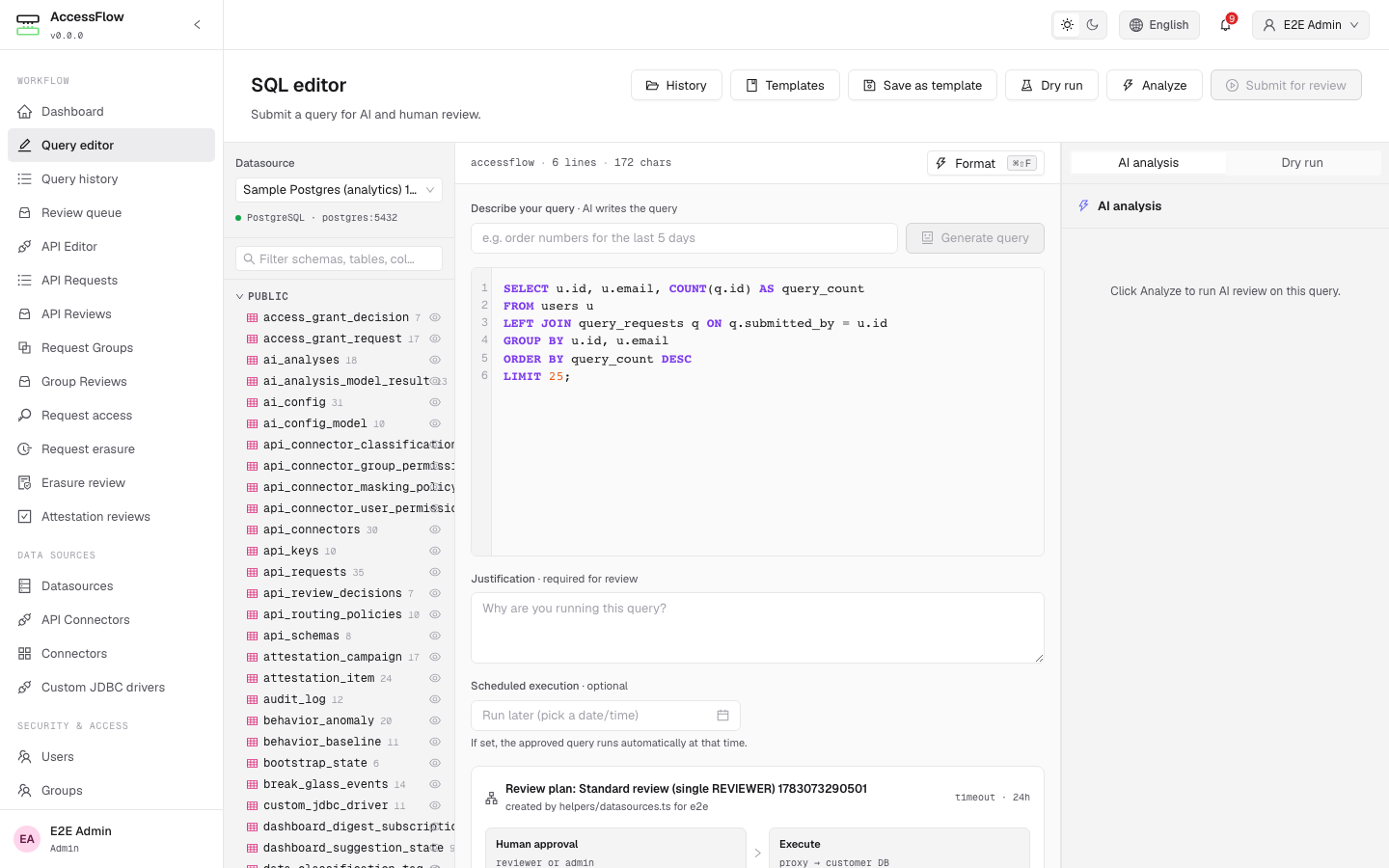
Submit a query — CodeMirror 6 with dialect-aware highlighting, live schema autocomplete, and an inline review-plan preview that shows exactly which approvals the submission will trigger.
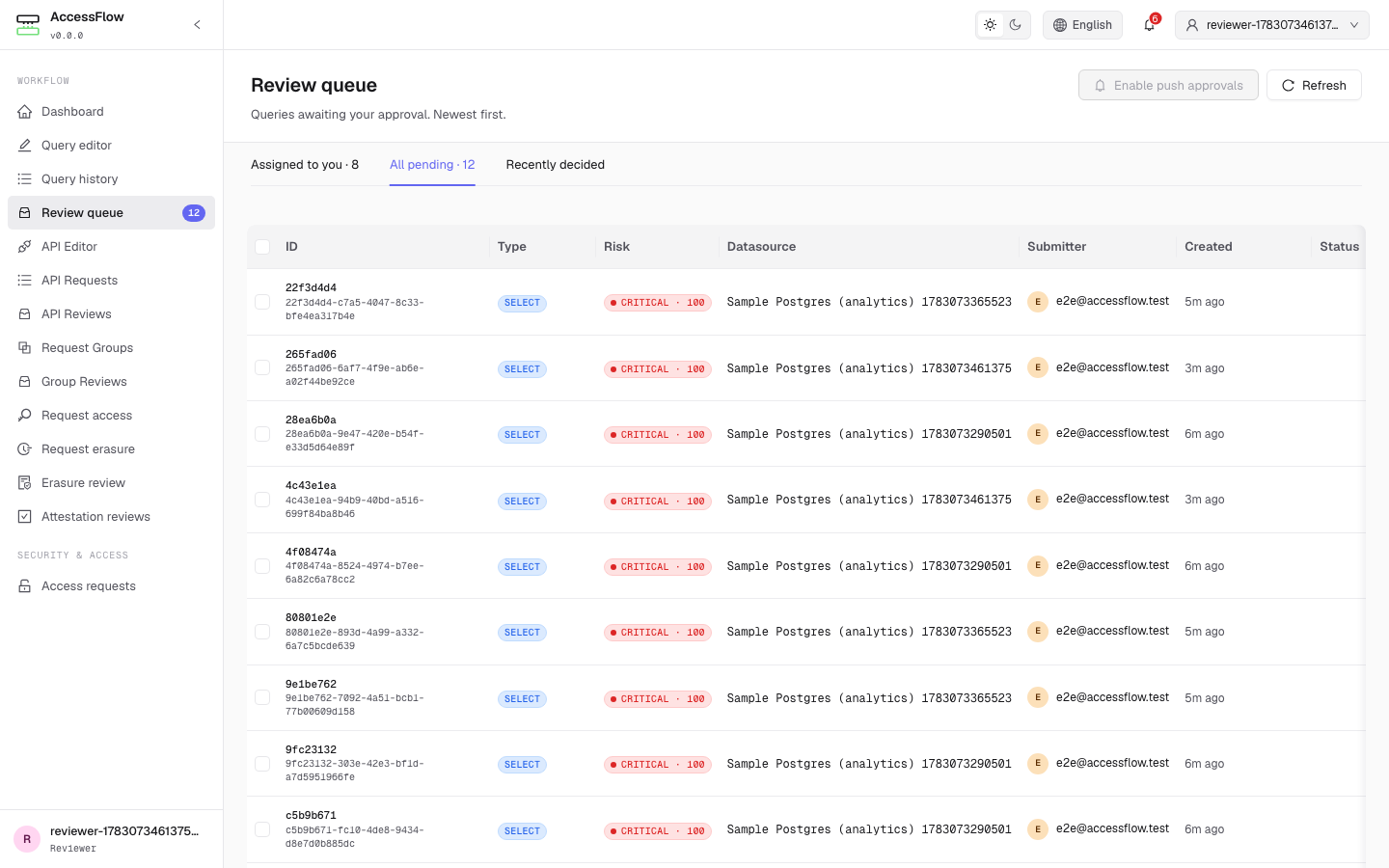
Approve or reject pending writes from one place — the queue is scoped to queries assigned to you, with risk score, query type, and submitter at a glance. A user can never approve their own query.
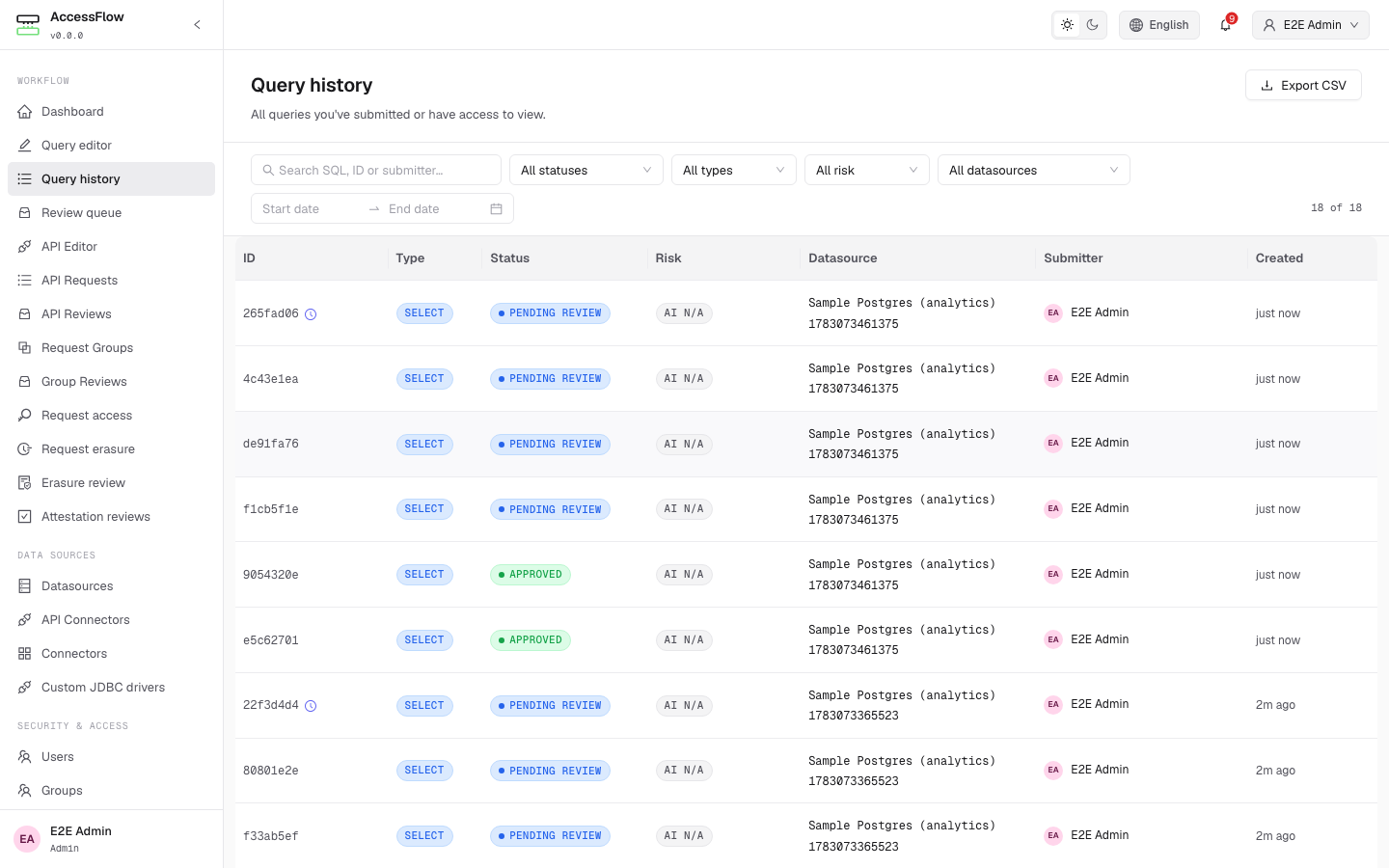
Searchable, filterable history of every query — by status, type, risk, datasource, submitter, or date range — with CSV export. Each row links to the full request, AI analysis, approval timeline, and result set.
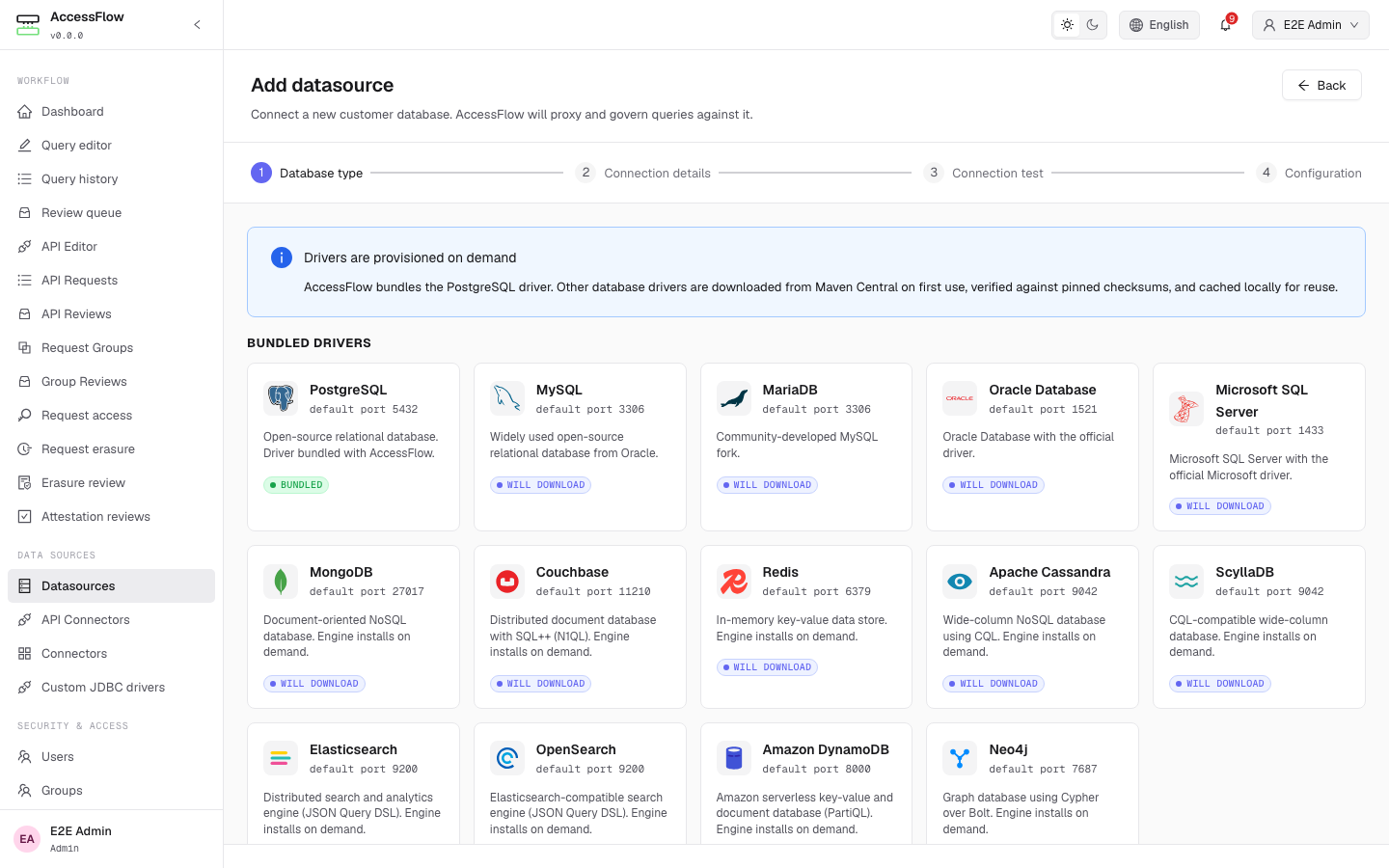
Connect a database in the admin UI — credentials are AES-256-GCM encrypted at rest, the proxy holds them, and end users never see them.
More walkthroughs — the Guides section carries step-by-step manuals for the setup tasks: your first governed query, adding a datasource, notifications and SMTP, users and roles, single sign-on, AI risk analysis, outbound API calls, gating a CI/CD pipeline, Terraform and the in-app help assistant — which, once enabled, answers all of the above from inside the app. Review plans, AI provider configuration, notification channels (Email, Slack, Discord, Telegram, Teams, PagerDuty, ServiceNow, Jira, webhooks), OAuth 2.0 / OIDC sign-in, SAML 2.0 SSO, users & invitations, and system SMTP each have their own reference chapter with screenshots on the public documentation site.
Features
- Proxy-first execution — no user ever holds production credentials; the proxy holds them encrypted and opens connections only after approval. Single SQL statements run with autocommit; multi-statement INSERT/UPDATE/DELETE batches wrapped in
BEGIN; … COMMIT;execute atomically inside one JDBC transaction (mixed SELECT/DML batches are rejected at parse time), with homogeneous INSERT runs collapsed into JDBCexecuteBatch()for bulk-load throughput. Optional multi-replica read load balancing: attach any number of replica endpoints to a datasource and SELECT traffic round-robins across the healthy ones — per-node health checks with circuit-breaker failover skip downed replicas, and only full replica-set exhaustion falls back to the primary (with an audit row). Optional SELECT result caching: opt a datasource into a Redis-backed result cache (per-datasource TTL) keyed over the security-rewritten query — masking and row-level security still apply — and invalidated on any proxied write to a referenced table. - Configurable review workflows — per-datasource review plans, multi-stage sequential approval chains, optional auto-approve for reads, approval timeouts with auto-reject. Reviewers can be scoped per-datasource (directly or via groups) so different teams see only the queues that belong to them. Reviewers going away can set an out-of-office delegation naming a colleague to cover their review duty for a window — across queries, governed API calls, and grouped requests — with every decision recording both identities. A delegate can never act on the delegator's own requests, delegation never grants a permission they lack, and it does not chain. Plans can also escalate a request that nobody has decided on to the reviewers at its current stage plus your admins before the approval timeout auto-rejects it, and nudge those same reviewers on a cadence — both optional, both notify-only, so waiting never changes who may approve.
- Policy-as-code routing — ordered, attribute-based routing policies decide a query's path after AI analysis and before reviewers see it: auto-approve, auto-reject, require N approvals, or escalate. Conditions match on query type, referenced tables (glob), AI risk level / score, requester role or group, time-of-day / day-of-week, WHERE / LIMIT presence, query shape (joins, set operations, subqueries, CTEs, GROUP BY / HAVING, aggregates, window functions), the transactional flag, the pre-flight estimate (estimated rows, estimated bytes scanned, scan type), the submitter's data-budget usage, and the submission client context — source IP / CIDR, user-agent, time-since-last-approval, and CI/CD origin (API key or
X-AccessFlow-CIheader) — combined with AND / OR / NOT. Client-context conditions fail closed (missing context never auto-approves), so an off-network or stale-approval query escalates to stricter review instead. First match by priority wins; on no match the query falls through to the datasource's review plan. Every automated decision is recorded in the audit log. - External policy decision hook (#945) — for rules that do not decompose into routing conditions, point AccessFlow at your own policy service (an OPA sidecar, an in-house API). It is consulted over HMAC-signed HTTPS for every query no routing policy matched, just before the grant fast path, and may allow, escalate, require approvals (never below the plan minimum) or reject — it can never approve. Every failure — timeout, error status, redirect, bad or missing response signature, unknown answer — sends the query to human review, and a per-hook circuit breaker stops a dead endpoint from stalling submissions. The SQL text is sent only on opt-in; the endpoint URL is SSRF-guarded (private and metadata addresses refused unless the deployment allows them). Managed at
/admin/decision-hooksor with the Terraformaccessflow_decision_hookresource. - Policy simulator — dry-run a draft routing, row-security, or masking policy against your own historical query traffic before you save it. AccessFlow replays the window twice — once against your current policies, once with the draft applied — and reports the difference between those two runs: how many past queries would change, which users would be affected, and which queries a row predicate would newly filter, deny, or reject outright. It is strictly read-only — no connection to your database, nothing executed, nothing persisted — and it names its own approximations (memberships are read as they are now; an engine that cannot classify a query shape offline is reported as unclassifiable, never as safe) instead of implying a precision the data does not have.
- Deterministic SQL review rules (#860) — a named rule catalog that judges every SQL query alongside the AI verdict and routing policies, and shows its findings in the editor as you type. Eighteen built-in rules derived from the parsed statement alone (missing
WHEREonUPDATE/DELETE, an always-trueWHERE,SELECT *, unbounded reads, cross joins, leading-wildcardLIKE,DROP/TRUNCATE/ DDL, banned functions, protected tables by glob, DML outside a transaction, and risky migrations — aNOT NULLcolumn added without a default, a PostgreSQLCREATE INDEXwithoutCONCURRENTLY, an in-place column type change,SET NOT NULLon an existing column), each at an admin-setOFF/WARN/BLOCKseverity configured per environment (DEVELOPMENT/TEST/STAGING/PRODUCTION, plus an organisation default).BLOCKescalates, it never rejects: a blocking finding suppresses every auto-approve path and sends the query to a human reviewer; a routing auto-reject still rejects. Evaluated synchronously at submission so findings exist even when AI analysis is off or fails, rendered in each reader's language on the query detail, review queue, break-glass retro-review and request-group detail; break-glass runs record findings but are never gated by them, and non-relational engines report not applicable. Admins can add custom rules of their own without code (v2.8, epic #1008) — composed from criteria over the parsed statement (statement type, tables and columns by pattern, functions called, missing clauses) or a bounded regular expression, tested against sample SQL before they are switched on, and configured per environment exactly like the built-ins; also manageable from Terraform. Seedocs/19-sql-review.md. - Just-in-time (JIT) access requests — users self-request temporary, scoped access to a datasource (read/write/DDL, optional schema/table scope) or an API connection (read/write, optional operation allow-list) for an ISO-8601 duration. Requests flow through the same approval engine, a time-boxed permission is granted on approval, and a clustered scheduler auto-revokes it on expiry (admins can also revoke early). A grant can opt into query pre-approval: while it is active, queries it covers skip human review and are auto-approved with the grant recorded as the approval provenance — routing policies, high-risk AI verdicts, and behavioural anomalies still override.
- Break-glass / emergency access — a gated emergency path for when production is on fire and approvers are asleep. A per-user/per-datasource
can_break_glasspermission (required for everyone, including admins; time-boxed) lets a query execute immediately, bypassing review — still through every proxy guard (allow-list, masking, row-level security, row caps). Compensating controls: a mandatory justification, instant fanout to all org admins (incl. PagerDuty), a prominently-tagged audit row, and a mandatory retro-review an admin (never the submitter) must acknowledge on the/admin/break-glasslog. - Dynamic data masking — per-column masking policies (full, partial last-N, keep first-N, stable hash, email-preserving, format-preserving, constant, nullify, regex replace, numeric bucketing, date generalization — configured by parameters and validated on save, never user code; every strategy fails closed to a full mask on a value it cannot handle) with role / group / user reveal conditions evaluated per requester. Masking is applied at result-read time before results are serialized or stored, so unmasked values never persist; applied policy ids are recorded in the audit log. Extends the static
restricted_columnsmasking; for a column that must never be read at all, a grant'sdenied_columnsrejects any query that references it — including throughSELECT *— before it runs (relational engines). - Row-level security — per-table row predicates the proxy injects into the parsed SQL so a scoped user only sees (SELECT) or affects (UPDATE/DELETE) the rows they are authorised for. Admins author a structured
column operator valuepredicate where the value is a fixed literal or a:user.*variable (built-in id / email / role / groups, or an admin-set per-user attribute). Values are bound as JDBC parameters — never concatenated; predicates that can't be safely applied are rejected, never run unfiltered. Composes with column masking and the schema/table allow-list — and with table/schema deny-lists that always beat it ("all ofcrmexceptcrm.salary", tables created later included) — and with query-shape deny-lists on a grant, which refuse joins, unions, subqueries, CTEs, grouping, aggregates or window functions anywhere in a statement before it runs (relational engines, fail-closed). - Per-table row limits — cap how many rows a SELECT may return from a specific table, for everyone or for chosen roles, groups or users, so two tables on one datasource (or two teams on one table) get different limits. A limit only ever lowers the cap set by the datasource and the access grant; a query across several limited tables takes the lowest one, and an unqualified table name still matches a schema-qualified policy. The policies that applied are recorded on the execution's audit entry.
- Data classification tagging — tag tables and columns as PII, PCI, PHI, GDPR, FINANCIAL, or SENSITIVE right in the schema explorer. Tagging a column auto-applies a masking policy, the AI analyzer raises a query's risk score when it touches a tagged object, and a derivation preview suggests a stricter review posture. Tags are audited and queryable org-wide as the evidence base for compliance reporting.
- Automated sensitive-data discovery — an opt-in per-datasource scanner samples column data through the same governed sampling path, detects sensitive values with local regex + checksum detectors (emails, credit-card PANs with Luhn, SSNs, IBANs, phone numbers) and optionally your bound AI analyzer (which only ever sees column names, types, and redacted samples), and proposes classification tags in a review worklist. Confirming a finding applies the tag — deriving masking automatically — while dismissing suppresses it permanently; scans and decisions are audited, and an on-demand "Scan now" complements the scheduled cadence. Proposals the scanner keeps sampling but no longer finds — the column was dropped, the data cleaned up, or masking added by hand — are marked stale after a few consecutive misses and leave the active worklist for a filtered bulk dismissal, reversibly: re-detection returns them to pending, and a run cut short by its table cap or time budget never ages proposals it did not look at.
- Result-export governance & DLP — masking governs what a user sees; export policies govern what leaves. Per-datasource policies with role / group / user targeting (
allow/watermark/row-cap/deny-when-classified, most-restrictive-wins, no admin bypass) gate the signed CSV/PDF result-export endpoint and the results attachment on recurring-run emails. Classified detection reuses the classification tags at export time; watermarked exports carry the exporter, timestamp, and query id inside the signed bytes (stripping the stamp invalidates the signature); every export writes aRESULT_EXPORTEDaudit row, and classified exports notify org admins — so "who downloaded this data" always has an answer. - User groups — bundle reviewers (and other users) into groups; groups can be assigned as datasource reviewers, granted data/API access (a whole team inherits a datasource or API-connector grant — read/write/DDL/break-glass — instead of a row per member; effective access is the most-permissive union of a user's direct and group grants), and auto-synced from SAML / OAuth2 IdP claims via per-IdP
group_mappings(admin-managed memberships are preserved across logins). - AI query analysis — pluggable adapters for OpenAI, Anthropic Claude, self-hosted Ollama, any OpenAI API–compatible backend (vLLM, LM Studio, Together, Groq, OpenRouter, …) via a custom endpoint, and Hugging Face (Inference Providers router or a local / self-hosted TGI server); risk scoring (0–100), missing-index detection, anti-pattern hints. Embeddings for the RAG knowledge base are configured separately on the same row and draw on a different list — Voyage AI belongs there and nowhere else, which gives an Anthropic-only install an embedding path without a second chat vendor (Claude has no embeddings API). Per-organization configuration via the admin UI, including an editable analyzer prompt per configuration (override the built-in template, or leave it blank to use the default); admin AI analyses dashboard charts average risk over time, top issue categories, and most active submitters. A per-organization rate limit (requests/minute, default 30) and optional monthly token budget cap AI usage so a runaway editor or compromised account can't drain the provider API key — enforced before every analysis call; exceedance returns HTTP 429 in the editor or records a sentinel
CRITICALanalysis row on the async path. A per-organization fallback pool marks configurations (typically a local Ollama) to retry in priority order when the primary provider is unreachable — air-gap-friendly resilience without weakening any failure semantics. - Multi-model orchestration, voting & guardrails — an AI configuration can run several models in parallel (the primary plus weighted
{provider, model, weight}members — e.g. a fast local Ollama pre-score alongside a deep Claude analysis) and combine their verdicts by a configurable voting strategy (weighted average, highest risk, or majority); issues are merged and risk aggregated. Guardrails block configured prompt patterns (case-insensitive regex) before any model is called, and the strict output-schema validation rejects malformed responses without failing the query. Per-model cost (tokens) and latency are recorded for every analysis and charted on the admin dashboard. - Query-optimization suggestions — alongside the risk verdict, the analyzer returns concrete, dialect-aware optimization suggestions: index recommendations (
CREATE INDEX …) and query rewrites. Each suggestion has a one-click "Apply as draft" that pre-fills the editor with the suggested statement and routes it through the normal review pipeline — nothing auto-executes, and the draft is audited as AI-suggested. - Query playground / dry-run sandbox — preview a query's impact before submitting it for review. A Dry run action returns the engine's execution plan (node type, estimated rows, cost, filters) and a best-effort estimated row impact without executing or mutating data, shown in the editor next to the AI panel. It runs through the same governance as a real execution (datasource access, table allow-list, row-level security) but creates no review. Dialect-aware across every engine with a plan concept — relational
EXPLAIN(PostgreSQL / MySQL / MariaDB / Oracle / SQL Server), MongoDBexplain, Couchbase / Neo4jEXPLAIN, Elasticsearch / OpenSearch query validation; engines without one degrade gracefully. Cloud warehouses additionally report the estimated bytes the query would scan (BigQuery's native dry-run job) — the direct cost signal for bytes-billed engines. SELECT dry-runs prefer the read replica when configured. - Pre-flight cost & blast-radius estimation (AF-624) — every submitted query automatically gets a persisted cost estimate before review: the engine's own
EXPLAINplan (estimated rows, scan type, cost) plus, for UPDATE/DELETE, an exact affected-row count computed with a governed, non-mutating count (relationalSELECT COUNT(*)rewrite; MongoDBcountDocuments, SQL++COUNT(*), Cyphercount(*), Elasticsearch_count). Reviewers see it on the query detail page ("this DELETE touches ~2.4M rows via Seq Scan"), routing policies can match onestimated_rows/scan_type(e.g. auto-escalate full-scan DELETEs over 100k rows), and the estimate is folded into the AI analyzer's prompt so risk scoring reflects the act
AccessFlow MCP 질문
AccessFlow는 어떤 데이터베이스를 지원하나요?
PostgreSQL, MySQL, MariaDB, Oracle, Microsoft SQL Server, MongoDB, Couchbase, Redis, Apache Cassandra, ScyllaDB, Elasticsearch, OpenSearch, Amazon DynamoDB, Neo4j, Snowflake, Google BigQuery 및 Databricks SQL을 지원합니다.
AccessFlow는 API 액세스를 어떻게 처리하나요?
AI 리스크 스코어링, 속성 기반 라우팅, 응답 마스킹을 포함한 다단계 승인 프로세스를 통해 외부로 나가는 REST, SOAP, GraphQL 및 gRPC 호출까지 거버넌스를 확장합니다.
자체 인증 제공자를 사용할 수 있나요?
네, JWT (RS256)를 지원하며 선택적으로 SAML 2.0 SSO 및 OAuth 2.0 / OIDC 로그인을 사용할 수 있습니다. Google, GitHub, Microsoft, GitLab용 템플릿도 제공합니다.