
Serveur MCP DiffGate
✓ VérifiéFournit une barrière de sécurité déterministe pour les agents de codage en effectuant des vérifications de sécurité et de maintenabilité limitées au diff avant que le code ne soit écrit sur le disque.
Aussi connu sous srbsa/diffgate, diffgate-review
- Étoiles
- 5
- Outils
- —
- Téléchargements, 30 jours
- —
- Dernière version
- 0.8.0
- Dernier commit
- 27 juil. 2026
- Licence
- Apache-2.0
Qu'est-ce que DiffGate MCP ?
DiffGate est un serveur MCP. Fournit une barrière de sécurité déterministe pour les agents de codage en effectuant des vérifications de sécurité et de maintenabilité limitées au diff avant que le code ne soit écrit sur le disque.
Résumé généré à partir du README du projet
À propos du MCP server DiffGate
DiffGate agit comme une barrière de sécurité déterministe pour les agents de codage en effectuant des vérifications de sécurité et de maintenabilité spécifiquement sur les lignes modifiées avant que le code ne soit écrit sur le disque. Contrairement aux bots de revue traditionnels qui se déclenchent lors d'une pull request ou aux hooks pre-commit qui s'exécutent après qu'un agent a terminé sa tâche, cet outil fonctionne comme un agent hook via MCP. Cela permet à un client IA de recevoir des résultats structurés en quelques millisecondes et de corriger les problèmes tant que le contexte est encore actif, sans utiliser aucun token LLM pour l'évaluation elle-même.
Le système utilise une approche de triage par niveaux pour minimiser le bruit, en catégorisant les changements comme green pour des fusions sûres, yellow pour des revues manuelles, ou orange pour les éléments à fort impact nécessitant une vérification. Pour les résultats orange, le moteur peut exécuter sélectivement votre testCommand spécifique afin de valider le changement. Il est conçu pour les développeurs utilisant des agents comme Claude Code ou Cursor, offrant un verdict cohérent à travers la boucle de l'agent, les éditeurs locaux et les pipelines CI. L'outil utilise l'analyse AST pour des langages tels que JavaScript, TypeScript, Python et Go afin de garantir la précision de la détection de problèmes comme les injections SQL ou les secrets codés en dur.
Ce que vous pouvez faire avec
- 1Réduction de la duplication et de la complexité du codeLes développeurs peuvent utiliser la règle reinvented-helper pour empêcher les agents de recréer des fonctions existantes au lieu de les réutiliser.
- 2Automatisation de la vérification des changements à fort impactLe système peut déclencher automatiquement votre suite de tests existante uniquement lorsqu'un changement est signalé comme étant à fort impact ou orange.
Extrait du README du projet. Chaque cas d'utilisation est vérifié par rapport à une citation du document.
Comment installer DiffGate MCP
Formats vérifiés le 10 nov. 2026Ajouter à CursorAjouter à GooseInstaller DiffGate MCP dans Claude Code
$ claude mcp add diffgate -- npx -y diffgate-reviewInstaller DiffGate MCP dans Cursor
~/.cursor/mcp.json
{
  "mcpServers": {
    "diffgate": {
      "command": "npx",
      "args": [
        "-y",
        "diffgate-review"
      ]
    }
  }
}Installer DiffGate MCP dans VS Code
.vscode/mcp.json
{
  "servers": {
    "diffgate": {
      "type": "stdio",
      "command": "npx",
      "args": [
        "-y",
        "diffgate-review"
      ]
    }
  }
}Installer DiffGate MCP dans VS Code CLI
$ code --add-mcp '{"name":"diffgate","type":"stdio","command":"npx","args":["-y","diffgate-review"]}'Installer DiffGate MCP dans Claude Desktop
claude_desktop_config.json
{
  "mcpServers": {
    "diffgate": {
      "command": "npx",
      "args": [
        "-y",
        "diffgate-review"
      ]
    }
  }
}Installer DiffGate MCP dans Codex
$ codex mcp add diffgate -- npx -y diffgate-reviewInstaller DiffGate MCP dans Codex config.toml
~/.codex/config.toml
[mcp_servers.diffgate]
command = "npx"
args = ["-y", "diffgate-review"]
Installer DiffGate MCP dans Gemini CLI
$ gemini mcp add -s user diffgate npx -- -y diffgate-reviewInstaller DiffGate MCP dans Gemini settings.json
~/.gemini/settings.json
{
  "mcpServers": {
    "diffgate": {
      "command": "npx",
      "args": [
        "-y",
        "diffgate-review"
      ]
    }
  }
}Vérifications automatisées
Exécuté le 15 nov. 2026Rapport complet →A passé nos vérifications automatisées. Il ne s'agit pas d'un audit de sécurité : lisez le code et donnez au serveur l'accès le plus restreint dont il a besoin. Fonctionnement des vérifications

- Dépôt source lié et accessiblesrbsa/diffgate is public and reachablegithub.com/srbsa/diffgate ↗Réussi
- Le nom du package correspond au dépôt sourcediffgate-review names srbsa/diffgate as sourcenpmjs.com/package/diffgate-review ↗Réussi
- Provenance du build (attestation Sigstore)Sigstore attestation for diffgate-reviewnpmjs.com/package/diffgate-review/v/0.8.0#provenance ↗Réussi
- Licence open source (OSI)Apache-2.0spdx.org/licenses/Apache-2.0.html ↗Réussi
- Commit ou version publiée au cours de l'année écouléeLast commit or release 2026-07-28github.com/srbsa/diffgate ↗Réussi
- OpenSSF ScorecardNon vérifié
- Nom du package non proche d'un package populaireNo popular package one edit away from diffgate-reviewRéussi
- Aucun avis critique dans le package ou ses dépendances31 resolved dependencies checked; no critical advisoryosv.dev ↗Réussi
- Aucune instruction cachée destinée au modèle0 tool descriptions and the README read; no override phrases, credential paths or hidden charactersRéussi
- Les outils destructifs sont étiquetésNon vérifié
- Le point de terminaison distant répond à la poignée de main MCPNon vérifié
README
Voir sur GitHubDiffGate






A deterministic guardrail your coding agent runs on itself — before the code reaches your disk.
Every other check fires too late. A review bot needs a PR. A pre-commit hook runs after the agent has finished and moved on. DiffGate is an agent hook: your agent calls it over MCP, gets back structured findings in milliseconds for zero LLM tokens, and fixes the problem while it still has the context — then the same engine, same verdict runs in your editor, your pre-commit hook, and CI. Not a model grading its own homework: the same input always produces the same answer.
It stays quiet by construction. It grades only the lines that changed (🟢 merge · 🟡 glance · 🟠 verify), runs your tests only when a change earns it, and blocks only when it's earned — 0 false blocks on a public, versioned corpus you can rerun yourself with diffgate bench (BENCHMARK.md). Everyone claims low noise; this one ships the corpus.
Across local and frontier models: 0% classic OWASP bugs (SQL injection, XSS, hardcoded secrets) in code written from scratch. But the same frontier model that wrote flawless greenfield code reintroduced security footguns in 13% of edits — an unguarded recursive merge (prototype pollution), a bare cors() (any origin), a path built from request data with no containment check. Editing existing code is most of what an agent does, and the residue lives in the diff, not in the textbook. Rerun it yourself with diffgate marginal. The measurement →
The same shift shows up in third-party maintainability data: GitClear's 2026 analysis finds block duplication up 81% since 2023 (40.3 → 73.0 per million changed lines) and cross-file function connectivity down 35% — agents reinvent code rather than reuse it. That's what the reinvented-helper rule is for (docs/STRUCTURAL-RULES.md).
| Tier | Meaning | What you do | Examples |
|---|---|---|---|
| 🟢 Green | Safe / self-contained | merge freely | comments, local logging |
| 🟡 Yellow | Review (soft dependency) | take a look | deprecated APIs, raw SQL, network calls, dependency edits |
| 🟠 Orange | High-impact, gate it | verify before merge | schema/migrations, hardcoded secrets, auth/crypto, public-API changes, injection sinks |
Why an agent hook, not another review bot
Every check in the pipeline fires after the code exists, and each one is later than the last:
| Fires when | Problem | |
|---|---|---|
| Review bot (CodeRabbit, Greptile) | a PR exists | the code is finished, defended, and someone is waiting on it |
| Pre-commit hook | you're done and committing | the agent has moved on; you're re-loading context to fix it |
| DiffGate over MCP | the agent is still writing | it fixes its own output before the code lands |
Being early is not the only thing that matters, though — it has to be quiet, or the agent learns to ignore it. Review bots comment after the PR exists; linters and scanners flag everything they see. Neither guarantees the risky line gets discussed: we scanned 350 merged AI-assisted PRs — of the 109 with flagged AI-attributed changes, only 3 drew public discussion from any human besides the author. DiffGate decides what deserves your attention, your tests, or a block, and stays quiet otherwise. That's the whole product:
- Diff-scoped. Findings report only on the lines that changed, against the committed baseline — no whole-file noise, no re-litigating code you didn't touch.
- Tiered triage, not a flat list. Three tiers route attention: green merges, yellow is a glance, orange is gated.
- The gate runs your tests — selectively. On an orange change, DiffGate runs your
testCommandand shows the real exit code and output. Green and yellow pass instantly. The pre-commit hook is fast because tests fire only when a change is genuinely high-impact. - Earns the right to block. Broad cross-language injection findings stay advisory on their own; they escalate to a blocking finding only when the optional code graph proves the sink is reachable from an untrusted entry point (an HTTP/event handler). Recall from the rules, the right to block from the graph.
- Change-impact aware. With an optional code graph, a finding carries its cross-file blast radius — caller counts, suggested reviewers, untested call sites — and an exported symbol nobody calls is de-escalated. Cross-file context makes reviews quieter, not louder.
- Fast. A review runs in milliseconds on the changed lines — quick enough to sit in the agent and editor inner loop, not only in CI.
- Provably low-noise.
diffgate benchruns a versioned corpus offline: 100% precision / 0 false blocks on clean changes. Reproduce it yourself — that's the point of shipping the corpus. See BENCHMARK.md.
The measurement is reproducible
The 0% / 13% numbers aren't a marketing line — they come from a scripted experiment (four models from local to frontier, greenfield vs. edit mode, Wilson confidence intervals) that you can rerun with diffgate marginal. Methodology, per-model tables, and caveats: docs/MEASUREMENT.md. DiffGate's security rules are tuned to that measured residue, not to maximizing rule count.
Quick start
npm install -g diffgate-review
cd your-repo
diffgate init                    # auto-detects language + test command, writes .diffgate.json
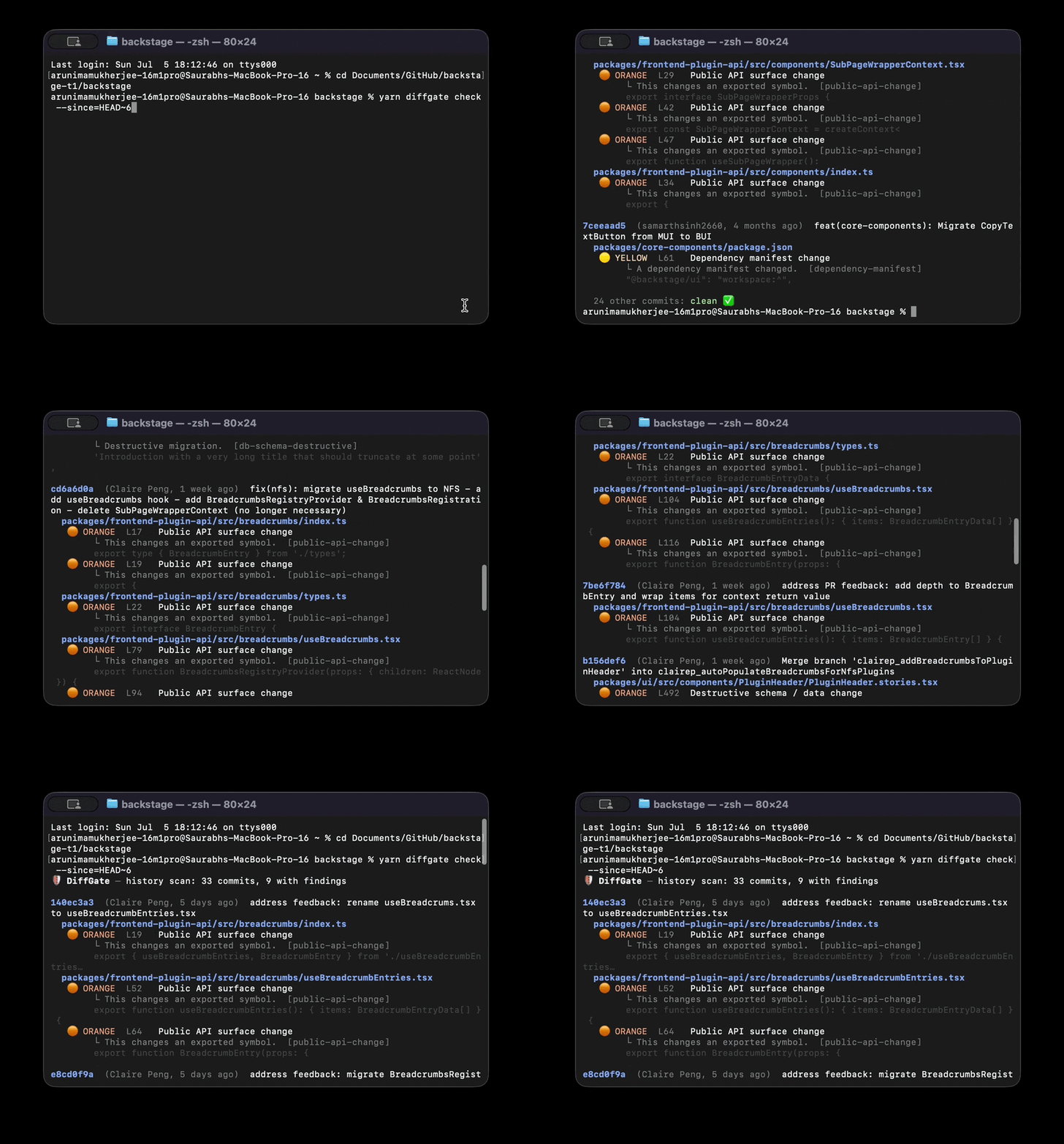
diffgate check --since=HEAD~20   # see what it catches in your own history — no PR required
diffgate check                   # review your pending changes right now
No git history or uncommitted changes yet? See the output on bundled examples first:
diffgate init --demo # live scan, no config or git changes needed
The surfaces (one shared engine, one verdict)
1. In your coding agent (via MCP)
The highest-leverage spot: the agent self-checks generated code before it's written to disk, gets back structured findings (zero LLM tokens), and surfaces what it corrected (original + fix + why) instead of silently rewriting. A trustworthy, deterministic self-check is what makes it safe to grant the agent more autonomy.
# Claude Code — one command:
claude mcp add diffgate -- diffgate mcp

# One-click via Smithery (zero config):
npx @smithery/cli install diffgate-review --client claude

# Cursor — add to MCP settings:
# { "diffgate": { "command": "diffgate", "args": ["mcp"] } }
Or one-click in Claude Desktop: download diffgate.mcpb and open it. The server also exposes prompts and resources; see MCP.md.
2. In your editor (VS Code / Cursor)
Inline squiggles on changed lines, hover cards (why · who owns it · quick-fix), a Risk Review tree, a status-bar summary, and Deep Review (agentic blast-radius analysis for orange findings). The same verdict you'd get from the CLI, on the diff you're reviewing.
Install from the VS Code Marketplace or Open VSX (Cursor / Windsurf / Gitpod).
3. On the command line — and in CI
diffgate check reviews your diff and exits non-zero on high-impact findings: a pre-commit hook locally, the same gate in your pipeline.
diffgate install-hook # adds .git/hooks/pre-commit; only runs tests on 🟠 orange changes
The local loop is the wedge — fix while the context is fresh — and the same engine runs as a PR gate so the verdict carries to where it's enforced for the whole team. See docs/TEAM.md for the GitHub Action, shared learnings, and org policy packs. CI runs can optionally layer an external scanner (Semgrep) through the same gate for broader language coverage — advisory-only, off by default (docs/CONFIG.md).
Common commands:
diffgate check                 # review pending changes (the gate)
diffgate check --staged        # staged-only (pre-commit)
diffgate check --since=HEAD~20 # audit recent history, per-commit (see below)
diffgate check --agent         # machine verdict for coding agents
diffgate scan <path>           # analyze files directly (no git needed)
diffgate watch                 # live review as you edit
diffgate guidelines            # review diff against AGENTS.md / CLAUDE.md etc.
diffgate feedback <rule> <f> <l> --dismiss   # suppress a false positive (shared via git)
diffgate mcp                   # start the MCP stdio server
Audit recent AI-authored history. Point check at commits already in your log — each
finding is attributed to a specific commit, so you get a story, not a repo-wide report card:
diffgate check --since=HEAD~20        # last 20 commits, one block per commit
diffgate check --since="2 weeks ago"  # by date instead of a rev
diffgate check --ai-authored          # only agent commits (Claude/Copilot/Cursor/… — heuristic)
diffgate check --author="Claude"      # matches author *and* Co-authored-by trailers
diffgate check <sha>                  # a single commit by hash
History mode is report-only (it audits the past — it never runs your test command or blocks a
commit) and honors --json and --limit=<n> (default 50). Merge commits are skipped.
Run diffgate --help for the full list (report, bench, stats, graph, marginal, …).
How it works
- Diff-aware:
git diff(CLI) or an in-memory LCS diff (editor, accurate on unsaved buffers) finds changed lines; findings only report on those lines. - Real AST where it counts:
@babel/parser(JS/TS) and tree-sitter (Python, PHP, Go, Ruby, Java, C#, Kotlin — via WASM, no native build) power precise rules: deprecated calls aren't matched inside comments or strings, exported-signature changes are detected structurally, and SQL injection is sink-targeted, parameter-aware, and sanitizer-aware —cur.execute(f"… {uid}")/$pdo->query("… $id")block, whilecur.execute("… %s", (uid,)),$pdo->prepare("… ?"), a single-quoted'… $id', and aSELECTin a log line don't. - A deterministic floor everywhere else: comment-aware pattern rules for secrets, destructive/schema changes, auth/crypto, dynamic execution / shell-out, raw queries, and network calls across Go, Java, Ruby, and any text. Commented-out code (
# os.system(x)) isn't flagged; a secret committed inside a comment still is. Docs/prose files (.md,.rst, …) are held to the same standard: the word "oauth2-provider" in a changelog isn't auth code, but a key pasted in a README is still a leak. - Earned blocking: broad cross-language injection advisories for the non-AST languages (Ruby
#{}, Go/Ruby shell-out) escalate to blocking only when the optional code graph proves reachability from an untrusted entry point — community CodeGraph, no Pro taint engine required. (JS/TS, Python, and PHP block on local AST evidence and don't need this.) - The gate: on a high-impact change, DiffGate runs your
testCommandand shows the actual exit code and output. - Learnings:
diffgate feedbackrecords dismiss/confirm verdicts; dismissed findings (same rule + same code) are suppressed everywhere. Stored in.diffgate/learnings.json; commit it to share across the team. - Optional add-ons: a provider-agnostic AI layer (plain-English explanations + fixes) and a cross-file blast-radius pass via an optional code graph. Both are off by default and degrade gracefully to a no-op.
Engine layout: src/core (shared) · src/cli.ts (CLI) · src/mcp.ts (MCP) · extension/ (VS Code).
Coverage scales with language
How deeply DiffGate analyzes a change depends on the file's language — be explicit about this so you can calibrate how much to trust a clean result.
| Tier | Languages | Depth |
|---|---|---|
| Deep (AST) | JS / TS (@babel) |
All injection classes + public-API & signature changes + deprecated-API quick-fixes. Prototype pollution and NoSQL injection are JS/TS-only; JS/TS findings are also eligible for code-graph taint confirmation. |
| Deep (AST) | Python, PHP, Go, Ruby, Java, C#, Kotlin (tree-sitter) | Sink-targeted, parameter- and sanitizer-aware injection detection — placeholders, argument-vectors, and escapers are correctly treated as safe. Sink classes per language below. |
Sink classes per Deep-AST language (full detail — every sanitizer and safe-form, plus the code-graph boundary — in docs/SCOPE.md):
- Python (7) — SQL · XSS · path traversal · CORS · command · code · deserialization
- PHP (8) — SQL · command · code · file inclusion · deserialization · XSS · path traversal · CORS
- Go (4) — SQL · command · path traversal · CORS
- Ruby (6) — SQL · command · code · deserialization · XSS · CORS
- Java (6) — SQL · command · deserialization · path traversal · XXE · CORS
- C# (7) — SQL · command · deserialization · path traversal · XSS · XXE · CORS
- Kotlin (6) — SQL · command · deserialization · path traversal · XXE · CORS
SSRF is a cross-language advisory across all eight Deep-AST languages (a request-tainted URL into an outbound-request sink; library-qualified and tainted-only, so static/config URLs aren't flagged). XXE covers the JVM (Java, Kotlin) and .NET (C#), suppressed when the file shows recognized hardening. Permissive CORS now also covers all eight — wildcard Access-Control-Allow-Origin, allow-all framework configs (gin/rs-cors, Spring @CrossOrigin, ASP.NET AllowAnyOrigin(), Ktor anyHost(), rack-cors), and request-reflected origins; explicit allowlists aren't flagged.
| Tier | Languages | Depth |
|---|---|---|
| Floor (pattern) | C/C++, Rust, Swift, Scala, … | Secrets, destructive/schema changes, auth/crypto, dynamic exec / shell-out, raw queries, network calls, TODO. Cross-language injection advisories that escalate via the code graph. |
| Text | YAML, Terraform, JSON, any text | Secrets and TODO/FIXME markers. |
Fast by design — and scoped to match. A review runs in milliseconds on the changed lines, which is exactly what lets the same check sit in the agent and editor inner loop. That speed is a deliberate trade: DiffGate is the deterministic gate on the diff, not an exhaustive whole-repo taint engine. Coverage is per-language (deep where there's an AST, a pattern floor elsewhere), the security rules are tuned to the residue agents actually ship rather than to maximize raw rule count, and a clean result means "nothing matched at this language's tier," not "proven safe." For deep cross-file taint analysis across many languages, pair it with a dedicated SAST. Full per-language detail and the code-graph boundary: docs/SCOPE.md.
Configuration
diffgate init writes a tailored .diffgate.json at your repo root. Minimal example:
{
  "testCommand": "npm test",          // run for orange changes (the gate)
  "gate": { "mode": "working", "failOn": "orange" },
  "deprecated": [
    { "pattern": "StripeClient.charge", "replacedBy": "StripeClient.createPaymentIntent" }
  ]
}
Any rule — built-in or custom — can be path-scoped with include/exclude globs, the escape hatch for the one file where a forbidden idiom is legitimate (e.g. process.env inside the config loader itself). Full schema, the built-in rule table, LLM providers, and per-rule tuning: docs/CONFIG.md.
More
- The PR was reviewed. The risky line wasn't. — our PR-trail study: 350 merged AI-assisted PRs, 109 with flagged AI-attributed changes, 3 with public human discussion beyond the author.
- docs/SCOPE.md: per-language coverage tiers (deep AST vs. pattern vs. text-only) and what the code graph does and doesn't do.
- docs/CONFIG.md: full
.diffgate.jsonschema, all built-in rules, LLM providers, native precision & test-scope behavior. - docs/TEAM.md: rolling DiffGate out to a team (GitHub Action / PR gate, shared learnings, org-wide policy packs, SOC 2 evidence, metrics for leaders).
- docs/CODE-GRAPH.md: optional cross-file blast radius (caller counts, suggested reviewers, test gaps, reachability, taint analysis).
- docs/STRUCTURAL-RULES.md: the
structuralpack — over-engineering rather than vulnerabilities (needless abstractions, pass-through wrappers, complexity spikes), all non-blocking, with per-language thresholds. - docs/MEASUREMENT.md: what agents actually ship unprompted and how to reproduce it (
diffgate marginal). - MCP.md: MCP tools, prompts, resources, and AI configuration.
Try it
diffgate scan mock_project
You'll see green findings (logging), yellow findings (a deprecated call), and orange findings (a DROP COLUMN migration, a public export).
Tests
npm test # builds the extension, runs the full unit/integration suite + extension smoke test
Support the project
If DiffGate caught something for you — or you just like the idea of a deterministic gate for agent code — star the repo ⭐. It's the signal that tells other people this is worth trying.
- 🐛 Found a false block, or a sink it missed? Open an issue — a false block is a bug we treat as P0.
- 💡 Want a language or rule covered? File a feature request with the idiom you'd like caught.
- 🔒 Security report? Please disclose privately — see SECURITY.md.
Contributing & License
See CONTRIBUTING.md. Apache 2.0; see LICENSE.
Questions sur DiffGate MCP
Comment ajouter DiffGate MCP à Claude Code ?
Exécutez claude mcp add diffgate -- npx -y diffgate-review dans votre terminal. Ajoutez --scope user pour le rendre disponible dans tous les projets.
Comment ajouter DiffGate MCP à Cursor ?
Ouvrez ~/.cursor/mcp.json et ajoutez le serveur sous mcpServers, avec la configuration Cursor indiquée dans la section d'installation ci-dessus.
Est-ce que DiffGate utilise des tokens LLM pour ses vérifications ?
Non, DiffGate fournit des résultats structurés via un moteur déterministe qui ne nécessite aucun token LLM.
Comment DiffGate gère-t-il les faux positifs et le bruit ?
Il utilise des analyses limitées au diff pour ne signaler que les lignes modifiées et emploie un système de triage par niveaux (Green, Yellow, Orange) pour décider ce qui nécessite une attention particulière.
DiffGate peut-il exécuter mes tests existants ?
Oui, lors de changements à fort impact (orange), DiffGate peut exécuter votre commande de test spécifiée et afficher le résultat.