
Обеспечивает локальный гибридный поиск по ключевым словам и векторам в markdown-заметках и коде для создания долгосрочной памяти ИИ.
Также известен как GitGudatCodeing/claude-second-brain, claude-second-brain
- Звёзды
- 1
- Инструменты
- —
- Загрузки, 30 дней
- —
- Последняя версия
- 0.4.2
- Последний коммит
- 7 нояб. 2026 г.
- Лицензия
- MIT
Что такое vault-index MCP?
vault-index — это MCP server. Обеспечивает локальный гибридный поиск по ключевым словам и векторам в markdown-заметках и коде для создания долгосрочной памяти ИИ.
Сводка сгенерирована из README проекта
О vault-index MCP server
vault-index предоставляет локальное и приватное решение для долгосрочной памяти, разработанное специально для Claude Code. Оно позволяет пользователям поддерживать «второй мозг», индексируя markdown-заметки и код с помощью механизма гибридного поиска, который сочетает в себе ключевые слова и векторный поиск. Эта система гарантирует, что ваша информация остается в человекочитаемых markdown-файлах, а не запирается в закрытой базе данных, что упрощает редактирование, версионирование и аудит.
Сервер полностью работает на вашем локальном устройстве, используя один файл SQLite и небольшие модели для CPU, не требуя облачных сервисов или внешних API ключей. Он использует FTS5 для поиска по ключевым словам и sqlite-vec для векторного поиска, что дополнительно усиливается cross-encoder MiniLM-L6 для переранжирования результатов. Разработчики могут управлять своими знаниями с помощью специальных инструментов, таких как index_paths, search_notes и get_note, чтобы извлекать точную информацию из своих локальных хранилищ.
Что вы можете с ним делать
- 1Извлечение решений по прошлым проектамПросите ИИ найти конкретные архитектурные решения или уроки, извлеченные из предыдущих рабочих сессий.
- 2Документирование технических уроковФиксируйте конкретные технические ошибки или успехи в качестве проверяемых директив внутри вашей документации.
Взято из README проекта. Каждый вариант использования проверен на соответствие цитате из него.
Как установить vault-index MCP
Форматы проверены 10 ноя 2026Установка vault-index MCP в Claude Code
$ claude mcp add claude-second-brain -- uvx vault-indexУстановка vault-index MCP в Cursor
~/.cursor/mcp.json
{
  "mcpServers": {
    "claude-second-brain": {
      "command": "uvx",
      "args": [
        "vault-index"
      ]
    }
  }
}Установка vault-index MCP в VS Code
.vscode/mcp.json
{
  "servers": {
    "claude-second-brain": {
      "type": "stdio",
      "command": "uvx",
      "args": [
        "vault-index"
      ]
    }
  }
}Установка vault-index MCP в Claude Desktop
claude_desktop_config.json
{
  "mcpServers": {
    "claude-second-brain": {
      "command": "uvx",
      "args": [
        "vault-index"
      ]
    }
  }
}Установка vault-index MCP в Codex
~/.codex/config.toml
[mcp_servers.claude-second-brain]
command = "uvx"
args = ["vault-index"]
Установка vault-index MCP в Gemini CLI
~/.gemini/settings.json
{
  "mcpServers": {
    "claude-second-brain": {
      "command": "uvx",
      "args": [
        "vault-index"
      ]
    }
  }
}Конфигурация
VAULT_INDEX_DBPath to the SQLite index file (default ~/.mcp-memory/vault-index.db)
VAULT_MODEL_CACHEEmbedding model cache folder (default ~/.mcp-memory/models)
VAULT_RERANKSet to 0 to turn off the cross-encoder rerank of the top 10 results
| Название | Описание | Тип |
|---|---|---|
| VAULT_INDEX_DB | Path to the SQLite index file (default ~/.mcp-memory/vault-index.db) | |
| VAULT_MODEL_CACHE | Embedding model cache folder (default ~/.mcp-memory/models) | |
| VAULT_RERANK | Set to 0 to turn off the cross-encoder rerank of the top 10 results |
Автоматические проверки
Запущено 13 нояб. 2026 г.Полный отчёт →Прошло наши автоматизированные проверки. Это не аудит безопасности: изучите код и предоставьте серверу минимально необходимый доступ. Как работают проверки

- Связанный и доступный исходный репозиторийgitgudatcodeing/claude-second-brain is public and reachablegithub.com/gitgudatcodeing/claude-second-brain ↗Пройдено
- Пакет указывает этот репозиторий как источникvault-index names gitgudatcodeing/claude-second-brain as sourcepypi.org/project/vault-index/ ↗Пройдено
- Происхождение сборки (аттестация Sigstore)Sigstore attestation for vault-indexpypi.org/project/vault-index/ ↗Пройдено
- Open source лицензия (OSI)MITspdx.org/licenses/MIT.html ↗Пройдено
- Коммит или релиз за последний годLast commit or release 2026-11-07github.com/gitgudatcodeing/claude-second-brain ↗Пройдено
- OpenSSF ScorecardНе проверялось
- Имя пакета не похоже на популярный пакетNo popular package one edit away from vault-indexПройдено
- Нет критических уязвимостей в пакете и зависимостях51 resolved dependencies checked; no critical advisoryosv.dev ↗Пройдено
- Нет скрытых инструкций для модели0 tool descriptions and the README read; no override phrases, credential paths or hidden charactersПройдено
- Деструктивные инструменты помеченыНе проверялось
- Удалённый endpoint отвечает на MCP handshakeНе проверялось
README
Открыть на GitHubclaude-second-brain




A local, private long-term memory for Claude Code. Your markdown notes stay the record. Claude searches them through a hybrid keyword + vector index, writes decisions and lessons back as plain files, and hooks keep the index, the knowledge graph and long sessions in check.
Everything runs on your machine: one SQLite file, two small CPU models, no cloud services.
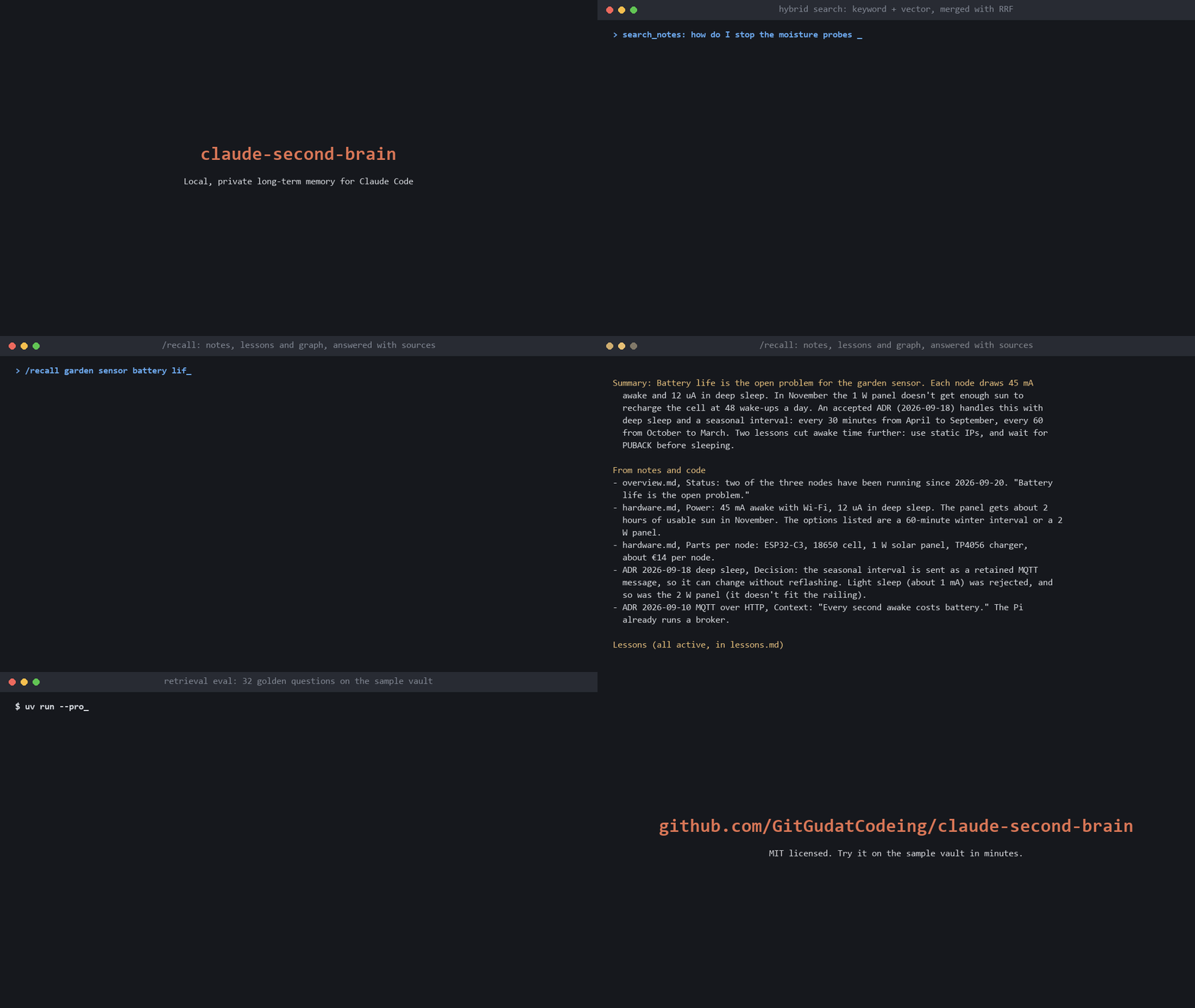
Terminal replay of real output from a fresh clone of v0.1.0 with the sample vault (eval then had 32 questions); only the typing animation is added.
Why
Claude Code forgets everything between sessions. The usual fixes are a huge CLAUDE.md (expensive on every turn) or a vector store nobody can read or fix. This project takes a different line:
- Files are the truth. Notes, decision records and lessons are markdown you can read, edit and version. The index and the graph can be rebuilt from them at any time.
- Search before guessing. Claude is told to search the vault before answering about past work, and gets a tool that actually finds paraphrased answers.
- Measured, not vibes. Every search change is scored against a golden set and kept only if it beats the baseline. The experiments that failed are documented too.
- Self-checking. At session start, invariants verify that each pipeline still reaches its consumer, so silent breakage shows up the same day.
How it works
flowchart LR
    subgraph files["Markdown files: the record"]
        notes["notes/"]
        adr["docs/adr/"]
        lessons["docs/lessons.md"]
        handoffs["docs/handoffs/"]
    end

    cc["Claude Code"]
    vi["vault-index MCP server<br/>mcp/server.py"]
    db[("vault-index.db<br/>FTS5 + sqlite-vec")]
    mem["memory MCP server"]
    kg[("memory.jsonl<br/>entities and relations")]

    cc -- "Write / Edit" --> files
    cc -- "PostToolUse hook<br/>reindex_hook.py" --> db
    cc -- "search_notes, get_note" --> vi
    vi --> db
    files -- "index_paths" --> db
    cc -- "search_nodes" --> mem
    mem --> kg
    kg -. "each fact names its source file" .-> files
| Hook | Script | What it does |
|---|---|---|
| SessionStart | scripts/invariants.py --hook |
10 checks: MCP servers launchable, graph sources exist, index fresh, hooks wired, golden labels valid, lessons well-formed, context budget. |
| PostToolUse (Write, Edit) | mcp/reindex_hook.py |
Re-indexes the edited file if it sits under a registered source. Never blocks. |
| UserPromptSubmit, PostToolUse (async) | scripts/context_guard.py |
Reads the real context size from the transcript. Silent until 250k tokens (.claude/handoff.json), then requires /handoff: a note plus a card to start the fresh session. On every prompt, and once per session mid-turn. |
| PreCompact | scripts/precompact_snapshot.py |
Saves recent requests and touched files to docs/handoffs/auto/ as a fallback before compaction. |
Search
flowchart LR
    q["query"] --> sw["drop stopwords"] --> fts["FTS5 bm25<br/>top 4 x limit"]
    q --> emb["embed with<br/>bge-small-en-v1.5"] --> vec["sqlite-vec kNN<br/>top 4 x limit"]
    fts --> rrf["reciprocal rank fusion<br/>k = 60, keyword weight 0.1"]
    vec --> rrf
    rrf --> rr["cross-encoder rerank<br/>top 10, MiniLM-L6"]
    rr --> out["top chunks with<br/>file path and heading path"]
- Markdown is chunked by heading (up to about 1,200 characters), so every hit carries a path like
Recipe box data model > Units. - Indexing is incremental: unchanged files are skipped by mtime and content hash; deleted files are dropped on the next sync.
- Keyword ranks count at a tenth of vector ranks: they break ties and lift exact terms (ids, tool names) without outvoting meaning.
- A small cross-encoder (
ms-marco-MiniLM-L-6-v2, 80 MB) then reorders the top 10 by reading query and chunk together. It adds about 200 ms per search on CPU;VAULT_RERANK=0turns it off. - A per-folder
.indexignorekeeps tooling code out of results.
MCP tools: index_paths, search_notes, get_note, list_sources, remove_source.
Commands
| Command | What it does |
|---|---|
/recall <topic> |
Searches notes, lessons and the graph together and answers with clickable sources. Read-only. |
/adr <title> |
Writes a decision record to docs/adr/ and links it in the graph. |
/learn <what happened> |
Records a lesson as a testable directive (scripts/learn.py): lesson, cause, how to detect it. Supersede or retire, never delete. |
/ingest <path> |
Indexes a file or folder and adds its durable entities to the graph. |
/handoff [topic] |
Writes a handoff note and starts a fresh session from it. |
Installed as a plugin, the commands carry its name: /second-brain:recall, /second-brain:adr and so on.
Quickstart
Needs uv (it fetches Python 3.10 to 3.13), Node.js for the memory server, and Claude Code.
As a plugin
In the folder that holds your notes:
claude plugin marketplace add GitGudatCodeing/claude-second-brain
claude plugin install second-brain@second-brain --scope project
Start claude there, then ask it to index the folder ("index_paths .") and try /second-brain:recall <topic>. The plugin brings the five commands, the hooks (re-index on edit, context guard, pre-compact snapshot) and both MCP servers. Decision records go to docs/adr/, lessons to docs/lessons.md, handoffs to docs/handoffs/, and the knowledge graph to memory.jsonl, all inside that folder. The search index is shared at ~/.mcp-memory/vault-index.db.
--scope project keeps the plugin to that folder: the context guard would otherwise run in every project. The plugin leaves out the session-start invariants, which check this repo's layout. Change the handoff limit with a .claude/handoff.json like this repo's (default 250k tokens).
Use the plugin or the clone below in a folder, not both: each starts its own vault-index server.
From a clone
The full repo adds the sample vault, the eval and the invariants.
git clone https://github.com/GitGudatCodeing/claude-second-brain.git
cd claude-second-brain
uv run --project mcp python scripts/setup.py
setup.py writes .mcp.json (memory graph at ~/.mcp-memory/memory.jsonl unless you pass --memory-file), indexes the folder and runs the invariants. Then start claude in the folder, approve the project MCP servers and hooks, and try /recall garden sensor battery life. Check the wiring any time with python scripts/invariants.py.
Your own notes go in notes/. Delete example-vault/ when you no longer need the eval, and update eval/golden.jsonl with questions about your own notes.
On Windows, Claude Code runs hooks through Git Bash; the hook commands already use forward slashes.
Just the search server
vault-index is on PyPI and in the MCP registry. To use the hybrid search on any folder of notes without the rest of this repo:
claude mcp add vault-index -- uvx --python 3.12 vault-index
Then ask Claude to index a folder (for example "index_paths ~/notes") and search it with search_notes.
It also works from a terminal. Indexing a large vault there first shows progress and keeps Claude's first tool call short:
uvx --python 3.12 vault-index index ~/notes        # no paths re-syncs every source
uvx --python 3.12 vault-index search "your question" -n 5
uvx --python 3.12 vault-index sources
uvx --python 3.12 vault-index --help
With no command it serves MCP over stdio. The index lives in ~/.mcp-memory/vault-index.db. To move it, set VAULT_INDEX_DB in your shell environment rather than only in the MCP config, so the server, the re-index hook and the invariants all use the same file. --python 3.12 keeps uvx off newer Pythons that the embedding runtime does not support yet.
Retrieval eval
example-vault/ is a fictional person's notes, decisions and lessons. eval/golden.jsonl has 44 questions about it and about this repo's own docs, worded differently from the notes on purpose, so keyword overlap alone does not find most answers. The last 12 are hard paraphrases that share almost no words with their answer. (Keep golden questions out of indexed files like this README, or they compete with the real answers.)
VAULT_INDEX_DB=/tmp/csb-eval.db uv run --project mcp python eval/run_eval.py --modes all -v
| Mode | NDCG@5 | MRR | Recall@5 |
|---|---|---|---|
hybrid + rerank (what search_notes serves) |
0.747 | 0.797 | 0.780 |
| hybrid, fusion only (no rerank) | 0.686 | 0.724 | 0.758 |
| keyword only (FTS5) | 0.491 | 0.544 | 0.576 |
| vector only | 0.697 | 0.729 | 0.758 |
| naive grep, no index (baseline) | 0.305 | 0.341 | 0.375 |
The grep row ranks chunks by how many query words they contain, roughly what searching with rg per word gives you.
Without the reranker, vector-only edged out fusion on the sample vault (the hard paraphrases give keywords nothing to match); the reranker puts hybrid back on top. On the author's private vault (41 questions) the order is the same: hybrid + rerank 0.550, fusion only 0.487, vector 0.473, keyword 0.433, grep 0.327.
Compared with basic-memory
basic-memory is a popular markdown memory MCP server with its own hybrid search. eval/compare_basic_memory.py runs it (v0.24.1, same bge-small model) on a copy of the same markdown files and scores both on the same 44 questions. basic-memory returns whole notes, so both are scored per file here (vault-index chunks collapsed to their file):
| System (file level) | NDCG@5 | MRR | Recall@5 |
|---|---|---|---|
| vault-index hybrid + rerank | 0.829 | 0.858 | 0.886 |
| basic-memory, default search | 0.619 | 0.611 | 0.750 |
| basic-memory, vector only | 0.708 | 0.736 | 0.814 |
basic-memory does much more than search (it writes notes, builds a graph from them, offers cloud sync); this compares retrieval only. Its default search varied by about 0.005 between runs. It is not run in CI.
CI fails if any hybrid metric drops more than 0.03 below eval/baseline.json. Scores are identical on Ubuntu and Windows.
What worked and what did not
Each change tested alone against a saved baseline, mostly on the author's private vault:
| Change | Effect on NDCG@5 | Kept |
|---|---|---|
| Cross-encoder rerank of the top 10 (MiniLM-L6, 80 MB) | sample +0.061, private +0.063 | yes: about 200 ms per search |
| Larger rerankers (MiniLM-L12, Jina v1 tiny/turbo, bge-reranker-base) | mixed: some lost on the sample set | no |
| Keyword weight 0.1 in the fusion (was 1.0) | private +0.037, sample +0.066 | yes |
Exclude tooling code (.indexignore) |
+0.063 | yes |
| Drop stopwords from the FTS query | +0.018 | yes |
| all-MiniLM-L6-v2 instead of bge-small | -0.024 | no |
| Weight headings higher in bm25 (x2 to x10) | -0.015 to -0.036 | no |
| bge-base + query prefix (768 dims) | +0.030, about one question | no: 3x the model for noise-level gain |
With equal weights, vector-only beat hybrid on the sample vault while hybrid won on the private one (jargon needs keywords). A sweep of keyword weight by RRF k on both sets found one setting that wins on both; vector-only is still worse on the private vault, so keywords stay in at a low weight. Details in docs/adr/.
Repository layout
mcp/            vault-index MCP server and re-index hook
scripts/        invariants, learn.py, context guard, pre-compact snapshot
eval/           golden set, baseline, run_eval.py, compare_basic_memory.py
tests/          pytest suite (fake embedder, no model download)
example-vault/  fictional sample notes for the eval
docs/adr/       decision records for this system
docs/lessons.md lessons learned while building it
.claude/        slash commands, hook settings, handoff thresholds
plugin/         the Claude Code plugin, built from the files above
.claude-plugin/ marketplace listing the plugin
Development
uv run --project mcp --with pytest pytest tests -q
uvx ruff check .
The tests use a fake bag-of-words embedder, so they run in about a second. CI runs lint, tests, the retrieval eval and the invariants on Ubuntu and Windows for every push. See CONTRIBUTING.md.
Status
Early and opinionated: built for one person's daily use, then generalised. Tested day to day on Windows 11 with the Claude desktop app; CI covers Ubuntu and Windows. The portable hook commands ($CLAUDE_PROJECT_DIR) pass the invariants in CI but have not yet run in a live session on macOS or Linux.
License
Вопросы о vault-index MCP
Как добавить vault-index MCP в Claude Code?
Выполните claude mcp add claude-second-brain -- uvx vault-index в терминале. Добавьте --scope user, чтобы сервер был доступен во всех проектах.
Как добавить vault-index MCP в Cursor?
Откройте ~/.cursor/mcp.json и добавьте сервер в mcpServers, используя конфигурацию Cursor из раздела установки выше.
Требует ли этот сервер облачных сервисов?
Нет, всё работает локально на вашем устройстве с использованием одного файла SQLite и легковесных моделей для CPU.