
MCP server DiffGate
✓ VerificadoFornece uma barreira de proteção determinística para agentes de codificação, realizando verificações de segurança e manutenibilidade com escopo de diff antes que o código seja gravado no disco.
Também conhecido como srbsa/diffgate, diffgate-review
- Stars
- 5
- Ferramentas
- —
- Downloads, 30 dias
- —
- Versão mais recente
- 0.8.0
- Último commit
- 27 de jul. de 2026
- Licença
- Apache-2.0
O que é o MCP DiffGate?
DiffGate é um MCP server. Fornece uma barreira de proteção determinística para agentes de codificação, realizando verificações de segurança e manutenibilidade com escopo de diff antes que o código seja gravado no disco.
Resumo gerado a partir do README do projeto
Sobre o MCP server de DiffGate
O DiffGate atua como uma barreira de proteção determinística para agentes de codificação, realizando verificações de segurança e manutenibilidade especificamente nas linhas alteradas antes que o código seja gravado no disco. Diferente de bots de revisão tradicionais que são acionados durante um pull request ou hooks de pre-commit que rodam após o agente concluir sua tarefa, esta ferramenta funciona como um agent hook via MCP. Isso permite que um cliente de IA receba descobertas estruturadas em milissegundos e corrija problemas enquanto o contexto ainda está ativo, utilizando zero tokens de LLM para a própria avaliação.
O sistema utiliza uma abordagem de triagem em camadas para minimizar o ruído, categorizando as mudanças como green para merges seguros, yellow para revisões manuais ou orange para itens de alto impacto que exigem verificação. Para descobertas orange, o motor pode executar seletivamente o seu testCommand específico para validar a mudança. Ele foi projetado para desenvolvedores que utilizam agentes como Claude Code ou Cursor, fornecendo um veredito consistente em todo o loop do agente, editores locais e pipelines de CI. A ferramenta utiliza parsing baseado em AST para linguagens como JavaScript, TypeScript, Python e Go para garantir precisão na detecção de problemas como SQL injection ou segredos hardcoded.
O que você pode fazer com ele
- 1Redução de duplicidade e complexidade de códigoDesenvolvedores podem usar a regra reinvented-helper para impedir que agentes recriem funções existentes em vez de reutilizá-las.
- 2Automação de verificação de mudanças de alto impactoO sistema pode acionar automaticamente sua suíte de testes existente apenas quando uma mudança for sinalizada como de alto impacto ou orange.
Escrito a partir do README do projeto. Cada caso de uso é verificado com uma citação dele.
Como instalar o MCP DiffGate
Formatos verificados em 10 nov 2026Adicionar ao CursorAdicionar ao GooseInstalar o MCP DiffGate no Claude Code
$ claude mcp add diffgate -- npx -y diffgate-reviewInstalar o MCP DiffGate no Cursor
~/.cursor/mcp.json
{
  "mcpServers": {
    "diffgate": {
      "command": "npx",
      "args": [
        "-y",
        "diffgate-review"
      ]
    }
  }
}Instalar o MCP DiffGate no VS Code
.vscode/mcp.json
{
  "servers": {
    "diffgate": {
      "type": "stdio",
      "command": "npx",
      "args": [
        "-y",
        "diffgate-review"
      ]
    }
  }
}Instalar o MCP DiffGate no VS Code CLI
$ code --add-mcp '{"name":"diffgate","type":"stdio","command":"npx","args":["-y","diffgate-review"]}'Instalar o MCP DiffGate no Claude Desktop
claude_desktop_config.json
{
  "mcpServers": {
    "diffgate": {
      "command": "npx",
      "args": [
        "-y",
        "diffgate-review"
      ]
    }
  }
}Instalar o MCP DiffGate no Codex
$ codex mcp add diffgate -- npx -y diffgate-reviewInstalar o MCP DiffGate no Codex config.toml
~/.codex/config.toml
[mcp_servers.diffgate]
command = "npx"
args = ["-y", "diffgate-review"]
Instalar o MCP DiffGate no Gemini CLI
$ gemini mcp add -s user diffgate npx -- -y diffgate-reviewInstalar o MCP DiffGate no Gemini settings.json
~/.gemini/settings.json
{
  "mcpServers": {
    "diffgate": {
      "command": "npx",
      "args": [
        "-y",
        "diffgate-review"
      ]
    }
  }
}Verificações automatizadas
Executado em 15 de nov. de 2026Relatório completo →Passou em nossas verificações automatizadas. Isso não é uma auditoria de segurança: leia o código e dê ao servidor o acesso mais restrito de que ele precisa. Como as verificações funcionam

- Repositório de origem vinculado e acessívelsrbsa/diffgate is public and reachablegithub.com/srbsa/diffgate ↗Passou
- O pacote indica este repositório como sua origemdiffgate-review names srbsa/diffgate as sourcenpmjs.com/package/diffgate-review ↗Passou
- Proveniência da build (atestação Sigstore)Sigstore attestation for diffgate-reviewnpmjs.com/package/diffgate-review/v/0.8.0#provenance ↗Passou
- Licença de código aberto (OSI)Apache-2.0spdx.org/licenses/Apache-2.0.html ↗Passou
- Commit ou release no último anoLast commit or release 2026-07-28github.com/srbsa/diffgate ↗Passou
- OpenSSF ScorecardNão verificado
- Nome do pacote não é próximo a um pacote popularNo popular package one edit away from diffgate-reviewPassou
- Nenhum aviso crítico no pacote ou em suas dependências31 resolved dependencies checked; no critical advisoryosv.dev ↗Passou
- Sem instruções ocultas para o modelo0 tool descriptions and the README read; no override phrases, credential paths or hidden charactersPassou
- Ferramentas destrutivas estão rotuladasNão verificado
- O endpoint remoto responde ao handshake do MCPNão verificado
README
Ver no GitHubDiffGate






A deterministic guardrail your coding agent runs on itself — before the code reaches your disk.
Every other check fires too late. A review bot needs a PR. A pre-commit hook runs after the agent has finished and moved on. DiffGate is an agent hook: your agent calls it over MCP, gets back structured findings in milliseconds for zero LLM tokens, and fixes the problem while it still has the context — then the same engine, same verdict runs in your editor, your pre-commit hook, and CI. Not a model grading its own homework: the same input always produces the same answer.
It stays quiet by construction. It grades only the lines that changed (🟢 merge · 🟡 glance · 🟠 verify), runs your tests only when a change earns it, and blocks only when it's earned — 0 false blocks on a public, versioned corpus you can rerun yourself with diffgate bench (BENCHMARK.md). Everyone claims low noise; this one ships the corpus.
Across local and frontier models: 0% classic OWASP bugs (SQL injection, XSS, hardcoded secrets) in code written from scratch. But the same frontier model that wrote flawless greenfield code reintroduced security footguns in 13% of edits — an unguarded recursive merge (prototype pollution), a bare cors() (any origin), a path built from request data with no containment check. Editing existing code is most of what an agent does, and the residue lives in the diff, not in the textbook. Rerun it yourself with diffgate marginal. The measurement →
The same shift shows up in third-party maintainability data: GitClear's 2026 analysis finds block duplication up 81% since 2023 (40.3 → 73.0 per million changed lines) and cross-file function connectivity down 35% — agents reinvent code rather than reuse it. That's what the reinvented-helper rule is for (docs/STRUCTURAL-RULES.md).
| Tier | Meaning | What you do | Examples |
|---|---|---|---|
| 🟢 Green | Safe / self-contained | merge freely | comments, local logging |
| 🟡 Yellow | Review (soft dependency) | take a look | deprecated APIs, raw SQL, network calls, dependency edits |
| 🟠 Orange | High-impact, gate it | verify before merge | schema/migrations, hardcoded secrets, auth/crypto, public-API changes, injection sinks |
Why an agent hook, not another review bot
Every check in the pipeline fires after the code exists, and each one is later than the last:
| Fires when | Problem | |
|---|---|---|
| Review bot (CodeRabbit, Greptile) | a PR exists | the code is finished, defended, and someone is waiting on it |
| Pre-commit hook | you're done and committing | the agent has moved on; you're re-loading context to fix it |
| DiffGate over MCP | the agent is still writing | it fixes its own output before the code lands |
Being early is not the only thing that matters, though — it has to be quiet, or the agent learns to ignore it. Review bots comment after the PR exists; linters and scanners flag everything they see. Neither guarantees the risky line gets discussed: we scanned 350 merged AI-assisted PRs — of the 109 with flagged AI-attributed changes, only 3 drew public discussion from any human besides the author. DiffGate decides what deserves your attention, your tests, or a block, and stays quiet otherwise. That's the whole product:
- Diff-scoped. Findings report only on the lines that changed, against the committed baseline — no whole-file noise, no re-litigating code you didn't touch.
- Tiered triage, not a flat list. Three tiers route attention: green merges, yellow is a glance, orange is gated.
- The gate runs your tests — selectively. On an orange change, DiffGate runs your
testCommandand shows the real exit code and output. Green and yellow pass instantly. The pre-commit hook is fast because tests fire only when a change is genuinely high-impact. - Earns the right to block. Broad cross-language injection findings stay advisory on their own; they escalate to a blocking finding only when the optional code graph proves the sink is reachable from an untrusted entry point (an HTTP/event handler). Recall from the rules, the right to block from the graph.
- Change-impact aware. With an optional code graph, a finding carries its cross-file blast radius — caller counts, suggested reviewers, untested call sites — and an exported symbol nobody calls is de-escalated. Cross-file context makes reviews quieter, not louder.
- Fast. A review runs in milliseconds on the changed lines — quick enough to sit in the agent and editor inner loop, not only in CI.
- Provably low-noise.
diffgate benchruns a versioned corpus offline: 100% precision / 0 false blocks on clean changes. Reproduce it yourself — that's the point of shipping the corpus. See BENCHMARK.md.
The measurement is reproducible
The 0% / 13% numbers aren't a marketing line — they come from a scripted experiment (four models from local to frontier, greenfield vs. edit mode, Wilson confidence intervals) that you can rerun with diffgate marginal. Methodology, per-model tables, and caveats: docs/MEASUREMENT.md. DiffGate's security rules are tuned to that measured residue, not to maximizing rule count.
Quick start
npm install -g diffgate-review
cd your-repo
diffgate init                    # auto-detects language + test command, writes .diffgate.json
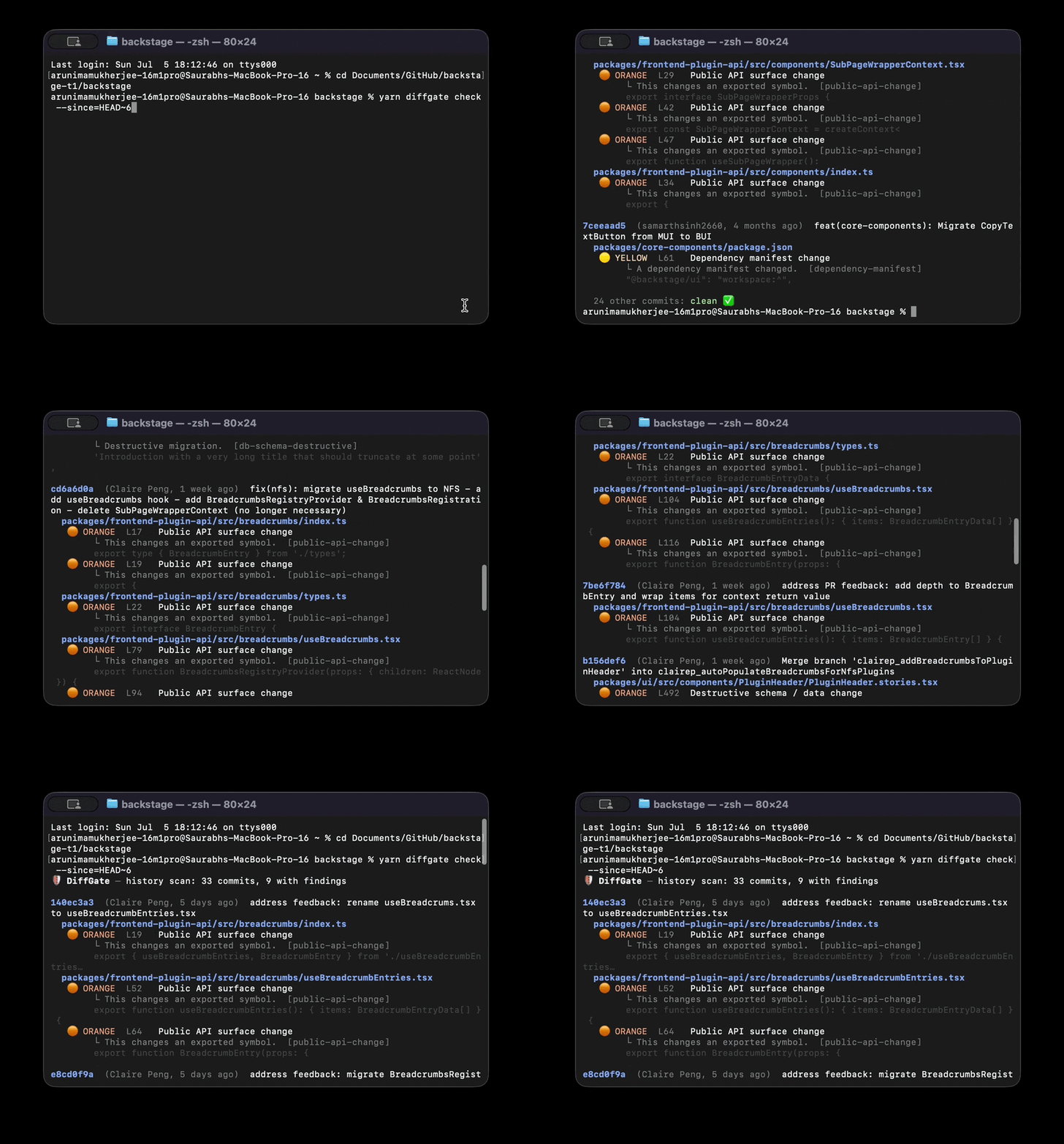
diffgate check --since=HEAD~20   # see what it catches in your own history — no PR required
diffgate check                   # review your pending changes right now
No git history or uncommitted changes yet? See the output on bundled examples first:
diffgate init --demo # live scan, no config or git changes needed
The surfaces (one shared engine, one verdict)
1. In your coding agent (via MCP)
The highest-leverage spot: the agent self-checks generated code before it's written to disk, gets back structured findings (zero LLM tokens), and surfaces what it corrected (original + fix + why) instead of silently rewriting. A trustworthy, deterministic self-check is what makes it safe to grant the agent more autonomy.
# Claude Code — one command:
claude mcp add diffgate -- diffgate mcp

# One-click via Smithery (zero config):
npx @smithery/cli install diffgate-review --client claude

# Cursor — add to MCP settings:
# { "diffgate": { "command": "diffgate", "args": ["mcp"] } }
Or one-click in Claude Desktop: download diffgate.mcpb and open it. The server also exposes prompts and resources; see MCP.md.
2. In your editor (VS Code / Cursor)
Inline squiggles on changed lines, hover cards (why · who owns it · quick-fix), a Risk Review tree, a status-bar summary, and Deep Review (agentic blast-radius analysis for orange findings). The same verdict you'd get from the CLI, on the diff you're reviewing.
Install from the VS Code Marketplace or Open VSX (Cursor / Windsurf / Gitpod).
3. On the command line — and in CI
diffgate check reviews your diff and exits non-zero on high-impact findings: a pre-commit hook locally, the same gate in your pipeline.
diffgate install-hook # adds .git/hooks/pre-commit; only runs tests on 🟠 orange changes
The local loop is the wedge — fix while the context is fresh — and the same engine runs as a PR gate so the verdict carries to where it's enforced for the whole team. See docs/TEAM.md for the GitHub Action, shared learnings, and org policy packs. CI runs can optionally layer an external scanner (Semgrep) through the same gate for broader language coverage — advisory-only, off by default (docs/CONFIG.md).
Common commands:
diffgate check                 # review pending changes (the gate)
diffgate check --staged        # staged-only (pre-commit)
diffgate check --since=HEAD~20 # audit recent history, per-commit (see below)
diffgate check --agent         # machine verdict for coding agents
diffgate scan <path>           # analyze files directly (no git needed)
diffgate watch                 # live review as you edit
diffgate guidelines            # review diff against AGENTS.md / CLAUDE.md etc.
diffgate feedback <rule> <f> <l> --dismiss   # suppress a false positive (shared via git)
diffgate mcp                   # start the MCP stdio server
Audit recent AI-authored history. Point check at commits already in your log — each
finding is attributed to a specific commit, so you get a story, not a repo-wide report card:
diffgate check --since=HEAD~20        # last 20 commits, one block per commit
diffgate check --since="2 weeks ago"  # by date instead of a rev
diffgate check --ai-authored          # only agent commits (Claude/Copilot/Cursor/… — heuristic)
diffgate check --author="Claude"      # matches author *and* Co-authored-by trailers
diffgate check <sha>                  # a single commit by hash
History mode is report-only (it audits the past — it never runs your test command or blocks a
commit) and honors --json and --limit=<n> (default 50). Merge commits are skipped.
Run diffgate --help for the full list (report, bench, stats, graph, marginal, …).
How it works
- Diff-aware:
git diff(CLI) or an in-memory LCS diff (editor, accurate on unsaved buffers) finds changed lines; findings only report on those lines. - Real AST where it counts:
@babel/parser(JS/TS) and tree-sitter (Python, PHP, Go, Ruby, Java, C#, Kotlin — via WASM, no native build) power precise rules: deprecated calls aren't matched inside comments or strings, exported-signature changes are detected structurally, and SQL injection is sink-targeted, parameter-aware, and sanitizer-aware —cur.execute(f"… {uid}")/$pdo->query("… $id")block, whilecur.execute("… %s", (uid,)),$pdo->prepare("… ?"), a single-quoted'… $id', and aSELECTin a log line don't. - A deterministic floor everywhere else: comment-aware pattern rules for secrets, destructive/schema changes, auth/crypto, dynamic execution / shell-out, raw queries, and network calls across Go, Java, Ruby, and any text. Commented-out code (
# os.system(x)) isn't flagged; a secret committed inside a comment still is. Docs/prose files (.md,.rst, …) are held to the same standard: the word "oauth2-provider" in a changelog isn't auth code, but a key pasted in a README is still a leak. - Earned blocking: broad cross-language injection advisories for the non-AST languages (Ruby
#{}, Go/Ruby shell-out) escalate to blocking only when the optional code graph proves reachability from an untrusted entry point — community CodeGraph, no Pro taint engine required. (JS/TS, Python, and PHP block on local AST evidence and don't need this.) - The gate: on a high-impact change, DiffGate runs your
testCommandand shows the actual exit code and output. - Learnings:
diffgate feedbackrecords dismiss/confirm verdicts; dismissed findings (same rule + same code) are suppressed everywhere. Stored in.diffgate/learnings.json; commit it to share across the team. - Optional add-ons: a provider-agnostic AI layer (plain-English explanations + fixes) and a cross-file blast-radius pass via an optional code graph. Both are off by default and degrade gracefully to a no-op.
Engine layout: src/core (shared) · src/cli.ts (CLI) · src/mcp.ts (MCP) · extension/ (VS Code).
Coverage scales with language
How deeply DiffGate analyzes a change depends on the file's language — be explicit about this so you can calibrate how much to trust a clean result.
| Tier | Languages | Depth |
|---|---|---|
| Deep (AST) | JS / TS (@babel) |
All injection classes + public-API & signature changes + deprecated-API quick-fixes. Prototype pollution and NoSQL injection are JS/TS-only; JS/TS findings are also eligible for code-graph taint confirmation. |
| Deep (AST) | Python, PHP, Go, Ruby, Java, C#, Kotlin (tree-sitter) | Sink-targeted, parameter- and sanitizer-aware injection detection — placeholders, argument-vectors, and escapers are correctly treated as safe. Sink classes per language below. |
Sink classes per Deep-AST language (full detail — every sanitizer and safe-form, plus the code-graph boundary — in docs/SCOPE.md):
- Python (7) — SQL · XSS · path traversal · CORS · command · code · deserialization
- PHP (8) — SQL · command · code · file inclusion · deserialization · XSS · path traversal · CORS
- Go (4) — SQL · command · path traversal · CORS
- Ruby (6) — SQL · command · code · deserialization · XSS · CORS
- Java (6) — SQL · command · deserialization · path traversal · XXE · CORS
- C# (7) — SQL · command · deserialization · path traversal · XSS · XXE · CORS
- Kotlin (6) — SQL · command · deserialization · path traversal · XXE · CORS
SSRF is a cross-language advisory across all eight Deep-AST languages (a request-tainted URL into an outbound-request sink; library-qualified and tainted-only, so static/config URLs aren't flagged). XXE covers the JVM (Java, Kotlin) and .NET (C#), suppressed when the file shows recognized hardening. Permissive CORS now also covers all eight — wildcard Access-Control-Allow-Origin, allow-all framework configs (gin/rs-cors, Spring @CrossOrigin, ASP.NET AllowAnyOrigin(), Ktor anyHost(), rack-cors), and request-reflected origins; explicit allowlists aren't flagged.
| Tier | Languages | Depth |
|---|---|---|
| Floor (pattern) | C/C++, Rust, Swift, Scala, … | Secrets, destructive/schema changes, auth/crypto, dynamic exec / shell-out, raw queries, network calls, TODO. Cross-language injection advisories that escalate via the code graph. |
| Text | YAML, Terraform, JSON, any text | Secrets and TODO/FIXME markers. |
Fast by design — and scoped to match. A review runs in milliseconds on the changed lines, which is exactly what lets the same check sit in the agent and editor inner loop. That speed is a deliberate trade: DiffGate is the deterministic gate on the diff, not an exhaustive whole-repo taint engine. Coverage is per-language (deep where there's an AST, a pattern floor elsewhere), the security rules are tuned to the residue agents actually ship rather than to maximize raw rule count, and a clean result means "nothing matched at this language's tier," not "proven safe." For deep cross-file taint analysis across many languages, pair it with a dedicated SAST. Full per-language detail and the code-graph boundary: docs/SCOPE.md.
Configuration
diffgate init writes a tailored .diffgate.json at your repo root. Minimal example:
{
  "testCommand": "npm test",          // run for orange changes (the gate)
  "gate": { "mode": "working", "failOn": "orange" },
  "deprecated": [
    { "pattern": "StripeClient.charge", "replacedBy": "StripeClient.createPaymentIntent" }
  ]
}
Any rule — built-in or custom — can be path-scoped with include/exclude globs, the escape hatch for the one file where a forbidden idiom is legitimate (e.g. process.env inside the config loader itself). Full schema, the built-in rule table, LLM providers, and per-rule tuning: docs/CONFIG.md.
More
- The PR was reviewed. The risky line wasn't. — our PR-trail study: 350 merged AI-assisted PRs, 109 with flagged AI-attributed changes, 3 with public human discussion beyond the author.
- docs/SCOPE.md: per-language coverage tiers (deep AST vs. pattern vs. text-only) and what the code graph does and doesn't do.
- docs/CONFIG.md: full
.diffgate.jsonschema, all built-in rules, LLM providers, native precision & test-scope behavior. - docs/TEAM.md: rolling DiffGate out to a team (GitHub Action / PR gate, shared learnings, org-wide policy packs, SOC 2 evidence, metrics for leaders).
- docs/CODE-GRAPH.md: optional cross-file blast radius (caller counts, suggested reviewers, test gaps, reachability, taint analysis).
- docs/STRUCTURAL-RULES.md: the
structuralpack — over-engineering rather than vulnerabilities (needless abstractions, pass-through wrappers, complexity spikes), all non-blocking, with per-language thresholds. - docs/MEASUREMENT.md: what agents actually ship unprompted and how to reproduce it (
diffgate marginal). - MCP.md: MCP tools, prompts, resources, and AI configuration.
Try it
diffgate scan mock_project
You'll see green findings (logging), yellow findings (a deprecated call), and orange findings (a DROP COLUMN migration, a public export).
Tests
npm test # builds the extension, runs the full unit/integration suite + extension smoke test
Support the project
If DiffGate caught something for you — or you just like the idea of a deterministic gate for agent code — star the repo ⭐. It's the signal that tells other people this is worth trying.
- 🐛 Found a false block, or a sink it missed? Open an issue — a false block is a bug we treat as P0.
- 💡 Want a language or rule covered? File a feature request with the idiom you'd like caught.
- 🔒 Security report? Please disclose privately — see SECURITY.md.
Contributing & License
See CONTRIBUTING.md. Apache 2.0; see LICENSE.
Perguntas sobre o MCP DiffGate
Como adiciono o MCP DiffGate ao Claude Code?
Execute claude mcp add diffgate -- npx -y diffgate-review no seu terminal. Adicione --scope user para torná-lo disponível em todos os projetos.
Como adiciono o MCP DiffGate ao Cursor?
Abra ~/.cursor/mcp.json e adicione o servidor em mcpServers, usando a configuração do Cursor mostrada na seção de instalação acima.
O DiffGate utiliza tokens de LLM para suas verificações?
Não, o DiffGate fornece descobertas estruturadas usando um motor determinístico que não requer nenhum token de LLM.
Como o DiffGate lida com falsos positivos e ruídos?
Ele utiliza descobertas com escopo de diff para relatar apenas as linhas alteradas e emprega um sistema de triagem em camadas (Green, Yellow, Orange) para decidir o que requer atenção.
O DiffGate pode executar meus testes existentes?
Sim, em mudanças de alto impacto (orange), o DiffGate pode executar o seu comando de teste especificado e exibir o resultado.