
Memberikan penjelasan deterministik dan solusi konkret untuk error Node.js, npm, Next.js, CORS, dan PostgreSQL tanpa menggunakan LLM atau koneksi jaringan.
Juga dikenal sebagai mahdibrr/dev-error-explainers, dev-error-explainers
- Stars
- 0
- Tools
- —
- Unduhan, 30 hari
- —
- Versi terbaru
- 0.2.1
- Commit terakhir
- 3 Nov 2026
- Lisensi
- MIT
Apa itu Dev error explainers MCP?
Dev error explainers adalah MCP server. Memberikan penjelasan deterministik dan solusi konkret untuk error Node.js, npm, Next.js, CORS, dan PostgreSQL tanpa menggunakan LLM atau koneksi jaringan.
Ringkasan dibuat dari README proyek
Tentang Dev error explainers MCP server
Developer yang menghadapi kendala umum dalam pengembangan web dapat memperoleh penjelasan deterministik secara instan untuk berbagai error tanpa harus bergantung pada LLM atau koneksi internet. MCP server ini menyediakan tool diagnostik spesifik untuk masalah Node.js, npm, Next.js, CORS, dan PostgreSQL. Cara kerjanya adalah secara lokal dengan menganalisis teks error, stack traces, atau file environment untuk mengidentifikasi akar masalah dan menyarankan perbaikan yang konkret.
Anda dapat berinteraksi dengan server ini untuk menyelesaikan masalah kompleks seperti konflik modul ESM/CJS, ketidakcocokan peer-dependency di npm, atau kegagalan koneksi database. Sistem ini mencakup modul khusus seperti database-url-doctor untuk connection string dan build-error-decoder untuk kegagalan build Next.js. Karena beroperasi tanpa jaringan atau telemetri, server ini menjaga privasi dengan melakukan redaksi pada informasi sensitif sebelum dianalisis, memastikan bahwa kredensial dan secret tetap aman selama proses diagnostik.
Apa yang bisa Anda lakukan dengannya
- 1Resolve Node.js module conflictsIdentifikasi alasan mengapa sebuah ES module tidak bisa di-require dalam file CommonJS dan dapatkan solusi yang telah diranking.
- 2Fix PostgreSQL connection stringsDiagnosis masalah pada database URL untuk tool seperti Prisma atau Drizzle dan dapatkan connection string yang sudah diperbaiki.
- 3Debug Next.js build failuresAnalisis output build yang gagal untuk menemukan penyebab seperti hydration mismatches atau masalah memori.
- 4Audit environment configurationsPeriksa file .env Next.js untuk mendeteksi assignment ganda atau URL produksi yang tidak valid tanpa mengekspos nilai aslinya.
Ditulis berdasarkan README proyek. Setiap use case diperiksa terhadap kutipan dari README tersebut.
Cara menginstal Dev error explainers MCP
Format diverifikasi 10 Nov 2026Instal Dev error explainers MCP di Claude Code
$ claude mcp add dev-error-explainers -- npx -y dev-error-explainersInstal Dev error explainers MCP di Cursor
~/.cursor/mcp.json
{
  "mcpServers": {
    "dev-error-explainers": {
      "command": "npx",
      "args": [
        "-y",
        "dev-error-explainers"
      ]
    }
  }
}Instal Dev error explainers MCP di VS Code
.vscode/mcp.json
{
  "servers": {
    "dev-error-explainers": {
      "type": "stdio",
      "command": "npx",
      "args": [
        "-y",
        "dev-error-explainers"
      ]
    }
  }
}Instal Dev error explainers MCP di Claude Desktop
claude_desktop_config.json
{
  "mcpServers": {
    "dev-error-explainers": {
      "command": "npx",
      "args": [
        "-y",
        "dev-error-explainers"
      ]
    }
  }
}Instal Dev error explainers MCP di Codex
~/.codex/config.toml
[mcp_servers.dev-error-explainers]
command = "npx"
args = ["-y", "dev-error-explainers"]
Instal Dev error explainers MCP di Gemini CLI
~/.gemini/settings.json
{
  "mcpServers": {
    "dev-error-explainers": {
      "command": "npx",
      "args": [
        "-y",
        "dev-error-explainers"
      ]
    }
  }
}Pengecekan otomatis
Berjalan 14 Nov 2026Laporan lengkap →Lolos checks otomatis kami. Ini bukan audit keamanan: baca kodenya dan berikan server akses paling terbatas yang dibutuhkannya. Cara kerja checks

- Source repository terhubung dan dapat dijangkaumahdibrr/dev-error-explainers is public and reachablegithub.com/mahdibrr/dev-error-explainers ↗Lolos
- Paket menyebut repo ini sebagai sumbernyadev-error-explainers names mahdibrr/dev-error-explainers as sourcenpmjs.com/package/dev-error-explainers ↗Lolos
- Provenance build (atestasi Sigstore)Sigstore attestation for dev-error-explainersnpmjs.com/package/dev-error-explainers/v/0.2.1#provenance ↗Lolos
- Lisensi open source (OSI)MITspdx.org/licenses/MIT.html ↗Lolos
- Ada commit atau release dalam satu tahun terakhirLast commit or release 2026-11-03github.com/mahdibrr/dev-error-explainers ↗Lolos
- OpenSSF ScorecardTidak diperiksa
- Nama package tidak mirip dengan package populerNo popular package one edit away from dev-error-explainersLolos
- Tidak ada advisory kritis di paket maupun dependensinya1 resolved dependencies checked; no critical advisoryosv.dev ↗Lolos
- Tidak ada instruksi tersembunyi untuk model0 tool descriptions and the README read; no override phrases, credential paths or hidden charactersLolos
- Tools yang bersifat destruktif telah diberi labelTidak diperiksa
- Endpoint remote menjawab handshake MCPTidak diperiksa
README
Lihat di GitHubdev-error-explainers



Paste an error. Get a deterministic explanation.
Version 0.4.0 adds an explicit environment audit and native assistant setup. Public database helpers now return masked metadata and URL templates; see the migration notes before upgrading from 0.2.x. The 1.0 verification record remains incomplete.
No LLM · no API · no network · no telemetry
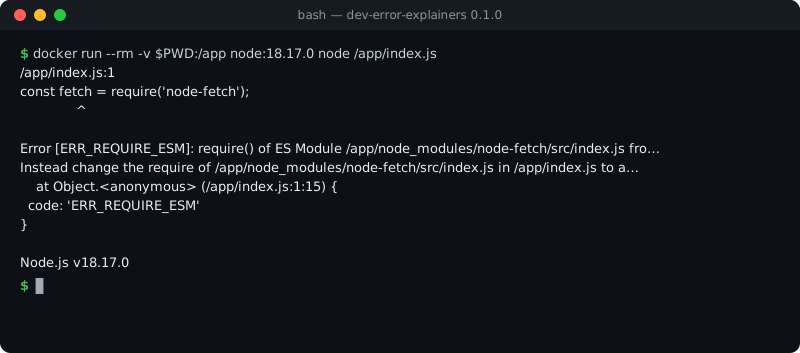
npm run build 2>&1 | npx dev-error-explainers
npm install dev-error-explainers
import { detect, explainEsmCjs } from 'dev-error-explainers';
const error = 'Error [ERR_REQUIRE_ESM]: require() of ES Module /app/node_modules/node-fetch/src/index.js from /app/index.js not supported.';
console.log(detect(error));
const { findings } = explainEsmCjs({ error, nodeVersion: '20.10.0' });
console.log(findings[0].title, findings[0].fixes.map((f) => f.title));
Output:
[ 'esm-cjs-explainer' ]
ERR_REQUIRE_ESM — require() of an ES module [
  'Upgrade Node.js (you are on 20.10.0)',
  'Use dynamic import() from CommonJS',
  'Convert the calling file to ESM'
]
Eight small, pure JavaScript modules with zero runtime dependencies: seven error explainers and one explicit environment-file audit. The seven explainers recognise
error text a developer pastes (from the browser console, npm, next build,
curl -I, a Node.js stack trace…), explains why it happens, and returns concrete fixes
with a link to the primary source where one exists (MDN, the Node.js docs, the npm docs,
the PostgreSQL docs, the Supabase docs…). The same engine runs as a library, a CLI, a
GitHub Action and an MCP server.
Secrets: error diagnosis in the CLI, Action and MCP server passes the input through redact()
before it is analysed, with one exception in error diagnosis: the DATABASE_URL doctor reads the raw
postgres:// line (a password's exact characters decide the diagnosis), and never
prints that password. Library diagnostics also mask recognised credentials in
build evidence and database query components. The separate auditEnv / audit_env
audit inspects raw values locally to classify keys, but returns no input keys or
values. Public database parsing helpers now return masked metadata;
correctedWithPassword is a deprecated alias returning masked corrections.
See the 0.3 migration and confidentiality limits
and what redaction does not catch.
Six of them power the free tools on iloveblogs.blog/tools, where you can try each one in the browser.
| Module | Main export (dev-error-explainers) |
What it explains | Try it live |
|---|---|---|---|
cors-error-explainer |
diagnoseCors |
Chrome / Firefox / Safari "blocked by CORS policy" errors: missing or wrong Access-Control-Allow-* headers, preflight failures, credentials, mixed content — with a fix for your stack |
CORS Error Explainer |
esm-cjs-explainer |
explainEsmCjs |
ERR_REQUIRE_ESM, "Cannot use import statement outside a module", "exports is not defined in ES module scope", ERR_UNKNOWN_FILE_EXTENSION ".ts", ERR_MODULE_NOT_FOUND, ERR_PACKAGE_PATH_NOT_EXPORTED — aware of your Node.js version |
ESM/CJS Error Explainer |
npm-eresolve-explainer |
analyseEresolveLog |
npm ERR! ERESOLVE peer-dependency conflicts: who asks for which range, what is installed, and why they do not intersect |
npm ERESOLVE Explainer |
chunk-cache-explainer |
diagnoseChunkCache |
ChunkLoadError / "Loading chunk failed" after a deploy: reads your response headers and finds the stale HTML, the CDN cache hit or the SPA fallback |
ChunkLoadError Cache Checker |
database-url-doctor |
diagnoseDatabaseUrl |
Postgres / Supabase connection strings: pooler vs direct, port 5432 vs 6543, pgbouncer, SSL, unencoded password characters — with a corrected URL for Prisma, Drizzle, pg or psql |
DATABASE_URL Doctor |
build-error-decoder |
decodeBuildError |
Failing next build / next dev output: Suspense bailouts, dynamic server usage, window is not defined, hydration mismatches, module resolution, heap out of memory, EADDRINUSE… |
Next.js Build Error Decoder |
next-env-checker |
auditEnv |
Explicit audit of one Next.js .env file: public secret indicators, duplicate assignments, invalid lines and production loopback URLs. Values never returned | Env audit contract |
database-connection-explainer |
explainDatabaseConnection |
"Can't connect to the database" from Node.js apps on PostgreSQL: ECONNREFUSED (including ::1 localhost), ETIMEDOUT, ENOTFOUND, Prisma P1000 / P1001 / P1017, password authentication failed, no pg_hba.conf entry, too many clients, self-signed certificates. Generic network codes are only diagnosed next to a Postgres signal |
No browser tool yet — rules and sources |
Evidence: most findings cite the primary source they were checked against. The build-error decoder has no primary-source URL; its links point to articles on the author's site, iloveblogs.blog.
Node.js 20 or later. ES modules only.
See input/resource limits,
the prospective evaluation report, and
the execution record for the measured scope and gaps.
npm run check:drift, npm run typecheck and npm test are release gates.
The development fixture score is not independent accuracy.
Usage
Everything is available from the package root, and each module can also be imported on its own:
import { diagnose } from 'dev-error-explainers/cors-error-explainer';

const r = diagnose({
  error: "Access to fetch at 'https://api.example.com/data' from origin 'http://localhost:3000' has been blocked by CORS policy: No 'Access-Control-Allow-Origin' header is present on the requested resource.",
});
r.isCorsProblem; // true
r.findings;      // what is wrong, why, and the source
r.fix;           // a fix for the detected (or guessed) stack
import {
  analyseEresolveLog, diagnoseDatabaseUrl, diagnoseChunkCache, decodeBuildError, explainDatabaseConnection,
} from 'dev-error-explainers';

analyseEresolveLog(npmOutput);                                        // { detected, code, conflicts: [...] }
diagnoseDatabaseUrl(process.env.DATABASE_URL, { client: 'prisma' }); // { ok, kind, findings, corrected }
diagnoseChunkCache({ htmlHeaders, chunkHeaders });                    // headers from `curl -I`
decodeBuildError(nextBuildOutput);                                    // matched rules, most severe first
explainDatabaseConnection({ error: stackTrace });                     // { recognised, findings, related }
detect(text)
Returns the names of the modules that recognise text, in a fixed order, or [].
Each module is asked through its own recogniser — detect adds no heuristics of its own.
Note that chunk-cache-explainer reads HTTP response headers (the output of curl -I),
not the ChunkLoadError message itself; the message alone is recognised by
build-error-decoder.
Audit an environment file
import { auditEnv } from 'dev-error-explainers';
const audit = auditEnv(envText, { environment: 'production' });
// { version: '0.1', status, assignments, matched, redactions, results }
npx dev-error-explainers --only env --environment production --json .env.local
This mode never prints file contents or assignment values. The MCP equivalent
is audit_env({ env: envText, environment: "production" }). Error auto-diagnosis
and the GitHub Action do not automatically treat logs as environment files.
An audit with no findings does not certify that the configuration is safe.
See the parsing scope, rules and limits.
JSON contract
Every module has its own result shape. diagnose(text) maps all of them onto one
shape with stable rule ids, after redacting the input — the shape the CLI prints with
--json, the GitHub Action renders and the MCP server returns:
import { diagnose } from 'dev-error-explainers'; // or 'dev-error-explainers/contract'

diagnose('FATAL:  password authentication failed for user "andym"');
// { version: '0.1', matched: true, redactions: 0,
//   results: [{ rule: 'database-connection.password-auth-failed', family: 'database-connection',
//               severity: 'critical', confidence: 'high', title, cause, fixes, evidence, module }] }
Unknown input gives { matched: false, results: [] } — never a closest guess. The shape,
the full rule table, the confidence semantics and the redaction limits are in
docs/CONTRACT.md.
A public corpus of real pasted errors with their expected results lives in
fixtures/, each case with its source.
redact(text) is exported too (dev-error-explainers/redact).
CLI
Pipe a failing command into it, or pass a log file. Nothing is sent anywhere.
npm run build 2>&1 | npx dev-error-explainers
npx dev-error-explainers < error.log
npx dev-error-explainers --text "Error [ERR_REQUIRE_ESM]: require() of ES Module …" --node 18.17.0
npx dev-error-explainers --json < error.log     # the contract result (docs/CONTRACT.md)
Flags: --only cors|esm|eresolve|build|database-url|database-connection|chunk-cache|env, --json,
--node <version>, --client prisma|drizzle|pg|psql, --html-headers <file> --chunk-headers <file>,
--help, --version. npx dev-error-explainers mcp starts the MCP server.
Exit codes: 0 an error was recognised, 2 nothing recognised (nothing is guessed), 64 usage error.
A connection string is always printed with its password masked.
Use it in CI (GitHub Action)
When a step fails, the Action reads the log you saved from it and writes the cause and the fix to the job summary, with annotations on the file and line when the log names a file in your checkout. No network, no LLM, no token.
      - name: Build
        id: build
        continue-on-error: true      # let the explain step run…
        shell: bash
        run: |
          set -o pipefail
          npm run build 2>&1 | tee build.log

      - name: Explain the failure
        if: steps.build.outcome == 'failure'
        uses: mahdibrr/dev-error-explainers@v0
        with:
          log-file: build.log

      - name: Fail the job if the build failed
        if: steps.build.outcome == 'failure'
        run: exit 1                  # …then keep the job red
Inputs, outputs and why pipefail and steps.build.outcome matter:
docs/ACTION.md.
Use it from your AI assistant (MCP)
An MCP server with two tools, explain_error and audit_env, so an assistant can check a pasted error or explicitly audit an environment file. explain_error checks the pasted error
against the documented cause before it guesses. Offline and deterministic; unrecognised
input is reported as such. Claude Code:
claude mcp add dev-error-explainers -- npx -y -p dev-error-explainers dev-error-explainers-mcp
Claude Desktop, Cursor, VS Code and the protocol details: docs/MCP.md.
Codex can use the same local stdio server; see native Codex setup. The recorded test uses actual MCP tool receipts, not a simulated assistant.
Use it in Claude Code (plugin: skill + MCP)
The plugin bundles its local MCP server and a skill that tells Claude when to call it. The engine has no integrated AI provider. Load a cloned repository or extracted plugin from your project with:
claude --plugin-dir "/absolute/path/to/dev-error-explainers"
Node.js 20+ must be on PATH. The server runs directly from the plugin's files, with no npm download or dependency installation. See native setup and limits. The repository also contains a marketplace definition; remote installation uses the repository version, which can differ from an older local checkout:
/plugin marketplace add mahdibrr/dev-error-explainers
/plugin install dev-error-explainers@dev-error-explainers
Principles
- Deterministic. The same input always gives the same answer; the rules are tested against real error text (Stack Overflow questions, GitHub issues, framework output).
- Offline engine. The deterministic library/CLI/MCP server makes no network request. An assistant host handles pasted text under its own data policy; see native integration privacy.
- Cited where possible. Findings link to the documentation that states the rule, where one exists — not every rule cites a source.
- Honest about unknowns. An error the module does not recognise is reported as not recognised, never guessed.
Selected corrections have actual before/after evidence; alternatives remain unverified by repair execution. See fix verification scope.
Tests
npm install
npm test
CI runs the suite on Node.js 20, 22 and 24.
Contributing
Unrecognised error? Open an issue with the exact text. Paste the error as printed, the command that produced it, and the tool versions. A new rule needs a test built from a real error. A diagnosis that is wrong is a bug too — there is a separate template for that.
License
Maintainer and project context
Maintained by Mahdi Ben Rhouma.
- Project notes and browser tools - How the offline library connects to browser tools, the CLI and public examples.
Pertanyaan tentang Dev error explainers MCP
Bagaimana cara menambahkan Dev error explainers MCP ke Claude Code?
Jalankan claude mcp add dev-error-explainers -- npx -y dev-error-explainers di terminal Anda. Tambahkan --scope user agar tersedia di semua proyek.
Bagaimana cara menambahkan Dev error explainers MCP ke Cursor?
Buka ~/.cursor/mcp.json dan tambahkan server di bawah mcpServers, menggunakan config Cursor yang ditunjukkan di bagian instalasi di atas.
Apakah server ini menggunakan LLM atau memerlukan koneksi internet?
Tidak, server ini beroperasi sepenuhnya secara offline tanpa LLM, tanpa API, tanpa jaringan, dan tanpa telemetri.
Bagaimana server ini menangani informasi sensitif seperti password?
Server akan memproses input melalui proses redaksi sebelum dianalisis, dan database helpers akan mengembalikan metadata yang telah di-masking serta template URL.
Jenis error apa saja yang bisa didiagnosis?
Server ini menjelaskan error yang terkait dengan CORS, konflik modul ESM/CJS, masalah peer-dependency pada npm, build Next.js, dan connection string PostgreSQL.