
Menyediakan memori persisten untuk AI agent termasuk riwayat percakapan, konteks key-value, semantic search, dan antrean FIFO.
Juga dikenal sebagai jyswee/agenticmemory, agmry
- Stars
- 1
- Tools
- —
- Unduhan, 30 hari
- —
- Versi terbaru
- 1.10.0
- Commit terakhir
- 23 Sep 2026
- Lisensi
- —
Apa itu agenticmemory MCP?
agenticmemory adalah MCP server. Menyediakan memori persisten untuk AI agent termasuk riwayat percakapan, konteks key-value, semantic search, dan antrean FIFO.
Ringkasan dibuat dari README proyek
Tentang agenticmemory MCP server
Agentic Memory menyediakan layer memori persisten bagi AI agent untuk menyimpan dan memanggil kembali informasi di berbagai sesi dan mesin yang berbeda. Tool ini dirancang untuk developer yang menggunakan tool seperti Claude Code, Cursor, Cline, dan Windsurf. Sistem ini memungkinkan agent untuk mengelola state mereka sendiri melalui berbagai tipe memori, termasuk riwayat percakapan jangka pendek, konteks key-value yang tahan lama untuk preferensi, dan entri pengetahuan jangka panjang yang diberi tag. Sistem ini juga menyertakan scratchpad untuk memori kerja ephemeral dan antrean FIFO yang berfungsi sebagai agent bus untuk meneruskan tugas antar agent yang berbeda.
Pengguna dapat berinteraksi dengan layanan ini melalui CLI, REST API, atau MCP server. MCP server dapat dijalankan secara lokal menggunakan command agmry mcp-serve atau dihubungkan ke hosted clients melalui remote SSE endpoint. Untuk keamanan, layanan ini mendukung end-to-end encryption untuk zero-knowledge spaces di mana server tidak dapat membaca datanya. Agent bahkan dapat melakukan self-signup melalui CLI untuk mendapatkan API key tanpa perlu intervensi browser secara manual.
Apa yang bisa Anda lakukan dengannya
- 1Mempertahankan konteks proyek di berbagai sesiSeorang agent dapat menggunakan command boot untuk memuat semua pesan, konteks, dan entri pada saat memulai sesi baru.
- 2Menyimpan dan mengambil fakta yang tahan lamaDeveloper dapat menyimpan keputusan spesifik atau runbook sebagai pasangan key-value bertipe data tertentu untuk memastikan informasi tersebut tidak pernah terlupakan.
- 3Melakukan semantic search pada data masa laluKetika agent hanya mengingat sebagian topik, agent dapat menggunakan semantic search untuk menemukan entri historis yang relevan.
- 4Mengoordinasikan tugas di antara beberapa agentSatu agent dapat memasukkan tugas JSON ke dalam antrean FIFO agar dapat diambil oleh agent lain di kemudian waktu.
Ditulis berdasarkan README proyek. Setiap use case diperiksa terhadap kutipan dari README tersebut.
Cara menginstal agenticmemory MCP
Format diverifikasi 10 Nov 2026Tambahkan ke CursorTambahkan ke GooseInstal agenticmemory MCP di Claude Code
$ claude mcp add --env 'AGMRY_API_KEY=<YOUR_AGMRY_API_KEY>' agenticmemory -- npx -y agmryInstal agenticmemory MCP di Cursor
~/.cursor/mcp.json
{
  "mcpServers": {
    "agenticmemory": {
      "command": "npx",
      "args": [
        "-y",
        "agmry"
      ],
      "env": {
        "AGMRY_API_KEY": "<YOUR_AGMRY_API_KEY>"
      }
    }
  }
}Instal agenticmemory MCP di VS Code
.vscode/mcp.json
{
  "servers": {
    "agenticmemory": {
      "type": "stdio",
      "command": "npx",
      "args": [
        "-y",
        "agmry"
      ],
      "env": {
        "AGMRY_API_KEY": "<YOUR_AGMRY_API_KEY>"
      }
    }
  }
}Instal agenticmemory MCP di VS Code CLI
$ code --add-mcp '{"name":"agenticmemory","type":"stdio","command":"npx","args":["-y","agmry"],"env":{"AGMRY_API_KEY":"<YOUR_AGMRY_API_KEY>"}}'Instal agenticmemory MCP di Claude Desktop
claude_desktop_config.json
{
  "mcpServers": {
    "agenticmemory": {
      "command": "npx",
      "args": [
        "-y",
        "agmry"
      ],
      "env": {
        "AGMRY_API_KEY": "<YOUR_AGMRY_API_KEY>"
      }
    }
  }
}Instal agenticmemory MCP di Codex
$ codex mcp add agenticmemory --env 'AGMRY_API_KEY=<YOUR_AGMRY_API_KEY>' -- npx -y agmryInstal agenticmemory MCP di Codex config.toml
~/.codex/config.toml
[mcp_servers.agenticmemory]
command = "npx"
args = ["-y", "agmry"]

[mcp_servers.agenticmemory.env]
AGMRY_API_KEY = "<YOUR_AGMRY_API_KEY>"
Instal agenticmemory MCP di Gemini CLI
$ gemini mcp add -s user -e 'AGMRY_API_KEY=<YOUR_AGMRY_API_KEY>' agenticmemory npx -- -y agmryInstal agenticmemory MCP di Gemini settings.json
~/.gemini/settings.json
{
  "mcpServers": {
    "agenticmemory": {
      "command": "npx",
      "args": [
        "-y",
        "agmry"
      ],
      "env": {
        "AGMRY_API_KEY": "<YOUR_AGMRY_API_KEY>"
      }
    }
  }
}Konfigurasi
AGMRY_API_KEYRahasiaAgentic Memory API key (amk_...). Optional for tool discovery; required to call a tool. Get one instantly with `agmry signup my-project` — no browser, no card, live for 48h; $0 card-auth starts the free 7-day trial.
| Nama | Deskripsi | Tipe |
|---|---|---|
| AGMRY_API_KEY | Agentic Memory API key (amk_...). Optional for tool discovery; required to call a tool. Get one instantly with `agmry signup my-project` — no browser, no card, live for 48h; $0 card-auth starts the free 7-day trial. | Rahasia |
Pengecekan otomatis
Berjalan 14 Nov 2026Laporan lengkap →Lolos checks otomatis kami. Ini bukan audit keamanan: baca kodenya dan berikan server akses paling terbatas yang dibutuhkannya. Cara kerja checks · Yang perlu diperbaiki untuk menambah poin

- Source repository terhubung dan dapat dijangkaujyswee/agenticmemory is public and reachablegithub.com/jyswee/agenticmemory ↗Lolos
- Nama paket mencantumkan repositori ini sebagai sumbernyaagmry names jyswee/agenticmemory as sourcenpmjs.com/package/agmry ↗Lolos
- Provenance build (atestasi Sigstore)No build attestation published for this releaseTidak diperiksa
- Lisensi open source (OSI)No licenseTemuan
- Ada commit atau release dalam satu tahun terakhirLast commit or release 2026-09-23github.com/jyswee/agenticmemory ↗Lolos
- OpenSSF ScorecardTidak diperiksa
- Nama package tidak mirip dengan package populerNo popular package one edit away from agmryLolos
- Tidak ada advisory kritis pada paket atau dependensinya1 resolved dependencies checked; no critical advisoryosv.dev ↗Lolos
- Tidak ada instruksi tersembunyi untuk model0 tool descriptions and the README read; no override phrases, credential paths or hidden charactersLolos
- Tools yang bersifat destruktif telah diberi labelTidak diperiksa
- Endpoint remote merespons handshake MCPEndpoint did not answer initialize: HTTP 404Temuan
README
Lihat di GitHubagmry



Persistent memory for AI agents — conversation history, key-value context, and semantic search across sessions. As easy as git.
git remembers your code. agmry remembers everything else.
Your agent writes great code all day — then forgets every decision the moment its context window resets. So you become the memory layer: re-explaining the project, the preferences, what broke last time. Agentic Memory is the memory your agent runs itself: one install, and it stores, recalls, and searches its own state across sessions, machines, and even other agents. It can even sign itself up — one command returns a working API key, no browser, no human.
Works with: Claude Code · Cursor · Cline · Windsurf · Aider · Codex · any MCP client

Install to full recall in 60 seconds — real terminal session, no mockups. Watch all the demos.
Install
npm install -g agmry
Quick Start
# Agent signs itself up — working key returned instantly, no card, no browser
agmry signup my-project --local

# Store memory
agmry store my-project "User prefers TypeScript strict mode and pnpm"

# New session? Recall everything
agmry recall my-project

# Half-remember something? Search it
agmry search my-project "how do we deploy"

# Full reference
agmry --help
Agents sign themselves up
No browser. No OAuth. No waiting for a human.
$ agmry signup my-project
✓ Project "my-project" created
  API key: amk_************************  (saved to .agmry/config.json)
  Live:    full access for 48h — no card, $0 today
The key works immediately — every endpoint, every tool, full access for 48 hours. Within that window, your human completes a $0 card-auth that starts the free 7-day trial on the same key. Miss the window? Nothing is deleted — the key pauses and revives the moment the card-auth completes. Add --email you@company.com and the human gets the link automatically.
Three tiers of memory — because not all memory is equal
A transcript dump isn't memory. Agents need different recall for different things:
# Short-term: ordered, role-aware conversation history (sub-ms reads)
agmry store my-project "Deployed v2.1, rolled back — migration locked the users table" -r assistant
agmry recall my-project -n 50

# Durable facts: typed key-value context — decisions, preferences, runbooks
agmry ctx my-project set deploy_flow "push image to registry, then ask infra to roll"
agmry ctx my-project get deploy_flow

# Long-term: titled, tagged knowledge entries that survive months
agmry entry my-project "Auth decision" "JWT not sessions — mobile clients can't hold cookies" --tags "arch,decisions"
agmry entries my-project --tags "decisions"

# Work-in-progress: scratchpad that's allowed to expire
agmry scratch my-project set "midway through the billing refactor, invoice.js next"
And semantic search stitches it together when the agent only half-remembers:
agmry search my-project "did we ever discuss rate limiting"
# → surfaces a months-old entry, with similarity score
Session start = one command
Instead of pasting yesterday's summary into today's prompt:
agmry boot my-project --json          # messages + context + entries, one call
agmry boot my-project --semantic "billing refactor"   # or focused on a topic
~200 tokens of structured state, not top-k chunks of old transcripts.
MCP Server
Prefer tools over a CLI? agmry ships an MCP server. Point Claude Code (or any MCP client) at it and your agent gets 17 native tools: store, recall, search, bootstrap, context, entries, spaces, queues.
claude mcp add agenticmemory -- agmry mcp-serve
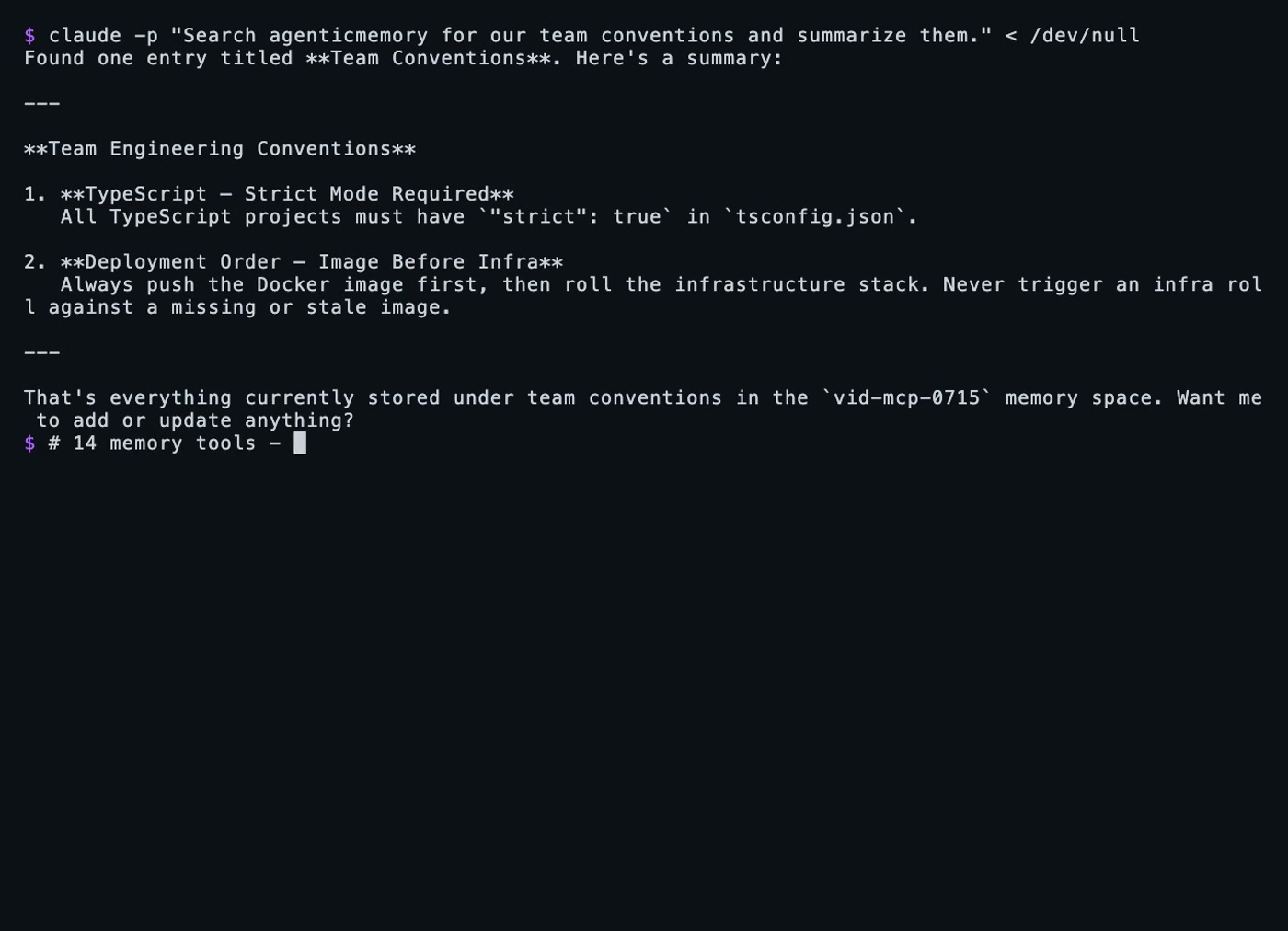
Claude Code remembering across sessions via MCP — click to watch.
For clients that use a JSON config (Cline, Cursor, Windsurf), pass your API key via the environment — the MCP server runs outside your project directory, so it won't pick up .agmry/config.json:
{
  "mcpServers": {
    "agenticmemory": {
      "command": "agmry",
      "args": ["mcp-serve"],
      "env": { "AGMRY_API_KEY": "amk_your_key_here" }
    }
  }
}
Remote MCP — zero install
Claude Web, Claude Desktop, Raycast, or any hosted MCP client can connect straight to the remote server. Same tools, same API key, nothing to install:
URL:  https://mcp.agenticmemory.ai/sse
Auth: Authorization: Bearer YOUR_API_KEY
End-to-end encryption (zero-knowledge spaces)
Create a space the server can never read. Encryption happens inside the CLI — the API only ever sees ciphertext.
agmry key generate                                  # one-time: creates + saves your key
agmry space create "Private" private --encryption e2e

agmry store SPACE "my secret"                       # encrypted before it leaves your machine
agmry recall SPACE                                  # transparently decrypted
agmry key verify SPACE                              # holding the right key?
Or derive per-space keys from a passphrase instead of storing a key:
agmry key set --passphrase "long secret phrase"
Notes:
- Semantic search is impossible on zero-knowledge spaces by design.
- Prefer encrypted at rest instead?
--encryption managed— the server encrypts your data at rest and every feature (search, summaries) keeps working. No client key needed. - Losing the key or passphrase means the data is unrecoverable. That's the point. Back it up:
agmry key show --reveal.
Key resolution order: --enc-key / --passphrase flag → AGMRY_ENCRYPTION_KEY env → ./.agmry/config.json → ~/.agmry/config.json. Same envelope and key derivation as the Node and Python SDKs — keys are interchangeable across all three.
Multi-agent: one brain, many agents
Spaces are shareable. One agent stores the deploy runbook; another recalls it a week later, from a different machine, over a different interface (CLI, MCP, or REST — same memory). Your agents hand off between sessions and between projects without you couriering context.
And you stay in the loop: everything your agents remember is browsable in a human dashboard.
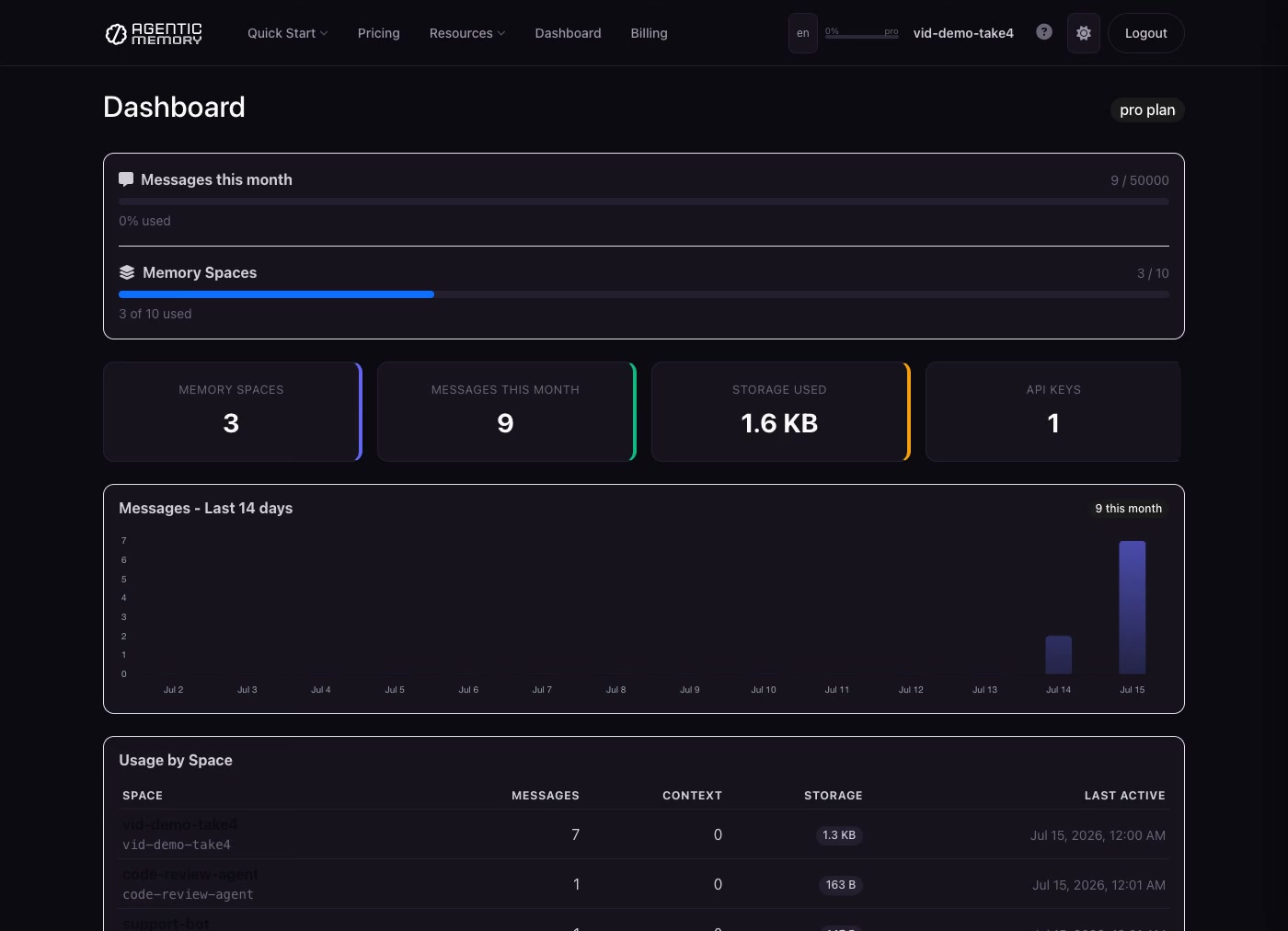
Everything your agents remember, in one dashboard — click to watch.
Queues — the agent bus
FIFO queues inside a space. One agent pushes work, another pops it — no polling glue, no extra infra.
agmry queue SPACE jobs push '{"task":"review PR #42"}'   # enqueue (FIFO)
agmry queue SPACE jobs pop                                # dequeue oldest — exit code 2 if empty
agmry queue SPACE jobs pop --wait 25                      # long-poll up to 25s for the next item
agmry queue SPACE jobs                                    # peek: length + head, without consuming
agmry queue SPACE jobs dlq push '{"task":"..."}' --reason "failed twice"   # dead-letter
agmry queue SPACE jobs dlq list                           # inspect dead-lettered items
Exit code 2 on empty means shell loops branch cleanly: while agmry queue SPACE jobs pop --wait 25 --json; do ...; done. Envelopes are opaque JSON — the server never inspects them.
Agent Integration
Add to your CLAUDE.md, .cursorrules, .clinerules, .windsurfrules, or AGENTS.md:
## Agentic Memory
This project uses Agentic Memory for persistent memory across sessions.
Use the `agmry` CLI. Key is in .agmry/config.json (auto-loaded).

agmry boot SPACE --json               # load everything at session start
agmry store SPACE "what happened"     # remember something
agmry ctx SPACE set key "value"       # store a durable decision/fact
agmry search SPACE "the deadline"     # find past context
agmry queue SPACE jobs push '{...}'   # send work to another agent
agmry queue SPACE jobs pop --wait 25  # receive work (exit 2 = empty)
Config Priority
--keyflagAGMRY_API_KEYenvironment variableAGENTICMEMORY_API_KEYenvironment variable./.agmry/config.json(project-local)~/.agmry/config.json(global)
Add .agmry/ to your .gitignore.
Features
- Conversation history — ordered, role-aware messages with recency windowing, sub-ms reads
- Key-value context — typed durable facts: decisions, preferences, runbooks
- Long-term entries — titled, tagged knowledge that survives months, with auto-summarisation
- Entities — people and systems the agent should know about
- Scratchpad — ephemeral working memory with TTLs (expiry is a feature)
- Semantic search — across everything the agent has ever stored
- Bootstrap — full session context in one call
- Agent self-signup — working API key from one CLI command, live for 48h keyless; $0 card-auth starts the free 7-day trial
- Queues — FIFO agent bus with long-poll and dead-letter,
agmry queue(exit 2 = empty) - MCP server — 46 tools, local (
agmry mcp-serve) or fully remote (mcp.agenticmemory.ai) - REST API — same memory on the request path of proxies and pipelines
- Multi-agent spaces — a fleet of agents reads and writes one memory
- End-to-end encryption — zero-knowledge spaces where only you hold the key (
agmry key generate) - Export — full data takeout per space, one command (
agmry space export)
Pricing: The agent's key works instantly — full access for 48h, no card. A $0 card-auth starts the free 7-day trial; after that from $24.99/mo. No data deletion, ever: your memory waits for you. Details.
Why not just Claude's built-in memory?
Claude Memory is great — but it only works with Claude, and only Claude decides what's in it.
| Agentic Memory | Claude Memory | |
|---|---|---|
| LLM support | Any — GPT, Claude, Gemini, Llama, Mistral, DeepSeek | Claude only |
| Switch LLMs | Keep all memory | Lose everything |
| Multi-agent | Shared spaces across agents | Single user |
| Programmatic control | Full CLI + MCP + REST | Black box — Claude decides |
| Structured data | Messages + context + entries + entities + scratchpad | Free-text notes |
| Semantic search | agmry search "the deadline" |
No search API |
| Data ownership | You own it, export any time | Stored by Anthropic |
Why this exists
I was my agents' memory. Every session started with me re-explaining my own project to my own tools — decisions, preferences, what broke last time. So I built the memory they run themselves. My own agents use it in production across a dozen projects; if something's rough or missing, open an issue — I read every one.
Documentation
- Quickstart guides — Claude Code, Cursor, LangChain, CrewAI, AutoGen + 7 more
- API docs
- Pricing
License
Proprietary — Tyga.Cloud Ltd. See LICENSE.
Pertanyaan tentang agenticmemory MCP
Bagaimana cara menambahkan agenticmemory MCP ke Claude Code?
Jalankan claude mcp add --env 'AGMRY_API_KEY=<YOUR_AGMRY_API_KEY>' agenticmemory -- npx -y agmry di terminal Anda. Tambahkan --scope user agar tersedia di semua proyek.
Bagaimana cara menambahkan agenticmemory MCP ke Cursor?
Buka ~/.cursor/mcp.json dan tambahkan server di bawah mcpServers, menggunakan config Cursor yang ditunjukkan di bagian instalasi di atas.
Apakah agent bisa melakukan sign up sendiri tanpa intervensi manusia?
Ya, agent dapat melakukan sign up melalui satu perintah yang langsung mengembalikan API key yang aktif tanpa memerlukan browser atau bantuan manusia.
Apakah mendukung end-to-end encryption?
Ya, Anda dapat membuat zero-knowledge spaces di mana enkripsi dilakukan di dalam CLI dan server hanya melihat ciphertext.
Bisakah saya menggunakannya dengan remote MCP clients?
Ya, hosted MCP clients seperti Claude Web atau Claude Desktop dapat terhubung langsung ke remote server menggunakan URL dan API key yang disediakan.