
CloudPing MCP server
Commit 15 Okt 2026Memungkinkan AI client untuk menjalankan probe ping, traceroute, DNS, dan HTTP dari agent global yang terdistribusi dan melakukan streaming hasilnya dalam format JSON.
Juga dikenal sebagai internetworklab/cloudping
- Stars
- 24
- Tools
- —
- Unduhan, 30 hari
- —
- Versi terbaru
- —
- Commit terakhir
- 15 Okt 2026
- Lisensi
- MIT
Apa itu CloudPing MCP?
CloudPing adalah MCP server. Memungkinkan AI client untuk menjalankan probe ping, traceroute, DNS, dan HTTP dari agent global yang terdistribusi dan melakukan streaming hasilnya dalam format JSON.
Ringkasan dibuat dari README proyek
Tentang CloudPing MCP server
Network engineer dan developer dapat melakukan diagnostik konektivitas global langsung dari dalam AI client menggunakan CloudPing. Tool ini memungkinkan Anda mengeksekusi probe jaringan terdistribusi termasuk pengujian ping, traceroute, DNS, dan HTTP dari berbagai lokasi geografis. Dengan menggunakan interface MCP server, sistem akan melakukan streaming hasil kembali ke client Anda dalam format JSON yang terstruktur, sehingga memudahkan AI untuk menginterpretasikan latensi jaringan dan jalur routing.
Arsitekturnya menggunakan model hub-and-agent di mana agent yang terdistribusi melakukan pengukuran aktual. Anda dapat menjalankan pengujian di seluruh internet atau di dalam jaringan DN42. Server ini mendukung berbagai tipe probe seperti TCP ping, UDP atau ICMP traceroute, dan DNS probe yang mencakup protokol DoT dan DoH. CloudPing juga menyediakan HTTP probe untuk HTTP/1.1, HTTP/2, dan HTTP/3. Untuk menggunakan layanan ini, MCP server memanfaatkan StreamableHTTP dan autentikasi JWT guna memastikan komunikasi yang aman antara client Anda dan central hub.
Apa yang bisa Anda lakukan dengannya
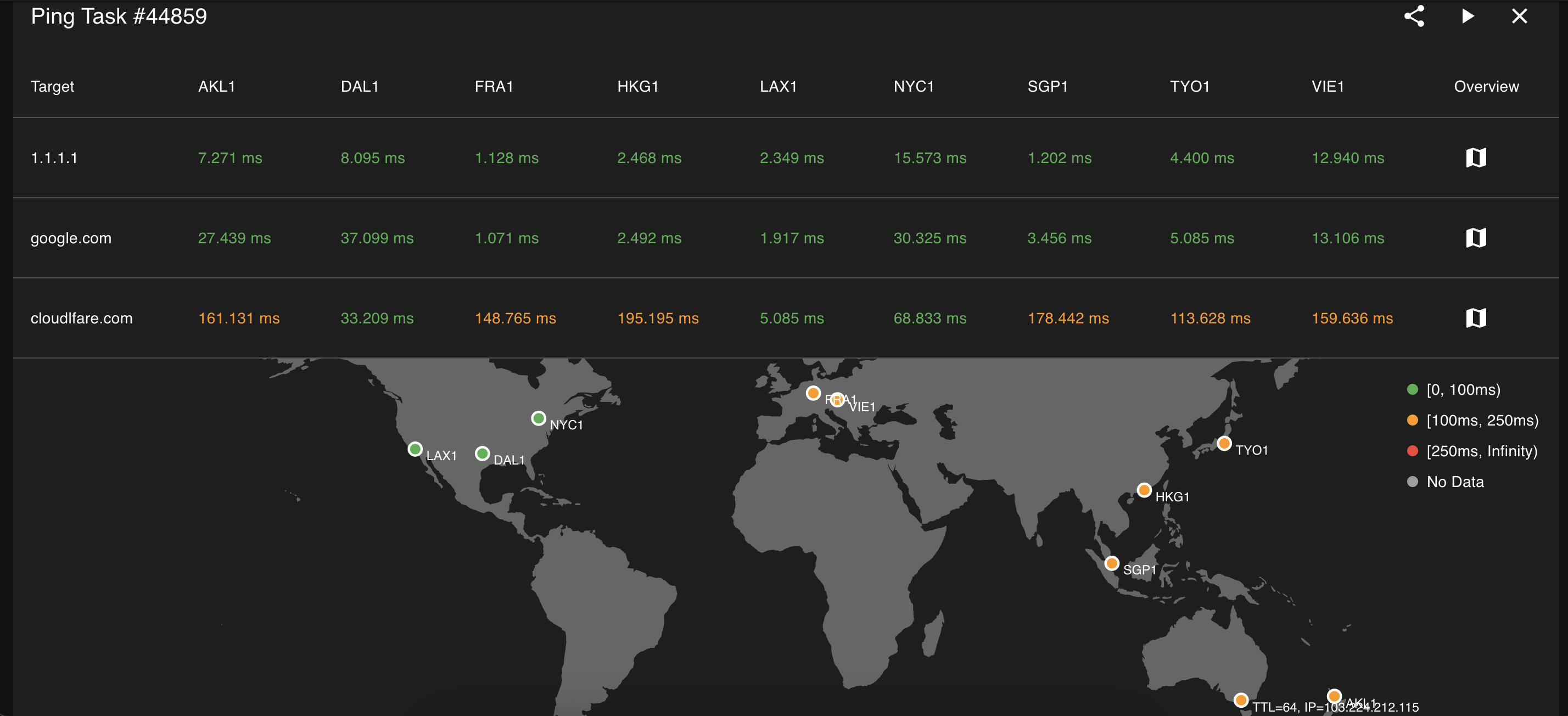
- 1Diagnosa masalah latensi globalMinta AI untuk menjalankan ping test dari berbagai lokasi global untuk mengidentifikasi di mana keterlambatan jaringan terjadi.
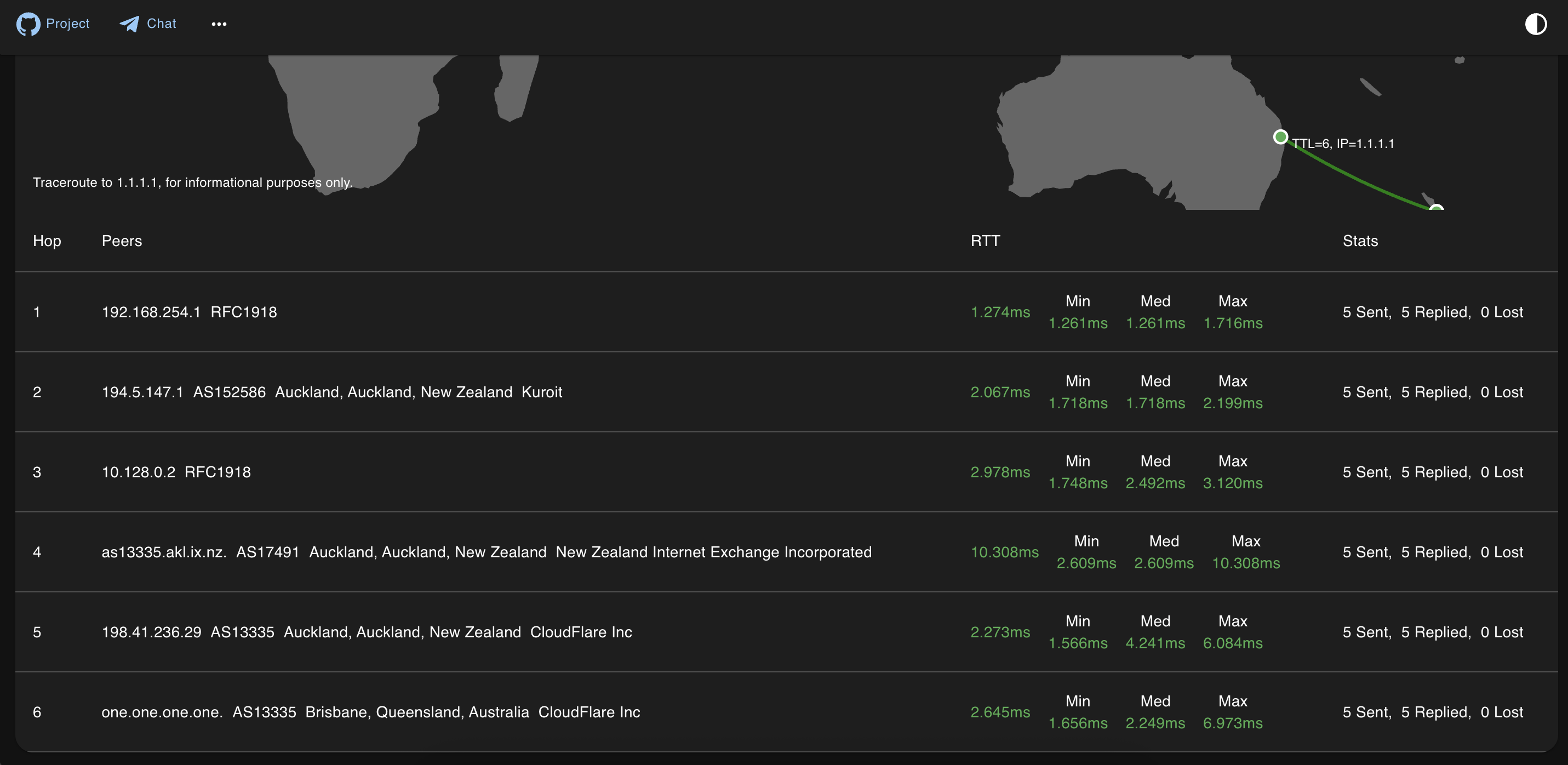
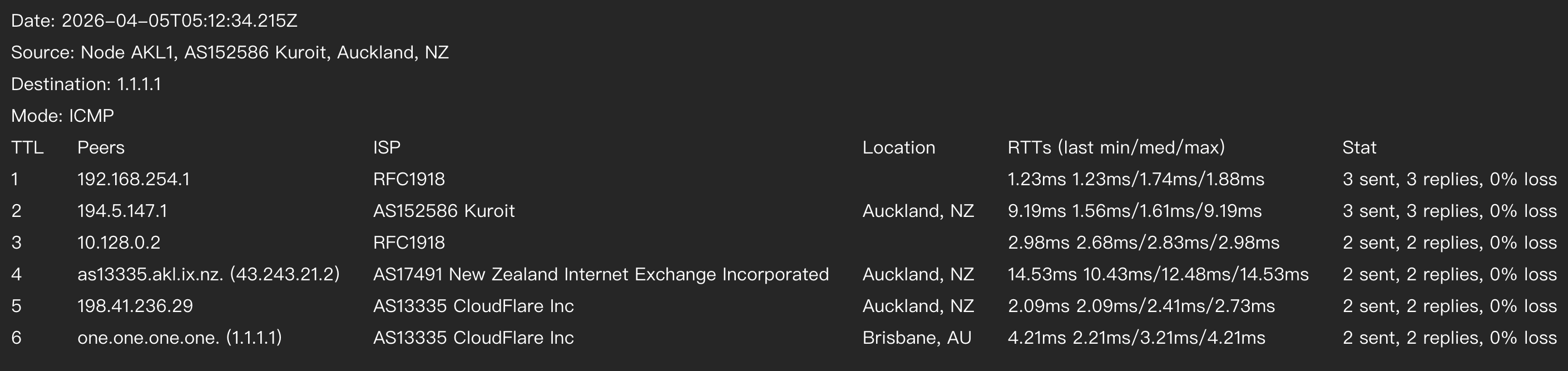
- 2Trace jalur routing jaringanMinta traceroute untuk melihat detail peer hop-by-hop dan latensi ke destinasi tertentu.
- 3Verifikasi ketersediaan DNS dan HTTPGunakan client untuk melakukan probe pada record DNS tertentu atau memeriksa responsivitas endpoint HTTP/3.
- 4Analisis data routing BGPLakukan BGP route lookup untuk memahami bagaimana prefix IP diiklankan.
Ditulis berdasarkan README proyek. Setiap use case diperiksa terhadap kutipan dari README tersebut.
Konfigurasi
DN42_ASNDN42_ISPEXACT_LOCATION_LAT_LONJWT_TOKENNODE_NAMESUBNET_OVERRIDE
| Nama | Deskripsi | Tipe |
|---|---|---|
| DN42_ASN | — | |
| DN42_ISP | — | |
| EXACT_LOCATION_LAT_LON | — | |
| JWT_TOKEN | — | |
| NODE_NAME | — | |
| SUBNET_OVERRIDE | — |
Pengecekan otomatis
Berjalan 14 Nov 2026Laporan lengkap →Belum diverifikasi. Sebuah server memerlukan skor 80, tidak ada temuan serius, dan data yang cukup untuk kami periksa. Cara kerja checks · Yang perlu diperbaiki untuk menambah poin

- Source repository terhubung dan dapat dijangkauinternetworklab/cloudping is public and reachablegithub.com/internetworklab/cloudping ↗Lolos
- Nama paket mencantumkan repositori ini sebagai sumbernyaTidak diperiksa
- Provenance build (atestasi Sigstore)Tidak diperiksa
- Lisensi open source (OSI)MITspdx.org/licenses/MIT.html ↗Lolos
- Ada commit atau release dalam satu tahun terakhirLast commit or release 2026-10-15github.com/internetworklab/cloudping ↗Lolos
- OpenSSF ScorecardTidak diperiksa
- Nama package tidak mirip dengan package populerTidak diperiksa
- Tidak ada advisory kritis pada paket atau dependensinyaTidak diperiksa
- Tidak ada instruksi tersembunyi untuk model0 tool descriptions and the README read; no override phrases, credential paths or hidden charactersLolos
- Tools yang bersifat destruktif telah diberi labelTidak diperiksa
- Endpoint remote merespons handshake MCPTidak diperiksa
README
Lihat di GitHubCloudPing

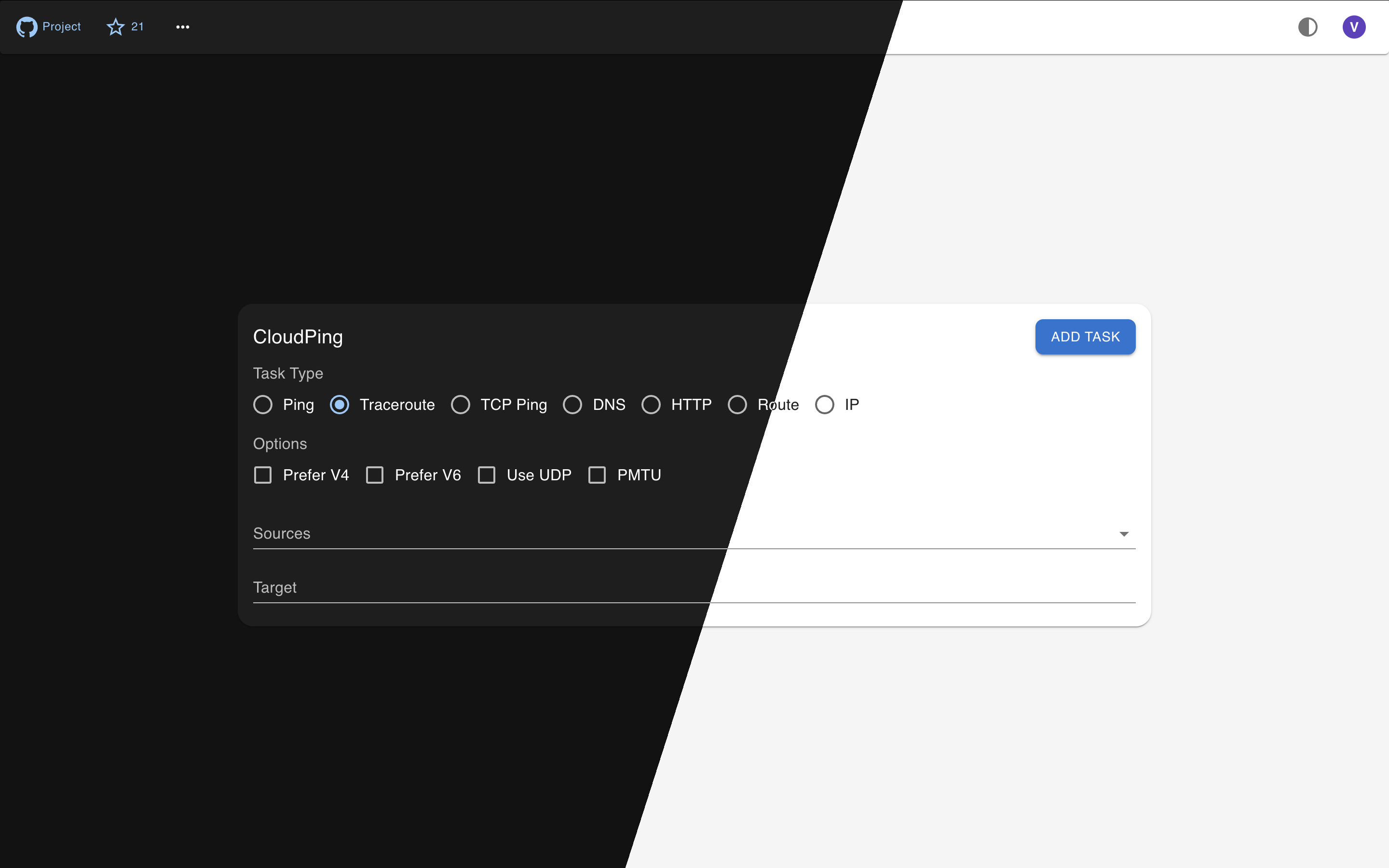
CloudPing is a web-based ping and traceroute tool that provides an easy-to-use interface, giving users an intuitive view of network information such as how IP packets are routed and what the round-trip latency looks like. We believe that making these network tracing and diagnostic capabilities available via the cloud is a great idea — hence the name "CloudPing".
Features
- Ping, Traceroute (UDP flavor or ICMP flavor)
- TCP Ping
- DNS Probe (UDP, TCP, RFC7858 DoT, RFC8484 DoH)
- HTTP Probe (HTTP/1.1, HTTP/2 and HTTP/3)
- DN42 Dual Stack support, Internet support
- Displaying IP information of many aspects, like ASN, Org name, City, Country, and probably Lat Lon
- QUIC for hub-agent communication support and NAT-traversal
- JWT authentication with multi-provider SSO login (GitHub, Google, Microsoft Entra ID, Generic OIDC, and guest/visitor)
- Telegram Bot (Currently supporting:
/ping,/traceroute, and/probe) - Email Interface (Interact via Email)
- MCP Server (StreamableHTTP + JWT)
- Multiple GeoIP/IPInfo provider support: IPInfo.io, IP2Location.io, IPRegistry.co, and MaxMind MMDB
- BGP Route Lookup via MRT data
- Prometheus Metrics
Architecture
CloudPing is designed with a three-layer architecture that separates user-facing interfaces, control logic, and actual probe execution.
┌───────────────────────────────────────────────────────────────────────────────┐
│                           Access Layer                                        │
│  ┌──────────────┐  ┌──────────────┐  ┌──────────────┐  ┌───────────────────┐  │
│  │  Web Client  │  │ Telegram Bot │  │ Email Client │  │    MCP Server     │  │
│  │  (Next.js)   │  │   (@bot)     │  │ (SMTP/IMAP)  │  │ (Streamable HTTP) │  │
│  └──────┬───────┘  └──────┬───────┘  └──────┬───────┘  └──────┬────────────┘  │
└─────────┼─────────────────┼─────────────────┼─────────────────┼───────────────┘
          │                 │                 │                 │
          │                 │                 ▼                 │
          │                 │      ┌────────────────────┐       │
          │                 │      │   Email Gateway    │       │
          │                 │      │(Cloudflare Email)  │       │
          │                 │      └─────────┬──────────┘       │
          ▼                 ▼                ▼                  ▼
┌─────────────────────────────────────────────────────────────────────────────┐
│                           Control Layer                                     │
│  ┌─────────────────────────────────────────────────────────────────────┐    │
│  │                              Hub                                    │    │
│  │   (HTTP API, WebSocket/QUIC for agents, JWT Auth, Request Routing)  │    │
│  └─────────────────────────────────────────────────────────────────────┘    │
└─────────────────────────────────────────────────────────────────────────────┘
          │
          │  QUIC / mTLS / WebSocket / HTTP(s)
          ▼
┌─────────────────────────────────────────────────────────────────────────────┐
│                         Execution Layer                                     │
│  ┌─────────┐  ┌─────────┐  ┌─────────┐  ┌─────────┐  ┌──────────────┐       │
│  │ Agent 1 │  │ Agent 2 │  │   ...   │  │ Agent N │  │ MRT Query    │       │
│  │(at-vie1)│  │(us-nyc1)│  │         │  │(jp-tyo1)│  │ Service      │       │
│  └─────────┘  └─────────┘  └─────────┘  └─────────┘  └──────────────┘       │
│      Ping, Traceroute, DNS Probe, HTTP Probe, TCP Ping, BGP Route Lookup    │
└─────────────────────────────────────────────────────────────────────────────┘
- Access Layer: End-user interfaces including the web UI, Telegram bot, email interface, and MCP server.
- Email Gateway: Sits between the Email Client and the Hub. Currently, the only supported email gateway is Cloudflare Email Service.
- Control Layer: The Hub acts as the central coordinator — it exposes the public API, authenticates requests, and routes probe tasks to the appropriate agents.
- Execution Layer: Distributed agents at various geographical locations performing network measurements (ping, traceroute, DNS, HTTP probes), plus the MRT Query Service for BGP route lookup.
Try
If you are in a hurry, just go straight to try our deployed instance at here, or here(DN42). Which is ready to use, and doesn't require you to build or install anything.
Telegram Bot service is available via @as4242421771_bot.
Build
Make sure golang of newer version is already installed, if not, go visit go.dev/doc/install to download and un-tar a tarball, and make sure that $GOPATH/bin, and /usr/local/go/bin are in the $PATH.
git clone https://github.com/internetworklab/cloudping
cd cloudping
./buildversion.sh # to generate version metadata dependence
go build -o bin/globalping ./cmd/globalping
Now the binary bin/globalping can serve as an agent or a hub depending on the CLI arguments provided.
Optionally, to embed the web frontend assets into the binary (so that globalping web can serve the web UI without an external static file server such as nginx), build the frontend static export first:
cd web
npm ci && npm run build # generates web/out
cd -
go build -o bin/globalping ./cmd/globalping
Debugging
For how to generate self-signed certs (and CA) for testing, see Notes.md.
After the binary is built, to see how it goes, try launch a testing purpose localhost agent:
Open a terminal window, launch the testing hub in foreground:
scripts/launch_example_clustered_hub.sh
Then open one or more terminal winodws, launch the testing agent(s) in foreground:
scripts/launch_example_clustered_agent_1.sh # ls scripts/*.sh to see all
It binds on 127.0.0.1:8084, listens for plaintext HTTP requests, you can call the API with whaever HTTP client you like, for example:
curl --url-query targets=1.1.1.1 --url-query count=3 localhost:8084/simpleping
Doing so cause it send out 3 icmp echo request packets to the destination specified, 1.1.1.1, and the response will be stream to stdout in realtime in JSON line format.
It's better to use the web UI directly, since it has much richer feature set as well as easier to use UI.
Screenshots
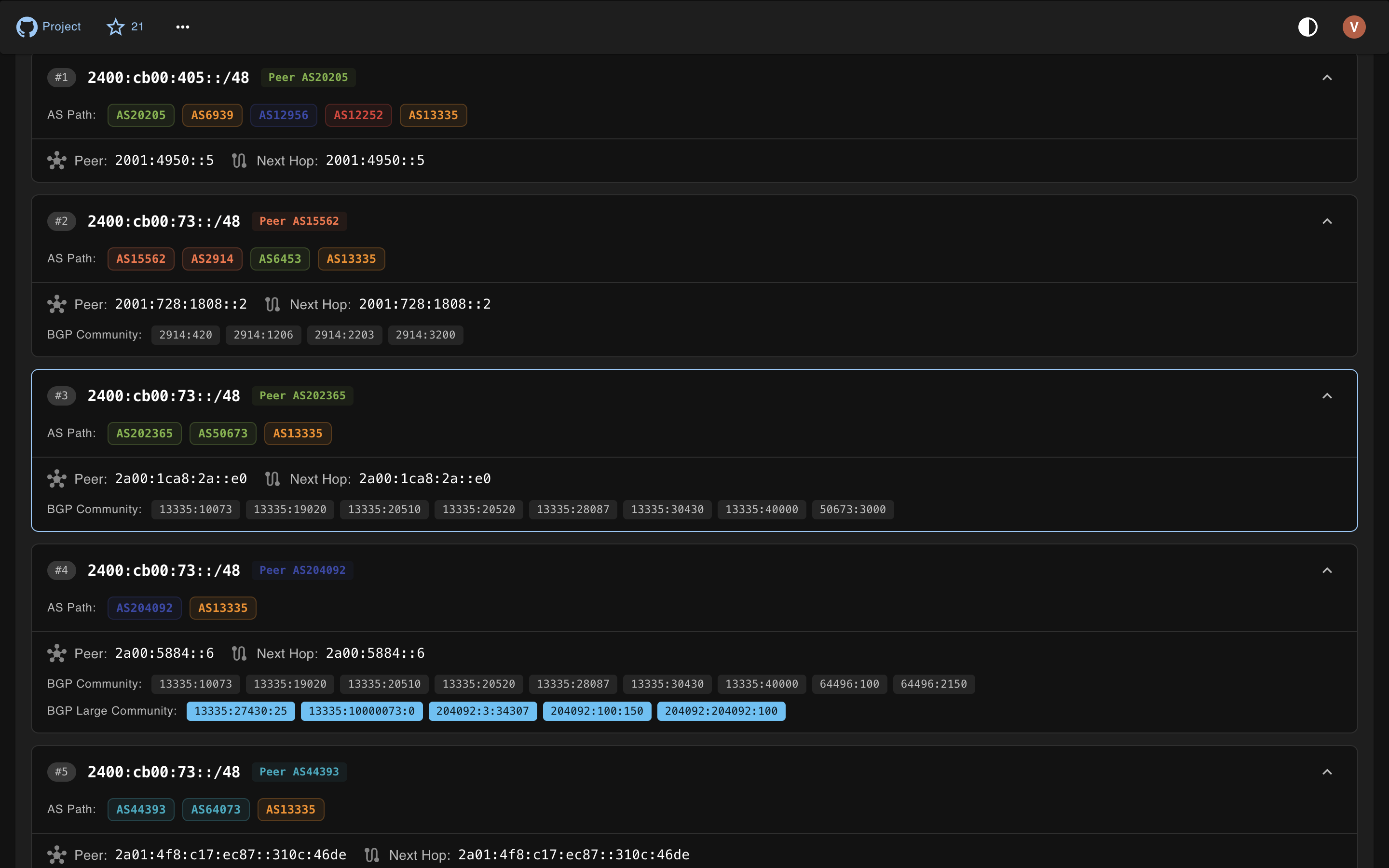
Currently the UI is still rugged, but we are actively iterating it.
| Traceroute | Ping Matrix | MRT Route Query Service |
|---|---|---|
 |
 |
 |
| Telegram Bot — Traceroute | Telegram Bot — Probe | Email — Traceroute |
|---|---|---|
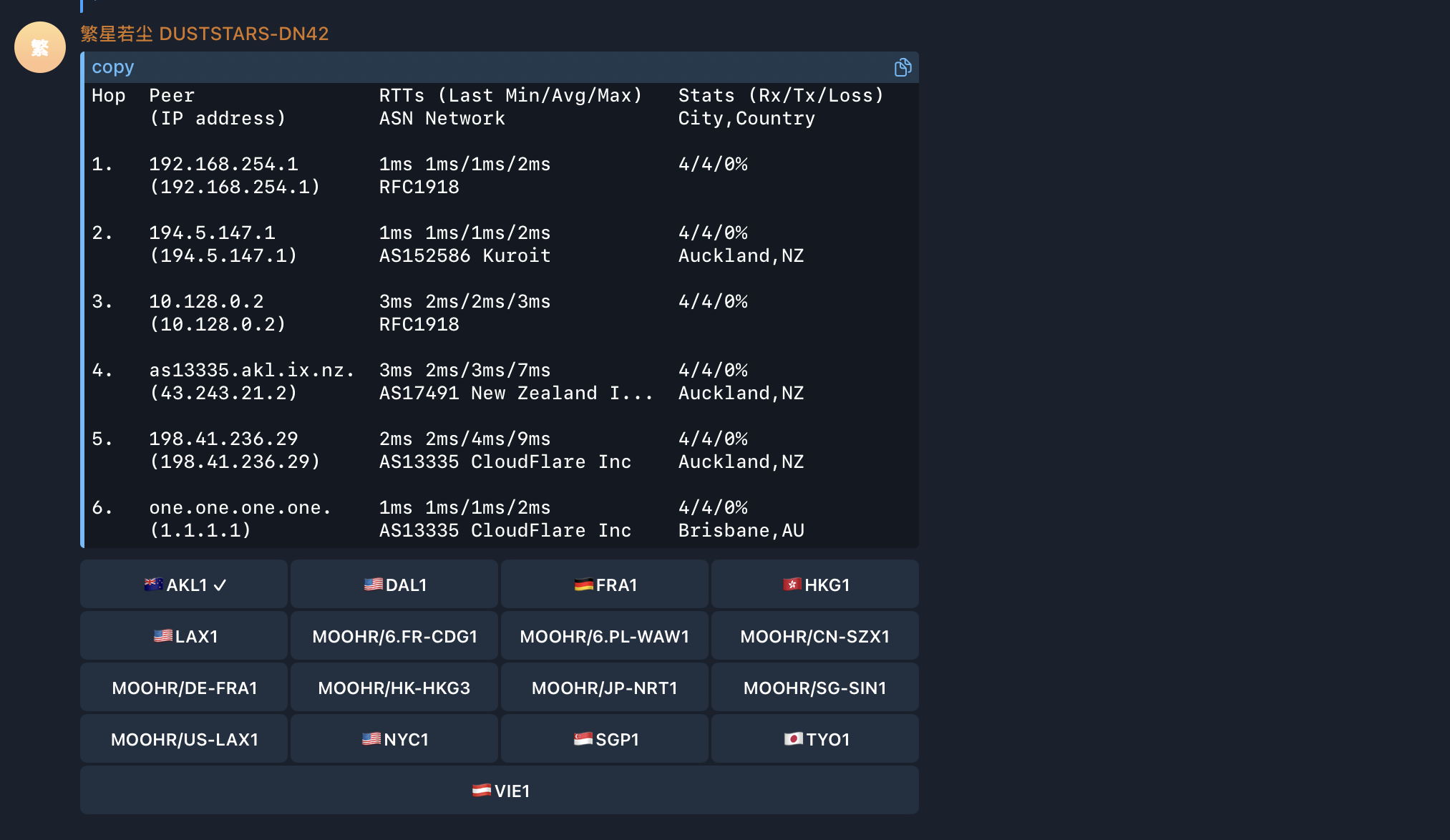 |
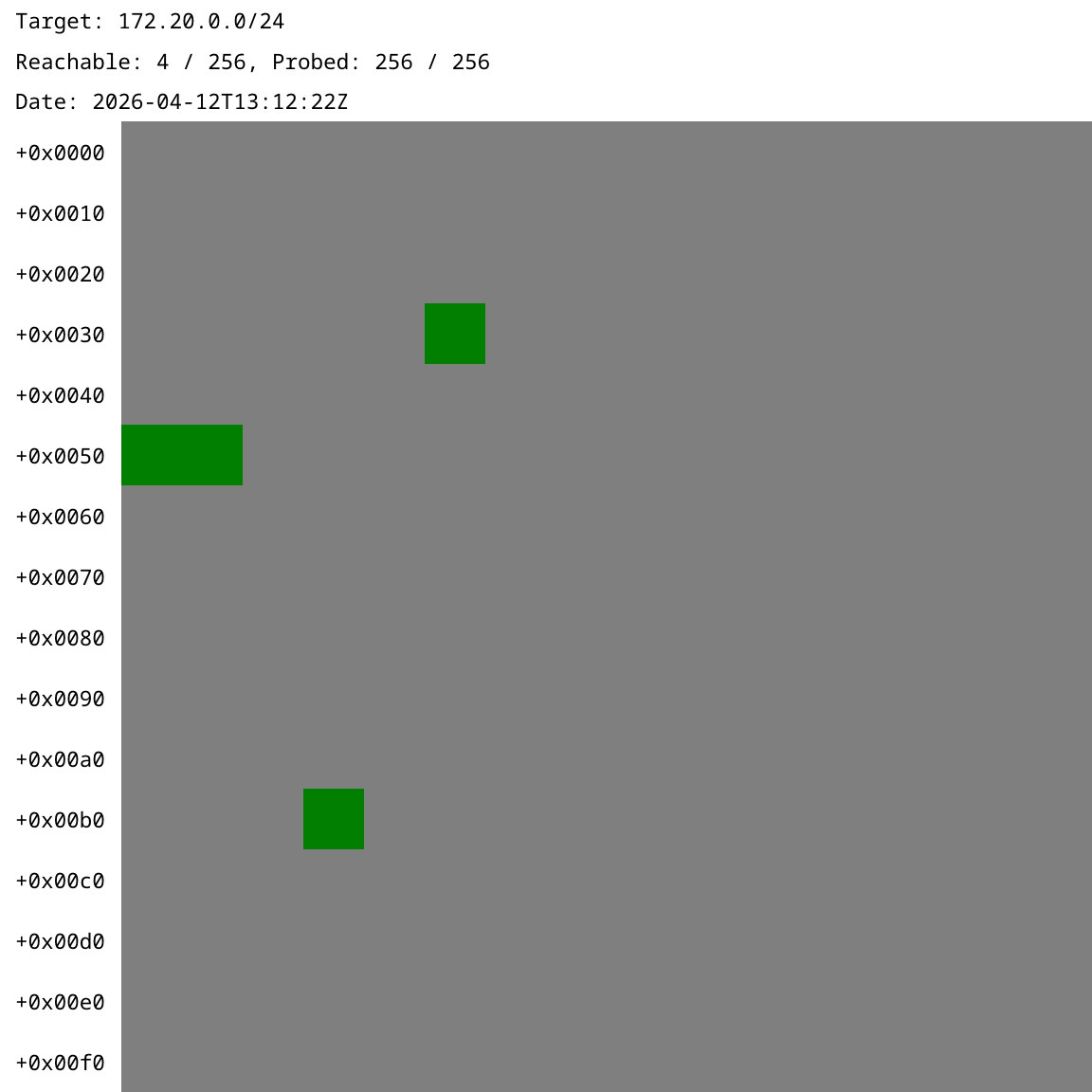 |
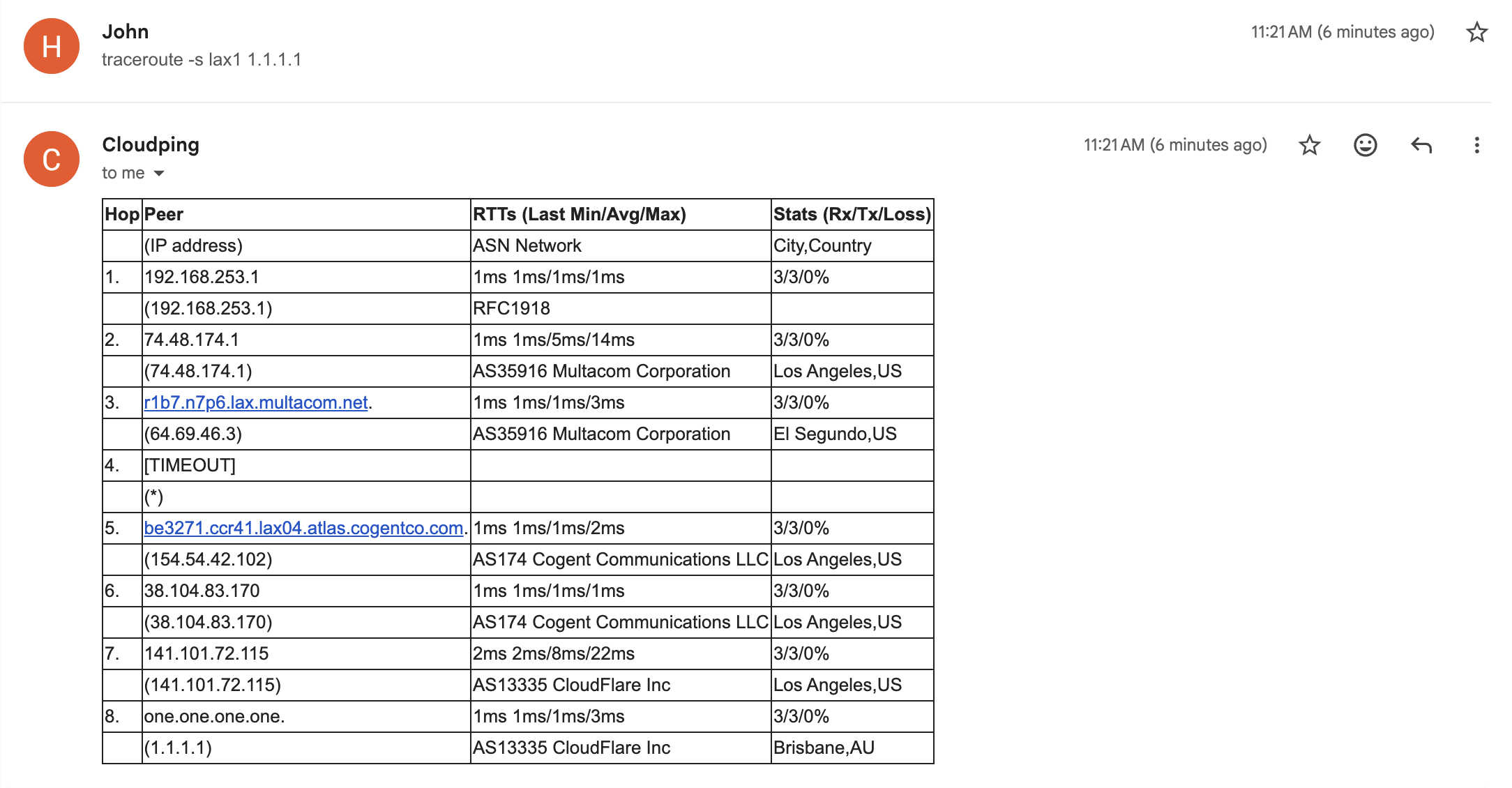 |
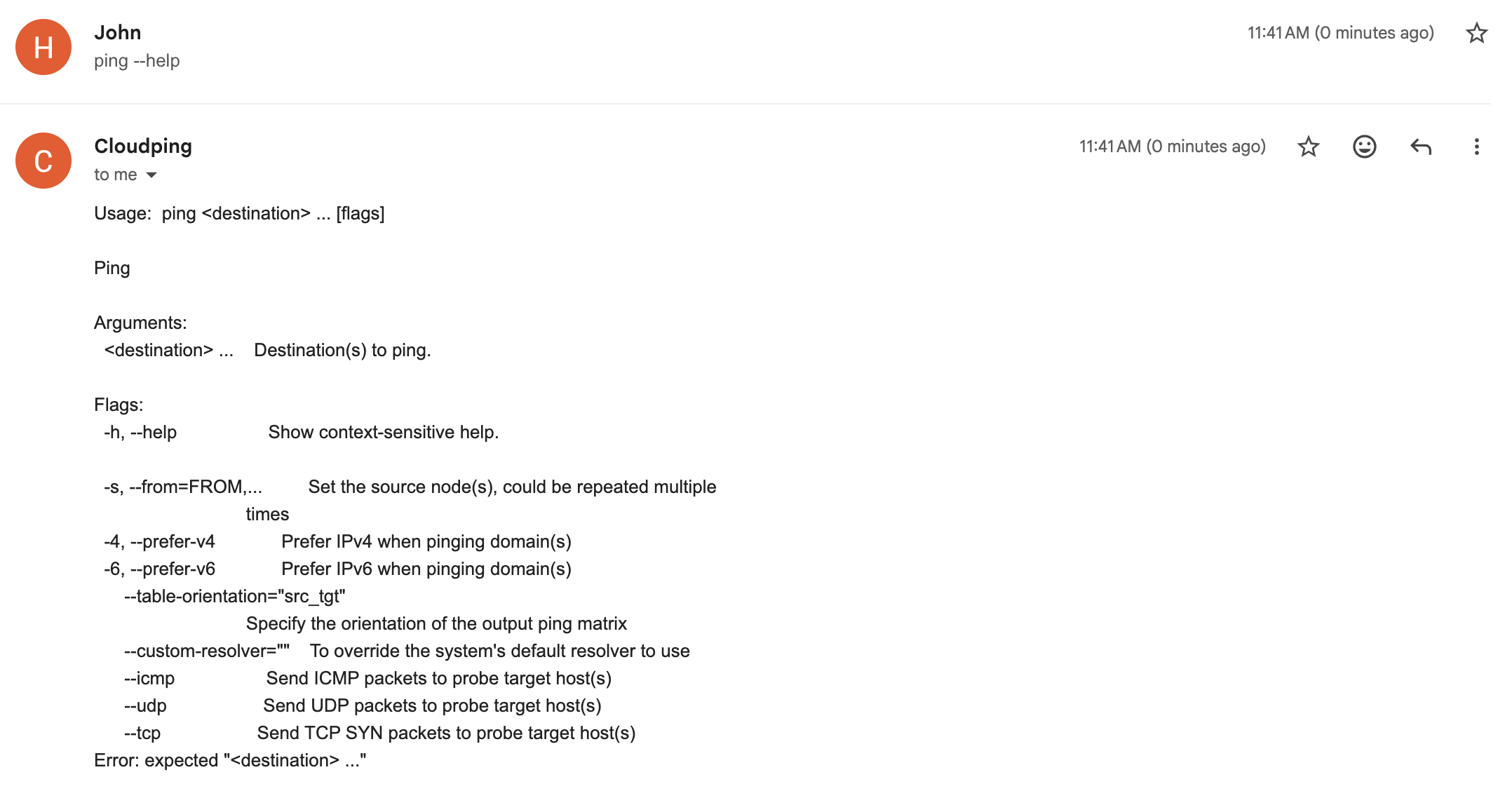
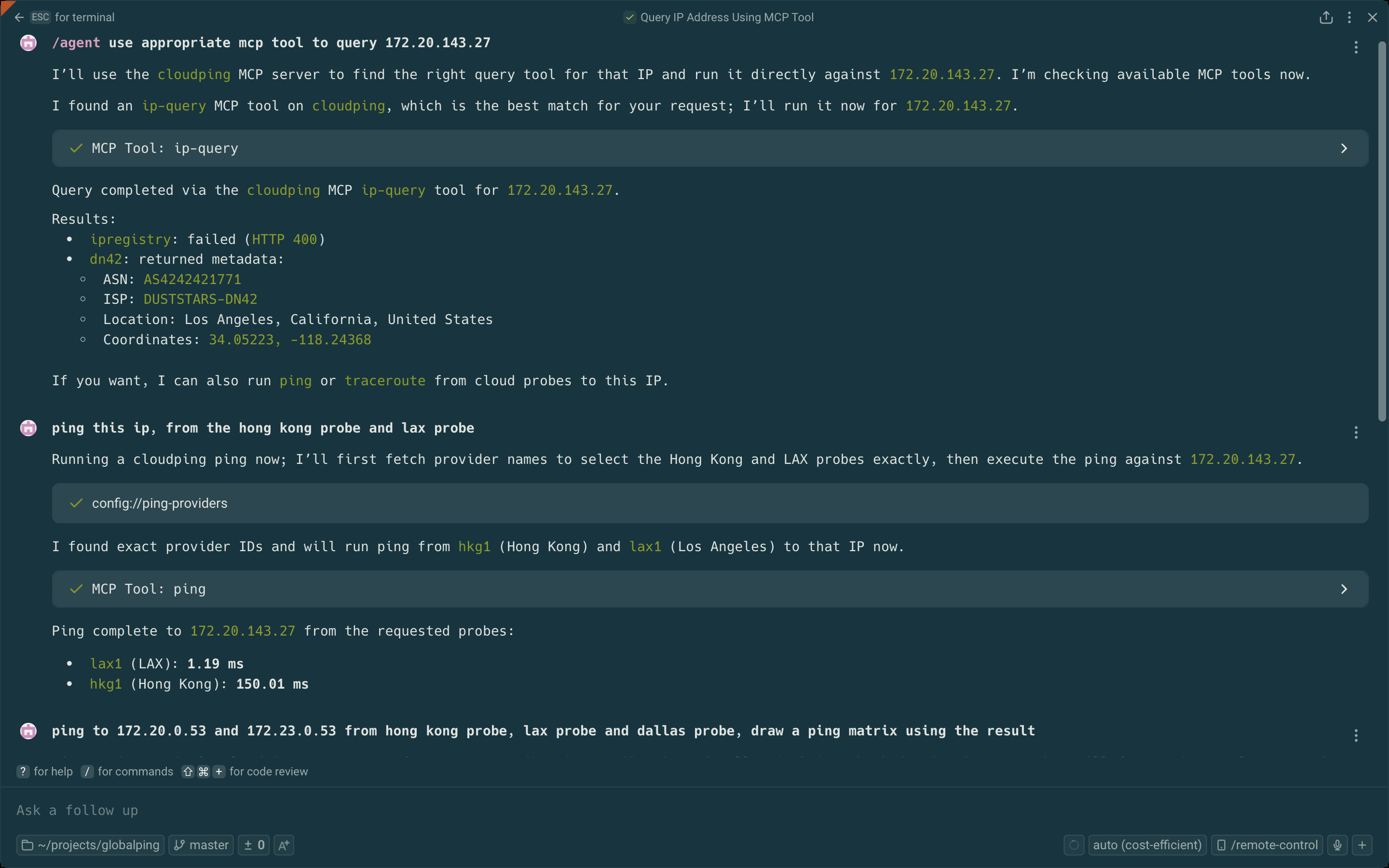
| Email — Ping Matrix | Email — Help Reply | MCP Server Tools |
|---|---|---|
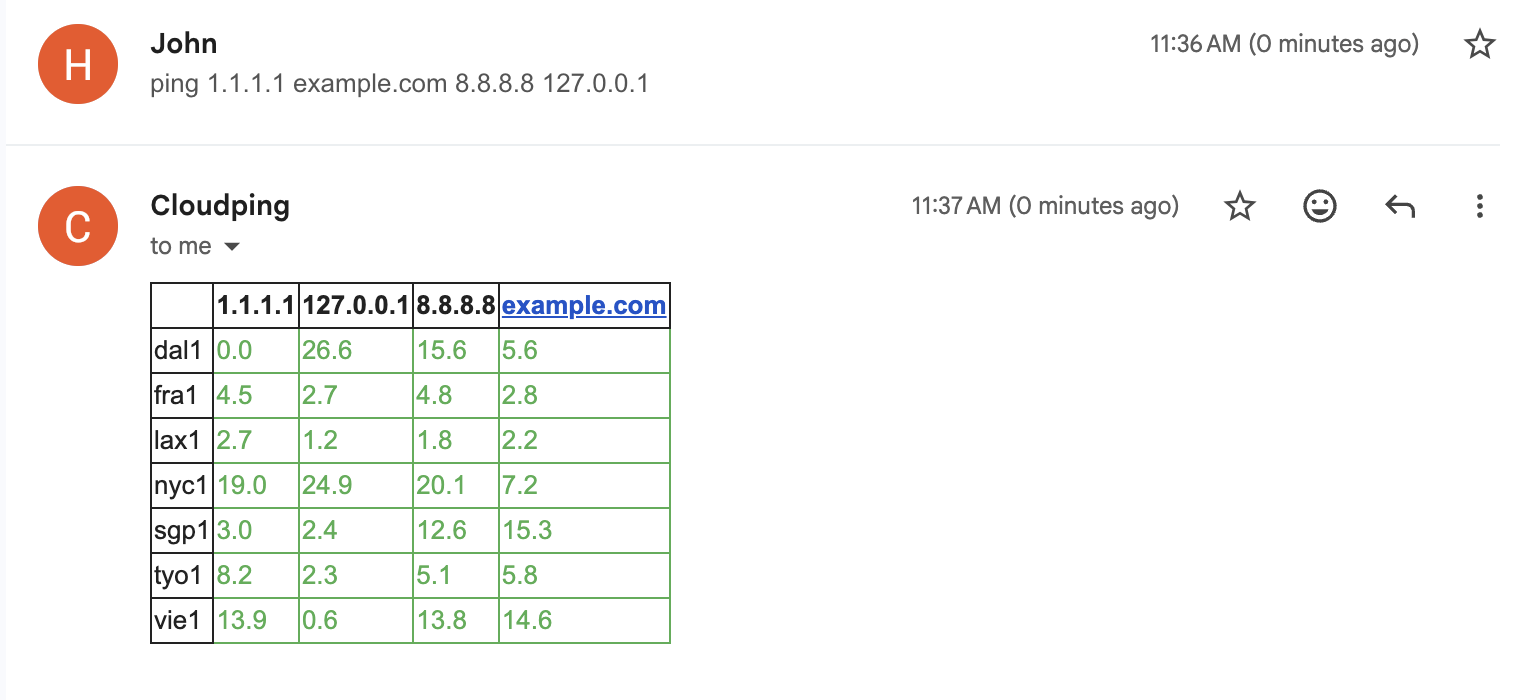 |
 |
 |
| Traceroute Canvas Export | ||
|---|---|---|
 |
API Design
Endpoints Overview
| Component | Endpoint | Method | Target Parameter | Targets Supported |
|---|---|---|---|---|
| Agent | /simpleping |
GET | destination |
Single target |
| Hub | /ping |
GET | targets |
Multiple (comma-separated) |
Port numbers are configured via command-line arguments.
Request Format
Parameters are encoded as URL search params. For available parameters and their effects, see:
- pkg/pinger/request.go - Supported parameters
- pkg/pinger/ping.go - Parameter effects
Example (curl):
Bring up the testing hub and agent(s) as described in the Debugging section
# Agent
curl --url-query targets=1.1.1.1 --url-query count=3 localhost:8085/simpleping

# Hub
curl --url-query from=us-lax1 --url-query targets=1.1.1.1 --url-query count=3 localhost:8084/ping
Note:
--url-queryis curl syntax sugar for encoding URL search params.
Prometheus Metrics:
Agents can expose Prometheus metrics by setting --metrics-listen-address (e.g. :2112). The metrics path defaults to /metrics.
# Agent (requires --metrics-listen-address to be set when launching the agent)
curl localhost:2112/metrics
Response Format
Both endpoints return a stream of JSON lines. Use line feed (\n) as the delimiter.
Developer Note
These APIs are intended for developers only. End users should use the Web UI.
MRT Query Service
The MRT Query Service provides BGP route lookup by streaming MRT (RFC6396, Multi-threaded Routing Toolkit Routing Information Export Format) data entries. Results are delivered as newline-delimited JSON (ndjson) streams, supporting queries by origin ASN, neighbor ASN, AS path segments, and IP/CIDR prefix.
For the data format specification and the reference implementation, see internetworklab/mrtparse-stream. The reference implementation uses GoBGP to parse MRT files and PostgreSQL to store and index the resulting entries.
Bot Interface
Currently, only Telegram Bot is supported.
| Command | Description | Example |
|---|---|---|
/ping |
Ping a destination with real-time streaming statistics. Supports IPv4/IPv6 preference and interactive location switching. | /ping -c 3 example.com |
/traceroute |
Traceroute to a destination with hop-by-hop peer and latency details. Supports IPv4/IPv6 preference and packet count. | /traceroute -6 example.com |
/probe |
Probe a CIDR subnet and generate a bitmap visualization. Requires a source node. | /probe -s us-lax1 172.23.0.0/24 |
/list |
List all available probe nodes with their network (ASN/ISP) and location information. | /list |
/version |
Show build version information as a JSON payload. | /version |
For how to deploy your own bot, see the docker-compose.yaml file in example1 or the dev scripts in scripts/.
Email Interface
Send email to cli at ping2.sh to interact with it. To display the help, send --help or [subcommand] --help (e.g. traceroute --help, no backtick).
| Command | Description | Example |
|---|---|---|
list |
List all available probe nodes with their network (ASN/ISP) and location information. | list |
ping |
Ping one or more destinations from specified source nodes. Supports IPv4/IPv6 preference and protocol selection (ICMP/UDP/TCP). | ping example.com |
traceroute |
Traceroute to a destination from a specified source node with hop-by-hop latency details. Supports IPv4/IPv6 preference and packet count. | traceroute -s lax1 -c example.com |
Connect to the MCP server
First, grab a JWT token by sending a /token command to the bot @as4242421771_bot.
Our MCP server: https://mcp.ping2.sh/mcp .
Authentication: JWT.
Example MCP server config on Warp.dev terminal's MCP server setting page:
{
  "cloudping": {
    "headers": {
      "Authorization": "bearer the_token_here"
    },
    "url": "https://mcp.ping2.sh/mcp"
  }
}
And the MCP client have to be able to use StreamableHTTP as transport.
Deployment
Web (frontend)
The Web UI is built with Next.js and supports the following build-time environment variables:
| Variable | Description | Default (Example) |
|---|---|---|
NEXT_PUBLIC_API_ENDPOINT |
API endpoint to use (prefix prepended to every request path) | /api |
NEXT_PUBLIC_GITHUB_REPO |
Link to the repository website | internetworklab/cloudping |
NEXT_PUBLIC_REPO_OWNER |
For display count of stargazers of the repo in the page | internetworklab |
NEXT_PUBLIC_REPO_NAME |
For display count of stargazers of the repo in the page | cloudping |
NEXT_PUBLIC_SITE_NAME |
WebUI title for self-hosted deployments | CloudPing |
NEXT_PUBLIC_DEFAULT_RESOLVER |
Resolver to specify in every probe request send to backend | 127.0.0.11:53 |
NEXT_PUBLIC_<NAME>_LOGIN_URL |
URL of oauth login page | /login/as/<name>/start |
These variables are evaluated at build time and embedded into the frontend bundle.
For 3rd-parth OAuth2 Login, currently we supports: Github, Google, Microsoft Entra ID, iEdon, Kioubit, Visitor, available env variables are: NEXT_PUBLIC_GITHUB_LOGIN_URL, NEXT_PUBLIC_GOOGLE_LOGIN_URL, NEXT_PUBLIC_ENTRA_LOGIN_URL, NEXT_PUBLIC_IEDON_LOGIN_URL, NEXT_PUBLIC_KIOUBIT_LOGIN_URL, NEXT_PUBLIC_VISITOR_LOGIN_URL.
Full Deployment (Docker Compose)
A complete self-hosted deployment example is available under docker/example1/. It includes a docker-compose.yaml that brings up all components — web frontend (Caddy), hub, Telegram bot, probe agents, and a Cloudflare Tunnel (cloudflared) for public ingress — along with setup scripts for provisioning tunnels, DNS records, and self-signed mTLS certificates for securing hub-to-agent's bidirectional communication.
Note: This is intended as a hands-on demonstration, not a production-ready setup, for a production setup, the agents should be deployed at where they actually are.
For step-by-step instructions, see docker/example1/README.md.
Join Agent
To run your cloudping agent and join our cluster, prepare three files:
docker-compose.yaml:
networks:
  globalping:
    name: globalping
    enable_ipv6: false
    ipam:
      driver: default
      config:
        - subnet: "${SUBNET_OVERRIDE}"
services:
  agent:
    container_name: globalping-agent
    pull_policy: always
    image: ghcr.io/internetworklab/cloudping:${VERSION}
    working_dir: /app/globalping
    networks:
      - globalping
    volumes:
      - "./.env.inside:/app/globalping/.env:ro" # .env.inside has some sensitive data, such as apikeys for invoking third-party services.
    command:
      - "/usr/local/bin/globalping"
      - "agent"
      - "--node-name=${NODE_NAME}"
      - "--exact-location-lat-lon=${EXACT_LOCATION_LAT_LON}"
      - "--country-code=${ALPHA2}"
      - "--city-name=${CITY}"
      - "--asn=${ASN}"
      - "--isp=${ISP}"
      - "--dn42-asn=${DN42_ASN}"
      - "--dn42-isp=${DN42_ISP}"
    mem_limit: 256m
.env:
NODE_NAME=nickname-nue1
SUBNET_OVERRIDE=192.168.253.0/30
EXACT_LOCATION_LAT_LON=48.1952,16.3503
VERSION=latest
ALPHA2=DE
CITY=Nuremberg
ASN=AS197540
ISP=netcup GmbH
DN42_ASN=AS4242421234
DN42_ISP=YOUR-DN42-AS
Just don't forget to replace the informations in .env with that of yours, such as node name (node name must not be conflict with current node names), locations and ASNs.
.env.inside:
JWT_TOKEN=<jwt_token>
Grab the JWT token from bot @as4242421771_bot, with command /token.
Credits
Thanks the following GeoIP datasources, in no particular order:
Todos
- introduce text-based cross-session AI memories (like personal-site), and design-doc (like personal-site)
- improve planar worldmap to allow infinite panning and infinite zooming
- add 3d globe / 2d plannar worldmap toggle
- add dnssec switch toggle
- add supportness of more dns query types, e.g.: NAPTR
Pertanyaan tentang CloudPing MCP
Probe apa saja yang bisa dijalankan oleh CloudPing?
CloudPing mendukung ping, traceroute (UDP atau ICMP), TCP ping, DNS probe, HTTP probe melalui HTTP/1.1, HTTP/2, dan HTTP/3, serta BGP route lookup via data MRT.
Bagaimana cara MCP server CloudPing melakukan autentikasi client?
MCP server menggunakan StreamableHTTP dengan autentikasi JWT.
Format apa yang digunakan oleh respons API CloudPing?
Respons di-stream sebagai newline-delimited JSON lines menggunakan delimiter line feed.
Bisakah saya menggunakan instance CloudPing yang sudah dideploy daripada membangunnya sendiri?
Ya, instance publik tersedia di ping2.sh, dan instance DN42 di ping.dn42. Anda tidak perlu membangun atau melakukan install apa pun.
Apakah CloudPing mendukung BGP route lookup?
Ya, CloudPing menawarkan BGP Route Lookup via data MRT, yang dapat dikueri berdasarkan origin ASN, neighbor ASN, segmen AS path, dan prefix IP/CIDR.