
Posthouse MCP server
Commit 28 Okt 2026Menyediakan workspace memori bersama yang terversi, memungkinkan beberapa AI agent untuk membaca dan menulis ke file proyek yang sama.
Juga dikenal sebagai conscienceli/posthouse
- Stars
- 0
- Tools
- 5
- Unduhan, 30 hari
- —
- Versi terbaru
- —
- Commit terakhir
- 28 Okt 2026
- Lisensi
- MIT
Apa itu Posthouse MCP?
Menyediakan workspace memori bersama yang terversi, memungkinkan beberapa AI agent untuk membaca dan menulis ke file proyek yang sama. Server ini menyediakan 5 tool, seperti list_workspaces, create_workspace, start_session.
Ringkasan dibuat dari README proyek
Tentang Posthouse MCP server
Developer yang bekerja di berbagai platform AI dapat menggunakan Posthouse untuk menjaga memori bersama yang terversi untuk proyek mereka. Posthouse menyediakan workspace terpusat di mana berbagai agent seperti Claude, ChatGPT, Gemini, dan Claude Code dapat membaca dan menulis ke kumpulan file plain yang sama. Hal ini memungkinkan percakapan baru di client mana pun untuk mengikuti progres proyek hanya dengan satu kali pemanggilan tool start_session.
User dapat terhubung melalui remote MCP connector menggunakan sign-in OAuth 2.1, atau melalui REST API dan Python skill bawaan untuk CLI agents. Sistem ini mengelola workspace sebagai direktori di server, menggunakan git untuk version control sehingga setiap perubahan tercatat sebagai commit. Ini memungkinkan Anda untuk melihat history, melakukan diff pada perubahan, dan memulihkan versi lama melalui Admin UI khusus. Server ini mudah di-deploy menggunakan Docker atau instalasi Python langsung di Linux, hanya memerlukan satu proses dengan SQLite.
Apa yang bisa Anda lakukan dengannya
- 1Sinkronisasi konteks antar AI agent yang berbedaSebuah agent dapat melanjutkan pekerjaan tepat di mana agent lain berhenti dengan mengakses file proyek dan catatan hand-off yang sama.
- 2Onboarding sesi chat baru dengan cepatDeveloper dapat menggunakan satu perintah untuk memberikan status proyek saat ini dan keputusan terbaru kepada sesi AI yang baru.
- 3Melacak dan membatalkan modifikasi agentKarena setiap perubahan adalah git commit, Anda dapat mengaudit apa yang diubah oleh agent dan memulihkan versi sebelumnya jika diperlukan.
- 4Otomatisasi logging percakapan untuk tool CLIUser dapat menginstal hook di Claude Code untuk menyimpan history chat ke workspace secara otomatis sambil menyamarkan (redacting) data rahasia.
Ditulis berdasarkan README proyek. Setiap use case diperiksa terhadap kutipan dari README tersebut.
Tool Posthouse MCP 5
Terdeteksi dari READMElist_workspacescreate_workspacestart_sessionlog_progresshistory
| list_workspaces | — | |
| create_workspace | — | |
| start_session | — | |
| log_progress | — | |
| history | — |
Konfigurasi
POSTHOUSE_URL
| Nama | Deskripsi | Tipe |
|---|---|---|
| POSTHOUSE_URL | — |
Pengecekan otomatis
Berjalan 14 Nov 2026Laporan lengkap →Belum diverifikasi. Sebuah server memerlukan skor 80, tidak ada temuan serius, dan data yang cukup untuk kami periksa. Cara kerja checks · Yang perlu diperbaiki untuk menambah poin

- Source repository terhubung dan dapat dijangkauconscienceli/posthouse is public and reachablegithub.com/conscienceli/posthouse ↗Lolos
- Nama paket mencantumkan repositori ini sebagai sumbernyaTidak diperiksa
- Provenance build (atestasi Sigstore)Tidak diperiksa
- Lisensi open source (OSI)MITspdx.org/licenses/MIT.html ↗Lolos
- Ada commit atau release dalam satu tahun terakhirLast commit or release 2026-10-28github.com/conscienceli/posthouse ↗Lolos
- OpenSSF ScorecardTidak diperiksa
- Nama package tidak mirip dengan package populerTidak diperiksa
- Tidak ada advisory kritis pada paket atau dependensinyaTidak diperiksa
- Tidak ada instruksi tersembunyi untuk model5 tool descriptions and the README read; no override phrases, credential paths or hidden charactersLolos
- Tools yang bersifat destruktif telah diberi labelNo tool named like delete, drop or execLolos
- Endpoint remote merespons handshake MCPTidak diperiksa
README
Lihat di GitHubPosthouse
Shared, versioned memory for all your AI agents. Claude, ChatGPT, Gemini, Claude Code, Codex, Gemini CLI, Cursor and others can all read and write the same project. When you open a new conversation with any of them, it can catch up on the project with a single call.
A posthouse (驿站) was a relay station where a courier handed over the mail and a fresh rider carried it on. Here every agent hands over at the workspace, and the next one picks it up.
More screenshots: change history · OAuth sign-in page
Why
Web chat apps cannot mount a file share or log in to WebDAV, and each app keeps its own separate memory. Posthouse gives every project a workspace: a folder of plain files on your server. Agents reach it in three ways:
- MCP: Claude, ChatGPT, Gemini and the CLI agents add it as a remote MCP connector. The server has its own OAuth login page, where you sign in with a password.
- REST + Skill: agents that have a shell (Claude Cowork, Claude Code, Codex, …) use the
bundled skill,
posthouse.py, orcurl. - Admin UI: you browse, edit, upload, restore old versions and manage access in a browser.
 Claude.ai ─┐                    ┌──────────── Posthouse ─────────────┐
 ChatGPT  ──┤  MCP (OAuth)       │  /mcp     MCP server (Streamable HTTP)          │
 Gemini   ──┤ ─────────────────▶ │  /oauth   OAuth 2.1 (password sign-in page)     │──▶ data/workspaces/<name>/
 Claude Code┤                    │  /api     REST API (+ /api/docs)                │      AGENTS.md  STATUS.md
 Codex ─────┤  REST / Skill      │  /        Admin UI                              │      DECISIONS.md journal/
 you ───────┘ ─────────────────▶ │  git history · SQLite index · activity log      │      memory/ files/  (.git)
                                 └─────────────────────────────────────────────────┘
Features
- Plain files, full history. Each workspace is a directory on disk and its own git repository. Every change becomes a commit authored by the agent that made it, so you can view old versions, diff them and restore them. History is packed automatically every day to save disk space. Deleted workspaces go to a trash first.
- One-call onboarding.
start_sessionreturns the project guide, the current status, recent decisions, the latest hand-off notes, the file list and recent changes. - Hand-off protocol. Each workspace starts with
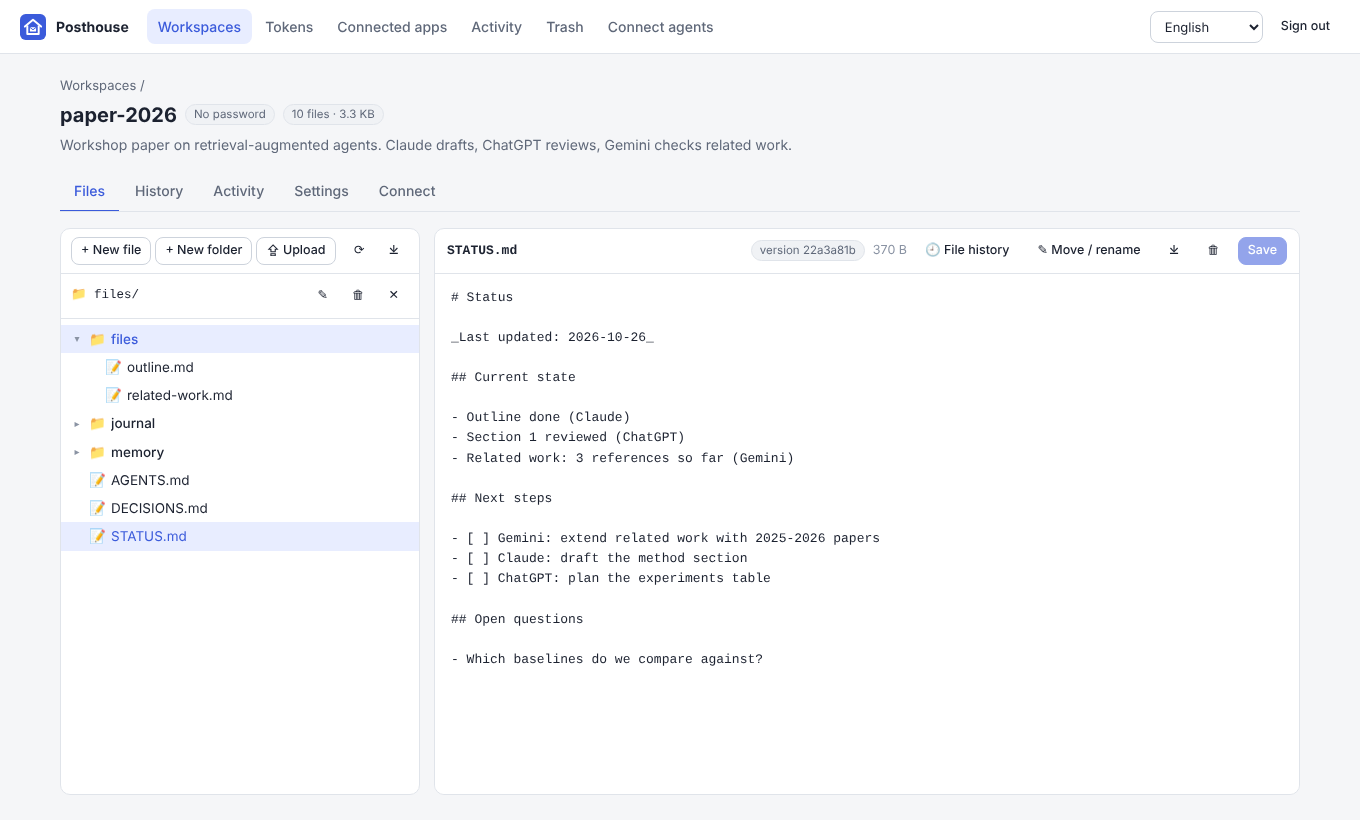
AGENTS.md,STATUS.md,DECISIONS.md,journal/,memory/andfiles/.log_progresswrites a dated hand-off note and can updateSTATUS.mdat the same time. - Conversation auto-save (Claude Code). One command installs hooks that save the conversation to the workspace before and after every turn, with secrets redacted. See docs/skill.md.
- Safe concurrent edits. Writes can be optimistic: they fail if the file changed since you read
it. Exact-text
edit_fileandappend_fileavoid rewriting whole files. - Works with today's MCP clients. The server speaks the stateless 2026-07-28 protocol
(
server/discover, per-request_meta) and the olderinitialize-based revisions (2024-11-05 … 2025-11-25) on the same endpoint. It is tested with the official MCP Python SDK v1 and v2. - Auth the web apps accept. A built-in OAuth 2.1 authorization server: discovery, dynamic client registration, client ID metadata documents, PKCE (S256) and rotating refresh tokens. CLIs and scripts can also use HTTP Basic, revocable access tokens, or a secret token URL.
- Three password levels. An admin password, an agent password, and an optional password per workspace (see below).
- Admin UI. Workspaces, file browser and editor, upload, history and restore, access tokens, connected apps (revoke OAuth grants), activity log, trash, connection instructions, and a Settings page (disk use, compact all workspaces, effective configuration). English by default, with a language dropdown (English, 简体中文). See Translations to add more languages.
- Easy to run. One Python process with SQLite and no external services. Run it with Docker, with optional automatic HTTPS through Caddy, or directly on any Linux server.
Quick start
With Docker (recommended)
git clone https://github.com/conscienceli/posthouse.git
cd posthouse

# Pick the line that matches your server (Claude/ChatGPT/Gemini on the web need public HTTPS):
./scripts/docker-start.sh --domain posthouse.example.com                # ports 80/443 free: built-in HTTPS
./scripts/docker-start.sh --behind-proxy https://posthouse.example.com  # nginx or Cloudflare already in front
./scripts/docker-start.sh --behind-proxy https://posthouse.example.com --tunnel-token <TOKEN>  # Cloudflare Tunnel
./scripts/docker-start.sh                                               # plain HTTP on :8080 for testing
The script creates .env with random admin and agent passwords, builds the image, starts the
container and prints the URLs and passwords. Other commands: logs, status, restart,
stop, update and passwords. Data lives in ./data. Step-by-step guides for an existing nginx
and for Cloudflare (Tunnel, Full (strict), Flexible) are in docs/deploy.md.
Without Docker
./scripts/install.sh                 # Python venv + dependencies + .env
./scripts/run.sh                     # run in the foreground
sudo ./scripts/install.sh --systemd --behind-proxy https://posthouse.example.com   # systemd service behind nginx
Requirements: Linux, Python 3.10+, and git (optional; it powers history). nginx examples:
deploy/nginx.conf.example and
deploy/nginx-cloudflare.conf.example.
Web apps need public HTTPS. Claude, ChatGPT and Gemini connect from their own cloud, so the server must be reachable at
https://…on port 443. See docs/deploy.md, which also has notes for servers in mainland China.
Access levels
| Level | Credential | Can do |
|---|---|---|
| Admin | POSTHOUSE_ADMIN_PASSWORD |
Everything: admin UI, delete/rename workspaces, set passwords, tokens, revoke apps |
| Agent | POSTHOUSE_AGENT_PASSWORD |
List and create workspaces; read/write files in all workspaces |
| Workspace | that workspace's own password (optional) | Read/write files in that workspace only |
Ways to present a credential:
- OAuth sign-in page. Web apps and most MCP clients open this page; you type a password there. Leave Workspace empty to grant the password's full level, or enter a workspace name to limit that connection to one workspace (this works with the admin or agent password too).
- HTTP Basic. User
agent,adminor a workspace name, plus the password (for the skill, curl, CLI agents and Claude request headers). - Access tokens (
ph_…). Created in the UI asAuthorization: Bearer ph_…, or as a secret URLhttps://…/mcp/t/ph_…for apps that only accept a URL. They are revocable and can be limited to one workspace.
Connect your agents
Your MCP URL is https://<your-domain>/mcp. The Connect agents page in the admin UI shows it
with copy buttons.
| Agent | How to connect |
|---|---|
| Claude (web, desktop, mobile, Cowork) | Settings → Connectors → Add custom connector → paste the URL → sign in with a password |
| ChatGPT (web) | Settings → Security → enable Developer mode, then Apps/Plugins → + → paste the URL → OAuth → password. Select the app in each new chat. Requires a paid plan; write support depends on the plan (beta). |
| Gemini (web) | Settings → Connected apps → Add a custom app (currently US-only, personal accounts) |
| Claude Code | claude mcp add --transport http posthouse https://posthouse.example.com/mcp, then /mcp to sign in. Or add --header "Authorization: Bearer ph_…" |
| Codex CLI | codex mcp add posthouse --url https://posthouse.example.com/mcp, then codex mcp login posthouse. Or set bearer_token_env_var in ~/.codex/config.toml |
| Gemini CLI | gemini mcp add --transport http posthouse https://posthouse.example.com/mcp, then /mcp auth posthouse. Or "httpUrl" + "headers" in settings.json |
| Anything with a shell | The skill / posthouse.py / curl with Basic auth or a token |
| Apps that only take a URL | Create a token in the UI and use https://…/mcp/t/ph_… |
Step-by-step guides and troubleshooting are in docs/mcp.md. A good first message in a new chat:
You can use the "Posthouse" connector. Our project lives in the workspace "my-project". First call start_session(workspace="my-project") and read AGENTS.md and STATUS.md. Keep STATUS.md current and call log_progress before you stop.
MCP tools
| Tool | Purpose |
|---|---|
list_workspaces |
Workspaces you can access |
create_workspace |
New workspace with the standard layout (agent/admin) |
start_session |
Load guide, status, decisions, journal, file list, recent changes |
list_files · read_file |
Browse and read (with offset/limit, or an older revision) |
write_file · edit_file · append_file |
Write (optionally with expected_version), exact-text edit, append |
move_file · delete_file |
Rename/move and delete (recoverable from history) |
search · fetch |
Full-text search; fetch by id (shape compatible with ChatGPT deep research) |
log_progress |
Hand-off note in journal/YYYY-MM-DD.md, optional new STATUS.md |
history |
Who changed what and when |
Skill and CLI
skills/posthouse holds a ready-made agent skill:
SKILL.md and scripts/posthouse.py, a CLI that uses only the
Python standard library.
export POSTHOUSE_URL=https://posthouse.example.com POSTHOUSE_USER=agent POSTHOUSE_PASSWORD=… POSTHOUSE_AGENT="Claude Code"
python3 posthouse.py start my-project
python3 posthouse.py read my-project STATUS.md
python3 posthouse.py log my-project --summary "Drafted section 2" --next "Review section 3"
The quickest way to start a new Cowork or Claude Code task on a workspace: click Setup message on the workspace in the admin UI and paste the copied message into the task. It contains the server address and a new token for that workspace only; Claude installs the skill from your server, signs in and turns on conversation auto-save.
To do the same by hand (before and after each turn, secrets redacted):
python3 posthouse.py login --url https://posthouse.example.com --token ph_…
python3 posthouse.py install-hooks --workspace my-project
./scripts/package-skill.sh builds dist/posthouse-skill.zip for upload to Claude.
To use the skill with Claude, Claude Code, Codex and Gemini CLI, see docs/skill.md.
REST API
Everything the UI and the skill do goes through /api. Interactive docs are at /api/docs, and a
summary is in docs/api.md. Curl-friendly raw endpoints:
curl -u agent:$PW https://posthouse.example.com/api/workspaces/my-project/raw/STATUS.md
curl -u agent:$PW -X PUT --data-binary @STATUS.md -H "If-Match: <version>" \
     https://posthouse.example.com/api/workspaces/my-project/raw/STATUS.md
Configuration
All settings come from environment variables or .env. See .env.example.
| Variable | Default | Meaning |
|---|---|---|
POSTHOUSE_ADMIN_PASSWORD |
generated | Admin password (saved to data/admin-password.txt if not set) |
POSTHOUSE_AGENT_PASSWORD |
empty (disabled) | Agent password |
POSTHOUSE_PUBLIC_URL |
from request | Public base URL, e.g. https://posthouse.example.com (set it behind a proxy) |
POSTHOUSE_DATA_DIR |
./data (/data in Docker) |
Workspaces, trash and the SQLite database |
POSTHOUSE_HOST / POSTHOUSE_PORT |
0.0.0.0 / 8080 |
Listen address (bare metal) |
POSTHOUSE_DOMAIN |
empty | Enables the bundled Caddy HTTPS profile (Docker) |
POSTHOUSE_HOST_PORT / POSTHOUSE_BIND |
8080 / 0.0.0.0 |
Published port and bind address (Docker) |
POSTHOUSE_MAX_FILE_MB |
10 |
Maximum file size |
POSTHOUSE_GIT |
true |
Version every change with git |
POSTHOUSE_GIT_GC_HOURS |
24 |
Compact each workspace's change history this often (git gc; 0 turns it off). Admins can also run it from Workspace → Settings |
POSTHOUSE_ACCESS_TOKEN_TTL |
3600 |
OAuth access token lifetime (seconds) |
POSTHOUSE_REFRESH_TOKEN_DAYS |
180 |
OAuth refresh token lifetime (days, rotated on use) |
POSTHOUSE_SESSION_HOURS |
12 |
Admin UI session lifetime |
POSTHOUSE_LOGIN_MAX_FAILURES / POSTHOUSE_LOGIN_WINDOW_SECONDS |
10 / 600 |
Password rate limit per client IP |
POSTHOUSE_TRUSTED_PROXIES |
127.0.0.1,::1 |
Proxies allowed to set X-Forwarded-* (set by --domain for the bundled Caddy) |
Security notes
- Always serve it over HTTPS. Use long random passwords; the start scripts generate them.
- Give agents the agent password, a workspace password, or a token, never the admin password. Revoke OAuth connections and tokens you no longer use in the UI.
- Content written by one agent is read by others. The bundled instructions tell agents to treat file contents as data, not instructions. Git history lets you undo anything.
- Failed password attempts are rate-limited per IP. The admin UI uses
HttpOnly/SameSite=Strictcookies plus a CSRF header. Files are never served as active HTML. - You can optionally restrict access at your firewall to the platforms' published egress ranges
(see docs/deploy.md). Back up the
data/directory.
Translations
UI strings live in posthouse/static/i18n/. To add a language, copy en.json to
<code>.json (for example ja.json or fr.json), translate the values, and add
{"code": "<code>", "name": "<native name>"} to languages.json. The admin UI dropdown and the
OAuth sign-in page (chosen from the browser's Accept-Language) use these files. Any missing keys
fall back to English.
Development
pip install -r requirements-dev.txt
pytest                      # unit + integration tests (REST, MCP, OAuth, CLI)
python -m posthouse --port 8080   # reads .env if present
Code layout: posthouse/storage.py (workspaces, files, git), posthouse/auth.py (passwords, tokens),
posthouse/oauth.py (authorization server), posthouse/mcp_server.py (MCP), posthouse/api.py (REST),
posthouse/static/ (admin UI, no build step).
License
Pertanyaan tentang Posthouse MCP
Tool apa yang disediakan Posthouse MCP?
Server ini menyediakan 5 tool, termasuk list_workspaces, create_workspace, start_session, log_progress, history.
Apakah Posthouse mendukung version control?
Ya, setiap workspace adalah direktori di disk dan merupakan git repository tersendiri, sehingga Anda dapat melihat, melakukan diff, dan memulihkan versi lama dari file.