
prod-code MCP server
Commit 14 Nov 2026Menyediakan remote code intelligence, build, dan testing untuk AI coding agent menggunakan cluster gateway terdistribusi.
Juga dikenal sebagai alex09x/prod-code
- Stars
- 7
- Tools
- —
- Unduhan, 30 hari
- —
- Versi terbaru
- —
- Commit terakhir
- 14 Nov 2026
- Lisensi
- Apache-2.0
Apa itu prod-code MCP?
prod-code adalah MCP server. Menyediakan remote code intelligence, build, dan testing untuk AI coding agent menggunakan cluster gateway terdistribusi.
Ringkasan dibuat dari README proyek
Tentang prod-code MCP server
prod-code memungkinkan penyediaan remote code intelligence dan beban kerja komputasi berat untuk AI coding agent. Tool ini memindahkan tugas-tugas intensif seperti analisis bahasa, build, dan testing dari laptop lokal ke cluster gateway terdistribusi. Setup ini memungkinkan developer untuk menjaga mesin lokal tetap ringan sementara sekumpulan agent melakukan query frekuensi tinggi menggunakan tool seperti rust-analyzer, gopls, clangd, pyright, dan sourcekit-lsp pada node remote.
User dapat terhubung melalui prod-code CLI atau mendaftarkan server sebagai MCP tool di client seperti Claude Code, OpenAI Codex, atau Gemini. Sistem ini menggunakan engine mirroring yang cepat untuk menyinkronkan kode via Base64 diff melalui 10 GbE LAN, bukan melalui network mounting tradisional. Arsitektur ini mendukung lingkungan polyglot, dengan mengarahkan tugas spesifik seperti subproject Swift ke node macOS, sementara menjalankan workload Rust, Go, atau Python pada cluster Linux. Tool ini dirancang untuk tim yang menjalankan banyak agent yang membutuhkan akses cepat dan persisten ke workspace intelligence tanpa menghabiskan core CPU lokal.
Apa yang bisa Anda lakukan dengannya
- 1Menjalankan distributed test suitesDeveloper dapat memicu eksekusi test skala besar pada remote node dengan jumlah core yang tinggi.
- 2Integrasi remote intelligence ke dalam editorCode editor dapat menggunakan protokol LSP untuk mengakses remote language server seolah-olah berjalan secara lokal.
- 3Otomatisasi polyglot buildsSistem secara otomatis mengarahkan tugas spesifik bahasa ke hardware yang sesuai, seperti node macOS untuk Swift.
Ditulis berdasarkan README proyek. Setiap use case diperiksa terhadap kutipan dari README tersebut.
Konfigurasi
PROD_CODE_REMOTE
| Nama | Deskripsi | Tipe |
|---|---|---|
| PROD_CODE_REMOTE | — |
Pengecekan otomatis
Berjalan 14 Nov 2026Laporan lengkap →Belum diverifikasi. Sebuah server memerlukan skor 80, tidak ada temuan serius, dan data yang cukup untuk kami periksa. Cara kerja checks · Yang perlu diperbaiki untuk menambah poin

- Source repository terhubung dan dapat dijangkaualex09x/prod-code is public and reachablegithub.com/alex09x/prod-code ↗Lolos
- Nama paket mencantumkan repositori ini sebagai sumbernyaTidak diperiksa
- Provenance build (atestasi Sigstore)Tidak diperiksa
- Lisensi open source (OSI)Apache-2.0spdx.org/licenses/Apache-2.0.html ↗Lolos
- Ada commit atau release dalam satu tahun terakhirLast commit or release 2026-11-12github.com/alex09x/prod-code ↗Lolos
- OpenSSF ScorecardTidak diperiksa
- Nama package tidak mirip dengan package populerTidak diperiksa
- Tidak ada advisory kritis pada paket atau dependensinyaTidak diperiksa
- Tidak ada instruksi tersembunyi untuk model0 tool descriptions and the README read; no override phrases, credential paths or hidden charactersLolos
- Tools yang bersifat destruktif telah diberi labelTidak diperiksa
- Endpoint remote merespons handshake MCPTidak diperiksa
README
Lihat di GitHub⚡ prod-code
Remote code intelligence for fleets of coding agents




Why
A language server was designed for one human typing in one checkout. What runs on a machine
now is a fleet: a resident agent in the main checkout, workers in their own worktrees, each
asking the analyzer the kind of question a human asks once a minute and asking it ten times a
second. Every worktree brings its own analyzer and its own mitts test, and they share the
cores with your editor.
prod-code moves all of it one hop away. Measured on this repository, with nothing compiled
on the laptop:
| hover on a warm workspace | 1–4 ms |
| tool call over a persistent session | ~10 ms |
a one-shot CLI command from the laptop, end to end (prod-code hover …) |
~0.1 s |
mitts clippy --workspace --all-targets on a 32-core node, one file changed |
1 s |
mitts test --workspace — 565 tests |
5 min |
mitts test --workspace --exclude prod-code-gateway |
56 s |
| first load of a Rust workspace (build scripts, proc macros) | ~45 s, once per worktree |
These are recorded workloads; current test counts and timings are listed in each pull request.
The live suite starts real gateways and drives their language servers. Unit and scripted-server
tests complement those scenarios. The 56 s workload excludes the entire gateway crate.
The required coverage floor is 80% of regions per Rust source file
(python3 scripts/coverage.py --min 80). The default gate enumerates Rust sources in workspace
package directories, skipping hidden, build-output, test, bench and example directories and
workspace exclusions. It rejects missing measurements for enumerated files except those
filtered by omitted_by_llvm_cov: test/example/bench paths, build scripts, modules declared
only off Unix, and files without a recognized fn item. Those omissions need no zero-region
report entry and are not coverage evidence. Malformed report entries fail; explicit zero-region
entries are reported as having no code. These gate limits do not relax the required 80% floor;
see Coverage for the evidence policy.
Architecture
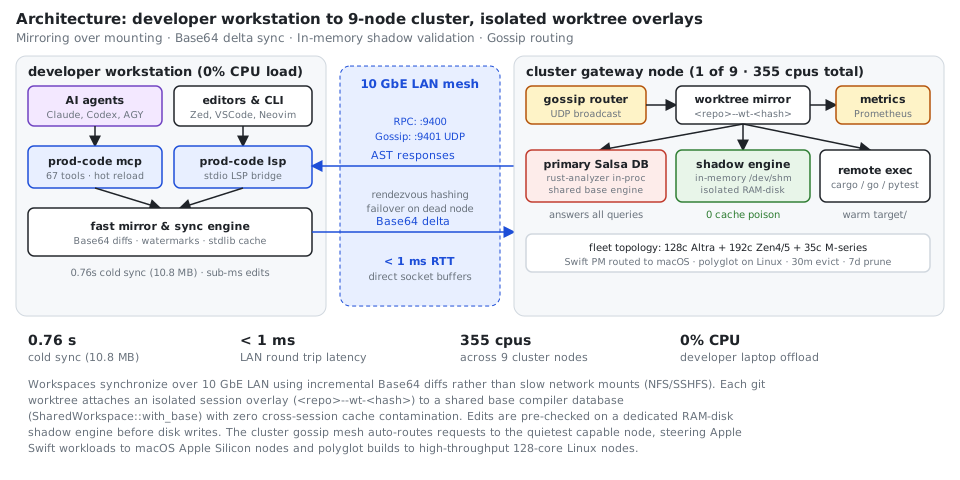
flowchart TD
    subgraph ClientHost["Developer Workstation (Laptop / Desktop)"]
        Agent["AI Coding Agents\n(Claude Code, Codex, Antigravity)"]
        Editor["Code Editors\n(Zed, VS Code, Neovim)"]
        CLI["prod-code CLI"]

        Agent -->|"Native MCP tools"| MCPBridge["prod-code mcp"]
        Editor -->|"LSP protocol"| LSPBridge["prod-code lsp"]
        CLI -->|"Commands / Queries"| ClientCore["prod-code client"]

        MCPBridge & LSPBridge & ClientCore --> SyncEngine["Fast Mirror & Sync Engine\n(Base64 diffs, watermarks, local cache)"]
    end

    SyncEngine -->|"10 GbE LAN / Gossip (:9400)"| GatewayCluster

    subgraph GatewayCluster["Production Cluster (9 nodes · 355 CPU cores)"]
        subgraph LinuxAarch64["128-Core aarch64 (Ampere Altra)"]
            LinuxArmNode["Linux aarch64 build node (128 cpus)\nRust, Go, C++, Python, TS, Java, Kotlin"]
        end

        subgraph LinuxX86["High-Throughput x86_64 Nodes (192 cpus)"]
            LinuxX86Node1["Zen 5 build node (32 cpus)"]
            LinuxX86Node2["Zen 4 build node + telemetry (32 cpus)"]
            LinuxX86Node3["Polyglot build node (32 cpus)"]
            LinuxX86Storage["Storage & build nodes (96 cpus)"]
        end

        subgraph MacNodes["Apple Silicon macOS Nodes (35 cpus)"]
            MacNodeStudio["macOS build node (24 cpus) · Swift, Go"]
            MacNodeBook["macOS build node (11 cpus) · Swift"]
        end

        subgraph GatewayInternals["Gateway Architecture (per node)"]
            Router["Placement & Gossip Router"] --> Workspaces["Per-Worktree Mirrors\n(<repo>--wt-<hash>)"]
            Workspaces --> PrimarySalsa["Primary Salsa DB\n(rust-analyzer in-proc; child LSPs)"]
            Workspaces --> ShadowValidation["Validation Engines\n(private or shared by engine)"]
    Workspaces --> RemoteExec["Remote Builds, Lints & Tests\n(mitts, go, pytest, swift, etc.)"]
            GatewayInternals --> Telemetry["Prometheus Scrape (:9401)\n& Pushgateway (:9091)"]
        end
    end

    Telemetry --> Monitoring["Prometheus + VictoriaMetrics + Grafana"]
prod-code separates the lightweight developer interface from heavy language intelligence and compilation:
- Mirroring over Mounting: Workspaces synchronize fast Base64 diffs over 10 GbE LAN instead of network-mounting filesystems (NFS/SSHFS), keeping filesystem operations local and fast.
- Worktree Isolation: Rust worktree mirrors attach isolated overlays to a shared base compiler database (
SharedWorkspace::with_base), while child language servers run isolated per-process, avoiding cross-session state corruption. - Validation Engines: Proposed edits use private validation engines for generic LSP engines and normally for Rust. Rust can fall back to its main engine; Go and other non-generic, non-Rust views use the shared view. See the validation details below.
- Polyglot Cluster Gossip: Nodes discover each other via UDP gossip on
:9401, evaluate load and memory pressure, and route requests to capable nodes (including automatic rerouting of Swift subprojects to macOS nodes).
Requirements
Building prod-code and running its development checks require Rust 1.95.0 or newer. With
rustup, install the supported minimum and the check components, then build and check with Mitts:
rustup toolchain install 1.95.0 --profile minimal -c rustfmt -c clippy
Use Mitts for Rust builds, formatting, tests, and linting.
Install
Direct Download & Packages
Choose your preferred installation method for the prod-code CLI:
# Direct shell installer (detects OS and architecture)
curl -fsSL https://prod.codes/install.sh | sh

# Debian / Ubuntu (.deb)
curl -fsSLO https://github.com/alex09x/prod-code/releases/download/v0.3.29/prod-code_0.3.29_amd64.deb
sudo dpkg -i prod-code_0.3.29_amd64.deb

# RHEL / Fedora / Rocky Linux (.rpm)
sudo rpm -i https://github.com/alex09x/prod-code/releases/download/v0.3.29/prod-code-0.3.29-1.x86_64.rpm

# Arch Linux (.pkg.tar.gz)
sudo pacman -U https://github.com/alex09x/prod-code/releases/download/v0.3.29/prod-code-0.3.29-1-x86_64.pkg.tar.gz

# Build the client from source
mitts build --release -p prod-code-client --bins
Native notarized macOS installers (prod-code-0.3.29-macOS.pkg and .dmg) and standalone binaries for Linux (x86_64, aarch64) and macOS (arm64 Apple Silicon) are available on GitHub Releases.
In-Place Self-Updater
Keep your client installation up to date with a single command:
prod-code update --check   # check for newer releases on GitHub
prod-code update           # download, verify SHA-256 integrity, and replace binary in-place
When prod-code is updated, its MCP process re-executes between requests and announces
notifications/tools/list_changed. The agent host must refresh its exposed tool catalog;
some long-running sessions retain the old list. An updated executable or installed skill
does not prove that a running host can call a newly added tool. See
catalog discovery and refresh for verification and recovery.
Registering with AI Coding Agents
Register prod-code once; every repository accessed by your agent gains remote code intelligence tools:
For related investigation steps, the experimental code_workflow MCP tool composes
lookups with bounded result passing and explicit partial failures. It also accepts
short symbol-context and search-and-expand requests. See agent workflows
for the read contract and guarded edits for explicit
preview, apply and scoped verification steps. The first experimental slice is included in v0.3.49.
# Claude Code
claude mcp add --scope user prod-code -e "PROD_CODE_REMOTE=192.0.2.10:9400" -- prod-code mcp

# OpenAI Codex CLI
codex mcp add prod-code --env "PROD_CODE_REMOTE=192.0.2.10:9400" -- prod-code mcp

# Gemini CLI
gemini mcp add -s user prod-code prod-code mcp -e "PROD_CODE_REMOTE=192.0.2.10:9400"
For Google Antigravity, add the server definition to ~/.gemini/config/mcp_config.json (or use ~/.gemini/settings.json for Gemini CLI):
{
  "mcpServers": {
    "prod-code": {
      "command": "prod-code",
      "args": ["mcp"],
      "env": {
        "PROD_CODE_REMOTE": "192.0.2.10:9400"
      }
    }
  }
}
Running the Gateway Daemon
On the remote Linux or macOS worker host, install the separately packaged gateway from the
repository root before invoking the server (the client source-install step installs only prod-code):
# Build the gateway on this worker host
mitts build --release -p prod-code-gateway --bin prod-code-server

# Start gateway server directly
prod-code-server --bind 0.0.0.0:9400 --storage /srv/prod-code/workspaces \
  --advertise 192.0.2.10:9400 --peers 192.0.2.11:9400,192.0.2.12:9400

# Or run with declarative gateway.toml
prod-code-server --config /etc/prod-code/gateway.toml
In an editor
prod-code lsp is an editor's language server. The language's own server (rust-analyzer,
gopls, clangd, basedpyright, the TypeScript server, sourcekit-lsp) runs on the node, started
for the editor's session in the node's copy of the checkout, and the bridge carries the
protocol both ways:
- The editor's settings, rust-analyzer's check on save and the server's protocol extensions work as they do with a local server.
- A save reaches the node before the server hears of it.
- Files the server points at that exist only on the node (the standard library, dependency caches, generated files) are mirrored read-only under the user's cache directory.
--languagepicks the server for one language of a mixed checkout.- After a gateway interruption, the bridge retries for up to two minutes and restores
open documents, including unsaved edits. Set
PROD_CODE_RECONNECT=falseto disable retries for ordinary disconnects; redirects and workspace model changes still reconnect. Requests already in flight are rejected so the editor can retry against the restored state. A stalled state replay is bounded and terminates the session instead of risking a partial editor-protocol frame; incompatible sync capabilities require a fresh session. While reconnecting, up to 2,048 editor messages and 32 MiB are queued; exceeding either limit ends the session rather than silently discarding edits.PROD_CODE_LSP_TRACEcan name a local trace file containing the client version, message metadata and reconnect events without document contents. A running bridge keeps its current client executable until its editor language-server session is restarted.
For Zed there is an extension in editors/zed. Or point Zed's own
rust-analyzer at prod-code lsp --language rust, which keeps everything Zed wires to
rust-analyzer.
What it gives an agent
Tools use the node that holds the workspace. The tables describe current source; check CHANGELOG.md for the version that contains a change.
For a Git worktree, run the CLI from that worktree to select it. In an existing MCP
session, supported navigation and grep calls can select another worktree of the same
repository with workspace: "/absolute/path/to/worktree". Relative paths in the call
resolve against that worktree. Omitting workspace uses the MCP session's configured
workspace. For these calls, use filesystem paths without .. components; file URIs are
not accepted.
code_source and prod-code source <path> --line N --context K read checkout files
directly with the existing byte limit and line window; their language server is not
required. External library and SDK paths retain gateway routing and access checks.
Find code
| tool | what it does |
|---|---|
code_search |
find code by natural language query; ranked declarations with matching doc comments (dense embeddings fused with lexical ranking) |
code_symbols |
workspace symbol index by name, fuzzy matching, analyzer-backed |
code_definition · code_references |
exact symbol definition location; every reference and usage across the workspace |
code_callers · code_callees · code_implementations · code_supertypes |
call hierarchy in both directions as a tree to requested depth; trait/interface implementations, and supertypes or required traits |
code_outline |
declaration outline with kinds and line numbers for a single file or every source file in a directory |
code_source |
read stdlib, crate/package registry and SDK sources that live cached only on the gateway node |
code_structural_search |
AST pattern search across polyglot languages using metavariables ($name) without brittle regex |
code_find_duplicates |
clone and duplicate block detection across workspace files using Type-1 and Type-2 AST hashing |
Understand it without reading everything
| tool | what it does |
|---|---|
code_slice |
bounded transitive traversal of declarations referenced by a symbol; depth and byte budgets limit result size |
code_hover · code_type_at |
signature, precise inferred type, documentation, and markdown hover information |
code_impact |
blast radius of uncommitted changes: changed functions, reachable callers, and candidate tests |
code_dependencies |
workspace dependency graph analysis, direct and transitive dependencies, coupling metrics, and cycle detection |
code_dead_code |
reference-based unreferenced candidate declarations, marking unverified and protected symbols |
code_prune_orphans |
eligible dead-code candidates removed with safe delete and analyzer validation; unverified and protected symbols remain |
Change it safely
Most custom planners below target Rust. The parameter, move, extract-function, wrap-return, and OOP refactoring tools also support Go, C/C++, TypeScript/JavaScript, Python, and Swift for their documented input shapes. Rename and server code actions depend on the selected language server. See ROADMAP-AUDIT.md for missing capabilities and ROADMAP.md for individual restrictions.
Analyzer diagnostics do not include every compiler or borrow-checker check. Tools with
verify: "compile" can additionally run a shadow compiler check; semantic refusals still apply.
A Rust file reported as unlinked-file is unchecked and cannot pass edit validation. New
modules must be checked with their module declarations; new Cargo targets need a workspace
reload or an explicit compiler check that includes them. Missing or malformed diagnostic
reports also fail validation. Manifest and lockfile proposals need
code_shadow_run with the appropriate parser or build command; JSON manifests, Markdown documentation,
and SVG vector graphics are validated directly through built-in syntax parsers.
| tool | what it does |
|---|---|
code_validate_edit · code_validate_edits |
in-memory analyzer diagnostics and syntax validation for proposed contents across one or many files before writing; detects broken references and schema violations |
code_diagnostics |
diagnostics for a file, in memory, without running a full build |
code_rename · code_safe_delete |
semantic rename across the workspace (a field with its accessors, with accessors); delete declaration only when zero references exist, or parameter with arguments |
code_change_signature |
Rust signature changes, including &name to borrow an owned parameter with every resolved call (the preview is the analyzer's check, which has no borrow checker; write with apply and verify: "compile" after a compiler check accepts it); Go reorder/removal through gopls and typed literal additions to ordinary functions with compiler checks |
code_move |
a declaration moved to another module across languages, with imports it takes and leaves behind |
code_move_method · code_move_module |
a method moved to the type of one of its parameters; a whole module moved to another parent with all referencing paths |
code_extract_function |
a selection extracted into a named function across languages; duplicate replacement defaults on within the file (duplicates: true); cross-file search requires other_files: true, and parameterized matching requires parameterize: true (both default false) |
code_introduce_parameter_object |
parameters bundled into a struct, dataclass, or object across callers and body uses |
code_extract_parameter · code_inline_parameter |
promote an expression to a parameter; inline a uniform constant parameter into the body |
code_migrate_type |
change a declared type, listing all incompatible sites before execution, with automatic .into() insertion |
code_generify |
turn a parameter's concrete type into a bounded generic type parameter, verifying callers against the new signature |
code_invert_boolean |
invert a boolean predicate, variable, or field, rewriting all conditions with identical runtime semantics |
code_make_static · code_convert_to_method |
turn a method that never uses self into an associated function; turn an associated function into a method |
code_extract_delegate |
move cohesive fields and methods to a helper delegate struct, updating accessors and instantiations |
code_extract_trait · code_extract_interface |
extract inherent methods into a trait or interface definition across languages with caller imports |
code_loop_to_iterator |
transform accumulator loops into idiomatic functional iterator chains across languages |
code_introduce_variable |
bind repeated expression once (let w1 = expr;) and replace occurrences safely |
code_wrap_return |
wrap return type in Option, Result, or Promise, adding ? or await at propagating callers |
code_extract_field · code_encapsulate_field |
turn an expression into a struct field; encapsulate a public field with getters/setters |
code_schema_rename |
rename a database/serialization schema field across multi-language models |
code_assists · code_assist |
list and apply analyzer code actions, quick fixes, and compiler suggestions directly to checkout |
code_codemod |
structural search and replace on syntax trees (pattern ==>> replacement), as diff or applied |
code_generate_fixture |
synthesize valid typed test fixtures and builders from struct definitions with default fallbacks |
code_propose_expression |
synthesize valid in-scope expressions evaluating to a requested target type |
code_pull_up · code_push_down |
pull members up to a superclass/trait or push members down to subclasses/implementors |
code_replace_constructor_with_factory |
replace direct constructor calls with named static factory methods |
code_replace_constructor_with_builder |
transform multi-parameter constructors into fluent builder patterns |
code_replace_inheritance_with_delegation |
refactor class inheritance hierarchies into composition and delegation |
code_replace_conditional_with_polymorphism |
replace switch/match/if-else conditionals with polymorphic dispatch |
code_shadow_run |
compare hypotheses and return the winning diff; concurrent overlays where supported (RAM optional), otherwise serialized in-place execution on the worker mirror |
For a small one-off source change, use a contextual editor or patch and inspect the diff.
For repeated structural changes, preview code_codemod or use the relevant refactoring
tool before applying it.
Run it
| tool | what it does |
|---|---|
code_check · code_lint · code_test · code_benchmarks |
compile check, lint, test, and benchmark on the node with parsed diagnostics; path narrows scope; fix: true applies compiler fixes |
code_exec |
execute any build or toolchain command in remote workspace copy; modified files, formatters, and lockfiles are written back |
code_pull |
retrieve files and compiled artifacts from the last execution node, preserving executable permissions; reports the node and checkout copy |
code_diagnose_failure |
run tests and generate diagnostic failure dossiers with sites, callers, changes, and printed assertion operands |
Operate it
| tool | what it does |
|---|---|
code_status · code_sync |
gateway health, registered engines, loaded workspaces, and running builds/tests; manual delta sync push or pull |
code_report_issue |
report a bug or missing feature directly to GitHub with sanitized diagnostics and automated issue deduplication |
Every position tool also takes symbol instead of a file and a position, so an agent never
has to grep for a line number:
{ "name": "code_callers", "arguments": { "symbol": "Metrics::record" } }
The same surface exists as a CLI for humans and scripts: prod-code search | slice | codemod | fixture | change-signature | schema-rename | migrate-type | move | move-method | move-module | parameter-object | extract-parameter | extract-field | encapsulate-field | wrap-return | make-static | convert-to-method | inline-parameter | introduce-variable | extract-trait | extract-interface | extract-delegate | pull-up | push-down | replace-constructor-with-factory | replace-constructor-with-builder | replace-inheritance-with-delegation | replace-conditional-with-polymorphism | prune | loop-to-iterator | invert-boolean | generify | hover | def | refs | callers | callees | impls | supertypes | symbols | outline | validate | diagnostics | check | lint | test | benchmarks | exec | impact | diagnose | rename | assists | assist | safe-delete | dead-code | dependencies | duplicates | structural-search | propose-expression | shadow-run | source | status | cluster | resolve | sync | pull | update | package | cert | metrics. The position commands take
--symbol NAME instead of a file and a position, prod-code symbols <name> finds a declaration by
name, and prod-code validate FILE --from NEW --with OTHER=NEW2 checks a multi-file change in one overlay.
Pertanyaan tentang prod-code MCP
Bagaimana prod-code menangani sinkronisasi file?
prod-code menggunakan engine mirroring dan sync yang cepat yang menyinkronkan Base64 diff melalui 10 GbE LAN, alih-alih menggunakan network-mounted filesystem seperti NFS atau SSHFS.
Bisakah saya menggunakan prod-code dengan code editor yang sudah ada?
Ya, prod-code menyediakan language server bridge yang memungkinkan editor seperti Zed, VS Code, dan Neovim untuk menggunakan remote language intelligence melalui protokol LSP.
Apa yang terjadi jika koneksi ke gateway terputus?
Bridge akan mencoba melakukan retry secara otomatis hingga dua menit dan mencoba memulihkan dokumen yang terbuka, termasuk editan yang belum disimpan.