
Fournit une recherche hybride locale par mots-clés et vecteurs sur des notes markdown et du code pour une mémoire IA à long terme.
Aussi connu sous GitGudatCodeing/claude-second-brain, claude-second-brain
- Étoiles
- 1
- Outils
- —
- Téléchargements, 30 jours
- —
- Dernière version
- 0.4.2
- Dernier commit
- 7 nov. 2026
- Licence
- MIT
Qu'est-ce que vault-index MCP ?
vault-index est un serveur MCP. Fournit une recherche hybride locale par mots-clés et vecteurs sur des notes markdown et du code pour une mémoire IA à long terme.
Résumé généré à partir du README du projet
À propos du MCP server vault-index
vault-index fournit une solution de mémoire à long terme locale et privée, conçue spécifiquement pour Claude Code. Il permet aux utilisateurs de maintenir un second cerveau en indexant des notes markdown et du code via un mécanisme de recherche hybride combinant la recherche par mots-clés et la recherche vectorielle. Ce système garantit que vos informations restent dans des fichiers markdown lisibles par l'homme plutôt que d'être enfermées dans une base de données opaque, ce qui facilite l'édition, le versionnage et l'audit.
Le serveur s'exécute entièrement sur votre machine locale en utilisant un seul fichier SQLite et de petits modèles basés sur le CPU, sans nécessiter de services cloud ni de clés API externes. Il utilise FTS5 pour la recherche par mots-clés et sqlite-vec pour la recherche vectorielle, le tout optimisé par un cross-encoder MiniLM-L6 pour le re-classement des résultats. Les développeurs peuvent gérer leurs connaissances à l'aide d'outils spécifiques tels que index_paths, search_notes et get_note pour récupérer des informations précises depuis leurs coffres locaux (vaults).
Ce que vous pouvez faire avec
- 1Récupérer des décisions de projets passésDemandez à l'IA de retrouver des décisions architecturales spécifiques ou des enseignements tirés de sessions de travail précédentes.
- 2Documenter des leçons techniquesEnregistrez des échecs ou des succès techniques spécifiques sous forme de directives testables au sein de votre documentation.
Extrait du README du projet. Chaque cas d'utilisation est vérifié par rapport à une citation du document.
Comment installer vault-index MCP
Formats vérifiés le 10 nov. 2026Installer vault-index MCP dans Claude Code
$ claude mcp add claude-second-brain -- uvx vault-indexInstaller vault-index MCP dans Cursor
~/.cursor/mcp.json
{
  "mcpServers": {
    "claude-second-brain": {
      "command": "uvx",
      "args": [
        "vault-index"
      ]
    }
  }
}Installer vault-index MCP dans VS Code
.vscode/mcp.json
{
  "servers": {
    "claude-second-brain": {
      "type": "stdio",
      "command": "uvx",
      "args": [
        "vault-index"
      ]
    }
  }
}Installer vault-index MCP dans Claude Desktop
claude_desktop_config.json
{
  "mcpServers": {
    "claude-second-brain": {
      "command": "uvx",
      "args": [
        "vault-index"
      ]
    }
  }
}Installer vault-index MCP dans Codex
~/.codex/config.toml
[mcp_servers.claude-second-brain]
command = "uvx"
args = ["vault-index"]
Installer vault-index MCP dans Gemini CLI
~/.gemini/settings.json
{
  "mcpServers": {
    "claude-second-brain": {
      "command": "uvx",
      "args": [
        "vault-index"
      ]
    }
  }
}Configuration
VAULT_INDEX_DBPath to the SQLite index file (default ~/.mcp-memory/vault-index.db)
VAULT_MODEL_CACHEEmbedding model cache folder (default ~/.mcp-memory/models)
VAULT_RERANKSet to 0 to turn off the cross-encoder rerank of the top 10 results
| Nom | Description | Type |
|---|---|---|
| VAULT_INDEX_DB | Path to the SQLite index file (default ~/.mcp-memory/vault-index.db) | |
| VAULT_MODEL_CACHE | Embedding model cache folder (default ~/.mcp-memory/models) | |
| VAULT_RERANK | Set to 0 to turn off the cross-encoder rerank of the top 10 results |
Vérifications automatisées
Exécuté le 13 nov. 2026Rapport complet →A passé nos vérifications automatisées. Il ne s'agit pas d'un audit de sécurité : lisez le code et donnez au serveur l'accès le plus restreint dont il a besoin. Fonctionnement des vérifications

- Dépôt source lié et accessiblegitgudatcodeing/claude-second-brain is public and reachablegithub.com/gitgudatcodeing/claude-second-brain ↗Réussi
- Le paquet cite ce dépôt comme sourcevault-index names gitgudatcodeing/claude-second-brain as sourcepypi.org/project/vault-index/ ↗Réussi
- Provenance du build (attestation Sigstore)Sigstore attestation for vault-indexpypi.org/project/vault-index/ ↗Réussi
- Licence open source (OSI)MITspdx.org/licenses/MIT.html ↗Réussi
- Commit ou version publiée au cours de l'année écouléeLast commit or release 2026-11-07github.com/gitgudatcodeing/claude-second-brain ↗Réussi
- OpenSSF ScorecardNon vérifié
- Nom du package non proche d'un package populaireNo popular package one edit away from vault-indexRéussi
- Aucun avis critique dans le paquet ni ses dépendances51 resolved dependencies checked; no critical advisoryosv.dev ↗Réussi
- Aucune instruction cachée destinée au modèle0 tool descriptions and the README read; no override phrases, credential paths or hidden charactersRéussi
- Les outils destructifs sont étiquetésNon vérifié
- L'endpoint distant répond au handshake MCPNon vérifié
README
Voir sur GitHubclaude-second-brain




A local, private long-term memory for Claude Code. Your markdown notes stay the record. Claude searches them through a hybrid keyword + vector index, writes decisions and lessons back as plain files, and hooks keep the index, the knowledge graph and long sessions in check.
Everything runs on your machine: one SQLite file, two small CPU models, no cloud services.
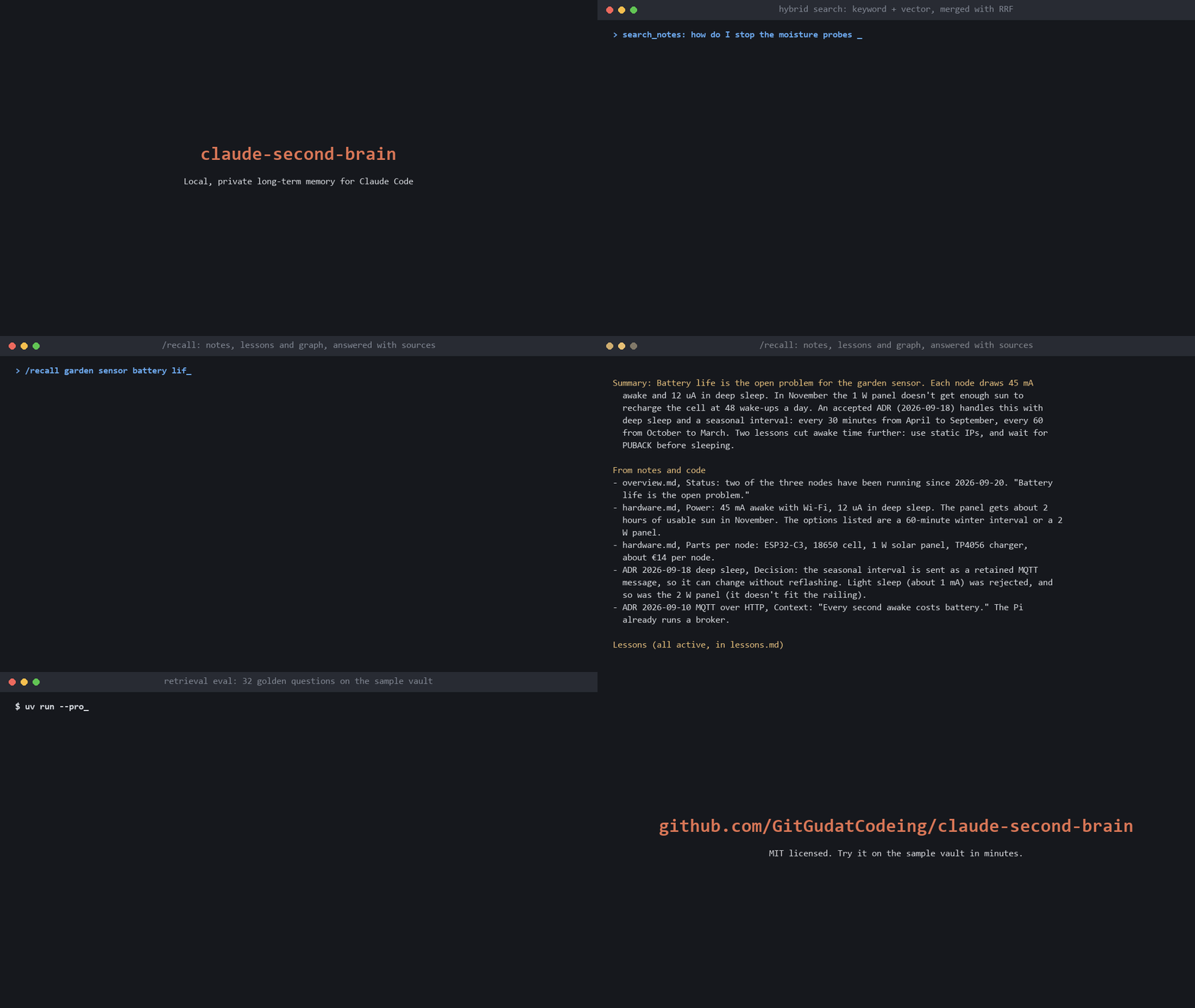
Terminal replay of real output from a fresh clone of v0.1.0 with the sample vault (eval then had 32 questions); only the typing animation is added.
Why
Claude Code forgets everything between sessions. The usual fixes are a huge CLAUDE.md (expensive on every turn) or a vector store nobody can read or fix. This project takes a different line:
- Files are the truth. Notes, decision records and lessons are markdown you can read, edit and version. The index and the graph can be rebuilt from them at any time.
- Search before guessing. Claude is told to search the vault before answering about past work, and gets a tool that actually finds paraphrased answers.
- Measured, not vibes. Every search change is scored against a golden set and kept only if it beats the baseline. The experiments that failed are documented too.
- Self-checking. At session start, invariants verify that each pipeline still reaches its consumer, so silent breakage shows up the same day.
How it works
flowchart LR
    subgraph files["Markdown files: the record"]
        notes["notes/"]
        adr["docs/adr/"]
        lessons["docs/lessons.md"]
        handoffs["docs/handoffs/"]
    end

    cc["Claude Code"]
    vi["vault-index MCP server<br/>mcp/server.py"]
    db[("vault-index.db<br/>FTS5 + sqlite-vec")]
    mem["memory MCP server"]
    kg[("memory.jsonl<br/>entities and relations")]

    cc -- "Write / Edit" --> files
    cc -- "PostToolUse hook<br/>reindex_hook.py" --> db
    cc -- "search_notes, get_note" --> vi
    vi --> db
    files -- "index_paths" --> db
    cc -- "search_nodes" --> mem
    mem --> kg
    kg -. "each fact names its source file" .-> files
| Hook | Script | What it does |
|---|---|---|
| SessionStart | scripts/invariants.py --hook |
10 checks: MCP servers launchable, graph sources exist, index fresh, hooks wired, golden labels valid, lessons well-formed, context budget. |
| PostToolUse (Write, Edit) | mcp/reindex_hook.py |
Re-indexes the edited file if it sits under a registered source. Never blocks. |
| UserPromptSubmit, PostToolUse (async) | scripts/context_guard.py |
Reads the real context size from the transcript. Silent until 250k tokens (.claude/handoff.json), then requires /handoff: a note plus a card to start the fresh session. On every prompt, and once per session mid-turn. |
| PreCompact | scripts/precompact_snapshot.py |
Saves recent requests and touched files to docs/handoffs/auto/ as a fallback before compaction. |
Search
flowchart LR
    q["query"] --> sw["drop stopwords"] --> fts["FTS5 bm25<br/>top 4 x limit"]
    q --> emb["embed with<br/>bge-small-en-v1.5"] --> vec["sqlite-vec kNN<br/>top 4 x limit"]
    fts --> rrf["reciprocal rank fusion<br/>k = 60, keyword weight 0.1"]
    vec --> rrf
    rrf --> rr["cross-encoder rerank<br/>top 10, MiniLM-L6"]
    rr --> out["top chunks with<br/>file path and heading path"]
- Markdown is chunked by heading (up to about 1,200 characters), so every hit carries a path like
Recipe box data model > Units. - Indexing is incremental: unchanged files are skipped by mtime and content hash; deleted files are dropped on the next sync.
- Keyword ranks count at a tenth of vector ranks: they break ties and lift exact terms (ids, tool names) without outvoting meaning.
- A small cross-encoder (
ms-marco-MiniLM-L-6-v2, 80 MB) then reorders the top 10 by reading query and chunk together. It adds about 200 ms per search on CPU;VAULT_RERANK=0turns it off. - A per-folder
.indexignorekeeps tooling code out of results.
MCP tools: index_paths, search_notes, get_note, list_sources, remove_source.
Commands
| Command | What it does |
|---|---|
/recall <topic> |
Searches notes, lessons and the graph together and answers with clickable sources. Read-only. |
/adr <title> |
Writes a decision record to docs/adr/ and links it in the graph. |
/learn <what happened> |
Records a lesson as a testable directive (scripts/learn.py): lesson, cause, how to detect it. Supersede or retire, never delete. |
/ingest <path> |
Indexes a file or folder and adds its durable entities to the graph. |
/handoff [topic] |
Writes a handoff note and starts a fresh session from it. |
Installed as a plugin, the commands carry its name: /second-brain:recall, /second-brain:adr and so on.
Quickstart
Needs uv (it fetches Python 3.10 to 3.13), Node.js for the memory server, and Claude Code.
As a plugin
In the folder that holds your notes:
claude plugin marketplace add GitGudatCodeing/claude-second-brain
claude plugin install second-brain@second-brain --scope project
Start claude there, then ask it to index the folder ("index_paths .") and try /second-brain:recall <topic>. The plugin brings the five commands, the hooks (re-index on edit, context guard, pre-compact snapshot) and both MCP servers. Decision records go to docs/adr/, lessons to docs/lessons.md, handoffs to docs/handoffs/, and the knowledge graph to memory.jsonl, all inside that folder. The search index is shared at ~/.mcp-memory/vault-index.db.
--scope project keeps the plugin to that folder: the context guard would otherwise run in every project. The plugin leaves out the session-start invariants, which check this repo's layout. Change the handoff limit with a .claude/handoff.json like this repo's (default 250k tokens).
Use the plugin or the clone below in a folder, not both: each starts its own vault-index server.
From a clone
The full repo adds the sample vault, the eval and the invariants.
git clone https://github.com/GitGudatCodeing/claude-second-brain.git
cd claude-second-brain
uv run --project mcp python scripts/setup.py
setup.py writes .mcp.json (memory graph at ~/.mcp-memory/memory.jsonl unless you pass --memory-file), indexes the folder and runs the invariants. Then start claude in the folder, approve the project MCP servers and hooks, and try /recall garden sensor battery life. Check the wiring any time with python scripts/invariants.py.
Your own notes go in notes/. Delete example-vault/ when you no longer need the eval, and update eval/golden.jsonl with questions about your own notes.
On Windows, Claude Code runs hooks through Git Bash; the hook commands already use forward slashes.
Just the search server
vault-index is on PyPI and in the MCP registry. To use the hybrid search on any folder of notes without the rest of this repo:
claude mcp add vault-index -- uvx --python 3.12 vault-index
Then ask Claude to index a folder (for example "index_paths ~/notes") and search it with search_notes.
It also works from a terminal. Indexing a large vault there first shows progress and keeps Claude's first tool call short:
uvx --python 3.12 vault-index index ~/notes        # no paths re-syncs every source
uvx --python 3.12 vault-index search "your question" -n 5
uvx --python 3.12 vault-index sources
uvx --python 3.12 vault-index --help
With no command it serves MCP over stdio. The index lives in ~/.mcp-memory/vault-index.db. To move it, set VAULT_INDEX_DB in your shell environment rather than only in the MCP config, so the server, the re-index hook and the invariants all use the same file. --python 3.12 keeps uvx off newer Pythons that the embedding runtime does not support yet.
Retrieval eval
example-vault/ is a fictional person's notes, decisions and lessons. eval/golden.jsonl has 44 questions about it and about this repo's own docs, worded differently from the notes on purpose, so keyword overlap alone does not find most answers. The last 12 are hard paraphrases that share almost no words with their answer. (Keep golden questions out of indexed files like this README, or they compete with the real answers.)
VAULT_INDEX_DB=/tmp/csb-eval.db uv run --project mcp python eval/run_eval.py --modes all -v
| Mode | NDCG@5 | MRR | Recall@5 |
|---|---|---|---|
hybrid + rerank (what search_notes serves) |
0.747 | 0.797 | 0.780 |
| hybrid, fusion only (no rerank) | 0.686 | 0.724 | 0.758 |
| keyword only (FTS5) | 0.491 | 0.544 | 0.576 |
| vector only | 0.697 | 0.729 | 0.758 |
| naive grep, no index (baseline) | 0.305 | 0.341 | 0.375 |
The grep row ranks chunks by how many query words they contain, roughly what searching with rg per word gives you.
Without the reranker, vector-only edged out fusion on the sample vault (the hard paraphrases give keywords nothing to match); the reranker puts hybrid back on top. On the author's private vault (41 questions) the order is the same: hybrid + rerank 0.550, fusion only 0.487, vector 0.473, keyword 0.433, grep 0.327.
Compared with basic-memory
basic-memory is a popular markdown memory MCP server with its own hybrid search. eval/compare_basic_memory.py runs it (v0.24.1, same bge-small model) on a copy of the same markdown files and scores both on the same 44 questions. basic-memory returns whole notes, so both are scored per file here (vault-index chunks collapsed to their file):
| System (file level) | NDCG@5 | MRR | Recall@5 |
|---|---|---|---|
| vault-index hybrid + rerank | 0.829 | 0.858 | 0.886 |
| basic-memory, default search | 0.619 | 0.611 | 0.750 |
| basic-memory, vector only | 0.708 | 0.736 | 0.814 |
basic-memory does much more than search (it writes notes, builds a graph from them, offers cloud sync); this compares retrieval only. Its default search varied by about 0.005 between runs. It is not run in CI.
CI fails if any hybrid metric drops more than 0.03 below eval/baseline.json. Scores are identical on Ubuntu and Windows.
What worked and what did not
Each change tested alone against a saved baseline, mostly on the author's private vault:
| Change | Effect on NDCG@5 | Kept |
|---|---|---|
| Cross-encoder rerank of the top 10 (MiniLM-L6, 80 MB) | sample +0.061, private +0.063 | yes: about 200 ms per search |
| Larger rerankers (MiniLM-L12, Jina v1 tiny/turbo, bge-reranker-base) | mixed: some lost on the sample set | no |
| Keyword weight 0.1 in the fusion (was 1.0) | private +0.037, sample +0.066 | yes |
Exclude tooling code (.indexignore) |
+0.063 | yes |
| Drop stopwords from the FTS query | +0.018 | yes |
| all-MiniLM-L6-v2 instead of bge-small | -0.024 | no |
| Weight headings higher in bm25 (x2 to x10) | -0.015 to -0.036 | no |
| bge-base + query prefix (768 dims) | +0.030, about one question | no: 3x the model for noise-level gain |
With equal weights, vector-only beat hybrid on the sample vault while hybrid won on the private one (jargon needs keywords). A sweep of keyword weight by RRF k on both sets found one setting that wins on both; vector-only is still worse on the private vault, so keywords stay in at a low weight. Details in docs/adr/.
Repository layout
mcp/            vault-index MCP server and re-index hook
scripts/        invariants, learn.py, context guard, pre-compact snapshot
eval/           golden set, baseline, run_eval.py, compare_basic_memory.py
tests/          pytest suite (fake embedder, no model download)
example-vault/  fictional sample notes for the eval
docs/adr/       decision records for this system
docs/lessons.md lessons learned while building it
.claude/        slash commands, hook settings, handoff thresholds
plugin/         the Claude Code plugin, built from the files above
.claude-plugin/ marketplace listing the plugin
Development
uv run --project mcp --with pytest pytest tests -q
uvx ruff check .
The tests use a fake bag-of-words embedder, so they run in about a second. CI runs lint, tests, the retrieval eval and the invariants on Ubuntu and Windows for every push. See CONTRIBUTING.md.
Status
Early and opinionated: built for one person's daily use, then generalised. Tested day to day on Windows 11 with the Claude desktop app; CI covers Ubuntu and Windows. The portable hook commands ($CLAUDE_PROJECT_DIR) pass the invariants in CI but have not yet run in a live session on macOS or Linux.
License
Questions sur vault-index MCP
Comment ajouter vault-index MCP à Claude Code ?
Exécutez claude mcp add claude-second-brain -- uvx vault-index dans votre terminal. Ajoutez --scope user pour le rendre disponible dans tous les projets.
Comment ajouter vault-index MCP à Cursor ?
Ouvrez ~/.cursor/mcp.json et ajoutez le serveur sous mcpServers, avec la configuration Cursor indiquée dans la section d'installation ci-dessus.
Ce serveur nécessite-t-il des services cloud ?
Non, tout s'exécute localement sur votre machine à l'aide d'un unique fichier SQLite et de petits modèles CPU.