
Fournit un contexte de dépôt déterministe, une analyse d'impact et une vérification de l'aptitude au merge pour les agents IA grâce à une analyse statique locale.
Aussi connu sous BASHBOP/solumbe, @bashbop/solumbe
- Étoiles
- 3
- Outils
- —
- Téléchargements, 30 jours
- 2 297
- Dernière version
- 4.11.0
- Dernier commit
- 12 nov. 2026
- Licence
- MIT
Qu'est-ce que Solumbe MCP ?
Solumbe est un serveur MCP. Fournit un contexte de dépôt déterministe, une analyse d'impact et une vérification de l'aptitude au merge pour les agents IA grâce à une analyse statique locale.
Résumé généré à partir du README du projet
À propos du MCP server Solumbe
Solumbe agit comme une couche de confiance local-first pour le développement assisté par IA, fournissant un contexte de dépôt déterministe et une analyse d'impact. Il est conçu pour les développeurs utilisant des agents IA tels que Claude Code, Cursor ou VS Code afin de vérifier que les modifications générées par le modèle sont sûres et conformes à l'intention initiale. En utilisant l'analyse statique plutôt que des embeddings ou des recherches basées sur le réseau, il garantit que le code ne quitte jamais la machine locale et que les résultats restent cohérents d'une exécution à l'autre.
Le serveur fonctionne via une implémentation MCP en stdio qui se connecte à divers hôtes d'agents, notamment Claude Desktop, Gemini CLI et Kimi Code CLI. Il expose 14 outils spécifiques tels que change_impact, review_gate et convergence_score pour aider les agents à comprendre le périmètre d'impact d'une requête. Les utilisateurs peuvent l'installer globalement via npm et utiliser la commande install pour configurer automatiquement leurs environnements de développement préférés. Il fonctionne aux côtés des outils existants plutôt que de les remplacer, servant de gate de vérification pour les arbres Git indexés.
Ce que vous pouvez faire avec
- 1Appliquer des contrats de périmètreIdentifier si un agent IA a modifié des fichiers qui ne faisaient pas partie de l'intention initiale déclarée.
- 2Générer du contexte de dépôtConstruire un ensemble de fichiers, de tests et de commandes contextuels à une tâche, nécessaires pour répondre à une demande de développement spécifique.
Extrait du README du projet. Chaque cas d'utilisation est vérifié par rapport à une citation du document.
Comment installer Solumbe MCP
Formats vérifiés le 10 nov. 2026Ajouter à CursorAjouter à GooseInstaller Solumbe MCP dans Claude Code
$ claude mcp add solumbe -- npx -y @bashbop/solumbeInstaller Solumbe MCP dans Cursor
~/.cursor/mcp.json
{
  "mcpServers": {
    "solumbe": {
      "command": "npx",
      "args": [
        "-y",
        "@bashbop/solumbe"
      ]
    }
  }
}Installer Solumbe MCP dans VS Code
.vscode/mcp.json
{
  "servers": {
    "solumbe": {
      "type": "stdio",
      "command": "npx",
      "args": [
        "-y",
        "@bashbop/solumbe"
      ]
    }
  }
}Installer Solumbe MCP dans VS Code CLI
$ code --add-mcp '{"name":"solumbe","type":"stdio","command":"npx","args":["-y","@bashbop/solumbe"]}'Installer Solumbe MCP dans Claude Desktop
claude_desktop_config.json
{
  "mcpServers": {
    "solumbe": {
      "command": "npx",
      "args": [
        "-y",
        "@bashbop/solumbe"
      ]
    }
  }
}Installer Solumbe MCP dans Codex
$ codex mcp add solumbe -- npx -y @bashbop/solumbeInstaller Solumbe MCP dans Codex config.toml
~/.codex/config.toml
[mcp_servers.solumbe]
command = "npx"
args = ["-y", "@bashbop/solumbe"]
Installer Solumbe MCP dans Gemini CLI
$ gemini mcp add -s user solumbe npx -- -y @bashbop/solumbeInstaller Solumbe MCP dans Gemini settings.json
~/.gemini/settings.json
{
  "mcpServers": {
    "solumbe": {
      "command": "npx",
      "args": [
        "-y",
        "@bashbop/solumbe"
      ]
    }
  }
}Vérifications automatisées
Exécuté le 14 nov. 2026Rapport complet →A passé nos vérifications automatisées. Il ne s'agit pas d'un audit de sécurité : lisez le code et donnez au serveur l'accès le plus restreint dont il a besoin. Fonctionnement des vérifications

- Dépôt source lié et accessiblebashbop/solumbe is public and reachablegithub.com/bashbop/solumbe ↗Réussi
- Le nom du package correspond au dépôt source@bashbop/solumbe names bashbop/solumbe as sourcenpmjs.com/package/@bashbop/solumbe ↗Réussi
- Provenance du build (attestation Sigstore)Sigstore attestation for @bashbop/solumbenpmjs.com/package/@bashbop/solumbe/v/4.11.0#provenance ↗Réussi
- Licence open source (OSI)MITspdx.org/licenses/MIT.html ↗Réussi
- Commit ou version publiée au cours de l'année écouléeLast commit or release 2026-11-12github.com/bashbop/solumbe ↗Réussi
- OpenSSF ScorecardNon vérifié
- Nom du package non proche d'un package populaireNo popular package one edit away from @bashbop/solumbeRéussi
- Aucun avis critique dans le package ou ses dépendances2 resolved dependencies checked; no critical advisoryosv.dev ↗Réussi
- Aucune instruction cachée destinée au modèle0 tool descriptions and the README read; no override phrases, credential paths or hidden charactersRéussi
- Les outils destructifs sont étiquetésNon vérifié
- Le point de terminaison distant répond à la poignée de main MCPNon vérifié
README
Voir sur GitHubSolumbe
Models generate the change. Solumbe proves whether it is safe to merge.
Formerly Òtítọ́ (@bashbop/otito), renamed in 4.0.0; the CHANGELOG maps every old name to its new one.




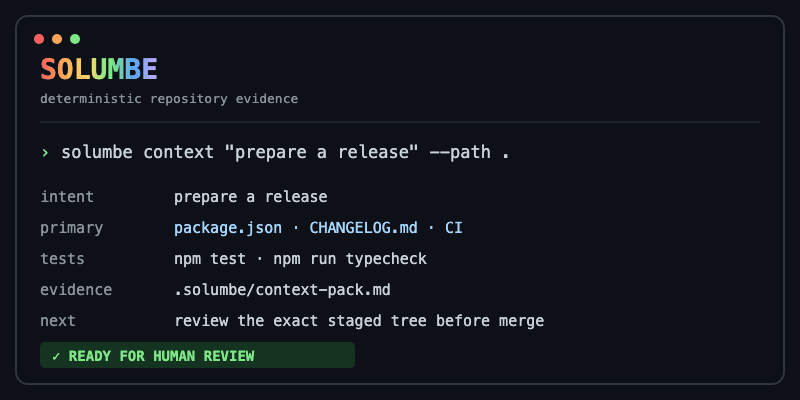

Solumbe is a local-first, deterministic, model-agnostic trust layer for AI-assisted development. It builds task-aware repository context before an agent edits, scores how much a change actually touches, and gates merge readiness against the exact staged tree, with no server, no account, and no code leaving the machine.
It does not replace Claude Code, Codex, Cursor, Gemini, or any native agent harness. It runs beside them and keeps working as the models change underneath.
A passing local gate is never an automatic merge approval: hosted CI, GitHub review, CODEOWNERS, and the human release decision remain separate authorities.
Install
npm install -g @bashbop/solumbe
solumbe doctor
solumbe install --host all
The last command connects Solumbe's MCP server to every agent host it finds: Claude Code, Claude Desktop, Codex CLI, Cursor, VS Code, Gemini CLI and Kimi Code CLI. Add --dry-run to see the plan first, or name hosts with --host claude-code,cursor. Restart each host afterwards.
Or without installing: npx -y @bashbop/solumbe doctor.
What it does
Rank what a change actually touches, from the request alone, with no model, no embeddings, and no network:
$ solumbe impact . "add refund handling to checkout" --top 3

  concepts: money flow

   1.  src/payment/checkout.service.ts    score 155
       |- role: required
       |- path matches: checkout
       |- symbol matches: checkout, refund
       |- concept match: money flow (×1.4 + 6.0)
       |- risk: money flow

   2.  src/payment/stripe.webhook.ts    score 6
       |- role: advisory
       |- concept match: money flow (×1.4 + 6.0)
Gate the exact staged tree, and say precisely why:
$ solumbe gate . --staged --base origin/main --request "add refund handling to checkout" --min-convergence 80

  [OK]    Changed files          1 changed file found.
  [OK]    Staged snapshot        Changed-file scope and convergence evidence are captured from the exact staged Git tree.
     |- Tree: 7d0b513dd256877d6bd309a6406468a9b1eaeedc
     |- Base: b776f04fcfbd02c8ce8d63e1a0c2450be58de039
  [OK]    Secret safety          No secret file paths and no credential values found in the changed content.
  [WARN]  Risk review            Risk-sensitive files changed; maintainer review should be explicit.
     |- src/payment/checkout.service.ts
  [OK]    Convergence            Task and diff satisfy the convergence requirement.
     |- Score: 100/100 (aligned)
     |- Receipt handle: rcpt_a8d31efae06e
     |- Subject tree: 7d0b513dd256877d6bd309a6406468a9b1eaeedc

  VERDICT  WARN
The convergence score is the part a model cannot grade for itself: it compares the stated intent against the files the diff actually changed, and produces a receipt bound to the exact base, parent, and staged-tree identity.
Hold the change to what was declared. Record the files a request is expected to touch before the edit, and the gate names any file that was never declared:
$ solumbe declare . "add refund handling to checkout"
$ # ... the agent edits ...
$ solumbe gate . --staged --base HEAD --intent .solumbe/intent.json

  [FAIL]  Scope contract         Touched `src/auth/session.ts`, which was never declared. Amend the intent with the reason it belongs (`solumbe amend <file> --reason "<why>"`), or take it out of the change.
     |- Request: "add refund handling to checkout"
     |- Contract: fe655c2af2b31b7e3edec6aedd248b379235811d1228c829f87ff73796ace487
     |- Changed files: 3 (1 declared, 0 amended, 1 implied, 1 undeclared)
     |- Implied: tests/checkout.service.test.ts (owner-test of src/payment/checkout.service.ts)
     |- Undeclared on a risk-sensitive path: src/auth/session.ts [auth/security]
An amendment adds a file with its reason, hashed onto the contract, so a reviewer reads why the scope grew. Over MCP it is change_impact with declare: true, and review_gate with intent.
The core
Four commands are the product. They call no model, open no socket, and read nothing outside the repository.
| Step | Command | What it proves |
|---|---|---|
| Before the edit | solumbe context "add refund handling" --path . |
Which files, tests and commands the request needs |
| After the edit | solumbe converge . "add refund handling" --base origin/main --staged |
How far the diff is from the request, with a receipt |
| Before the merge | solumbe gate . --staged --base origin/main --request "add refund handling" |
PASS / WARN / FAIL on the exact staged tree |
| After the merge | solumbe attest . --verdict verdict.json --merge <sha> |
A hash-chained record of what shipped, under which verdict |
solumbe help shows these and how to set up; solumbe help --all lists every command, including the ones that support them (impact, declare, pr, review, map, calibrate, route, ax, dashboard and the rest). Nothing was removed.
Nothing hosted is required, and nothing hosted can change a verdict. Local Core, Optional Hosted lists exactly what the optional pieces send, and where.
Supporting commands
| Goal | Command |
|---|---|
| Rank change blast radius | solumbe impact . "add refund handling" --top 12 |
| Score intent vs. execution | solumbe converge "add refunds" --path . --base HEAD --staged |
| Score a committed change exactly | solumbe converge "add refunds" --path . --base HEAD~1 --head HEAD |
| Gate a product change across repos | solumbe workspace-gate ../web ../api --request "ship change" |
| Grade risk flags against history | solumbe calibrate . --window 30 |
| Grade route tiers against history | solumbe regret . --window 30 --offline |
| Regrade a saved run, same answers | solumbe regret --rescore run.json |
| Score Agent Experience | solumbe ax . "add a new MCP tool" |
| Recommend a model tier | solumbe route . "add a new MCP tool" |
| Sharpen context with a model read | solumbe context "add a new MCP tool" --path . --online |
| Inspect one repo | solumbe repo . --json |
| Build a code map | solumbe map . --json |
| Index and search local projects | solumbe index ~/projects --discover then solumbe search "events controller" |
| Generate an agent harness | solumbe harness . --out .solumbe/harness.md |
| Run the MCP server | solumbe mcp |
Every command takes --json, and solumbe help lists the full set with flags.
MCP
Solumbe ships a stdio MCP server exposing 14 tools: repo_inspect, repo_map, repo_index, repo_search, context_pack, change_impact, agent_experience, model_route, convergence_score, review_context, review_gate, review_verdict, workspace_report, and repo_harness.
{
  "mcpServers": {
    "solumbe": {
      "command": "npx",
      "args": ["-y", "@bashbop/solumbe", "mcp"]
    }
  }
}
solumbe install --host all writes this entry for you, using absolute paths so hosts that do not inherit your shell PATH can still start it. Published in the MCP Registry as io.github.BASHBOP/solumbe. Repo-map lookups use an external per-user cache and never write into the inspected repository. Host-specific setup for Claude Code, Claude Desktop, Codex, Cursor, VS Code, Gemini CLI, and Kimi Code is in MCP and Agent Workflows.
How it compares
| Approach | Strengths | Where solumbe differs |
|---|---|---|
| Sourcegraph / Cody context | Powerful hosted code search and embedding-based context across an org | Local-first and deterministic: no server, no account, no code leaves the machine, and the same query always yields the same packet |
Hand-written CLAUDE.md / rules files |
Curated, intent-rich guidance | Hand-written context goes stale; solumbe regenerates context from the actual code (symbols, imports, routes, tests) on every run and complements a short CLAUDE.md |
grep / ripgrep |
Fast, universal text matching | solumbe ranks whole files by task intent across paths, symbols, exports, and tests, then adds patterns and validation commands, producing a context packet rather than a list of matching lines |
Documentation
Full command reference, agent workflows, release process, evaluation method, and the design theses behind the trust layer:
Contributing
git clone https://github.com/BASHBOP/solumbe.git
cd solumbe && npm ci && npm run ci
npm run ci is the full gate: format, lint, typecheck, version check, tests, coverage floors (70% lines / 60% branches / 75% functions), three evaluation corpora, dependency audit, and a packaged-tarball smoke test. Run it before requesting review.
Start with CONTRIBUTING.md and the Code of Conduct. All changes need maintainer review; main requires passing gates and resolved conversations. Solumbe follows Semantic Versioning, so say whether a PR is no-impact, patch, minor, or major.
Part of the toolchain
solumbe is one of four tools that form a deterministic trust layer for AI-assisted development. Each uses static analysis to answer a question people keep handing to an LLM.
- solumbe (this tool), for context: what does this change actually touch?
- tieline, for contracts: did the front end and back end quietly stop agreeing?
- bouncer, for compliance: could you defend this to Ofcom?
- aiglare, for governance: where can the model do something you can't undo?
More at segunolumbe.com. static analysis, never the model.
Questions sur Solumbe MCP
Comment ajouter Solumbe MCP à Claude Code ?
Exécutez claude mcp add solumbe -- npx -y @bashbop/solumbe dans votre terminal. Ajoutez --scope user pour le rendre disponible dans tous les projets.
Comment ajouter Solumbe MCP à Cursor ?
Ouvrez ~/.cursor/mcp.json et ajoutez le serveur sous mcpServers, avec la configuration Cursor indiquée dans la section d'installation ci-dessus.
Est-ce que Solumbe remplace les outils de codage IA existants ?
Non, il est conçu pour fonctionner aux côtés d'outils comme Claude Code, Cursor et Gemini afin de fournir une couche de confiance.
Mon code est-il envoyé vers un serveur distant ?
Non, Solumbe est un outil local-first qui garantit qu'aucun code ne quitte votre machine.
Le passage d'un gate local signifie-t-il que le code est automatiquement fusionné ?
Non, les gates locaux sont distincts des processus de CI hébergés et de la revue humaine.