
Un estudio de contenido de IA para Instagram que permite a los creadores analizar el rendimiento, rastrear competidores, generar Reels y gestionar una cola de publicación mediante chat.
También conocido como pandich93/creatorloop
- Stars
- 0
- Herramientas
- —
- Descargas, 30 días
- —
- Última versión
- 0.3.0
- Último commit
- 18 oct 2026
- Licencia
- MIT
¿Qué es creatorloop MCP?
creatorloop es un MCP server. Un estudio de contenido de IA para Instagram que permite a los creadores analizar el rendimiento, rastrear competidores, generar Reels y gestionar una cola de publicación mediante chat.
Resumen generado a partir del README del proyecto
Acerca del MCP server de creatorloop
Los creadores de Instagram pueden gestionar todo el ciclo de vida de su contenido a través de una interfaz de chat con Claude. Este estudio utiliza la API oficial de Instagram para analizar métricas de rendimiento como el tiempo de reproducción de Reels, el crecimiento de seguidores y las tasas de engagement. Permite a los usuarios dejar de adivinar, proporcionando insights basados en datos sobre qué ganchos, subtítulos y horarios de publicación generan resultados reales.
Los usuarios pueden monitorear legalmente cuentas de la competencia, rastrear su historial de seguidores y recibir alertas cuando publicaciones específicas rinden significativamente mejor que su promedio. El sistema también gestiona la creación y programación de contenido. Incluye una plantilla de Remotion Reel con comprobaciones automáticas de zonas seguras y música original. Para garantizar la seguridad, cada acción pública, como publicar contenido multimedia o responder a comentarios, requiere la aprobación explícita del usuario mediante un proceso de dos pasos.
La configuración requiere una app de Meta, una cuenta de Instagram Business o Creator vinculada a una página de Facebook y la herramienta uv para la instalación local. El servidor se ejecuta localmente en tu máquina mediante Python o Docker, manteniendo las credenciales sensibles como tu App Secret y tokens de acceso seguros en tu sistema local en lugar de en el historial del chat.
Qué puedes hacer con él
- 1Analizar el rendimiento del contenidoSolicita un informe de tus últimos 60 días de contenido para ver si los Reels o los carruseles funcionan mejor.
- 2Monitorear el crecimiento de la competenciaRastrea cuentas profesionales para identificar cuáles de sus publicaciones se están volviendo virales.
- 3Programar publicaciones vía chatAñade una publicación preparada desde una carpeta local a tu cola de publicación para un horario futuro.
- 4Gestionar la interacción con la comunidadIdentifica comentarios no leídos y redacta respuestas para tu aprobación.
Escrito a partir del README del proyecto. Cada caso de uso se verifica con una cita del mismo.
Cómo instalar creatorloop MCP
Formatos verificados el 10 nov 2026Añadir a CursorAñadir a GooseInstalar creatorloop MCP en Claude Code
$ claude mcp add --env 'IG_ACCESS_TOKEN=<YOUR_IG_ACCESS_TOKEN>' creatorloop -- uvx creatorloopInstalar creatorloop MCP en Cursor
~/.cursor/mcp.json
{
  "mcpServers": {
    "creatorloop": {
      "command": "uvx",
      "args": [
        "creatorloop"
      ],
      "env": {
        "IG_ACCESS_TOKEN": "<YOUR_IG_ACCESS_TOKEN>"
      }
    }
  }
}Instalar creatorloop MCP en VS Code
.vscode/mcp.json
{
  "servers": {
    "creatorloop": {
      "type": "stdio",
      "command": "uvx",
      "args": [
        "creatorloop"
      ],
      "env": {
        "IG_ACCESS_TOKEN": "<YOUR_IG_ACCESS_TOKEN>"
      }
    }
  }
}Instalar creatorloop MCP en VS Code CLI
$ code --add-mcp '{"name":"creatorloop","type":"stdio","command":"uvx","args":["creatorloop"],"env":{"IG_ACCESS_TOKEN":"<YOUR_IG_ACCESS_TOKEN>"}}'Instalar creatorloop MCP en Claude Desktop
claude_desktop_config.json
{
  "mcpServers": {
    "creatorloop": {
      "command": "uvx",
      "args": [
        "creatorloop"
      ],
      "env": {
        "IG_ACCESS_TOKEN": "<YOUR_IG_ACCESS_TOKEN>"
      }
    }
  }
}Instalar creatorloop MCP en Codex
$ codex mcp add creatorloop --env 'IG_ACCESS_TOKEN=<YOUR_IG_ACCESS_TOKEN>' -- uvx creatorloopInstalar creatorloop MCP en Codex config.toml
~/.codex/config.toml
[mcp_servers.creatorloop]
command = "uvx"
args = ["creatorloop"]

[mcp_servers.creatorloop.env]
IG_ACCESS_TOKEN = "<YOUR_IG_ACCESS_TOKEN>"
Instalar creatorloop MCP en Gemini CLI
$ gemini mcp add -s user -e 'IG_ACCESS_TOKEN=<YOUR_IG_ACCESS_TOKEN>' creatorloop uvx -- creatorloopInstalar creatorloop MCP en Gemini settings.json
~/.gemini/settings.json
{
  "mcpServers": {
    "creatorloop": {
      "command": "uvx",
      "args": [
        "creatorloop"
      ],
      "env": {
        "IG_ACCESS_TOKEN": "<YOUR_IG_ACCESS_TOKEN>"
      }
    }
  }
}Configuración
IG_ACCESS_TOKENSecretoInstagram Graph API token (long-lived or System User). Can also live in the creatorloop .env file.
IG_USER_IDInstagram professional account ID (not the username).
| Nombre | Descripción | Tipo |
|---|---|---|
| IG_ACCESS_TOKEN | Instagram Graph API token (long-lived or System User). Can also live in the creatorloop .env file. | Secreto |
| IG_USER_ID | Instagram professional account ID (not the username). |
Verificaciones automáticas
Ejecutado 14 nov 2026Informe completo →Pasó nuestras verificaciones automáticas. Esto no es una auditoría de seguridad: lee el código y dale al servidor el acceso más limitado que necesite. Cómo funcionan las verificaciones

- Repositorio de origen vinculado y accesiblepandich93/creatorloop is public and reachablegithub.com/pandich93/creatorloop ↗Aprobado
- El paquete indica este repositorio como su origencreatorloop names pandich93/creatorloop as sourcepypi.org/project/creatorloop/ ↗Aprobado
- Procedencia de la compilación (atestación de Sigstore)Sigstore attestation for creatorlooppypi.org/project/creatorloop/ ↗Aprobado
- Licencia de código abierto (OSI)MITspdx.org/licenses/MIT.html ↗Aprobado
- Commit o lanzamiento en el último añoLast commit or release 2026-10-18github.com/pandich93/creatorloop ↗Aprobado
- OpenSSF ScorecardNo verificado
- El nombre del paquete no es similar a un paquete popularNo popular package one edit away from creatorloopAprobado
- No hay avisos críticos en el paquete ni en sus dependencias35 resolved dependencies checked; no critical advisoryosv.dev ↗Aprobado
- Sin instrucciones ocultas para el modelo0 tool descriptions and the README read; no override phrases, credential paths or hidden charactersAprobado
- Las herramientas destructivas están etiquetadasNo verificado
- El endpoint remoto responde al handshake de MCPNo verificado
README
Ver en GitHubcreatorloop
Open-source AI content studio for Instagram creators, built on Claude and the official Instagram API.
Analyse what works → make Reels and carousels → publish or queue them → review how they did. All from a chat with Claude.




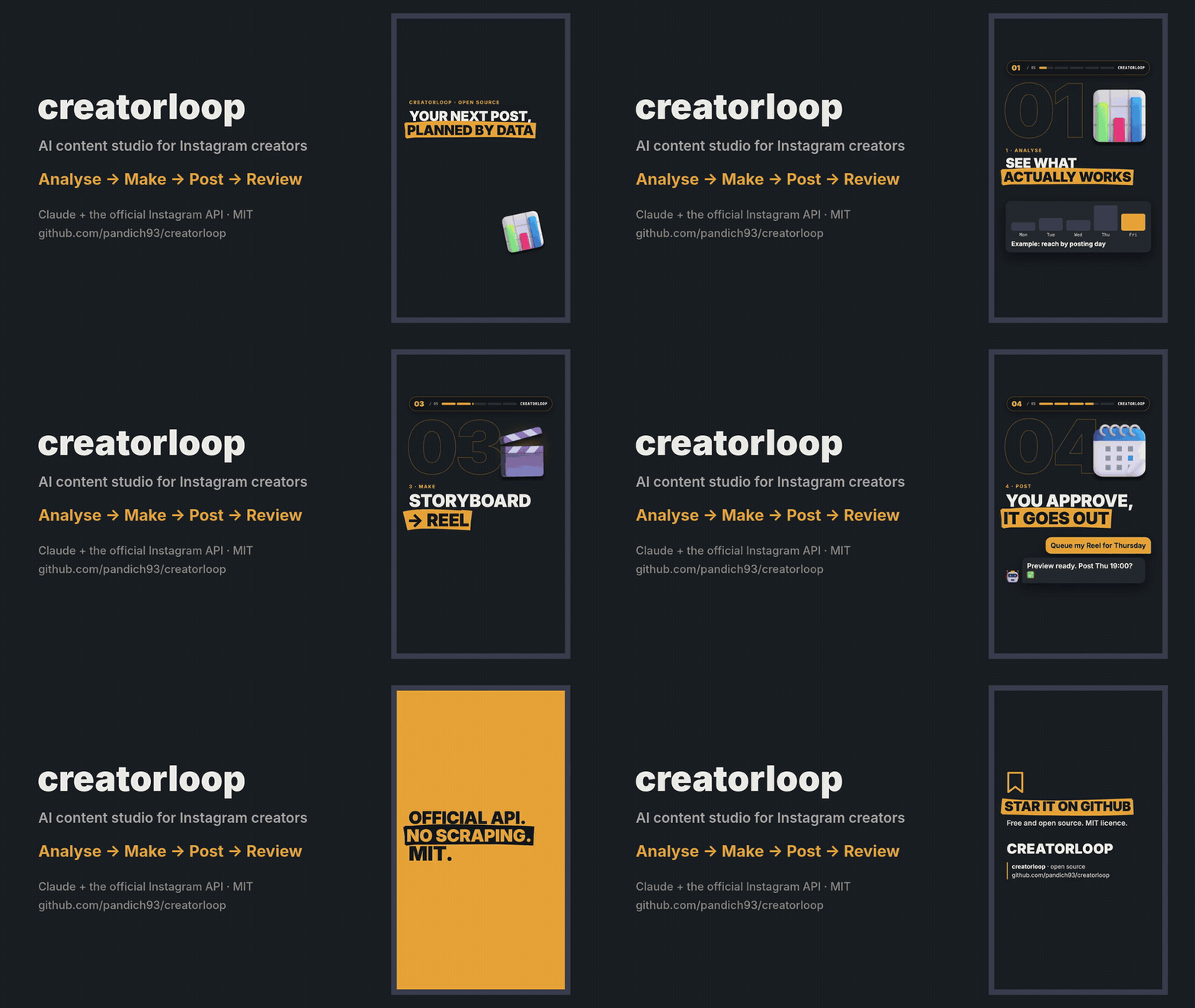
Why
There are plenty of "Instagram API for Claude" servers. creatorloop is built for the creator's loop instead:
- Learn from data, not vibes. Best and worst posts with their hooks, format comparison, follows per 1,000 reach, Reels watch time, best day and hour — and which captions (language, question hook, CTA, length) actually work.
- Spy on competitors legally. Track professional accounts, keep their follower history, and get alerted to the posts that did N× better than their median. Analyse any public post by URL, slides included.
- Make the content. A Remotion Reel template with automatic checks (first-second rule, safe zones, "not a copy of the carousel"), original music and licensed 3D objects.
- Publish safely. Two-step publishing with a preview, a queue with fingerprints (a changed file blocks the post), 24 h / 72 h post reviews and comment replies — every public action needs your explicit OK.
- Official API only. No scraping, no browser automation, no risk to your account.
Quick start
You need uv, Claude Desktop, an Instagram Business or Creator account linked to a Facebook Page, and your own Meta app (5-minute guide).
uvx --from creatorloop creatorloop-setup
It connects Claude Desktop and opens a setup page in your browser: enter your app's App ID and App Secret, press Continue with Facebook, done. Then ask Claude: "How did my last 10 posts do, and what should I post next?"
Already in Claude? Ask "connect my Instagram": Claude opens the same page (open_setup). Your App Secret and
token are typed only into that local page, never into the chat.
| System | Command |
|---|---|
| Windows | powershell -ExecutionPolicy ByPass -c "irm https://astral.sh/uv/install.ps1 | iex" |
| macOS | brew install uv or curl -LsSf https://astral.sh/uv/install.sh | sh |
| Linux | curl -LsSf https://astral.sh/uv/install.sh | sh |
creatorloop runs on Python 3.12 or newer; uv downloads one by itself if you don't have it.
creatorloop-setup finds the Claude Desktop config on Windows (including the Microsoft Store build), macOS and Linux,
keeps your other servers, makes a backup and creates your settings file. Claude Desktop rewrites its config while it
runs, so on macOS the command quits and reopens it for you; on Windows and Linux it asks you to quit it first.
One-click install (Claude Desktop)
Prefer not to open a terminal? Download the .mcpb file from the
latest release and double-click it (or drag it into
Claude Desktop → Settings → Extensions). Claude Desktop sets up Python and the dependencies itself, so the first start
takes a minute. Leave the two optional fields empty and ask Claude "connect my Instagram": the same setup page opens.
Fill them in only if you already have a token and account ID — values entered there win over the setup page. If
Claude Desktop says it can't find uv, install it (see Installing uv above) and restart Claude Desktop.
Build the image straight from GitHub and keep your settings in a folder on your computer:
docker build -t creatorloop https://github.com/pandich93/creatorloop.git
mkdir "$HOME/creatorloop"
If you use the post queue, first create .env in that folder with IG_TIMEZONE=Europe/Berlin (your zone): the container
runs in UTC.
Connect your account (the setup page runs in the container; open the printed link in your browser). Keep all three
8765 the same; to use another port change all three:
docker run --rm -it -p 127.0.0.1:8765:8765 -v "$HOME/creatorloop:/data" --entrypoint creatorloop-auth creatorloop \
  login --no-browser --port 8765 --bind 0.0.0.0
creatorloop-setup doesn't run inside Docker, so add the server to claude_desktop_config.json yourself, with the
full path to the folder:
{
  "mcpServers": {
    "creatorloop": {
      "command": "docker",
      "args": ["run", "-i", "--rm", "-v", "/Users/you/creatorloop:/data", "creatorloop"]
    }
  }
}
Post folders for prepare_post and queue_post go into creatorloop/content/. The image includes cloudflared for
publishing carousels.
The open_setup tool does not work inside Docker; use the command above to reconnect.
What you can ask
- "Make a report on my content for the last 60 days. Reels or carousels — what works better, and when should I post?"
- "Compare me with @competitor1 and @competitor2. Who has the higher engagement and why?"
- "Analyse this post https://www.instagram.com/p/… and write my own version of it."
- "Track @competitor and tell me every week which of their posts took off."
- "Check the hashtags #ai, #productivity and #startup. Check the quota first."
- "Queue the post from folder
my-first-reelfor the next free slot." → preview → "yes" → it goes out on time. - "Which new comments haven't I answered? Draft replies." → you approve each reply.
Ready-made prompts in Claude Desktop's + menu: Weekly Instagram report, Competitor brief, Data-driven content ideas.
Tools
| Area | Tools |
|---|---|
| Your account | get_my_profile, get_my_media, get_media_insights, get_account_insights, get_audience_demographics |
| Content analysis | get_my_content_report, get_caption_insights, get_post_history, post_reviews |
| Competitors | get_competitor, compare_accounts, get_follower_history, track_competitor, untrack_competitor, list_tracked_competitors, update_tracked_competitors, find_viral_posts, get_competitor_post |
| Hashtags | search_hashtag, compare_hashtags, plan_hashtag_research |
| Publishing | prepare_post, get_post_job, publish_media, list_publications |
| Queue | queue_post, list_queue, cancel_queued |
| Comments | get_new_comments, reply_comment |
| Service | get_api_status, open_setup, clear_cache, restart_server |
34 tools in total. Tools that change something on Instagram are annotated as such for Claude, and their descriptions
tell it to act only after you approve: publish_media and reply_comment after you OK the preview or the exact
text, queue_post only with confirm=true after you saw the preview.
Publishing
Put the files into a folder inside your content folder (<creatorloop home>/content/<name>/):
my-carousel/                   my-reel/
  slide_01.png … slide_10.png    reel.mp4        # H.264/HEVC, 23–60 fps, ≤1920 px wide, 3 s–15 min, ≤300 MB
  caption.txt                    caption.txt
                                 reel.json       # optional: {"cover_ms": 1667, "share_to_feed": true, "trial": "SS_PERFORMANCE"}
- Slides: 1–10 PNG/JPG (API limit), aspect ratio 4:5 to 1.91:1, ordered by file name. Everything below a
---line incaption.txtis notes and is not published. - Then: "prepare the post from folder
my-carousel" → preview → "publish". Or queue it for a slot. - Carousels: Instagram downloads images from a public URL, so creatorloop opens a temporary
Cloudflare Quick Tunnel
for that minute. Install
cloudflaredonce:winget install --id Cloudflare.cloudflared -e(Windows),brew install cloudflared(macOS) or a package from pkg.cloudflare.com (Linux). - Reels upload directly to Meta (no tunnel). The MP4 header is checked before upload (duration, size, width,
moovfirst) with the exactffmpegfix if something is off. - Queue slots default to Tue/Thu/Sun 19:00 in your timezone — an example, change
QUEUE_SLOTSin the settings file. A queued post is blocked if its files or caption change after you approved it, and is marked missed if your computer was asleep for more than 3 hours past the slot. - Meta's limit is 100 posts per rolling 24 hours;
list_publicationsshows what is left. Publishing is never retried automatically, so there are no duplicates.
Making the content itself: see examples/ and the content pipeline —
a sample carousel, a sample Reel storyboard and the Remotion Reel template.
What the Instagram API allows (and doesn't)
| Possible | Not possible | |
|---|---|---|
| Your account | Reach, views, likes, comments, saves, shares, profile visits, follows per post, Reels average watch time, audience demographics, account totals | Data older than 2 years; insights per carousel slide; Stories after 24 h |
| Competitors (Business Discovery) | Public data of Business/Creator accounts: followers, posts, bio, likes, comments, Reels views per post | Personal or private accounts; their reach, saves, shares, demographics; Stories |
| Hashtags | Top posts and posts from the last 24 h | More than 30 unique hashtags per rolling 7 days; post authors; keyword, audio or trend search |
| Follower growth | creatorloop saves a daily snapshot for you and every competitor you look at | History before the first snapshot |
Engagement rate for your posts = Σ(likes + comments + saves + shares) / Σreach × 100 (weighted, so tiny posts don't skew it). Posts younger than 72 h are reported separately as "still growing". Competitors' ER is per follower — the API does not expose their reach.
Settings
creatorloop-setup creates .env in your creatorloop home folder:
| System | Home folder |
|---|---|
| Windows | %APPDATA%\creatorloop |
| macOS | ~/Library/Application Support/creatorloop |
| Linux | ~/.local/share/creatorloop (or $XDG_DATA_HOME/creatorloop) |
Set CREATORLOOP_HOME to use another folder. The home folder holds .env, the creatorloop.db database and the
content/ folder.
| Variable | Required | Meaning |
|---|---|---|
IG_ACCESS_TOKEN |
yes | Long-lived (60 days) or System User (never expires) token — see Meta setup |
IG_USER_ID |
yes | Your Instagram professional account ID (1784…), not the username |
GRAPH_API_VERSION |
no | Default v26.0 |
META_APP_ID, META_APP_SECRET |
no | Filled by the setup page; also used to check the token expiry |
IG_TIMEZONE |
no | IANA name, e.g. Europe/Berlin. Default: your computer's timezone |
QUEUE_SLOTS |
no | e.g. Mon,Wed,Fri 20:00 |
IG_DB_PATH, CACHE_TTL_*_MIN |
no | Database location, cache lifetime in minutes |
The token expiry shows up in get_api_status, and every tool answer carries a token_warning 14 days before expiry.
FAQ
Data & privacy
- Your token, settings, database and content stay on your computer in the creatorloop home folder.
- creatorloop talks to Meta only: the Instagram Graph API (
graph.facebook.com,rupload.facebook.comfor video uploads) and Instagram's media servers when it downloads the slides of a post you asked it to analyse. - To publish carousels (and Reels, if the direct upload is refused) it opens a temporary Cloudflare Quick Tunnel to your local files for the minute Meta needs to fetch them, then closes it and deletes the temporary copies.
- No analytics, telemetry or third-party services.
Development
git clone https://github.com/pandich93/creatorloop && cd creatorloop
uv sync
uv run pytest            # offline: mocked Graph API and captured response shapes
uv run creatorloop-setup # points Claude Desktop at this checkout instead of the PyPI package
See CONTRIBUTING.md. Security issues: SECURITY.md.
Disclaimer
creatorloop is an independent open-source project. Not affiliated with, endorsed or sponsored by Meta or Instagram. "Instagram" is a trademark of Meta Platforms, Inc. You are responsible for complying with the Meta Platform Terms and Instagram's policies when you use it.
License
MIT. The Reel template in examples/reel-template uses Remotion, which has
its own licence; bundled assets and fonts are listed in
examples/reel-template/public/assets/LICENSES.md.
Preguntas sobre creatorloop MCP
¿Cómo agrego creatorloop MCP a Claude Code?
Ejecuta claude mcp add --env 'IG_ACCESS_TOKEN=<YOUR_IG_ACCESS_TOKEN>' creatorloop -- uvx creatorloop en tu terminal. Añade --scope user para que esté disponible en todos los proyectos.
¿Cómo agrego creatorloop MCP a Cursor?
Abre ~/.cursor/mcp.json y añade el servidor en mcpServers, usando la configuración de Cursor que se muestra en la sección de instalación de arriba.
¿Este servidor utiliza scraping o automatización de navegador?
No, utiliza únicamente la API oficial de Instagram, lo que evita el riesgo de bloqueos de cuenta.
¿Puedo rastrear el rendimiento de mis competidores?
Sí, puedes rastrear cuentas profesionales, monitorear su historial de seguidores y recibir alertas sobre publicaciones con alto rendimiento.
¿Cómo funciona el proceso de publicación?
El servidor utiliza un proceso de publicación de dos pasos con vistas previas y un sistema de cola para asegurar que apruebes cada acción.
¿A qué tipo de datos de Instagram puedo acceder?
Puedes acceder a alcance, visualizaciones, likes, comentarios, guardados, compartidos, visitas al perfil y datos demográficos de la audiencia.