
Un entorno de ejecución de automatización local-first que proporciona una capa de decisión para que los agentes de IA automaticen tareas de forma segura en GitHub, Slack, Gmail y más de 45 servicios.
También conocido como Oolab-labs/patchwork-os
- Stars
- 33
- Herramientas
- —
- Descargas, 30 días
- —
- Última versión
- —
- Último commit
- 14 nov 2026
- Licencia
- MIT
¿Qué es Patchwork OS MCP?
Patchwork OS es un MCP server. Un entorno de ejecución de automatización local-first que proporciona una capa de decisión para que los agentes de IA automaticen tareas de forma segura en GitHub, Slack, Gmail y más de 45 servicios.
Resumen generado a partir del README del proyecto
Acerca del MCP server de Patchwork OS
Patchwork OS funciona como un entorno de ejecución de automatización local-first diseñado para desarrolladores y operadores técnicos que necesitan gestionar agentes de IA que interactúan con sistemas del mundo real. Actúa como una capa de decisión situada entre la intención de un agente y su ejecución, lo que permite a los usuarios gobernar acciones en GitHub, Slack, Gmail y más de 45 servicios adicionales. Al clasificar las acciones según su radio de impacto potencial, el sistema puede pausar automáticamente las tareas de alto riesgo o irreversibles para obtener aprobación humana.
Los usuarios pueden implementarlo como un bridge de IDE independiente que proporciona 180 herramientas MCP para editores como VS Code o Cursor, o como un entorno de ejecución de automatización completo utilizando recetas YAML y workers. La configuración requiere Node 22.5+, una terminal y un driver de modelo como Claude CLI o una API key. Aunque el entorno de ejecución y todas las credenciales permanecen en tu máquina local, el sistema se comunica con el proveedor de modelo que elijas y con los conectores de servicios autorizados. Ofrece perfiles distintos, incluyendo un modo gobernado que aplica una cola de aprobación y un modo de compatibilidad para automatización sin restricciones.
Qué puedes hacer con él
- 1Revisar acciones de agentes de alto riesgoSe puede configurar un agente de IA para que se pause y solicite permiso antes de realizar cualquier operación de escritura irreversible.
- 2Automatizar la síntesis diaria de informaciónPuedes ejecutar una receta de resumen matutino que agregue datos de Gmail, Google Calendar, GitHub y Linear en un único resumen Markdown.
- 3Gestionar niveles de autonomía de los agentesLos desarrolladores pueden asignar identidades específicas a los agentes y permitirles ganar más independencia basándose en su historial de éxitos.
- 4Mejorar las capacidades del IDE con MCPUtiliza el bridge del IDE para proporcionar a un asistente de IA herramientas especializadas para diagnósticos, refactorización y acceso a la terminal.
Escrito a partir del README del proyecto. Cada caso de uso se verifica con una cita del mismo.
Cómo instalar Patchwork OS MCP
Formatos verificados el 10 nov 2026Añadir a CursorAñadir a GooseInstalar Patchwork OS MCP en Claude Code
$ claude mcp add patchwork-os -- npx -y patchwork-osInstalar Patchwork OS MCP en Cursor
~/.cursor/mcp.json
{
  "mcpServers": {
    "patchwork-os": {
      "command": "npx",
      "args": [
        "-y",
        "patchwork-os"
      ]
    }
  }
}Instalar Patchwork OS MCP en VS Code
.vscode/mcp.json
{
  "servers": {
    "patchwork-os": {
      "type": "stdio",
      "command": "npx",
      "args": [
        "-y",
        "patchwork-os"
      ]
    }
  }
}Instalar Patchwork OS MCP en VS Code CLI
$ code --add-mcp '{"name":"patchwork-os","type":"stdio","command":"npx","args":["-y","patchwork-os"]}'Instalar Patchwork OS MCP en Claude Desktop
claude_desktop_config.json
{
  "mcpServers": {
    "patchwork-os": {
      "command": "npx",
      "args": [
        "-y",
        "patchwork-os"
      ]
    }
  }
}Instalar Patchwork OS MCP en Codex
$ codex mcp add patchwork-os -- npx -y patchwork-osInstalar Patchwork OS MCP en Codex config.toml
~/.codex/config.toml
[mcp_servers.patchwork-os]
command = "npx"
args = ["-y", "patchwork-os"]
Instalar Patchwork OS MCP en Gemini CLI
$ gemini mcp add -s user patchwork-os npx -- -y patchwork-osInstalar Patchwork OS MCP en Gemini settings.json
~/.gemini/settings.json
{
  "mcpServers": {
    "patchwork-os": {
      "command": "npx",
      "args": [
        "-y",
        "patchwork-os"
      ]
    }
  }
}Verificaciones automáticas
Ejecutado 13 nov 2026Informe completo →Pasó nuestras verificaciones automáticas. Esto no es una auditoría de seguridad: lee el código y dale al servidor el acceso más limitado que necesite. Cómo funcionan las verificaciones

- Repositorio de origen vinculado y accesibleoolab-labs/patchwork-os is public and reachablegithub.com/oolab-labs/patchwork-os ↗Aprobado
- El paquete indica este repositorio como su origenpatchwork-os names oolab-labs/patchwork-os as sourcenpmjs.com/package/patchwork-os ↗Aprobado
- Procedencia de la compilación (atestación de Sigstore)Sigstore attestation for patchwork-osnpmjs.com/package/patchwork-os/v/1.2.7#provenance ↗Aprobado
- Licencia de código abierto (OSI)MITspdx.org/licenses/MIT.html ↗Aprobado
- Commit o lanzamiento en el último añoLast commit or release 2026-11-13github.com/oolab-labs/patchwork-os ↗Aprobado
- OpenSSF ScorecardNo verificado
- El nombre del paquete no es similar a un paquete popularNo popular package one edit away from patchwork-osAprobado
- No hay avisos críticos en el paquete ni en sus dependenciasNo verificado
- Sin instrucciones ocultas para el modelo0 tool descriptions and the README read; no override phrases, credential paths or hidden charactersAprobado
- Las herramientas destructivas están etiquetadasNo verificado
- El endpoint remoto responde al handshake de MCPNo verificado
README
Ver en GitHubPatchwork OS


You don't have an automation problem. You have a decision problem.
Every AI-agent horror story ends the same way: an action nobody stopped to question. Patchwork OS is the layer between the agent's impulse and the action — a local-first runtime where your AI can automate real work across your editor, GitHub, Slack, Gmail, and 45+ services, while anything consequential can be made to stop and ask you first.
Who it's for: developers and technical operators who already run agents against real systems — a repo that ships, an inbox that matters, a production service — and who want a record of what was allowed and why. It expects a terminal, a Node install, and comfort editing YAML.
Three ideas, one runtime:
-
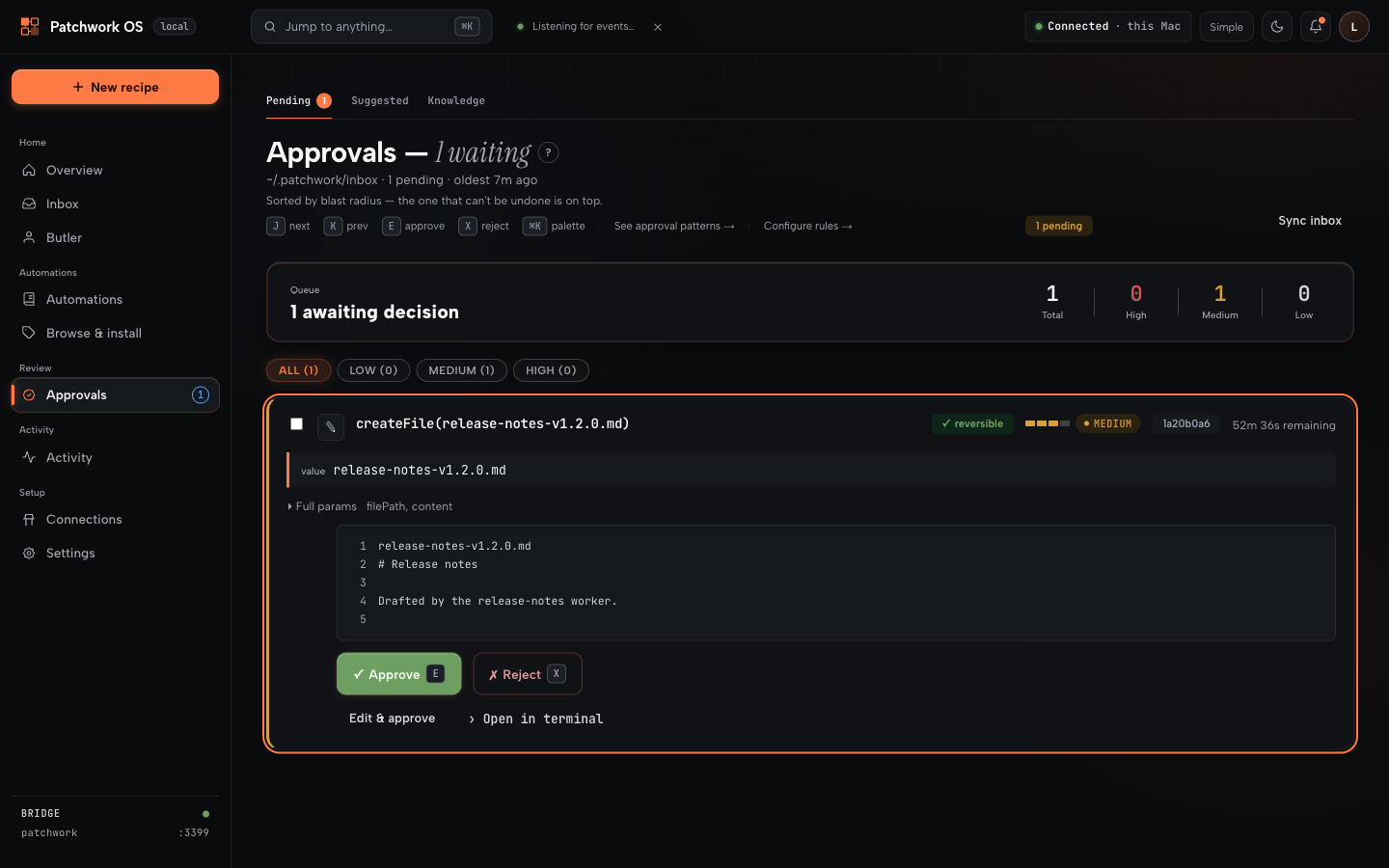
Ask before acting. Every action is classified by blast radius — can it be undone, and how much breaks if it's wrong? Reversible things flow freely. Risky things wait in an approval queue with the evidence attached: what exactly will run, why it fired, and what happens if it's wrong.
-
Trust is earned, never assumed. Workers — named agents with jobs — start supervised and earn independence from their track record, per action type. Good at filing issues ≠ allowed to push code. One bad high-stakes action outweighs a hundred trivial successes. You set the ceiling; the math never raises it for them.
-
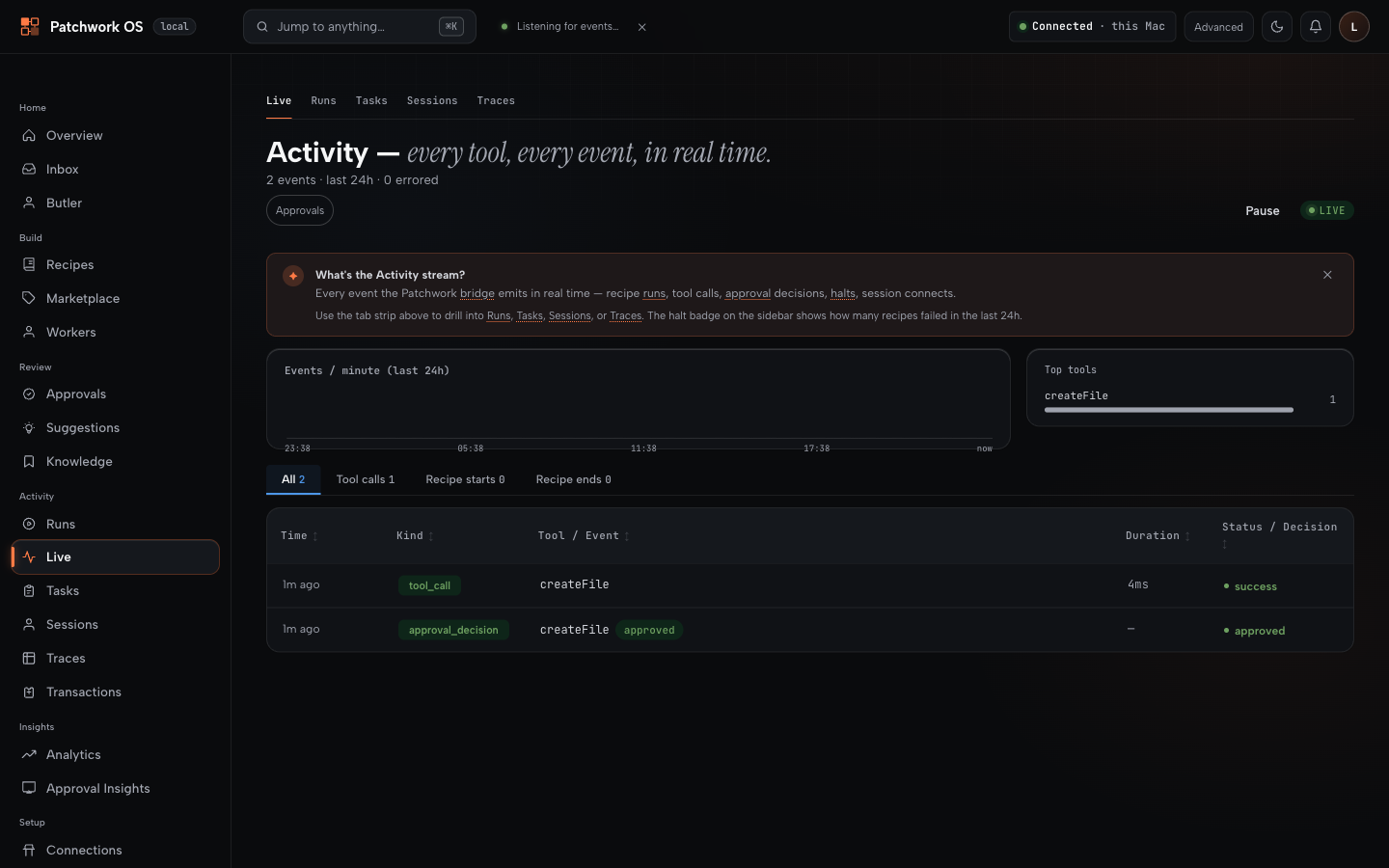
Every decision leaves a receipt. What was done, why it was allowed, and how it turned out — durable, replayable, explainable via
patchwork judgments, the dashboard's traces page, andpatchwork gate explain. When you approve something, you find out later whether you were right.
An agent wants to write a file. With the gate on, it waits — and shows you exactly what it would do:
You approve. The call proceeds, and both halves are on the record:
Status: stable 1.2
Version 1.2.6, published to npm as latest. The decision layer, recipes, connectors and IDE bridge all work and are dogfooded daily. Interfaces can still change between minor versions and some surfaces are rougher than others. Pin an exact version if you are building on it.
Whether the safety features are on depends on how you installed. This matters more than any other line in this README:
- New install:
patchwork-os initon a machine with no~/.patchwork/config.jsonwritesprofile: governed. The gate is on from the first run. - Existing install: upgrading never changes your profile. An existing config stays as it is; opt in with
patchwork profile governedand restart the bridge. - No config at all (starting the bridge without
init): thecompatprofile, where nothing is gated.
Run patchwork doctor to see what is enforced on your machine right now. Trust its output over this table.
| Feature | governed (new init) |
compat (existing config, or none) |
|---|---|---|
| Approval queue | on at high, for automated triggers (cron, webhook, file-watch, git-hook) as well as manual runs |
off unless --approval-gate high or all, and then manual runs only |
| Non-reversible writes | ask for approval whatever their tier | follow the tier threshold |
| Agent steps | contained: read-only tools, no network or shell | full access unless a step sets sandbox: true |
Recipe plugins (servers:) |
load only if listed in plugins.allow |
any entry loads, in-process |
| A tool nothing is registered under | the run halts | the step is skipped |
Kill switch (patchwork panic) |
available; fails closed if its state is unreadable | available; fails open |
| Worker autonomy ramp | on for worker-owned recipes (runs need a driver, e.g. --driver subprocess) |
off unless PATCHWORK_FLAG_WORKER_AUTONOMY=1 (same driver requirement) |
| Telemetry | off | off; opt in explicitly (details) |
Under compat, a fresh bridge is an automation runtime, and it becomes a decision layer when you switch the gate on. Everything above about "stops and asks you first" describes the gate when it is on.
The loop
trigger → recipe/worker → reversible?           → runs
                        → risky, gate on        → approval queue → your yes → receipt
                        → risky, gate off       → runs
                        → forbidden by policy   → refused (no approval unlocks it)
patchwork panic blocks every write-tier tool call across all running bridges, immediately. Reads keep working, and in-flight reasoning is not killed — it is a write block, not a full stop.
Install
npm install -g patchwork-os@beta
patchwork-os init
init scaffolds ~/.patchwork, seeds local-only recipes, and registers Patchwork's PreToolUse hook in ~/.claude/settings.json. Restart Claude Code afterwards — it reads hooks at session start.
Prereqs: Node 22.5+. macOS, Linux, and native Windows (no WSL).
Two things worth knowing before you start:
- Use a global install, not
npx.npxdoes not persist the binary, so the very next command in any guide will not be found. - The web dashboard is not in the npm package. It's a Next.js app that needs its own build, so it ships with the repo:
Everything below works from the CLI without it. The dashboard is where approvals, traces and connector setup are pleasant rather than possible.git clone https://github.com/Oolab-labs/patchwork-os && cd patchwork-os/dashboard npm install && npm run build && npm start # http://localhost:3200
First run: zero connectors
Prove the runtime works before wiring any service to it. daily-status touches only git and local files — no accounts, no network:
patchwork recipe run daily-status
It reads your commits since yesterday plus ~/.patchwork/planned.md, and writes a Markdown digest to ~/.patchwork/inbox/daily-status-<date>.md. If that file exists, your install is sound.
Useful neighbours: patchwork recipe list, patchwork status, patchwork recipe doctor <name> when something misbehaves.
Morning Brief: the connected workflow
patchwork-os init --with-connectors   # seeds the connector-backed recipes
patchwork connect gmail
patchwork connect google-calendar
patchwork connect github
patchwork connect linear
patchwork recipe run morning-brief
The recipe pulls unread mail, today's calendar, your open GitHub issues and PRs, Linear issues, and local git activity, then has a model summarise them into one Markdown brief in ~/.patchwork/inbox/. Its email step is triage — it lists what needs an answer; it does not compose or send replies. Nothing leaves your machine except the API calls to the services you connected.
All four connectors are required as written — no step is guarded, so a missing one halts the run. Drop the steps you don't want, or start from daily-status and add sources one at a time.
Requires a working model driver (--driver subprocess with the Claude CLI on PATH, or an API key). patchwork recipe preflight templates/recipes/morning-brief.yaml lists exactly what a recipe needs before you run it.
Two ways to run this
As an automation runtime — recipes, workers, connectors, the decision layer. Needs ~/.patchwork and a model driver; an editor is optional.
patchwork start # bridge + Claude + dashboard
patchwork start launches claude --ide alongside the bridge, so it expects the Claude CLI on your PATH. Use patchwork start --no-dashboard, or run the bridge alone with patchwork --workspace ., if you don't want that.
On a global npm install there is no dashboard/ to start, so it logs a dashboard warning and carries on with bridge + Claude; pass --no-dashboard to silence it. From a repo clone it starts all three.
As a standalone IDE bridge — 180 MCP tools giving Claude Code eyes and hands in your editor: diagnostics, LSP navigation, refactoring with risk analysis, debugger, terminal, git/GitHub, file ops. No ~/.patchwork, no recipes, no gate.
npm install -g patchwork-os
claude-ide-bridge install-extension     # VS Code / Cursor / Windsurf / Antigravity
claude-ide-bridge --workspace .
claude --ide                            # in another terminal
JetBrains via a companion plugin. Claude Desktop, Gemini CLI, Codex CLI, Grok Build, and claude.ai connect over stdio or HTTP. Use the bridge alone forever if that's all you need; the runtime is an optional layer on top.
claude --ide can't find an IDE? Set CLAUDE_CODE_IDE_SKIP_VALID_CHECK=true (init does this for you).
What "local-first" does and doesn't mean
On your machine: the runtime, every recipe and worker, all credentials and connector tokens, the approval queue, and every log and decision receipt under ~/.patchwork/. Nothing is uploaded, and no Patchwork-operated server sits in any path.
Over the network, necessarily: calls to whatever model you point it at (Anthropic, OpenAI, Google, xAI) and to every connector you authorise (Gmail, GitHub, Slack…). Prompts, and whatever context a step feeds them, go to that model provider. Choosing a local Ollama endpoint keeps inference on your machine too; connector calls still leave it, because that is what a connector is.
Only if you opt in: anonymous analytics.
Other boundaries worth knowing: runCommand executes only allowlisted commands, sendHttpRequest blocks private and loopback ranges, and file tools refuse symlink escapes out of the workspace. Remote deployments must sit behind TLS with OAuth 2.0 — see docs/remote-access.md.
What's here
-
Decision layer — approval queue · blast-radius action classes · worker trust ramp · kill switch · decision receipts
-
Automation — YAML recipes · cron/file/git/test/webhook triggers · event hooks · multi-model (Claude, GPT, Gemini, Grok, Ollama)
-
Connectors — 45+, all writes governed by your policy: GitHub, Slack, Gmail, Calendar, Drive, Linear, Jira, Sentry, Notion, Stripe, PagerDuty, Datadog, …
-
IDE bridge — 180 MCP tools · VS Code-family extension · JetBrains plugin · plugins hot-reload (write tools mid-session)
-
Oversight — web dashboard · mobile push approvals (PWA) · halts/judgments CLI · trace memory across sessions
-
Deployment — your laptop · headless VPS with OAuth 2.0 (guide) · native Windows
Recipes are plain YAML: a trigger (cron, file save, git commit, test run, or any webhook — iPhone Shortcut, Stream Deck, Home Assistant) plus steps. Share them like dotfiles, install them from the marketplace, or let the dashboard generate one from a sentence.
Workers are recipes with an identity and a track record. A worker that triages failing CI starts by only proposing ("this looks like a real break — file an issue?"). Confirm its filings were real and it earns a longer leash — for that job only. It can be demoted in one bad day. You can cap any worker permanently with one line of YAML.
Why not Zapier / an MCP server / a hosted assistant? Honest tradeoffs: documents/comparison.md.
Docs
Docs index · Platform reference · Recipes & triggers · Worker autonomy · Plugin authoring · Architecture · Windows · ADRs
Telemetry
Off by default; nothing is sent unless you opt in. If you do: aggregate counts and latencies only — never paths, prompts, file contents, arguments, or anything from ~/.patchwork/. Details & source.
Contributing & support
Issues · Discussions · CONTRIBUTING.md
⭐ If this saved you a config file or a blown deploy, a star is the only signal I get that it's helping.
MIT © Oolab Labs — what that covers · name and marks
Preguntas sobre Patchwork OS MCP
¿Cómo agrego Patchwork OS MCP a Claude Code?
Ejecuta claude mcp add patchwork-os -- npx -y patchwork-os en tu terminal. Añade --scope user para que esté disponible en todos los proyectos.
¿Cómo agrego Patchwork OS MCP a Cursor?
Abre ~/.cursor/mcp.json y añade el servidor en mcpServers, usando la configuración de Cursor que se muestra en la sección de instalación de arriba.
¿Cómo funciona el proceso de aprobación?
Las acciones de riesgo se clasifican según su radio de impacto y se colocan en una cola de aprobación donde puedes revisar la evidencia, qué se ejecutará y el impacto potencial antes de decidir.
¿Se suben mis datos a un servidor?
No, el entorno de ejecución, las recetas, los workers, las credenciales y los registros de decisiones se almacenan localmente en tu máquina en ~/.patchwork/.
¿Qué pasa si necesito detener todas las acciones de los agentes inmediatamente?
Puedes usar el comando patchwork panic para bloquear inmediatamente todas las llamadas a herramientas de nivel de escritura en todos los bridges que estén en ejecución.