
Proporciona memoria persistente para agentes de IA, incluyendo historial de conversaciones, contexto de clave-valor, búsqueda semántica y colas FIFO.
También conocido como jyswee/agenticmemory, agmry
- Stars
- 1
- Herramientas
- —
- Descargas, 30 días
- —
- Última versión
- 1.10.0
- Último commit
- 23 sept 2026
- Licencia
- —
¿Qué es agenticmemory MCP?
agenticmemory es un MCP server. Proporciona memoria persistente para agentes de IA, incluyendo historial de conversaciones, contexto de clave-valor, búsqueda semántica y colas FIFO.
Resumen generado a partir del README del proyecto
Acerca del MCP server de agenticmemory
Agentic Memory proporciona una capa de memoria persistente para que los agentes de IA almacenen y recuperen información a través de diferentes sesiones y máquinas. Está diseñado para desarrolladores que utilizan herramientas como Claude Code, Cursor, Cline y Windsurf. El sistema permite a los agentes gestionar su propio estado mediante varios tipos de memoria, incluyendo historial de conversación a corto plazo, contexto de clave-valor duradero para preferencias y entradas de conocimiento etiquetadas a largo plazo. También incluye un scratchpad para memoria de trabajo efímera y colas FIFO que actúan como un bus de agentes para pasar tareas entre diferentes agentes.
Los usuarios pueden interactuar con el servicio a través de un CLI, una REST API o un MCP server. El MCP server puede ejecutarse localmente usando el comando agmry mcp-serve o conectarse a clientes alojados mediante un endpoint SSE remoto. Por seguridad, el servicio admite cifrado de extremo a extremo para espacios de conocimiento cero donde el servidor no puede leer los datos. Los agentes incluso pueden realizar un registro automático vía CLI para recibir una API key sin intervención manual en un navegador.
Qué puedes hacer con él
- 1Mantener el contexto del proyecto entre sesionesUn agente puede usar el comando boot para cargar todos los mensajes, el contexto y las entradas al inicio de una nueva sesión.
- 2Almacenar y recuperar datos duraderosLos desarrolladores pueden guardar decisiones específicas o manuales de procedimientos como pares clave-valor tipados para asegurar que nunca se olviden.
- 3Realizar búsquedas semánticas en datos pasadosCuando un agente solo recuerda parcialmente un tema, puede usar la búsqueda semántica para encontrar entradas históricas relevantes.
- 4Coordinar tareas entre múltiples agentesUn agente puede enviar una tarea en JSON a una cola FIFO para que otro agente la recoja más tarde.
Escrito a partir del README del proyecto. Cada caso de uso se verifica con una cita del mismo.
Cómo instalar agenticmemory MCP
Formatos verificados el 10 nov 2026Añadir a CursorAñadir a GooseInstalar agenticmemory MCP en Claude Code
$ claude mcp add --env 'AGMRY_API_KEY=<YOUR_AGMRY_API_KEY>' agenticmemory -- npx -y agmryInstalar agenticmemory MCP en Cursor
~/.cursor/mcp.json
{
  "mcpServers": {
    "agenticmemory": {
      "command": "npx",
      "args": [
        "-y",
        "agmry"
      ],
      "env": {
        "AGMRY_API_KEY": "<YOUR_AGMRY_API_KEY>"
      }
    }
  }
}Instalar agenticmemory MCP en VS Code
.vscode/mcp.json
{
  "servers": {
    "agenticmemory": {
      "type": "stdio",
      "command": "npx",
      "args": [
        "-y",
        "agmry"
      ],
      "env": {
        "AGMRY_API_KEY": "<YOUR_AGMRY_API_KEY>"
      }
    }
  }
}Instalar agenticmemory MCP en VS Code CLI
$ code --add-mcp '{"name":"agenticmemory","type":"stdio","command":"npx","args":["-y","agmry"],"env":{"AGMRY_API_KEY":"<YOUR_AGMRY_API_KEY>"}}'Instalar agenticmemory MCP en Claude Desktop
claude_desktop_config.json
{
  "mcpServers": {
    "agenticmemory": {
      "command": "npx",
      "args": [
        "-y",
        "agmry"
      ],
      "env": {
        "AGMRY_API_KEY": "<YOUR_AGMRY_API_KEY>"
      }
    }
  }
}Instalar agenticmemory MCP en Codex
$ codex mcp add agenticmemory --env 'AGMRY_API_KEY=<YOUR_AGMRY_API_KEY>' -- npx -y agmryInstalar agenticmemory MCP en Codex config.toml
~/.codex/config.toml
[mcp_servers.agenticmemory]
command = "npx"
args = ["-y", "agmry"]

[mcp_servers.agenticmemory.env]
AGMRY_API_KEY = "<YOUR_AGMRY_API_KEY>"
Instalar agenticmemory MCP en Gemini CLI
$ gemini mcp add -s user -e 'AGMRY_API_KEY=<YOUR_AGMRY_API_KEY>' agenticmemory npx -- -y agmryInstalar agenticmemory MCP en Gemini settings.json
~/.gemini/settings.json
{
  "mcpServers": {
    "agenticmemory": {
      "command": "npx",
      "args": [
        "-y",
        "agmry"
      ],
      "env": {
        "AGMRY_API_KEY": "<YOUR_AGMRY_API_KEY>"
      }
    }
  }
}Configuración
AGMRY_API_KEYSecretoAgentic Memory API key (amk_...). Optional for tool discovery; required to call a tool. Get one instantly with `agmry signup my-project` — no browser, no card, live for 48h; $0 card-auth starts the free 7-day trial.
| Nombre | Descripción | Tipo |
|---|---|---|
| AGMRY_API_KEY | Agentic Memory API key (amk_...). Optional for tool discovery; required to call a tool. Get one instantly with `agmry signup my-project` — no browser, no card, live for 48h; $0 card-auth starts the free 7-day trial. | Secreto |
Verificaciones automáticas
Ejecutado 14 nov 2026Informe completo →Pasó nuestras verificaciones automáticas. Esto no es una auditoría de seguridad: lee el código y dale al servidor el acceso más limitado que necesite. Cómo funcionan las verificaciones · Qué corregir para obtener más puntos

- Repositorio de origen vinculado y accesiblejyswee/agenticmemory is public and reachablegithub.com/jyswee/agenticmemory ↗Aprobado
- El paquete indica este repositorio como su origenagmry names jyswee/agenticmemory as sourcenpmjs.com/package/agmry ↗Aprobado
- Procedencia de la compilación (atestación de Sigstore)No build attestation published for this releaseNo verificado
- Licencia de código abierto (OSI)No licenseHallazgo
- Commit o lanzamiento en el último añoLast commit or release 2026-09-23github.com/jyswee/agenticmemory ↗Aprobado
- OpenSSF ScorecardNo verificado
- El nombre del paquete no es similar a un paquete popularNo popular package one edit away from agmryAprobado
- No hay avisos críticos en el paquete ni en sus dependencias1 resolved dependencies checked; no critical advisoryosv.dev ↗Aprobado
- Sin instrucciones ocultas para el modelo0 tool descriptions and the README read; no override phrases, credential paths or hidden charactersAprobado
- Las herramientas destructivas están etiquetadasNo verificado
- El endpoint remoto responde al handshake de MCPEndpoint did not answer initialize: HTTP 404Hallazgo
README
Ver en GitHubagmry



Persistent memory for AI agents — conversation history, key-value context, and semantic search across sessions. As easy as git.
git remembers your code. agmry remembers everything else.
Your agent writes great code all day — then forgets every decision the moment its context window resets. So you become the memory layer: re-explaining the project, the preferences, what broke last time. Agentic Memory is the memory your agent runs itself: one install, and it stores, recalls, and searches its own state across sessions, machines, and even other agents. It can even sign itself up — one command returns a working API key, no browser, no human.
Works with: Claude Code · Cursor · Cline · Windsurf · Aider · Codex · any MCP client

Install to full recall in 60 seconds — real terminal session, no mockups. Watch all the demos.
Install
npm install -g agmry
Quick Start
# Agent signs itself up — working key returned instantly, no card, no browser
agmry signup my-project --local

# Store memory
agmry store my-project "User prefers TypeScript strict mode and pnpm"

# New session? Recall everything
agmry recall my-project

# Half-remember something? Search it
agmry search my-project "how do we deploy"

# Full reference
agmry --help
Agents sign themselves up
No browser. No OAuth. No waiting for a human.
$ agmry signup my-project
✓ Project "my-project" created
  API key: amk_************************  (saved to .agmry/config.json)
  Live:    full access for 48h — no card, $0 today
The key works immediately — every endpoint, every tool, full access for 48 hours. Within that window, your human completes a $0 card-auth that starts the free 7-day trial on the same key. Miss the window? Nothing is deleted — the key pauses and revives the moment the card-auth completes. Add --email you@company.com and the human gets the link automatically.
Three tiers of memory — because not all memory is equal
A transcript dump isn't memory. Agents need different recall for different things:
# Short-term: ordered, role-aware conversation history (sub-ms reads)
agmry store my-project "Deployed v2.1, rolled back — migration locked the users table" -r assistant
agmry recall my-project -n 50

# Durable facts: typed key-value context — decisions, preferences, runbooks
agmry ctx my-project set deploy_flow "push image to registry, then ask infra to roll"
agmry ctx my-project get deploy_flow

# Long-term: titled, tagged knowledge entries that survive months
agmry entry my-project "Auth decision" "JWT not sessions — mobile clients can't hold cookies" --tags "arch,decisions"
agmry entries my-project --tags "decisions"

# Work-in-progress: scratchpad that's allowed to expire
agmry scratch my-project set "midway through the billing refactor, invoice.js next"
And semantic search stitches it together when the agent only half-remembers:
agmry search my-project "did we ever discuss rate limiting"
# → surfaces a months-old entry, with similarity score
Session start = one command
Instead of pasting yesterday's summary into today's prompt:
agmry boot my-project --json          # messages + context + entries, one call
agmry boot my-project --semantic "billing refactor"   # or focused on a topic
~200 tokens of structured state, not top-k chunks of old transcripts.
MCP Server
Prefer tools over a CLI? agmry ships an MCP server. Point Claude Code (or any MCP client) at it and your agent gets 17 native tools: store, recall, search, bootstrap, context, entries, spaces, queues.
claude mcp add agenticmemory -- agmry mcp-serve
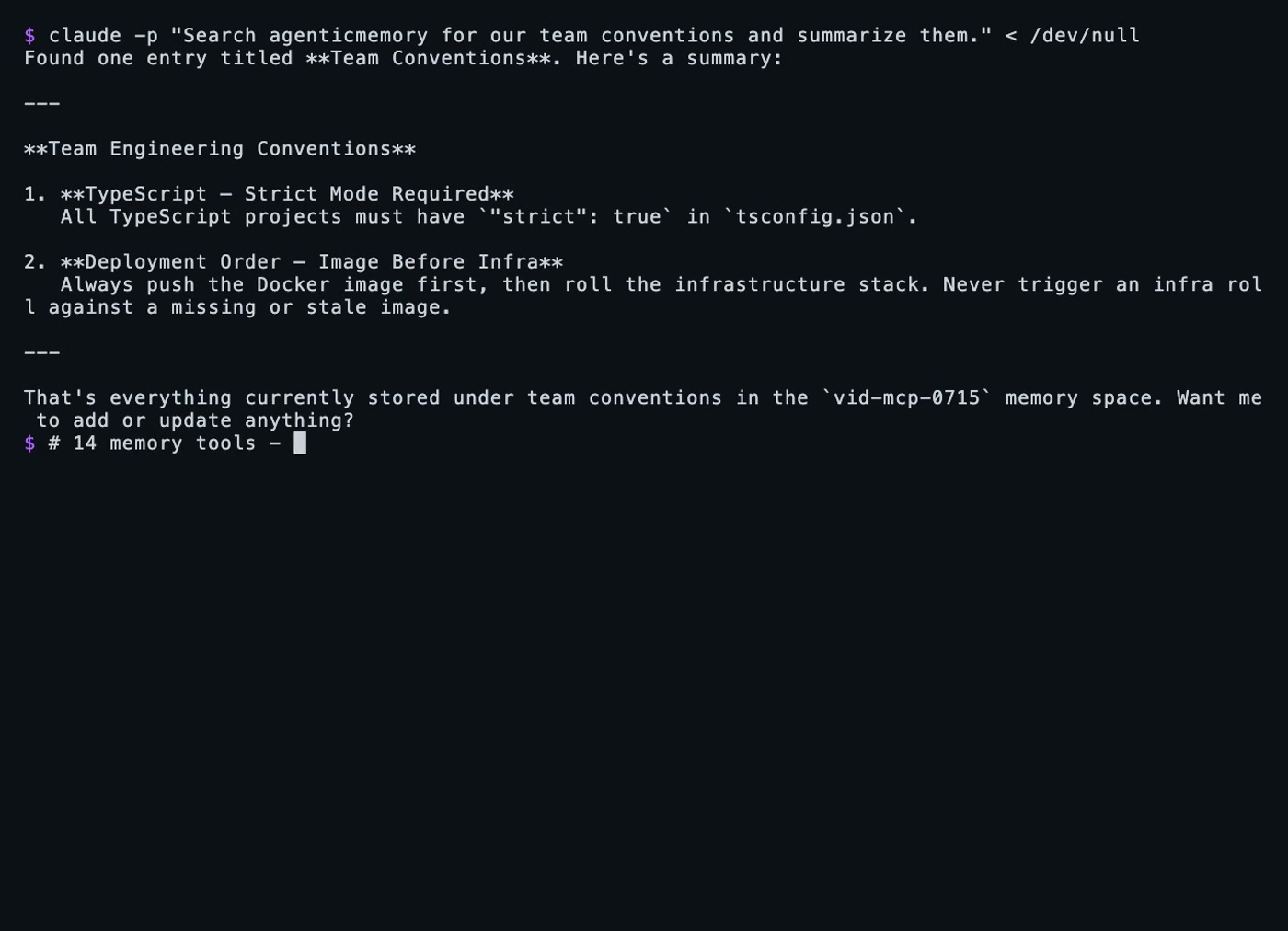
Claude Code remembering across sessions via MCP — click to watch.
For clients that use a JSON config (Cline, Cursor, Windsurf), pass your API key via the environment — the MCP server runs outside your project directory, so it won't pick up .agmry/config.json:
{
  "mcpServers": {
    "agenticmemory": {
      "command": "agmry",
      "args": ["mcp-serve"],
      "env": { "AGMRY_API_KEY": "amk_your_key_here" }
    }
  }
}
Remote MCP — zero install
Claude Web, Claude Desktop, Raycast, or any hosted MCP client can connect straight to the remote server. Same tools, same API key, nothing to install:
URL:  https://mcp.agenticmemory.ai/sse
Auth: Authorization: Bearer YOUR_API_KEY
End-to-end encryption (zero-knowledge spaces)
Create a space the server can never read. Encryption happens inside the CLI — the API only ever sees ciphertext.
agmry key generate                                  # one-time: creates + saves your key
agmry space create "Private" private --encryption e2e

agmry store SPACE "my secret"                       # encrypted before it leaves your machine
agmry recall SPACE                                  # transparently decrypted
agmry key verify SPACE                              # holding the right key?
Or derive per-space keys from a passphrase instead of storing a key:
agmry key set --passphrase "long secret phrase"
Notes:
- Semantic search is impossible on zero-knowledge spaces by design.
- Prefer encrypted at rest instead?
--encryption managed— the server encrypts your data at rest and every feature (search, summaries) keeps working. No client key needed. - Losing the key or passphrase means the data is unrecoverable. That's the point. Back it up:
agmry key show --reveal.
Key resolution order: --enc-key / --passphrase flag → AGMRY_ENCRYPTION_KEY env → ./.agmry/config.json → ~/.agmry/config.json. Same envelope and key derivation as the Node and Python SDKs — keys are interchangeable across all three.
Multi-agent: one brain, many agents
Spaces are shareable. One agent stores the deploy runbook; another recalls it a week later, from a different machine, over a different interface (CLI, MCP, or REST — same memory). Your agents hand off between sessions and between projects without you couriering context.
And you stay in the loop: everything your agents remember is browsable in a human dashboard.
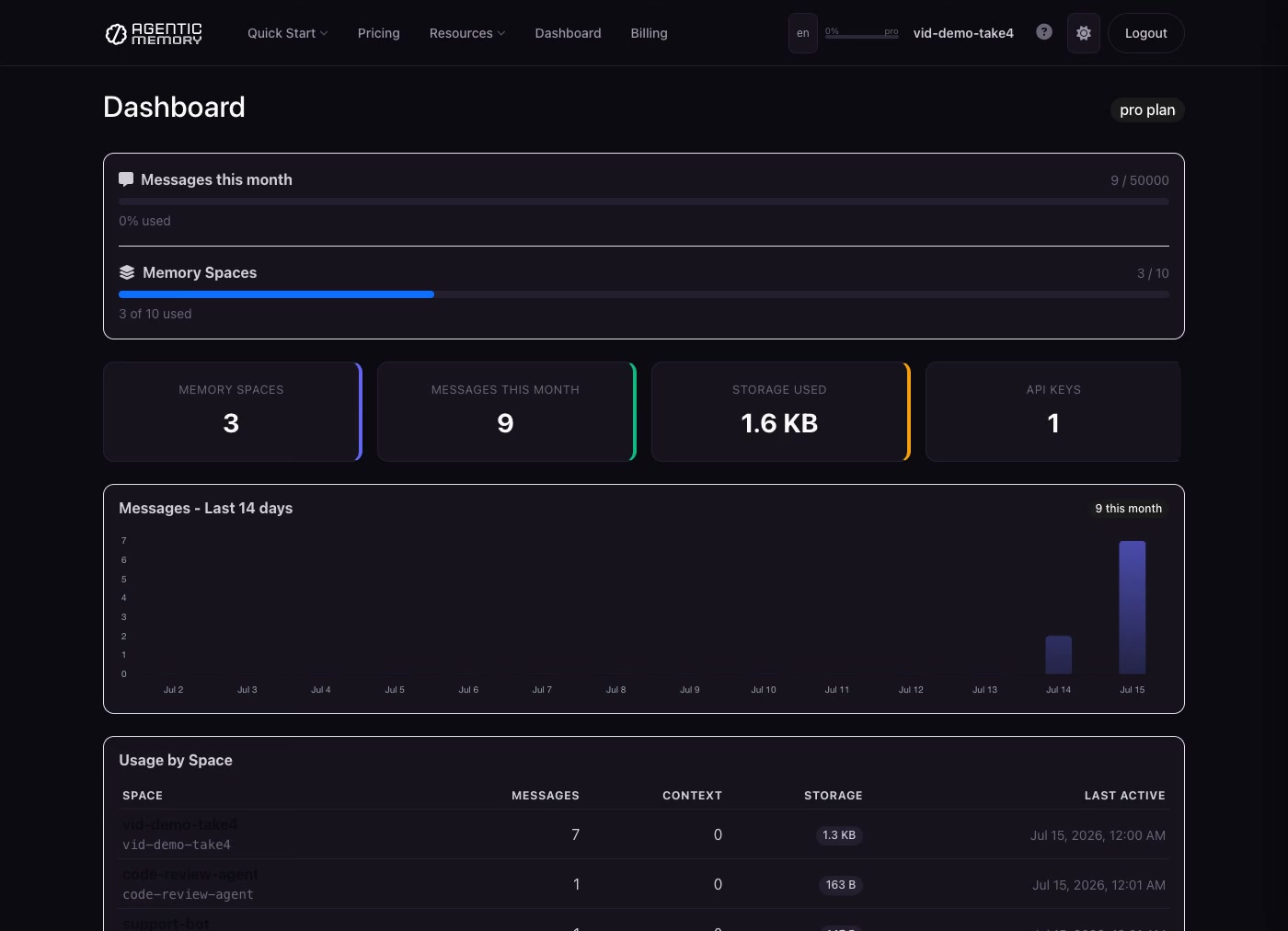
Everything your agents remember, in one dashboard — click to watch.
Queues — the agent bus
FIFO queues inside a space. One agent pushes work, another pops it — no polling glue, no extra infra.
agmry queue SPACE jobs push '{"task":"review PR #42"}'   # enqueue (FIFO)
agmry queue SPACE jobs pop                                # dequeue oldest — exit code 2 if empty
agmry queue SPACE jobs pop --wait 25                      # long-poll up to 25s for the next item
agmry queue SPACE jobs                                    # peek: length + head, without consuming
agmry queue SPACE jobs dlq push '{"task":"..."}' --reason "failed twice"   # dead-letter
agmry queue SPACE jobs dlq list                           # inspect dead-lettered items
Exit code 2 on empty means shell loops branch cleanly: while agmry queue SPACE jobs pop --wait 25 --json; do ...; done. Envelopes are opaque JSON — the server never inspects them.
Agent Integration
Add to your CLAUDE.md, .cursorrules, .clinerules, .windsurfrules, or AGENTS.md:
## Agentic Memory
This project uses Agentic Memory for persistent memory across sessions.
Use the `agmry` CLI. Key is in .agmry/config.json (auto-loaded).

agmry boot SPACE --json               # load everything at session start
agmry store SPACE "what happened"     # remember something
agmry ctx SPACE set key "value"       # store a durable decision/fact
agmry search SPACE "the deadline"     # find past context
agmry queue SPACE jobs push '{...}'   # send work to another agent
agmry queue SPACE jobs pop --wait 25  # receive work (exit 2 = empty)
Config Priority
--keyflagAGMRY_API_KEYenvironment variableAGENTICMEMORY_API_KEYenvironment variable./.agmry/config.json(project-local)~/.agmry/config.json(global)
Add .agmry/ to your .gitignore.
Features
- Conversation history — ordered, role-aware messages with recency windowing, sub-ms reads
- Key-value context — typed durable facts: decisions, preferences, runbooks
- Long-term entries — titled, tagged knowledge that survives months, with auto-summarisation
- Entities — people and systems the agent should know about
- Scratchpad — ephemeral working memory with TTLs (expiry is a feature)
- Semantic search — across everything the agent has ever stored
- Bootstrap — full session context in one call
- Agent self-signup — working API key from one CLI command, live for 48h keyless; $0 card-auth starts the free 7-day trial
- Queues — FIFO agent bus with long-poll and dead-letter,
agmry queue(exit 2 = empty) - MCP server — 46 tools, local (
agmry mcp-serve) or fully remote (mcp.agenticmemory.ai) - REST API — same memory on the request path of proxies and pipelines
- Multi-agent spaces — a fleet of agents reads and writes one memory
- End-to-end encryption — zero-knowledge spaces where only you hold the key (
agmry key generate) - Export — full data takeout per space, one command (
agmry space export)
Pricing: The agent's key works instantly — full access for 48h, no card. A $0 card-auth starts the free 7-day trial; after that from $24.99/mo. No data deletion, ever: your memory waits for you. Details.
Why not just Claude's built-in memory?
Claude Memory is great — but it only works with Claude, and only Claude decides what's in it.
| Agentic Memory | Claude Memory | |
|---|---|---|
| LLM support | Any — GPT, Claude, Gemini, Llama, Mistral, DeepSeek | Claude only |
| Switch LLMs | Keep all memory | Lose everything |
| Multi-agent | Shared spaces across agents | Single user |
| Programmatic control | Full CLI + MCP + REST | Black box — Claude decides |
| Structured data | Messages + context + entries + entities + scratchpad | Free-text notes |
| Semantic search | agmry search "the deadline" |
No search API |
| Data ownership | You own it, export any time | Stored by Anthropic |
Why this exists
I was my agents' memory. Every session started with me re-explaining my own project to my own tools — decisions, preferences, what broke last time. So I built the memory they run themselves. My own agents use it in production across a dozen projects; if something's rough or missing, open an issue — I read every one.
Documentation
- Quickstart guides — Claude Code, Cursor, LangChain, CrewAI, AutoGen + 7 more
- API docs
- Pricing
License
Proprietary — Tyga.Cloud Ltd. See LICENSE.
Preguntas sobre agenticmemory MCP
¿Cómo agrego agenticmemory MCP a Claude Code?
Ejecuta claude mcp add --env 'AGMRY_API_KEY=<YOUR_AGMRY_API_KEY>' agenticmemory -- npx -y agmry en tu terminal. Añade --scope user para que esté disponible en todos los proyectos.
¿Cómo agrego agenticmemory MCP a Cursor?
Abre ~/.cursor/mcp.json y añade el servidor en mcpServers, usando la configuración de Cursor que se muestra en la sección de instalación de arriba.
¿Pueden los agentes registrarse solos sin intervención humana?
Sí, los agentes pueden registrarse mediante un único comando que devuelve una API key funcional de inmediato sin necesidad de un navegador o de una persona.
¿Soporta cifrado de extremo a extremo?
Sí, puedes crear espacios de conocimiento cero donde el cifrado ocurre dentro del CLI y el servidor solo ve el texto cifrado.
¿Puedo usarlo con clientes MCP remotos?
Sí, clientes MCP alojados como Claude Web o Claude Desktop pueden conectarse directamente al servidor remoto usando la URL y la API key proporcionadas.