
Proporciona un motor de memoria local basado en evidencia para agentes de IA, utilizando afirmaciones con fuentes, niveles de certeza e historiales de revisión.
También conocido como GhostPawJS/codex, codex, @ghostpaw/codex
- Stars
- 3
- Herramientas
- 7
- Descargas, 30 días
- 3341
- Última versión
- 0.6.5
- Último commit
- 11 nov 2026
- Licencia
- MIT
¿Qué es GhostPaw Codex MCP?
GhostPaw Codex es un MCP server. Proporciona un motor de memoria local basado en evidencia para agentes de IA, utilizando afirmaciones con fuentes, niveles de certeza e historiales de revisión. Expone 7 herramientas, como search_codex, review_codex, inspect_codex_item.
Resumen generado a partir del README del proyecto
Acerca del MCP server de GhostPaw Codex
GhostPaw Codex proporciona un motor de memoria local diseñado para que los agentes de IA almacenen y gestionen información como creencias estructuradas. En lugar de simplemente añadir texto, los agentes utilizan este sistema para mantener afirmaciones completas con fuentes, niveles de certeza y conteos de evidencia. Este enfoque permite a los agentes rastrear cómo evoluciona su conocimiento a través de un historial de revisión, ayudándoles a identificar qué creencias están obsoletas, perdiendo vigencia o tienen un respaldo débil.
El sistema funciona como una base de datos SQLite local sin dependencias de tiempo de ejecución, lo que lo hace ideal para la memoria privada de agentes en el dispositivo. Los desarrolladores pueden integrarlo como una librería de TypeScript, una herramienta CLI o un MCP server. Es compatible con clientes como Claude Desktop, Cursor y Cline. Los usuarios pueden gestionar la base de datos mediante la variable de entorno GHOSTPAW_CODEX_DB o el flag --db para asegurar los permisos adecuados en entornos de sandbox.
Qué puedes hacer con él
- 1Mantener conocimiento verificable del agenteUn agente de IA puede almacenar hechos como afirmaciones que incluyen fuentes específicas y niveles de certeza para evitar la desinformación.
- 2Auditar y revisar el historial de creenciasLos desarrolladores pueden examinar el linaje de una pieza de información para ver cómo ha cambiado la comprensión de un agente a lo largo del tiempo.
Escrito a partir del README del proyecto. Cada caso de uso se verifica con una cita del mismo.
Cómo instalar GhostPaw Codex MCP
Formatos verificados el 10 nov 2026Añadir a CursorAñadir a GooseInstalar GhostPaw Codex MCP en Claude Code
$ claude mcp add codex -- npx -y @ghostpaw/codexInstalar GhostPaw Codex MCP en Cursor
~/.cursor/mcp.json
{
  "mcpServers": {
    "codex": {
      "command": "npx",
      "args": [
        "-y",
        "@ghostpaw/codex"
      ]
    }
  }
}Instalar GhostPaw Codex MCP en VS Code
.vscode/mcp.json
{
  "servers": {
    "codex": {
      "type": "stdio",
      "command": "npx",
      "args": [
        "-y",
        "@ghostpaw/codex"
      ]
    }
  }
}Instalar GhostPaw Codex MCP en VS Code CLI
$ code --add-mcp '{"name":"codex","type":"stdio","command":"npx","args":["-y","@ghostpaw/codex"]}'Instalar GhostPaw Codex MCP en Claude Desktop
claude_desktop_config.json
{
  "mcpServers": {
    "codex": {
      "command": "npx",
      "args": [
        "-y",
        "@ghostpaw/codex"
      ]
    }
  }
}Instalar GhostPaw Codex MCP en Codex
$ codex mcp add codex -- npx -y @ghostpaw/codexInstalar GhostPaw Codex MCP en Codex config.toml
~/.codex/config.toml
[mcp_servers.codex]
command = "npx"
args = ["-y", "@ghostpaw/codex"]
Instalar GhostPaw Codex MCP en Gemini CLI
$ gemini mcp add -s user codex npx -- -y @ghostpaw/codexInstalar GhostPaw Codex MCP en Gemini settings.json
~/.gemini/settings.json
{
  "mcpServers": {
    "codex": {
      "command": "npx",
      "args": [
        "-y",
        "@ghostpaw/codex"
      ]
    }
  }
}Herramientas de GhostPaw Codex MCP 7
Detectado desde el READMEsearch_codexreview_codexinspect_codex_itemremember_beliefrevise_beliefretire_beliefdismiss_proximity
| search_codex | — | |
| review_codex | — | |
| inspect_codex_item | — | |
| remember_belief | — | |
| revise_belief | — | |
| retire_belief | — | |
| dismiss_proximity | — |
Configuración
GHOSTPAW_CODEX_DBSQLite database path (default: ~/.ghostpaw/codex.db)
GHOSTPAW_CODEX_DBSQLite database path (default: ~/.ghostpaw/codex.db)
| Nombre | Descripción | Tipo |
|---|---|---|
| GHOSTPAW_CODEX_DB | SQLite database path (default: ~/.ghostpaw/codex.db) | |
| GHOSTPAW_CODEX_DB | SQLite database path (default: ~/.ghostpaw/codex.db) |
Verificaciones automáticas
Ejecutado 12 nov 2026Informe completo →Pasó nuestras verificaciones automáticas. Esto no es una auditoría de seguridad: lee el código y dale al servidor el acceso más limitado que necesite. Cómo funcionan las verificaciones

- Repositorio de origen vinculado y accesibleAprobado
- Licencia de código abierto (OSI)Aprobado
- Commit o lanzamiento en el último añoAprobado
- El nombre del paquete no es similar a un paquete popularAprobado
- El endpoint remoto usa HTTPSNo verificado
- Las herramientas destructivas están etiquetadasAprobado
- Sin instrucciones ocultas para el modeloAprobado
- No hay avisos críticos en el paquete ni en sus dependenciasAprobado
README
Ver en GitHub@ghostpaw/codex








Agent memory as beliefs with a source, a certainty and a revision history.
ghostpaw-codex --help
Local, evidence-backed memory for agents. One SQLite file, zero runtime dependencies.
Codex stores what an agent believes as claims with a source, a certainty, evidence counts, decay and an honest revision history. Agents search before they remember, confirm or correct instead of appending, and see which beliefs are stale, fading or weakly evidenced. It runs as a TypeScript library, an MCP server, a CLI and an Agent Skill, all generated from the same seven tools.
Website: codex.ghostpaw.dev
The release binary includes its runtime. npm and library use require Node.js 24+.
Install
Release binary (default)
Each line downloads the latest release asset, checks it against the release's SHA256SUMS and installs ghostpaw-codex into ~/.local/bin. On Linux and macOS the trailing export puts that folder on PATH for the current shell only: neither the line nor install.sh edits ~/.profile or any other shell startup file. The Windows script adds its folder to the user PATH (open a new terminal afterwards).
linux-x64:
curl -fsSL https://raw.githubusercontent.com/GhostPawJS/codex/main/install.sh | sh -s -- --target linux-x64 && export PATH="$HOME/.local/bin:$PATH"
linux-arm64:
curl -fsSL https://raw.githubusercontent.com/GhostPawJS/codex/main/install.sh | sh -s -- --target linux-arm64 && export PATH="$HOME/.local/bin:$PATH"
darwin-arm64:
curl -fsSL https://raw.githubusercontent.com/GhostPawJS/codex/main/install.sh | sh -s -- --target darwin-arm64 && export PATH="$HOME/.local/bin:$PATH"
darwin-x64:
curl -fsSL https://raw.githubusercontent.com/GhostPawJS/codex/main/install.sh | sh -s -- --target darwin-x64 && export PATH="$HOME/.local/bin:$PATH"
windows-x64 (PowerShell):
irm https://raw.githubusercontent.com/GhostPawJS/codex/main/install.ps1 | iex
To keep ~/.local/bin on PATH in new shells, append it to ~/.profile once (this is the only step that edits a startup file):
echo 'export PATH="$HOME/.local/bin:$PATH"' >> ~/.profile
To pin a release instead of taking the latest, pass --version:
curl -fsSL https://raw.githubusercontent.com/GhostPawJS/codex/main/install.sh | sh -s -- --target linux-x64 --version 0.6.0 && export PATH="$HOME/.local/bin:$PATH"
$ ghostpaw-codex --version
ghostpaw-codex 0.6.0 (binary, linux-x64)
$ ghostpaw-codex --version --short
0.6.0
$ ghostpaw-codex --version --json
{"name":"ghostpaw-codex","version":"0.6.0","variant":"binary","target":"linux-x64"}
variant is binary, npm or library; target is null outside the release binary.
A session with the 0.5.2 linux-x64 binary against a small database of five beliefs:
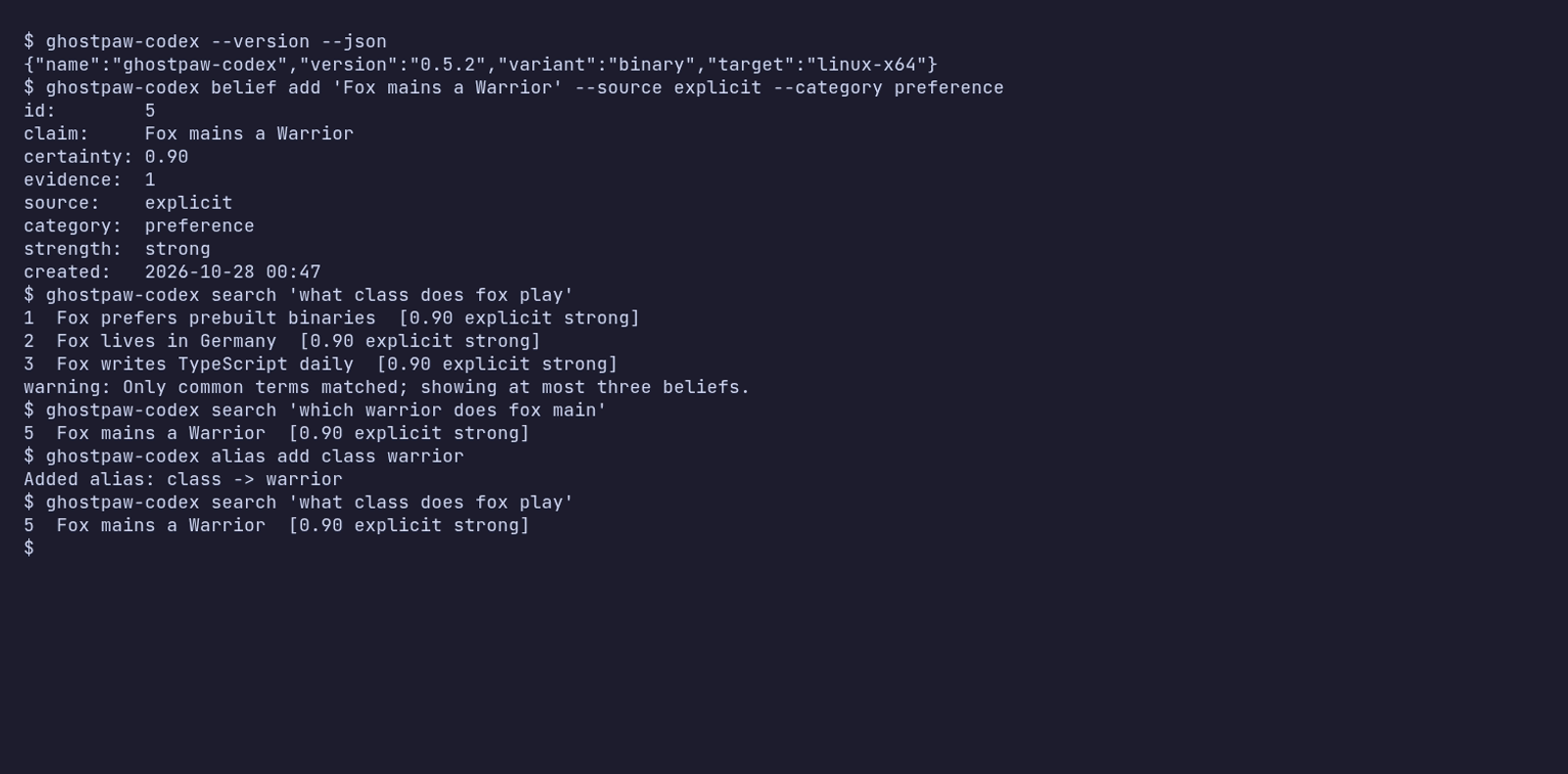
The same session as an animated GIF.
Other release installers:
mise use -g github:GhostPawJS/codex
ubi --project GhostPawJS/codex --exe ghostpaw-codex --in ~/.local/bin
eget GhostPawJS/codex
For aqua, define a
github_release package in aqua.yaml:
registries:
  - name: codex
    type: local
    path: codex-registry.yaml
packages:
  - name: GhostPawJS/codex@v0.6.0
    registry: codex
codex-registry.yaml:
packages:
  - type: github_release
    repo_owner: GhostPawJS
    repo_name: codex
    asset: ghostpaw-codex-{{trimV .Version}}-{{.OS}}-{{.Arch}}.tar.gz
    format: tar.gz
    replacements: { amd64: x64 }
    overrides:
      - goos: windows
        asset: ghostpaw-codex-{{trimV .Version}}-windows-{{.Arch}}.zip
        format: zip
    files:
      - name: ghostpaw-codex
Install scripts verify SHA256SUMS. To verify a downloaded archive's build attestation:
gh attestation verify <archive> -R GhostPawJS/codex
Set GHOSTPAW_VERIFY=attestation for attestation verification in install.sh.
Binaries are unsigned; macOS binaries carry an ad-hoc signature. For a browser
download on macOS, remove quarantine with
xattr -d com.apple.quarantine /path/to/ghostpaw-codex.
Linux binaries require glibc 2.28+; use npx on Alpine.
See the binary build workflow.
Approximate sizes for 0.5.2 (Node 26.12.1 inside each binary):
| Target | Archive | Binary |
|---|---|---|
| linux-x64 | 41.7 MB tar.gz | 117.4 MB |
| linux-arm64 | 41.2 MB tar.gz | 115.2 MB |
| darwin-arm64 | 44.8 MB tar.gz | 146.7 MB |
| darwin-x64 | 46.4 MB tar.gz | 149.5 MB |
| windows-x64 | 38.4 MB zip | 105.6 MB |
The npm package is about 920 KB unpacked and needs Node 24+. Every release is installed and run on ubuntu-24.04, macos-15 and windows-2025 by the install check.
npx / npm (for npm-based environments)
The npm package requires Node 24+:
npm install -g @ghostpaw/codex
npx -y @ghostpaw/codex --help
Library (for harnesses embedding it in code)
Requires Node 24+:
npm install @ghostpaw/codex
import { initCodexTables, read, write } from '@ghostpaw/codex';
See Library usage.
Running inside sandboxed agent harnesses
Inside a Codex CLI --sandbox workspace-write session, the database and its
parent directory must be inside a writable root, including SQLite's -wal and
-shm side files. A default DB under ~/.ghostpaw outside those roots can fail
with SQLITE_CANTOPEN or EPERM (often exit 70; directory creation failures
may exit 2), even when normal shell permissions allow access. Put the DB inside the workspace with --db ./state/codex.db,
or set GHOSTPAW_CODEX_DB="$PWD/state/codex.db" for CLI/MCP use.
To use an external DB directory, add it when starting the OpenAI Codex CLI
(replace <dir-with-db> with its absolute path):
codex exec --sandbox workspace-write --add-dir <dir-with-db> "Run the GhostPaw CLI"
Alternatively, set sandbox_workspace_write.writable_roots in
~/.codex/config.toml before starting the session:
[sandbox_workspace_write]
writable_roots = ["/absolute/dir-with-db"]
30-second quickstart
MCP server
Every client below starts the same stdio server: ghostpaw-codex mcp.
Use the full executable path if its folder is not on PATH.
For npm-based environments, use npx -y @ghostpaw/codex mcp.
Beliefs live in ~/.ghostpaw/codex.db unless the GHOSTPAW_CODEX_DB
environment variable (absolute path) or --db <path> says otherwise.
Claude Code
claude mcp add ghostpaw-codex -- ghostpaw-codex mcp
or as a plugin, which also installs the skill:
/plugin marketplace add GhostPawJS/codex
/plugin install ghostpaw-codex@ghostpaw-codex
Codex CLI (~/.codex/config.toml)
[mcp_servers.ghostpaw-codex]
command = "ghostpaw-codex"
args = ["mcp"]
Cursor (.cursor/mcp.json), Claude Desktop (claude_desktop_config.json)
or a project .mcp.json:
{
  "mcpServers": {
    "ghostpaw-codex": {
      "command": "ghostpaw-codex",
      "args": ["mcp"]
    }
  }
}
Cline (MCP Servers → Configure MCP Servers, cline_mcp_settings.json).
VS Code often starts without ~/.local/bin on PATH, so use the absolute path
that echo "$HOME/.local/bin/ghostpaw-codex" prints (PowerShell:
"$env:LOCALAPPDATA\Programs\ghostpaw\bin\ghostpaw-codex.exe"). Merge the
entry into the existing mcpServers. Settings file locations, the
cline mcp add form and checks: llms-install.md.
For Cline CLI 3.x, cline config mcp lists the configured servers.
{
  "mcpServers": {
    "ghostpaw-codex": {
      "command": "/absolute/path/to/ghostpaw-codex",
      "args": ["mcp"],
      "env": { "GHOSTPAW_CODEX_DB": "/absolute/path/to/.ghostpaw/codex.db" }
    }
  }
}
Claude Desktop users can also install server.mcpb from the
latest GitHub release.
A Dockerfile is included for container hosts:
docker build -t ghostpaw-codex . && docker run -i --rm -v codex:/data ghostpaw-codex.
The server speaks MCP 2026-07-28 (stateless, server/discover) and the
initialize-based revisions 2025-11-25, 2025-06-18, 2025-03-26 and 2024-11-05.
CLI
ghostpaw-codex search <query> [--limit N --min-score N --category C --source S]
ghostpaw-codex review <flags|status|log|trends> [--limit N --now N]
ghostpaw-codex belief add <claim> --source S --category C [--certainty N --provenance P]
ghostpaw-codex belief show <beliefId>
ghostpaw-codex belief retire <beliefId>
ghostpaw-codex belief confirm|correct|forget|defer <beliefId> [flags]
ghostpaw-codex belief merge <beliefIds...> [flags]
ghostpaw-codex proximity dismiss <beliefA> <beliefB>
ghostpaw-codex mcp|skill|tools|describe|call|completions|version|help
Belief additions include a nearest-belief hint when an active belief has similarity of at least 0.7; use it to confirm or merge related claims.
WARNING: belief retire hard-deletes the whole lineage (the belief and all its predecessors/successors) and cannot be undone. Use belief forget for soft removal that keeps lineage. Every retire invocation warns on stderr.
--json is accepted on every read command, including all review views, belief show, alias list, tools, describe, version, help and skill guides. Set GHOSTPAW_OUTPUT=json to opt all commands into JSON output as if --json were passed. Other values or an unset variable preserve default output, including when stdout is piped or a TTY.
Global flags can appear anywhere: --db <path>, --json, --quiet,
--compact, --help/-h, --version/-V/-v, --no-color.
NO_COLOR is accepted; output uses no terminal colors.
Noun-verb commands print short text by default, including when stdout is piped.
Search and review lists show one belief per line: id claim [certainty source strength].
Flags append reason codes; the log shows id type claim. Add, show, correct and
merge show aligned detail fields and nearby beliefs. Status and trends show
aligned key: value lines. --json prints the full tool result and --compact
removes JSON indentation. Legacy tool invocation keeps its JSON output.
--quiet prints only result ids for search, review flags and log, and the affected
belief id for writes; status, trends and version print nothing.
Use help belief, belief --help or belief correct --help for schema-derived
help. Each revision verb accepts only the flags it uses. Correction takes
--claim; forgetting also accepts --successor-id. Deferral accepts
--deferred-until as YYYY-MM-DD, DD.MM.YYYY, today, tomorrow, +3d, an ISO
date-time with timezone, or epoch milliseconds. Calendar dates resolve to local
end of day and must be in the future.
Array flags repeat, kebab-case flags map to schema properties, and values are literal, including leading @. Use JSON stdin (-) for long input. -- ends flags. Except for raw belief import, a positional -, or piped stdin
with no arguments, reads a JSON object; explicit flags override its fields.
Database selection uses --db, GHOSTPAW_CODEX_DB, then ~/.ghostpaw/codex.db.
Opening the default database prints using default db <path> once on stderr.
Suppress the notice with --quiet or GHOSTPAW_QUIET=1. Commands that do not open a database print no notice.
Top-level help shows the resolved path. Version output starts with
ghostpaw-codex and identifies binary target, npm or library execution.
ghostpaw-codex skill prints the full skill reference. Use
ghostpaw-codex skill --list to list workflow guides and
ghostpaw-codex skill capture-beliefs-well to read a guide. skill --help
shows these forms; unknown guide names include a suggestion.
| Exit | Noun-verb result |
|---|---|
| 0 | Success, including no_op |
| 1 | Tool error |
| 2 | Usage or schema error |
| 3 | Clarification needed or not found |
| 4 | Conflict or version mismatch |
| 70 | Internal error |
Errors and recovery hints go to stderr. Clarification prints the question and missing flags to stderr. With --json, usage and internal errors also print
{ok:false,error:{code,message}} to stdout. Tool results retain their full
shape. Legacy tools [--json], describe <tool>, call <tool> [JSON|-]
and <tool_name> --parameter value keep their existing exit codes.
completions bash, completions zsh and completions fish print shell scripts.
ghostpaw-codex belief add "Deploys go out on Tuesdays" --source explicit --category procedure
ghostpaw-codex search "when do we deploy" --json | jq '.data.results'
printf '%s' '{"beliefId":1}' | ghostpaw-codex belief show - --json
File values and leading @
File input is opt-in for each CLI argument. When an argument's help lists
(@file, @- stdin, @@ literal @), @path reads a UTF-8 file, @- reads
stdin, and @@text passes the literal value @text.
The belief import input enables this option. Other Codex arguments do not: flags and positional values
keep leading @ and @@ as written. For long claims, pass a JSON object
through stdin with - (see the example above).
Agent Skill
SKILL.md (repo root) and skills/codex/SKILL.md follow the
Agent Skills format and ship in the npm package.
Copy skills/codex/ into your agent's skills folder, or print it:
ghostpaw-codex skill > SKILL.md
Library
npm install @ghostpaw/codex
import { DatabaseSync } from 'node:sqlite';
import { initCodexTables, read, write } from '@ghostpaw/codex';

const db = new DatabaseSync('codex.db');
initCodexTables(db);

const { id } = write.remember(db, {
  claim: 'The API uses GraphQL with a REST fallback.',
  source: 'explicit',
  category: 'fact',
});
write.confirmBelief(db, id);
write.correctBelief(db, id, {
  claim: 'The API uses GraphQL exclusively; REST was retired.',
  source: 'observed',
  category: 'fact',
});

read.recall(db, 'graphql api'); // ranked, lineage-aware
read.listFlags(db);             // stale, fading, low-trust, single-evidence
Wire the same tools into any LLM SDK. Each tool carries a JSON Schema:
import { tools } from '@ghostpaw/codex';

for (const tool of tools.codexTools) {
  // tool.name, tool.description, tool.inputSchema, tool.handler(db, input)
}
Or embed the MCP server in your own process:
import { createCodexMcpServer } from '@ghostpaw/codex/mcp';
const server = createCodexMcpServer({ dbPath: './codex.db' });
Docs
The live demo runs the library in your browser against an in-memory SQLite database. Each view below opens a different part of it:
- Dashboard: integrity score and recent beliefs
- Capture: record a belief and see close matches you already hold
- Flags: beliefs flagged for review: confirm, correct or forget
- Activity Log: activity log of every write
Why not MEMORY.md?
A markdown memory file works until it doesn't:
- It only grows. Agents append, rarely delete, and the file ends up in every prompt. Codex returns the few beliefs that match a query (FTS5 bm25 plus hashed character-trigram similarity, IDF-weighted with a 55% relative cutoff).
- Contradictions pile up. "We use REST" and "REST was retired" sit side by side. Codex detects near-duplicates on every write, and corrections supersede the old belief while keeping the lineage.
- Everything looks equally true. A guess and a confirmed fact read the same in prose. Codex tracks source (explicit, observed, distilled, inferred), certainty and evidence count, and flags what is stale or weakly supported.
- No time. Codex decays freshness, so old beliefs surface for review instead of quietly steering behaviour.
- Concurrent edits. Two agents writing one file clobber each other. Codex is a SQLite database in WAL mode.
It stays local: one file you can copy, back up or inspect with any SQLite tool. No server, no API key, no network.
Tools
| Tool | What it does |
|---|---|
search_codex |
Lexical recall with FTS5 bm25 and character-trigram similarity |
review_codex |
Dashboards: flags, status, trends, log |
inspect_codex_item |
One belief in full: metrics, lineage, nearby beliefs |
remember_belief |
Capture a claim with source, category and provenance |
revise_belief |
Confirm, correct, forget, defer or merge |
retire_belief |
Hard-delete for privacy or cleanup |
dismiss_proximity |
Mark two nearby beliefs as intentionally distinct |
Results are structured (outcome: success | no_op | needs_clarification | error) with entities, next-step hints and recovery advice. The MCP server,
CLI, SKILL.md and plugin manifests are generated from this registry
(npm run surfaces) and drift-checked in CI.
Performance
Measured with npm run bench on Node 24.14.0, Linux, Intel Xeon (shared
cloud vCPU), 10,000 beliefs in a file-backed database:
| Operation | p50 | p95 |
|---|---|---|
search_codex (tool) |
3.6 ms | 5.0 ms |
MCP tools/call search, stdio framing included |
3.8 ms | 4.2 ms |
read.recall |
3.7 ms | 4.8 ms |
inspect_codex_item |
3.5 ms | 3.8 ms |
write.remember (includes proximity scan) |
4.5 ms | 5.6 ms |
review_codex |
11.7 ms | 13.2 ms |
Cold start (process spawn to first response, median): --version 26 ms,
MCP server/discover 24 ms, first search against the 10,000-belief file
53 ms. Seeding 10,000 beliefs takes 2.2 s on disk.
Gzip sizes and cold-start medians are budgeted in budgets.json and enforced
by npm run check.
The model
| Concept | Purpose |
|---|---|
| Belief | A claim held with certainty, evidence, provenance, decay and revision lineage |
| Dismissal | A record that two beliefs close by character-trigram vectors are intentionally distinct |
| Flag | A derived attention signal: stale, fading, low-trust, single-evidence or gap |
| Proximity | Lexical nearness between beliefs (character-trigram vectors), detected on write |
| Lineage | The revision chain from corrections and supersessions, with version diffs |
State is derived, never toggled: freshness, strength, review priority and flags are computed at read time.
Package surface
| Import | Contents |
|---|---|
@ghostpaw/codex |
initCodexTables, read, write, tools, skills, soul, all types |
@ghostpaw/codex/mcp |
createCodexMcpServer, serveCodexMcp, generic MCP server helpers |
ghostpaw-codex (bin) |
Noun-verb CLI, legacy tool forms, mcp, skill, shell completions |
dist/mcp-server.js |
Standalone stdio MCP server entry (used by the MCP Bundle and the Dockerfile) |
SKILL.md, skills/codex/ |
Agent Skill with 17 workflow references |
ESM and CommonJS, with type declarations for both.
Documentation
| Document | Audience |
|---|---|
| HUMAN.md | Developers using the read / write API |
| LLM.md | Agent builders wiring soul, tools and skills |
| docs/README.md | Architecture: model, invariants, scoring, source layout |
| docs/entities/ | Per-entity manuals with exact public API listings |
| CHANGELOG.md | Release history |
Development
npm install
npm run check   # types, lint, zero-deps, tests, build, surfaces, size, API, consumer, startup, ratchet
npm run bench   # hot-path benchmarks at 10,000 beliefs
npm run surfaces  # regenerate SKILL.md, plugin manifests, server.json, mcpb manifest
npm run check is the single gate, locally and in CI. Size budgets
(budgets.json) and the public API snapshot (api-surface.json) can only
grow with an explicit approval tag in the commit message. The repo is pinned
to Node 24.14.0 via .nvmrc.
Support
If this package helps your project, consider sponsoring its maintenance:

Query aliases
Search is lexical: FTS5 bm25 plus hashed character-trigram similarity, with
IDF-like token weighting and a 55% relative cutoff. It does not provide semantic
understanding. In corpora of at least 20 active beliefs, queries matching only common terms return at most three results
with a partial_match warning.
Aliases are off by default (the table starts empty). Add directed, one-hop aliases when query vocabulary differs from stored claims:
ghostpaw-codex alias add class warrior
ghostpaw-codex alias list
ghostpaw-codex alias remove class warrior
The library equivalents are write.addQueryAlias(db, term, alias, options?),
write.removeQueryAlias(db, term, alias) (returns whether removed), and
read.listQueryAliases(db) (sorted { term, alias, createdAt } records).
Both words are normalized with normalizeClaim and must be distinct single words.
Adding an existing pair preserves its creation time; options.now sets the time
on first insertion. Expansion is deduplicated and never follows alias chains;
the query vector uses the original query.
Preguntas sobre GhostPaw Codex MCP
¿Cómo agrego GhostPaw Codex MCP a Claude Code?
Ejecuta claude mcp add codex -- npx -y @ghostpaw/codex en tu terminal. Añade --scope user para que esté disponible en todos los proyectos.
¿Cómo agrego GhostPaw Codex MCP a Cursor?
Abre ~/.cursor/mcp.json y añade el servidor en mcpServers, usando la configuración de Cursor que se muestra en la sección de instalación de arriba.
¿Qué herramientas proporciona GhostPaw Codex MCP?
Expone 7 herramientas, incluidas search_codex, review_codex, inspect_codex_item, remember_belief, revise_belief.
¿Qué es GhostPaw Codex?
Es un motor de memoria local basado en evidencia para agentes que almacena creencias como afirmaciones con fuentes, certeza e historial de revisión.
¿Cómo instalo el binario de la versión lanzada?
Puedes instalarlo mediante un script de curl para Linux y macOS, o un script de PowerShell para Windows, que descarga el asset y lo instala en ~/.local/bin.
¿Qué sucede si uso el comando 'belief retire'?
El comando 'belief retire' realiza un borrado definitivo de todo el linaje, incluyendo la creencia y todos sus predecesores y sucesores, y no se puede deshacer.