
MCP server de fireround
Commit 12 nov 2026Proporciona un feed de financiación de código abierto que permite a un cliente de IA buscar y recuperar rondas de financiación de startups verificadas, perfiles de empresas y datos de inversores.
También conocido como firecrawl/fireround
- Stars
- 11
- Herramientas
- —
- Descargas, 30 días
- —
- Última versión
- —
- Último commit
- 12 nov 2026
- Licencia
- MIT
¿Qué es fireround MCP?
Proporciona un feed de financiación de código abierto que permite a un cliente de IA buscar y recuperar rondas de financiación de startups verificadas, perfiles de empresas y datos de inversores.
Resumen generado a partir del README del proyecto
Acerca del MCP server de fireround
Fireround permite buscar datos de financiación de startups verificados directamente desde un cliente de IA. Proporciona un feed estructurado de anuncios de financiación que van desde etapas pre-seed hasta etapas de crecimiento, extrayendo información de toda la web abierta. En lugar de depender de bases de datos desactualizadas o con muros de pago, utiliza Firecrawl para encontrar noticias, lee el contenido en registros estructurados y verifica los datos con las fuentes de información originales.
Los desarrolladores pueden usar este MCP server para acceder a doce herramientas especializadas, incluyendo capacidades para listar rondas en tendencia, buscar empresas específicas y recuperar perfiles de inversores. El servidor requiere una MCP_API_KEY para un acceso seguro en despliegues privados. Puede alojarse localmente usando una base de datos PGlite embebida o desplegarse en Vercel usando una base de datos Neon. Para habilitar funciones avanzadas como la verificación entre fuentes y dossieres detallados de empresas, los usuarios pueden proporcionar una AI_GATEWAY_API_KEY o claves de proveedores específicos como OpenAI, Anthropic o OpenRouter.
Qué puedes hacer con él
- 1Rastrear rondas de startups en tendenciaPide a tu IA que encuentre qué rondas de financiación de startups se están discutiendo más actualmente en X y Hacker News.
- 2Investigar el historial de inversión de una empresaSolicita un perfil detallado de una empresa específica para ver su monto total recaudado y una lista de todos sus inversores.
- 3Identificar inversores con mejor rendimientoHaz que el cliente de IA liste los inversores que han liderado la mayor cantidad de rondas de financiación dentro de un sector o etapa específica recientemente.
- 4Monitorear etapas de financiación específicasInstruye a la IA para que busque todos los anuncios recientes de financiación Series A y B.
Escrito a partir del README del proyecto. Cada caso de uso se verifica con una cita del mismo.
Verificaciones automáticas
Ejecutado 14 nov 2026Informe completo →Aún no verificado. Un servidor necesita una puntuación de 80, ningún hallazgo grave y suficientes datos para que podamos revisarlo. Cómo funcionan las verificaciones · Qué corregir para obtener más puntos

- Repositorio de origen vinculado y accesiblefirecrawl/fireround is public and reachablegithub.com/firecrawl/fireround ↗Aprobado
- El paquete indica este repositorio como su origenNo verificado
- Procedencia de la compilación (atestación de Sigstore)No verificado
- Licencia de código abierto (OSI)MITspdx.org/licenses/MIT.html ↗Aprobado
- Commit o lanzamiento en el último añoLast commit or release 2026-11-12github.com/firecrawl/fireround ↗Aprobado
- OpenSSF ScorecardNo verificado
- El nombre del paquete no es similar a un paquete popularNo verificado
- No hay avisos críticos en el paquete ni en sus dependenciasNo verificado
- Sin instrucciones ocultas para el modelo0 tool descriptions and the README read; no override phrases, credential paths or hidden charactersAprobado
- Las herramientas destructivas están etiquetadasNo verificado
- El endpoint remoto responde al handshake de MCPNo verificado
README
Ver en GitHubFireround
The open-source funding feed built on Firecrawl. Fireround finds funding announcements from across the open web, pre-seed to growth, reads each one into a structured record, checks it against the pages that reported it, and serves the result as a dashboard, feeds, an API, and an MCP server.
Live at fireround.dev.
The cron schedule deploys on any Vercel plan: by default every scheduled route runs once a day, which is what Hobby allows and all the default Lite coverage needs. On Vercel Pro, set FIREROUND_SCHEDULE=frequent for the full cadence (hourly lanes, quarter-hour verification); see the deployment guide.


Why
Funding data is usually paywalled, and it is often stale by the time it reaches you. Fireround rebuilds it from primary sources for a few thousand Firecrawl credits a month per preset. Every row is read back against the pages that reported it before it publishes, and every row links to those pages.
What you get
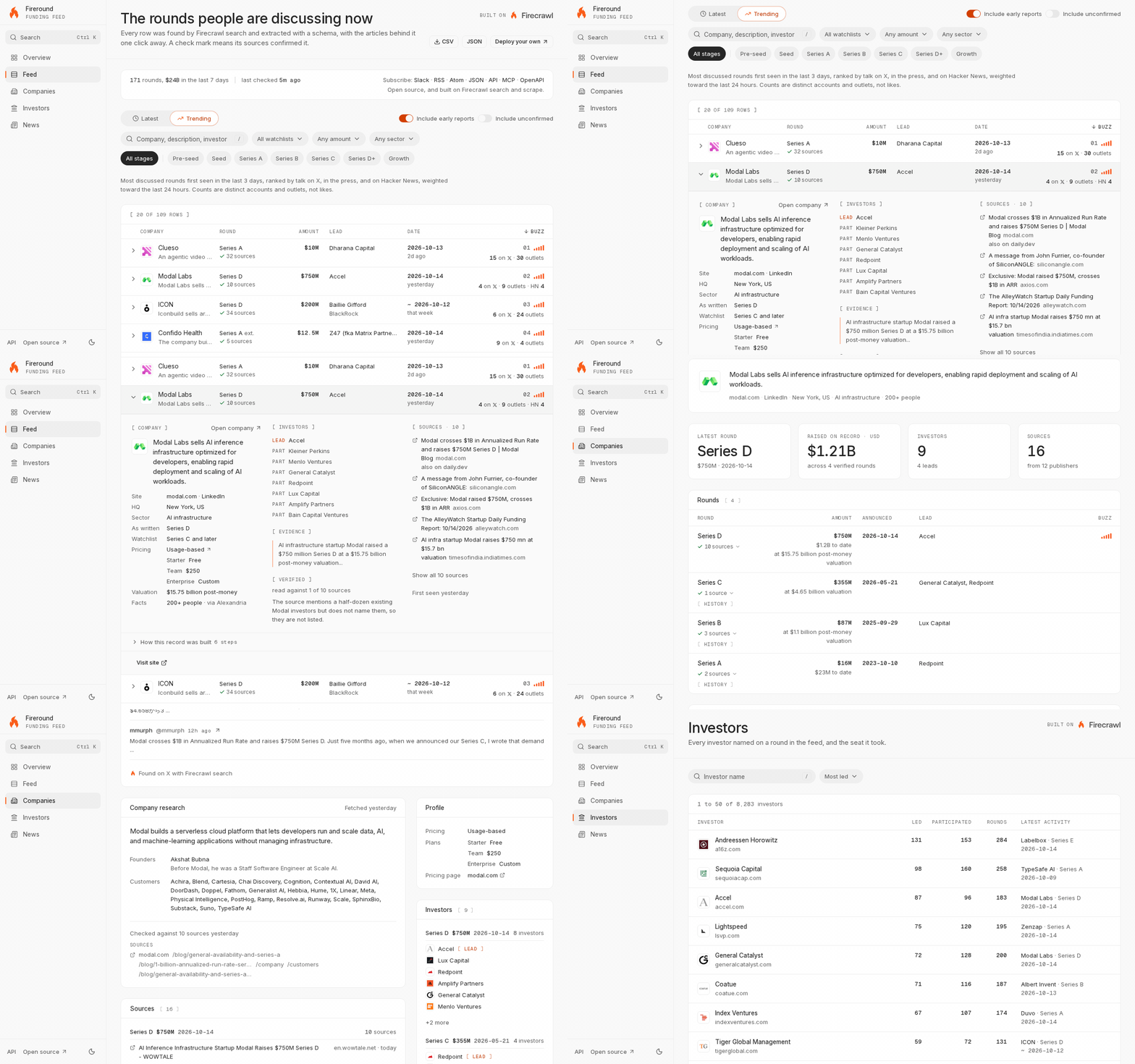
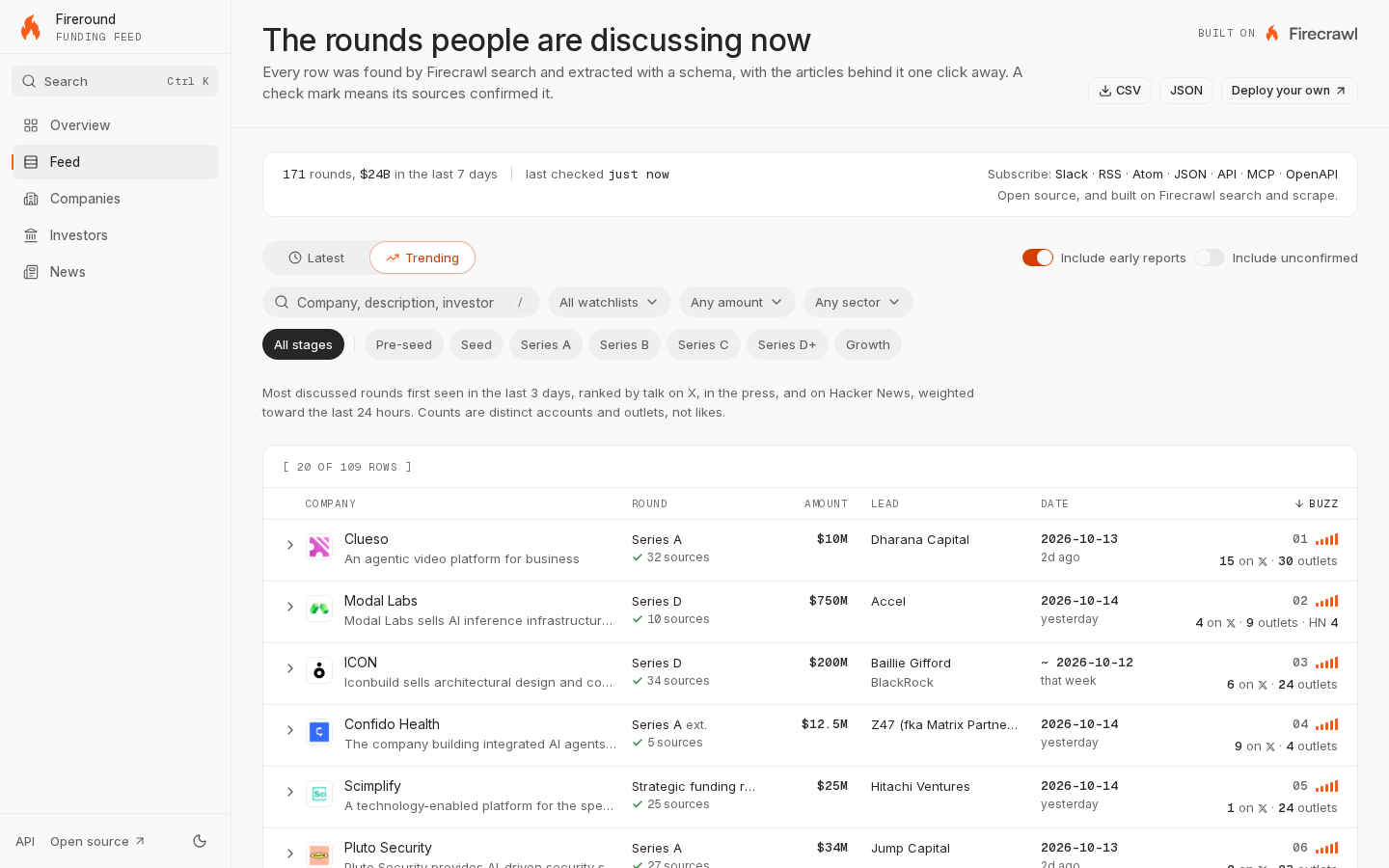
- Feed: every round with its logo, stage, amount, lead, date, and source check. Filter by stage, preset, amount, and sector; open a row for the evidence sentence and the field-by-field verdict. A Trending view ranks rounds first seen in the last three days by how much they are discussed on X, in the press, and on Hacker News.
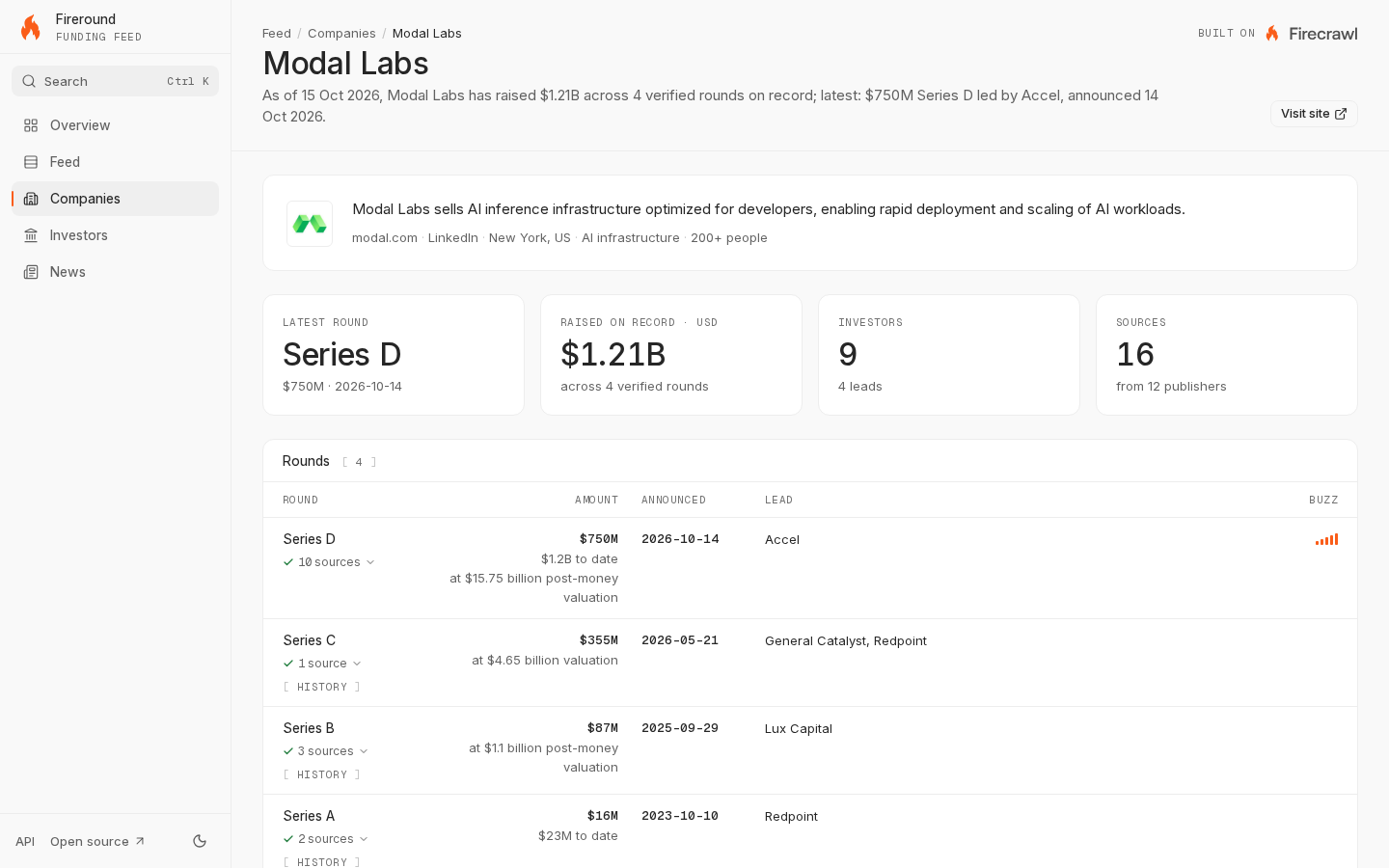
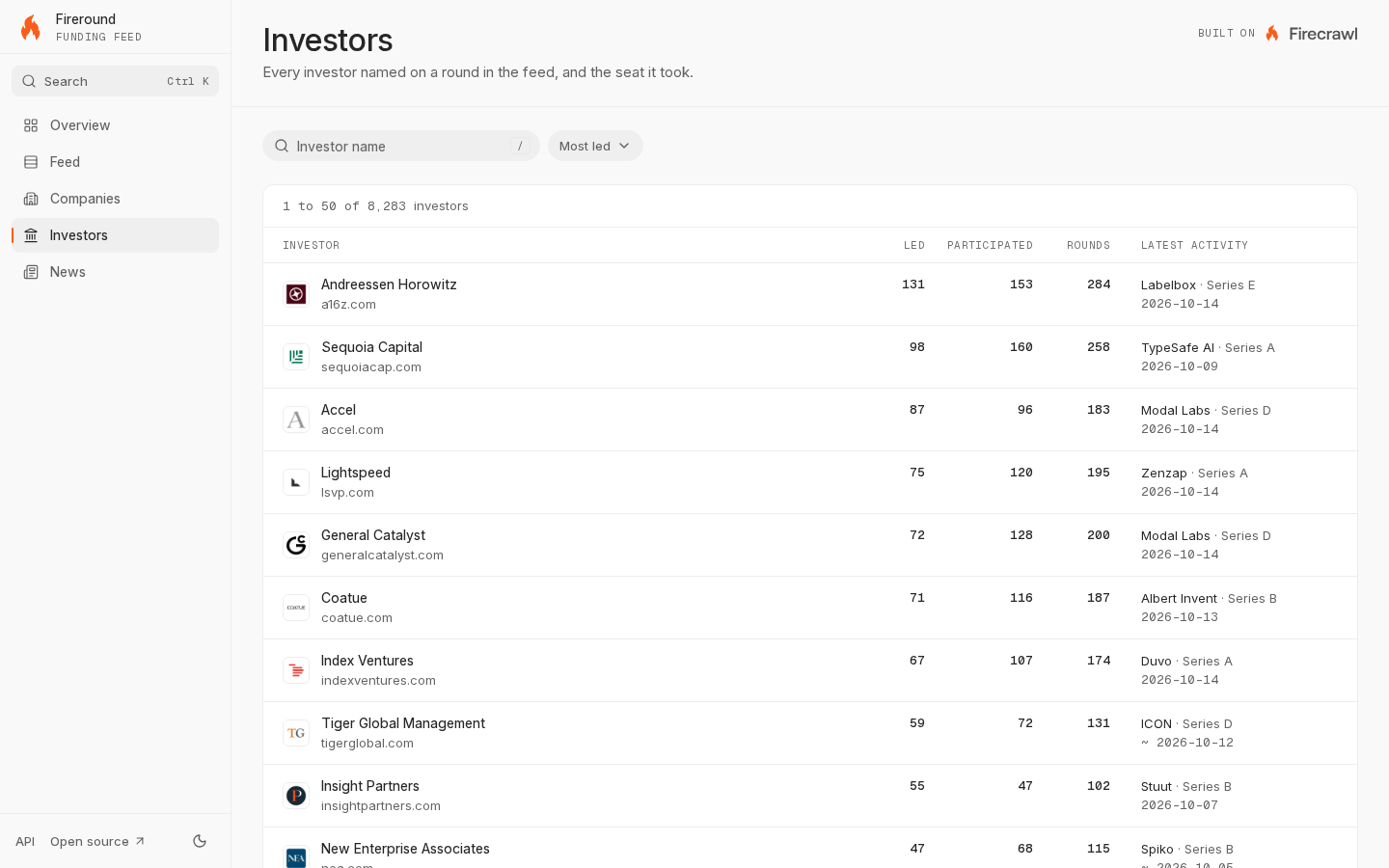
- Companies and investors: a searchable index and a page for each, with every round on record, total raised, the syndicate, logos, and sourced company facts. Deep dive builds a company dossier on demand, checked claim by claim before it is saved.
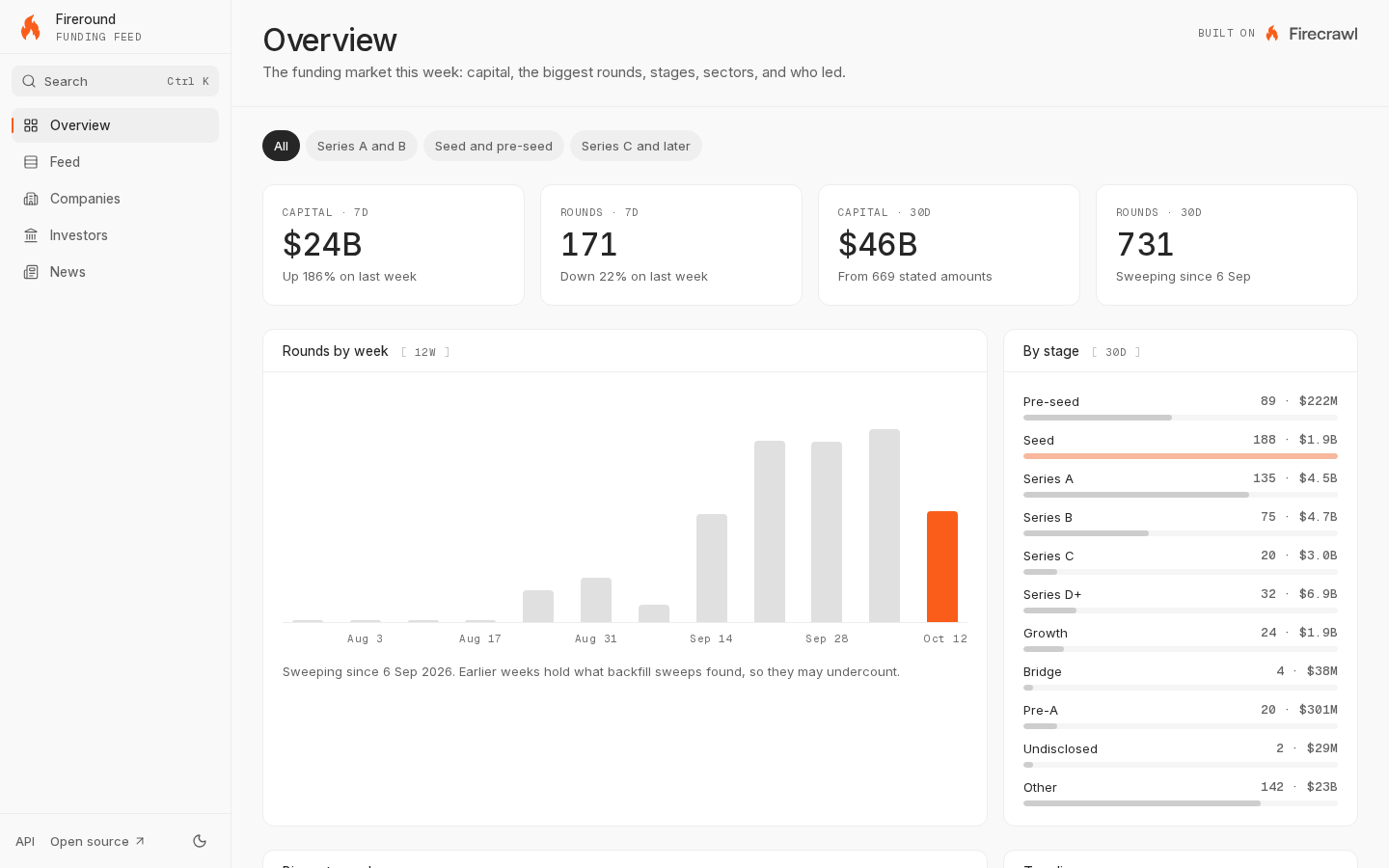
- Overview and news: the market at a glance, and the articles behind the records grouped by day. Cmd+K finds any company or investor.
- Presets: what to watch. Series A and B is the default; seed and pre-seed, and Series C and later, ship too. Add your own in the UI, priced before it runs.
- Review: undated or low-confidence rows to publish, reject, or research, with keyboard shortcuts and undo.
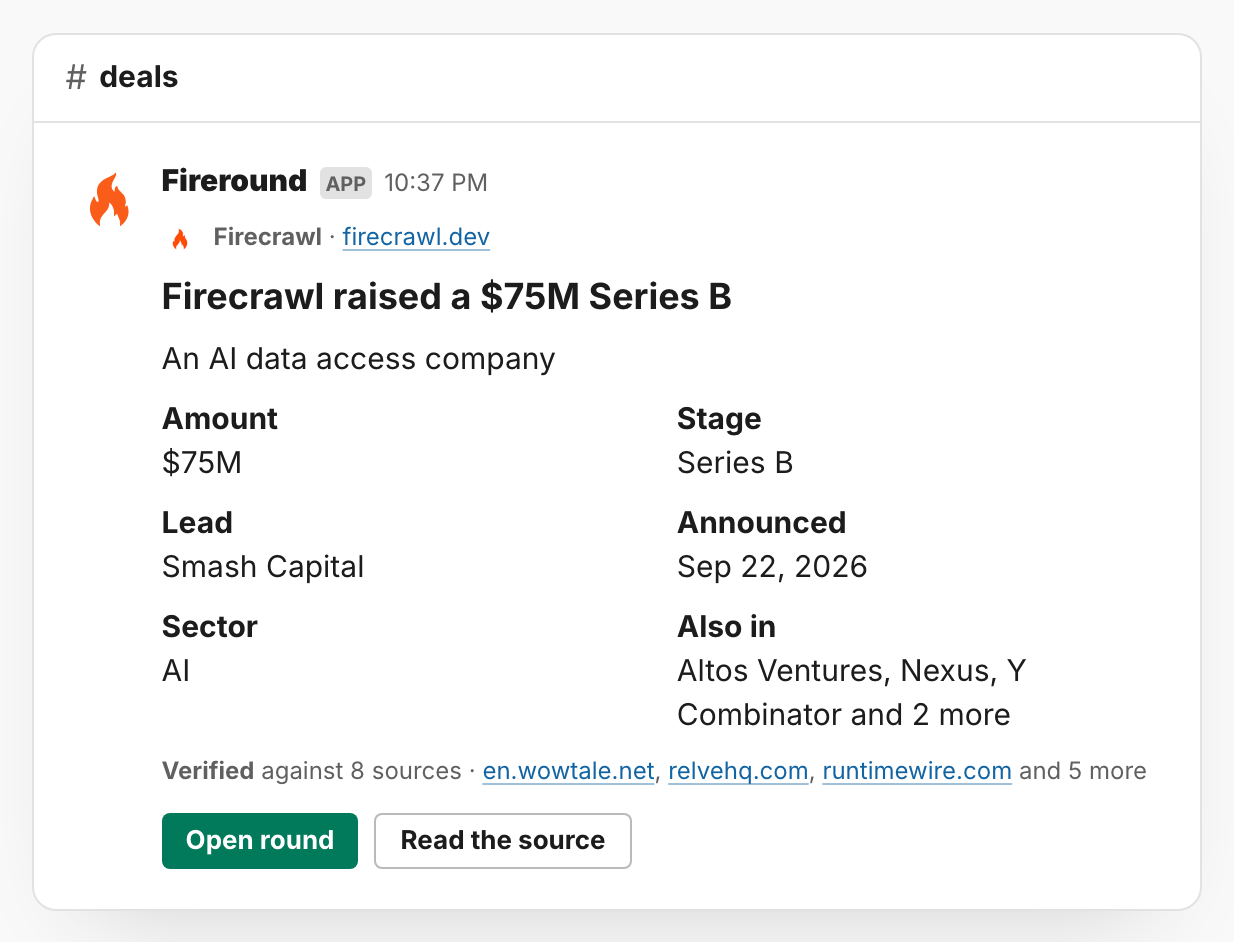
- Delivery: Slack (one click once the app is set up, docs/slack.md), RSS, Atom, and JSON Feed, signed webhooks (Standard Webhooks), and, optionally for self-hosters with a Resend key, a daily or weekly email digest. Company and investor links unfurl as share cards.
- API and MCP: JSON, CSV, and JSONL over
/api/v1with an OpenAPI spec, and twelve MCP tools (fourteen with company requests on). - Runs: every sweep and lane with the credits it was estimated to cost beside the credits it measured.
Quick start
Requires Node 24+ and pnpm (corepack enable installs the version package.json pins).
git clone https://github.com/firecrawl/fireround.git && cd fireround
pnpm install
cp .env.example .env   # paste your Firecrawl key: https://www.firecrawl.dev/app/api-keys
pnpm dev               # http://localhost:3000
No database to set up: without DATABASE_URL the app runs on embedded Postgres (PGlite) under ./data. An empty store opens on one panel that explains the first sweep, prices it, and runs it: last week of Series A and B, about ten minutes and about 630 to 690 credits, which fits in Firecrawl's free plan.
No key yet? Run pnpm demo-data before pnpm dev and the dashboard opens on ten fictional sample rounds, with no key and no credits. pnpm reset-data -- --yes clears them before your first real sweep. The embedded database is single-process, so stop pnpm dev before running either script.
Everything else is optional. Without a model key the read-back uses Firecrawl alone and Deep dive stays off; without Slack, Resend, or X keys those deliveries stay off. Settings lists what each key turns on. Posting to X is off unless you set X_POSTING.
Deploy
Vercel. Press Deploy with Vercel above. It asks for your Firecrawl key, a dashboard password, and a cron secret (any random string of 16+ characters, such as openssl rand -hex 24), and provisions a Neon database (which sets DATABASE_URL). Migrations apply at build. The default schedule runs each cron route once a day, so it deploys on Hobby; on Pro, set FIREROUND_SCHEDULE=frequent and redeploy for the full cadence. Add AI_GATEWAY_API_KEY afterwards to turn on the cross-source read-back and Deep dive, MCP_API_KEY to turn on MCP (a password-protected deployment refuses MCP until it is set), and APP_ORIGIN once you have a production URL.
Anywhere else. Set DATABASE_URL to any Postgres 15+ and CRON_SECRET to any random string of 16+ characters, then pnpm db:migrate && pnpm build && pnpm start. A production pnpm start calls its own cron routes on the hour with that secret; without it every scheduled call is refused and nothing sweeps. With a throwaway local Postgres:
docker run -d --name fireround-pg -p 5432:5432 -e POSTGRES_PASSWORD=postgres postgres:18
echo 'DATABASE_URL=postgres://postgres:postgres@localhost:5432/postgres' >> .env   # no sslmode: local Postgres has no TLS
echo "CRON_SECRET=$(openssl rand -hex 24)" >> .env
pnpm db:migrate && pnpm build && pnpm start
On the default coverage the scheduled sweep runs on Mondays at 06:00 UTC, so press Run the first sweep to fill the store now.
Public instances, Slack, and who can reach what: docs/deploy.md.
Configuration
Only FIRECRAWL_API_KEY is required to run sweeps, and production also needs CRON_SECRET for anything to run on a schedule. .env.example lists every variable with a comment. The ones most deployments set:
| Variable | Purpose |
|---|---|
FIRECRAWL_API_KEY |
Your Firecrawl key |
DATABASE_URL |
Any Postgres 15+; unset uses embedded PGlite |
DASHBOARD_PASSWORD |
HTTP Basic auth on the dashboard and /api/v1; unset means open |
CRON_SECRET |
Bearer for the cron routes; Vercel Cron and a production pnpm start send it on every scheduled call, and without it production runs nothing on a schedule |
MCP_API_KEY |
Bearer for /api/mcp; required to enable MCP on a password-protected private deployment |
AI_GATEWAY_API_KEY |
Reads every record against all its sources with a model before it publishes (or set an OpenAI, OpenRouter, or Anthropic key) |
APP_ORIGIN |
Your public URL, for webhooks, Slack links, and share cards |
Every variable: docs/configuration.md.
Coverage is one setting that decides how wide the net is and how often it runs. Lite, the default, sweeps the news once a week: about 3.3K to 3.6K credits a month for the Series A and B preset, and about 10K for all three shipped presets. Max runs every lane hourly. Settings prices each rung against your presets before you switch: docs/coverage.md.
API, feeds, and MCP
GET /api/v1/roundsreturns JSON, CSV, or JSONL with cursor pagination and acertaintyfield; filter with?certainty=announced,reported,expected, orunconfirmed. A CSV withoutlimitis the whole filtered set, up to 10,000 rows.GET /api/v1/companiessearches and lists companies (by name, sector, stage, date of the latest raise, or headquarters),GET /api/v1/companies/{id}is one company's funding history with total raised, rounds, and investors,GET /api/v1/investorssearches investors by name,GET /api/v1/investors/topranks the investors that led the most rounds in the last 7, 30, or 90 days (optionally by sector or stage),GET /api/v1/investors/{id}is one investor's profile, andGET /api/v1/newslists the latest articles about the feed's rounds.GET /api/v1/runslists runs. The spec is at/api/v1/openapi.json; docs/api.md explains the certainty contract. On a public demo, a visitor's reads are open to any origin (CORS) and cached at the edge for a minute; an admin's are neither.- Feeds live at
/feeds/<token>/<preset>.rss,.atom, or.json. Mint a token in Settings or withpnpm feed-token. - The MCP server at
/api/mcphaslist_rounds,search_rounds,get_company,list_trending,mark_seen, andlist_presets, pluslist_companies,get_company_profile,list_investors,get_investor,top_investors, andlist_news, which answer with the same JSON as/api/v1/companies,/api/v1/companies/{id},/api/v1/investors,/api/v1/investors/{id},/api/v1/investors/top, and/api/v1/news. SetMCP_API_KEYand sendAuthorization: Bearer <key>; a password-protected private deployment refuses MCP without it. A keylessPUBLIC_DEMO=1instance keeps public read tools but omitsmark_seen. WithCOMPANY_REQUESTS=1it addsrequest_companyandcompany_request_status, under the same checks and daily caps as the request page, and the OpenAPI spec listsPOST /api/company-requestsandGET /api/company-requests/{id}; requested rounds are stored as history and never delivered (docs/how-it-works.md).
How Fireround uses Firecrawl
Every record starts with the Firecrawl API through the Node SDK. Each call below links to the code that makes it.
| Firecrawl | What Fireround does with it | Code |
|---|---|---|
| Search | Runs each preset's eight queries over news and the web with a recency window, and finds company homepages, investor sites, and posts on X | sweep.ts, trending/x.ts |
| Scrape with JSON mode | Reads each article into a funding-round schema; one extraction covers every round on a roundup page | extract.ts |
Scrape with the branding format |
Reads the logo, the brand name, and the primary colour off company and investor homepages | enrich.ts, investor-enrich.ts |
Scrape with the links format |
Reads 27 publisher funding sections and daily funding lists, in every region, and extracts only the articles not seen before | watch.ts |
| Map | Finds a company's own announcement on its site to corroborate a round | corroborate.ts |
| Monitoring | Runs a preset's queries on a schedule inside Firecrawl and posts new pages to /api/webhooks/firecrawl |
monitor.ts |
| Agent | Research fills a record's gaps from its sources; Deep dive builds a company dossier | gapfill.ts, deepdive.ts |
| Alexandria | Adds the Y Combinator record on each verified domain | alexandria.ts |
Firecrawl launched Alexandria on September 22, 2026, alongside its Series B: Introducing Alexandria and our $75M Series B.
How it works
Sweeps search for each preset's queries and extract every round from the articles they find. Watched publisher sections, stage-free searches, monitors, X, and SEC Form D filings catch what the sweep misses. Every record is grounded in its page's own text, deduped against the store, and read back against its sources before it publishes, then enriched with the company's homepage profile, its logo, and Alexandria's facts.
- docs/how-it-works.md: the lanes, verification, dossiers, and history rounds
- docs/data-quality.md: the rules that keep the data honest
- docs/coverage.md: what each coverage rung turns on and what it costs
- docs/deploy.md and docs/configuration.md: hosting and every variable
- docs/slack.md: the three ways to get rounds into Slack
- docs/scripts.md: every
pnpmscript
Development
pnpm test        # the suite on an in-memory Postgres; no network, no key
pnpm typecheck
pnpm lint
Next.js 16, React 19, TypeScript, Tailwind 4 and shadcn/ui, Drizzle over PGlite or Postgres, the Vercel Workflow SDK, and the AI SDK. The repo layout and the house rules: CONTRIBUTING.md.
Contributing
Issues and pull requests are welcome. CONTRIBUTING.md covers the three gates, adding a preset or a data-quality rule, and the house rules for prose. Report security problems privately through SECURITY.md, not in a public issue.
License
MIT. See LICENSE.
Preguntas sobre fireround MCP
¿Qué herramientas están disponibles a través del MCP server?
El MCP server incluye doce herramientas como list_rounds, search_rounds, get_company, list_trending, mark_seen, list_presets, y herramientas para perfiles de empresas, inversores y noticias.
¿Cómo activo MCP en un despliegue privado?
Debes configurar la variable de entorno MCP_API_KEY; un despliegue protegido por contraseña rechazará las conexiones MCP hasta que esta clave esté configurada.
¿Requiere Fireround una configuración de base de datos?
No se requiere configuración de base de datos para uso local, ya que la aplicación se ejecutará en un Postgres embebido (PGlite) si no se proporciona un DATABASE_URL.