
Proporciona contexto determinista del repositorio, análisis de impacto y verificación de preparación para merge para agentes de IA mediante análisis estático local.
También conocido como BASHBOP/solumbe, @bashbop/solumbe
- Stars
- 3
- Herramientas
- —
- Descargas, 30 días
- 2297
- Última versión
- 4.11.0
- Último commit
- 12 nov 2026
- Licencia
- MIT
¿Qué es Solumbe MCP?
Solumbe es un MCP server. Proporciona contexto determinista del repositorio, análisis de impacto y verificación de preparación para merge para agentes de IA mediante análisis estático local.
Resumen generado a partir del README del proyecto
Acerca del MCP server de Solumbe
Solumbe actúa como una capa de confianza local-first para el desarrollo asistido por IA, proporcionando contexto determinista del repositorio y análisis de impacto. Está diseñado para desarrolladores que utilizan agentes de IA como Claude Code, Cursor o VS Code para verificar que los cambios generados por el modelo sean seguros y estén alineados con la intención original. Al utilizar análisis estático en lugar de embeddings o búsquedas basadas en red, garantiza que el código nunca salga de la máquina local y que los resultados sean consistentes en cada ejecución.
El servidor funciona mediante una implementación de MCP vía stdio que se conecta con varios hosts de agentes, incluyendo Claude Desktop, Gemini CLI y Kimi Code CLI. Expone 14 herramientas específicas como change_impact, review_gate y convergence_score para ayudar a los agentes a entender el radio de impacto de una solicitud. Los usuarios pueden instalarlo globalmente vía npm y usar el comando install para configurar automáticamente sus entornos de desarrollo preferidos. Funciona junto con las herramientas existentes en lugar de reemplazarlas, sirviendo como un gate de verificación para árboles de Git en staging.
Qué puedes hacer con él
- 1Aplicar contratos de alcanceIdentificar si un agente de IA ha modificado archivos que no formaban parte de la intención declarada originalmente.
- 2Generar contexto del repositorioConstruir un paquete de archivos, pruebas y comandos conscientes de la tarea necesarios para cumplir con una solicitud de desarrollo específica.
Escrito a partir del README del proyecto. Cada caso de uso se verifica con una cita del mismo.
Cómo instalar Solumbe MCP
Formatos verificados el 10 nov 2026Instalar Solumbe MCP en Claude Code
$ claude mcp add solumbe -- npx -y @bashbop/solumbeInstalar Solumbe MCP en Cursor
~/.cursor/mcp.json
{
  "mcpServers": {
    "solumbe": {
      "command": "npx",
      "args": [
        "-y",
        "@bashbop/solumbe"
      ]
    }
  }
}Instalar Solumbe MCP en VS Code
.vscode/mcp.json
{
  "servers": {
    "solumbe": {
      "type": "stdio",
      "command": "npx",
      "args": [
        "-y",
        "@bashbop/solumbe"
      ]
    }
  }
}Instalar Solumbe MCP en Claude Desktop
claude_desktop_config.json
{
  "mcpServers": {
    "solumbe": {
      "command": "npx",
      "args": [
        "-y",
        "@bashbop/solumbe"
      ]
    }
  }
}Instalar Solumbe MCP en Codex
~/.codex/config.toml
[mcp_servers.solumbe]
command = "npx"
args = ["-y", "@bashbop/solumbe"]
Instalar Solumbe MCP en Gemini CLI
~/.gemini/settings.json
{
  "mcpServers": {
    "solumbe": {
      "command": "npx",
      "args": [
        "-y",
        "@bashbop/solumbe"
      ]
    }
  }
}Verificaciones automáticas
Ejecutado 14 nov 2026Informe completo →Pasó nuestras verificaciones automáticas. Esto no es una auditoría de seguridad: lee el código y dale al servidor el acceso más limitado que necesite. Cómo funcionan las verificaciones

- Repositorio de origen vinculado y accesiblebashbop/solumbe is public and reachablegithub.com/bashbop/solumbe ↗Aprobado
- El paquete cita este repositorio como fuente@bashbop/solumbe names bashbop/solumbe as sourcenpmjs.com/package/@bashbop/solumbe ↗Aprobado
- Procedencia de la compilación (atestación Sigstore)Sigstore attestation for @bashbop/solumbenpmjs.com/package/@bashbop/solumbe/v/4.11.0#provenance ↗Aprobado
- Licencia de código abierto (OSI)MITspdx.org/licenses/MIT.html ↗Aprobado
- Commit o lanzamiento en el último añoLast commit or release 2026-11-12github.com/bashbop/solumbe ↗Aprobado
- OpenSSF ScorecardNo verificado
- El nombre del paquete no es similar a un paquete popularNo popular package one edit away from @bashbop/solumbeAprobado
- Sin avisos críticos en el paquete ni en sus dependencias2 resolved dependencies checked; no critical advisoryosv.dev ↗Aprobado
- Sin instrucciones ocultas para el modelo0 tool descriptions and the README read; no override phrases, credential paths or hidden charactersAprobado
- Las herramientas destructivas están etiquetadasNo verificado
- El endpoint remoto responde al handshake MCPNo verificado
README
Ver en GitHubSolumbe
Models generate the change. Solumbe proves whether it is safe to merge.
Formerly Òtítọ́ (@bashbop/otito), renamed in 4.0.0; the CHANGELOG maps every old name to its new one.




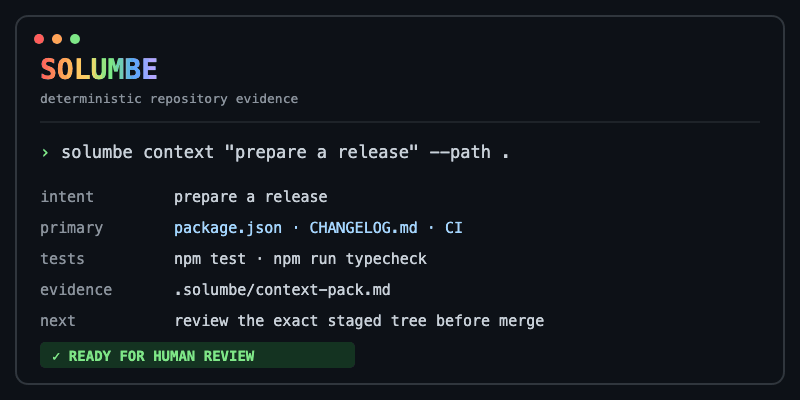

Solumbe is a local-first, deterministic, model-agnostic trust layer for AI-assisted development. It builds task-aware repository context before an agent edits, scores how much a change actually touches, and gates merge readiness against the exact staged tree, with no server, no account, and no code leaving the machine.
It does not replace Claude Code, Codex, Cursor, Gemini, or any native agent harness. It runs beside them and keeps working as the models change underneath.
A passing local gate is never an automatic merge approval: hosted CI, GitHub review, CODEOWNERS, and the human release decision remain separate authorities.
Install
npm install -g @bashbop/solumbe
solumbe doctor
solumbe install --host all
The last command connects Solumbe's MCP server to every agent host it finds: Claude Code, Claude Desktop, Codex CLI, Cursor, VS Code, Gemini CLI and Kimi Code CLI. Add --dry-run to see the plan first, or name hosts with --host claude-code,cursor. Restart each host afterwards.
Or without installing: npx -y @bashbop/solumbe doctor.
What it does
Rank what a change actually touches, from the request alone, with no model, no embeddings, and no network:
$ solumbe impact . "add refund handling to checkout" --top 3

  concepts: money flow

   1.  src/payment/checkout.service.ts    score 155
       |- role: required
       |- path matches: checkout
       |- symbol matches: checkout, refund
       |- concept match: money flow (×1.4 + 6.0)
       |- risk: money flow

   2.  src/payment/stripe.webhook.ts    score 6
       |- role: advisory
       |- concept match: money flow (×1.4 + 6.0)
Gate the exact staged tree, and say precisely why:
$ solumbe gate . --staged --base origin/main --request "add refund handling to checkout" --min-convergence 80

  [OK]    Changed files          1 changed file found.
  [OK]    Staged snapshot        Changed-file scope and convergence evidence are captured from the exact staged Git tree.
     |- Tree: 7d0b513dd256877d6bd309a6406468a9b1eaeedc
     |- Base: b776f04fcfbd02c8ce8d63e1a0c2450be58de039
  [OK]    Secret safety          No secret file paths and no credential values found in the changed content.
  [WARN]  Risk review            Risk-sensitive files changed; maintainer review should be explicit.
     |- src/payment/checkout.service.ts
  [OK]    Convergence            Task and diff satisfy the convergence requirement.
     |- Score: 100/100 (aligned)
     |- Receipt handle: rcpt_a8d31efae06e
     |- Subject tree: 7d0b513dd256877d6bd309a6406468a9b1eaeedc

  VERDICT  WARN
The convergence score is the part a model cannot grade for itself: it compares the stated intent against the files the diff actually changed, and produces a receipt bound to the exact base, parent, and staged-tree identity.
Hold the change to what was declared. Record the files a request is expected to touch before the edit, and the gate names any file that was never declared:
$ solumbe declare . "add refund handling to checkout"
$ # ... the agent edits ...
$ solumbe gate . --staged --base HEAD --intent .solumbe/intent.json

  [FAIL]  Scope contract         Touched `src/auth/session.ts`, which was never declared. Amend the intent with the reason it belongs (`solumbe amend <file> --reason "<why>"`), or take it out of the change.
     |- Request: "add refund handling to checkout"
     |- Contract: fe655c2af2b31b7e3edec6aedd248b379235811d1228c829f87ff73796ace487
     |- Changed files: 3 (1 declared, 0 amended, 1 implied, 1 undeclared)
     |- Implied: tests/checkout.service.test.ts (owner-test of src/payment/checkout.service.ts)
     |- Undeclared on a risk-sensitive path: src/auth/session.ts [auth/security]
An amendment adds a file with its reason, hashed onto the contract, so a reviewer reads why the scope grew. Over MCP it is change_impact with declare: true, and review_gate with intent.
The core
Four commands are the product. They call no model, open no socket, and read nothing outside the repository.
| Step | Command | What it proves |
|---|---|---|
| Before the edit | solumbe context "add refund handling" --path . |
Which files, tests and commands the request needs |
| After the edit | solumbe converge . "add refund handling" --base origin/main --staged |
How far the diff is from the request, with a receipt |
| Before the merge | solumbe gate . --staged --base origin/main --request "add refund handling" |
PASS / WARN / FAIL on the exact staged tree |
| After the merge | solumbe attest . --verdict verdict.json --merge <sha> |
A hash-chained record of what shipped, under which verdict |
solumbe help shows these and how to set up; solumbe help --all lists every command, including the ones that support them (impact, declare, pr, review, map, calibrate, route, ax, dashboard and the rest). Nothing was removed.
Nothing hosted is required, and nothing hosted can change a verdict. Local Core, Optional Hosted lists exactly what the optional pieces send, and where.
Supporting commands
| Goal | Command |
|---|---|
| Rank change blast radius | solumbe impact . "add refund handling" --top 12 |
| Score intent vs. execution | solumbe converge "add refunds" --path . --base HEAD --staged |
| Score a committed change exactly | solumbe converge "add refunds" --path . --base HEAD~1 --head HEAD |
| Gate a product change across repos | solumbe workspace-gate ../web ../api --request "ship change" |
| Grade risk flags against history | solumbe calibrate . --window 30 |
| Grade route tiers against history | solumbe regret . --window 30 --offline |
| Regrade a saved run, same answers | solumbe regret --rescore run.json |
| Score Agent Experience | solumbe ax . "add a new MCP tool" |
| Recommend a model tier | solumbe route . "add a new MCP tool" |
| Sharpen context with a model read | solumbe context "add a new MCP tool" --path . --online |
| Inspect one repo | solumbe repo . --json |
| Build a code map | solumbe map . --json |
| Index and search local projects | solumbe index ~/projects --discover then solumbe search "events controller" |
| Generate an agent harness | solumbe harness . --out .solumbe/harness.md |
| Run the MCP server | solumbe mcp |
Every command takes --json, and solumbe help lists the full set with flags.
MCP
Solumbe ships a stdio MCP server exposing 14 tools: repo_inspect, repo_map, repo_index, repo_search, context_pack, change_impact, agent_experience, model_route, convergence_score, review_context, review_gate, review_verdict, workspace_report, and repo_harness.
{
  "mcpServers": {
    "solumbe": {
      "command": "npx",
      "args": ["-y", "@bashbop/solumbe", "mcp"]
    }
  }
}
solumbe install --host all writes this entry for you, using absolute paths so hosts that do not inherit your shell PATH can still start it. Published in the MCP Registry as io.github.BASHBOP/solumbe. Repo-map lookups use an external per-user cache and never write into the inspected repository. Host-specific setup for Claude Code, Claude Desktop, Codex, Cursor, VS Code, Gemini CLI, and Kimi Code is in MCP and Agent Workflows.
How it compares
| Approach | Strengths | Where solumbe differs |
|---|---|---|
| Sourcegraph / Cody context | Powerful hosted code search and embedding-based context across an org | Local-first and deterministic: no server, no account, no code leaves the machine, and the same query always yields the same packet |
Hand-written CLAUDE.md / rules files |
Curated, intent-rich guidance | Hand-written context goes stale; solumbe regenerates context from the actual code (symbols, imports, routes, tests) on every run and complements a short CLAUDE.md |
grep / ripgrep |
Fast, universal text matching | solumbe ranks whole files by task intent across paths, symbols, exports, and tests, then adds patterns and validation commands, producing a context packet rather than a list of matching lines |
Documentation
Full command reference, agent workflows, release process, evaluation method, and the design theses behind the trust layer:
Contributing
git clone https://github.com/BASHBOP/solumbe.git
cd solumbe && npm ci && npm run ci
npm run ci is the full gate: format, lint, typecheck, version check, tests, coverage floors (70% lines / 60% branches / 75% functions), three evaluation corpora, dependency audit, and a packaged-tarball smoke test. Run it before requesting review.
Start with CONTRIBUTING.md and the Code of Conduct. All changes need maintainer review; main requires passing gates and resolved conversations. Solumbe follows Semantic Versioning, so say whether a PR is no-impact, patch, minor, or major.
Part of the toolchain
solumbe is one of four tools that form a deterministic trust layer for AI-assisted development. Each uses static analysis to answer a question people keep handing to an LLM.
- solumbe (this tool), for context: what does this change actually touch?
- tieline, for contracts: did the front end and back end quietly stop agreeing?
- bouncer, for compliance: could you defend this to Ofcom?
- aiglare, for governance: where can the model do something you can't undo?
More at segunolumbe.com. static analysis, never the model.
Preguntas sobre Solumbe MCP
¿Cómo agrego Solumbe MCP a Claude Code?
Ejecuta claude mcp add solumbe -- npx -y @bashbop/solumbe en tu terminal. Añade --scope user para que esté disponible en todos los proyectos.
¿Cómo agrego Solumbe MCP a Cursor?
Abre ~/.cursor/mcp.json y añade el servidor en mcpServers, usando la configuración de Cursor que se muestra en la sección de instalación de arriba.
¿Solumbe reemplaza las herramientas de codificación de IA existentes?
No, está diseñado para ejecutarse junto a herramientas como Claude Code, Cursor y Gemini para proporcionar una capa de confianza.
¿Se envía mi código a un servidor remoto?
No, Solumbe es una herramienta local-first que garantiza que ningún código salga de tu máquina.
¿Que un gate local pase significa que el código se fusiona automáticamente?
No, los gates locales son independientes de los procesos de CI alojados y de la revisión humana.